Paragraph 74 · 49% changed
Every version of it
Screener
/
SEC EDGAR
/CIK 0001867072
/10-K filed May 29, 2026, compared with May 30, 2025
/Numbers from the XBRL of the 10-Ks
NYSE
Technology · IT Services
Kyndryl Holdings, Inc. KD
The 10-K against last year's
135 changes: 40 added, 16 removed, 77 reworded, 2 quiet changes
10-K May 29, 2026 vs May 30, 2025
Risk Factors
33.6%
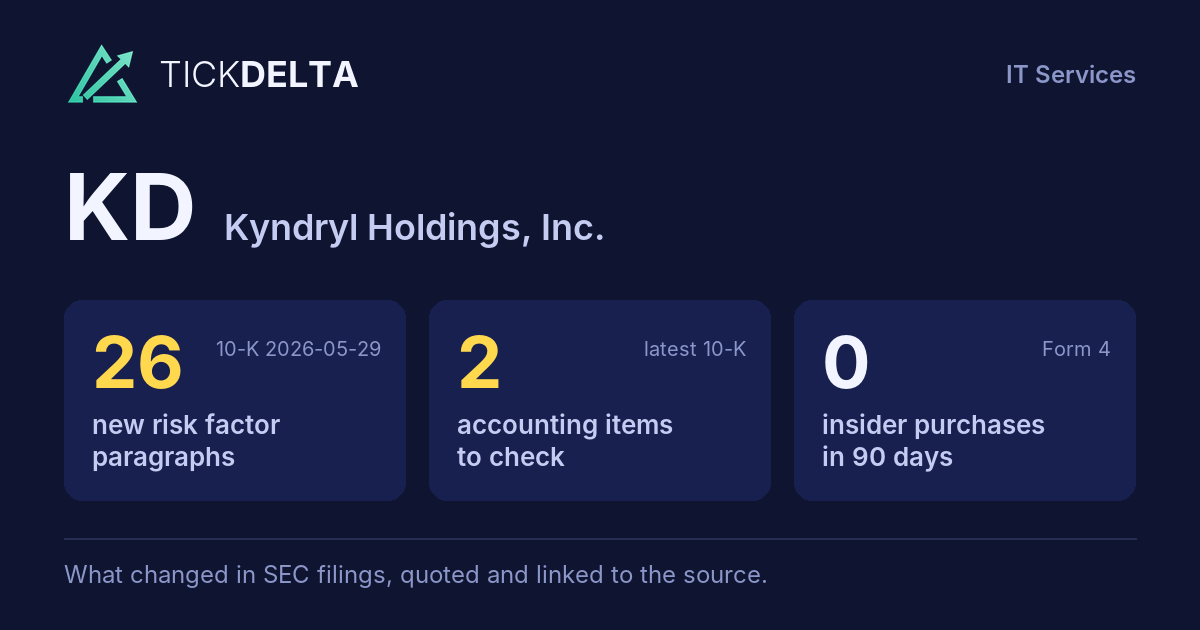
of the text changed · 9,788 words now · 26 new paragraphs, 2 gone
MD&A
27.8%
of the text changed · 8,400 words now · 14 new paragraphs, 14 gone
Legal Proceedings
42.5%
of the text changed · 965 words now
Accounting Policies
11.9%
of the text changed · 7,552 words now
10-K 0001104659-26-067881 (May 29, 2026) vs 10-K 0001558370-25-008282 (May 30, 2025)
Every paragraph, and how much of it changed
One bar per paragraph, in the order of the 10-K. Height and colour show the share of its words not in the closest paragraph a year earlier; the tallest bars are new paragraphs.
Risk Factors
97 paragraphs · 26 new · 38 reworded · 2 gone · 10-K May 29, 2026 against May 30, 2025
New paragraph
Reworded (5% of its words or more)
Same or nearly
Paragraph 70 · 47% changed
Every version of it
Paragraph 38 · 45% changed
Every version of it
We have made, and may continue to make, acquisitions and dispositions in furtherance of our strategy. Such transactions can present significant challenges and risks, and there can be no assurances that we will identify or manage such transactions successfully or that strategic opportunities will be available to us on acceptable terms or at all. The related risks include our We have faced, and may continue to face, delays in completing or failure to achieve strategic objectives, our failure complete transactions. Completing transactions is subject to achieve anticipated revenue improvements delays, uncertainties and cost savings, our failure to retain key strategic relationships of acquired companies, our failure to retain key personnel and our assumption of liabilities related to litigation or other legal proceedings involving risks, including the businesses in such transactions, as well as our failure to close planned transactions. Such transactions may require us to secure financing, and our indebtedness may limit the availability of financing to us or the favorability of the terms of available financing. If we do acquire other companies, risk that we may not realize all be unable to satisfy certain closing conditions, such as regulatory and financing conditions and the economic benefit from those acquisitions, which could cause an impairment absence of goodwill or intangible assets. material adverse changes to our business, and related litigation.
Paragraph 1 · 42% changed
Every version of it
Our operations and financial results are subject to various risks and uncertainties, including but not limited to those described below, that could adversely affect our business, reputation, financial condition, results of operations, cash flows and the trading price of our common stock. The disclosures in this section reflect our beliefs and opinions as to factors that could materially and adversely affect us in the future. References to past events are provided by way of example only and are not intended to be a complete listing or a representation as to whether or not such factors have occurred in the past or their likelihood of occurring in the future. These risk factors do not identify all risks that we face; there may be other risks and uncertainties we are not currently aware of or that we currently deem not to be material but that may become material in the future.
Paragraph 14 · 42% changed
Every version of it
Our business employs a wide variety of products and services from a number of suppliers and partners around the world. Our relationships with them are critical to our ability to provide many of our services and solutions, and our relationships with various alliance partners allow us to enter new markets and take advantage of existing ecosystems built and sustained by our alliance partners. There can be no assurance that we will be able to develop and maintain such relationships, that the products and services will be available on the expected timelines or for anticipated prices, or that the financial terms of our relationships will remain affordable. Among other things, such partners may in the future decide to compete with us, form exclusive or more favorable arrangements with our competitors or otherwise reduce our access to their products or services. If we are not able to maintain, or realize the expected benefits from, our relationships for any reason, we may be less competitive, and our ability to offer attractive services and solutions to address the needs and demands of our customers and our results of operations could be adversely affected. Any performance failure on the part of our critical suppliers or alliance partners, or the discontinuance by such suppliers or alliance partners of technologies or services that we have relied on them to provide for our customers, could impact our performance or require us to engage alternative third parties to perform the services at our cost or to perform them ourselves, any of which could deprive us of potential revenue or adversely impact our profitability. Further, changes in the business condition (financial or otherwise) of our suppliers or partners could subject us to losses and affect our ability to bring our offerings to market. Additionally, the failure of our suppliers and partners to deliver products and services in sufficient quantities, in a timely manner, and in compliance with all applicable laws and regulations could adversely affect our business. Any defective products or inadequate services received from suppliers or partners could reduce the reliability of our services and harm our reputation.
Paragraph 19 · 39% changed
Every version of it
Paragraph 22 · 38% changed
Every version of it
If any of our key employees were to leave, we could face substantial difficulty in hiring qualified successors and could experience a loss in productivity while any successor obtains the necessary training and experience. Although In particular, we have experienced senior management changes in the last year, and may continue to experience further changes, which may adversely impact our business as we transition those roles. Such transitions can increase the risk of turnover among key personnel, require significant time and attention from management and the Board, hinder strategic planning, impact the effectiveness of our internal control environment and create uncertainty among investors, employees, customers and others regarding the Company’s future direction and performance. Further, although we have arrangements with some of our executive officers designed to promote retention, our employment relationships are generally at-will, and key employees may leave us. We intend to continue to hire additional highly qualified personnel with relevant skills and experience consistent with our current business strategy and offerings, but may not be able to attract, assimilate or retain similarly qualified personnel in the future. Further, for certain executives where a significant portion of compensation is in the form of equity grants, our ability to attract, retain, and motivate such employees may be adversely affected by our recent stock price volatility or our ability to obtain stockholder approval to provide additional stock to our employees.
Paragraph 6 · 34% changed
Every version of it
Our goals for profitability and growth rely upon a number of assumptions, including our ability to make successful investments to grow and further develop our business and simplify our operations. The risks and challenges we face in connection with our strategies include expanding our professional services capability, expanding in areas where we currently have a small presence and presence, ensuring that our services remain competitive in a rapidly changing technological environment. environment and streamlining our operations to optimize operational efficiency. We may invest significantly in key strategic areas to drive long-term revenue growth and share gains. These investments may adversely affect our near-term revenue growth and results of operations, and we cannot guarantee that they will ultimately be successful or produce any or all of the long-term benefits that we expect. Additionally, emerging business In addition, our productivity initiatives are subject to known and delivery models unknown risks and uncertainties, including assumptions about cash expenditures, cost savings and the effectiveness of the Company’s reduced spend and risks affecting the timing and amount of workforce rebalancing charges, payments and related savings, and we may unfavorably impact demand not fully achieve the expected operational expense savings and profitability for our solutions or services. If we are unable to find, and maintain relationships with, partners to develop cutting-edge innovations in a highly competitive and rapidly evolving environment or are unable to implement and integrate such innovations with sufficient speed and versatility, we could fail in our ongoing efforts to maintain and increase our revenue and profit margins, achieve and sustain our targeted growth rates or improve our market share, operating margins and competitive position generally or in specific markets or services. other benefits anticipated.
Paragraph 74 · 49% changed
Every version of it
10-K May 30, 2025As a multinational company with customers and employees around the world, we are or may become involved as a party and/or may be subject to a variety of claims, demands, suits, investigations, tax matters and other proceedings that arise from time to time in the ordinary course of our business. In addition, our former Parent may obtain, or may seek to obtain, indemnity from us for judgments against it relating to events that occurred prior to the Separation pursuant to agreements put in place in connection with the Separation. The risks associated with known significant legal proceedings are described in more detail in Note 14 – Commitments and Contingencies in the financial statements elsewhere in this report. We believe that we have adopted appropriate risk management and compliance programs. Legal and compliance risks, however, will continue to exist, and additional legal proceedings and other contingencies, the outcome of which cannot be predicted with certainty, may arise from time to time.
10-K May 29, 2026
The risks associated with known significant legal proceedings and regulatory investigations are described in more detail in Note 14 – Commitments and Contingencies in the consolidated financial statements included elsewhere in this report and herein under the heading “The SEC matter and related events are ongoing, and the timing for their resolution and outcome cannot be predicted.” Additional legal proceedings, regulatory investigations and other contingencies, the outcome of which cannot be predicted with certainty, may arise from time to time.
Paragraph 70 · 47% changed
Every version of it
10-K May 30, 2025We are subject to income taxes and withholding taxes in both the United States and numerous foreign jurisdictions. We calculate and provide for taxes in each tax jurisdiction in which we operate. Tax accounting often involves complex matters and requires our judgment to determine our worldwide provision for income taxes and other tax liabilities. Our provision for income taxes and cash tax liability in the future could be adversely affected by numerous factors including, but not limited to, income before taxes being lower than anticipated in countries with lower statutory tax rates and higher than anticipated in countries with higher statutory tax rates, changes in the valuation of deferred tax assets and liabilities, and changes in tax laws, regulations, accounting principles or interpretations thereof, which could adversely impact our results of operations and financial condition in future periods. The Organization for Economic Cooperation and Development (the “OECD”) continues to issue guidelines that are different, in some respects, than long-standing international tax principles. Local country adoption of some or all of these rules may increase tax uncertainty and may adversely impact our income taxes. Furthermore, local country, state, provincial or municipal taxation may also be subject to review and potential override by regional, federal, national or similar forms of government, which may also adversely impact our income taxes. In addition, we are subject to periodic examinations of our domestic and foreign tax returns by taxing authorities in the jurisdictions in which we do business. While we regularly assess the likelihood of adverse outcomes resulting from these examinations in order to determine the adequacy of our provision for income taxes, there can be no assurance that the outcomes from these examinations will not have an adverse effect on the Company’s provision for income taxes and cash flows.
10-K May 29, 2026
tax liabilities. Our provision for income taxes and cash tax liability in the future could be adversely affected by numerous factors including, but not limited to, changes in the geographic mix of income, changes in the valuation of deferred tax assets and liabilities, and changes in tax laws, regulations, accounting principles or interpretations thereof, which could adversely impact our results of operations and financial condition in future periods. The Organization for Economic Cooperation and Development (the “OECD”) continues to issue guidelines as part of its Base Erosion and Profit Shifting (“BEPS”) initiative and related international tax reform efforts. These initiatives reflect evolving views on the alignment of taxable income with economic activity and may differ in certain respects from long-standing international tax principles. Local country adoption and interpretation of these guidelines may increase tax uncertainty, result in inconsistent application among jurisdictions, and may adversely impact our effective tax rate, provision for income taxes and cash flows.
Paragraph 38 · 45% changed
Every version of it
10-K May 30, 2025
We have made, and may continue to make, acquisitions and dispositions in furtherance of our strategy. Such transactions can present significant challenges and risks, and there can be no assurances that we will identify or manage such transactions successfully or that strategic opportunities will be available to us on acceptable terms or at all. The related risks include our failure to achieve strategic objectives, our failure to achieve anticipated revenue improvements and cost savings, our failure to retain key strategic relationships of acquired companies, our failure to retain key personnel and our assumption of liabilities related to litigation or other legal proceedings involving the businesses in such transactions, as well as our failure to close planned transactions. Such transactions may require us to secure financing, and our indebtedness may limit the availability of financing to us or the favorability of the terms of available financing. If we do acquire other companies, we may not realize all the economic benefit from those acquisitions, which could cause an impairment of goodwill or intangible assets.
10-K May 29, 2026
We have made, and may continue to make, acquisitions and dispositions in furtherance of our strategy. Such transactions can present significant challenges and risks, and there can be no assurances that we will identify or manage such transactions successfully or that strategic opportunities will be available to us on acceptable terms or at all. We have faced, and may continue to face, delays in completing or failure to complete transactions. Completing transactions is subject to delays, uncertainties and risks, including the risk that we may be unable to satisfy certain closing conditions, such as regulatory and financing conditions and the absence of material adverse changes to our business, and related litigation.
Paragraph 1 · 42% changed
Every version of it
10-K May 30, 2025
Our operations and financial results are subject to various risks and uncertainties, including but not limited to those described below, that could adversely affect our business, reputation, financial condition, results of operations, cash flows and the trading price of our common stock.
10-K May 29, 2026
Our operations and financial results are subject to various risks and uncertainties, including but not limited to those described below, that could adversely affect our business, reputation, financial condition, results of operations, cash flows and the trading price of our common stock. The disclosures in this section reflect our beliefs and opinions as to factors that could materially and adversely affect us in the future. References to past events are provided by way of example only and are not intended to be a complete listing or a representation as to whether or not such factors have occurred in the past or their likelihood of occurring in the future. These risk factors do not identify all risks that we face; there may be other risks and uncertainties we are not currently aware of or that we currently deem not to be material but that may become material in the future.
Paragraph 14 · 42% changed
Every version of it
10-K May 30, 2025
Our business employs a wide variety of products and services from a number of suppliers and partners around the world. Our relationships with them are critical to our ability to provide many of our services and solutions, and our relationships with various alliance partners allow us to enter new markets and take advantage of existing ecosystems built and sustained by our alliance partners. There can be no assurance that we will be able to develop and maintain such relationships, that the products and services will be available on the expected timelines or for anticipated prices, or that the financial terms of our relationships will remain affordable. Among other things, such partners may in the future decide to compete with us, form exclusive or more favorable arrangements with our competitors or otherwise reduce our access to their products or services. If we are not able to maintain, or realize the expected benefits from, our relationships for any reason, we may be less competitive, and our ability to offer attractive services and solutions to address the needs and demands of our customers and our results of operations could be adversely affected. Any performance failure on the part of our critical suppliers or alliance partners, or the discontinuance by such suppliers or alliance partners of technologies or services that we have relied on them to provide for our customers, could impact our performance or require us to engage alternative third parties to perform the services at our cost or to perform them ourselves, any of which could deprive us of potential revenue or adversely impact our profitability. Further, changes in the business condition (financial or otherwise) of our suppliers or partners could subject us to losses and affect our ability to bring our offerings to market. Additionally, the failure of our suppliers and partners to deliver products and services in sufficient quantities, in a timely manner, and in compliance with all applicable laws and regulations could adversely affect our business. Any defective products or inadequate services received from suppliers or partners could reduce the reliability of our services and harm our reputation.
10-K May 29, 2026
Our business employs a wide variety of products and services from a number of suppliers and partners around the world. Our relationships with them are critical to our ability to provide many of our services and solutions, and our relationships with various alliance partners allow us to enter new markets and take advantage of existing ecosystems built and sustained by our alliance partners. There can be no assurance that we will be able to develop and maintain such relationships, that the products and services will be available on the expected timelines or for anticipated prices, or that the financial terms of our relationships will remain affordable.
Paragraph 19 · 39% changed
Every version of it
10-K May 30, 2025Our growth strategy depends in part on our ability to continue to develop and implement services and solutions that anticipate and respond to rapid and continuing changes in technology, offerings and industry standards to serve the evolving demands and needs of our customers. If we fail to respond and adapt successfully to technology developments and trends and customer demands in a timely or cost-effective manner or fail to effectively leverage new technologies into our services and solutions, or if our competitors or other third parties respond to such challenges more quickly or successfully than we do, the demand for our services and solutions may diminish. We have made and expect to continue to make investments in new technologies, including in AI and generative AI. We sometimes dedicate a significant amount of resources to our development efforts before knowing to what extent our investments will result in services and solutions the market will accept. The adoption and use of new technologies that are still in their early stages, such as AI and generative AI capabilities, involve significant risks and uncertainties. In addition, investments in technology systems, capabilities, talent and resources may not deliver the benefits or perform as expected, may be replaced or
10-K May 29, 2026
We have made and expect to continue to make investments in new technologies, including in AI, generative AI and agentic AI. We sometimes dedicate a significant amount of resources to our development efforts before knowing to what extent our investments will result in services and solutions the market will accept. The adoption and use of new technologies that are still in their early stages, such as AI, generative AI and agentic AI capabilities, involve significant
Paragraph 22 · 38% changed
Every version of it
10-K May 30, 2025
If any of our key employees were to leave, we could face substantial difficulty in hiring qualified successors and could experience a loss in productivity while any successor obtains the necessary training and experience. Although we have arrangements with some of our executive officers designed to promote retention, our employment relationships are generally at-will, and key employees may leave us. We intend to continue to hire additional highly qualified personnel but may not be able to attract, assimilate or retain similarly qualified personnel in the future.
10-K May 29, 2026
If any of our key employees were to leave, we could face substantial difficulty in hiring qualified successors and could experience a loss in productivity while any successor obtains the necessary training and experience. In particular, we have experienced senior management changes in the last year, and may continue to experience further changes, which may adversely impact our business as we transition those roles. Such transitions can increase the risk of turnover among key personnel, require significant time and attention from management and the Board, hinder strategic planning, impact the effectiveness of our internal control environment and create uncertainty among investors, employees, customers and others regarding the Company’s future direction and performance. Further, although we have arrangements with some of our executive officers designed to promote retention, our employment relationships are generally at-will, and key employees may leave us. We intend to continue to hire highly qualified personnel with relevant skills and experience consistent with our current business strategy and offerings, but may not be able to attract, assimilate or retain similarly qualified personnel in the future. Further, for certain executives where a significant portion of compensation is in the form of equity grants, our ability to attract, retain, and motivate such employees may be adversely affected by our recent stock price volatility or our ability to obtain stockholder approval to provide additional stock to our employees.
Paragraph 6 · 34% changed
Every version of it
10-K May 30, 2025
Our goals for profitability and growth rely upon a number of assumptions, including our ability to make successful investments to grow and further develop our business and simplify our operations. The risks and challenges we face in connection with our strategies include expanding our professional services capability, expanding in areas where we currently have a small presence and ensuring that our services remain competitive in a rapidly changing technological environment. We may invest significantly in key strategic areas to drive long-term revenue growth and share gains. These investments may adversely affect our near-term revenue growth and results of operations, and we cannot guarantee that they will ultimately be successful or produce any or all of the long-term benefits that we expect. Additionally, emerging business and delivery models may unfavorably impact demand and profitability for our solutions or services. If we are unable to find, and maintain relationships with, partners to develop cutting-edge innovations in a highly competitive and rapidly evolving environment or are unable to implement and integrate such innovations with sufficient speed and versatility, we could fail in our ongoing efforts to maintain and increase our revenue and profit margins, achieve and sustain our targeted growth rates or improve our market share, operating margins and competitive position generally or in specific markets or services.
10-K May 29, 2026
Our goals for profitability and growth rely upon a number of assumptions, including our ability to make successful investments to grow and further develop our business and simplify our operations. The risks and challenges we face in connection with our strategies include expanding our professional services capability, expanding in areas where we currently have a small presence, ensuring that our services remain competitive in a rapidly changing technological environment and streamlining our operations to optimize operational efficiency. We may invest significantly in key strategic areas to drive long-term revenue growth and share gains. These investments may adversely affect our near-term revenue growth and results of operations, and we cannot guarantee that they will ultimately be successful or produce any or all of the long-term benefits that we expect. In addition, our productivity initiatives are subject to known and unknown risks and uncertainties, including assumptions about cash expenditures, cost savings and the effectiveness of the Company’s reduced spend and risks affecting the timing and amount of workforce rebalancing charges, payments and related savings, and we may not fully achieve the expected operational expense savings and other benefits anticipated.
MD&A
108 paragraphs · 14 new · 48 reworded · 14 gone · 10-K May 29, 2026 against May 30, 2025
New paragraph
Reworded (5% of its words or more)
Same or nearly
Paragraph 49 · 45% changed
The effective tax rate for the year ended March 31, 2026 was higher compared to the year ended March 31, 2025, primarily due to non-recurring, non-cash tax accruals from the refinement of certain tax positions recorded in the fourth quarter of fiscal 2026, and the jurisdictional mix of our earnings. The effective tax rate for the year ended March 31, 2025 was higher compared to the year ended March 31, 2024, primarily due to the Company’s pretax income in fiscal year 2025, compared to a pretax loss in 2024. The effective tax rate for the year ended March 31, 2024 was lower (more negative) compared to the year ended March 31, 2023 primarily due to the Company’s pretax loss being significantly lower in fiscal year 2024. For more information, see Note 5 – Taxes in the accompanying Consolidated Financial Statements.
Paragraph 6 · 44% changed
Paragraph 32 · 44% changed
Paragraph 52 · 44% changed
Total liabilities of $9.1 $11.3 billion at March 31, 2025 decreased 2026 increased by $347 million $2.1 billion (and decreased increased by $305 million $2.0 billion adjusted for currency) from March 31, 2024, 2025, primarily as a result of: a decrease of an increase in operating lease liabilities debt of $121 $917 million due to cash borrowed under a reduction revolving credit agreement and an increase in right-of-use assets; a decrease in long-term debt other liabilities of $70 million due to lower finance lease obligations; a decrease in accounts payable of $57 million due to lower costs; $1.2 billion driven by the extended and a decrease in accrued contract costs of $51 million due to lower volumes. amended multi-year, third-party software agreement.
Paragraph 51 · 42% changed
Total assets of $10.5 $12.6 billion at March 31, 2025 decreased 2026 increased by $138 million $2.1 billion (and decreased increased by $52 million $1.9 billion adjusted for currency) from March 31, 2024, 2025, primarily driven by: a decrease by an increase in deferred costs of $254 $997 million in accounts receivable primarily mainly due to lower past-due receivables; a reduction in operating right-of-use assets, net, of $133 million due to amortization outpacing additions; an extended and a decrease in property amended multi-year, third-party software agreement and equipment, net, of $104 million due to depreciation outpacing net additions; partially offset by an increase in cash and cash equivalents of $234 $837 million mainly due to our net income in the period; and an increase in other non-current assets $1.0 billion of $95 cash borrowed under a revolving credit agreement, partially offset by a decrease of $304 million due to an increase in long-term prepaid assets. share repurchases.
Paragraph 83 · 39% changed
Signings decreased $4.7 billion, or 26%, in the year ended March 31, 2026 compared to the Company’s strong signings performance during the year ended March 31, 2025, reflecting a record 55 contracts valued in excess of $50 million and a $1.8 billion signing, the largest signing in Kyndryl’s history as an independent company. Signings performance in the year ended March 31, 2026 was unfavorably impacted by lengthening sales cycles and evolving content from the Company’s former parent in the Company’s customer engagements. Signings increased $5.7 billion, or 46%, in the year ended March 31, 2025 compared to the year ended March 31, 2024, driven by growth in each of our four operating segments. The Company’s global signings growth spanned segments and spanning a broad range of industries and included a record 55 contracts valued in excess of $50 million. Signings increased by $332 million, or 3%, in the year ended March 31, 2024 compared to the year ended March 31, 2023. industries.
Paragraph 55 · 37% changed
We believe that our existing cash and cash equivalents and our revolving credit agreement facility will be sufficient to meet our anticipated operating cash needs needs, and to fund our planned capital investments, debt maturities and stock repurchases for at least the next twelve months. As of March 31, 2026, we had cash and cash equivalents of approximately $2.6 billion and approximately $2.2 billion in available borrowing capacity under our revolving credit facility.
Paragraph 39 · 37% changed
Paragraph 49 · 45% changed
10-K May 30, 2025
The effective tax rate for the year ended March 31, 2025 was higher compared to the year ended March 31, 2024, primarily due to the Company’s pretax income in fiscal year 2025, compared to a pretax loss in 2024. The effective tax rate for the year ended March 31, 2024 was lower (more negative) compared to the year ended March 31, 2023 primarily due to the Company’s pretax loss being significantly lower in fiscal year 2024. For more information, see Note 5 – Taxes in the accompanying Consolidated Financial Statements.
10-K May 29, 2026
The effective tax rate for the year ended March 31, 2026 was higher compared to the year ended March 31, 2025, primarily due to non-recurring, non-cash tax accruals from the refinement of certain tax positions recorded in the fourth quarter of fiscal 2026, and the jurisdictional mix of our earnings. The effective tax rate for the year ended March 31, 2025 was higher compared to the year ended March 31, 2024, primarily due to the Company’s pretax income in
Paragraph 6 · 44% changed
10-K May 30, 2025low-margin components of its customer relationships, as well as currency effects. United States revenue declined 10 percent, Japan revenue increased 1 percent, Principal Markets revenue declined 5 percent and Strategic Markets revenue decreased 8 percent, compared to the year ended March 31, 2024. Net income of $252 million improved by $592 million versus the prior year driven by progress on our key initiatives to drive operating efficiencies and increased margins, lower depreciation expense and a $138 million after-tax gain from the sale of our SIS platform in Canada.
10-K May 29, 2026
For the year ended March 31, 2026, we reported $15.1 billion in revenue, unchanged compared to the year ended March 31, 2025. The revenue performance included a favorable currency exchange rate impact of three points. United States revenue decreased 2 percent, Japan revenue decreased 3 percent, Principal Markets revenue increased 4 percent and Strategic Markets revenue was unchanged, compared to the year ended March 31, 2025. During the period, the Company experienced growth in Kyndryl Consult and hyperscaler-related revenues and revenue performance was unfavorably impacted by lengthening sales cycles and evolving content from the Company’s former parent in the Company’s customer engagements. Net income of $198 million decreased by $53 million versus the prior year reflecting a $138 million after-tax gain from the sale of our Securities Industry Services (“SIS”) platform in Canada (classified as a transaction-related benefit) in the prior year, partially offset by progress on our key initiatives to drive operating efficiencies. During the period, margins were adversely affected by lengthening sales cycles.
Paragraph 32 · 44% changed
10-K May 30, 2025customer relationships. Adjusted EBITDA increased $209 million from the prior year, primarily due to increased operating efficiencies and higher margins on recent signings, as well as a vendor credit.
10-K May 29, 2026
EBITDA increased $16 million from the prior year, primarily due to progress on our key initiatives to drive operating efficiencies.
Paragraph 52 · 44% changed
10-K May 30, 2025
Total liabilities of $9.1 billion at March 31, 2025 decreased by $347 million (and decreased by $305 million adjusted for currency) from March 31, 2024, primarily as a result of: a decrease in operating lease liabilities of $121 million due to a reduction in right-of-use assets; a decrease in long-term debt of $70 million due to lower finance lease obligations; a decrease in accounts payable of $57 million due to lower costs; and a decrease in accrued contract costs of $51 million due to lower volumes.
10-K May 29, 2026
Total liabilities of $11.3 billion at March 31, 2026 increased by $2.1 billion (and increased by $2.0 billion adjusted for currency) from March 31, 2025, primarily as a result of an increase in debt of $917 million due to cash borrowed under a revolving credit agreement and an increase in other liabilities of $1.2 billion driven by the extended and amended multi-year, third-party software agreement.
Paragraph 51 · 42% changed
10-K May 30, 2025
Total assets of $10.5 billion at March 31, 2025 decreased by $138 million (and decreased by $52 million adjusted for currency) from March 31, 2024, primarily driven by: a decrease of $254 million in accounts receivable primarily due to lower past-due receivables; a reduction in operating right-of-use assets, net, of $133 million due to amortization outpacing additions; and a decrease in property and equipment, net, of $104 million due to depreciation outpacing net additions; partially offset by an increase in cash and cash equivalents of $234 million mainly due to our net income in the period; and an increase in other non-current assets of $95 million due to an increase in long-term prepaid assets.
10-K May 29, 2026
Total assets of $12.6 billion at March 31, 2026 increased by $2.1 billion (and increased by $1.9 billion adjusted for currency) from March 31, 2025, primarily driven by an increase in deferred costs of $997 million mainly due to an extended and amended multi-year, third-party software agreement and an increase in cash and cash equivalents of $837 million mainly due to $1.0 billion of cash borrowed under a revolving credit agreement, partially offset by a decrease of $304 million due to share repurchases.
Paragraph 83 · 39% changed
10-K May 30, 2025
Signings increased $5.7 billion, or 46%, in the year ended March 31, 2025 compared to the year ended March 31, 2024, driven by growth in each of our four operating segments. The Company’s global signings growth spanned a broad range of industries and included a record 55 contracts valued in excess of $50 million. Signings increased by $332 million, or 3%, in the year ended March 31, 2024 compared to the year ended March 31, 2023.
10-K May 29, 2026
Signings decreased $4.7 billion, or 26%, in the year ended March 31, 2026 compared to the Company’s strong signings performance during the year ended March 31, 2025, reflecting a record 55 contracts valued in excess of $50 million and a $1.8 billion signing, the largest signing in Kyndryl’s history as an independent company. Signings performance in the year ended March 31, 2026 was unfavorably impacted by lengthening sales cycles and evolving content from the Company’s former parent in the Company’s customer engagements. Signings increased $5.7 billion, or 46%, in the year ended March 31, 2025 compared to the year ended March 31, 2024, driven by growth in each of our four operating segments and spanning a broad range of industries.
Paragraph 55 · 37% changed
10-K May 30, 2025
We believe that our existing cash and cash equivalents and our revolving credit agreement will be sufficient to meet our anticipated cash needs for at least the next twelve months.
10-K May 29, 2026
We believe that our existing cash and cash equivalents and our revolving credit facility will be sufficient to meet our anticipated operating cash needs, and to fund our planned capital investments, debt maturities and stock repurchases for at least the next twelve months. As of March 31, 2026, we had cash and cash equivalents of approximately $2.6 billion and approximately $2.2 billion in available borrowing capacity under our revolving credit facility.
Paragraph 39 · 37% changed
10-K May 30, 2025Total cash outlays for this program are expected to be approximately $150 million, of which approximately $110 million has been paid through March 31, 2025, and the remainder is expected to be paid thereafter. Management expects that these workforce rebalancing and site-rationalization activities will reduce payroll costs, rent expenses and depreciation of property and equipment by more than $200 million in fiscal year 2026. There can be no guarantee that we will achieve our expected cost savings.
10-K May 29, 2026
Management expects that these workforce rebalancing activities, once completed, will reduce annual payroll costs and related expenses and result in savings of approximately $400 to $500 million in fiscal year 2028. There can be no guarantee that we will achieve our expected cost savings.
A paragraph is matched with the one last year that shares the most of its words; under half in common makes it new. The paragraphs shown are the 8 reworded the most in each section.
The paragraph that changed most in each section
The redline
Marked against last year's 10-K: cut words struck through, new words highlighted.
Risk Factors287 words changed in this paragraph; it is 32% similar to last year's version.
Over the past few years, governments, certain government entities, regulators, lawmakers, investors, employees, customers and other stakeholders have focused on environmental, social and governance sustainability-related initiatives and considerations relating to businesses. This includes matters relating to climate change and carbon emissions, human rights, diversity, equity and inclusion, workforce management, responsible supply chain management, ethics, cybersecurity and privacy. At the same time, a number of other stakeholders, including government entities, regulators regulators, lawmakers and lawmakers investors have expressed contrary views and expectations, including the proposal proposal, enactment or enactment adoption of “anti-ESG” legislation, regulation, policies enforcement priorities and enforcement priorities, which may result in scrutiny, reputational risk, lawsuits or market access restrictions. Conflicting regulations and requirements, and a lack of harmonization of legal and regulatory environments across the jurisdictions in which we operate, may create enhanced compliance risks and costs. We have established and publicly announced certain goals, commitments and initiatives that reflect our current plans and aspirations on corporate citizenship matters, which are based on available data and estimates. There are no guarantees that we will be able to achieve these goals and commitments. The implementation of these goals, commitments and initiatives is subject to numerous risks, many of which are beyond our control, and in the future we may determine that further pursuit of them in light of changing circumstances is impracticable or inadvisable. Examples of such risks include but are not limited to: the availability and cost of resources and related technologies; the availability of suppliers and partners that can meet our standards; reliance on third-party performance and data; and our ability to manage geopolitical disruptions and natural disasters that could impact our employees, customers and businesses. Our failure, or perceived failure, to achieve our corporate citizenship and other related goals and commitments, maintain our practices, adhere to our public statements, comply with existing and new laws and regulations or meet evolving and varied stakeholder expectations and standards could adversely affect our reputation, our financial condition and our ability to attract and retain customers and talent, and expose us to increased scrutiny from the investment community, enforcement authorities and others. policies,
Source: Item 1A, 10-K 0001104659-26-067881 vs Item 1A, 10-K 0001558370-25-008282
MD&A188 words changed in this paragraph; it is 50% similar to last year's version.
Cost of services was 79.1% of revenue in the year ended March 31, 2025, compared to 82.2% in the year ended March 31, 2024, driven by lower depreciation expense of $180 million, a vendor credit of $65 million, and progress on our key initiatives to drive operating efficiencies. Selling, general and administrative expenses were 17.2% of revenue in the year ended March 31, 2025, compared to 17.3% in the year ended March 31, 2024. Transaction-related costs (benefits) were (0.8)% of revenue in the year ended March 31, 2025, primarily due to a $145 million pretax gain from the sale of the SIS platform in Canada, compared to transaction-related costs (benefits) of (0.3)% of revenue in the year ended March 31, 2024, compared which reflected an agreement that allowed us to 85.2% in the year ended March 31, 2023, driven by increased operating efficiencies, higher margins on recent signings and actions the Company has taken to reduce low-margin components of its customer relationships. Selling, general and administrative expenses were 17.3% collect previously reserved receivables from our former Parent. Interest expense was 0.7% of revenue in the year ended March 31, 2024 2025 compared to 17.1% 0.8% in the year ended March 31, 2023, driven by lower revenue, partially offset by reduced expenses. Workforce rebalancing charges were 0.9% 2024. Other expense was 0.2% of revenue in the year ended March 31, 2024 versus 0.4% of revenue in the prior-year period, due 2025, compared to increased workforce rebalancing actions taken in fiscal 2024. Transaction-related costs (benefits) were (0.3)% of revenue 0.3% in the year ended March 31, 2024 compared to 1.5% in the prior-year, 2024, driven by reduced rebranding and employee-retention costs and the favorable resolution of certain pre-Separation and Separation-related matters with our former Parent. Interest expense was 0.8% of revenue currency-related hedging gains recorded in the year ended March 31, 2024 compared to 0.5% in the prior year due to higher interest rates in fiscal 2024. 2025.
Source: Item 7, 10-K 0001104659-26-067881 vs Item 7, 10-K 0001558370-25-008282
Accounting Policies137 words changed in this paragraph; it is 36% similar to last year's version.
Revenue is recognized when, or as, control of a promised service or product transfers to a client, in an amount that reflects the consideration to which the Company expects to be entitled in exchange for transferring those products or services. If the consideration promised in a contract includes a variable amount, the Company estimates the amount to which it expects to be entitled using either the expected value or most likely amount method. The Company’s contracts may include terms that could cause variability in the transaction price, including, for example, rebates, volume discounts, service-level penalties and performance bonuses or other forms of variable consideration. In certain rare circumstances, if we grant the customer the right to return a product and receive a full or partial credit or refund of any consideration paid, the Company (i) recognizes revenue for the transferred products in the amount of consideration to which it expects to be entitled, (ii) records a refund liability and (iii) recognizes an asset for its right to recover products from customers on settling the refund liability.
Source: Item 8, Note 1 – SIGNIFICANT ACCOUNTING POLICIES, 10-K 0001104659-26-067881 vs Item 8, Note 1 – SIGNIFICANT ACCOUNTING POLICIES, 10-K 0001558370-25-008282
Legal Proceedings106 words changed in this paragraph; it is 76% similar to last year's version.
As a Fortune 500 company with customers and employees around the world, Kyndryl is subject to, or and could become subject to, either as plaintiff or defendant, a variety of contingencies, including claims, demands and suits, investigations, tax matters and other legal proceedings that arise from time to time time, including in the ordinary course of its business. Given In addition, given the rapidly evolving external landscape of cybersecurity, privacy and data protection laws, regulations and threat actors, the Company or its clients have and could become subject to actions or proceedings in various jurisdictions. Also, as is typical for companies of Kyndryl’s scope and scale, the The Company is also subject to, or and could become subject to, actions and proceedings in various jurisdictions involving a wide range of labor and employment issues (including matters related to contested employment decisions, country-specific labor and employment laws, and the Company’s benefit plans), as well as actions with respect to commercial matters, contracts, securities, foreign operations, competition law law, environmental matters and environmental matters. regulatory compliance matters, among others. These actions have been and may be commenced by a number of different parties, including competitors, clients, suppliers, service providers, licensees, employees, government and regulatory agencies, stockholders and representatives of the locations in which the Company does business. Some of the actions to which the Company is, or may become, party may involve particularly complex technical issues, and some actions may raise novel questions under the laws of the various jurisdictions in which these matters arise. Additionally, the Company is, or may be, a party to agreements pursuant to which it may be obligated to indemnify the other party with respect to certain matters.
Source: Item 3, via Note 14 – COMMITMENTS AND CONTINGENCIES, 10-K 0001104659-26-067881 vs Item 3, via Note 14 – COMMITMENTS AND CONTINGENCIES, 10-K 0001558370-25-008282
Sentences and paragraphs added, removed or reworded
Every change, by type
Sentences and paragraphs of KD's Risk Factors and MD&A, 10-K May 29, 2026 against 10-K May 30, 2025. Each links to the text at sec.gov.
Quiet changes are sentences kept from last year with one to four words changed, at least one of them a hedge, a modal or a qualifier (may, could, will, not, significant, material…). A year or date rolling forward is not counted.
The full word list
adverse, adversely, all, although, anticipate, anticipates, any, approximately, believe, believes, can, cannot, certain, could, expect, expects, generally, however, if, intend, intends, largely, likely, many, material, materially, may, might, most, must, never, no, not, possible, primarily, probable, should, significant, significantly, some, substantial, substantially, unlikely, will, would
AddedRisk Factors
Among other things, such partners may in the future decide to compete with us, form exclusive or more favorable arrangements with our competitors or otherwise reduce our access to their technology, products or services. In addition, our alliance partners may also experience reduced demand for their technology, including as a result of changes in technology, which could reduce demand for our services and solutions. Furthermore, certain of our customers may demand flexibility with regard to products or third-party service providers, and our contractual commitments to certain suppliers and partners may limit our ability to respond to those preferences. Similarly, changes in customer preferences have affected, and may in the future continue to affect, our relationships with certain suppliers. For example, as our relationship with IBM following the Spin-off continues to evolve, the amount of revenue generated by customers consuming IBM’s content through our service contracts has declined and may continue to decline, while having a limited impact on profitability. If we are unable to predict or prepare for changes in the evolution of our relationships with our alliance partners and suppliers or otherwise grow our services content, our business and results of operations could be adversely affected.
Read it in 10-K May 29, 2026 at sec.gov
AddedRisk Factors
In addition, much of our future success depends on the continued service, availability and integrity of skilled employees, including technical, sales and staff resources. Skilled and experienced personnel in the areas where we compete often are in high demand, and competition for their talents is often intense.
Read it in 10-K May 29, 2026 at sec.gov
AddedRisk Factors
If we are unable to hire or deploy employees with the needed skillsets or at scale to meet customer demand or if we are unable to adequately equip our employees with the skills needed, our business could be adversely affected and we may not be able to meet key objectives to further our growth strategy.
Read it in 10-K May 29, 2026 at sec.gov
AddedRisk Factors
Additionally, we are currently taking, and may take in the future, actions intended to reduce operating costs, including actions to rebalance our workforce and reduce the rate of new hires. From time to time, as a result of technological developments, changes in demand or an unanticipated decline in overall employee attrition, we can have more people than we need in certain skill sets, geographies or compensation levels. As part of our ongoing efforts to further streamline operations, we are undertaking workforce rebalancing actions designed to optimize and support the Company’s financial and operational efficiency. These actions, and any additional workforce actions taken in the future, could negatively impact our ability to attract, integrate, retain and motivate key employees, while also negatively impacting our corporate culture and employee engagement and retention.
Read it in 10-K May 29, 2026 at sec.gov
AddedRisk Factors
Damage to our reputation and negative publicity adversely affects the Company and the price of our common stock.
Read it in 10-K May 29, 2026 at sec.gov
AddedRisk Factors
Our reputation is susceptible to damage by events such as significant disputes with customers, internal control deficiencies, delivery failures, cybersecurity incidents, government investigations, including the SEC matter discussed below, or legal proceedings or actions of current or former customers, directors, employees, competitors, vendors, alliance partners or joint venture partners. Negative publicity, including adverse media coverage, unfavorable commentary or reports published by short sellers and public statements or actions by stockholders (such as in connection with efforts by private law firms to solicit clients for securities or derivative litigation), significantly impact the price and volatility of the Company’s common stock, regardless of the accuracy of such commentary, reports or actions. Negative publicity also impacts the terms under which some customers and suppliers are willing to continue to do business with the Company, affects the Company’s ability to attract and retain employees, and harms the Company’s relationships with investors, lenders and other stakeholders. In addition, negative publicity or unfavorable perceptions make it more difficult for the Company and its employees to operate, resulting in reduced morale, a potential increase in employee turnover and difficulty attracting talent. As a result, negative publicity adversely impacts the Company’s business, reputation and the price of its common stock.
Read it in 10-K May 29, 2026 at sec.gov
AddedRisk Factors
transaction may depend upon, among other things, competition, market trends, regulatory developments and challenges, additional costs or investments and the action of suppliers or other third parties.
Read it in 10-K May 29, 2026 at sec.gov
AddedRisk Factors
The SEC matter and related events are ongoing, and the timing for their resolution and outcome cannot be predicted.
Read it in 10-K May 29, 2026 at sec.gov
Show the other 56
AddedRisk Factors
We continue to cooperate with the SEC Division of Enforcement’s investigation relating to the Company’s cash management practices, related disclosures, the efficacy of the Company’s internal control over financial reporting, and certain other matters. This matter is ongoing and the Company cannot currently predict its final outcome.
Read it in 10-K May 29, 2026 at sec.gov
AddedRisk Factors
Amid these circumstances, the Company is subject to a number of risks, including:
Read it in 10-K May 29, 2026 at sec.gov
AddedRisk Factors
the Company has been and may continue to be subject to legal and regulatory claims, lawsuits (including stockholder lawsuits), investigations, proceedings and other matters, which are costly and time-consuming to defend, and may result in substantial financial and legal liability;
Read it in 10-K May 29, 2026 at sec.gov
AddedRisk Factors
the Company’s access to the capital and credit markets and the cost of such capital may be impacted, including as a result of actions taken by credit rating agencies;
Read it in 10-K May 29, 2026 at sec.gov
RemovedRisk Factors
RemovedRisk Factors
RewordedRisk Factors
Our Amended and Restated Certificate of Incorporation provides, in all cases to the fullest extent permitted by law, provides that unless we consent in writing to the selection of an alternative forum, the Court of Chancery located within the State of Delaware will be the sole and exclusive forum for any derivative action or proceeding brought on behalf of us, and to the fullest extent permitted by applicable law, any action asserting a claim of breach of a fiduciary duty owed by any director, officer or other employee or stockholder to us or our stockholders, any action asserting a claim arising pursuant to the DGCL or as to which the DGCL confers jurisdiction on the Court of Chancery located in the State of Delaware or any action asserting a claim governed by the internal affairs doctrine or any other action asserting an “internal corporate claim” as that term is defined in Section 115 of the DGCL, or any action asserting a claim arising under the DGCL, our Amended and Restated Certificate of Incorporation or our Amended and Restated By-Laws. By-Laws or any action asserting a claim governed by the internal affairs doctrine.
Read it in 10-K May 29, 2026 at sec.gov
RewordedRisk Factors
The risks associated with known significant legal proceedings and regulatory investigations are described in more detail in Note 14 – Commitments and Contingencies in the consolidated financial statements included elsewhere in this report. report and herein under the heading “The SEC matter and related events are ongoing, and the timing for their resolution and outcome cannot be predicted.
Read it in 10-K May 29, 2026 at sec.gov
RewordedRisk Factors
Our provision for income taxes and cash tax liability in the future could be adversely affected by numerous factors including, but not limited to, income before taxes being lower than anticipated changes in countries with lower statutory tax rates and higher than anticipated in countries with higher statutory tax rates, the geographic mix of income, changes in the valuation of deferred tax assets and liabilities, and changes in tax laws, regulations, accounting principles or interpretations thereof, which could adversely impact our results of operations and financial condition in future periods.
Read it in 10-K May 29, 2026 at sec.gov
RewordedRisk Factors
Our failure, or perceived failure, to achieve any goals or commitments related to our corporate citizenship and other related goals and commitments, citizenship, maintain our practices, adhere to our prior public statements, comply with existing and new laws and regulations statements regarding our aspirations or meet evolving and varied stakeholder expectations and standards could adversely affect our reputation, our financial condition and our ability to attract and retain customers and talent, and expose us to increased scrutiny from the investment community, enforcement authorities and others.
Read it in 10-K May 29, 2026 at sec.gov
RewordedRisk Factors
Local country adoption of some or all and interpretation of these rules guidelines may increase tax uncertainty uncertainty, result in inconsistent application among jurisdictions, and may adversely impact our effective tax rate, provision for income taxes. taxes and cash flows.
Read it in 10-K May 29, 2026 at sec.gov
RewordedRisk Factors
The Organization for Economic Cooperation and Development (the “OECD”) continues to issue guidelines that are different, in some respects, than long-standing as part of its Base Erosion and Profit Shifting (“BEPS”) initiative and related international tax principles. reform efforts.
Read it in 10-K May 29, 2026 at sec.gov
RewordedRisk Factors
RewordedRisk Factors
If we do not sufficiently invest in new technologies and adapt to industry developments, if we are unable to commercialize them in our services and solutions, evolve, expand and scale them effectively with sufficient speed and versatility, or if we do not make the right strategic investments to respond to these developments and successfully drive innovation, innovation or if we do not adapt to these developments as effectively as our competition and/or new entrants to our industry, our results of operations and our ability to develop and maintain a competitive advantage and to execute on our growth strategy could be negatively affected.
Read it in 10-K May 29, 2026 at sec.gov
RewordedRisk Factors
Moreover, a reduction in our rating ratings to below certain levels could potentially cause impact our contracts and relationships with certain customers or vendors and lead them to reduce or cease to do business with us, or impact our ability to attract new customers, which would adversely impact our financial performance.
Read it in 10-K May 29, 2026 at sec.gov
RewordedRisk Factors
However, if the Court of Chancery within the State of Delaware does not have jurisdiction, the such action may be brought in another court in the State of Delaware, or if no court of the State of Delaware has jurisdiction, then in the United States District Court for the District of Delaware.
Read it in 10-K May 29, 2026 at sec.gov
RewordedRisk Factors
RewordedRisk Factors
Any future lowering of our ratings, outlook or watch likely would make it more difficult or more expensive for us to refinance or obtain additional debt financing. financing at competitive rates and impact the value and liquidity of our current debt.
Read it in 10-K May 29, 2026 at sec.gov
Quiet changesRisk Factors
Quiet changesRisk Factors
Our ability to issue debt or enter into other financing arrangements on acceptable terms could can be adversely affected if there is a material decline in the demand for our services or in the solvency of our customers or suppliers or if there are other significantly unfavorable changes in economic conditions.
Read it in 10-K May 29, 2026 at sec.gov
AddedMD&A
Kyndryl is a leading provider of mission-critical enterprise technology services, offering advisory, implementation and managed service capabilities to thousands of customers in more than 60 countries. As the world’s largest IT infrastructure services provider, the Company designs, builds, manages and modernizes the complex information systems that the world depends on every day.
Read it in 10-K May 29, 2026 at sec.gov
AddedMD&A
The Company is organized, managed and classified into four reportable segments by geography: United States, Japan, Principal Markets and Strategic Markets. For additional information on these segments, refer to Note 4 – Segments to our consolidated financial statements included elsewhere in this report.
Read it in 10-K May 29, 2026 at sec.gov
AddedMD&A
The Company continues to cooperate with the SEC Division of Enforcement’s investigation relating to the Company’s cash management practices, related disclosures, the efficacy of the Company’s internal control over financial reporting, and certain other matters. The matter is ongoing and the Company cannot currently predict its final outcome. See Note 14 – Commitments and Contingencies in the consolidated financial statements included elsewhere in this report for further information about this and other contingency matters.
Read it in 10-K May 29, 2026 at sec.gov
AddedMD&A
In addition, as previously disclosed, the Company identified material weaknesses in internal control over financial reporting. For more information, see “Controls and Procedures” in Part II, Item 9A in this report.
Read it in 10-K May 29, 2026 at sec.gov
AddedMD&A
For information concerning our recent acquisitions activity, including regarding the pending acquisition of Solvinity Group B.V., see Note 10 – Acquisitions and Divestitures in the consolidated financial statements included elsewhere in this report.
Read it in 10-K May 29, 2026 at sec.gov
AddedMD&A
On May 5, 2026, the Company approved, as part of its ongoing efforts to further streamline operations, workforce rebalancing actions to optimize and support the Company’s financial and operational efficiency in fiscal year 2027. As a result of these actions, the Company expects to incur workforce rebalancing charges of approximately $200 million, primarily consisting of future cash expenditures for severance and related benefits.
Read it in 10-K May 29, 2026 at sec.gov
AddedMD&A
Our principal ongoing cash requirements include operating expenses, income taxes, debt service payments and capital expenditures, and may include discretionary debt repayments, stock repurchases and business acquisitions. Our primary sources of liquidity include available cash and cash equivalents, cash from operations and proceeds obtained from long-term debt. Additionally, we have access to incremental liquidity, if needed, through borrowings under our revolving credit facility to manage our working capital and investment needs.
Read it in 10-K May 29, 2026 at sec.gov
AddedMD&A
As part of our ongoing cash and commercial management strategy with customers and suppliers and as previously disclosed, our standard practice since the time of our spin-off from IBM is to actively manage our working capital, including accounts receivables and accounts payables. This includes optimizing payment terms and conditions, accelerating certain cash receipts (including through the sale of accounts receivables to third-party financial institutions as described under “Transfers of Financial Assets” below and in Note 1 to the consolidated financial statements) and delaying certain cash payments (including deferring vendor payments quarter to quarter, in certain cases beyond vendor payment terms), and undertaking other discretionary cash and working capital management initiatives. The magnitude of these practices (including deferrals) varies from period to period. The effects of these practices, including any impacts on our cash flows, have been and are reflected in our accounts payable, accounts receivable and operating cash flows, which are accounted for in accordance with U.S. GAAP, the material drivers of which are quantified below under “Cash Flow.” Our working capital and cash flows have also reflected the impact of accrued contract costs in certain periods due to the timing of vendor billings. We may, from time to time, revise or adapt our cash and working capital management practices as we deem appropriate.
Read it in 10-K May 29, 2026 at sec.gov
AddedMD&A
Furthermore, our cash provided from operating activities is somewhat impacted by seasonality. Working capital needs are generally highest in our first quarter due to annual and biannual payments, such as for pre-paid software subscriptions and incentive payments. On a continuing basis, we consider various transactions to increase stockholder value and enhance our business results, including acquisitions and divestitures, stock repurchases, and productivity and other efficiency initiatives. These transactions may result in future cash proceeds or payments.
Read it in 10-K May 29, 2026 at sec.gov
AddedMD&A
Net cash provided by operating activities was $948 million in the year ended March 31, 2026, compared to $942 million in the year ended March 31, 2025, due to the year-over-year increase in net income of $214 million excluding the net gain/loss on asset sales and other, the cash flow effect of which is included in net cash used in investing activities. Receivables and deferred income partially offset the increase: current accounts receivable was lower by $200 million driven by the timing of collections in the prior year, and lease and other receivables was higher by $207 million driven by current-year lease transactions; and deferred income was higher by $195 million due to customer contract terms that enabled higher billings in the current year, as well as amortization outpacing new deferrals in the prior year. In addition, the decline in accounts payable of $93 million in the current period includes the impact of deferred vendor payments, which largely coincide with delayed receipts from customers.
Read it in 10-K May 29, 2026 at sec.gov
AddedMD&A
We have outstanding $700 million of fixed-rate notes that mature in October 2026. We intend to refinance these notes at a future date, subject to market conditions.
Read it in 10-K May 29, 2026 at sec.gov
AddedMD&A
The total facility fees recorded by the Company for the Revolving Credit Agreement were $5 million and $5 million for the years ended March 31, 2026 and 2025, respectively. In February 2026, the Company borrowed $1 billion under the Revolving Credit Agreement, bearing an interest rate of 4.97%. The borrowing matures in August 2026 and may be refinanced utilizing the facility. The Company had approximately $2.2 billion of additional borrowing capacity remaining at March 31, 2026. Proceeds are intended to be used for working capital and other general corporate purposes, which may include repayment of indebtedness and acquisitions.
Read it in 10-K May 29, 2026 at sec.gov
RemovedMD&A
RemovedMD&A
RemovedMD&A
RemovedMD&A
RemovedMD&A
RemovedMD&A
RemovedMD&A
RemovedMD&A
RemovedMD&A
RemovedMD&A
RemovedMD&A
RemovedMD&A
RewordedMD&A
Transaction-related costs (benefits) were 0.3% of revenue in the year ended March 31, 2026, compared to transaction-related costs (benefits) of (0.8)% of revenue in the year ended March 31, 2025, primarily due to a reserve for an interim arbitration decision on a pre-spin matter in the year ended March 31, 2026, compared to a $145 million pretax gain from the sale of the SIS platform in Canada, compared to transaction-related costs (benefits) of (0.3)% of revenue in the year ended March 31, 2024, which reflected an agreement that allowed us to collect previously reserved receivables from our former Parent. 2025.
Read it in 10-K May 29, 2026 at sec.gov
RewordedMD&A
For the year ended March 31, 2025, 2026, Japan revenue of $2.4 $2.3 billion increased 1 decreased 3 percent, and increased 6 decreased 4 percent in constant currency, compared to the year ended March 31, 2024, primarily 2025, driven by expanding actions the scope Company has taken to reduce certain low-margin components of services we provide to our customers. its customer relationships entered into before the Spin-off.
Read it in 10-K May 29, 2026 at sec.gov
RewordedMD&A
For the year ended March 31, 2024, Strategic 2025, Principal Markets revenue of $3.9 $5.2 billion decreased 7 5 percent, and decreased 4 percent in constant currency compared to the year ended March 31, 2023, including a favorable currency exchange rate impact 2024, driven by actions the Company has taken to reduce low-margin components of three points. its customer relationships.
Read it in 10-K May 29, 2026 at sec.gov
RewordedMD&A
The effective tax rate for the year ended March 31, 2025 2026 was higher compared to the year ended March 31, 2024, 2025, primarily due to non-recurring, non-cash tax accruals from the Company’s pretax income refinement of certain tax positions recorded in the fourth quarter of fiscal year 2025, compared to a pretax loss in 2024. 2026, and the jurisdictional mix of our earnings.
Read it in 10-K May 29, 2026 at sec.gov
RewordedMD&A
Adjusted EBITDA increased $158 $209 million from the prior year, primarily due to increased operating efficiencies and higher margins on recent signings, partially offset by an increase in software costs as well as a vendor credit of $29 million resulting from an amendment of the contract with a software provider that re-allocated costs among our segments. $65 million.
Read it in 10-K May 29, 2026 at sec.gov
RewordedMD&A
Net cash used in provided by financing activities totaled $286 $457 million for in the year ended March 31, 2025, 2026, compared to net cash used by financing activities of $170 $286 million for in the year ended March 31, 2024, 2025, mainly due to $1.0 billion of cash borrowed under our revolving credit agreement partially offset by share repurchases of $94 $304 million under the Company’s share repurchase program. Share Repurchase Program.
Read it in 10-K May 29, 2026 at sec.gov
RewordedMD&A
For the year ended March 31, 2025, Japan 2026, Principal Markets revenue of $2.4 $5.4 billion increased 1 4 percent, and increased 6 decreased 2 percent in constant currency, compared to the year ended March 31, 2024, primarily driven by expanding 2025, reflecting the scope expiration of services we provide to our customers. certain low-margin contracts entered into before the Spin-off.
Read it in 10-K May 29, 2026 at sec.gov
RewordedMD&A
To the extent the outlook for long-term returns changes such that management changes its expected long-term return on plan assets assumption, a 25-basis-point increase or decrease in the expected long-term return on plan assets assumption would not have a material estimated decrease or increase on the following year’s pretax net periodic benefit cost (based upon plan assets at March 31, 2025 and expected contributions and benefit payments for fiscal 2026).
Read it in 10-K May 29, 2026 at sec.gov
RewordedMD&A
Cost of services was 79.1% 78.2% of revenue in the year ended March 31, 2025, 2026, compared to 82.2% 79.1% in the year ended March 31, 2024, 2025, driven by lower depreciation expense, increased progress on our key initiatives to drive operating efficiencies, higher margins on recent signings, and a vendor credit. including our Advanced Delivery initiative.
Read it in 10-K May 29, 2026 at sec.gov
RewordedMD&A
Net cash used in investing activities was $404 $561 million for in the year ended March 31, 2025, 2026, compared to a net cash use of $553 $404 million for in the year ended March 31, 2024, 2025, due to cash provided by the sale of our the SIS platform in Canada partially offset by our acquisition of Skytap. the year ended March 31, 2025.
Read it in 10-K May 29, 2026 at sec.gov
RewordedMD&A
Cost of services was 79.1% of revenue in the year ended March 31, 2025, compared to 82.2% in the year ended March 31, 2024, driven by lower depreciation expense, increased operating efficiencies, higher margins on recent signings, and expense of $180 million, a vendor credit. credit of $65 million, and progress on our key initiatives to drive operating efficiencies.
Read it in 10-K May 29, 2026 at sec.gov
RewordedMD&A
Management expects that these workforce rebalancing and site-rationalization activities activities, once completed, will reduce annual payroll costs, rent costs and related expenses and depreciation result in savings of property and equipment by more than $200 approximately $400 to $500 million in fiscal year 2026. 2028.
Read it in 10-K May 29, 2026 at sec.gov
Sources
The two latest 10-Ks on EDGAR, section by section. Each change links to the text at sec.gov.
Also
New risk factors: paragraphs with nothing like them last year, quoted in full.
Work with it
Excel workbook · CSV. Google Sheet that stays up to date: paste =IMPORTDATA("https://tickdelta.com/company/KD/export.csv") into a cell.