Screener / SEC EDGAR /CIK 0000056047 /10-K filed Feb 17, 2026, compared with Feb 18, 2025 /Numbers from the XBRL of the 10-Ks
NYSE Industrials · Cruise Lines & Shipping

Kirby Corp KEX

Compare with peers Embed
SEC comment letters, last 20 years

3 reviews of KEX's filings by SEC staff

UPLOAD and CORRESP
Reviews 3 latest letter Dec 2, 2020
Questions asked 12 each answered in the company's own letter
No closing letter 0 reviews without a letter saying the staff completed it

When the SEC's staff reviews a filing, it writes to the company with numbered questions, and the company answers each one in a letter. SEC publishes the exchange once the review is over, at least 20 business days later. A question is not an accusation; most reviews end with the company adding detail to its next filing.

How the reviews went

Every review on EDGAR, from the first staff letter to the letter that closes it

  1. 1. Staff letters 4 UPLOAD
  2. 2. Questions in them 12 numbered comments
  3. 3. Company replies 4 CORRESP
  4. 4. Reviews closed 3 of 3 closing letter

Half the closed reviews took 30 days or less from the first letter to the closing letter.

Form 10-K for the Year Ended December 31, 2019

2020-12-02 to 2020-12-14 · 1 question · 1 letter from the SEC, 1 from the company
Review closed 2020-12-14
Non-GAAP measuresGoodwill and impairment
After reviewing your response to the comment, we may have additional comments. Exhibit 99.1 · GAAP to Non-GAAP Financial Measures, page 4
SEC asked
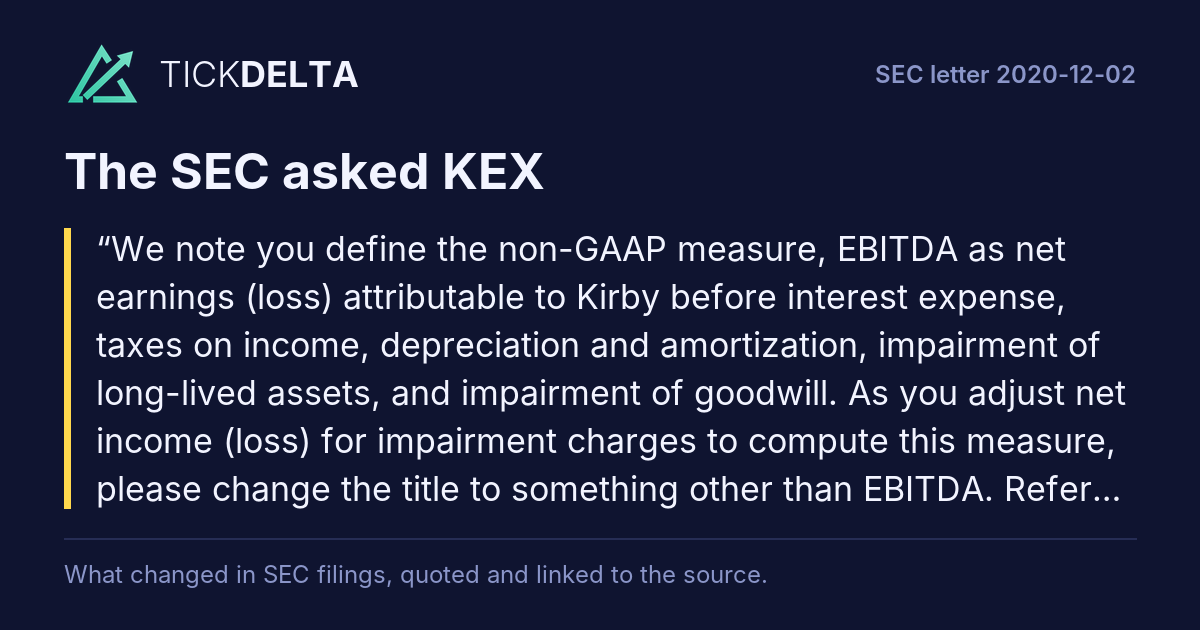
We note you define the non-GAAP measure, EBITDA as net earnings (loss) attributable to Kirby before interest expense, taxes on income, depreciation and amortization, impairment of long-lived assets, and impairment of goodwill. As you adjust net income (loss) for impairment charges to compute this measure, please change the title to something other than EBITDA.
Rest of the question

Refer to Question 103.01 of the Compliance and Disclosure Interpretations for further guidance.

KEX answered
The Company acknowledges the staff’s comment and will use the title “Adjusted EBITDA” in its future filings, where applicable and relevant, in accordance with the guidance in Question 103.01 of the Compliance and Disclosure Interpretations.

55 Waugh Drive Suite 1000 P.O. Box 1745 Houston, Texas 77251 713/435-1000 Fax 713/435-1010

Mr. Steve Lo and Mr.
Rest of the answer

Craig Arakawa

Securities and Exchange Commission

For example, the disclosure on page 4 of Exhibit 99.1 in our Form 8-K filed on October 29, 2020 would appear as follows (changes underlined):

GAAP to Non-GAAP Financial Measures

The financial and other information to be discussed in the conference call is available in this press release and in a Form 8-K filed with the Securities and Exchange Commission. This press release and the Form 8-K includes a non-GAAP financial measure, Adjusted EBITDA, which Kirby defines as net earnings (loss) attributable to Kirby before interest expense, taxes on income, depreciation and amortization, impairment of long-lived assets, and impairment of goodwill. A reconciliation of Adjusted EBITDA with GAAP net earnings (loss) attributable to Kirby is included in this press release. This press release also includes non-GAAP financial measures which exclude certain one-time items, including earnings before taxes on income (excluding one-time items), net earnings attributable to Kirby (excluding one-time items), and diluted earnings per share (excluding one-time items). A reconciliation of these measures with GAAP is included in this press release. Management believes the exclusion of certain one-time items from these financial measures enables it and investors to assess and understand operating performance, especially when comparing those results with previous and subsequent periods or forecasting performance for future periods, primarily because management views the excluded items to be outside of Kirby’s normal operating results. This press release also includes a non-GAAP financial measure, free cash flow, which Kirby defines as net cash provided by operating activities less capital expenditures. A reconciliation of free cash flow with GAAP is included in this press release. Kirby uses free cash flow to assess and forecast cash flow and to provide additional disclosures on the Company’s liquidity as a result of uncertainty surrounding the impact of the COVID-19 pandemic on global and regional market conditions. Free cash flow does not imply the amount of residual cash flow available for discretionary expenditures as it excludes mandatory debt service requirements and other non-discretionary expenditures. This press release also includes marine transportation performance measures, consisting of ton miles, revenue per ton mile, towboats operated and delay days. Comparable marine transportation performance measures for the 2019 year and quarters are available in the Investor Relations section of Kirby’s website, https://kirbycorp.com, under

Financials.

Read in the reply
In its next report

First report after the company's reply of Dec 11, 2020: 10-K filed Feb 23, 2021 ↗, against the 10-K filed Feb 24, 2020 ↗.

Tickdelta does not hold the text of both reports, so they are not compared here.

Also in this review: closing letter, 2020-12-14
Form 10-K for the Year Ended December 31, 2017

2018-11-27 to 2019-03-08 · 8 questions · 2 letters from the SEC, 2 from the company
Review closed 2019-03-08
AcquisitionsRevenueResults discussion (MD&A)
Notes to Consolidated Financial Statements · Note (3) Revenues, page 9
SEC asked (1)
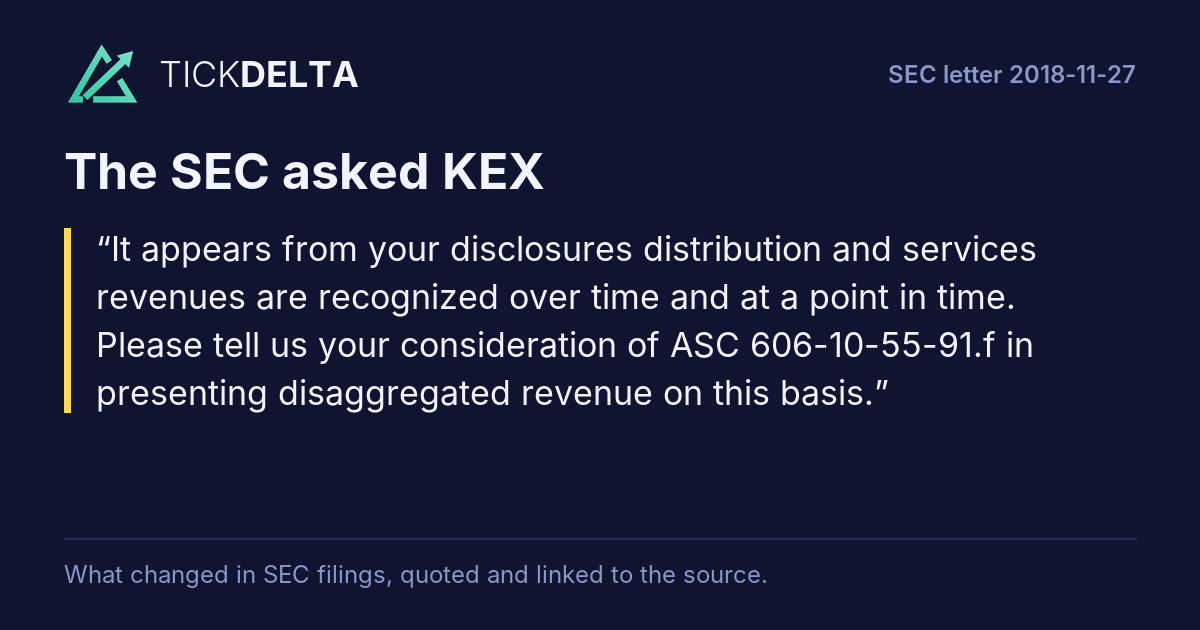
It appears from your disclosures distribution and services revenues are recognized over time and at a point in time. Please tell us your consideration of ASC 606-10-55-91.f in presenting disaggregated revenue on this basis.
KEX answered
ASC 606-10-55-90 describes that “when selecting the type of category (or categories) to use to disaggregate revenue, an entity should consider how information about the entity’s revenue has been presented for other purposes, including all of the following:

55 Waugh Drive Suite 1000 P.O. Box 1745 Houston, Texas 77251 713/435-1000 Fax 713/435-1010

Mr. Patrick Kuhn and Mr.
Rest of the answer

Doug Jones

Securities and Exchange Commission a)

Disclosures presented outside the financial statements (for example, in earnings releases, annual reports, or investor presentations) b)

Information regularly reviewed by the chief operating decision maker for evaluating the financial performance of operating segments c)

Other information that is similar to the types of information identified in (a) and (b) and that is used by the entity or users of the entity’s financial statements to evaluate the entity’s financial performance or make resource allocation decisions.”

ASC 606-10-55-91 provides examples of disaggregation of revenue categories that might be appropriate, but are not limited to, all the following:

Type of good or service (for example, major product lines)

Geographical region (for example, country or region)

Market or type of customer (for example, government and nongovernment customers) d)

Type of contract (for example, fixed-price and time-and-materials contracts) e)

Contract duration (for example, short-term and long-term contracts) f)

Timing of transfer of goods or services (for example, revenue from goods or services transferred to customers at a point in time and revenue from goods or services transferred over time) g)

Sales channels (for example, goods sold directly to consumers and goods sold through intermediaries).

The Company considered the most appropriate categories for users of our financial statements in accordance with ASC 606-10-55-90 and ASC

606-10-55-91. As part of its consideration for its distribution and services revenues, the Company observed that disaggregation of revenues recognized at a point in time and over time is not presented externally in its earnings releases, annual reports or investor presentations and is not typically used by the chief operating decision maker in assessing financial performance or making capital resource allocation decisions.

The Company also considered the examples of disaggregation of revenues in ASC 606-10-55-91 and believes its current disaggregation disclosure of its distribution and services revenues by two primary markets to be the most meaningful. Furthermore, the Company believes that further disaggregation based on the timing of recognition does not provide any additional insight for the users of the Company’s financial statements.

Read in the reply
In its next report

First report after the company's reply of Dec 11, 2018: 10-K filed Feb 26, 2019 ↗, against the 10-K filed Feb 26, 2018 ↗.

Tickdelta does not hold the text of both reports, so they are not compared here.

Management's Discussion and Analysis, page 37
SEC asked (2)
Please quantify each factor identified as a cause for the variance of your annual and interim period results. Refer to section 501.04 of staff’s Codification of Financial Reporting Releases and also Item 303(a)(3)(iii) of Regulation S-K in regard to revenues for guidance.
KEX answered
The Company acknowledges the staff’s comment and the requirements of section 501.04 of the Codification of Financial Reporting Releases and also Item 303(a)(3)(iii) of Regulation S-K regarding quantification and discussion of the factors that materially impact the revenues of the Company’s consolidated and segment results.

The acquisition of Stewart & Stevenson (“S&S”) in 2017 was the primary material factor that drove the increases in the Company’s revenues as disclosed in its Management’s Discussion and Analysis (MD&A).
Rest of the answer

This acquisition was quickly integrated into the Company’s own operations which made it difficult to segregate the revenues of the acquiree compared to revenues of the legacy Company’s revenues.

The Company immediately began to coordinate sales efforts between its United Holdings LLC (“United”) subsidiary and S&S which helped secure orders for the manufacture of pressure pumping units that both standalone companies would have struggled to deliver on-time to the customer and would likely not have received and began to complete orders at each other’s manufacturing facilities for geographic convenience as well. In fact, the Company’s incentive compensation system for 2018 adds the two subsidiaries financial goals together into a single incentive because of the extent of immediate integration of the two subsidiaries.

The Company believes that providing a specific amount of revenue for S&S would not be practical and could be overstated due to the reasons cited in the preceding paragraph and considered misleading to the users of the financial statements.

In the Company’s consideration of section 501.04 of staff’s Codification of Financial Reporting Releases, the Company believed that providing a specific amount of revenue for S&S would not be practical and could be overstated and considered misleading to the users of the financial statements and that a disclosure of the reason for the revenue increases without quantifying an amount, that could not be determined with precision, would be the most meaningful without the risk of misleading the users of the financial statements.

In the Company’s consideration of Item 303(a)(3)(iii) of Regulation S-K regarding revenues, it is not reasonably practicable to quantity each factor due to the acquisition above but the Company does believe that the disclosure of the primary drivers of the material revenue changes does provide meaningful disclosure of the reasons for the material year-to-year and quarter-to-quarter changes in revenues despite its inability to determine the changes with precision.

The Company does believe that it will be able to better provide the magnitude and relative impact of material revenue changes in future periods and filings as period over period comparisons due to the passage of time after the acquisition date and the integration of the acquired company. It will then become practical for the Company to quantify the material revenue charges with an acceptable level of precision.

Read in the reply
In its next report

First report after the company's reply of Dec 11, 2018: 10-K filed Feb 26, 2019 ↗, against the 10-K filed Feb 26, 2018 ↗.

Tickdelta does not hold the text of both reports, so they are not compared here.

Consolidated Statements of Earnings, page 70
SEC asked (3)
You disclose you provide services, sell parts, manufacture equipment and rent equipment. Please tell us your consideration of Rule 5-03(b)(1) and (2) of Regulation S-X in regard to your presentation in the statement of earnings.
KEX answered
The Company acknowledges the staff’s comment and the requirements of Rule 5-03(b)(1) and (2) of Regulation S-X regarding presentation in our statement of earnings, which requires a separate presentation of revenue and cost of revenue by tangible products and services if a class of revenue represents 10% or more of the total consolidated revenues.

Section 5-03(b) of Regulation S-X states that if income is derived from more than one of the sub-captions described below, each class which is not more than 10% of the sum of the items may be combined with another class.
Rest of the answer

If these items are combined, related costs and expenses applicable to sales and revenues shall be combined in the same manner. The sub-captions are:

Net sales of tangible products (gross sales less discounts, returns and allowances);

Operating revenues of public utilities or others;

Income from rentals;

Revenues from services; and

Other revenues.

The Company derives substantially all its revenue from services (item d). The Company considers the marine transportation segment to be a provider of marine transportation services, which makes up approximately half of the Company’s consolidated revenues.

In the distribution and services segment, the Company considers its service revenue to also include the parts component of a service job and these service revenues make up a significant portion of all of distribution and services revenue. Direct parts sales (item a), where there is no service component, and rentals (item c) do not meet the requirements for separate disclosure and the Company has no revenues under item b.

Based on the guidance in Section 5-03(b)(1) and (2), the Company believes that it has properly disclosed its revenues and related costs of sales and revenues as required based on the explanations provided in the two preceding paragraphs.

Read in the reply
In its next report

First report after the company's reply of Dec 11, 2018: 10-K filed Feb 26, 2019 ↗, against the 10-K filed Feb 26, 2018 ↗.

Tickdelta does not hold the text of both reports, so they are not compared here.

Note (2) Acquisitions, page 78
SEC asked (4)
The acquisitions of S&S in 2017 represented approximately 18% of total assets at June 30, 2017 and Higman Marine in 2018 represented approximately 8% of total assets at December 31, 2017. You disclose each acquisition as a factor affecting the variance in results in the applicable periods affected without quantifying the impact of each.
Rest of the question

You disclose you did not present the pro forma results of the acquisitions because you believe they are not material to your results. Also, you did not disclose the revenue and earnings of each acquiree since the acquisition date included in your consolidated statement of earnings for the applicable periods. Please explain to us your analysis of ASC 805-10-50- 2.h.1 and 3 in the preparation of your disclosures. Quantify for us the impact each acquisition had on your results for 2017 and through June 30, 2018, as appropriate, as a variance factor and in regard to the amount of revenue and earnings included in the consolidated statement of earnings.

KEX answered
The acquisitions of S&S in 2017 and Higman Marine, Inc. and affiliated companies (“Higman”) in 2018 were two acquisitions that were quickly integrated into the Company’s own operations which made it difficult to segregate the revenues and earnings of the acquiree compared to revenues and earnings of the legacy Company’s revenues and earnings.

In the case of S&S, the Company immediately began to coordinate sales efforts between its United subsidiary and S&S which helped secure orders for the manufacture of pressure pumping units that both standalone companies would have struggled to deliver
Rest of the answer

on-time to the customer and would likely not have received and began to complete orders at each other’s manufacturing facilities for geographic considerations as well. In fact, the Company’s incentive compensation system for 2018 adds the two subsidiaries financial goals together into a single incentive because of the extent and speed of integration of the

In the Company’s consideration of ASC 805-10-50-2h.1 and 3, the Company believed that providing a specific amount of revenue and earnings for S&S would not be practical and could be overstated due to the reasons cited in the preceding paragraph and considered misleading to the users of the financial statements. In future filings, the Company will disclose that fact and explain why the disclosure is impracticable as required by ASC 805-10-50-2.

In the case of Higman, the Company also immediately began to integrate its tank barges and towboats between its Kirby Inland Marine, LP

(“KIM”) subsidiary and Higman. As such, the Higman equipment began to operate on the KIM contracts soon after the acquisition and Higman barges worked with KIM towboats and vice versa resulting in differences in vessel utilization and pricing among the individual assets and the consolidated fleet. This is possible as customer contracts do not specify which particular vessel is used and prices are quoted based on vessel classes, not individual assets. Nominations of vessels for specific jobs are determined on a day by day basis and are a function of the equipment class required and the geographic position of vessels within that class at that particular time as vessels within a class are interchangeable and provide the same service. Also, the Higman fleet was newer than the legacy KIM fleet which allowed KIM to avoid capital expenditures and significant capital outlays for new barges and towboats and the legacy KIM business retired more equipment than it might have otherwise done so if the acquisition was not made; thus, generating more revenues and earnings for the Higman fleet.

In the Company’s consideration of ASC 805-10-50-2h.1 and 3, the Company believed that providing a specific amount of revenue and earnings for Higman could be overstated and considered misleading to the users of the financial statements due to the reasons cited in the preceding paragraph. In future filings, the Company will disclose that fact and explain why the disclosure is impracticable as required by ASC 805-10-50-2.

* * * * *

In connection with responding to the staff’s comments, we acknowledge that:

· the Company is responsible for the adequacy and accuracy of the disclosure in the filing;

staff comments or changes to disclosure in response to staff comments do not foreclose the Commission from taking any action with respect to the filing; and

The Company may not assert staff comments as a defense in any proceedings initiated by the Commission or any person under the federal securities laws of the United States.

Read in the reply
In its next report

First report after the company's reply of Dec 11, 2018: 10-K filed Feb 26, 2019 ↗, against the 10-K filed Feb 26, 2018 ↗.

Tickdelta does not hold the text of both reports, so they are not compared here.

Notes to Consolidated Financial Statements · Note (2) Acquisitions, page 78
SEC asked (1)
Refer to your response to prior comment 4. Please clarify for us why you were not able to provide the pro forma information for each of the S&S and Higman acquisitions pursuant to ASC 805-10-50-2.h.3 which is based on historical information prior to the acquisitions.
KEX answered
In our response to prior comment 4, our response was focused on our inability to provide specific amounts of revenues and earnings for

S&S and Higman after the acquisitions as a result of the quick integration into the Company’s own operations, not historical information prior to the acquisitions. Sorry if there was any confusion in our previous response.

Mr. Patrick Kuhn and Mr. Doug Jones

Securities and Exchange Commission

Our conclusion at the date of acquisitions was that the pro forma results would not be materially different than our actual historical results.
Rest of the answer

While not quantitatively material, the Company has concluded that qualitatively this information could be meaningful to an investor and has presented pro forma information pursuant to ASC 805-10-50-2.h.3 for the years 2016 and 2017 as though the S&S acquisition had occurred as of the beginning of 2016 in note 3 to our consolidated financial statements in our 2018 Form 10-K, as follows:

The following unaudited pro forma results present consolidated information as if the S&S acquisition had been completed as of January 1, 2016. The pro forma results do not include any of the other acquisitions completed in 2016 through 2018 described above as the effect of these acquisitions would not be materially different from the Company’s actual results.

The pro forma results include the amortization associated with the acquired intangible assets, interest expense associated with the debt used to fund a portion of the acquisition, the impact of the additional shares issued in connection with the S&S acquisition, removal of a product line sold in 2016 and the impact of certain fair value adjustments such as depreciation adjustments related to adjustments to property and equipment. The pro forma results do not include any cost savings or potential synergies related to the acquisition nor any integration costs. The pro forma results should not be considered indicative of the results of operations or financial position of the combined companies had the acquisitions had been consummated as of January 1, 2016 and are not necessarily indicative of results of future operations of the Company.

The following table sets forth the Company’s pro forma revenues and net earnings attributable to Kirby for the years ended

December 31, 2016 and 2017 (unaudited and in thousands):

Read in the reply
In its next report

First report after the company's reply of Mar 4, 2019: 10-Q filed May 9, 2019 ↗, against the 10-Q filed Nov 5, 2018 ↗.

Tickdelta does not hold the text of both reports, so they are not compared here.

Notes to Consolidated Financial Statements · Note (2) Acquisitions, page 78
SEC asked (2)
Additionally, please clarify the basis for the belief in your disclosure that the acquisitions were not material. In connection with this, provide us with your analysis of the significance of each of the S&S and Higman acquisitions in regard to Rules 3-05 and 1101(b)(1) of Regulation S-X.
KEX answered
For the S&S acquisition, the test for significance under Rules 3-05 and 11-01(b)(1) determined that none of the conditions of the test exceeded the 20% level with the investment test being at 18%, the asset test at 10% and the income test being at 7%. The combination of acquisitions also did not exceed the 50% significance level when aggregated with only two small business combinations in 2017.

As discussed in the response to comment number one, the S&S acquisition was not considered significant under Rules 3-05 and 11-01(b)(1) and S&S operating results were not deemed material to the pro
Rest of the answer

forma information pursuant to ASC 805-10-50-2.h.3. However, the Company has concluded that qualitatively this information could be meaningful to an investor and has presented pro forma results in note 3 to our consolidated financial statements in our 2018 Form 10-K for the years 2016 and 2017 for the impact of the S&S acquisition in the interest of better disclosure and to facilitate the comparison of the combined companies.

For the Higman acquisition, the test for significance under Rules 3-05 and 11-01(b)(1) determined that none of the conditions of the test exceeded the 20% level with the investment test being at 10%, the asset test at 15% and the income test being at 2%. The combination of the Higman and S&S acquisitions in aggregate also did not meet the 50% significance level. The Company’s determination that the pro forma disclosures under ASC 805-10-50-2.h.3 were not material to the financial statements was based in part on the income test being at 2% and Higman’s revenues being less than 10% of the Company’s consolidated revenues.

Read in the reply
In its next report

First report after the company's reply of Mar 4, 2019: 10-Q filed May 9, 2019 ↗, against the 10-Q filed Nov 5, 2018 ↗.

Tickdelta does not hold the text of both reports, so they are not compared here.

Notes to Consolidated Financial Statements · Note (2) Acquisitions, page 78
SEC asked (3)
You state in your response it was difficult to segregate the revenues and earnings of the S&S and Higman acquisitions because they were quickly integrated into your operations. However, we note disclosure in the earnings release included in your Form 8-K furnished November 2, 2017 about the actual and expected per share impacts of the S&S acquisition. Please reconcile the foregoing for us.
KEX answered
The Form 8-K and related earnings release was furnished on November 1, 2017, which was approximately six weeks after S&S was acquired. Visibility into the separate operating results of S&S became increasingly difficult over time as the Company was actively working to integrate S&S into the rest of the Company. The earnings guidance and related impact of the

S&S acquisition on future earnings was provided for the 2017 fourth quarter and included a fairly large range.
Rest of the answer

The earnings guidance was also provided to help investors understand the impact of issuing shares to acquire S&S which was going to dilute the Company’s legacy earnings. As the fourth quarter of 2017 progressed, the coordination of the sales effort intensified between United Holdings LLC and S&S, and the companies began to complete orders at each other’s manufacturing facilities which resulted in a January 2018 decision to combine the two companies’ financial goals for their incentive compensation system into one combined goal for reasons including the realization that it was becoming impractical to separate the financial performance of the two companies.

Read in the reply
In its next report

First report after the company's reply of Mar 4, 2019: 10-Q filed May 9, 2019 ↗, against the 10-Q filed Nov 5, 2018 ↗.

Tickdelta does not hold the text of both reports, so they are not compared here.

Notes to Consolidated Financial Statements · Note (2) Acquisitions, page 78
SEC asked (4)
We understand new business after the acquisitions may not have been discernible due to the integrated nature of operations, as stated in your response in regard to S&S. However, it is not clear how operations of each acquisition existing at the date of acquisition and continuing thereafter were no longer discernible. Please advise.
KEX answered
Due to the extent of the integration of the acquired operations with the Company’s legacy operations following the acquisition, it is impractical to discern the revenue and earnings of the acquired operations, as all such transactions are co-mingled with legacy operations and not captured in a single reporting unit resulting in the inability to report information that relates solely to the acquired operations.

We have added disclosure of the fact that it is not practical to separate the results of the acquisitions due to the quick integration of acquired companies’ operations in Item 7.
Rest of the answer

Management’s Discussion and Analysis of Financial Condition and Results of Operations in our 2018 Form 10-K to explain why the disclosure is not included. The following disclosures were included:

The S&S operations were quickly integrated into the Company’s own operations. This helped the Company to secure orders for the manufacture of pressure pumping units that both standalone companies would have struggled to deliver on-time to the customer and would likely have not received, as well as began to complete orders at each other’s manufacturing facilities for geographic convenience as well. Due to the accelerated integration, it is not practical to provide a specific amount of revenues for S&S, but the acquisition of S&S in 2017 was one of the primary factors that drove increases in distribution and services revenues in 2018 compared to 2017 and 2017 compared to 2016.

The Higman fleet was quickly integrated into the Company’s own fleet. The Higman equipment began to operate on the Company’s contracts soon after the acquisition and Higman barges worked with the Company’s towboats and vice versa resulting in differences in vessel utilization and pricing among individual assets and the consolidated fleet. Due to this quick integration, it is not practical to provide a specific amount of revenues for Higman but the acquisition in February 2018 was one of the primary factors that drove increases in marine transportation revenues in 2018 as compared to 2017.

* * * * *

In connection with responding to the staff’s comments, we acknowledge that:

· the Company is responsible for the adequacy and accuracy of the disclosure in the filing;

staff comments or changes to disclosure in response to staff comments do not foreclose the Commission from taking any action with respect to the filing; and

The Company may not assert staff comments as a defense in any proceedings initiated by the Commission or any person under the federal securities laws of the United

States.

Read in the reply
In its next report

First report after the company's reply of Mar 4, 2019: 10-Q filed May 9, 2019 ↗, against the 10-Q filed Nov 5, 2018 ↗.

Tickdelta does not hold the text of both reports, so they are not compared here.

Also in this review: closing letter, 2019-03-08

Form 10-K for the Fiscal Year Ended December 31, 2016

2017-12-19 to 2018-01-18 · 3 questions · 1 letter from the SEC, 1 from the company
Review closed 2018-01-18
Results discussion (MD&A)Liquidity and cashControlsRevenueSegments
Management’s Discussion and Analysis · Cash Flow and Capital Expenditures, page 38
SEC asked (1)
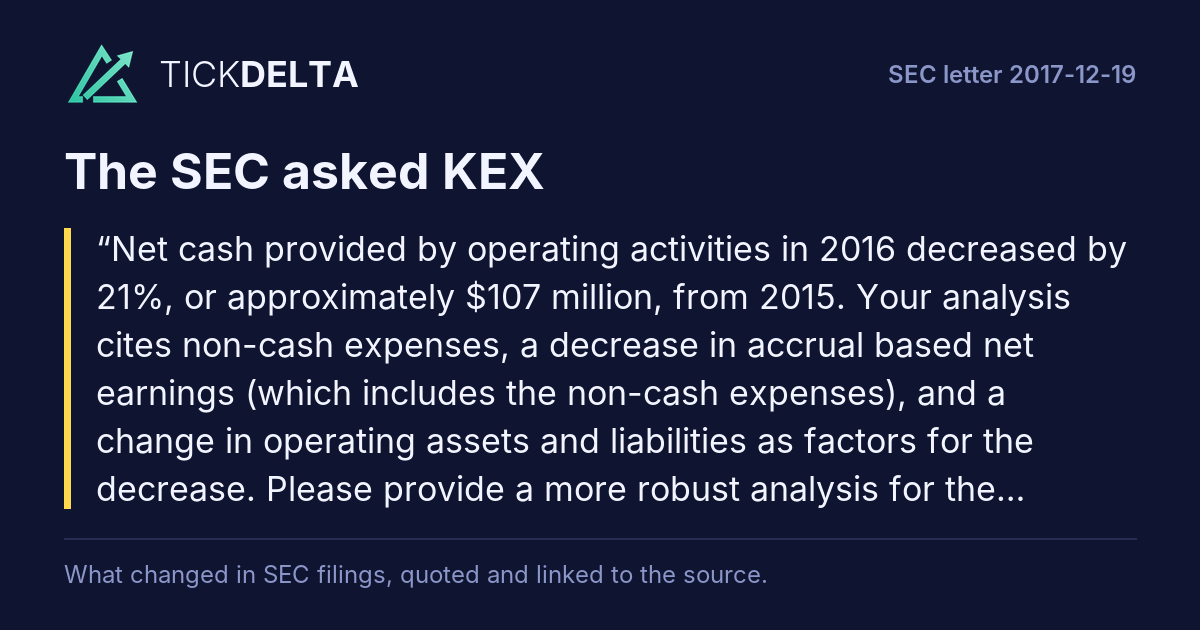
Net cash provided by operating activities in 2016 decreased by 21%, or approximately $107 million, from 2015. Your analysis cites non-cash expenses, a decrease in accrual based net earnings (which includes the non-cash expenses), and a change in operating assets and liabilities as factors for the decrease. Please provide a more robust analysis for the decrease.
Rest of the question

Your analysis should address the material drivers underlying factors cited. Note that citing noncash items as well as net earnings and changes in assets and liabilities may not provide a sufficient basis to understand how actual operating cash was impacted. Refer to section IV.B.1 of SEC Release No. 33-8350 for guidance. Please provide us with a copy of your intended revised disclosure. Additionally, please conform the disclosure contained in your interim period filings.

KEX answered
Following is a more detailed analysis of the changes in net cash provided by operating activities. We will include comparable explanations in future filings pursuant to the guidance cited.

The Company continued to generate favorable operating cash flow during 2016 with net cash provided by operating activities of $414,038,000 compared with $521,305,000 of net cash provided by operating activities for 2015.
Rest of the answer

The largest component contributing to the $107,267,000 decrease in net cash provided by operating activities in 2016 as compared to 2015 was a decline in the revenues and operating income of the marine transportation segment and the diesel engine services segment, resulting in an $85,166,000 decrease in net earnings. The revenues and operating income of the marine transportation segment declined during 2016 due to lower pricing on inland term and spot contracts and lower equipment utilization, as well as an increase in the number of coastal vessels operating in the spot market which led to lower utilization and an increase in non-billable repositioning and port expenses. The revenues and operating income of the diesel engine services segment also declined during 2016 due to the lack of demand for the manufacture of pressure pumping units and other oilfield service equipment and for the sale and distribution of engines, transmissions and parts due to the impact of the decline in the price of crude oil and decreased drilling activity in North American shale formations.

The 2016 year also experienced a net decrease in cash flows from changes in operating assets and liabilities of $12,452,000 compared with a net increase in 2015 of $3,530,000. The 2016 year experienced a net decrease in cash flow from changes in operating assets and liabilities primarily due to an increase in accounts receivable driven by slower collections at the Company’s marine transportation segment and several large projects billed late in the 2016 fourth quarter in the diesel engine services segment as well lower employee compensation accruals for 2016 and a decrease in deferred revenues as a result of decreased advance billings in the coastal marine transportation market and in the diesel engine services power generation market. The 2015 year experienced a net increase in operating assets and liabilities primarily due to a decrease in receivables in 2015 due to reduced business activity levels partially offset by increases in land-based inventory due to lower activity levels and parts ordered prior to customer order cancelations or delays and lower accounts payable due to decreased business activity levels in the land-based diesel engine services market.

Read in the reply
In its next report

First report after the company's reply of Jan 3, 2018: 10-K filed Feb 26, 2018 ↗, against the 10-K filed Feb 23, 2017 ↗.

Tickdelta does not hold the text of both reports, so they are not compared here.

Controls and Procedures · Disclosure Controls and Procedures, page 60
SEC asked (2)
Your conclusion refers only to a portion of disclosure controls and procedures defined by Exchange Act Rules 13a-15(e) and 15d-15(e). In this regard, it appears your conclusion applies only to the portion referred to. Please confirm to us and revise to clarify, if true, that your conclusion is in regard to the entirety of disclosure controls and procedures as defined.
Rest of the question

Additionally, please conform the disclosure in regard to controls and procedures contained in your interim period filings.

KEX answered
We confirm that the conclusion of our Chief Executive Officer and Chief Financial Officer with respect to disclosure controls and procedures does relate to the entirety of disclosure controls and procedures as defined. In future filings, in response to this comment, we will revise the disclosures in Item 9A. Controls and Procedures, Disclosure Controls and Procedures in the Form 10-K and Item 4.
Rest of the answer

Controls and Procedures in the Form 10-Q to read as follows:

“The Company’s management, with the participation of the Chief Executive Officer and the Chief Financial Officer, has evaluated the Company’s disclosure controls and procedures (as defined in Rule 13a-15(e) under the Securities Exchange Act of 1934 (“Exchange Act”)), as of Month DD, YYYY, as required by Rule 13a-15(b) under the Exchange Act. Based on that evaluation, the Chief Executive Officer and the Chief Financial Officer concluded that, as of Month DD, YYYY, the disclosure controls and procedures were effective to ensure that information required to be disclosed by the Company in the reports that it files or submits under the Exchange Act (i) is recorded, processed, summarized and reported within the time periods specified in the Securities and Exchange Commission’s rules and forms and (ii) is accumulated and communicated to the Company’s management, including the Chief Executive Officer and the Chief Financial Officer, as appropriate to allow timely decisions regarding required disclosure.”

Read in the reply
In its next report

First report after the company's reply of Jan 3, 2018: 10-K filed Feb 26, 2018 ↗, against the 10-K filed Feb 23, 2017 ↗.

Tickdelta does not hold the text of both reports, so they are not compared here.

Form 10-Q for Fiscal Quarter Ended September 30, 2017 · Distribution and Services, page 22
SEC asked (3)
We note each of distribution and services segment revenue and segment profit for 2015 decreased 39% and 68%, respectively, compared to 2014. We note the decline in this segment’s operations continued in 2016 with each of revenue and segment profit for 2016 decreasing 38% and 83%, respectively, compared to 2015.
Rest of the question

We further note the significant increase in this segment’s revenue and segment profit for the nine months ended September 30, 2017, and the operating margin for this period was 10.2% compared with margins of 7.5%, 3.9%, and 1.1% for the 2014, 2015, and 2016 annual periods, respectively. If recent significant growth in this segment is indicative of a material known trend, please explain to us in detail the reasons for this trend and provide a detailed discussion in your filing identifying and explaining this trend, including your assessment of the specific factors underlying this trend, and whether they are indicative of future segment operating results. See the lead in paragraph of Item 303(b) and Item 303(a)(3)(ii) of Regulation S-K.

KEX answered
The results of the distribution and services segment are largely influenced by the economic cycles of the land-based oilfield service and oil and gas operator and producer markets, marine, power generation, on-highway and other industrial markets. During 2015 and 2016, lower crude oil prices resulted in a decrease in the number of oil and gas wells being drilled. Oilfield service companies reduced their capital spending, resulting in decreased demand for new parts and equipment, including pressure pumping units, provided by the distribution and services segment.
Rest of the answer

In early 2015, an estimated 19.5 million horsepower of pressure pumping units were working in North America. The Company also services offshore supply vessels and offshore drilling rigs operating in the Gulf of Mexico, as well as internationally. Low energy prices negatively impacted the number of wells drilled in the Gulf of Mexico and international waters. By late 2016, the working horsepower in North America had declined to an estimated 9.0 million. These contributing factors resulted in a negative impact on the distribution and services segment’s revenue and profit in 2015 and 2016.

The United States land rig count has improved in 2017 from the lows in 2016, oil prices have traded in the $40 to $60 per barrel range during 2017 and service intensity in the well completion business has increased. In addition, the condition of the industry’s pressure pumping fleet remains poor. Based on these positive conditions, the Company anticipates the trend to continue for the strong demand for pressure pumping unit remanufacturing and the increased demand is anticipated to generate orders for the manufacture of new pressure pumping units and ancillary oilfield service support equipment, resulting in a continued trend of increased revenues and profit in the distribution and services segment for the fourth quarter of 2017 and into the 2018 year.

As noted in Footnote (3) Acquisitions, on September 13, 2017, the Company completed the acquisition of the assets of Stewart & Stevenson LLC (“S&S”), a global manufacturer and distributor of products and services for the oil and gas, marine, construction, power generation, transportation, mining and agricultural industries. The higher revenue and profit in the nine months ended September 30, 2017 included S&S operations for the last 17 days of the quarter during which S&S was owned by the Company. While the revenues and profit for S&S reflected healthy demand for service work, parts sales and the manufacturing of pressure pumping equipment, S&S also benefited from elevated demand in September for rental equipment and increased service work as a result of pent-up demand following Hurricanes Harvey, Irma and Maria.

In future filings, we confirm that we will explain in detail the reasons for trends in the distribution and services segment revenue and profit results, including our assessment of the specific factors underlying the trends and whether they are indicative of future segment operating results.

* * * * *

In connection with responding to the staff’s comments, we acknowledge that:

· the Company is responsible for the adequacy and accuracy of the disclosure in the filing;

staff comments or changes to disclosure in response to staff comments do not foreclose the Commission from taking any action with respect to the filing; and

The Company may not assert staff comments as a defense in any proceedings initiated by the Commission or any person under the federal securities laws of the United States.

Read in the reply
In its next report

First report after the company's reply of Jan 3, 2018: 10-K filed Feb 26, 2018 ↗, against the 10-K filed Feb 23, 2017 ↗.

Tickdelta does not hold the text of both reports, so they are not compared here.

Also in this review: closing letter, 2018-01-18

From the SEC's correspondence on EDGAR: staff letters (form UPLOAD) and company letters (form CORRESP), 11 letters filed since 2017-12-19. Questions and answers are matched by their numbers; topics come from words in each question. The reports are compared word for word (same form, before the first SEC letter against the first report after the company's reply). No AI.

Sources

The SEC's correspondence on EDGAR: staff letters (form UPLOAD) and company letters (form CORRESP), matched question by question. No AI.

Also

Filings: the letters in the filing list.

Work with it

Excel workbook · CSV. Google Sheet that stays up to date: paste =IMPORTDATA("https://tickdelta.com/company/KEX/export.csv") into a cell.

Next in Owners and insiders:Insider trades
Esc

Type a ticker such as AAPL, a name, an investor such as Buffett, or a topic such as tariffs. ↑ ↓ to move, Enter to open.