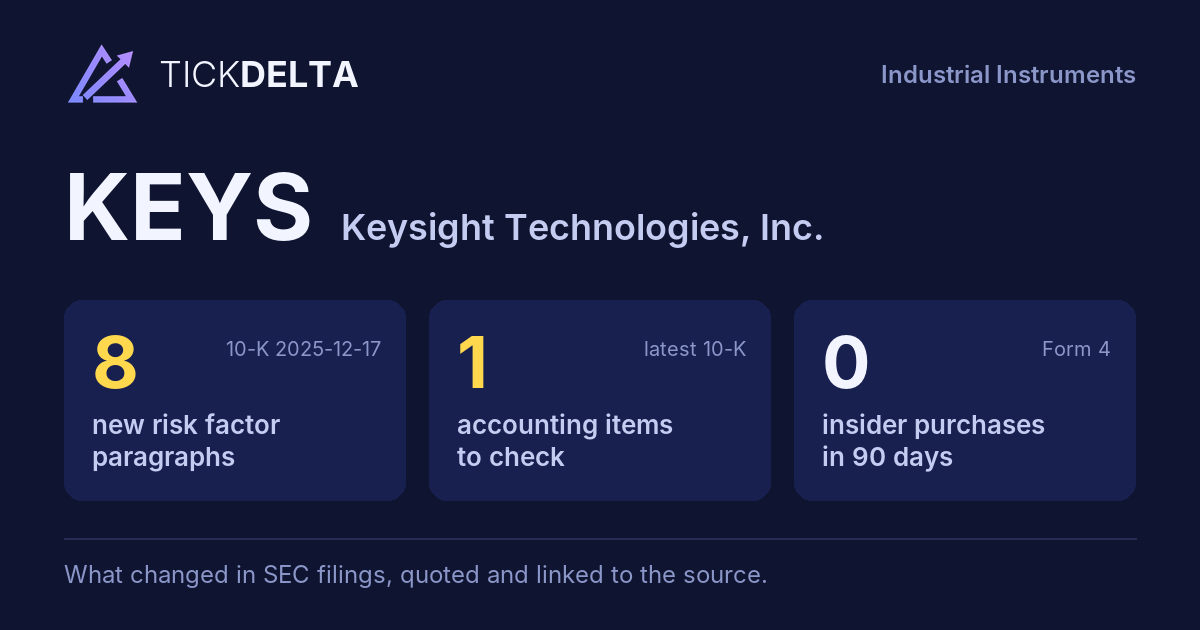
10-K 0001601046-25-000127 (2025-12-17) vs 10-K 0001601046-24-000159 (2024-12-17)
| Section | Compared text | Words now | Changed |
|---|
| Risk Factors | Item 1A | 11,395 |
17.2% |
| MD&A | Item 7 | 11,278 |
30.1% |
| Legal Proceedings | Item 3 | 674 |
50.0% |
| Accounting Policies | Item 8, Note 1 – OVERVIEW, BASIS OF PRESENTATION AND SUMMARY OF SIGNIFICANT ACCOUNTING POLICIES | 5,503 |
2.7% |
The redline: what was cut and what was added
In each section, the paragraph that changed most, marked against last year's 10-K:
cut words struck through, new words highlighted and underlined.
Risk Factors 242 words changed in this paragraph; it is 46% similar to last year's version.
International trade disputes There have been recent and increased ongoing changes to U.S. tariff policy, resulting in broad-based increases in tariff rates. Commencing in the second quarter of fiscal 2025, new U.S. tariffs between applying to imports from all countries were announced, including significantly higher rates on imports from China. In response, several countries, including China, have imposed or threatened to impose retaliatory measures on imports from the United States U.S. The U.S. government has announced various modifications and delays to its tariff policy and further changes may be made in the United Kingdom, future. There has also been continuing litigation in the European Union, Singapore, Malaysia and China, among other countries could substantially change our expectations and ability to operate in such jurisdictions as we have done historically. federal courts regarding the validity of the imposition of certain tariffs. Many of our suppliers, vendors, customers, partners, and other entities with whom we do business have strong ties to doing business in China. China and other countries impacted by the increased tariffs. Their ability to supply materials to us, buy products or services from us, or otherwise work with us is affected by their ability to do business in China. impacted countries. Continued uncertainty around trade policy could substantially change our cost of operating in such jurisdictions. Moreover, these tariffs and any other trade restrictions imposed on our customers or suppliers could adversely affect our financial results and position through reduced demand for our products and solutions, cancelled orders, supply chain disruptions, increased transaction costs, and increased expenses. If the U.S.’s U.S.’ relationship with China countries subject to increased tariffs results in additional trade disputes, trade protection measures, retaliatory actions, tariffs actions and increased barriers, policies that favor domestic industries, or increased import or export licensing requirements or restrictions, then our deployment of resources in jurisdictions affected by such measures could be misaligned and our operations may be adversely affected due to such changes in the economic and political ecosystem in which our suppliers, vendors, customers, partners, and other entities with whom we do business operate. affected.
Source: Item 1A, 10-K 0001601046-25-000127 vs Item 1A, 10-K 0001601046-24-000159
MD&A 178 words changed in this paragraph; it is 35% similar to last year's version.
We are subject to income taxes in the U.S. and various other countries globally. Changes in tax law, tax rates, or in the composition of earnings in countries with differing tax rates may affect deferred tax assets and liabilities recorded and our future effective tax rate. The Organization for Economic Cooperation and Development (“OECD”) reached agreement among various certain member countries to implement a global minimum 15 percent tax rate on certain multinational enterprises, framework, commonly referred to as Pillar Two. Numerous Two, which established a minimum 15 percent income tax rate. Various countries have enacted passed legislation to adopt comply with the Pillar Two model rules. A subset of the these rules will be became effective for Keysight as in the current fiscal year. While we expect to meet transitional safe harbor requirements in most jurisdictions, there are a limited number of November 1, 2024, with the remaining rules effective as of November 1, 2025. Keysight continues to analyze the jurisdictions where we expect Pillar Two model rules and monitor developments. taxes to apply. The income tax provision for the year ended October 31, 2025 includes the effects of Pillar Two could have taxes, resulting in a material impact on our effective tax rate in fiscal year 2025, primarily offsetting the reduction to our effective income tax rate from our tax incentives. expense of $13 million.
Source: Item 7, 10-K 0001601046-25-000127 vs Item 7, 10-K 0001601046-24-000159
Legal Proceedings 151 words changed in this paragraph; it is 69% similar to last year's version.
On January 1, 2022, Centripetal Networks filed a lawsuit in Federal District Court in Virginia, alleging that certain Keysight products infringe certain of Centripetal’s patents. We challenged the validity of claims of eight of these patents at the U.S. Patent and Trademark Office, with all or most claims being found invalid in each patent. Centripetal is appealing seven of these results. In addition, in February 2022 Centripetal filed complaints in Germany alleging infringement of certain three of Centripetal’s German patents, patents. Keysight challenged the validity of the claims of these patents in German nullity or European Patent Office (“EPO”) opposition procedures. Two of the three patents were invalidated, and in the appeals process has ended. The third patent had all but one claim invalidated at trial and is under appeal. In April 2022 2022, Centripetal filed a complaint with the International Trade Commission (“ITC”) requesting that they investigate whether Keysight violated Section 337 of the Tariff Act (“Section 337”) and should be enjoined from importing certain products that are manufactured outside of the U.S. and which are alleged to infringe Centripetal patents. On December 5, 2023, the ITC issued its Notice of Determination that Keysight did not unfairly import products in violation of Section 337 and the investigation was terminated. Centripetal has appealed this determination. The lawsuit in Federal District Court in Virginia is stayed pending the finalization of appeals of the ITC findings and validity challenges. On August 21, 2024, Keysight was served in Germany with a complaint filed in the Unified Patent Court alleging that certain Keysight products sold in Germany, France, Italy Italy, and the Netherlands infringe a European Centripetal patent. In December 2025, the court issued its written determination that Keysight did not infringe the patent. Keysight also challenged the validity of the patent using EPO opposition procedures, and the EPO revoked the patent in its hearing in November 2025. We deny the allegations and are aggressively defending each case.
Source: Item 3, 10-K 0001601046-25-000127 vs Item 3, 10-K 0001601046-24-000159
Accounting Policies 52 words changed in this paragraph; it is 81% similar to last year's version.
Accounting Standards Update (“ASU”) 2023-07, Segment Reporting (Topic 280): Improvements to Reportable Segment Disclosures. In November 2023, the Financial Accounting Standards Board (“FASB”) issued guidance which will require requires us to disclose significant segment expenses and other segment items used by the Chief Operating Decision Maker ("CODM") (“CODM”) on an annual and interim basis as well as provide in interim periods all disclosures about a reportable segment’s profit or loss and assets that are currently required annually. Additionally, we will be are required to disclose the title and position of the CODM. The new standard is effective for fiscal years beginning after December 15, 2023, and interim periods within fiscal years beginning after December 15, 2024, with early adoption permitted. This ASU will have no impact on our results of operations, cash flows or financial condition. We will apply the amendments in adopted this ASU retrospectively to all prior period disclosures presented in the financial statements upon adoption. guidance during 2025 (see Note 16).
Source: Item 8, Note 1 – OVERVIEW, BASIS OF PRESENTATION AND SUMMARY OF SIGNIFICANT ACCOUNTING POLICIES, 10-K 0001601046-25-000127 vs Item 8, Note 1 – OVERVIEW, BASIS OF PRESENTATION AND SUMMARY OF SIGNIFICANT ACCOUNTING POLICIES, 10-K 0001601046-24-000159
Every change, by type
Sentences and paragraphs of KEYS's Risk Factors and MD&A, 10-K 2025-12-17 against 10-K 2024-12-17.
Each links to the text at sec.gov.
Quiet changes are sentences kept from last year with one to four words changed, at least one of them a hedge, a modal or a qualifier
(may, could, will, not, significant, material…). A year or date rolling forward is not counted.
The full word list
adverse, adversely, all, although, anticipate, anticipates, any, approximately, believe, believes, can, cannot, certain, could, expect, expects, generally, however, if, intend, intends, largely, likely, many, material, materially, may, might, most, must, never, no, not, possible, primarily, probable, should, significant, significantly, some, substantial, substantially, unlikely, will, would
AddedRisk Factors
•uncertainty regarding the U.S. government’s announced tariffs, potential changes to existing tariffs and whether additional tariffs may be imposed, modified or suspended;
Read it in 10-K 2025-12-17 at sec.gov ↗
AddedRisk Factors
There have been recent and ongoing changes to U.S. tariff policy, resulting in broad-based increases in tariff rates. Commencing in the second quarter of fiscal 2025, new U.S. tariffs applying to imports from all countries were announced, including significantly higher rates on imports from China. In response, several countries, including China, have imposed or threatened to impose retaliatory measures on imports from the U.S. The U.S. government has announced various modifications and delays to its tariff policy and further changes may be made in the future. There has also been continuing litigation in the federal courts regarding the validity of the imposition of certain tariffs.
Read it in 10-K 2025-12-17 at sec.gov ↗
AddedRisk Factors
If the U.S.’ relationship with countries subject to increased tariffs results in additional trade disputes, trade protection measures, retaliatory actions and increased barriers, policies that favor domestic industries, or increased import or export licensing requirements or restrictions, we could suffer additional unforeseen adverse effects on our operating results and financial condition.
Read it in 10-K 2025-12-17 at sec.gov ↗
AddedRisk Factors
efficiencies and could impact our results of operations and stock price. Much of our outsourcing takes place in developing countries and, as a result, may be subject to heightened geopolitical uncertainty.
Read it in 10-K 2025-12-17 at sec.gov ↗
AddedRisk Factors
On January 23, 2025, we filed a lawsuit against the United States of America in the United States Court of Federal Claims seeking a tax refund of $107 million, or such greater amount allowed by law, plus any other amount, including interest and cost, allowed by law. We intend to vigorously defend our position. The outcome cannot be predicted with certainty. If we are ultimately unsuccessful in defending our refund claim, we will be required to reverse the benefit previously recorded, most likely resulting in a material increase in the effective tax rate and income tax liability.
Read it in 10-K 2025-12-17 at sec.gov ↗
AddedRisk Factors
disruption and significant unexpected expense, delays in or inability to develop, manufacture and ship products and solutions, customer dissatisfaction, loss of revenue and damage to our reputation.
Read it in 10-K 2025-12-17 at sec.gov ↗
AddedRisk Factors
We continue to evaluate and, where appropriate, integrate AI technologies into our product offerings and internal operations to enhance innovation, efficiency, and customer value. While AI presents opportunities for advancement, its adoption also introduces a range of risks that could adversely impact our business, financial condition, and results of operations. These risks include, but are not limited to, competitive disadvantages if peers more effectively leverage AI to accelerate innovation, product development, or operational performance. The use of AI may also expose us to legal, regulatory, and reputational risks, particularly in jurisdictions with evolving or inconsistent regulatory frameworks governing AI, data privacy, and cybersecurity. Additionally, the deployment of AI tools, whether by us or by customers using our AI-enabled solutions may result in unintended consequences such as biased or inaccurate outputs, loss or compromise of confidential information or intellectual property, and challenges in asserting or defending intellectual property rights. These risks may be amplified by increasing regulatory scrutiny and potential compliance obligations, which could result in increased costs or limitations on our ability to deploy AI technologies. There can be no assurance that our use of AI will yield the anticipated benefits or that we will be able to effectively mitigate the associated risks.
Read it in 10-K 2025-12-17 at sec.gov ↗
AddedRisk Factors
In January 2025, the U.S. government issued executive orders prohibiting illegal Diversity, Equity and Inclusion (“DEI”) programs, policies and activities, and has increased scrutiny of companies’ DEI initiatives. Keysight has long had a policy of providing equal employment opportunity for all employees. Although we believe that our policies and programs comply with the law in all jurisdictions in which we operate, there can be no assurance that the current administration in the U.S. will not deem certain company policies and programs to be illegal DEI. Such a determination could result in extended investigations, litigation, fines, penalties, and damage to our reputation or brand and could adversely affect our operations and our business results.
Read it in 10-K 2025-12-17 at sec.gov ↗
RemovedRisk Factors
Our income could be harmed if we are unable to adjust our purchases to address market fluctuations, including those caused by volatile global economic conditions, geopolitical conflict, or the seasonal or cyclical nature of the markets in which
Read it in 10-K 2024-12-17 at sec.gov ↗
RemovedRisk Factors
The company believes the position meets the more likely than not recognition threshold. The company intends to vigorously defend its position. The outcome cannot be predicted with certainty. If we are ultimately unsuccessful in defending our position, we may be required to reverse the benefit previously recorded, which may impact our financial statements and our profitability in the quarter in which such a reversal is required.
Read it in 10-K 2024-12-17 at sec.gov ↗
RemovedRisk Factors
intellectual property licenses, and we cannot ensure that these licenses will be available to us in the future on terms favorable to us or at all.
Read it in 10-K 2024-12-17 at sec.gov ↗
RemovedRisk Factors
countries, and could also materially affect our brand, ability to attract and retain employees, international operations, business and operating results.
Read it in 10-K 2024-12-17 at sec.gov ↗
RewordedRisk Factors
If the U.S.’s U.S.’ relationship with China countries subject to increased tariffs results in additional trade disputes, trade protection measures, retaliatory actions, tariffs actions and increased barriers, policies that favor domestic industries, or increased import or export licensing requirements or restrictions, then our deployment of resources in jurisdictions affected by such measures could be misaligned and our operations may be adversely affected due to such changes in the economic and political ecosystem in which our suppliers, vendors, customers, partners, and other entities with whom we do business operate. affected.
Read it in 10-K 2025-12-17 at sec.gov ↗
RewordedRisk Factors
Our amended and restated certificate of incorporation provide that unless the board of directors otherwise determines, the state courts in the State of Delaware or, if no state court located within the State of Delaware has jurisdiction, the federal court for the District of Delaware, will be the sole and exclusive forum for any derivative action or proceeding brought on our behalf, any action asserting a claim of breach of a fiduciary duty owed by any of our directors or officers to the company or our shareholders, any action asserting a claim against us or any of our directors or officers arising pursuant to any provision of the DGCL or Keysight's amended and restated certificate of incorporation or bylaws, or any action asserting a claim against us or any of our directors or officers governed by the internal affairs doctrine.
Read it in 10-K 2025-12-17 at sec.gov ↗
RewordedRisk Factors
If operations are out of compliance, we may be subject to civil or criminal actions, fines and penalties and be required to make significant changes to facilities and operations and temporarily or permanently shut down non-compliant operations, which could result in business disruption and significant unexpected expense, delays in or inability to develop, manufacture and ship products and solutions, customer dissatisfaction, loss of revenue and damage to our reputation.
Read it in 10-K 2025-12-17 at sec.gov ↗
RewordedRisk Factors
Nationalistic economic policies and political trends such as opposition to globalization and free trade, sanctions or trade restrictions, including those on advanced computing and semiconductor manufacturing, manufacturing and design software, withdrawal from or re-negotiation of global trade agreements, increased tariffs and reciprocal tariffs, tax and local content policies that favor domestic industries and interests, changes to immigration laws or enforcement and other similar actions may result in conflicting local or regional requirements, increased transaction costs, reduced ability to hire employees, reduced access to components, supplies and materials, reduced demand or access to customers, and inability to conduct our operations as they have been conducted historically.
Read it in 10-K 2025-12-17 at sec.gov ↗
RewordedRisk Factors
In addition, in February 2022, Centripetal filed complaints in Germany alleging infringement of certain of Centripetal’s German patents, and in April 2022, Centripetal filed a complaint with the International Trade Commission (“ITC”) ITC requesting that they investigate whether Keysight violated Section 377 of the Tariff Act and should be enjoined from importing certain products that are manufactured outside of the U.S. and alleged to infringe Centripetal patents.
Read it in 10-K 2025-12-17 at sec.gov ↗
RewordedRisk Factors
In addition, global and regional macroeconomic developments, such as increased unemployment, uncertainty related to future economic activity, increased tariff rates and reciprocal tariffs, volatility in financial and capital markets, reduced access to credit, changing interest rates, volatility in capital markets, decreased liquidity, uncertain or destabilizing national elections and reactions to national election results, political violence and unrest in the U.S., the U.K., Europe, and Asia, and negative changes or volatility in general economic conditions in the U.S., Europe, and Asia those regions could negatively affect our ability to conduct business in those territories.
Read it in 10-K 2025-12-17 at sec.gov ↗
RewordedRisk Factors
Violations of these laws and regulations could result in fines and penalties, criminal sanctions, restrictions on our business conduct and on our ability to offer our solutions in one or more countries, and could also materially affect our brand, ability to attract and retain employees, international operations, business and operating results.
Read it in 10-K 2025-12-17 at sec.gov ↗
RewordedRisk Factors
The GILTI tax benefit for the fiscal year 2024 amortization is included in the annual effective tax rate, and the Singapore intangible assets will continue to be amortized for GILTI tax purposes until 2033.
Read it in 10-K 2025-12-17 at sec.gov ↗
RewordedRisk Factors
In addition, in February 2022, Centripetal filed complaints in Germany alleging infringement of certain of Centripetal’s German patents, and in April 2022, Centripetal filed a complaint with the International Trade Commission (“ITC”) requesting that they investigate whether Keysight violated Section 337 of the Tariff Act (“Section 337”) and should be enjoined from importing certain products that are manufactured outside of the U.S. which are alleged to infringe Centripetal patents.
Read it in 10-K 2025-12-17 at sec.gov ↗
RewordedRisk Factors
Tariffs Increased tariffs on imports sales to or imports from China could impacted countries, including China, will increase the cost of our customers’ components and raw materials, which could make our customers’ products and services more expensive and could reduce demand for our customers’ products.
Read it in 10-K 2025-12-17 at sec.gov ↗
RewordedRisk Factors
As a result, our effective tax rate could be higher than it would have been if we had we renewed or been granted renewal of the tax incentive and incentive, which could harm our operating results after tax.
Read it in 10-K 2025-12-17 at sec.gov ↗
RewordedRisk Factors
We proactively scan for vulnerabilities in our product lines. products and address them to minimize the potential for exploitation.
Read it in 10-K 2025-12-17 at sec.gov ↗
Quiet changesRisk Factors
Without the timely introduction of new solutions, services and enhancements, our solutions and services will become technologically obsolete over time, in which case our revenue and operating results would suffer.
Read it in 10-K 2025-12-17 at sec.gov ↗
AddedMD&A
Acquisitions of Spirent Communications plc, Synopsys’ Optical Solutions Group, and Ansys’ PowerArtist RTL Business
Read it in 10-K 2025-12-17 at sec.gov ↗
AddedMD&A
On October 17, 2025, we acquired the Optical Solutions Group business (“OSG”) from Synopsys, Inc. (“Synopsys”) and the PowerArtist RTL business (“PowerArtist”) from Ansys, Inc. (“Ansys”) for $578 million and $26 million, respectively. For the year ended October 31, 2025, the acquisitions had an immaterial impact on our revenue.
Read it in 10-K 2025-12-17 at sec.gov ↗
AddedMD&A
Beginning in the second quarter of fiscal 2025, the U.S. government announced tariffs on products from most countries and additional reciprocal tariffs on certain countries. In response, China and other countries announced retaliatory tariffs against certain imports from the United States. There have been recent changes effective August 1, 2025, resulting in broad-based increases in tariff rates, and there has been continuing litigation in the federal courts regarding the validity of the imposition of certain tariffs. These tariffs have impacted our financial results for the year ended October 31, 2025. We have taken actions across multiple vectors to reduce the impact on our results of operations. This multipronged mitigation approach spans our global manufacturing footprint and sourcing strategies, as well as pricing and cost actions.
Read it in 10-K 2025-12-17 at sec.gov ↗
AddedMD&A
In July 2025, the One Big Beautiful Bill Act (“OBBBA”) was enacted into law in the U.S. The OBBBA includes numerous provisions that affect corporate taxation, including changes to bonus depreciation, the expensing of domestic research costs, and modifications to certain U.S. international tax rules. The company has analyzed the impacts of the OBBBA and reflected them in the current period. These impacts do not have a material effect on the tax rate for the year ended October 31, 2025. The majority of the tax law changes will take effect in future years.
Read it in 10-K 2025-12-17 at sec.gov ↗
AddedMD&A
In June 2025, the United States and the other six countries that make up the G7 nations jointly announced that U.S. companies would be exempted from certain minimum taxes related to the OECD agreement, commonly referred to as Pillar Two. However, significant details regarding the G7 announcement remain uncertain and individual countries that have enacted the OECD agreement, including countries not within the G7, must amend their local legislation for the G7 announcement to become effective. We continue to closely monitor Pillar Two developments.
Read it in 10-K 2025-12-17 at sec.gov ↗
AddedMD&A
A significant portion of the segments' expenses arise from allocated corporate charges, as well as expenses related to our centralized sales force, and service, marketing, and technology functions that are provided to the segments in order to realize economies of scale and to efficiently use resources. Corporate charges include legal, accounting, real estate, insurance services, information technology services, treasury, and other corporate infrastructure expenses. Segment allocations are determined on a basis that we consider to be a reasonable reflection of the utilization of services provided to, or benefits received by the segments. Newly acquired businesses are not allocated these charges until integrated into our shared services and corporate infrastructure.
Read it in 10-K 2025-12-17 at sec.gov ↗
AddedMD&A
exercise reasonable judgment to determine the customer’s ability and intent to pay, which is based upon various factors including the customer’s historical payment experience or credit and financial information and credit risk management measures that we implement.
Read it in 10-K 2025-12-17 at sec.gov ↗
RemovedMD&A
Our global operations continued to be affected by a challenging macro environment, including higher interest rates, currency movements, inflationary pressures, geopolitical tensions and trade restrictions. These factors resulted in lower demand, as our customers also exercised caution in light of the same environment. Against this backdrop, we remained operationally disciplined by exercising our financial playbook and the structural flexibility in our operating model, while investing to expand our differentiated solutions portfolio and deepening our customer relationships. Consistent with the Keysight Leadership Model, our differentiated first-to-market solutions portfolio, technology leadership, customer relationships, and durable and resilient business model give us confidence in the long-term trajectory of the business and our ability to outperform in a variety of market conditions and deliver consistent long-term value to our customers.
Read it in 10-K 2024-12-17 at sec.gov ↗
RemovedMD&A
The 2024 income tax charge was partially offset by a one-time income tax benefit of $165 million related to Global Intangible Low Taxed Income (“GILTI”) tax deductions for intangible asset amortization. Keysight concluded that the U.S. Department of the Treasury exceeded its regulatory authority in issuing tax regulations disallowing these deductions under IRC § 951A. The company amended its U.S. federal income tax returns for the open tax years to claim GILTI tax deductions. The
Read it in 10-K 2024-12-17 at sec.gov ↗
RemovedMD&A
tax receivable resulting from the amended returns is reflected in “other assets” and “other current assets” in the consolidated balance sheet. The annual tax impact of the amortization of the intangible assets will continue to be recognized until 2033. The company believes the position meets the more likely than not recognition threshold and intends to vigorously defend its position. The outcome cannot be predicted with certainty. If we are ultimately unsuccessful in defending our position, we may be required to reverse the benefit previously recorded.
Read it in 10-K 2024-12-17 at sec.gov ↗
RemovedMD&A
The 2024 income tax charge was also partially offset by a one-time income tax benefit of $61 million for the release of tax reserves related to the successful appeal of a Malaysia income tax assessment. In the fourth quarter of 2017, Keysight was assessed and paid income tax and penalties in Malaysia on gains related to the transfer of intellectual property rights and recorded a tax reserve on the assessed amount. The Court of Appeal in Malaysia ruled in Keysight’s favor on May 24, 2024, and the company received a refund of the income tax and penalties.
Read it in 10-K 2024-12-17 at sec.gov ↗
RemovedMD&A
Foreign currency movements had an unfavorable impact of 2 percentage points on the year-over-year revenue change. Revenue grew across all regions and markets.
Read it in 10-K 2024-12-17 at sec.gov ↗
RemovedMD&A
As part of the ESI Group acquisition, we assumed debt of $24 million, of which $10 million was payable within one year. The debt included a syndicated loan of $11 million payable through yearly installments until April 2025 with an annual interest rate of EURIBOR + 2 to 2.5 percent. We also assumed various fixed interest rate state-guaranteed loans and other bank borrowings of $13 million. During the year ended October 31, 2024, we repaid the debt assumed as part of the acquisition.
Read it in 10-K 2024-12-17 at sec.gov ↗
RemovedMD&A
As part of the ESI Group acquisition, we assumed a revolving credit facility of 10 million euros that was subsequently terminated in April 2024.
Read it in 10-K 2024-12-17 at sec.gov ↗
RemovedMD&A
On March 28, 2024, we announced our intention to acquire the entire share capital of Spirent Communications PLC (“Spirent”) for cash consideration of 199 pence per Spirent share, which reflects a valuation of $1,463 million on a fully diluted basis. Spirent shareholders will also be entitled to receive a special dividend of 2.5 pence per Spirent share, in lieu of any final dividend for the year ended December 31, 2023 (together with the cash consideration of 199 pence per share). The acquisition is expected to be completed during the first half of fiscal year 2025, pending regulatory clearances.
Read it in 10-K 2024-12-17 at sec.gov ↗
RemovedMD&A
On September 19, 2024, Keysight announced that it had entered into a definitive agreement with Synopsys, Inc. (“Synopsys”) to acquire Synopsys’ Optical Solutions Group, a leading developer of optical design and analysis software tools. The transaction is subject to customary closing conditions, including review by regulatory authorities and the successful closing of Synopsys’ proposed acquisition of Ansys, which is pending regulatory approvals and is expected to close in the first half of 2025.
Read it in 10-K 2024-12-17 at sec.gov ↗
RewordedMD&A
In 2024, 2025, we used $913 generated $385 million for from financing activities, including $600 $748 million used for repayment of proceeds from the issuance of the 2024 2030 Senior Notes, $458 Notes and $63 million used for the acquisition of the non-controlling interest in ESI Group, $443 proceeds from issuance of common stock under employee stock plans, partially offset by $377 million used for treasury stock repurchases, including payment of $4 $3 million for excise taxes levied on share repurchases, $31 $39 million for tax payments related to net share settlement of equity awards, $24 million used for repayment of debt assumed as part of the ESI Group acquisition, $12 $8 million used for payment of debt issuance costs, costs and $10 $2 million used for other financing activities, partially offset by $599 million of proceeds from the issuance of the 2034 Senior Notes, and $66 million of proceeds from issuance of common stock under employee stock plans. activities.
Read it in 10-K 2025-12-17 at sec.gov ↗
RewordedMD&A
Non-cash adjustments to net income were higher lower by $339 $452 million, primarily due to a $271 $384 million increase in deferred tax expense benefit resulting from a prior period one-time income tax charge of $315 million to decrease deferred tax asset values from the Singapore statutory tax rate to an incentive tax rate (see Note 5, “Income Taxes,” for additional information), a $58 an $85 million increase in amortization unrealized gains on investments in equity securities, and depreciation expense, a $21 million gain on sale of investments, partially offset by a $25 million increase in share-based compensation, a $8 million increase in excess and obsolete inventory related charges, and a $2 $6 million increase in share-based compensation. amortization and depreciation expense.
Read it in 10-K 2025-12-17 at sec.gov ↗
RewordedMD&A
Additionally, we used $147 $127 million for purchases of property, plant and equipment, net of $7 $1 million of government incentives incentives, and $11 $7 million for equity and other purchase of investments, partially offset by $20 $399 million provided by other investing activities. the divestiture of Spirent’s high-speed ethernet, network security and channel emulation business lines to Viavi Solutions Inc. and $30 million provided by sale of investments.
Read it in 10-K 2025-12-17 at sec.gov ↗
RewordedMD&A
In 2024, 2025, we used $681 $2,022 million, net of cash acquired, for acquisitions, which included $477 $1,415 million, net of $35 $127 million cash acquired, for the acquisition of Spirent, $578 million used for the controlling block acquisition of ESI Group shares. Synopsys’ OSG, $26 million used for acquisition of Ansys’ PowerArtist RTL Business and $3 million used for other acquisition activity.
Read it in 10-K 2025-12-17 at sec.gov ↗
RewordedMD&A
Such risks and uncertainties include, but are not limited to, the impact of global economic conditions such as inflation or potential recession, the impacts of increased trade tensions such as an imposition of or increase in tariffs and tightening of export control regulations, slowing demand for products or services, volatility in financial markets, reduced access to credit, increased changes in interest rates, the existence of political or economic instability, uncertainty related to the impact of national elections results in the U.S. and UK, U.K., impacts of geopolitical tension and conflict in regions outside of the U.S., the impacts of increased trade tension and tightening of export control regulations, the impact of new and ongoing litigation, impacts related to net zero emissions commitments, and the impact of volatile weather caused by environmental conditions such as climate change.
Read it in 10-K 2025-12-17 at sec.gov ↗
RewordedMD&A
The increase in net cash used in 2024 2025 compared to 2023 2024 was primarily due to $624 million used for repayment of 2024 Senior Notes in 2024, $458 million used for the acquisition of the non-controlling interest in ESI Group, partially offset by $259 Group in 2024, $149 million higher proceeds from issuance of senior notes and $66 million lower treasury stock repurchases.
Read it in 10-K 2025-12-17 at sec.gov ↗
RewordedMD&A
The difference between 2024 and 2023 cash flows was primarily due to payments on settlement of foreign exchange forward contracts associated with the ESI Group acquisition, net unrealized gains on foreign exchange contracts not designated as hedging instruments, changes in derivative assets and liabilities (see Note 9, “Derivatives”), “Derivatives,” for additional information), changes in deferred revenue, and changes in other assets and liabilities, partially offset by higher income and other tax accruals, net of payments, lower variable compensation, and payroll-related payments, net of accruals.
Read it in 10-K 2025-12-17 at sec.gov ↗
RewordedMD&A
Selling, general and administrative expenses increased 7 6 percent in 2024 2025 compared to 2023, 2024, primarily driven by higher acquisition and integration costs, people-related costs, travel costs, and incremental costs from acquired businesses, higher amortization of acquisition-related balances, partially offset by lower people-related, marketing, and infrastructure costs resulting from the flexibility and amortization of our operating model and cost efficiency measures. acquisition-related balances.
Read it in 10-K 2025-12-17 at sec.gov ↗
RewordedMD&A
We generally intend to use available cash and funds generated from our operations to meet these cash requirements, but in In the event that additional liquidity is required, we may also borrow under our the Revolving Credit Facility. Facility and/or issue new debt.
Read it in 10-K 2025-12-17 at sec.gov ↗
RewordedMD&A
The increase in net other expense income for 2023 2025 compared to 2022 2024 was primarily driven by losses net gains on equity investments, gains on derivative instruments and higher lower amortization of net actuarial losses, partially offset by net gains on our equity investments. losses.
Read it in 10-K 2025-12-17 at sec.gov ↗
RewordedMD&A
The increase in the effective tax rate of 9 percent 7 percentage points from 2022 2023 to 2023 2024 was primarily due to a 5 percent increase from U.S. the one-time income tax capitalization of research and experimental expenditures items in 2023. 2024.
Read it in 10-K 2025-12-17 at sec.gov ↗
RewordedMD&A
R&D expense in 2025 increased 5 2 percent in 2023 compared to 2022, 2024, primarily driven by continued investments in key growth opportunities, partially offset by lower opportunities in our end markets and leading-edge technologies and higher variable people-related people related costs.
Read it in 10-K 2025-12-17 at sec.gov ↗
Quiet changesMD&A
We may experience some fluctuations within individual lines of the consolidated balance sheet and consolidated statement of operations because our hedging program is not designed to offset the currency movements in each category of revenues, expenses, and monetary assets and liabilities.
Read it in 10-K 2025-12-17 at sec.gov ↗