Screener / SEC EDGAR /CIK 0001170010 /10-K filed Apr 15, 2026, compared with Apr 11, 2025 /Numbers from the XBRL of the 10-Ks
NYSE Consumer discretionary · Auto Dealers

Carmax Inc KMX

Compare with peers Embed
The 10-K against last year's

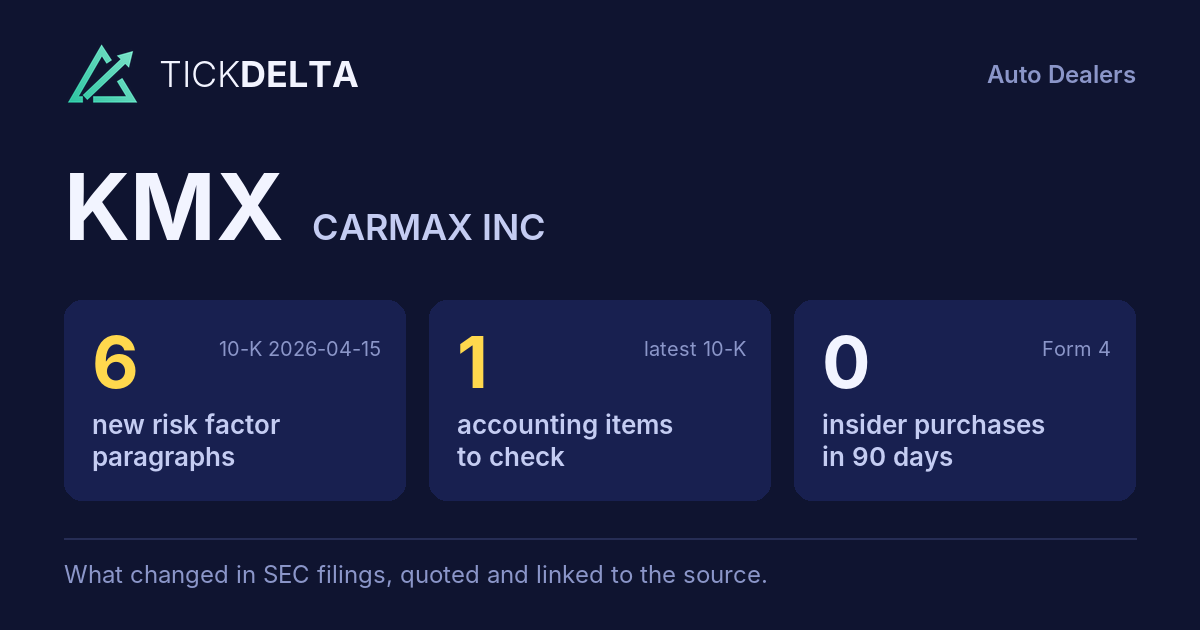
173 changes: 37 added, 40 removed, 92 reworded, 4 quiet changes

10-K Apr 15, 2026 vs Apr 11, 2025

10-K 0001170010-26-000021 (Apr 15, 2026) vs 10-K 0001170010-25-000024 (Apr 11, 2025)

Every paragraph, and how much of it changed

One bar per paragraph, in the order of the 10-K. Height and colour show the share of its words not in the closest paragraph a year earlier; the tallest bars are new paragraphs.

Risk Factors

80 paragraphs · 6 new · 30 reworded · 5 gone · 10-K Apr 15, 2026 against Apr 11, 2025
New paragraph Reworded (5% of its words or more) Same or nearly
Paragraph 33 · 48% changed Every version of it
also requires real estate. Our failure inability to manage acquire or lease suitable real estate at favorable terms could limit our growth expansion and the related challenges could have a material adverse effect on our business, sales business and results of operations.
Paragraph 63 · 45% changed Every version of it
The security measures we have implemented to protect against cybersecurity incidents may not always prevent or mitigate the impact of a cybersecurity incident and there can be no assurance that future efforts to prevent or mitigate a cybersecurity incident will be effective either. Numerous national retailers have disclosed security breaches involving sophisticated cyber- cyber-attacks, including ransomware, that were not recognized or detected until after such retailers had been affected, notwithstanding the preventive measures such retailers had in place. Further, the rapid evolution and increased adoption of AI and other evolving technologies may increase our level of cybersecurity risk. We and our third-party service providers face attempts by others to gain unauthorized access to, sabotage, take control of and corrupt our information systems and data. As a result of these types of attempts, both we and our third-party service providers have experienced information security, cybersecurity and data privacy incidents. To date, none of these incidents have had a material impact on our business, sales and results of
Paragraph 78 · 40% changed Every version of it
The price of our common stock may be subject to wide fluctuations based upon our operating results, general economic and market conditions, general trends and prospects for our industry, announcements by our competitors, our ability to achieve any long-term targets or performance metrics and other factors. In addition, the market price of our common stock may also be affected by whether we meet analysts’ expectations. Failure to meet such expectations has had and could in the future have a material adverse effect on the price of our common stock. Following periods of volatility in the market price of a the company’s securities, securities class action litigation is more likely. If has been brought against the company. Securities litigation were instituted against us, it could result in substantial costs and a diversion of our attention and resources, which could have a material adverse effect on our business.
Paragraph 1 · 35% changed Every version of it
We are subject to a variety of risks, the most significant of which are described below. Our business, sales, results of operations and financial condition could be materially adversely affected by any of these risks. These disclosures reflect the company’s beliefs and opinions as to factors that could materially and adversely affect the company and its securities in the future. References to past events are provided by way of example only and are not intended to be a complete listing or a representation as to whether or not such factors have occurred in the past or their likelihood of occurring in the future.
Paragraph 77 · 34% changed Every version of it
The price of our common stock has been and may continue to be subject to wide fluctuations based upon our operating results, general economic and market conditions, general trends and prospects for our industry, announcements by our competitors, our ability to achieve any long-term targets or performance metrics and other factors. In addition, the market price of our common stock may also be affected by whether we We have at times not met analysts’ expectations, and any continued failure to meet analysts’ expectations. Failure to meet such expectations expectations, or variations between our results and analysts’ projections, could have a material adverse effect on result in further volatility in the price of our common stock. Following periods of volatility in the market price of a company’s securities, securities class action litigation is more likely. If litigation were instituted against us, it could result in substantial costs and a diversion of our attention and resources, which could have a material adverse effect on our business.
Paragraph 14 · 32% changed Every version of it
We are subject to national and regional U.S. economic conditions. These conditions include, but are not limited to, recession, inflation, interest rates, unemployment levels, the state of the housing market, gasoline prices, consumer credit availability, consumer credit delinquency and loss rates, tariffs or the imposition of new tariffs, trade wars, barriers or restrictions, or threats of such actions, personal discretionary spending levels, and consumer sentiment about the economy in general. These conditions and the economy in general have been, and in the future may be, affected by significant national or international events such as a global health crisis or current geopolitical conditions. When these economic conditions worsen or stagnate, it can have a material adverse effect on consumer demand for vehicles generally, demand from particular consumer categories segments or demand for particular vehicle types. It can also negatively impact availability of credit to finance vehicle purchases for all or certain categories of consumers. This could result in challenges to vehicle affordability, lower sales, decreased margins on units sold, and decreased profits for our CAF segment. For example, tariffs impacting the availability and price of automotive parts, vehicles, or steel used in constructing new locations locations, and uncertainties regarding the ability to obtain refunds for previously paid tariffs that have subsequently been invalidated could also adversely impact our business. Economic conditions can also have a material adverse effect on the supply of late-model used vehicles, as automotive manufacturers produce fewer new vehicles and consumers retain their current vehicles for longer periods of time. This could result in increased costs to acquire used vehicle inventory and decreased margins on units sold.
Paragraph 11 · 31% changed Every version of it
Evolving Marketplace. The marketplace for used vehicles may be impacted by the significant, and likely accelerating, changes to the broader automotive industry. Demand for EVs is driving the need to adapt our business to source, recondition and service EVs. Technological changes, including the development of autonomous vehicles, new products and services, new business models, including subscription models, models and new methods of travel could reduce automotive retail demand or disrupt our current business model. In addition, technology related to generative AI is advancing rapidly, and its future impact on the automotive ecosystem, including online shopping behavior, is unknown. If we fail to respond effectively to the evolving marketplace, it could have a material adverse effect on our business, sales and results of operations.
Paragraph 13 · 30% changed Every version of it
We are subject to national and regional U.S. economic conditions. These conditions include, but are not limited to, economic downturn, recession, inflation, interest rates, unemployment levels, the state of the housing market, gasoline prices, consumer credit availability, consumer credit delinquency and loss rates, tariffs or the imposition and enforceability of new tariffs, trade wars, barriers or restrictions, or threats of such actions, actions and related uncertainties, personal discretionary spending levels, and consumer sentiment about the economy in general. These conditions and the economy in general have been, and in the future may be, affected by significant national or international events such as a global health crisis or current geopolitical conditions. When these economic conditions worsen or stagnate, stagnate (as, for example, the current conflict in the Middle East and the resulting increase in the price of gasoline in the U.S.), it can have a material adverse effect on consumer demand for vehicles generally, demand from particular consumer categories or demand for particular vehicle types. It can also negatively impact availability of credit to finance vehicle purchases for all or certain categories of consumers. This could result in challenges to vehicle affordability, lower sales, decreased margins on units sold, and decreased profits for our CAF segment. For example, tariffs impacting the availability and price of automotive parts, vehicles, or steel used in constructing new locations could also adversely impact our business. Economic conditions can also have a material adverse effect on the supply of late-model used vehicles, as automotive manufacturers produce fewer new vehicles and consumers retain their current vehicles for longer periods of time. This could result in increased costs to acquire used vehicle inventory and decreased margins on units sold.

MD&A

134 paragraphs · 31 new · 61 reworded · 35 gone · 10-K Apr 15, 2026 against Apr 11, 2025
New paragraph Reworded (5% of its words or more) Same or nearly
Paragraph 91 · 48% changed
During the second quarter of fiscal 2025, CAF began testing its new full-spectrum credit scoring models and corresponding strategies across both the Tier 1 1, Tier 2 and Tier 2 3 spaces. CAF began its testing of the new model in the Tier 3 space during the third quarter of During fiscal 2025. During March 2025, 2026, CAF began a measured expansion by recapturing profitable portions of Tier 1 originations that we had shifted to our Tier 2 lenders as we tightened lending standards. We expect this expansion will grow our penetration by 100 to 150 basis points standards as well as testing expanded lending with a focus in the near-term, which is enabled by our non-prime securitization program, allowing us to efficiently fund these non-prime receivables while retaining the full economic value top half of the contracts. Tier 2 space. This is a first step on the path towards our initial goal of increasing CAF penetration to 50%. We continue to learn from our new underwriting models and corresponding tests currently in place and anticipate capturing in order to capture additional volume across Tier 2 and Tier 3 during the back half of fiscal 2026. origination volume. We will continue to monitor consumer behavior and the broader economy and will adjust our origination strategy as needed. We would expect each additional percentage point of CAF penetration to generate $10 million to $12 million in lifetime pre-tax income per year of origination, net of the impact to finance partner participation fees. Our pre-tax income expectations will be impacted by the volume of loans originated, interest rates charged to customers, loan terms, loss rates, average credit scores and the broader macroeconomic and lending environments. While this income is earned over time, the provision for lifetime losses is recognized at the time of origination. We believe our unique finance platform with a full-spectrum in-house lending operation, coupled with a robust network of partner lenders, will strengthen our competitive advantage.
Paragraph 103 · 42% changed
◦The increase in the provision for loan losses in fiscal 2025 2026 was primarily driven by unfavorable loss performance. We experienced higher losses for receivables performance, primarily within loans originated in 2022 and 2023, when average selling prices were elevated and these customers were later challenged with by the macro-inflationary inflationary environment. In addition, we experienced higher losses pertaining to As a segment result of customers generally concentrated at the lower end previously disclosed tightening of Tier 1, which we addressed through further tightening in CAF's underwriting standards, loans originated after April 2024. While the loan loss reserve was adjusted for these receivables during the first quarter of fiscal 2025, further deterioration was observed during the second quarter, resulting in an additional adjustment to the reserve. In the third and fourth quarters, losses were 2024 are performing in line with our expectations.
Paragraph 72 · 41% changed
Fiscal 2025 2026 Versus Fiscal 2024. 2025. Other gross profit increased 27.9% 1.2% in fiscal 2025, 2026, primarily driven by a $70.7 an $18.4 million improvement in service department margins as well as margins, partially offset by an increase in EPP revenues, net third-party finance fees, as discussed above. The increase in service department profits margins was driven by cost coverage measures that we have implemented, implemented and increased efficiencies and the increase in used unit sales. In fiscal 2026, we plan to test EPP product enhancements that will focus on increasing penetration and margin per unit. We expect this will result in a slight year-over-year increase in EPP margin per unit during fiscal 2026, with the potential for more expansion in fiscal 2027. In addition, we expect service margin to grow year-over-year in fiscal 2026, efficiencies.
Paragraph 37 · 41% changed
In calendar 2024, 2025, we estimate we sold approximately 3.7% 3.6% of the age 0- to 10-year old vehicles sold on a nationwide basis, consistent with a decrease from 3.7% in calendar 2023. 2024. External title data indicates that while our year-over-year we gained market share came under pressure during in the first half of the year, it recovered as we achieved accelerating gains through calendar 2025, sales and market share were pressured in the second half of the year, with particular strength in vehicles aged 0 to 4 years, which grew for the entire year. The data indicates that our market share continued to grow year-over-year during January 2025, the latest period for which information is available. Our strategy to increase our market share includes focusing on:
Paragraph 92 · 40% changed
During the second quarter of fiscal 2025, CAF began testing its new full-spectrum credit scoring models and corresponding strategies across both the Tier 1 and Tier 2 spaces. CAF began its testing of the new model in the Tier 3 space during the third quarter of fiscal 2025. During March 2025, CAF began a measured expansion by recapturing profitable portions of Tier 1 originations that we had shifted to our Tier 2 lenders as we tightened lending standards. We expect this expansion will grow our penetration by 100 to 150 basis points in the near-term, which is enabled by our non-prime securitization program, allowing us to efficiently fund these non-prime receivables while retaining the full economic value of the contracts. We continue to learn from our new underwriting models and corresponding tests currently in place and anticipate capturing additional volume across Tier 2 and Tier 3 during the back half of fiscal 2026. We will continue to monitor consumer behavior and the broader economy and will adjust our origination strategy as needed. We would expect each additional percentage point of CAF penetration to generate $10 million to $12 million in lifetime pre-tax income per year of origination, net of the impact to finance partner participation fees. Our pre-tax income expectations will be impacted by the volume of loans originated, interest rates charged to customers, loan terms, loss rates, average credit scores scores, funding strategy, loan sales and the broader macroeconomic and lending environments. While this income is earned over time, the provision for lifetime losses is recognized at the time of origination. We believe our unique finance platform with a full-spectrum in-house lending operation, coupled along with a robust our complementary network of partner lenders, will strengthen our competitive advantage.
Paragraph 70 · 40% changed
Fiscal 2025 2026 Versus Fiscal 2024. 2025. Wholesale vehicle gross profit increased 0.1% decreased 6.0% in fiscal 2025. 2026, driven by a $50 decrease in wholesale vehicle gross profit per unit as well as a 1.1% decrease in unit sales.
Paragraph 14 · 38% changed
(3) (4) An omni retail sale is defined as a sale where customers complete at least one, but not all, of the four activities listed above online. in note (4) below online, or additional steps that can be completed online, including pre-qualifying for financing, setting appointments and signing up for notifications of cars coming soon.
Paragraph 42 · 36% changed
The allowance for loan losses is determined using a net loss timing curve method (“method”), primarily based on the composition of the portfolio of managed receivables auto loans held for investment and historical gross loss and recovery trends. Due to the fact that losses for receivables loans with less than 18 months of performance history can be volatile, our net loss estimate weights both historical losses by credit grade at origination and actual loss data on the receivables to-date, along with forward loss curves, in estimating future performance. Once the receivables have 18 months of performance history, the net loss estimate reflects actual loss experience of those receivables to date, along with forward loss curves, to predict future performance. The forward loss curves are constructed using historical performance data and show the average timing of losses over the course of a receivable’s life. The net loss estimate is calculated by applying the loss rates developed using the methods described above to the amortized cost basis of the managed receivables.

A paragraph is matched with the one last year that shares the most of its words; under half in common makes it new. The paragraphs shown are the 8 reworded the most in each section.

The paragraph that changed most in each section

The redline

Marked against last year's 10-K: cut words struck through, new words highlighted.

MD&A238 words changed in this paragraph; it is 42% similar to last year's version.
During the second quarter of fiscal 2025, CAF began testing its new full-spectrum credit scoring models and corresponding strategies across both the Tier 1 1, Tier 2 and Tier 2 3 spaces. CAF began its testing of the new model in the Tier 3 space during the third quarter of During fiscal 2025. During March 2025, 2026, CAF began a measured expansion by recapturing profitable portions of Tier 1 originations that we had shifted to our Tier 2 lenders as we tightened lending standards. We expect this expansion will grow our penetration by 100 to 150 basis points standards as well as testing expanded lending with a focus in the near-term, which is enabled by our non-prime securitization program, allowing us to efficiently fund these non-prime receivables while retaining the full economic value top half of the contracts. Tier 2 space. This is a first step on the path towards our initial goal of increasing CAF penetration to 50%. We continue to learn from our new underwriting models and corresponding tests currently in place and anticipate capturing in order to capture additional volume across Tier 2 and Tier 3 during the back half of fiscal 2026. origination volume. We will continue to monitor consumer behavior and the broader economy and will adjust our origination strategy as needed. We would expect each additional percentage point of CAF penetration to generate $10 million to $12 million in lifetime pre-tax income per year of origination, net of the impact to finance partner participation fees. Our pre-tax income expectations will be impacted by the volume of loans originated, interest rates charged to customers, loan terms, loss rates, average credit scores and the broader macroeconomic and lending environments. While this income is earned over time, the provision for lifetime losses is recognized at the time of origination. We believe our unique finance platform with a full-spectrum in-house lending operation, coupled with a robust network of partner lenders, will strengthen our competitive advantage.

Source: Item 7, 10-K 0001170010-26-000021 vs Item 7, 10-K 0001170010-25-000024

Risk Factors161 words changed in this paragraph; it is 60% similar to last year's version.
We are subject to national and regional U.S. economic conditions. These conditions include, but are not limited to, economic downturn, recession, inflation, interest rates, unemployment levels, the state of the housing market, gasoline prices, consumer credit availability, consumer credit delinquency and loss rates, tariffs or the imposition and enforceability of new tariffs, trade wars, barriers or restrictions, or threats of such actions, actions and related uncertainties, personal discretionary spending levels, and consumer sentiment about the economy in general. These conditions and the economy in general have been, and in the future may be, affected by significant national or international events such as a global health crisis or current geopolitical conditions. When these economic conditions worsen or stagnate, stagnate (as, for example, the current conflict in the Middle East and the resulting increase in the price of gasoline in the U.S.), it can have a material adverse effect on consumer demand for vehicles generally, demand from particular consumer categories or demand for particular vehicle types. It can also negatively impact availability of credit to finance vehicle purchases for all or certain categories of consumers. This could result in challenges to vehicle affordability, lower sales, decreased margins on units sold, and decreased profits for our CAF segment. For example, tariffs impacting the availability and price of automotive parts, vehicles, or steel used in constructing new locations could also adversely impact our business. Economic conditions can also have a material adverse effect on the supply of late-model used vehicles, as automotive manufacturers produce fewer new vehicles and consumers retain their current vehicles for longer periods of time. This could result in increased costs to acquire used vehicle inventory and decreased margins on units sold.

Source: Item 1A, 10-K 0001170010-26-000021 vs Item 1A, 10-K 0001170010-25-000024

Accounting Policies124 words changed in this paragraph; it is 36% similar to last year's version.
In November 2024, September 2025, the FASB issued an accounting pronouncement (ASU 2024-04) 2025-07) related to induced conversions of convertible debt instruments. derivative scope refinements and a scope clarification for share-based noncash consideration from a customer in a revenue contract. The amendments in this update exclude from derivative accounting non-exchange-traded contracts with underlyings that are based on operations or activities specific to one of the parties to the contract, with limited exceptions. The amendments in this update also clarify that an entity should apply the requirements noncash consideration guidance in ASC 606 to a contract with share-based noncash consideration from a customer for determining whether certain settlements the transfer of convertible debt instruments should be accounted for as induced conversions rather than as debt extinguishments. This update is goods or services. These updates are effective for annual periods beginning after December 15, 2025, 2026, including interim periods within those fiscal years, although early adoption is permitted. We plan to adopt this

Source: Item 8, Note 1 – NATURE OF OPERATIONS AND SUMMARY OF SIGNIFICANT ACCOUNTING POLICIES, 10-K 0001170010-26-000021 vs Item 8, Note 1 – NATURE OF OPERATIONS AND SUMMARY OF SIGNIFICANT ACCOUNTING POLICIES, 10-K 0001170010-25-000024

Legal Proceedings56 words changed in this paragraph; it is 68% similar to last year's version.
In accordance with the terms of real estate lease agreements, we generally agree to indemnify the lessor from certain liabilities arising as a result of the use of the leased premises, including environmental liabilities and repairs to leased property upon termination of the lease. Additionally, in accordance with the terms of agreements entered into for the sale of properties, we generally agree to indemnify the buyer from certain liabilities and costs arising subsequent to the date of the sale, including environmental liabilities and liabilities resulting from the breach of representations or warranties made in accordance with the agreements. We do not have any known material environmental commitments, contingencies or other indemnification issues arising from these arrangements.

Source: Item 3, via Note 18 – COMMITMENTS AND CONTINGENCIES, 10-K 0001170010-26-000021 vs Item 3, via Note 18 – COMMITMENTS AND CONTINGENCIES, 10-K 0001170010-25-000024

Sentences and paragraphs added, removed or reworded

Every change, by type

Sentences and paragraphs of KMX's Risk Factors and MD&A, 10-K Apr 15, 2026 against 10-K Apr 11, 2025. Each links to the text at sec.gov.

Quiet changes are sentences kept from last year with one to four words changed, at least one of them a hedge, a modal or a qualifier (may, could, will, not, significant, material…). A year or date rolling forward is not counted.

The full word list

adverse, adversely, all, although, anticipate, anticipates, any, approximately, believe, believes, can, cannot, certain, could, expect, expects, generally, however, if, intend, intends, largely, likely, many, material, materially, may, might, most, must, never, no, not, possible, primarily, probable, should, significant, significantly, some, substantial, substantially, unlikely, will, would

AddedRisk Factors
Integrity is a critical component of the CarMax brand and foundational to the trust our customers place in us. Our reputation for integrity, together with transparent, no‑haggle pricing, vehicle quality, customer service and a seamless omni‑channel experience, is important to our ability to attract and retain customers. While consumers consider a range of factors when choosing where to buy or sell a vehicle, a perceived failure to act with integrity, or a loss of trust in our brand for any reason, could significantly undermine customer confidence and have a material adverse effect on our business, sales and results of operations.
Read it in 10-K Apr 15, 2026 at sec.gov
AddedRisk Factors
Our brand and reputation could be harmed by actual or perceived failures to maintain high standards of integrity, quality or customer experience, including isolated incidents at a single store or broader issues, particularly if they result in adverse publicity, governmental investigations or litigation. These events could relate to, among other things, our sales or financing practices, vehicle reconditioning or quality, treatment of customers or associates, use of AI or other technologies, cultural brand positioning or real or perceived safety issues or injuries. The widespread use of social media and other digital platforms has increased the speed and scale with which information and misinformation can be disseminated, and we may not be successful in correcting or mitigating negative perceptions. Any resulting damage to our reputation or brand could have a material adverse effect on our business, sales and results of operations.
Read it in 10-K Apr 15, 2026 at sec.gov
AddedRisk Factors
Our associates are critical to our success, and our culture is an important differentiator. Cost-reduction initiatives, workforce reductions and changes to our workplace model may affect our ability to attract and retain qualified personnel, result in loss of institutional knowledge and expertise, cause attrition beyond our intended reduction in force or negatively impact associate morale. Internal restructurings may also divert management attention from our business and may negatively impact our culture. A failure to maintain our culture could have a material adverse effect on our business, sales and results of operations.
Read it in 10-K Apr 15, 2026 at sec.gov
AddedRisk Factors
Our future success also depends in substantial part on our ability to attract, recruit, hire, motivate, develop and retain talented personnel possessing the qualifications, experiences, capabilities and skills we need for all areas of our organization, including senior leadership. As our new chief executive officer leads our company in its next chapter, there could be uncertainty among investors, customers, third parties and employees. Failure to successfully execute our succession plans or disruptions associated with leadership transitions could have a material adverse effect on our business, sales and results of operations.
Read it in 10-K Apr 15, 2026 at sec.gov
AddedRisk Factors
Our business and operations could be negatively affected by actions of activist shareholders against us, which could cause us to incur significant expense, hinder execution of business and growth strategy, and impact our stock price.
Read it in 10-K Apr 15, 2026 at sec.gov
AddedRisk Factors
Shareholders have engaged, and in the future may engage, in activist activities against the company, including engaging in proxy solicitations, submitting shareholders proposals, nominating individuals to serve on our Board or otherwise attempting to effect changes, assert influence or acquire some level of control over us. We have been and may continue to be subject to activism in the future. Activist shareholders have sought, and may in the future seek, to effect changes in our strategic direction and how our company is governed through changes to our Board or otherwise. Shareholder activism, including potential proxy contests, could result in substantial costs and divert management’s and the Board’s attention and resources from our business. Additionally, such shareholder activism could give rise to perceived uncertainties as to our future, adversely affect our relationships with service providers and make it more difficult to attract and retain qualified personnel. We may also be required to incur significant fees and other expenses related to any activist shareholder matters. Further, our stock price could be subject to significant fluctuation or otherwise be adversely affected by the events, risks and uncertainties of any shareholder activism.
Read it in 10-K Apr 15, 2026 at sec.gov
RemovedRisk Factors
Our reputation as a company that is founded on the fundamental principle of integrity is critical to our success. Our reputation as a retailer offering competitive, no-haggle prices, a broad selection of CarMax Quality Certified used vehicles, superior customer service and a seamless omni-channel experience is also critical to our success. If we fail to maintain the high
Read it in 10-K Apr 11, 2025 at sec.gov
RemovedRisk Factors
standards on which our reputation is built, or if an event occurs that damages this reputation, it could adversely affect consumer demand and have a material adverse effect on our business, sales and results of operations. Such an event could include an isolated incident at a single store, particularly if such incident results in adverse publicity, governmental investigations, or litigation and could involve, among other things, our sales process, our provision of financing, our reconditioning process, our treatment of customers or associates, our use of AI, cultural brand positioning, or real or perceived vehicle quality and related injury. Even the perception of a decrease in the quality of our brand could impact results.
Read it in 10-K Apr 11, 2025 at sec.gov
Show the other 55
RemovedRisk Factors
The use of social media has increased the speed with which information and opinions can be shared and the speed with which reputation can be affected. We monitor social media and attempt to address customer concerns, provide accurate information and protect our reputation, but there can be no guarantee that our efforts will succeed. If we fail to correct or mitigate misinformation or negative information, including information spread through social media or traditional media channels, about the vehicles we offer, our customer experience, or any aspect of our brand, it could have a material adverse effect on our business, sales and results of operations.
Read it in 10-K Apr 11, 2025 at sec.gov
RemovedRisk Factors
Our associates are the driving force behind our success. We believe that one of the key factors that distinguishes CarMax is a culture centered on valuing our associates. We provide flexible, hybrid and remote work arrangements for certain associates, which may impact associate engagement, integration of new associates and overall company culture. A failure to maintain our culture could have a material adverse effect on our business, sales and results of operations.
Read it in 10-K Apr 11, 2025 at sec.gov
RemovedRisk Factors
7. Management’s Discussion and Analysis of Financial Condition and Results of Operations, and the notes to consolidated financial statements included in Item 8. Consolidated Financial Statements and Supplementary Data.
Read it in 10-K Apr 11, 2025 at sec.gov
RewordedRisk Factors
When these economic conditions worsen or stagnate, stagnate (as, for example, the current conflict in the Middle East and the resulting increase in the price of gasoline in the U.S.), it can have a material adverse effect on consumer demand for vehicles generally, demand from particular consumer categories or demand for particular vehicle types.
Read it in 10-K Apr 15, 2026 at sec.gov
RewordedRisk Factors
Our failure inability to manage acquire or lease suitable real estate at favorable terms could limit our growth expansion and the related challenges could have a material adverse effect on our business, sales business and results of operations.
Read it in 10-K Apr 15, 2026 at sec.gov
RewordedRisk Factors
For example, tariffs impacting the availability and price of automotive parts, vehicles, or steel used in constructing new locations locations, and uncertainties regarding the ability to obtain refunds for previously paid tariffs that have subsequently been invalidated could also adversely impact our business.
Read it in 10-K Apr 15, 2026 at sec.gov
RewordedRisk Factors
Some of our competitors have replicated or attempted to replicate portions of the our consumer offer that we pioneered when we opened our first used car store in 1993, offer, including our use of competitive, no-haggle prices and our commitment to buy a customer’s vehicle even if they do not purchase one from us.
Read it in 10-K Apr 15, 2026 at sec.gov
RewordedRisk Factors
See the risk factor above titled “We collect sensitive confidential information from our customers” for the risks associated with a breach of confidential customer or associate information. customers.
Read it in 10-K Apr 15, 2026 at sec.gov
RewordedRisk Factors
Our growth is dependent on the success of our omni-channel platform, opening stores in new and existing markets, continued sales growth and growth, the build-out of our offsite production and auction facilities. facilities and offering additional complementary products and services.
Read it in 10-K Apr 15, 2026 at sec.gov
RewordedRisk Factors
Although we have taken measures designed to safeguard such information and have received assurances from our third-party providers, our facilities and systems, and those of third-party providers, could be vulnerable to external or internal security breaches, acts of vandalism, computer viruses, misplaced or lost data, programming or human errors or other similar events. events, any of which could be enhanced or facilitated by AI.
Read it in 10-K Apr 15, 2026 at sec.gov
RewordedRisk Factors
Competitors using online focused business models, both for direct sales and consumer-to-consumer facilitation, have and could continue to materially impact our business model. model, sales and results of operations.
Read it in 10-K Apr 15, 2026 at sec.gov
RewordedRisk Factors
Failure to develop and execute strategies to remain compete in the nation’s largest retailer of used vehicles vehicle marketplace and to adapt to the increasing use of digital and online tools to market, buy, sell and finance used vehicles could adversely affect our business, sales and results of operations.
Read it in 10-K Apr 15, 2026 at sec.gov
RewordedRisk Factors
These conditions include, but are not limited to, economic downturn, recession, inflation, interest rates, unemployment levels, the state of the housing market, gasoline prices, consumer credit availability, consumer credit delinquency and loss rates, tariffs or the imposition and enforceability of new tariffs, trade wars, barriers or restrictions, or threats of such actions, actions and related uncertainties, personal discretionary spending levels, and consumer sentiment about the economy in general.
Read it in 10-K Apr 15, 2026 at sec.gov
RewordedRisk Factors
We have identified several one accounting policies policy as being “critical” to the fair presentation of our financial condition and results of operations because they involve it involves major aspects of our business and require requires us to make judgments about matters that are inherently uncertain.
Read it in 10-K Apr 15, 2026 at sec.gov
Quiet changesRisk Factors
The increasing increased use of such products by dealers who compete with CarMax could may reduce the relative competitive advantage of CarMax’s internally developed proprietary systems.
Read it in 10-K Apr 15, 2026 at sec.gov
Quiet changesRisk Factors
Any security breach involving the misappropriation, loss or other unauthorized disclosure of confidential customer or associate information, whether experienced by us or by our third-party service providers, and whether due to an external cybersecurity incident, a programming error, or other cause, could may damage our reputation, expose us to mitigation costs and the risks of private litigation and government enforcement, disrupt our business and otherwise have a material adverse effect on our business, sales and results of operations.
Read it in 10-K Apr 15, 2026 at sec.gov
AddedMD&A
(2) Adjusted net earnings per diluted share is a non-GAAP measure. See “Non-GAAP Financial Measures” below for a reconciliation of this measure to the most comparable GAAP measure net earnings per diluted share.
Read it in 10-K Apr 15, 2026 at sec.gov
AddedMD&A
To provide additional transparency, we disclose certain non-GAAP financial measures, which adjust for items as presented below. We believe this information is useful in providing period-to-period comparisons of the results of our operations. The reconciliations of SG&A expenses, SG&A as a percent of gross profit, SG&A per total unit and net earnings per diluted share (GAAP financial measures) to adjusted SG&A expenses, adjusted SG&A as a percent of gross profit, adjusted SG&A per total unit and adjusted net earnings per diluted share (non-GAAP financial measures) are as follows:
Read it in 10-K Apr 15, 2026 at sec.gov
AddedMD&A
(1) Includes the portion of costs related to severance costs for our CEO change and workforce reductions as well as costs related to the abandonment of our Edmunds lease that have been recorded in SG&A expenses.
Read it in 10-K Apr 15, 2026 at sec.gov
AddedMD&A
We possess a beloved brand with national scale, the combination of an unmatched physical footprint and strong digital infrastructure and an award-winning culture. Despite these advantages and after decades of industry leadership, based on recent results, it is clear CarMax needs change. In November 2025, we announced a change in leadership. Effective December 1, 2025, Bill Nash stepped down from his position as CEO and as a member of the board. David McCreight, a member of the board, was named Interim President and CEO and Tom Folliard, Chair of the Board, was appointed Interim Executive Chair of the Board. Effective March 16, 2026, Keith Barr was appointed President and CEO to lead the company in its next chapter. We are focused on driving sales and earnings, maximizing the benefits of our omni-channel experience, strengthening our brand, improving operations and championing our culture in order to capture the tremendous opportunity ahead of us.
Read it in 10-K Apr 15, 2026 at sec.gov
AddedMD&A
During the fourth quarter of fiscal 2026, we made progress on the priorities noted above. We improved sales trends by lowering our prices, investing in acquisition marketing and deploying an initial set of digital enhancements designed to drive conversion. We also continued to streamline our cost structure and lower the cost to bring cars to market, helping us offer more affordable vehicles. Concurrently, we made progress on our SG&A reduction goals, CAF full spectrum ambitions and EPP redesign.
Read it in 10-K Apr 15, 2026 at sec.gov
AddedMD&A
•Make CarMax the obvious and easy choice for customers by consistently delivering the three things that matter most to them: a fair, competitive price, access to a broad selection of high-quality vehicles and an end-to-end experience that meets their needs.
Read it in 10-K Apr 15, 2026 at sec.gov
AddedMD&A
•Use technology to drive more differentiated experiences and efficiencies by using software, data and AI in practical ways that make it even easier for customers to buy and sell cars and for our associates to serve them.
Read it in 10-K Apr 15, 2026 at sec.gov
AddedMD&A
•Act with more urgency and intention, while ensuring there is alignment across the organization. We plan to change what is not working, double down on what is and keep evaluating opportunities and risks as we move with speed to build a durable, long-term growth engine.
Read it in 10-K Apr 15, 2026 at sec.gov
RemovedMD&A
(4) Revenue from online transactions is defined as revenue from retail sales that qualify as an online retail sale, as well as any related EPP and third-party finance contribution, wholesale sales where the winning bid was taken from an online bid and all revenue earned by Edmunds.
Read it in 10-K Apr 11, 2025 at sec.gov
RemovedMD&A
Net earnings per diluted share during fiscal 2025 included a negative impact of $0.06 resulting from an Edmunds lease impairment charge. Net earnings per diluted share during fiscal 2024 included a benefit of $0.32 in connection with the Takata proceeds. Net earnings per diluted share excluding both of these impacts increased 21.1% in fiscal 2025.
Read it in 10-K Apr 11, 2025 at sec.gov
RemovedMD&A
As noted in the table above, our omni sales definition incorporates customers who complete some, but not all, of the listed activities online. To better reflect the ways customers are utilizing our digital capabilities to buy a car, going forward we are updating the definition to also include customers who complete any of the following steps online: pre-qualifying for financing, setting appointments and signing up for notifications on cars coming soon. Based on the updated definition, approximately 66% of retail units sales were omni sales in fiscal 2025, up from 63% in the prior year. This change has no impact on the definition for online sales. The following table presents quarterly omni sales under the new definition:
Read it in 10-K Apr 11, 2025 at sec.gov
RemovedMD&A
Our diversified business model, combined with our exceptional associates, stores, technology and digital capabilities seamlessly tied together, is a key differentiator that strengthens our competitive advantage and we believe will be increasingly important to win customers going forward. We expect the impact of our omni-channel capabilities will continue to grow as consumers demand a more personalized car-buying experience. The associate and customer facing tools we launched during fiscal 2025 are supporting our results and enable us to provide the most customer centric car buying and selling experience. Some examples of the steps we took to further differentiate our offering and drive incremental operational efficiencies during fiscal 2025 include:
Read it in 10-K Apr 11, 2025 at sec.gov
RemovedMD&A
•For retail, we rolled out several new systems including order processing in our stores, customer accounts online, AI-driven knowledge management in our Customer Experience Centers (“CECs”) and EV research and shopping tools on the Edmunds and CarMax websites. These systems enhance consumers’ shopping experiences while also supporting conversion and enabling our associates to be more efficient.
Read it in 10-K Apr 11, 2025 at sec.gov
RemovedMD&A
•Our digital tools and enhancements have made it easier for customers to self-progress in their shopping journey. Skye, our AI-powered virtual assistant, is now able to independently answer over half of the questions our customers ask it, reflecting a more than 20% year-over-year improvement. Additionally, the rate of fully self-progressed online sales grew by 25% in fiscal 2025. Fully self-progressed online sales, which are a subset of our online retail sales, are completed without the help of a CEC or store associate.
Read it in 10-K Apr 11, 2025 at sec.gov
RemovedMD&A
•For supply, we enhanced our industry-leading consumer and dealer-facing online appraisal experiences and are now able to give digital offers to approximately 99% of the customers who visit carmax.com for an appraisal. We also made MaxOffer even easier to use, which has attracted more dealers to the offering and has driven record sourcing volume each quarter.
Read it in 10-K Apr 11, 2025 at sec.gov
RemovedMD&A
•For finance, we began testing of our new credit scoring models and the corresponding strategies across the full credit spectrum, which positions us to grow CAF income modestly in the near-term and more materially over time. We also released an update to our finance-based shopping experience that seamlessly incorporates existing instant appraisal offers into our prequalification offering, giving customers more precise credit terms.
Read it in 10-K Apr 11, 2025 at sec.gov
RemovedMD&A
In fiscal 2026, we will leverage and enhance our capabilities to drive growth through better execution, innovative efforts and upleveled experiences. Examples of our initiatives for fiscal 2026 include the following:
Read it in 10-K Apr 11, 2025 at sec.gov
RemovedMD&A
•For retail, we will continue leveraging data science and AI to offer even better digital experiences for associates and consumers, driving conversion and efficiency. We plan to improve our online vehicle transfer experience and expand Skye’s functionality with additional data and new architecture.
Read it in 10-K Apr 11, 2025 at sec.gov
RewordedMD&A
(Dollars in millions except per share or per unit data) 2025 2026 Change from 2024 2025 Income statement information Net sales and operating revenues $26,353.4 (0.7)% $ 25,881.1 (1.8)% Gross profit $2,897.9 6.8% $ 2,806.6 (3.2)% CAF income $581.7 2.4% $ 562.7 (3.3)% Selling, general and administrative expenses $2,435.4 6.5% $ 2,453.4 0.7% Net earnings $500.6 4.5% $ 247.3 (50.6)% Unit sales information Used unit sales 789,050 3.1% 780,684 (1.1)% Change in used unit sales in comparable stores 2.2% (2.0) % N/A Wholesale unit sales 544,312 (0.4)% 538,203 (1.1)% Per unit information Used gross profit per unit $2,311 1.0% $ 2,253 (2.5)% Wholesale gross profit per unit $1,024 0.5% $ 974 (4.9)% SG&A per total unit $ 1,860 1.8% SG&A as a % of gross profit 84.0% (0.3)% 87.4 % 3.4% Per share information Net earnings per diluted share $3.21 6.3% $ 1.68 (47.7)% Adjusted net earnings per diluted share (2) $ 2.91 (11.0)% Online sales metrics Digitally enabled transactions (3) 81 % —% Omni sales (4) 68 % 2% Online retail sales (2) 15% 1% Omni sales (3)(5) 57% 2% Revenue (5) 13 % (2)% Unit buys information Total vehicle purchases 1,137,810 (1)% Vehicles purchased from online transactions (4) 30% (1)% consumers 987,191 (2)% Vehicles purchased from dealers 150,619 4%
Read it in 10-K Apr 15, 2026 at sec.gov
RewordedMD&A
LOAN PERFORMANCE INFORMATIONAs of and for the Years Ended February 28 or 29 (In millions) 2026 2025 2024 2023 Total ending managed receivables Ending auto loans held for investment $ 16,271.9 $ 17,594.6 $ 17,391.8 Average auto loans held for investment $ 16,767.9 Total average managed receivables 16,930.8 $ 17,683.9 $ 17,313.2 $ 16,304.3 Allowance for loan losses $ 453.0 $ 458.7 $ 482.8 $ 507.2 Allowance for loan losses as a percentage of ending managed receivables auto loans held for investment 2.78 % 2.61 % 2.78 % 3.02 % Net credit losses on managed receivables $ 396.9 $ 358.8 $ 334.9 $ 242.8 Net credit losses as a percentage of total average managed receivables auto loans held for investment 2.34 % 2.03 % 1.93 % 1.49 % Past due accounts as a percentage of ending managed receivables auto loans held for investment 5.11 % 4.85 % 5.44 % 5.00 % Average recovery rate (1) 45.5 % 47.2 % 53.0 % 64.2 %
Read it in 10-K Apr 15, 2026 at sec.gov
RewordedMD&A
TOTAL DEBT AND CASH AND CASH EQUIVALENTS(In thousands) As of February 28 or 29 Debt Description (1) Maturity Date 2026 2025 2024 Term loan (2) June 2024 — 300,000 Revolving credit facility (2) June 2028 $ — 840,800 $ — Term loan (2) October 2026 November 2030 499,271 699,773 699,633 4.17% Senior notes April 2026 200,000 200,000 4.27% Senior notes April 2028 200,000 200,000 Financing obligations Various dates through February 2059 483,633 487,676 516,544 Non-recourse notes payable Various dates through June 2032 February 2033 15,827,609 17,119,758 16,866,972 Total debt (3) $ 18,051,313 $ 18,707,207 $ 18,783,149 Cash and cash equivalents $ 122,826 $ 246,960 $ 574,142
Read it in 10-K Apr 15, 2026 at sec.gov
RewordedMD&A
(3) (4) An omni retail sale is defined as a sale where customers complete at least one, but not all, of the four activities listed above online. in note (4) below online, or additional steps that can be completed online, including pre-qualifying for financing, setting appointments and signing up for notifications of cars coming soon.
Read it in 10-K Apr 15, 2026 at sec.gov
RewordedMD&A
CAF income primarily reflects interest and fee income generated by CAF’s portfolio of auto loans receivable held for investment and auto loans held for sale less the interest expense associated with the debt issued to fund these receivables, loans, a provision for estimated loan losses and on loans held for investment, direct CAF expenses. expenses and income related to the sale of auto loans.
Read it in 10-K Apr 15, 2026 at sec.gov
RewordedMD&A
COMPARABLE STORE USED VEHICLE SALES CHANGESYears Ended February 28 or 29 (1) 2026 2025 2024 2023 Used vehicle units 2.2% (6.7)% (14.3)% (1.1)% 3.1% (5.2)% Used vehicle revenues (1.8)% 0.8% (9.2)% Wholesale vehicle units (1.1)% (0.4)% (10.6)% (7.6)% (6.6)% Wholesale vehicle revenues (1.8)% (7.8)% (16.9)%
Read it in 10-K Apr 15, 2026 at sec.gov
RewordedMD&A
The 7.8% 1.8% decrease in wholesale used vehicle revenues in fiscal 2025 2026 was primarily driven by a 7.9% 1.1% decrease in used unit sales and a 0.6% decrease in average retail selling price, or approximately $700, and a 0.4% decrease in unit sales. $150.
Read it in 10-K Apr 15, 2026 at sec.gov
RewordedMD&A
Our operating cash flows are significantly impacted by changes in auto loans receivable, held for investment and auto loans held for sale, which combined increased $131.8 million in fiscal 2026 compared with $565.6 million in fiscal 2025 compared with $980.6 million in fiscal 2024. 2025.
Read it in 10-K Apr 15, 2026 at sec.gov
RewordedMD&A
The decrease in average retail selling price in fiscal 2025 2026 primarily reflected lower vehicle acquisition costs, partially offset by shifts a shift in the mix of our sales by vehicle age and class. age, partially offset by an increase in vehicle acquisition costs.
Read it in 10-K Apr 15, 2026 at sec.gov
RewordedMD&A
Due to the fact that losses for receivables loans with less than 18 months of performance history can be volatile, our net loss estimate weights both historical losses by credit grade at origination and actual loss data on the receivables to-date, along with forward loss curves, in estimating future performance.
Read it in 10-K Apr 15, 2026 at sec.gov
RewordedMD&A
The decrease in average retail selling price in fiscal 2025 2026 primarily reflected lower vehicle acquisition costs, partially offset by shifts in the mix of our sales by vehicle age and class. age, partially offset by an increase in vehicle acquisition costs.
Read it in 10-K Apr 15, 2026 at sec.gov
RewordedMD&A
Changes to the allowance are primarily driven by loss and delinquency experience, experience as well as economic factors on related to our outlook for net losses expected to occur over the remaining contractual life of the loans receivable as well as changes in the mix of credit quality of originations. held for investment.
Read it in 10-K Apr 15, 2026 at sec.gov

Sources

The two latest 10-Ks on EDGAR, section by section. Each change links to the text at sec.gov.

Also

New risk factors: paragraphs with nothing like them last year, quoted in full.

Work with it

Excel workbook · CSV. Google Sheet that stays up to date: paste =IMPORTDATA("https://tickdelta.com/company/KMX/export.csv") into a cell.

Next:Related parties
Esc

Type a ticker such as AAPL, a name, an investor such as Buffett, or a topic such as tariffs. ↑ ↓ to move, Enter to open.