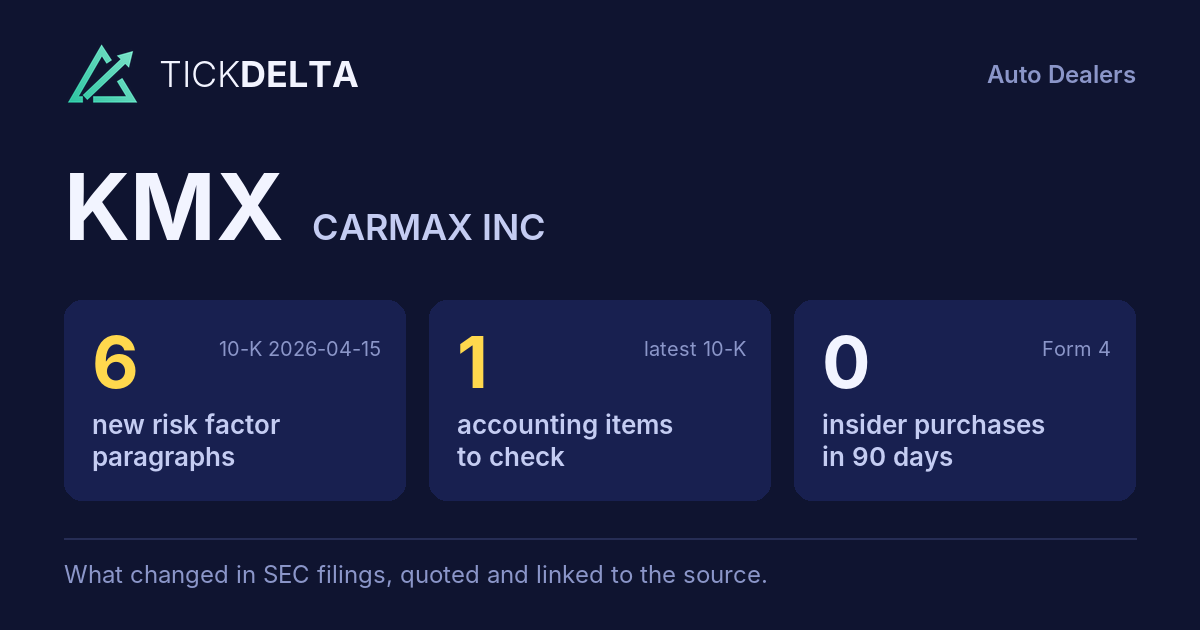
Screener / SEC EDGAR /CIK 0001170010 /10-K filed Apr 15, 2026, compared with Apr 11, 2025 /Numbers from the XBRL of the 10-Ks
NYSE Consumer discretionary · Auto Dealers

Carmax Inc KMX

Compare with peers Embed
SEC comment letters, last 20 years

5 reviews of KMX's filings by SEC staff

UPLOAD and CORRESP
Reviews 5 latest letter Feb 25, 2022
Questions asked 20 each answered in the company's own letter
No closing letter 0 reviews without a letter saying the staff completed it

When the SEC's staff reviews a filing, it writes to the company with numbered questions, and the company answers each one in a letter. SEC publishes the exchange once the review is over, at least 20 business days later. A question is not an accusation; most reviews end with the company adding detail to its next filing.

How the reviews went

Every review on EDGAR, from the first staff letter to the letter that closes it

  1. 1. Staff letters 6 UPLOAD
  2. 2. Questions in them 20 numbered comments
  3. 3. Company replies 6 CORRESP
  4. 4. Reviews closed 5 of 5 closing letter

Half the closed reviews took 34 days or less from the first letter to the closing letter.

Form 10-K

2022-02-25 to 2022-04-18 · 9 questions · 2 letters from the SEC, 2 from the company
Review closed 2022-04-18
Results discussion (MD&A)RevenueIncome taxesInventory
Business Overview · CarMax Background, page 5
SEC asked (1)
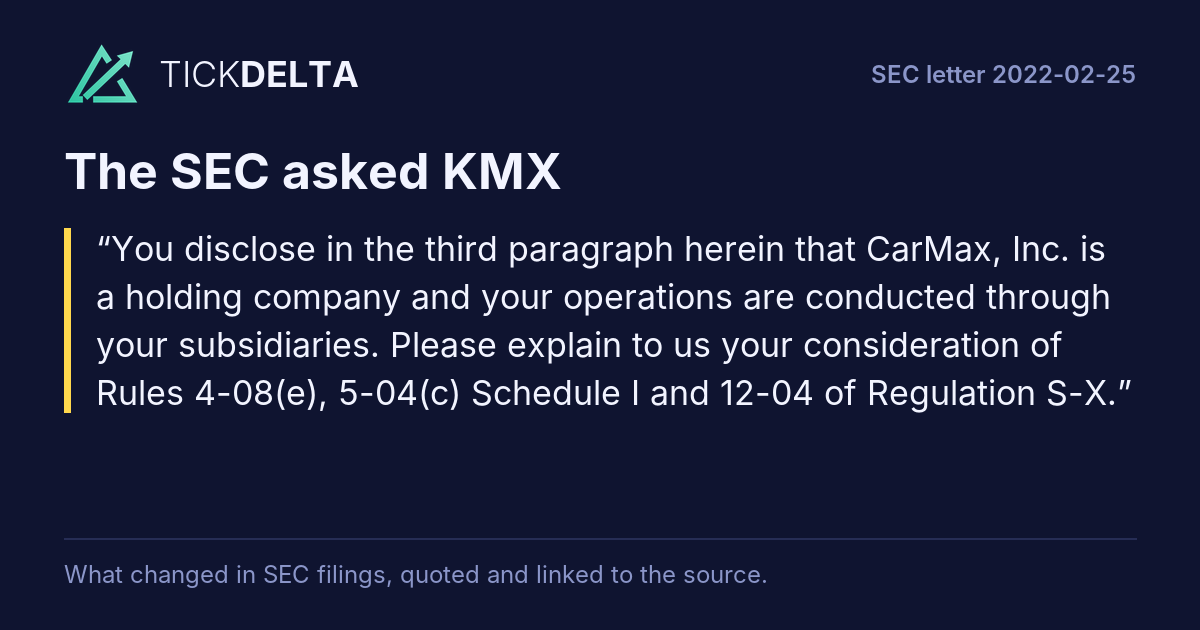
You disclose in the third paragraph herein that CarMax, Inc. is a holding company and your operations are conducted through your subsidiaries. Please explain to us your consideration of Rules 4-08(e), 5-04(c) Schedule I and 12-04 of Regulation S-X.
KMX answered
The Company has considered the requirements of Rules 4-08(e), 5-04(c) Schedule I, and 12-04 of Regulation S-X and can confirm to the Staff that the ratio of the restricted net assets of our consolidated subsidiaries over our total consolidated net assets as of February 28, 2021 was less than 25 percent. Based on that determination, the Company has concluded that it was not required to file Schedule I or provide Rule 4-08(e)(3) financial statement disclosures. The

Mr.
Rest of the answer

Abe Friedman

Company performed the computation of restricted net assets: (i) related to consolidated subsidiaries only and (ii) incorporating the effect of unconsolidated subsidiaries and equity in investees' undistributed earnings.

In determining whether parent-only financial statements should be furnished in Schedule I under Rules 5-04 and 12-04 of Regulation S-X, the Company considered restrictions on the Company’s subsidiaries, which relate to certain non-recourse notes payable. Specifically, certain subsidiaries have restricted cash from collections on auto loans receivable and restricted cash on deposit in reserve accounts, both of which are for the benefit of the holders of the non-recourse notes payable and which are not available to the Company, as disclosed in Footnote 1(D) and (J) of our most recent Form 10-K (the “Fiscal 2021 Form 10-K”). In accordance with the calculations described above, we determined that, as of February 28, 2021, the Company was not required to provide Schedule I or provide Rule 4-08(e)(3) financial statement disclosures due to such restrictions. There are no other limitations on the ability of the Company's subsidiaries to make distributions.

With regards to Rule 4-08(e)(1), we are also subject to certain covenants related to our various debt arrangements. As of February 28, 2021, we did not consider compliance with these covenants a material limitation on the ability of the Company to pay dividends.

Read in the reply
In its next report

First report after the company's reply of Mar 18, 2022: 10-K filed Apr 14, 2022 ↗, against the 10-K filed Apr 20, 2021 ↗.

Tickdelta does not hold the text of both reports, so they are not compared here.
Item 7. Management's Discussion and Analysis, page 26
SEC asked (2)
We note several instances in which two or more factors are cited as a cause of a variance, with references to offsetting items in some cases, without quantification. To the extent practicable, please quantify each factor cited so that investors may understand the magnitude and relative impact of each on your results. Refer to section 501.04 of the staff’s Codification of Financial Reporting Policies for guidance.
KMX answered
The Company respectfully acknowledges the Staff’s comment and, in future filings, including the Company’s Annual Report on Form 10-K for the year ending February 28, 2022, the Company will enhance its disclosures as appropriate in Management’s Discussion and Analysis of Financial Condition and Results of Operations to provide quantification of variance factors to the extent material to an investor’s understanding of changes in our results.

We believe that we have disclosed in our Fiscal 2021 Form 10-K, in accordance with Item 303 of Regulation S-K and the Staff’s guidance in section 501.04
Rest of the answer

of the Codification of Financial Reporting Policies, the primary factors that drove material year-over-year changes in our results of operations and have included quantification of such factors to the extent material to an investor’s understanding of changes in our results. For example, we cited several key factors that impacted our fourth quarter retail sales trends, including the launch of a new marketing campaign, expanded pricing tests, and government-issued stimulus checks, offset by severe winter weather, delays in tax refunds, and production constraints, among other factors. We did not include a quantification of the impact of each of these factors on our retail sales, however, because such quantification would require us to make significant assumptions that could be misleading to investors, and therefore we do not believe such quantification would assist investors in understanding the material changes in our results.

Going forward, we will continue to evaluate whether quantification of such factors, including their magnitude and relative impact on our results, is appropriate in the context of Item 303 of Regulation S-K, and we will add such disclosure as necessary.

Read in the reply
In its next report

First report after the company's reply of Mar 18, 2022: 10-K filed Apr 14, 2022 ↗, against the 10-K filed Apr 20, 2021 ↗.

Tickdelta does not hold the text of both reports, so they are not compared here.

Used Vehicle Sales · Fiscal 2021 Versus Fiscal 2020, page 34
SEC asked (3)
In the first paragraph you state the increase in average retail selling price was partially offset by shifts in the mix of sales by vehicle age. Please explain how mix in sales by vehicle age affected the average retail selling price so readers may have a better understanding of it on the amount of your revenue. In doing so, consider an analysis of comparative selling prices by age.
KMX answered
Our average retail selling prices are impacted by a number of factors. As disclosed in our Form 10-K, we target a dollar range of gross profit per used unit sold, and as a result, our average retail selling prices are significantly impacted by our vehicle acquisition costs. Such selling prices generally increase as our vehicle acquisition costs increase and decrease as our vehicle acquisition costs decrease.

During fiscal 2021, we experienced higher vehicle acquisition costs due to significant market appreciation, which in turn led to increased average retail selling prices.
Rest of the answer

The increase in vehicle acquisition costs was partially offset by our shift to sales of older vehicles, particularly in the 5-10-year-old range, which generally carry lower costs and thus lower selling prices. While the class mix of vehicles that we sell also impacts our average selling prices, as certain classes of vehicles generally carry higher or lower costs, such changes were immaterial in fiscal 2021.

Accordingly, we believe that we have disclosed in our Fiscal 2021 Form 10-K the material quantitative and qualitative factors that drove the change in our average retail selling prices. In addition, we do not believe that an analysis of comparative selling prices by age would be material to investors, as such prices are highly dependent on our own acquisition costs, which in turn are a reflection of the overall industry and macroeconomic environment.

In future filings, we will continue to disclose, when material, changes in average retail selling prices and how vehicle sales mix impacts average selling price.

Read in the reply
In its next report

First report after the company's reply of Mar 18, 2022: 10-K filed Apr 14, 2022 ↗, against the 10-K filed Apr 20, 2021 ↗.

Tickdelta does not hold the text of both reports, so they are not compared here.

Wholesale Vehicle Sales
SEC asked (4)
You state the decline in wholesale units was largely driven by lower appraisal traffic, partially offset by an increase in your appraisal buy rate. Please explain to us and disclose the reason for the increase in the appraisal buy rate given the lower appraisal traffic and your expectations about the level of your buy rate going forward as a trend factor pursuant to Item 303(b)(2)(ii) of Regulation S-K.
KMX answered
We measure our appraisal traffic by the number of offers we make through our in-store appraisal lanes as well as customers who come to a CarMax store having already received an online instant appraisal offer. We measure our appraisal buy rate by the number of offers we make that customers accept. While both our appraisal traffic and appraisal buy rate may impact our wholesale vehicle sales, we generally consider the two factors to be independent of each other, as our appraisal buy rate is more dependent on the quality of the offers we make.

We can quickly adjust our appraisal offers in
Rest of the answer

response to the wholesale pricing environment, and therefore as market prices increase, we can make increased appraisal offers that typically result in a higher rate of acceptance (buy rate) from our customers. During fiscal 2021, we were able to make strong appraisal offers in response to the increase in market prices, which resulted in a higher appraisal buy rate. The increase in our appraisal buy rate partially offset the decrease in our wholesale units driven by our lower appraisal traffic.

Our appraisal buy rate is also impacted by the mix of our appraisal traffic. For example, as disclosed in our Form 10-Q for the quarter ended November 30, 2021, the appraisal buy rate for customers who engage with us after first receiving an online appraisal offer is typically higher than the buy rate through our traditional appraisal lane.

In addition, we do not believe our appraisal buy rate represents a known trend as described in Item 303(b)(2)(ii) of Regulation S-K. We may adjust our appraisal offers based on several factors, the impacts of which we are unable to predict, including future market prices and changes in customer behavior.

Going forward, we will continue to identify and disclose known material trends that we believe are reasonably likely to have a material effect on our financial condition or operating performance.

Read in the reply
In its next report

First report after the company's reply of Mar 18, 2022: 10-K filed Apr 14, 2022 ↗, against the 10-K filed Apr 20, 2021 ↗.

Tickdelta does not hold the text of both reports, so they are not compared here.

Gross Profit Per Unit, page 35
SEC asked (5)
We note your presentation of "Gross Profit Per Unit" here and in your interim reports. In the footnotes to the tabular presentation, you state "the other and total categories... are divided by total used units sold." Please tell us and disclose why dividing by total used units sold is an appropriate reflection of "total gross profit per unit" when "total gross profit" includes wholesale vehicle gross profit.
KMX answered
In accordance with Item 303(a) of Regulation S-K, our presentation of gross profit per unit in our interim and annual reports aligns with management’s perspective as well as our internal reporting and analysis. Except for amounts related specifically to wholesale, we assess our performance on a gross profit per unit basis in relation to retail used units sold; therefore, we have historically calculated and presented both “other gross profit per unit” and “total gross profit per unit” by dividing the respective gross profit amounts by total used units sold.

In addition, we believe that
Rest of the answer

including wholesale vehicle units in the calculation of gross profit per unit could be misleading to investors. In this respect, “other gross profit” includes amounts related to sales of our extended protection plan products, third-party finance fees, service department profits, and our recently acquired Edmunds business. None of these amounts are tied to our wholesale vehicle sales and, in most cases, are specifically tied to our retail vehicle sales.

Further, as reflected in our calculation of “total gross profit,” our wholesale sales are a complement of conducting our retail sales. We purchase almost any vehicle from our customers, many of which do not meet our retail standards and thus must be sold through our wholesale auctions in order to provide a competitive sourcing advantage for our operations. We structure our operations and management approach accordingly and including wholesale vehicle units in the calculation of total gross profit per unit would not reflect such structure or approach.

Read in the reply
In its next report

First report after the company's reply of Mar 18, 2022: 10-K filed Apr 14, 2022 ↗, against the 10-K filed Apr 20, 2021 ↗.

Tickdelta does not hold the text of both reports, so they are not compared here.

Notes to Consolidated Financial Statements · Note 9. Income Taxes, page 66
SEC asked (6)
Please explain to us what the line item "Partnership basis" in the table of deferred tax assets and liabilities on page 67 represents. Consider disclosing what it represents as well for full understanding by readers.
KMX answered
The “Partnership basis” disclosed as part of deferred tax assets and liabilities represents the outside basis difference on the Company's investment in a fully consolidated partnership subsidiary. The primary driver of this outside basis difference relates to accrued expenses inside the partnership.

This “flow-through” entity (i.e., a limited liability company that is taxed as a partnership) is not taxable. Rather, the earnings of this entity flow through to the Company and are therefore reported in accordance with the tax laws and regulations governing the Company.
Rest of the answer

The Company will recognize and report any taxable income or loss from the difference between the financial reporting carrying amount of its investment and the corresponding tax basis if the partnership is sold or as the inside basis differences change and flow-through to the Company. The Company's temporary difference should therefore be determined by reference to its tax basis in its investment, the partnership. ASC 740-10-50-6 requires the disclosure and the approximate tax effect of each type of temporary difference and carryforward that give rise to a significant portion of deferred tax assets and liabilities. While the tax treatment of the partnership's underlying assets and liabilities generate the outside tax basis difference, the deferred tax asset recorded by the Company represents the outside tax basis difference of its investment in the partnership as the type of temporary difference giving rise to the deferred tax asset or liability.

We respectfully advise the Staff that during the fiscal year ended February 28, 2022, the Company underwent an internal legal entity restructuring. As a result, the Company no longer has an ownership in a fully consolidated partnership, and the Partnership Basis line item will not have a fiscal 2022 ending balance in our disclosure; we will appropriately disclose this change in our Annual Report on Form 10-K for the year ended February 28, 2022.

Read in the reply
In its next report

First report after the company's reply of Mar 18, 2022: 10-K filed Apr 14, 2022 ↗, against the 10-K filed Apr 20, 2021 ↗.

Tickdelta does not hold the text of both reports, so they are not compared here.

Item 2. Management's Discussion and Analysis · Used Vehicle Sales, page 36
SEC asked (7)
We note your disclosure regarding your increase in sales to be partially due to "macroeconomic factors." To the extent known, please include specific discussion of macroeconomic factors that materially impacted your results and may be indicative of uncertainties known to management.
Rest of the question

In this regard, we note discussion within your earnings calls of the impacts to used vehicle sales resulting from the chip shortage, and potential uncertainties relating to your current used vehicle inventory. Refer to Item 303(b)(2)(i) and (ii) of Regulation S-K.

KMX answered
In future filings, we will expand our disclosure to include specific discussion of macroeconomic factors that have materially impacted our results and that are indicative of material uncertainties known to management.

In evaluating the results of our operations for the quarter ended November 30, 2021, we determined that our increase in sales was partially due to several factors (some positive, some negative) that are macroeconomic in nature, including federal government stimulus, the chip shortage and its impact on the availability of new vehicles, market prices of both new and used
Rest of the answer

vehicles, and inflation. While the specific quantification of these factors and their impact on our results is not known, we believe that the disclosure of such factors is material to an investor’s understanding of our results of operations.

Going forward, in accordance with Item 303(b)(2)(i) and (ii) of Regulation S-K, we will continue to consider and describe specific macroeconomic factors that have materially impacted our results, as well as known trends or uncertainties, including those related to specific macroeconomic factors, that have had or that are reasonably likely to have a material impact on our revenues or income from continuing operations.

Read in the reply
In its next report

First report after the company's reply of Mar 18, 2022: 10-K filed Apr 14, 2022 ↗, against the 10-K filed Apr 20, 2021 ↗.

Tickdelta does not hold the text of both reports, so they are not compared here.

Used Vehicle Sales · Fiscal 2021 Versus Fiscal 2020, page 34
SEC asked (1)
It appears the second sentence in the second paragraph of your response to comment 3 is useful information to aid investors in understanding how mix in sales by vehicle age affected the average retail selling price and the consequent impact on your revenue. Please consider revising your disclosure to include this information.
KMX answered
The Company respectfully acknowledges the Staff’s comment and, in future filings, to the extent material, the Company will enhance our disclosures to include the specific ways that shifts in vehicle mix by age and / or class impact our average selling prices or other financial results.
Read in the reply
In its next report

First report after the company's reply of Apr 1, 2022: 10-K filed Apr 14, 2022 ↗, against the 10-K filed Apr 20, 2021 ↗.

Tickdelta does not hold the text of both reports, so they are not compared here.

Gross Profit Per Unit, page 35
SEC asked (2)
We have reviewed your response to comment 5. In your response you state "wholesale sales are a complement of conducting [your] retail sales," and you therefore do not include wholesale units sold within your calculation of total gross profit per unit. Please advise why "wholesale vehicle gross profit" would not similarly be excluded.
Rest of the question

Your response also states your wholesale vehicle purchases are in part to "provide a competitive sourcing advantage for [your] operations." Your response appears to indicate wholesale unit purchases (and sales) are designed to be a driver of your retail unit purchases (and sales), as is evidenced by inclusion of wholesale vehicle gross profit within total gross profit per unit. If true that wholesale vehicle gross profit is attributed to used vehicle sales, please advise why the Company performs a separate analysis of wholesale vehicle gross profit per unit using wholesale vehicle unit sales. You may contact Abe Friedman at 202-551-8298 or Doug Jones at 202-551-3309 with any questions.

KMX answered
also states your wholesale vehicle purchases are in part to "provide a competitive sourcing advantage for [your] operations." Your response appears to indicate wholesale unit purchases (and sales) are designed to be a driver of your retail unit purchases (and sales), as is evidenced by inclusion of wholesale vehicle gross profit within total gross profit per unit.
Rest of the answer

If true that wholesale vehicle gross profit is attributed to used vehicle sales, please advise why the Company performs a separate analysis of wholesale vehicle gross profit per unit using wholesale vehicle unit sales.

The Company acknowledges the Staff’s comment and, upon further consideration, advises the Staff that in future filings the Company will discontinue disclosing total gross profit per unit.

We believe that a separate analysis of our wholesale gross profit and gross profit per unit, and our used vehicle gross profit and gross profit per unit, represents material information that allows investors to assess the performance of each of our constituent sales channels. While our retail and wholesale channels are inextricably linked -- sharing many of the same company resources to procure, transport, manage and store the vehicles -- our wholesale profitability can be impacted by additional factors including market depreciation, dealer attendance, and the responsiveness of our appraisal offers to the overall pricing environment. We believe therefore, that a separate analysis of wholesale gross profit and wholesale gross profit per unit, combined with our analysis of used vehicle gross profit and used vehicle gross profit per unit, is an important distinction that allows investors to assess the performance of CarMax Sales Operations in support of our long-term total vehicle sales objectives.

Accordingly, in future filings we will omit total gross profit per used unit from our Gross Profit Per Unit table and will retain wholesale gross profit per unit in the table.

Read in the reply
In its next report

First report after the company's reply of Apr 1, 2022: 10-K filed Apr 14, 2022 ↗, against the 10-K filed Apr 20, 2021 ↗.

Tickdelta does not hold the text of both reports, so they are not compared here.

Also in this review: closing letter, 2022-04-18
Form 10-K for the Year Ended February 29, 2020

2020-06-12 to 2020-07-16 · 1 question · 1 letter from the SEC, 1 from the company
Review closed 2020-07-16
Non-GAAP measuresLiquidity and cash
Financial Condition · Liquidity and Capital Resources, page 37
SEC asked
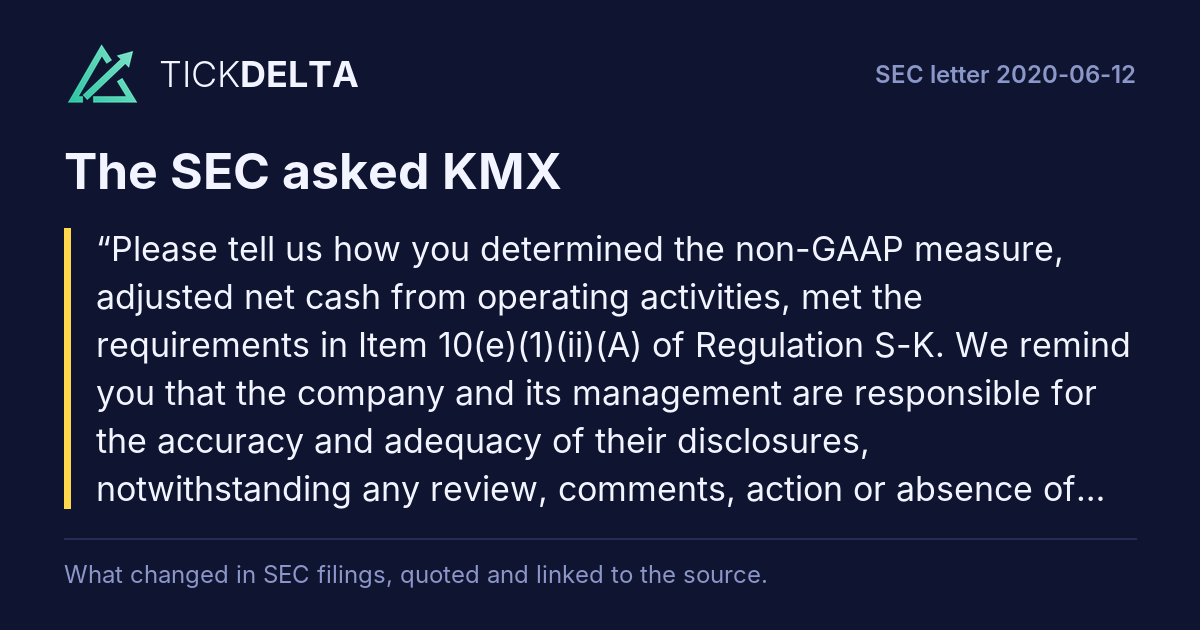
Please tell us how you determined the non-GAAP measure, adjusted net cash from operating activities, met the requirements in Item 10(e)(1)(ii)(A) of Regulation S-K. We remind you that the company and its management are responsible for the accuracy and adequacy of their disclosures, notwithstanding any review, comments, action or absence of action by the staff.
KMX answered
As noted by the Staff, we disclose a non-GAAP measure of adjusted net cash from operating activities. The reconciliation of this measure to the most closely related GAAP measure is as follows:

Net cash provided by (used in) operating activities

Add: Net issuances of non-recourse notes payable

Adjusted net cash provided by operating activities

Ms.
Rest of the answer

Linda Cvrkel

United States Securities and Exchange Commission

We have determined that presentation of this measure complies with the requirements in Item 10(e)(1)(ii)(A) of Regulation S-K as the addition of net issuances of non-recourse notes payable does not exclude liabilities that will require cash settlement by the Company, nor would they require cash settlement absent an ability to settle in another manner. The Company’s non-recourse notes payable relate to auto loans receivable funded through our warehouse facilities and asset-backed term funding transactions (together, “non-recourse funding vehicles”). To the extent there are not adequate cash collections on the auto loans receivable to settle obligations to the non-recourse funding vehicles, the investors have no recourse to our assets beyond the securitized receivables, amounts on deposit in reserve accounts and related restricted cash amounts. Additionally, there are no other arrangements, guarantees, or other commitments that could require us to provide financial support to the non-recourse funding vehicles.

Additional information about the entirety of our financing and securitization transactions, is addressed in detail by Notes 1(F), 4 and 11 to our consolidated financial statements in our Form 10-K for fiscal year ended February 29, 2020. Our auto loans receivable represent amounts due from customers related to retail vehicle sales financed through CarMax Auto Finance (“CAF”). We fund the auto loans receivable originated by CAF, in most instances, through a revolving funding program utilizing warehouse facilities until we elect to fund them through term securitizations or alternative funding arrangements.

The warehouse facilities are bankruptcy-remote special purpose entities that transfer an undivided percentage ownership interest in the receivables to third-party financing entities (“Warehouse Lenders”). Collections from receivables owned by the warehouse facilities are used to pay interest and fees owed to the Warehouse Lenders and to fund additional receivables. The receivables are only released from the facility in connection with repayments of principal to the Warehouse Lenders.

In our term securitizations, we sell a pool of auto loans receivable to a bankruptcy-remote special purpose entity that, in turn, transfers the receivables to a special purpose securitization trust. The securitization trust issues asset-backed securities in the form of non-recourse notes secured by the auto loans receivable. These securitized receivables can only be used as collateral to settle obligations of the non-recourse funding vehicles. Non-recourse funding vehicles and investors have no recourse to our assets beyond the securitized receivables, the amounts on deposit in reserve accounts and the restricted cash from collections on auto loans receivable.

Accordingly, all of our securitized auto loans receivable are used for the future payment of related non-recourse notes payable.

Our non-GAAP measure of adjusted cash from operating activities is a meaningful metric for investors because it provides better visibility into the cash generated from our operations when considering the full scope of our financing and securitization program as discussed above. Further, when considering the nature of the underlying non-recourse notes payable used in the calculation of the non-GAAP measure, we have concluded this non-GAAP measure is in compliance with Item 10(e)(1)(ii)(A) of Regulation S-K.

Read in the reply
In its next report

First report after the company's reply of Jun 22, 2020: 10-Q filed Jul 1, 2020 ↗, against the 10-Q filed Jan 7, 2020 ↗.

Tickdelta does not hold the text of both reports, so they are not compared here.

Also in this review: closing letter, 2020-07-16

Form 10-K for the Fiscal Year Ended February 28, 2017

2017-08-15 to 2017-09-18 · 6 questions · 1 letter from the SEC, 1 from the company
Review closed 2017-09-18
Non-GAAP measuresResults discussion (MD&A)Critical estimatesRevenue
Form 10-K for the Fiscal Year Ended December 31, 2016 · Item 6. Selected Financial Data, pages 21
SEC asked (1)
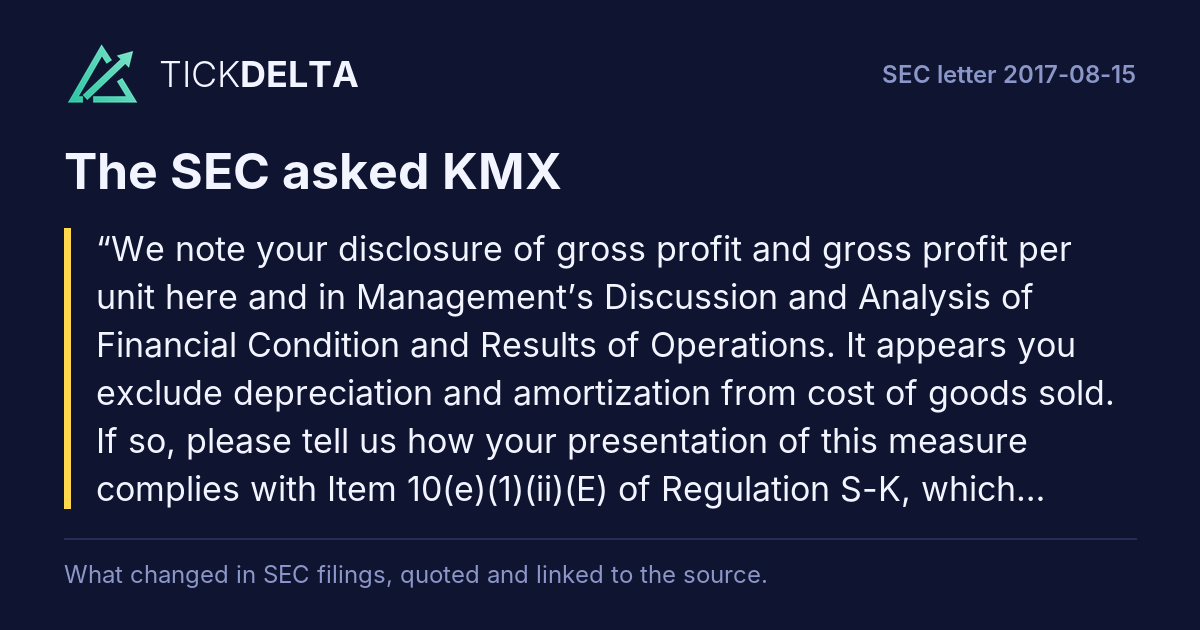
We note your disclosure of gross profit and gross profit per unit here and in Management’s Discussion and Analysis of Financial Condition and Results of Operations. It appears you exclude depreciation and amortization from cost of goods sold.
Rest of the question

If so, please tell us how your presentation of this measure complies with Item 10(e)(1)(ii)(E) of Regulation S-K, which prohibits using titles for non-GAAP measures that are the same as, or confusingly similar to, titles or descriptions used for GAAP financial measures. Additionally, please revise your presentation to disclose that the measures are non-GAAP financial measures and why management believes the non- GAAP measures provide useful information to investors. Please refer to Item 10(e) of Regulation S-K. Please note that this comment also applies to earnings releases filed under Item 2.02 on Form 8-K.

KMX answered
Mr. William H. Thompson

Regulation S-K. Please note that this comment also applies to earnings releases filed under Item 2.02 on Form 8-K.

We disclose in Note 2(P) to our consolidated financial statements in our Form 10-K for the fiscal year ended February 28, 2017 that cost of sales includes the cost to acquire vehicles and the reconditioning and transportation costs associated with preparing the vehicles for resale, as well as payroll, fringe benefits and parts, labor and overhead costs associated with reconditioning and vehicle repair services.

Vehicle reconditioning and repair services
Rest of the answer

are performed at our retail locations. These locations, while not uniform in design, include property and equipment related to the selling of retail products, such as a showroom and business office; a service department; and equipment used to perform service-related functions. The service department is a multi-functional space with a portion of the capacity used to perform vehicle reconditioning and retail service work; however, it is also used for selling activities. For example, wholesale auctions and customer vehicle appraisals often occur in this space. The specific use of the service department can vary, both from store-to-store and week-to-week, based on factors such as seasonality, vehicle appraisal traffic, customer demand, and the frequency of wholesale auctions. We have concluded that the store-related property and equipment depreciation that should be considered for an allocation to gross profit relates only to the service department and the related service equipment, to the extent that it is directly related to bringing our inventory to its saleable condition or providing a revenue-generating service. The depreciation associated with the store building space and equipment related to the selling of retail products is a selling expense.

We have concluded that such allocation of depreciation expense to cost of sales would be immaterial, both quantitatively and qualitatively. Consequently, our current policy is to report depreciation and amortization expense in selling, general and administrative (“SG&A”) expenses. We will periodically review our conclusion and will update this policy if such amounts become material or we believe it is meaningful to the reader to include such amounts in our measurement of cost of sales. Because any allocation of depreciation expense to cost of sales would be immaterial, we believe that our measurement of gross profit is in accordance with GAAP and that the presentation of gross profit and gross profit per unit in our Selected Financial Data table and in the Management Discussion and Analysis section does not result in the presentation of a non-GAAP measure.

Read in the reply
In its next report

First report after the company's reply of Sep 12, 2017: 10-Q filed Oct 5, 2017 ↗, against the 10-Q filed Jul 7, 2017 ↗.

Tickdelta does not hold the text of both reports, so they are not compared here.

Operations · Critical Accounting Policies, page 24
SEC asked (2)
It appears that the uncertainties associated with the methods, assumptions and estimates underlying your measurement of the allowance for loan losses have a material impact on reported financial condition and operating performance and on the comparability of loan losses over different periods.
Rest of the question

As such, please tell us your consideration of disclosing the allowance for loan losses as a critical accounting estimate Please note such disclosure should supplement, not duplicate, the description of accounting policies that are already disclosed in the notes to the financial statements. The disclosure should provide greater insight into the quality and variability of information regarding financial condition and operating performance and should present your analysis of the uncertainties involved in applying a principle at a given time or the variability that is reasonably likely to result from its application over time. Please refer to SEC Release 34-48960, Commission Guidance Regarding Management's Discussion and Analysis of Financial Condition and Results of Operations.

KMX answered
We have disclosed the allowance for loan losses as a critical accounting estimate by including a paragraph under “Critical Accounting Policies—Financing and Securitization Transactions” on page 24 of the Company’s Form 10-K for the fiscal year ended February 28, 2017. In order to provide greater insight into the quality and variability of information regarding financial condition and operating performance and to present the Company’s analysis of the uncertainties involved in applying this principle at a given time or the variability that is reasonably likely to result from its application
Rest of the answer

over time, in future filings, beginning with our next Form 10-Q filing, the Company will revise the disclosure of the allowance for loan losses so that it is a separately captioned critical accounting policy, stating:

Allowance for Loan Losses

The allowance for loan losses represents an estimate of the amount of net losses inherent in our portfolio of managed receivables as of the applicable reporting date. Such losses are expected to become evident during the following 12 months. Because net loss performance can vary substantially over time, estimating net losses requires assumptions about matters that are uncertain.

The allowance for loan losses is estimated using a combination of analytical models and management judgment. These models are primarily based on the composition of the portfolio of managed receivables (including month of origination and actual prior performance of the receivables), historical loss trends and forecasted forward loss curves. For receivables that have less than 12 months of performance history, the estimate also takes into account the credit grades of the receivables and historical losses by credit grade to supplement actual loss data in estimating future performance. Once the receivables have 12 months of performance history, the estimate reflects actual loss experience of those receivables to date along with forward loss curves to predict future performance. The forward loss curves are constructed using historical performance data and show the average timing of losses over the course of a receivable’s life.

Estimates from these models rely on historical performance information and may not fully reflect losses inherent in the present portfolio. Therefore, management also considers recent trends in delinquencies and defaults, recovery rates and the economic environment in assessing the models used in estimating the allowance for loan losses, and may adjust the allowance for loan losses to reflect factors that may not be captured in the models. In addition, management periodically considers whether the use of additional metrics would result in improved model performance and revises the models when appropriate.

Determining the appropriateness of the allowance for loan losses requires management to exercise judgment about matters that are inherently uncertain, including the timing and distribution of net losses that could materially affect the allowance for loan losses and, therefore, net income. To the extent that actual performance differs from our estimates, additional provision for credit losses may be required that would reduce net income. A 10% change in the estimated loss rates would have changed the allowance for loan losses by approximately $12 million as of February 28, 2017.

See Notes 2(H) and 4 for additional information on the allowance for loan losses.

Read in the reply
In its next report

First report after the company's reply of Sep 12, 2017: 10-Q filed Oct 5, 2017 ↗, against the 10-Q filed Jul 7, 2017 ↗.

Tickdelta does not hold the text of both reports, so they are not compared here.

Operations · Critical Accounting Policies, page 24
SEC asked (3)
You disclose net credit losses on managed receivables of $121.9 million for the year ended February 28, 2017 compared to your estimate of the allowance for loan losses of $94.9 as of February 29, 2016. Please tell us how the higher than expected loss rates and lower than expected recovery rates impact your future estimates of the allowance for loan losses and the timing of when those adjustments are made.
Rest of the question

In addition, please provide us with a schedule summarizing net credit losses for each of the last five years as compared to your allowance for loan losses at the previous fiscal year-end for each major credit grade and comparing the allowance for loan losses to total managed loans receivables and total past due loans receivable.

KMX answered
As disclosed under “Critical Accounting Policies—Financing and Securitization Transactions” on page 24 of the Company’s Form 10-K for the fiscal year ended February 28, 2017, the allowance for loan losses represents an estimate of the amount of net losses inherent in our portfolio of managed receivables as of the applicable reporting date and anticipated to occur during the following 12 months.
Rest of the answer

The estimate is primarily based on the credit quality of the underlying receivables, historical loss trends and forecasted forward loss curves, including recent performance of the portfolio of managed receivables. To the extent that, as of the applicable reporting date, recent charge-off rates were higher than expected or recent recovery rates were lower than expected, the estimate of net losses anticipated to occur during the following 12 months would have reflected these recent performance trends. For example, during the first quarter of fiscal 2017, recent performance trends indicated higher than expected net losses and, as a result, the allowance for loan losses increased accordingly. At that time, management also considered whether refinement of the methodology used in estimating the allowance for loan losses was necessary and ultimately made adjustments to weight more recent performance data more heavily in order to better capture the recent performance trend. Higher charge-offs and lower recovery rates can impact the current period provision for loan losses in two ways: 1) higher charge-offs and lower recovery rates can cause the provision to increase to account for the worse performance in the current period and 2) they can also increase the provision by causing reserve increases to account for expected increases in charge-offs in future periods.

The estimate of the allowance for loan losses is made on a portfolio basis, not by major credit grade, and therefore there is no separate allowance for loan losses for each major credit grade. Major credit grades are not considered by management in estimating the expected losses for receivables that have at least 12 months of performance history because, in our experience, actual performance history of a group of receivables is a better estimate of the future performance of those receivables than credit grade. For receivables that have less than 12 months of performance history, the estimate also takes into account the credit grades of the receivables and historical losses by credit grade to supplement actual loss data in estimating future performance. Because the allowance for loan losses is not estimated by credit grade, we have not provided actual net credit loss information by credit grade.

Once the receivables have 12 months of performance history, the estimate reflects actual loss experience of those receivables to date along with forward loss curves to predict future performance. The forward loss curves are constructed using historical performance data and show the average timing of losses over the course of a receivable’s life. Currently, the actual performance period used is the past 12 months. We believe that our use of 12 months of performance balances stability and responsiveness. The estimate will not react strongly to individual aberrant months, but it will adjust to reflect persistent changes (including any recent increase in charge-off frequency or decrease in recovery rates). Management periodically considers whether the use of additional metrics would improve the estimate and makes revisions to this process when appropriate.

The table below shows, for recent fiscal years, (a) the percentage of accounts that were at least 31 days past due, expressed as a percentage of managed receivables at the end of the fiscal year, (b) the allowance for loan losses, expressed as a percentage of managed receivables at the end of the fiscal year, and (c) net credit losses experienced during the following fiscal year, expressed as a percentage of average managed receivables for that fiscal year.

Read in the reply
In its next report

First report after the company's reply of Sep 12, 2017: 10-Q filed Oct 5, 2017 ↗, against the 10-Q filed Jul 7, 2017 ↗.

Tickdelta does not hold the text of both reports, so they are not compared here.

Consolidated Statements of Earnings, page 40
SEC asked (4)
Please tell us your how your presentation of gross profit on the face of the statement of earnings complies with the guidance in ASC 225-10-S99-8, Rule 5-03 of Regulation S-X and Item 10(e) (1)(ii)(C) of Regulation S-K. In this regard, it appears you exclude depreciation and amortization from gross profit and include such amounts in selling, general and administrative expenses.
Rest of the question

If so, please revise to either: (a) include an appropriate allocation of depreciation and amortization to costs applicable to revenue or (b) remove the gross profit subtotal and relabel the costs applicable to revenue line item throughout the filing to indicate that it excludes depreciation and amortization. Refer to ASC 225-10-S99-8. See also Item 302(a) of Regulation S-K. 18. Selected Quarterly Financial Data (Unaudited)

KMX answered
As discussed in our response to comment 1, cost of sales includes those costs that are related to preparing vehicles for retail sale or for providing repair services to customers. The property and equipment that are used in these processes include reconditioning and service-related equipment as well as portions of the related buildings. We have concluded that any allocation of depreciation expense to cost of sales would be immaterial, both quantitatively and qualitatively. Consequently, our current policy is to report depreciation and amortization expense in SG&A expenses.
Rest of the answer

We believe that our measurements of cost of sales and gross profit comply with the provisions of ASC 225-10-S99-8, Rule 5-03 of Regulation S-X and Item 10(e)(1)(ii)(C) of Regulation S-K. We will periodically review our conclusion and will update this policy if such amounts become material to our consolidated financial statements or we believe it is meaningful to the reader to include such amounts in our measurement of cost of sales.

18. Selected Quarterly Financial Data (Unaudited)

Read in the reply
In its next report

First report after the company's reply of Sep 12, 2017: 10-Q filed Oct 5, 2017 ↗, against the 10-Q filed Jul 7, 2017 ↗.

Tickdelta does not hold the text of both reports, so they are not compared here.

Consolidated Statements of Earnings, page 40
SEC asked (5)
Please revise your presentation in future filings to ensure gross profit presented is determined pursuant to Item 302(A)(1).
KMX answered
As discussed in our response to comments 1 and 4, we believe that our measurements of cost of sales and gross profit comply with the provisions of ASC 225-10-S99-8, Rule 5-03 of Regulation S-X and Items 10(e)(1)(ii)(C) and 302(a)(1) of Regulation S-K. We will periodically review the amount of depreciation related to assets used in the reconditioning and retail service processes and will update our presentation of selected quarterly financial data consistent with any changes to our consolidated financial statements.
Read in the reply
In its next report

First report after the company's reply of Sep 12, 2017: 10-Q filed Oct 5, 2017 ↗, against the 10-Q filed Jul 7, 2017 ↗.

Tickdelta does not hold the text of both reports, so they are not compared here.

Form 10-Q for the Quarterly Period Ended May 31, 2017 · Recent Accounting Pronouncements, page 9
SEC asked (6)
Please tell us if the adoption of ASU 2016-09 resulted in a cumulative-effect adjustment to equity and, if so, the amount thereof.
KMX answered
The adoption of ASU 2016-09 issued by the Financial Accounting Standards Board did not result in any cumulative-effect adjustment to equity.
Read in the reply
In its next report

First report after the company's reply of Sep 12, 2017: 10-Q filed Oct 5, 2017 ↗, against the 10-Q filed Jul 7, 2017 ↗.

Tickdelta does not hold the text of both reports, so they are not compared here.

Also in this review: closing letter, 2017-09-18

Form 10-K for the Fiscal Year Ended February 29, 2016

2016-06-20 to 2016-08-01 · 3 questions · 1 letter from the SEC, 1 from the company
Review closed 2016-08-01
Results discussion (MD&A)Liquidity and cash
Operations · Overview, page 22
SEC asked (1)
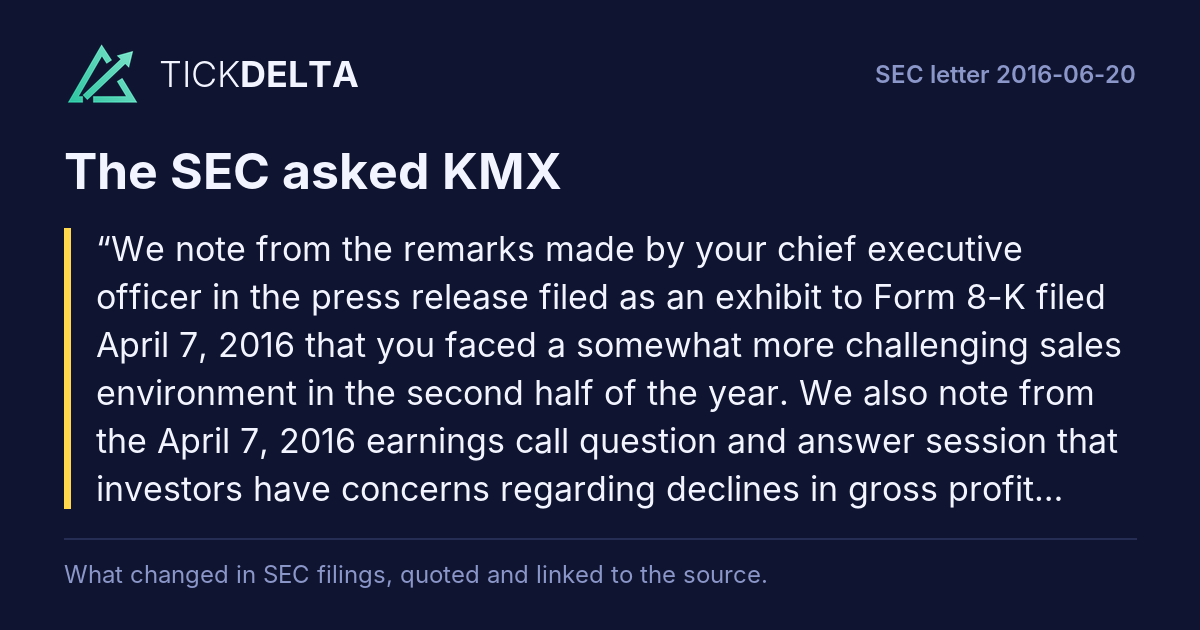
We note from the remarks made by your chief executive officer in the press release filed as an exhibit to Form 8-K filed April 7, 2016 that you faced a somewhat more challenging sales environment in the second half of the year.
Rest of the question

We also note from the April 7, 2016 earnings call question and answer session that investors have concerns regarding declines in gross profit and credit application volumes within your sector. In addition, the tables on pages 25, 26 and 27 show a trend towards declining improvement in used vehicle sales, prices and gross profit. In future filings please include a discussion and analysis of economic or industry-wide factors relevant to the company and management’s views regarding any known challenges, trends or uncertainties that have had or that you reasonably expect will have a materially favorable or unfavorable impact on your operating results and financial condition. Please refer to Item 303(a)(3)(ii) of Regulation S-K and Section III.B.3 of SEC Release 33-8350 for further guidance.

KMX answered
In future filings, beginning with our Form 10-Q for the quarter ended May 31, 2016, the Company will address economic or industry-wide factors to the extent that such factors are relevant to our views regarding any known challenges, trends or uncertainties that have had or that we reasonably expect will have a materially favorable or unfavorable impact on our operating results and financial condition.
Read in the reply
Liquidity, page 23
SEC asked (2)
You disclose and discuss adjusted net cash provided by operating activities without a similar disclosure of the comparable GAAP measure with equal or greater prominence, which may be inconsistent with the updated Compliance and Disclosure Interpretations issued on May 17, 2016. Please review this guidance when preparing your next periodic report.
KMX answered
The Company acknowledges the Staff’s comment and will revise this section in future periodic reports, beginning with our Form 10-Q for the quarter ended May 31, 2016, to present, with equal or greater prominence, the GAAP measure most directly comparable to adjusted net cash provided by operating activities.
Read in the reply
Item 8. Consolidated Financial Statements and Supplementary Data · Consolidated Statements of Shareholders’ Equity, page 43
SEC asked (3)
Please tell us the nature of the transactions included in the shares issued and shares cancelled line items related to stock incentive plans.
KMX answered
The shares issued line item, as presented in our consolidated statements of shareholders’ equity, represents total common shares issued on the vesting and conversion of our stock-settled market stock units (“MSUs”) and on the grant of our restricted stock awards. In Note 12(D) to our consolidated financial statements, we disclose that 339 thousand MSUs were vested and converted to shares of common stock and 19 thousand shares of restricted stock were granted during the fiscal year ended February 29, 2016.

We also disclose, in Note 12(C), that each MSU is converted into between zero and two
Rest of the answer

shares of common stock upon vesting and conversion. The conversion ratio is calculated by dividing the average closing price of our stock during the final 40 trading days of the vesting period by our stock price on the grant date, with the resulting quotient capped at two. For the fiscal year ended February 29, 2016, the vesting and conversion of 339 thousand MSUs resulted in the issuance of 654 thousand shares of our common stock. Together with the 19 thousand shares of restricted stock granted during the fiscal year, a total of 673 thousand shares were issued for the fiscal year ended February 29, 2016.

The shares cancelled line item on our consolidated statements of shareholders’ equity represents shares cancelled to pay the minimum statutory tax withholdings for the holders of the vested MSUs.

* * * * *

CarMax acknowledges that:

• the Company is responsible for the adequacy and accuracy of the disclosure in the filing;

staff comments or changes to disclosure in response to staff comments do not foreclose the Commission from taking any action with respect to the filing; and the Company may not assert staff comments as a defense in any proceeding initiated by the Commission or any person under the federal securities laws of the United States.

Read in the reply
In its next report

First report after the company's reply of Jul 14, 2016: 10-Q filed Oct 6, 2016 ↗, against the 10-Q filed Jan 7, 2016 ↗.

Tickdelta does not hold the text of both reports, so they are not compared here.

Also in this review: request for more time, Jun 23, 2016, closing letter, 2016-08-01

Form 10-K for the Fiscal Year Ended February 28, 2015

2015-07-10 to 2015-08-11 · 1 question · 1 letter from the SEC, 1 from the company
Review closed 2015-08-11
Debt
Item 8. Consolidated Financial Statements and Supplementary Data · Notes to Consolidated Financial Statements
SEC asked
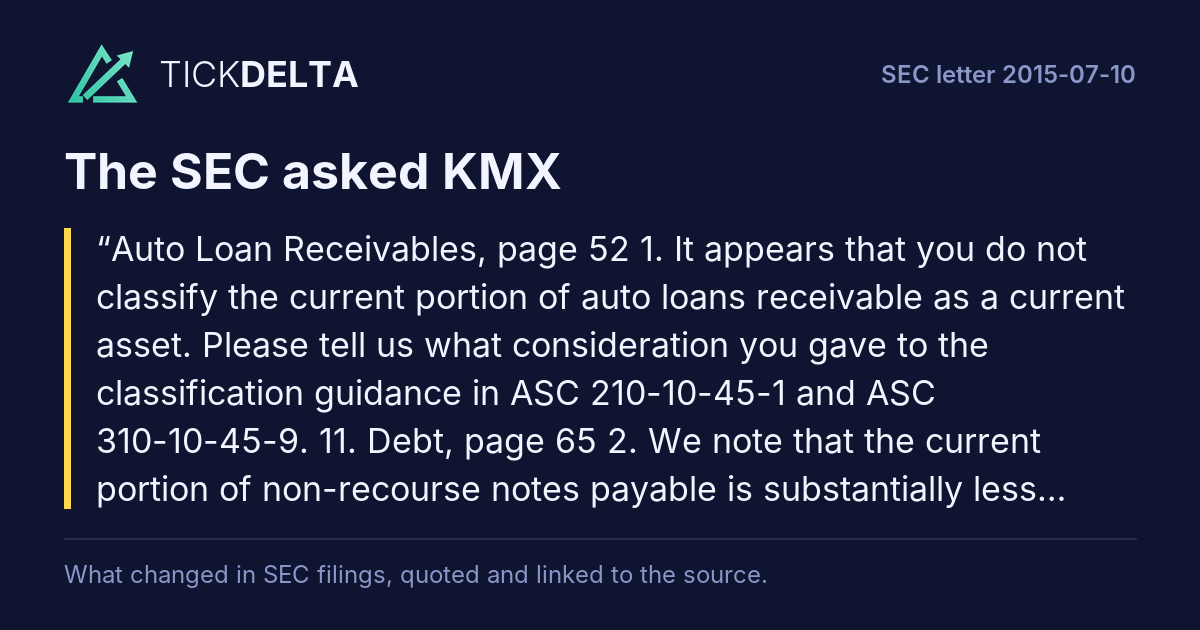
Auto Loan Receivables, page 52 1. It appears that you do not classify the current portion of auto loans receivable as a current asset. Please tell us what consideration you gave to the classification guidance in ASC 210-10-45-1 and ASC 310-10-45-9. 11. Debt, page 65 2. We note that the current portion of non-recourse notes payable is substantially less than payments on non-recourse notes for each year presented.
Rest of the question

Please explain to us how you determine the current portion of nonrecourse notes payable and why the current portion is substantially lower than payments made during each of the past three years. 3. Please tell us what consideration you gave to disclosing the combined aggregate amount of maturities for all long-term borrowings for each of the five years following the date of the latest balance sheet presented in accordance with ASC 470-10-50-1.

KMX answered
The Staff is correct that we do not classify any portion of auto loan receivables as a current asset on our consolidated balance sheets. We have considered the classification guidance in ASC 210-10-45-1 and ASC 310-10-45-9, and we understand that trade accounts receivable are generally included in the concept of current assets. However, the

Mr. William H.
Rest of the answer

Thompson

Page more specific guidance in ASC 210-10-45-4 is relevant to our auto loan receivables, and we have concluded, based on this guidance, that auto loan receivables should be excluded from current assets.

The guidance in ASC 210-10-45-4 indicates that claims to cash should be excluded from classification as current assets if such assets are restricted as to use for other than current operations or are segregated for the liquidation of long-term debts. The guidance further states, “Even though not actually set aside in special accounts, funds that are clearly to be used in the near future for the liquidation of long-term debts, payments to sinking funds, or for similar purposes shall also, under this concept, be excluded from current assets.”1

To understand the application of this guidance to our auto loan receivables, it is important to consider the entirety of our financing and securitization transactions, which are addressed in detail by Notes 2, 4, and 11 to our consolidated financial statements. Our auto loan receivables represent amounts due from customers related to retail vehicle sales financed through CarMax Auto

Finance (“CAF”). We fund the auto loan receivables originated by CAF, in most instances, through a revolving securitization program utilizing warehouse facilities until we elect to fund them through term securitizations.

The warehouse facilities are bankruptcy-remote special purpose entities that transfer an undivided percentage ownership interest in the receivables to third party financing entities (“Warehouse Lenders”). Collections from receivables owned by the warehouse facilities are used to pay interest and fees owed to the Warehouse Lenders and to fund additional receivables. The receivables are only released from the facility in connection with repayments of principal to the Warehouse Lenders.

In our term securitizations, we sell a pool of auto loan receivables to a bankruptcy-remote special purpose entity that, in turn, transfers the receivables to a special purpose securitization trust. The securitization trust issues asset-backed securities in the form of non-recourse notes secured by the auto loan receivables. These securitized receivables can only be used as collateral to settle obligations of the securitization vehicles. Securitization vehicles and investors have no recourse to our assets beyond the securitized receivables, the amounts on deposit in reserve accounts and the restricted cash from collections on auto loan receivables.

Accordingly, substantially all of our auto loan receivables are used for the future payment of related non-recourse notes payable.

Based on the structure of our revolving and term securitization programs, we believe it is clear that our “claims to cash” related to the securitized auto loan receivables should be excluded from consideration as a current asset because such assets must first be used to pay all amounts then due to the related non-recourse notes payable before any

ASC 210-10-45-4 excess amounts can be released to CarMax. Further, we believe it would be misleading to users of our financial statements to present any such amounts as a current asset in the event that it may imply that collections on those receivables could be used to fund current operations or other business purposes.

11. Debt, page 65

2. We note that the current portion of non-recourse notes payable is substantially less than payments on non-recourse notes for each year presented.

Please explain to us how you determine the current portion of nonrecourse notes payable and why the current portion is substantially lower than payments made during each of the past three years.

The current portion of non-recourse notes payable ($258.2 million at February 28, 2015) represents the portion of the payments received from the auto loan receivables that are due to be distributed as principal to the non-recourse note holders in the following period, generally in the next 15 days. As such, the current portion of non-recourse notes payable presented on our consolidated balance sheets does not represent all the payments expected to be made in the next 12 months; it only represents the known payments expected to be made to the holders of the non-recourse notes (i.e., the securitization investors) during the next payment period related to amounts that have been actually collected on the related auto loan receivables. Accordingly, as the Staff has correctly pointed out, the current portion of non-recourse notes payable at the end of any fiscal year will be significantly lower than the total cash payments on non-recourse notes for each fiscal year ($6.6 billion for the year ended February 28, 2015).

This current liability relates to the corresponding current asset, restricted cash from collections on auto loan receivables ($294.1 million at February 28, 2015). As stated in Note 2 to our consolidated financial statements, this restricted cash consists of collections of principal, interest and fee payments on securitized auto loan receivables that are restricted for payment to the securitization investors.2 ASC 210-10-20 states that “Current liabilities is used principally to designate obligations whose liquidation is reasonably expected to require the use of existing resources properly classifiable as current assets, or the creation of other current liabilities.” In addition, ASC 210-10-45-12, states that the “current liability classification is not intended to include debts to be liquidated by funds that have been accumulated in accounts of a type not properly classified as current assets.” We have concluded our presentation of the current portion of non-recourse notes payable is consistent with the definition of current liabilities in that its liquidation can only be achieved through the use of restricted cash from collections on auto loan receivables. This is also consistent with our presentation of auto loan receivables as a non-current asset discussed above in our response to Question 1.

The reported amounts of current liability and restricted cash are slightly different as the restricted cash includes interest and fees, some of which may be retained by CAF, as servicer, instead of being remitted to the securitization investors.

The only assets available for payments to the holders of the non-recourse notes are the securitized receivables, the amounts on deposit in reserve accounts and the restricted cash from collections on auto loan receivables, as described above. As described in Note 2 to our consolidated financial statements, investors in such notes have no recourse to our other assets. Collections on these receivables are variable due to several factors, but primarily due to customer loan repayment patterns. For example, customers often make advance unscheduled payments on their loan balance or prepay the loan entirely, which accelerates payments made to the securitization investors. As such, the timing of future payments on these non-recourse notes is variable as well. Accordingly, we only include amounts actually collected on the receivables as of the date of the financial statements in the current portion of non-recourse notes payable.

Based on the relationship of the non-recourse notes payable to the auto loan receivables, we have concluded it is not appropriate to classify any additional portion of the non-recourse notes as a current liability.

3. Please tell us what consideration you gave to disclosing the combined aggregate amount of maturities for all long-term borrowings for each of the five years following the date of the latest balance sheet presented in accordance with ASC 470-10-50-1.

As of February 28,

2015, the Company’s long-term debt, excluding current portion, is comprised of the following, as disclosed in Note 11 to our consolidated financial statements (in thousands):

Long-term debt

$

300,000

Finance and capital lease obligations

306,284

Non-recourse notes payable

8,212,466

Having considered the disclosure requirements of ASC 470-10-50-1, we have concluded that we have met such requirements. A more specific discussion of each component of our long-term debt follows:

•

In Note 11 to our consolidated financial statements, we disclosed that the Company entered into a $300 million term loan in November 2014, and that the total outstanding principal is due in November 2017. This disclosure was provided in narrative form.

Due to the nature of this debt, maturities essentially represent future lease payments. In accordance with ASC 840-30-50-1b, the Company has disclosed future minimum lease payments for the next five fiscal years and thereafter associated with our finance and capital lease obligations in Note 15 to our consolidated financial statements.3 Our debt footnote (Note 11) refers readers to Note 15 for this information.

The Company’s non-recourse notes payable relate to auto loan receivables funded through our warehouse facilities and term securitization program, as discussed further in our responses to Questions 1 and 2 above. The timing of principal payments on the non-recourse notes payable is based on the timing of principal collections on our auto loan receivables. As disclosed in Note 11 to our consolidated financial statements, this debt has scheduled maturities through September 20214, but could mature earlier depending upon the collections on the underlying auto loan receivables. Further, it is important to note that to the extent there are not adequate cash collections on the auto loan receivables to settle obligations to the securitization vehicles, the securitization investors have no recourse to our assets beyond the securitized receivables and related restricted cash amounts. Additionally, there are no other arrangements, guarantees, or other commitments that could require us to provide financial support to the securitization vehicles.

Notwithstanding the scheduled maturities of this debt, as previously noted, our payments made to the securitization investors are entirely dependent upon the timing and amount of collections on the underlying auto loan receivables. While we can estimate when such payments will be made based on customers’ loan payment schedules on the underlying auto loan receivables, we know based on our historical experience that our actual collections, and therefore the corresponding payments we will make on the related non-recourse notes, could vary significantly from these estimates. As discussed in our response to Question 2 above, this variability is primarily due to customer loan repayment patterns.

As there is a reasonable amount of uncertainty associated with the timing of future collections of auto loan receivables and the corresponding payments on the non-recourse notes, combined with the fact that the Company’s assets, other than the auto loan receivables and restricted cash, provide no recourse to the securitization investors, we have concluded that a disclosure of the scheduled maturities for the next five years would not be meaningful or useful to users of our financial statements, as it is unlikely to closely approximate what the ultimate actual payments will be. Indeed, we believe such disclosure could be misleading.

When comparing Note 11 to Note 15, the total amounts presented for finance and capital lease obligations differ, as amounts disclosed as future minimum payments in Note 15 represent nominal (undiscounted) amounts.

The final scheduled distribution dates of non-recourse notes issued in connection with our term securitization program are based on the contractual terms of the related underlying auto loan receivables, but the actual maturity of such notes depends on actual collections on such receivables, which may differ in timing and amount from the contractual terms.

We further considered that ASC 470-10-50-1 requires disclosures of the “combined aggregate” maturities for long-term debt. Given the discussion above, we do not believe it would be meaningful or relevant for users of our financial statements to see the maturity of the Company’s $300 million term loan presented in a tabular format combined with finance and capital lease obligations. We believe this information is adequately presented for financial statement users, and we believe it is presented in such a way as to maximize the effectiveness of the disclosures.

* * * * *

CarMax acknowledges that:

the Company is responsible for the adequacy and accuracy of the disclosure in the filing;

Staff comments or changes to disclosure in response to Staff comments do not foreclose the Commission from taking any action with respect to the filing; and the Company may not assert Staff comments as a defense in any proceeding initiated by the Commission or any person under the federal securities laws of the United States.

Read in the reply
In its next report

First report after the company's reply of Jul 31, 2015: 10-Q filed Oct 8, 2015 ↗, against the 10-Q filed Jul 8, 2015 ↗.

Tickdelta does not hold the text of both reports, so they are not compared here.

Also in this review: closing letter, 2015-08-11

From the SEC's correspondence on EDGAR: staff letters (form UPLOAD) and company letters (form CORRESP), 18 letters filed since 2015-07-10. Questions and answers are matched by their numbers; topics come from words in each question. The reports are compared word for word (same form, before the first SEC letter against the first report after the company's reply). No AI.

Sources

The SEC's correspondence on EDGAR: staff letters (form UPLOAD) and company letters (form CORRESP), matched question by question. No AI.

Also

Filings: the letters in the filing list.

Work with it

Excel workbook · CSV. Google Sheet that stays up to date: paste =IMPORTDATA("https://tickdelta.com/company/KMX/export.csv") into a cell.

Next in Owners and insiders:Insider trades
Esc

Type a ticker such as AAPL, a name, an investor such as Buffett, or a topic such as tariffs. ↑ ↓ to move, Enter to open.