Screener / SEC EDGAR /CIK 0001669162 /10-K filed Feb 20, 2026, compared with Feb 21, 2025 /Numbers from the XBRL of the 10-Ks
NYSE Financials · Property & Casualty Insurance

Kinsale Capital Group, Inc. KNSL

Compare with peers Embed
The 10-K against last year's

83 changes: 9 added, 6 removed, 65 reworded, 3 quiet changes

10-K Feb 20, 2026 vs Feb 21, 2025

10-K 0001669162-26-000015 (Feb 20, 2026) vs 10-K 0001669162-25-000010 (Feb 21, 2025)

Every paragraph, and how much of it changed

One bar per paragraph, in the order of the 10-K. Height and colour show the share of its words not in the closest paragraph a year earlier; the tallest bars are new paragraphs.

Risk Factors

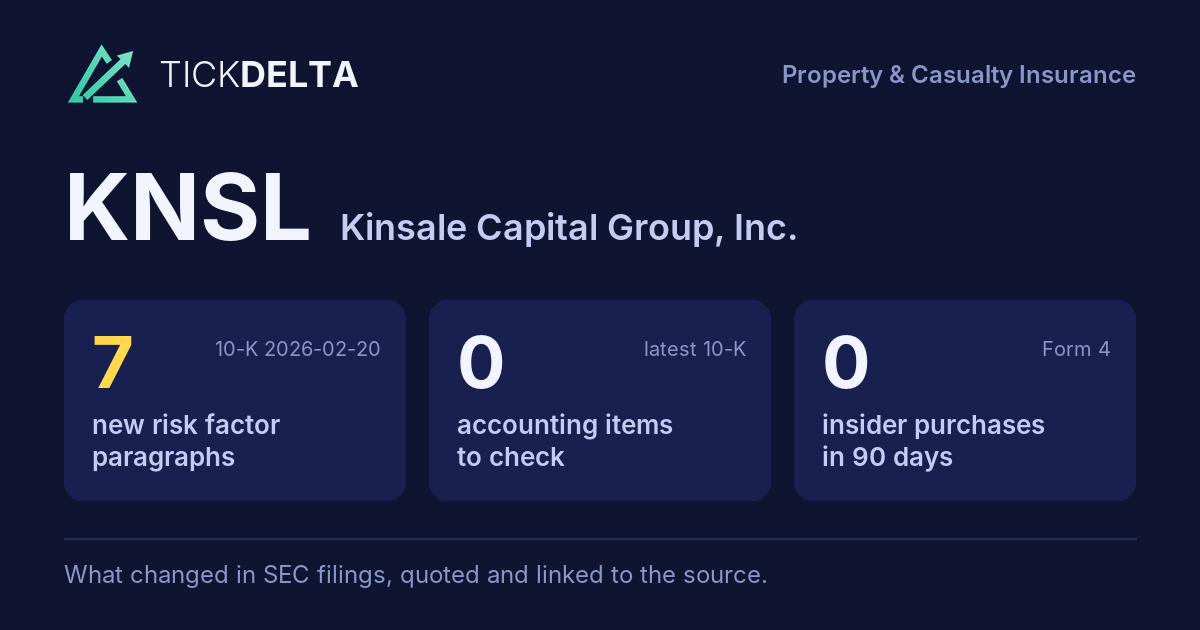
134 paragraphs · 7 new · 14 reworded · 4 gone · 10-K Feb 20, 2026 against Feb 21, 2025
New paragraph Reworded (5% of its words or more) Same or nearly
Paragraph 130 · 46% changed Every version of it
In addition, state insurance regulators have broad discretion to deny or revoke licenses for various reasons, including the violation of regulations. In some instances, where there is uncertainty as to applicability, we follow practices based on our interpretations of regulations or practices that we believe generally to be followed by the industry. These practices may turn out to be different from the interpretations of regulatory authorities. If we do not have the requisite licenses and approvals or do not comply with applicable regulatory requirements, state insurance regulators could preclude or temporarily suspend us from carrying on some or all of our activities or could otherwise penalize us. This could adversely affect our ability to operate our business. Further, changes in the level of regulation of the insurance industry or changes in laws or regulations themselves or interpretations by regulatory authorities could interfere with our operations and require us to bear additional costs of compliance, which could adversely affect our ability to operate our business.
Paragraph 92 · 42% changed Every version of it
Our business depends is highly dependent on our information technology and telecommunications systems, including our web-based underwriting system. Among other things, we rely on these systems to interact with brokers and insureds, to underwrite business, to prepare policies and process premiums, to perform actuarial and other modeling functions, to process claims and make claims payments and to prepare internal and external financial statements and information. In addition, some Many of these systems include or and processes rely on third-party systems service providers or cloud-based solutions that are not located on our premises or fully under our direct control. Events such as natural catastrophes, terrorist attacks, industrial accidents, third-party system or network outages or computer malware may cause our systems to fail or be inaccessible for extended periods of time. While we have implemented business contingency and other plans to protect our systems, sustained or repeated system failures or service denials could severely limit our ability to write and process new and renewal business, provide customer service, pay claims in a timely manner or otherwise operate in the ordinary course of business.
Paragraph 96 · 37% changed Every version of it
While we have implemented security measures designed to protect against breaches of security and other interference with our systems and networks, our systems and networks may be subject to significant breaches or interference. Any such event previously discussed may result in material operational disruptions as well as unauthorized access to or the to, disclosure of, or loss of our proprietary information or our customers’ data and information, which in turn customers data. Such occurrences may result in lead to legal claims, regulatory scrutiny and or liability, the incurrence of reputational damage, significant costs to eliminate or mitigate further exposure, and the potential loss of customers or affiliated advisors, reputational vendors. Increasing requirements for public disclosure of cybersecurity incidents may also increase the harm or other damage to our business. business, financial condition, and results of operations. We cannot be certain that advances in criminal capabilities, discovery of new vulnerabilities, attempts to exploit vulnerabilities weaknesses in our systems, data thefts, systems or those of our vendors, physical system or network break-ins or inappropriate access, break-ins, or other developments will not compromise or breach the technology or other defeat our security measures protecting the networks and systems used in connection with our business. measures.
Paragraph 99 · 22% changed Every version of it
Our business relies on certain third-party software obtained under licenses from other companies. Although we believe that there are commercially reasonable alternatives to the third-party software we currently license, this such alternatives may not always be the case, available on acceptable terms, or it may at all, and replacement could be difficult difficult, costly, or costly time consuming to replace. In addition, integration of new third-party software may require significant work development effort and require substantial investment of our time and resources. resources and may introduce additional operational or security risks. Our use of additional or alternative third-party software would require typically requires us to enter into license agreements with third parties, which may increase complexity and may not be available on commercially reasonable terms or at all, and add complexity to the environment. all. Many of the risks associated with the use of third-party software software, including cybersecurity, operational resilience, vendor concentration, and service continuity risks, cannot be fully eliminated, and these risks could negatively affect our business.
Paragraph 102 · 21% changed Every version of it
The rapid evolution and increasing adoption of artificial intelligence ("AI") AI could exacerbate the information technology and cybersecurity related risks described above, as well as alter the competitive landscape. While we anticipate that we will continue to research and selectively implement AI-based technology solutions to both mitigate enhance automation, efficiency and risk and increase automation management in our environment, it is possible that bad actors and/or competitors will leverage AI solutions more effectively to either exploit vulnerabilities or take market share. Either outcome could negatively impact our business. We are aware that generative AI tools may respond with inaccurate inaccurate, incomplete or fabricated information, introduce bias or fail to provide traceability of source information and have taken steps to train employees on these issues as well and to avoid inform on the risks of using these AI tools as primary decision processes. decision-making mechanisms. We will continue to look for opportunities to deploy these tools to aid in decision making processes but cannot guarantee that the risks will be completely eliminated.
Paragraph 98 · 19% changed Every version of it
We employ third-party and open-source licensed software for use in our business, and the inability to maintain these licenses, errors defects or vulnerabilities in the software we license such software, or the terms interruption or enforcement of open-source licenses could result in increased costs, or reduced service levels, or operational disruptions, which would could adversely affect our business.
Paragraph 100 · 16% changed Every version of it
Additionally, the software powering our technology systems incorporates software covered by components subject to open-source licenses. The terms of many open-source licenses have not been definitively interpreted by U.S. courts courts, creating uncertainty regarding the scope of the obligations they may impose and there is a risk that the licenses could be construed in a manner that imposes unanticipated conditions or restrictions on our ability to operate or modify our systems. software. In the event that portions of our proprietary software are determined to be subject to an open-source license, we could be required to publicly release the disclose affected source code, re-engineer portions of our source code or re-engineer all or a portion of our technology systems, or discontinue certain uses, each of which could reduce or eliminate the value of our technology systems. Such risk could be difficult or impossible to eliminate, fully mitigate, and such an event could adversely affect our business, financial condition and results of operations.
Paragraph 131 · 12% changed Every version of it
In addition, state insurance regulators have broad discretion to deny or revoke licenses for various reasons, including the violation of regulations. In some instances, where there is uncertainty as to applicability, we follow practices based on our interpretations of regulations or practices that we believe generally to be followed by the industry. These practices may turn out to be different from the interpretations of regulatory authorities. If we do not have the requisite licenses and approvals or do not comply with applicable regulatory requirements, state insurance regulators could preclude or temporarily suspend us from carrying on some or all of our activities or could otherwise penalize us. This could adversely affect our ability to operate our business. Further, changes in the level of regulation of the insurance industry or changes in laws or regulations themselves or interpretations by regulatory authorities could interfere with our operations and require us to bear additional costs of compliance, which could adversely affect our ability to operate our business.

MD&A

164 paragraphs · 2 new · 46 reworded · 2 gone · 10-K Feb 20, 2026 against Feb 21, 2025
New paragraph Reworded (5% of its words or more) Same or nearly
Paragraph 46 · 50% changed
•Construction, which represented approximately 7.8% Net written premiums increased across the majority of our gross written premiums in 2024, increased by $10.4 million, or 7.6%, underwriting divisions for the year ended December 31, 2024. 2025. Changes in net written premium were most notable in the following lines of business:
Paragraph 84 · 46% changed
On February 12, In October 2024, the Company’s our Board of Directors declared authorized a cash dividend share repurchase program authorizing the repurchase of $0.15 per share up to $100.0 million of our common stock. This dividend share repurchase program was paid on March 13, 2024 to all stockholders of record on February 27, 2024. exhausted in October 2025.
Paragraph 96 · 45% changed
For the year ended December 31, 2024, property insurance represented 32.6% of our gross written premiums. When we write property insurance, we buy reinsurance to significantly mitigate our risk to large losses. We use sophisticated computer models to analyze the risk of severe losses from weather-related events and earthquakes. We measure exposure to these catastrophe losses in terms of PML, which is an estimate of what level of loss we would expect to experience in a windstorm or earthquake event occurring once in every 100 or 250 years. We manage this PML by purchasing catastrophe reinsurance coverage. Effective June 1, 2024, we purchased catastrophe reinsurance coverage of $175.0 million per event in excess of our $60.0 million per event retention. Our property catastrophe reinsurance includes a reinstatement provision which requires us to pay reinstatement premiums after a loss has occurred in order to preserve coverage. Including the reinstatement provision, the maximum aggregate loss recovery limit is $350.0 $500.0 million and is in addition to the coverage provided by our other property reinsurance.
Paragraph 39 · 43% changed
•Commercial Property, which represented approximately 24.4% Gross written premiums increased across the majority of our gross written premiums in 2024, increased by $44.2 million, or 10.7%, underwriting divisions for the year ended December 31, 2024 2025 and were most notable in the following lines of business:
Paragraph 71 · 37% changed
Our income. The effective tax rate was approximately 19.4% higher for the year ended December 31, 2024 2025 compared to 19.8% for the year ended December 31, 2023. The effective tax rate was 2024 due primarily to a lower than the federal statutory rate volume of 21% primarily due to the tax benefits from stock-based compensation, including stock options exercised, and tax-exempt investment income. option exercises.
Paragraph 62 · 33% changed
The expense ratio was 20.8% for the year ended December 31, 2025 compared to 20.6% for the year ended December 31, 2024 compared to 20.8% for the year ended December 31, 2023. 2024. The decrease increase in the expense ratio was primarily due to lower relative net commissions as a result of higher ceding commissions earned under the commercial property quota share treaty as a result of commercial property premium growth. due to increased retention on our reinsurance treaties offset in part by routine variability in other underwriting expenses. Direct commissions paid as a percent of gross written premiums was 14.8% and 14.7% and 14.5% for the years ended December 31, 2024 2025 and 2023, 2024, respectively.
Paragraph 58 · 30% changed
During the year ended December 31, 2024, prior accident years developed favorably by $37.7 million, of which $57.6 million was attributable to the 2021 through 2023 accident years due to lower emergence of reported losses than expected across most lines of business. This favorable development was offset in part by adverse development primarily from the 2017 through 2019 accident years due to construction defect claims that are more exposed to inflation, from the 2020 accident year due to a large property claim and more conservative actuarial assumptions in the 2021 through 2023 accident years for lines of business exposed to construction liability.
Paragraph 38 · 28% changed
Gross written premiums were $2.0 billion for the year ended December 31, 2025 compared to $1.9 billion for the year ended December 31, 2024 compared to $1.6 billion for the year ended December 31, 2023, 2024, an increase of $301.5 $106.8 million, or 19.2%. The increase 5.7%. Gross written premiums in our Commercial Property Division, our largest division, decreased 17.9% relative to the prior year period due to rate declines and an increasingly competitive environment including from standard carriers. Excluding our Commercial Property Division, gross written premiums for the year ended December 31, 2024 was grew 13.3% due primarily due to higher continued strong submission activity flow from brokers and a favorable, yet increasingly competitive, pricing environment. across most divisions. The average premium per policy written by us was $13,400 in 2025 compared to $15,100 in 2024 compared to $15,200 in 2023. 2024. Excluding our personal insurance division, which has relatively low premiums per policy written, the average premium per policy written was $14,000 in 2025 compared to $15,900 in 2024 compared 2024. The decrease in average premium per policy was due primarily to $16,400 a decrease in 2023. Gross gross written premiums increased across substantially all of in our underwriting divisions for the year ended December 31, 2024 and were most notable in the following lines of business: Commercial Property Division.

A paragraph is matched with the one last year that shares the most of its words; under half in common makes it new. The paragraphs shown are the 8 reworded the most in each section.

The paragraph that changed most in each section

The redline

Marked against last year's 10-K: cut words struck through, new words highlighted.

Risk Factors134 words changed in this paragraph; it is 50% similar to last year's version.
While we have implemented security measures designed to protect against breaches of security and other interference with our systems and networks, our systems and networks may be subject to significant breaches or interference. Any such event previously discussed may result in material operational disruptions as well as unauthorized access to or the to, disclosure of, or loss of our proprietary information or our customers’ data and information, which in turn customers data. Such occurrences may result in lead to legal claims, regulatory scrutiny and or liability, the incurrence of reputational damage, significant costs to eliminate or mitigate further exposure, and the potential loss of customers or affiliated advisors, reputational vendors. Increasing requirements for public disclosure of cybersecurity incidents may also increase the harm or other damage to our business. business, financial condition, and results of operations. We cannot be certain that advances in criminal capabilities, discovery of new vulnerabilities, attempts to exploit vulnerabilities weaknesses in our systems, data thefts, systems or those of our vendors, physical system or network break-ins or inappropriate access, break-ins, or other developments will not compromise or breach the technology or other defeat our security measures protecting the networks and systems used in connection with our business. measures.

Source: Item 1A, 10-K 0001669162-26-000015 vs Item 1A, 10-K 0001669162-25-000010

MD&A109 words changed in this paragraph; it is 44% similar to last year's version.
For the year ended December 31, 2023, 2025, net cash used in financing activities was $28.5 $71.4 million and reflected proceeds of $50.0 million from the issuance of the Series B Note on September 18, 2023. Proceeds from the sale of our real estate investment were used to pay down $62.0 million from our Credit Facility. Financing activities also reflected dividends of $0.56 $0.68 per common share, or $13.0 $15.8 million in the aggregate. Proceeds received from our equity compensation plan were $0.9 million, offset by payroll aggregate and share repurchases of $90.0 million. Payroll taxes withheld and remitted on restricted stock awards were $6.3 million, offset in part by proceeds received from our equity compensation plan of $4.3 $0.7 million. In addition, we drew down $40.0 million from our revolving credit facility primarily to fund construction of our new corporate headquarters which was completed in November 2025 and for the year ended December 31, 2023. general corporate purposes.

Source: Item 7, 10-K 0001669162-26-000015 vs Item 7, 10-K 0001669162-25-000010

Accounting Policies59 words changed in this paragraph; it is 43% similar to last year's version.
Construction In 2024, construction in progress includes included capitalized expenses related to the development of the Company's new corporate headquarters' headquarters building. Construction is expected to be of the new headquarters building was substantially completed in the fourth quarter of 2025. 2025 and was placed into service. Upon moving operations to the new headquarters, the Company reclassified its former headquarters and related assets from property and equipment to real estate investments due to a change in the intended use of the former property.

Source: Item 8, Note 1 – Summary of significant accounting policies, 10-K 0001669162-26-000015 vs Item 8, Note 1 – Summary of significant accounting policies, 10-K 0001669162-25-000010

Legal Proceedings26 words changed in this paragraph; it is 76% similar to last year's version.
Venetian Hills was a policyholder of a $1 million general liability policy issued by Kinsale Insurance. The Company believes exclusions in the policy apply to the claim and intends to defend any action related to this proceeding vigorously. The Company does not expect a resolution as to the Company’s liability, if any, with respect to this matter in the foreseeable future, and potentially for multiple years.

Source: Item 3, via Note 12 – Contingencies, 10-K 0001669162-26-000015 vs Item 3, via Note 12 – Contingencies, 10-K 0001669162-25-000010

Sentences and paragraphs added, removed or reworded

Every change, by type

Sentences and paragraphs of KNSL's Risk Factors and MD&A, 10-K Feb 20, 2026 against 10-K Feb 21, 2025. Each links to the text at sec.gov.

Quiet changes are sentences kept from last year with one to four words changed, at least one of them a hedge, a modal or a qualifier (may, could, will, not, significant, material…). A year or date rolling forward is not counted.

The full word list

adverse, adversely, all, although, anticipate, anticipates, any, approximately, believe, believes, can, cannot, certain, could, expect, expects, generally, however, if, intend, intends, largely, likely, many, material, materially, may, might, most, must, never, no, not, possible, primarily, probable, should, significant, significantly, some, substantial, substantially, unlikely, will, would

AddedRisk Factors
We could suffer security breaches, loss of data or proprietary information, cyberattacks, and other information technology failures, and are subject to laws and regulations concerning data privacy and security that are continually evolving. Actual or suspected information technology failures or failures to comply with applicable law could disrupt our operations, damage our reputation, and adversely affect our business, financial condition, or results of operations.
Read it in 10-K Feb 20, 2026 at sec.gov
AddedRisk Factors
We and our service providers face numerous and evolving cybersecurity and operational risks that threaten the confidentiality, integrity, and availability of systems and data. These risks include vulnerabilities in commercial software integrated into our systems or into the products and services of our suppliers, as well as increasingly sophisticated cyberattack techniques that frequently change and may originate from less regulated or remote areas of the world. Events such as natural catastrophes, industrial accidents, terrorist attacks, power failures, computer viruses, ransomware, extortion attempts, business email compromise, or security breaches by unauthorized persons, including hackers or other threat actors, may cause our systems to fail or be inaccessible for extended periods. These events may also result in fraudulent fund transfers, unauthorized access to or exfiltration of sensitive or proprietary information, or other material operational impacts.
Read it in 10-K Feb 20, 2026 at sec.gov
AddedRisk Factors
We have implemented a variety of security measures, business contingency plans, and disaster recovery procedures designed to protect systems housed internally and through third-party cloud services. However, we cannot guarantee the effectiveness of these measures. We also monitor vendor and third-party risk, but we may fail to appropriately assess or understand the risks associated with these relationships, including the adequacy of their security and control environments. Sustained or repeated system failures, service interruptions, or successful cyberattacks could severely limit our ability to write and process new and renewal business, provide customer service, pay claims, or otherwise operate in the ordinary course of business. In addition, when vulnerabilities are discovered, we may be unable to remedy them promptly because attackers increasingly use tools and techniques designed to evade detection or remove forensic evidence.
Read it in 10-K Feb 20, 2026 at sec.gov
AddedRisk Factors
Our operations also depend on the continuous availability of our physical facilities. Disruption, damage, or loss of these facilities, for example due to natural catastrophes, utility failures, or other events, could impair our ability to maintain business functions that cannot be performed offsite or remotely. This could compound the effects of system interruptions or cyber events.
Read it in 10-K Feb 20, 2026 at sec.gov
AddedRisk Factors
As part of our normal business activities, we collect, store, and process personal information regarding employees, claimants, brokers, agents, and vendors. As a result, we are subject to numerous federal, state, and local laws and regulations governing data privacy, security, breach notification, and the use of personal information. These requirements continue to evolve, often becoming more stringent. Any failure or perceived failure to comply with applicable laws, regulations, policies, or regulatory guidance could result in investigations, enforcement actions, litigation, fines, penalties, or adverse publicity. These outcomes could erode trust in our company and adversely affect our business, financial condition, and results of operations.
Read it in 10-K Feb 20, 2026 at sec.gov
AddedRisk Factors
opportunities to deploy these tools to aid in decision making processes but cannot guarantee that the risks associated with AI use will be fully mitigated. Any failure to manage these risks could negatively impact our business.
Read it in 10-K Feb 20, 2026 at sec.gov
Show the other 34
RemovedRisk Factors
Our operations depend on the reliable and secure processing, storage and transmission of confidential and other data and information in our computer systems and networks. Computer malware, hackers, employee misconduct and other external hazards could expose our systems to security breaches, cyber attacks or other disruptions. In addition, we routinely transmit and receive personal, personally identifiable, sensitive, confidential and proprietary data by electronic means and are subject to data privacy laws and regulations enacted in the jurisdictions in which we do business.
Read it in 10-K Feb 21, 2025 at sec.gov
RemovedRisk Factors
We employ cloud-based services to host the majority of our applications and intend to continue and expand our use. As we use cloud-based services, we will rely on third-party cloud providers to maintain appropriate controls and safeguards to protect confidential information we receive, including personal, personally identifiable, sensitive, confidential or proprietary data, and the integrity and continuous operation of our proprietary technology platform. While we conduct due diligence on these cloud providers with respect to their security and business controls, these are point-in-time assessments, and we may not have the visibility to effectively monitor the continuous implementation and efficacy of these controls. Outside parties may be able to circumvent controls or exploit vulnerabilities, resulting in operational disruption, data loss, defects or a security event. Operating in the cloud increases the risk of operational disruption should internet service be interrupted. While we have implemented business contingency and other plans to facilitate continuous internet access, sustained or concurrent service denials or similar failures could limit our ability to write and process new and renewal business, provide customer service, pay claims in a timely manner or otherwise operate our business. Any such event or failure could have a material adverse effect on our business, financial condition and results of operations.
Read it in 10-K Feb 21, 2025 at sec.gov
RewordedRisk Factors
We cannot be certain that advances in criminal capabilities, discovery of new vulnerabilities, attempts to exploit vulnerabilities weaknesses in our systems, data thefts, systems or those of our vendors, physical system or network break-ins or inappropriate access, break-ins, or other developments will not compromise or breach the technology or other defeat our security measures protecting the networks and systems used in connection with our business. measures.
Read it in 10-K Feb 20, 2026 at sec.gov
RewordedRisk Factors
We employ third-party and open-source licensed software for use in our business, and the inability to maintain these licenses, errors defects or vulnerabilities in the software we license such software, or the terms interruption or enforcement of open-source licenses could result in increased costs, or reduced service levels, or operational disruptions, which would could adversely affect our business.
Read it in 10-K Feb 20, 2026 at sec.gov
RewordedRisk Factors
Although we believe that there are commercially reasonable alternatives to the third-party software we currently license, this such alternatives may not always be the case, available on acceptable terms, or it may at all, and replacement could be difficult difficult, costly, or costly time consuming to replace.
Read it in 10-K Feb 20, 2026 at sec.gov
RewordedRisk Factors
In the event that portions of our proprietary software are determined to be subject to an open-source license, we could be required to publicly release the disclose affected source code, re-engineer portions of our source code or re-engineer all or a portion of our technology systems, or discontinue certain uses, each of which could reduce or eliminate the value of our technology systems.
Read it in 10-K Feb 20, 2026 at sec.gov
RewordedRisk Factors
The terms of many open-source licenses have not been definitively interpreted by U.S. courts courts, creating uncertainty regarding the scope of the obligations they may impose and there is a risk that the licenses could be construed in a manner that imposes unanticipated conditions or restrictions on our ability to operate or modify our systems. software.
Read it in 10-K Feb 20, 2026 at sec.gov
RewordedRisk Factors
We are aware that generative AI tools may respond with inaccurate inaccurate, incomplete or fabricated information, introduce bias or fail to provide traceability of source information and have taken steps to train employees on these issues as well and to avoid inform on the risks of using these AI tools as primary decision processes. decision-making mechanisms.
Read it in 10-K Feb 20, 2026 at sec.gov
RewordedRisk Factors
In addition, integration of new third-party software may require significant work development effort and require substantial investment of our time and resources. resources and may introduce additional operational or security risks.
Read it in 10-K Feb 20, 2026 at sec.gov
RewordedRisk Factors
Our use of additional or alternative third-party software would require typically requires us to enter into license agreements with third parties, which may increase complexity and may not be available on commercially reasonable terms or at all, and add complexity to the environment. all.
Read it in 10-K Feb 20, 2026 at sec.gov
RewordedRisk Factors
While we anticipate that we will continue to research and selectively implement AI-based technology solutions to both mitigate enhance automation, efficiency and risk and increase automation management in our environment, it is possible that bad actors and/or competitors will leverage AI solutions more effectively to either exploit vulnerabilities or take market share.
Read it in 10-K Feb 20, 2026 at sec.gov
RewordedRisk Factors
In some instances, where there is uncertainty as to applicability, we follow practices based on our interpretations of regulations or practices that we believe generally to be followed by the industry.
Read it in 10-K Feb 20, 2026 at sec.gov
RewordedRisk Factors
Many of the risks associated with the use of third-party software software, including cybersecurity, operational resilience, vendor concentration, and service continuity risks, cannot be fully eliminated, and these risks could negatively affect our business.
Read it in 10-K Feb 20, 2026 at sec.gov
RewordedRisk Factors
Of our 2024 2025 gross written premiums, 62.3%, 60.6%, or $1.2 billion, were distributed through five of our approximately 197 227 brokers, three of which accounted for 48.4%, 47.6%, or $905.8 $941.4 million, of our 2024 2025 gross written premiums.
Read it in 10-K Feb 20, 2026 at sec.gov
AddedMD&A
In December 2025, the covenants limiting restricted payments under the Note Purchase Agreement and Amended and Restated Credit Agreement were amended to allow the Company to make restricted payments so long as at the time of the declaration of such restricted payment, no event of default under the Note Purchase Agreement has occurred and is continuing or would arise after giving effect, on a pro forma basis, to such restricted payment if such restricted payment were to be made at such time of declaration.
Read it in 10-K Feb 20, 2026 at sec.gov
AddedMD&A
The cost of treasury stock acquired pursuant to common share repurchases includes the 1% excise tax imposed on common share repurchase activity, net of common share issuances, as part of the Inflation Reduction Act of 2022. At December 31, 2025, the Company had $250.0 million of capacity remaining under the current share repurchase program.
Read it in 10-K Feb 20, 2026 at sec.gov
RemovedMD&A
In December of 2022, we acquired real estate property adjacent to our current headquarters for $76.6 million. The property is comprised of two office buildings totaling over 580,000 square feet and a parking deck situated on approximately 29 acres of land. During 2023, we sold one office building and the parking deck for approximately $62.0 million in cash, net of seller’s costs, and determined we would occupy the remaining building for future expansion of our operations. Upon this determination, we reclassified the carrying value of the building to property and equipment within other assets on the consolidated balance sheet. The building is currently under development for the Company's future headquarters and is expected to be completed during the fourth quarter of 2025. Capital expenditures related to the renovation of the building may be funded through draw downs on our Credit Facility. The remaining $15.0 million presented on the consolidated balance sheet represents the portion of remaining real estate assets held for investment purposes.
Read it in 10-K Feb 21, 2025 at sec.gov
RemovedMD&A
We are currently renovating an existing office building for our new corporate headquarters and have entered into an agreement under which we have incurred obligations relating to the renovation. We expect the construction costs to be approximately $59.0 million and are currently targeting a fourth quarter 2025 completion date. At December 31, 2024 we incurred approximately $19.5 million of construction costs toward the project. Our contractual obligations include payments which will become due under the construction agreement and project development.
Read it in 10-K Feb 21, 2025 at sec.gov
RewordedMD&A
Year Ended December 31, ($ in thousands) 2025 2024 2023 Change Interest from fixed-maturity securities $ 182,301 $ 144,834 $ 94,444 $ 50,390 37,467 Dividends on equity securities 8,602 6,442 5,097 1,345 2,160 Cash equivalents and short-term investments 6,185 3,012 3,004 8 3,173 Real estate investment income — 153 3,716 (3,563) (153) Gross investment income 197,088 154,441 106,261 48,180 42,647 Investment expenses (4,896) (4,154) (3,926) (228) (742) Net investment income 192,192 150,287 102,335 47,952 41,905 Change in the fair value of equity securities 58,836 43,367 15,277 28,090 15,469 Net realized investment gains 4,390 6,831 6,040 791 (2,441) Change in allowance for credit losses on investments (2) 526 (187) 713 (528) Net unrealized and realized investment gains 63,224 50,724 21,130 29,594 12,500 Total $ 255,416 $ 201,011 $ 123,465 $ 77,546 54,405
Read it in 10-K Feb 20, 2026 at sec.gov
RewordedMD&A
This favorable development was offset in part by adverse development primarily from in our construction liability business in the 2017 2016 through 2019 accident years due and adjustments to construction defect claims that are more exposed to inflation, from the 2020 accident year due to a large property claim and more conservative actuarial assumptions in the 2021 2020 through 2023 2024 accident years for lines of business exposed to reflect inflation uncertainty around construction liability. defect exposures.
Read it in 10-K Feb 20, 2026 at sec.gov
RewordedMD&A
Treasury securities and obligations of U.S. government agencies $ 15,465 861 $ 15,048 0.4% 874 —% Obligations of states, municipalities and political subdivisions 168,894 146,304 3.7% 146,222 127,860 2.6% Corporate and other securities 2,037,372 1,989,490 50.5% 1,711,348 1,713,888 34.5% Asset-backed securities 729,658 732,742 18.6% 582,780 588,519 11.8% Residential mortgage-backed securities 502,121 448,874 11.4% 1,491,642 1,459,270 29.3% Commercial mortgage-backed securities 209,521 205,105 5.2% 449,872 451,039 9.1% Total fixed maturities 3,663,031 3,537,563 89.8% 4,382,725 4,341,450 87.3% Equity securities:
Read it in 10-K Feb 20, 2026 at sec.gov
RewordedMD&A
Our net investment income increased by 46.9% 27.9% to $192.2 million for the year ended December 31, 2025 from $150.3 million for the year ended December 31, 2024 from $102.3 million for the year ended December 31, 2023, 2024, primarily due to growth in our investment portfolio largely generated from the investment of strong operating cash flows and higher interest rates relative to the prior year period. flows.
Read it in 10-K Feb 20, 2026 at sec.gov
RewordedMD&A
Based on our review, we recorded credit loss expense of less than $0.1 million for the year ended December 31, 2025 compared to a reduction to credit loss expense of $0.5 million for the year ended December 31, 2024 compared to credit loss expense of $0.2 million for the year ended December 31, 2023. 2024.
Read it in 10-K Feb 20, 2026 at sec.gov
RewordedMD&A
Exchange traded funds 72,773 129,731 3.3% 104,371 185,523 3.7% Nonredeemable preferred stock 27,938 26,433 0.7% 24,938 24,100 0.5% Common stock 213,011 242,195 6.1% 353,617 416,776 8.4% Total equity securities 313,722 398,359 10.1% 482,926 626,399 12.6% Short-term investments 3,714 3,714 3,864 3,864 0.1% Total $ 3,980,467 4,869,515 $ 3,939,636 4,971,713 100.0%
Read it in 10-K Feb 20, 2026 at sec.gov
RewordedMD&A
For the year ended December 31, 2024, 2025, funds from operations were used to purchase fixed-maturity securities, particularly mortgage- and asset-backed securities and corporate bonds and asset- and mortgage-backed securities of $1.6 billion, and to a lesser extent, municipal bonds of $3.7 million and sovereigns of $0.8 million. $2.5 billion.
Read it in 10-K Feb 20, 2026 at sec.gov
RewordedMD&A
Net income was $503.6 million for the year ended December 31, 2025 compared to $414.8 million for the year ended December 31, 2024 compared to $308.1 million for the year ended December 31, 2023, 2024, an increase of $106.8 $88.8 million, or 34.6%. 21.4%.
Read it in 10-K Feb 20, 2026 at sec.gov
RewordedMD&A
Underwriting income was $389.2 million for the year ended December 31, 2025 compared to $325.9 million for the year ended December 31, 2024 compared to $270.4 million for the year ended December 31, 2023, 2024, an increase of $55.5 $63.3 million, or 20.5%. 19.4%.
Read it in 10-K Feb 20, 2026 at sec.gov
RewordedMD&A
Gross written premiums were $2.0 billion for the year ended December 31, 2025 compared to $1.9 billion for the year ended December 31, 2024 compared to $1.6 billion for the year ended December 31, 2023, 2024, an increase of $301.5 $106.8 million, or 19.2%. 5.7%.
Read it in 10-K Feb 20, 2026 at sec.gov
RewordedMD&A
Year Ended December 31, ($ in thousands) 2025 2024 2023 Net income $ 503,614 $ 414,843 $ 308,093 Income tax expense 130,688 99,873 75,924 Income before taxes 634,302 514,716 384,017 Net investment income (192,192) (150,287) (102,335) Change in the fair value of equity securities (58,836) (43,367) (15,277) Net realized investment gains (4,390) (6,831) (6,040) Change in allowance for credit losses on investments 2 (526) 187 Interest expense 10,646 10,134 10,301 Other expenses (1) 1,650 3,968 942 Other income (2,015) (1,926) (1,421) Underwriting income $ 389,167 $ 325,881 $ 270,374
Read it in 10-K Feb 20, 2026 at sec.gov
RewordedMD&A
Net written premiums increased by $212.7 $138.7 million, or 16.8%, 9.4%, to $1.6 billion for the year ended December 31, 2025 from $1.5 billion for the year ended December 31, 2024 from $1.3 billion for the year ended December 31, 2023. 2024.
Read it in 10-K Feb 20, 2026 at sec.gov

Sources

The two latest 10-Ks on EDGAR, section by section. Each change links to the text at sec.gov.

Also

New risk factors: paragraphs with nothing like them last year, quoted in full.

Work with it

Excel workbook · CSV. Google Sheet that stays up to date: paste =IMPORTDATA("https://tickdelta.com/company/KNSL/export.csv") into a cell.

Next:Related parties
Esc

Type a ticker such as AAPL, a name, an investor such as Buffett, or a topic such as tariffs. ↑ ↓ to move, Enter to open.