Form 10-K for the Fiscal Year Ended December 31, 2022
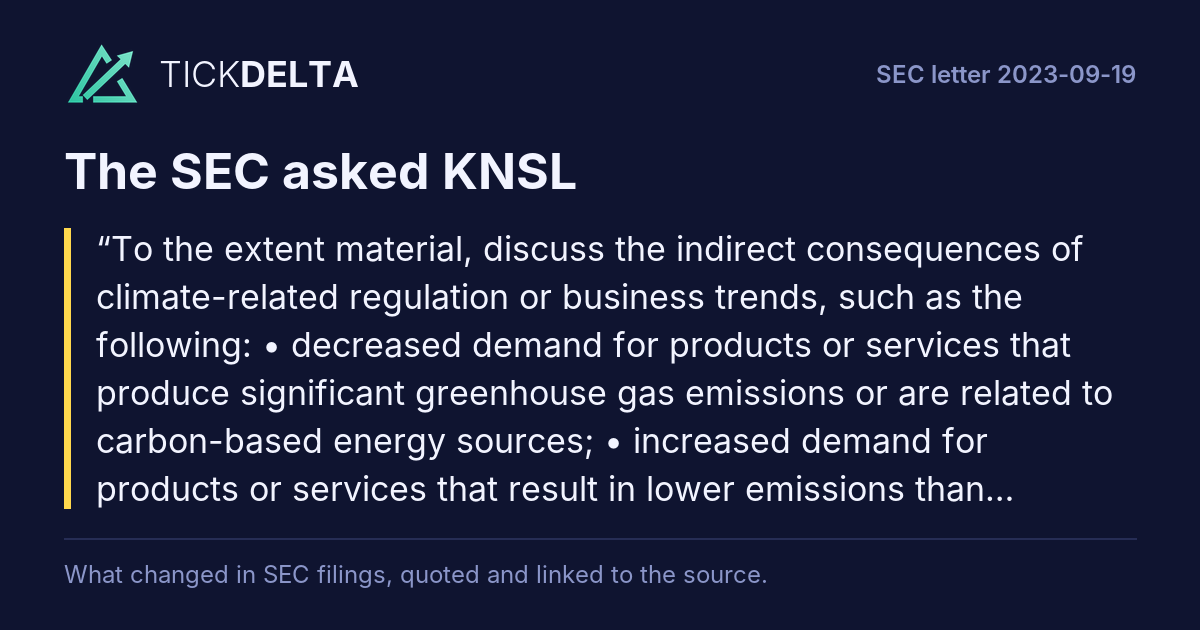
To the extent material, discuss the indirect consequences of climate-related regulation or business trends, such as the following: • decreased demand for products or services that produce significant greenhouse gas emissions or are related to carbon-based energy sources; • increased demand for products or services that result in lower emissions than competing products; • increased competition to develop innovativeRest of the question
new products that result in lower emissions; • increased demand for generation and transmission of energy from alternative energy sources; • any anticipated reputational risks resulting from operations or products that produce material greenhouse gas emissions; and • increased risk of loss and damage and/or increased number and amount of claims.
BackgroundRead in the reply
We respectfully acknowledge the Staff’s comment. We have disclosed what we view as the most significant risk factors to our business with respect to climate-related topics in Item 1A. Risk Factors on page 24 under the headers “Severe weather conditions, catastrophes, pandemics and similar events may adversely affect our business, results of operations and financial condition” and “Global climate change may have a material adverse effect on our financial results.”
We have not experienced material indirect consequences of climate-related regulation or business trends and do notRest of the answer
expect such indirect consequences, including the examples in the Staff’s comment, to have a material effect on our business, results of operations or financial condition.
Our operations and products themselves do not produce significant greenhouse gas emissions. We operate from a single corporate headquarters constructed in 2020 and we conduct our insurance operations through a digital technology platform. We are a digital financial services organization and have incorporated policies that reduce costs and enable us to operate efficiently. The primary product we sell is specialty insurance coverage for commercial entities and, to a lesser extent, individuals, across a range of industries in the United States. Our customers are generally small-to-medium-sized businesses. Our primary suppliers are wholesale insurance brokers who value efficiency. We believe our cost-effective operation provides the value desired by our customers and suppliers by virtue of lower costs and greater efficiency.
As a result, the most relevant indirect consequences of climate-related regulations and business trends are those experienced by the underlying businesses of our insureds. However, the related uncertainty and risk are precisely the types of matters that create dislocation within the property and casualty (“P&C”) insurance industry and provide opportunities for the excess and surplus (“E&S”) market in which the Company exclusively operates. The increasing volume of submission activity from wholesale brokers may support this thesis. For context, we received approximately 605,000, 520,000 and 461,000 new business submissions in 2022, 2021 and 2020, respectively. We elaborate on this concept further in the following responses. The primary area where we may experience indirect effects is within our underwriting operations.
Underwriting operations (including claims)
The Company’s insurance subsidiary, Kinsale Insurance Company, operates exclusively in the E&S market. The E&S market is the “safety valve” for the broader P&C industry. As insurance is generally a compulsory product, when standard P&C carriers decline to insure risks, including for climate-related reasons, those businesses generally turn to the E&S market to obtain requisite insurance coverage. As an E&S carrier, we use our freedom of rate and form to underwrite such risks that meet our risk and return objectives. Examples of the indirect consequences of climate-related regulation or business trends and our considerations follow:
•Decreased demand for products or services that produce significant greenhouse gas emissions or are related to carbon-based energy sources
Some of our insureds may operate in industries commonly known for significant greenhouse gas emissions. As disclosed on pages 100-101 of our Form 10-K, our energy division underwrites commercial general liability, pollution liability, professional liability and excess liability on enterprises engaged in the business of energy production or distribution or mining including drillers, lease operators, contractors, product manufacturers and alternative energy. The energy division accounted for $33.0 million, $19.9 million and $17.0 million, or approximately 3.0%, 2.6% and 3.1% of our gross written premiums in 2022, 2021 and 2020, respectively. Anecdotally, we understand certain companies in the P&C industry decline to insure certain businesses that we write through our energy division. We believe this withdrawal of competitors inures to our benefit by reducing competition in the insurance market.
•Increased demand for products or services that result in lower emissions than competing products
Some of our insureds produce and sell new or innovative lower-emission products and utilize alternative energy sources. We believe the most significant concentration of these insureds would likewise be written through our energy division. Generally, customers with these types of risks turn to the E&S market for their insurance needs as new products tend to be higher hazard in nature. We believe this influx of new products or services increases the size of the E&S market, which inures to our benefit.
•Increased competition to develop innovative new products that result in lower emissions
Similar to our prior response, if our insureds operate in industries developing innovative new products that result in lower emissions, we believe such new products would turn to the E&S market to fill their insurance needs, thereby increasing the size of the E&S market.
•Increased demand for generation and transmission of energy from alternative energy sources
Please refer to our response above regarding “Increased demand for products or services that result in lower emissions than competing products.”
•Any anticipated reputational risks resulting from operations or products that produce material greenhouse gas emissions
We do not believe there are material reputational risks resulting from our operations. As previously described, our direct operations do not produce material greenhouse gas emissions and we do not believe our customers or suppliers are dissatisfied with our management of our environmental footprint as evidenced by increased submission volumes. We are generally not a consumer-facing company as approximately 97.2%, 96.5% and 96.1% of our gross written premiums related to commercial insurance policies in 2022, 2021 and 2020, respectively. While some of our insureds, particularly written through our energy division, may operate in a manner that produces greenhouse gas emissions, our commercial insureds are enterprises that conduct legal business in the states in which they operate. Our business inherently includes underwriting risks that are declined by standard carriers as the E&S market is the market of last resort for many insureds. We underwrite and plan to continue underwriting risks for legal enterprises that meet our risk and return objectives.
Our insureds may realize the impact of reputational risks in their businesses if they fail to meet market expectations with respect to limiting greenhouse gas emissions. We believe this risk is not material to us as our business is diversified. We write a high volume of small accounts, and no individual insured is material to our business or results of operations. For reference, our average premium per policy written was $12,400, $10,400 and $9,100 in 2022, 2021 and 2020, respectively. Excluding our personal lines insurance, which has relatively low premium per policy, the average premium per policy written was $14,700, $12,900 and $11,800 in 2022, 2021 and 2020, respectively.
•Increased risk of loss and damage and/or increased number of claims
A primary indirect consequence of increased risk of loss, damage and/or claim volume is to drive risks from the standard P&C market to the E&S market, where we manage our business to achieve adequate returns for the risk we take, which increases the size of our market in certain classes of business. We see the most significant impact of this phenomenon in our catastrophe-exposed property business. As disclosed on page 100 of our Form 10-K, the written premiums generated from our commercial property, small property and personal insurance divisions, which represent our primary catastrophe-exposed business, were $237.1 million, $105.7 million and $73.5 million in 2022, 2021 and 2020, respectively. A secondary indirect consequence of increased risk of loss and damage and/or claim volume is the potential for an increase in cost and a decrease in supply of reinsurance capacity. Please refer to our response to the Staff’s comment 2 for quantification of weather-related impacts on our financial results due to increased risks of loss and damage and/or increased number of claims.
Overall, we believe the indirect consequences of climate-related regulation or business trends are not material. Our operations and products themselves do not produce significant greenhouse gas emissions. To date, we believe we have experienced net positive impacts, for example increased premiums in our property insurance business, that are likely partially related to climate trends. Our business is diversified across many industries and geographies within the United States and while we believe the matters described above will be a net benefit to our business, these indirect consequences will develop over time as the broader economy in the United States continues to evolve.
First report after the company's reply of Oct 2, 2023: 10-Q filed Oct 26, 2023 ↗, against the 10-Q filed Jul 27, 2023 ↗.
Tickdelta does not hold the text of both reports, so they are not compared here.
We note disclosure in your Form 10-K that assessing the risk of loss and damage and the range of approaches to address the adverse effects of climate change, including impacts related to extreme weather events and slow onset events, may materially adversely impact your business, financial condition, and results of operations. Please discuss the physical effects of climate change on your operations and results.Rest of the question
This disclosure may include the following: • severity of weather, such as floods, hurricanes, sea levels, arability of farmland, extreme fires, and water availability and quality; • quantification of material weather-related damages to your property or operations; • potential for indirect weather-related impacts that have affected or may affect your major customers or suppliers; • decreased agricultural production capacity in areas affected by drought or other weather-related changes; and • any weather-related impacts on the cost or availability of reinsurance. Please provide quantitative information for each of the periods covered by your most recent Form 10-K and disclose whether increased amounts are expected in future periods.
We respectfully acknowledge the Staff’s comment with respect to the physical effects of climate change and respond as follows:Read in the reply
•Severity of weather, such as floods, hurricanes, sea levels, arability of farmland, extreme fires, and water availability and quality
The most significant weather-related impact to our operations relates to our catastrophe-exposed property insurance business. Climate change is a complex and evolving issue. Climate change could have a significant impact on longer-term natural weather trends, including increases in severe weather and catastrophic events.Rest of the answer
The incidence and severity of catastrophes are unpredictable. While catastrophes are generally restricted to fairly specific geographic areas, for insurance purposes the extent of loss is a function of both the total amount of insured value in the area affected by the event and the severity of the event.
We have property risks where we provide coverage for various perils, including wind, fire and convective storm damage among others. We monitor and manage aggregation risk carefully to meet our risk tolerances. As disclosed on pages 8-9 of our Form 10-K, we use sophisticated computer models to analyze the risk of severe losses from natural catastrophes. We measure exposure to these losses in terms of probable maximum loss ("PML"), which is an estimate of the amount of loss we would expect to meet or exceed once in a given number of years (referred to as the return period). When managing hurricane exposure, we focus on the 100-year return period. We manage exposure to hurricanes through:
oCareful and disciplined underwriting, oPurchasing extensive reinsurance protection from financially strong counterparties, oAnalyzing results of catastrophe modeling for our business portfolio on a monthly basis, and oLimiting the concentration of property business by geographic area to reduce loss exposure from extreme events.
For example, with respect to aggregate risk management guidelines for our overall property business, we limit the exposed property values within a specified geographic radius, which in turn limits the gross and net PML. In addition to our aggregate risk management guidelines, we write policies using limits tactically in order to minimize exposure to large losses. While specific limits change over time as our risk appetite changes due to growth, the majority of our catastrophe-exposed property insurance business is concentrated in property coverages with policy limits of $5.0 million and lower. Importantly, our insurance policies are generally written for one year and are repriced annually to reflect changing exposures, including changes in frequency and severity of weather-related claims. Increased frequency and severity of natural catastrophes drive increased volatility for insurers. It also causes standard insurers to decline more catastrophe-exposed risks, which increases the size of the E&S market and thereby our business opportunity. E&S companies are better able to manage the volatility associated with catastrophe risk given their regulatory freedom of rate and form allowing for maximum flexibility in restricting coverage and charging higher rates.
When we write property insurance, we buy reinsurance to significantly mitigate our risk of large losses. Effective June 1, 2022, we purchased catastrophe reinsurance coverage of $75.0 million per event in excess of our $25.0 million per event retention. Our property catastrophe reinsurance includes a reinstatement provision which requires us to pay reinstatement premiums after a loss has occurred in order to preserve coverage. As of December 31, 2022, including the reinstatement provision, the maximum aggregate loss recovery limit was $150.0 million and was in addition to the per-occurrence coverage provided by our treaty coverages.
As disclosed on page 44 of each of our Form 10-K and page 44 of our Annual Report on Form 10-K for the fiscal year ended December 31, 2021, net catastrophe losses were $26.6 million, $8.6 million and $23.2 million or 3.4%, 1.5% and 5.6% of earned premiums in 2022, 2021 and 2020, respectively.
Prospectively, even contemplating the significant growth in our property insurance business, we do not currently expect losses relative to operating income to change materially based on our modeling.
•Quantification of material weather-related damages to your property or operations
At December 31, 2022, the Company owned two primary properties, a single-location corporate headquarters and a real estate investment adjacent to our corporate headquarters. We have not incurred any weather-related damages to these properties. Please refer to the previous response for quantitative and qualitative information with respect to weather-related damages to our operations.
•Potential for indirect weather-related impacts that have affected or may affect your major customers or suppliers
We do not believe there are significant indirect weather-related impacts that have affected or may affect our major customers or suppliers. Our customer base comprises a large volume of generally small-to-medium-sized businesses and certain individual homeowners within the United States. Our primary suppliers within our insurance operations are wholesale insurance brokers that we expect to be able to continue facilitating transactions in the insurance value chain between our insurance subsidiary and retail agents / insureds in instances of weather-related events. Wholesale insurance brokers generally have operations throughout the United States, and we are not aware of a significant geographical concentration that could reasonably materially impact the submission volume we receive.
•Decreased agricultural production capacity in areas affected by drought or other weather-related changes
We do not believe decreased agricultural production capacity in areas affected by drought or other weather-related changes will have a material effect on our business. Our gross written premiums for agricultural related classes of business were $9.1 million, $9.6 million and $5.6 million, or 0.8%, 1.3% and 1.0% of our gross written premiums in 2022, 2021 and 2020, respectively. Importantly, the majority of these underlying policies are property insurance policies, which are priced using total insured value in contrast to liability policies which are generally priced using metrics such as sales, production capacity, payroll costs or similar rating drivers.
•Any weather-related impacts on the cost or availability of reinsurance
We have disclosed qualitative information on page 24 of our Form 10-K under the header “We may be unable to obtain reinsurance coverage at reasonable prices or on terms that adequately protect us.” As background, we renew our reinsurance programs annually during the second quarter and monitor both the underlying business performance and the performance of our reinsurance treaties regularly. The terms of our reinsurance programs are negotiated annually and include consideration of expected growth, expected profitability, our appetite for risk retention and general conditions in reinsurance markets. As has been widely reported in industry press and traditional media, the cost has generally increased for catastrophe-exposed property reinsurance.
We did not experience constraints of the availability or increased pricing in 2022 compared to 2021 with respect to our reinsurance programs. For additional context in response to the Staff’s comment, although reinsurance capacity was more constrained in 2023 than in previous years due to several years of elevated industry losses, we were able to successfully renew our treaties at June 1, 2023 with a risk-adjusted rate increase of 2.3% on our property treaties and 1.3% on our reinsurance program in the aggregate. The estimated cost increase of reinsurance is approximately $4.2 million, which is not material to our business or results of operations.
In general, we continuously evaluate the physical risks associated with climate change while simultaneously pursuing opportunities by leveraging the short-tail nature of our policies and the ability to adjust pricing and coverage terms annually in response to changes in frequency and severity of weather-related claims. As described in a prior response, significant changes in claim frequency and severity create volatility in the financial results of insurance companies and exacerbate dislocation within the insurance industry. Significant volatility generally causes standard insurers to withdraw from certain lines of business, forcing those risks into the E&S market, which increases the demand and reduces the supply for our products.
In future filings, we will disclose the physical effects of climate change on our results of operations and business if material or we otherwise determine such disclosure to be appropriate.
First report after the company's reply of Oct 2, 2023: 10-Q filed Oct 26, 2023 ↗, against the 10-Q filed Jul 27, 2023 ↗.
Tickdelta does not hold the text of both reports, so they are not compared here.
If material, provide disclosure about your purchase or sale of carbon credits or offsets and any material effects on your business, financial condition, and results of operations. Please include quantitative information for each of the periods covered by your most recent Form 10-K and the amounts budgeted for and expected to be incurred in future periods.
The Company does not transact carbon credits or offsets and does not expect to do so in the future. As a result, there is no material impact of carbon credits and offsets to our business, financial condition or results of operations.Read in the reply
We acknowledge that the Company is responsible for the adequacy and accuracy of disclosures.
First report after the company's reply of Oct 2, 2023: 10-Q filed Oct 26, 2023 ↗, against the 10-Q filed Jul 27, 2023 ↗.
Tickdelta does not hold the text of both reports, so they are not compared here.
Your response to prior comment 1 appears to focus on the underlying businesses of your insureds without providing sufficient detail regarding the indirect consequences on your operations and results. Please discuss more fully the climate-related increased risk of loss and damage and/or increased number and amount of claims you have experienced to date and expect to experience in the future.Rest of the question
In this regard, we note disclosure on pages 44 and 89-90 of your Form 10-K that explains increasing losses as due to hurricanes, winter storms, and wildfires, as well as claims tables on pages 91-93 that appear to show increases. In addition, tell us how you considered disclosing such increases as an indirect consequence of the climate-related business trends described in your response.
We respectfully acknowledge the Staff’s comment. Loss experience, particularly related to catastrophe-exposed property risks, is inherently volatile. Increases or decreases in any given year-to-year period, particularly when affected by low-frequency events such as hurricanes, may not be representative of a trend.Read in the replyRest of the answer
We reviewed our operations, results, exposures, claims activity and other factors, and, with respect to our business, did not identify a known trend or uncertainty arising from climate-related risks that that has had or is reasonably expected to have a material impact on our total revenues or net income.
As disclosed on page 44 of our Form 10-K and page 44 of our Annual Report on Form 10-K for the fiscal year ended December 31, 2021, net catastrophe losses were $26.6 million, $8.6 million and $23.2 million, or 3.4%, 1.5% and 5.6% of earned premiums, in 2022, 2021 and 2020, respectively. As disclosed on pages 89-90 of our Form 10-K, the $26.6 million of net catastrophe losses in 2022 was primarily related to Hurricane Ian in that year and the $8.6 million of net catastrophe losses in 2021 was primarily related to Hurricane Ida and winter storms Uri and Viola in that year. We do not believe the increase in net catastrophe losses in 2022 compared with 2021 was representative of a known trend of increased losses attributable to natural catastrophes. In the same manner, we do not believe the decrease in net catastrophe losses, both nominally and as a percent of earned premiums, from 2020 to 2021 was representative of a known trend of decreased losses attributable to natural catastrophes. Such results are more representative of the inherent volatility of loss experience.
As disclosed in our Form 10-K, our property insurance business has grown at a faster rate than our casualty business in recent years, with gross written premiums generated from our property insurance business growing from $73.5 million in 2020 to $105.7 million in 2021 to $237.1 million in 2022. In insurance, loss reserves are the largest component of expense associated with such revenue and can be viewed similarly to cost of goods sold in the retail industry. Similar to how cost of goods sold would be expected to increase with increased sales for a business in the retail industry, we believe property insurance claims will increase as we write more property insurance business. We attribute the increase in property claims over prior years, as shown in the property claims tables on pages 90-91 of our Form 10-K, to the growth in our property insurance business and not as a trend in increased losses due to effects of climate change. Even contemplating continued significant growth in our property insurance business, we do not currently expect losses relative to operating income to change significantly based on our modeling.
As set forth more fully in our prior response, we have made disclosure with respect to potentially material climate-related risks in Item 1A. Risk Factors on pages 24 and 25 of our Form 10-K under the headers “Severe weather conditions, catastrophes, pandemics and similar events may adversely affect our business, results of operations and financial condition” and “Global climate change may have a material adverse effect on our financial results.” We have disclosed and plan to continue disclosing comparative trends in actual catastrophe losses and, if applicable, other known trends, including those potentially arising from climate-related risks.
First report after the company's reply of Oct 19, 2023: 10-Q filed Oct 26, 2023 ↗, against the 10-Q filed Jul 27, 2023 ↗.
Tickdelta does not hold the text of both reports, so they are not compared here.
Your response indicates that you are "a digital financial services organization" that conducts insurance operations through a digital technology platform, yet it does not appear to discuss these digital operations in relation to our prior comments 1 and 2.Rest of the question
Accordingly, please further address the following: • Clarify whether your response that “our direct operations do not produce material greenhouse gas emissions” takes into account the emissions related to your digital technology platform, and provide support for your assessment of materiality. • Discuss whether and how your digital technology platform relates to changes in demand and competition for products or services that result in lower greenhouse gas emissions, are related to carbon-based energy sources, or are operated using energy from alternative energy sources. Tell us how you considered providing disclosure regarding other reputational risks, for instance in relation to your digital operations or potential climate-related disruption thereof. • Discuss the physical effects of climate change in relation to your digital operations, including the potential for indirect weather-related impacts that have affected or may affect your digital trading platform, related suppliers (e.g., third-party data centers, cloud service or electricity providers, and infrastructure), and customers. Include support for your evaluation regarding the materiality of such impacts.
We respectfully acknowledge the Staff’s comment and respond as follows:Read in the reply
•Clarify whether your response that “our direct operations do not produce material greenhouse gas emissions” takes into account the emissions related to your digital technology platform, and provide support for your assessment of materiality.
We confirm that our prior response considered the emissions related to our digital technology platform. However, to clarify our prior response, we did not intend to indicate that we have quantified the greenhouse gas emissions and related costs related to our business.Rest of the answer
We understand the Commission is considering potential disclosure requirements related to emissions and other climate-related matters; however, we have not prepared such disclosures or quantifications at this time.
The intent of our prior response was to inform the Staff that qualitatively, we operate a business that uses technology and does not consume significant natural resources or otherwise produce significant greenhouse gas emissions. Our technology platform comprises a suite of predominantly internally developed interconnected applications that primarily reside on reputable third-party cloud services. The primary product we sell is an insurance contract, and our technology platform is the mechanism by which we ingest data, underwrite submissions, bind policies, evaluate claim information and report financial and non-financial information, among other activities.
Expanding on our prior response and as disclosed on page 19 of our Form 10-K, as of December 31, 2022, we had 466 employees that work in a single location and our business leverages technology. In formulating our prior response to the Staff, we considered that our environmental footprint is likely significantly smaller than our peers in the P&C industry due to our model of single-location corporate headquarters and fewer employees. We believe we are able to operate with fewer employees due in part to our technology platform. Supporting this assessment further, the primary competitors we reference in our Form 10-K (other than Lloyd’s of London, which is an insurance market and not a company) had 5,800 employees, 1,224 employees, 639 employees, 20,900 employees, 1,001 employees and 8,186 employees, respectively, and most disclose many leased and/or owned physical office spaces around the United States and the world in each company’s most recent Annual Report on Form 10-K.
•Discuss whether and how your digital technology platform relates to changes in demand and competition for products or services that result in lower greenhouse gas emissions, are related to carbon-based energy sources, or are operated using energy from alternative energy sources. Tell us how you considered providing disclosure regarding other reputational risks, for instance in relation to your digital operations or potential climate-related disruption thereof.
We do not believe our technology platform relates to changes in demand or competition for products or services that result in lower greenhouse gas emissions, are related to carbon-based energy sources, or are operated using energy from alternative energy sources. As noted in our prior response, we do not believe our customers or suppliers are dissatisfied with our management of our environmental footprint as evidenced by increased submission volumes.
We do not believe there are reputational risks in relation to our digital operations or potential climate-related disruption thereof. As previously described, our technology resides primarily on reputable third-party cloud services. We considered the results of our regular review of reporting from related vendors with a focus on availability and resiliency of the services these vendors provide to us. These reviews have not resulted in significant concerns that could reasonably indicate there are reputational risks related to potential climate-related disruption of our operations. As a result, we have not included disclosure of related risks.
•Discuss the physical effects of climate change in relation to your digital operations, including the potential for indirect weather-related impacts that have affected or may affect your digital trading platform, related suppliers (e.g., third-party data centers, cloud service or electricity providers, and infrastructure), and customers. Include support for your evaluation regarding the materiality of such impacts.
We have not experienced physical effects of climate change in relation to our digital operations and we do not expect to experience such effects prospectively. For example, we have not experienced weather-related disruption or any damage to our operations. As previously described, our technology resides primarily on infrastructure provided by reputable third-party cloud service providers. We regularly review reporting from these entities and focus on availability and resiliency of the services these vendors provide to us. These reviews have not resulted in significant concerns regarding the resiliency or availability of our technology systems. Additionally, we maintain a business continuity plan that includes consideration of continuing operations in the event of technology failures. We acknowledge that there is a risk of failure of such systems and accordingly, we disclosed such matters on page 29 in our Form 10-K under the header “The failure of our information technology and telecommunications systems could materially adversely affect our business.”
As described in our response to the Staff’s previous question and our prior response, we do not believe our customers or suppliers are dissatisfied with our management of our environmental footprint as evidenced by increasing submission volumes of 605,000, 520,000 and 461,000 new business submissions in 2022, 2021 and 2020, respectively. As described in our prior response, our business is diversified with a high volume of low-dollar insurance transactions and no individual insured is material to our operations. We are not aware of a significant geographical concentration that, based on the physical effects of climate change, could reasonably materially impact the submission volume we receive.
First report after the company's reply of Oct 19, 2023: 10-Q filed Oct 26, 2023 ↗, against the 10-Q filed Jul 27, 2023 ↗.
Tickdelta does not hold the text of both reports, so they are not compared here.
We note your response to prior comment 2 that “the cost has generally increased for catastrophe-exposed reinsurance.” Please provide quantitative information regarding the cost of reinsurance for each of the periods covered by your Form 10-K and explain whether increased amounts are expected in future periods.
We respectfully acknowledge the Staff’s comment. To clarify, our prior response regarding the cost increase for catastrophe-exposed reinsurance was referencing conditions in the broader reinsurance market. As the Staff's comments have focused specifically on climate change, we provide the following information with respect to our reinsured property insurance business.Read in the replyRest of the answer
Our reinsured casualty business is not impacted by climate change.
There are many factors that impact our cost of property reinsurance including, but not limited to, the number of locations we insure, projections of premiums for our property insurance portfolio, the age and quality of construction of underlying exposures, geographical concentration, our pricing of underlying risks, catastrophe modeling results, our risk appetite for retention, our desired reinsurance structure, historical and expected profitability, ceding commissions we earn and interest rates.
In 2022, direct earned property premiums were $173.0 million and we ceded $52.2 million to reinsurers net of ceding commissions resulting in a cost of property reinsurance as a percentage of earned property premiums of 30.1%.
In 2021, direct earned property premiums were $97.1 million and we ceded $25.7 million to reinsurers net of ceding commissions resulting in a cost of property reinsurance as a percentage of earned property premiums of 26.4%.
In 2020, direct earned property premiums were $64.3 million and we ceded $22.2 million to reinsurers net of ceding commissions resulting in a cost of property reinsurance as a percentage of earned property premiums of 34.5%.
Prospectively, we do not currently expect significant changes in the cost of our property reinsurance program as a percentage of earned property premiums absent significant changes to retentions. We generally expect the nominal cost of our property reinsurance program to change directionally with earned property premiums. Our retained business and our ceded business in the aggregate have demonstrated profitable returns which we believe will allow us to obtain reinsurance coverage commensurate with our risk appetite.
As disclosed on page 43 of our Form 10-K, our net retention ratio was 85.0% and 86.4% for 2022 and 2021, respectively. We define the net retention ratio on page 41 of our Form 10-K as the ratio of net written premiums to gross written premiums. As disclosed on page 43 of our Form 10-K, the decrease in the net retention ratio was due to higher premiums ceded under the commercial property quota share reinsurance treaty and a change in the mix of business. We plan to continue disclosing our comparative net retention ratio in future filings. The aforementioned change in the cost of our property reinsurance similarly relates to higher premiums ceded under the commercial property treaty as our property insurance business grows.
The matters described in our response were not material to warrant disclosure in our Form 10-K; however, in future filings, we will continue to assess the indirect consequences and physical effects of climate change on our results of operations and business and provide related disclosure as appropriate. We acknowledge that the Company is responsible for the adequacy and accuracy of disclosures.
First report after the company's reply of Oct 19, 2023: 10-Q filed Oct 26, 2023 ↗, against the 10-Q filed Jul 27, 2023 ↗.
Tickdelta does not hold the text of both reports, so they are not compared here.
Also in this review: closing letter, 2023-10-30