Schedule 14A
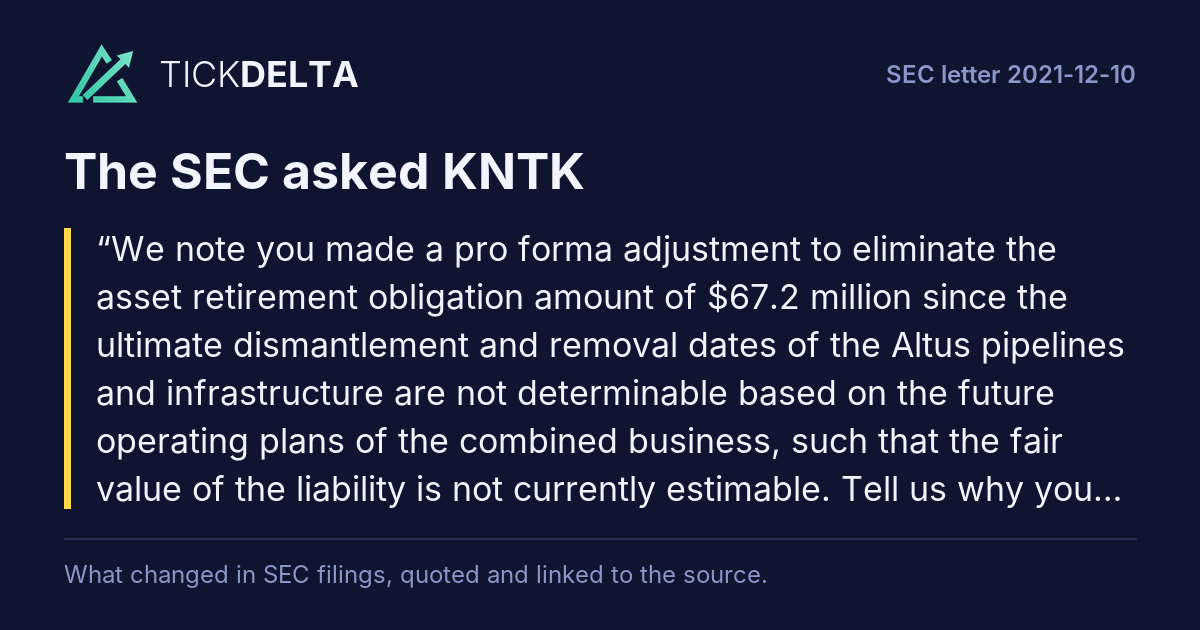
We note you made a pro forma adjustment to eliminate the asset retirement obligation amount of $67.2 million since the ultimate dismantlement and removal dates of the Altus pipelines and infrastructure are not determinable based on the future operating plans of the combined business, such that the fair value of the liability is not currently estimable. Tell us why you believe this adjustment is appropriate.Rest of the question
Additionally, tell us how you considered the guidance in ASC 410-20-25-7 through ASC 410-20-25-13 regarding obligations when uncertainty exists about the timing or method of settlement.
Following the closing of the transaction, we intend to connect the Company’s legacy assets to the legacy BCP RaptorRead in the reply
Holdco, LP (“Holdco”) assets via a pipeline interconnect that will allow for flexibility in future gas gathering and processing operations and expand volumes and producers to the Company’s assets.Rest of the answer
Given these plans, an asset retirement obligation (“ARO”) was not recorded because the Company’s assets, after the interconnect is installed, will have an indeterminate removal or abandonment date given the expected significant utilization of the Company’s assets with proper maintenance or replacement. As such, in accordance with ASC 410-20-25-10, management is not able to reasonably measure the fair value of an ARO because the settlement dates are indeterminable. Based on the widespread use of natural gas in industrial and power generation activities, management expects supply and demand to exist for the foreseeable future. Further, we have in place a rigorous repair and maintenance program that keeps the natural gas gathering and processing systems in good working order. Therefore, through management’s intent to connect these assets and our repair and maintenance programs, the natural gas gathering and processing systems themselves will remain intact indefinitely.
Revise footnote 6(i) to discuss the estimates and assumptions used to calculate the adjustments to stock compensation expense.
The Company has revised the footnote to clarify the estimates and assumptions used to calculate the adjustments to stock compensation expense. Please see footnote 6(i) on page 115 of the Amendment.Read in the reply
You disclose that you have not allocated any value to your 15% ownership interest in EPIC Crude Oil Pipeline in adjustment 5(b). You also disclose in adjustment 6(e) that you eliminated equity in losses of EPIC Crude Oil Pipeline unconsolidated affiliate, as no value was allocated in the transaction to EPIC Crude Oil Pipeline.Rest of the question
Please explain why these adjustments are appropriate and meet the requirements for pro forma presentation under Article 11 of Regulation S-X. Please also tell us how this assumption is consistent with the Selected Company Analysis performed by Credit Suisse that appears to have ascribed value to EPIC Crude Oil Pipeline.
During our preliminary accounting for the transaction, we determined the EPIC Crude Oil Pipeline (“EPIC”), which is accounted for as an equity method investment, to have a fair value of $0. In situations in which an investor’s share of equity method losses equals or exceeds its equity method investment balance plus any advances, equity method loss recognition should generally be discontinued.Read in the replyRest of the answer
The equity method is to be resumed only after an investor’s share of an investee’s subsequently reported net income equals the share of net losses not recognized during the period the equity method was suspended.
Based on our November analysis of the EPIC business enterprise value, predicated on similar information available to Credit Suisse, our financial advisor, we estimated a fair value of approximately $850 million on a 100% basis as of the valuation date. However, this business enterprise value, as of the valuation date, was entirely attributed to the investments made in the assets by the debt holders as the net book value of the debt held by EPIC was greater than the estimated business enterprise value. As such, we assigned a preliminary fair value of $0 to the 15% equity investment held in EPIC. We will continue to evaluate the fair value valuation up until the transaction is consummated and based on more and longer term information that may be received from EPIC in that time frame.
Given the above, in applying Rule 11-02(a)(6) of Regulation
S-X, we made transaction accounting adjustment 5(b) to the pro forma condensed consolidated combined balance sheet to reflect EPIC’s equity method investment fair value of $0 as prescribed by ASC 805,
Business Combinations. Given our preliminary conclusion of EPIC’s value, we made adjustment 6(e) to the pro forma condensed consolidated combined statement of operations to remove the equity method loss for EPIC given it would have reduced the Company’s equity method investment in EPIC below $0, noting that the Company has no current commitments to fund EPIC’s capital calls, to provide additional financial support, or to guarantee EPIC’s obligations.
Revise your disclosure to explain how management uses throughput volumes to analyze changes in your results of operations and quantify the extent to which revenue was impacted by changes in throughput volumes or commodity prices. Refer to Item 303(b)(2)(iii) of Regulation S-K.
Period-to-period fluctuations of EagleClawRead in the reply
Midstream’s (“ECM”) service revenue are primarily driven by changes in throughput volumes and rarely experience material fluctuations from changes in service rates. We respectfully advise the Staff that changes in throughput volumes are discussed on page A-17. Further, ECM’s service rates are fixed in advance through negotiated customer contracts and, as a result, its service revenues are not directly impacted by changes in commodity prices.Rest of the answer
As there were no material changes in service rates for the periods presented, we respectfully advise the Staff that we do not believe a discussion of service rates is required nor would it be helpful or material to stockholders.
The Company has revised the disclosure in the Amendment to address the Staff’s comment with respect to product revenue. Please see pages A-17 and A-20 of the Amendment.
You disclose that “During the third quarter of 2021, the Partnership entered into litigation with two third parties to collect outstanding receivables totaling $19.7 million that remain outstanding from the Winter Storm Uri during February of 2021.” Disclose the issues surrounding this legal dispute and how management assessed the collectability of these receivables as of September 30, 2021.
The Company acknowledges theRead in the reply
Staff’s comment and has revised the disclosure in the Amendment to clarify the issues involved in these legal disputes and management’s assessment of collectability accordingly. Please see page A-55 of the Amendment.
Revise your disclosure to discuss how you are organized, and whether operating segments have been aggregated. Refer to ASC 280-10-50-21.
The Company respectfully advises the Staff that the Holdco consolidated financial statements do not take into considerationRead in the reply
ASC 280, Segment Reporting, as they are issued under private company guidelines to which these disclosures are not required for purposes of the Proxy Statement. As noted in paragraph 2005.1 of the Financial Reporting Manual of the Division of
Corporation Finance (“Paragraph 2005.1”), “[a]n acquired business that is a nonpublic entity, as the term is defined in GAAP, need not include disclosures if specifically excluded from the scope of the FASB standard.” We interpretRest of the answer
this guidance to include segment information required under ASC 280. Following the consummation of the transaction, we will include the required segment disclosures, to the extent applicable, within our consolidated financial statements to be included in a Current Report on Form 8-K.
Revise to disclose how you monitor the financial solvency of your producers and the credit quality of your customers and the financial metrics used.
The Company respectfully advises the Staff thatRead in the reply
ECM’s operations involve a variety of counterparties, both investment grade and not investment grade. Typically, by contract with counterparties’ customers, ECM takes title to the rich gas and associated plant products (NGLs and residue gas). As such, ECM receives funds for the disposition and sale of such products from downstream counterparties that are large investment grade entities and is able to deduct all fees owed to it by its customers and associated costs before remitting the balance of any funds back to the relevant customer.Rest of the answer
For those few counterparties’ customers that retain ownership of their plant products, ECM attempts to minimize credit risk exposure through its credit policies and monitoring procedures as well as through customer deposits, and letters of credit. ECM manages trade credit risk to mitigate credit losses and exposure to uncollectible trade receivables. Prospective and existing customers are reviewed regularly for creditworthiness to manage credit risk within approved tolerances with the primary focus on published credit ratings when available and inherent liquidity metrics.
However, in accordance with the guidance in Paragraph 2005.1, there is no requirement to include such information in the Holdco consolidated financial statements. Therefore, we intend to incorporate the above language in our consolidated financial statements to be included in a Current Report on Form 8-K following the closing of the transaction.
Revise to disclose the information required by ASC 805-10-50-2, including the supplemental pro forma information.
The Company respectfully advises the Staff that, in accordance with the guidance in Paragraph 2005.1, the Holdco consolidated financial statements do not take into consideration the revenue, earnings and supplemental pro forma information disclosures under ASCRead in the reply
805-10-50-2h, as they are issued under private company guidelines to which these disclosures are not required for purposes of the
Proxy Statement.Rest of the answer
Following the consummation of the transaction, we will include the required disclosures, to the extent applicable, within our consolidated financial statements to be included in a Current Report on Form 8-K. All other required disclosures under ASC 805-10-50-2 for non-public entities have been reflected in Note 15.
* * * *
If any member of the Staff has any questions regarding the foregoing, or desires further information or clarification in connection therewith, please contact Ben Rodgers at (713) 296-6752.
Also in this review: closing letter, 2021-12-27