Paragraphs with nothing like them in last year's 10-K
Quoted exactly
18 paragraphs in Risk Factors of the 10-K filed Feb 23, 2026
with nothing like them in the 10-K filed Feb 26, 2025. Quoted exactly.
Paragraphs that were only edited are under 10-K change.
We operate in highly competitive markets and our competitors may have more financial capacity or more extensive or specialized engineering, technical, manufacturing, marketing or servicing capabilities than we do. They may be willing to accept more risk or lower profitability in competing for contracts. We have seen, and anticipate we will continue to see, increased competition, including in some of our core markets, especially as a result of our customers’ budget pressures and their focus on speed, affordability and competition. The U.S. government’s continued emphasis on reforming its acquisition processes, including procuring commercial products and services and utilizing non-Federal Acquisition Regulation-based procurement methods, such as Other Transaction Authority (OTA) agreements and other contract types, has facilitated, and may continue to facilitate, participation by new and emerging market entrants, which has increased and may in the future further increase competition for the programs we pursue, which could result in reduced contract opportunities, increased pricing pressure, and/or demands to accept less favorable terms. In certain circumstances, these alternative contracting models may place increased risk on the contractor, such as the potential for greater assumption of development costs or for limited reimbursement recourse in certain situations. Further, certain non-Federal Acquisition Regulation-based procurement methods, such as OTA awards, are not subject to all of the procurement requirements that typically apply to DoW contracts and rights to protest such awards may be more limited than for other contracts.
Our customers are increasingly working with commercial contractors as well as newer entrants and startups in the defense industry for some products and services. Such contractors may have lower cost, more agile operating structures and access to capital and talent, a greater ability to leverage changes in the customer’s acquisition strategies (e.g., multiple awardees, short lifecycles) or be more inclined to take on increased risk than we are. In addition, some customers continue to utilize small business contractors or determine to source work internally.
Our success in competing depends, in part, on our ability to remain price- and cost-competitive, respond to changes in customer acquisition strategies and preferences, accurately anticipate our customers’ needs, successfully effect our digital transformation strategy and identify, adopt and integrate new digital technologies, including artificial intelligence, into our manufacturing, operations, business processes, products and services.
We expect that the increasing competition in the U.S. and outside the U.S. from U.S., foreign and multinational firms, including new entrants, could further increase due to mergers or acquisitions within our industry and could limit our access to certain suppliers, absent appropriate remedies to protect our interests. We are also facing increasing competition for, and more limited access to, various critical products, services and supplies.
Additionally, in some instances, companies both inside and outside the U.S. may receive loans, investments, subsidies, preferential treatment and other assistance from their governments or customers that may not be provided or available to us. Such assistance may increase the competitiveness of such companies in certain opportunities that we may pursue. Certain foreign companies may also be subject to fewer restrictions on technology transfer than we are.
In addition, U.S. government procurement and certain other countries’ laws permit legal challenges to the terms of a contract solicitation or award, sometimes referred to as a bid protest. Bid protests can result in award decisions being reversed and loss of the contract award. Even where a bid protest does not result in such a loss, it can result in significant expenses and delay the start of contract activities and revenue or result in contract modifications.
In addition, President Trump has issued multiple executive orders, including one intended to reform the DoW’s defense acquisition processes and promote expedited and streamlined acquisitions. Following issuance of those executive orders, the Secretary of War issued a memorandum and released the DoW’s Acquisition Transformation Strategy, which is aligned with the executive orders and seeks to overhaul the existing defense acquisition system through process changes that prioritize speed, flexibility, and rigorous execution. A subsequent executive order was issued that may limit corporate distributions, share repurchases, and executive compensation incentives during periods of defense contractor underperformance, insufficient prioritization, investment or production speed under their U.S. Government contracts. Depending on the implementation thereof, our financial results and the market price of our common stock may be impacted by these executive orders and related actions.
In addition, government contracts are frequently awarded only after formal competitive bidding processes, which have been and may continue to be protracted and typically impose provisions that permit cancellation in the event that necessary
Other strategic transactions, including spin-offs, divestitures, and investments involve significant risks and uncertainties that could adversely affect our business, financial condition, results of operations, cash flows and equity.
In addition to acquisitions, we may engage in other strategic transactions in the future, including spin-offs, divestitures, and investments, any of which would present significant risks and uncertainties that could adversely affect our business, financial condition, results of operations, cash flows and equity. For example, while the Company has no current plans or arrangements to accept direct investment from the U.S. government or any governmental agency, the Department of War recently announced an Acquisition Transformation Strategy and "Go Direct-to-Supplier" initiative. According to its public statements, the DoW strategy calls for the DoW to negotiate and invest directly with critical suppliers to save money and time, while proactively managing the single points of failure. The DoW has announced significant investment transactions with other companies in our industry and we may have an opportunity to participate in the DoW “Go Direct-to-Supplier” initiative in the future. In the event we participate in any such strategic transaction, we will face numerous risk including, among others:
•Challenges in achieving strategic objectives, cost savings and other expected benefits;
•Risk that our markets do not evolve as anticipated and that the strategic transaction does not prove to be those needed to be successful in those markets;
•Risk that we assume or retain, or otherwise become subject to, significant liabilities that exceed the limitations of any applicable indemnification provisions or the financial resources of any indemnifying parties;
•Risk that indemnification related to businesses divested or spun off that we may be required to provide or otherwise bear may be significant and could negatively impact our business;
•Risk that divestitures, spin offs, investment transactions and other strategic transactions fail to qualify for the intended tax treatment for U.S. federal income tax purposes and the possibility that the full tax benefits anticipated to result from such transactions may not be realized;
•Risk that we are not able to complete strategic divestitures on satisfactory terms and conditions, including non-competition arrangements applicable to certain of our business lines, or within expected timeframes;
•Risk of diverting the attention of senior management from our existing operations.
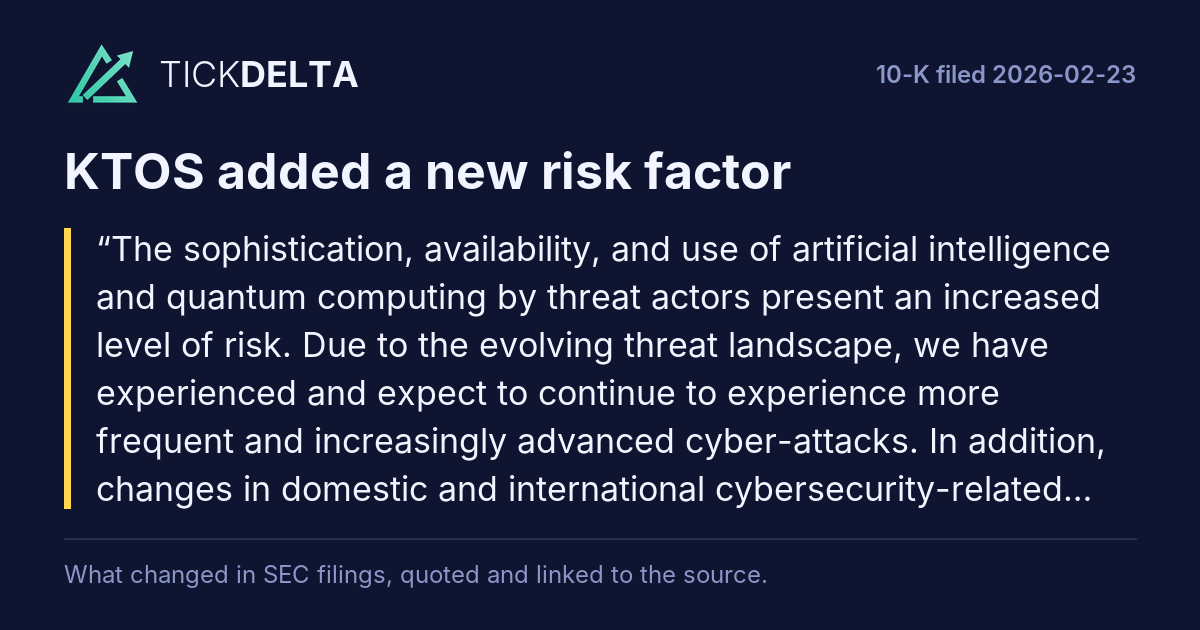
The sophistication, availability, and use of artificial intelligence and quantum computing by threat actors present an increased level of risk. Due to the evolving threat landscape, we have experienced and expect to continue to experience more frequent and increasingly advanced cyber-attacks. In addition, changes in domestic and international cybersecurity-related laws and regulations have expanded cybersecurity-related compliance requirements, and cybersecurity regulatory enforcement activity has grown. We expect the regulatory environment to continue to evolve, and these regulatory changes could increase our operational and compliance expenditures and those of our suppliers, and lead to new or additional IT and product development expenses. Due to the evolving nature of such risks, the impact of any potential incident cannot be predicted. In addition, our insurance coverage, which may exclude losses from war or cyber operations, may not be adequate to cover all related costs and we may not otherwise be fully indemnified for them.
Paragraphs in the 10-Q filed Nov 5, 2026 that were not in the one before
New in the latest 10-Q
9 paragraphs in the 10-Q filed Nov 5, 2026 with nothing like
them in the 10-Q filed Aug 4, 2026 (at least half the words must differ; new numbers alone do not count).
Quoted exactly, grouped by the item heading above them. This is text that changed, not a judgement of how serious it is.
Financial statements and notes
The identifiable intangible assets recognized in the Nomad acquisition are summarized as follows (in millions):
Read in the 10-Qopen_in_new
wages and prices for materials and related support cost allocations), execution by subcontractors, the availability and timing of funding from customers and overhead cost rates, among other variables.
Read in the 10-Qopen_in_new
On October 9, 2026, subsequent to quarter end, the Company completed the acquisition of Jetset Airmotive, Inc., a privately held business operating similarly to certain existing Kratos businesses in the aircraft engine components and services
Read in the 10-Qopen_in_new
sector, to expand the Company’s portfolio and capabilities within its aerospace related offerings including MRO (Maintenance, Repair and Overhaul).
Read in the 10-Qopen_in_new
The transaction was based on a contractual purchase price of approximately $ 60.0 million, subject to customary closing adjustments. At closing, the Company paid aggregate consideration of approximately $ 49.5 million, consisting of approximately $ 24.7 million in cash and 547,249 shares of the Company's common stock with an aggregate fair value of approximately $ 24.7 million, based on $ 45.21, the average closing stock price of the Company’s common stock for the twenty trading day period immediately prior to the acquisition date. In addition, approximately $ 4.0 million of the purchase price was subject to customary indemnification and purchase price adjustment holdback provisions under the acquisition agreement. Contingent consideration of up to approximately $ 4.9 million may also become payable upon the achievement of specified post-closing performance milestones.
Read in the 10-Qopen_in_new
Show the other 4
Due to the timing of the transaction, the initial accounting under ASC 805, including the valuation of acquired intangibles, contingent consideration, and goodwill is incomplete. The Company expects to provide disclosures and the preliminary purchase price allocation in future filings once the initial accounting is finalized.
Read in the 10-Qopen_in_new
fiscal year 2027 appropriations bills has been enacted, and we expect the continuing resolution to be extended beyond December 11, 2026.
Read in the 10-Qopen_in_new
the contracts may remain unfunded unless and until Congress makes a subsequent appropriation and the procuring agency allocates funding to the contract.
Read in the 10-Qopen_in_new
Market risk
Since December 28, 2025, there have been no material changes in the quantitative or qualitative aspects of our market risk profile, except as described below. For additional information regarding our exposure to certain market risks, see “Item 7A. Quantitative and Qualitative Disclosures About Market Risk” included in our Annual Report on Form 10-K for the fiscal year ended December 28, 2025 that we filed with the SEC on February 23, 2026. Following the Orbit acquisition, a larger portion of our costs, including materials and salaries at our operations in Israel, is denominated in the Israeli Shekel, and fluctuations in the exchange rate between the Shekel and the U.S. dollar may adversely affect our results of operations. During 2026, we began entering into foreign currency forward contracts to manage a portion of this exposure. At September 27, 2026, these contracts had a notional value of $27.5 million and a net fair value of zero (see Note 14 to the accompanying unaudited condensed consolidated financial statements).
Read in the 10-Qopen_in_new
The 10-Q's risk factors against the 10-K
Item 1A of the 10-Q filed Nov 5, 2026 against Item 1A of the 10-K filed Feb 23, 2026.
A 10-Q repeats only the risks that changed, so a 10-K paragraph that is missing from it is not counted as removed.
Added is a paragraph with nothing like it in the 10-K, Reworded a sentence that is in both with several words changed,
Quiet changes a sentence in both where one to four words changed and one is a hedge or a modal
(cut words struck through, new words highlighted).
Text on the page, not a score; each links to the filing at sec.gov.
Added10-Q Nov 5, 2026 vs 10-K Feb 23, 2026
In evaluating us and our common stock, we urge you to carefully consider the risks and other information in this Quarterly Report on Form 10-Q, as well as the risk factors disclosed in Item 1A. to Part I of our Annual Reports on Form 10-K, and other reports that we have filed with the SEC. Any of the risks discussed in such reports, as well as additional risks and uncertainties not currently known to us or that we currently deem immaterial, could materially and adversely affect our results of operations, financial condition or prospects. During the period covered by this Quarterly Report on Form 10-Q, there have been no material changes in our risk factors as previously disclosed.
Read it in the 10-Q at sec.govopen_in_new
Sources
Item 1A of each 10-K and 10-Q on EDGAR, quoted exactly. Each paragraph links to the filing at sec.gov.
Also
10-K change: what was reworded or cut, section by section.
Work with it
Excel workbook · CSV. Google Sheet that stays up to date: paste =IMPORTDATA("https://tickdelta.com/company/KTOS/export.csv") into a cell.