22 new paragraphs in the 10-K, 14 new in the latest 10-Q
Paragraphs with nothing like them in last year's 10-K
22 paragraphs in Risk Factors of the 10-K filed Feb 10, 2026 with nothing like them in the 10-K filed Feb 11, 2025. Quoted exactly. Paragraphs that were only edited are under 10-K change.
Compared with the Risk Factors in the latest 10-K of the other 75 Financials companies: a paragraph with at least half its words the same at another company is called similar, and the companies are listed under it. A paragraph most of them have is marked boilerplate. No line means no other company has one like it. This counts text; it does not say how serious a risk is.
CNA’s property and casualty insurance subsidiaries have exposures related to A&EP claims. CNA’s experience has been that establishing claim and claim adjustment expense reserves for casualty coverages relating to A&EP claims is subject to uncertainties that are greater than those presented by more traditional property and casualty claims. Additionally,
Read in the 10-K ↗
Further, CNA’s business could be affected as its policyholders adopt AI technologies. Policyholder use of AI could introduce novel exposures that may result in new or increased claims. Widespread adoption of AI could fundamentally disrupt entire industries, which could impact the demand for certain products.
Read in the 10-K ↗
cash. As a result, CNA would need to pursue other sources of capital which may be more expensive or may not be available at all.
Read in the 10-K ↗
is mandatory and generally a function of its respective share of the voluntary market by line of insurance in each jurisdiction.
Read in the 10-K ↗
Changes in U.S. trade policy and the impact of tariffs may have a material adverse effect on Boardwalk Pipelines’ business and results of operations.
Similar paragraph at 20 of 75 other Financials companies: AIZ, AJG, AMP, AON, AXP, CBOE, CFG, COF and 12 moreBoardwalk Pipelines’ business and results of operations may be adversely affected by uncertainty and changes in U.S. trade policies, including tariffs, trade agreements or other trade restrictions imposed by the U.S. or other governments. These actions have caused uncertainty and volatility in financial markets, may result in retaliatory measures on U.S. goods and may adversely impact both the U.S. and global economies.
Boardwalk Pipelines’ business requires access to steel and other materials to construct and maintain its pipelines. While Boardwalk Pipelines’ practice is to source steel through domestic producers in the U.S. in most instances, any imposition of or increase in tariffs on imports of steel or other materials, as well as corresponding price increases for such materials available domestically, could increase its construction costs and its costs to maintain its assets. To the extent that Boardwalk Pipelines is unable to pass all or any such cost increases on to its customers, such cost increases could adversely affect its returns on investment. Higher materials costs could also diminish Boardwalk Pipelines’ ability to develop new projects at acceptable returns, particularly during times of economic uncertainty, and limit its ability to pursue growth opportunities.
Tariffs or other trade restrictions may lead to continuing uncertainty and volatility in U.S. and global economies and commodity markets and inflation, and reduced demand for Boardwalk Pipelines’ and its customers’ products and services. Such conditions could have a material adverse impact on Boardwalk Pipelines’ business, results of operations and cash flows. Also, disruptions and volatility in the financial markets may lead to adverse changes in the availability, terms and cost of capital. Such adverse changes could increase Boardwalk Pipelines’ costs of capital and limit its access to external financing sources to fund acquisitions, capital projects, or refinancing of debt maturities on similar terms.
Read in the 10-K ↗
Show the other 4
Failure to comply with environmental or worker safety laws and regulations or an accidental release of pollutants into the environment may cause Boardwalk Pipelines to incur significant costs and liabilities.
Boardwalk Pipelines’ operations are subject to extensive federal, state, and local laws and regulations relating to protection of the environment and occupational health and safety. Such laws and regulations impose, among other things, restrictions, liabilities and obligations in connection with the generation, handling, use, storage, transportation, treatment and disposal of various substances, including hazardous substances and waste, and in connection with spills, releases, discharges and emissions of various substances into the environment. These laws include, for example, the CAA, the Clean Water Act, CERCLA, the RCRA, ESA, NEPA, OSHA and analogous state laws. These laws and regulations may restrict or impact Boardwalk Pipelines’ business activities, including requiring the acquisition or renewal of permits or other approvals to conduct regulated activities, restricting the manner in which Boardwalk Pipelines handles or disposes of wastes, imposing remedial obligations to remove or mitigate contamination resulting from a spill or other release, requiring capital expenditures to comply with pollution control requirements and imposing safety and health criteria addressing worker protection. Failure to comply with these laws and regulations may trigger a variety of administrative, civil and criminal enforcement measures, including the assessment of monetary penalties, the imposition of remedial requirements, the incurrence of capital expenditures, the occurrence of delays, denials or cancellations in the permitting or performance or expansion of projects and the issuance of orders enjoining future operations in a particular area. Under certain of these environmental laws and regulations, Boardwalk Pipelines could be subject to joint and several strict liability for the removal or remediation of previously released pollutants or property contamination, regardless of whether it was responsible for the release or contamination or if its operations were in compliance with applicable laws. Boardwalk Pipelines may not be able to recover some or any of the costs incurred from insurance.
Stricter environmental or worker safety laws, regulations or enforcement policies could significantly increase Boardwalk Pipelines’ operational or compliance costs and compliance with new or more stringent environmental legal requirements could delay or prohibit its ability to obtain permits for operations or require it to install additional pollution control equipment. For instance, the construction or expansion of pipelines often requires authorizations under the Clean Water Act, which may be subject to challenge. Boardwalk Pipelines relies on NWP 12, alongside other NWPs, as blanket authority for construction, maintenance, repair and removal of pipelines. The NWP process relies upon the Clean Water Act Section 401 certification process, which is subject to ongoing litigation. In September 2023, the EPA finalized its Clean Water Act Section 401 Water Quality Certification Improvement Rule, effective in November 2023, which expanded the scope of certification authority. However, in September 2023, several states challenged the final rule in federal court, alleging that the rule exceeds the EPA’s statutory authority under the Clean Water Act, and the litigation has been held in abeyance pending the administration’s review of the rule and litigation. In January 2026, the EPA proposed a rule revising its regulations governing Section 401 Water Quality Certifications. The proposed rule seeks to streamline the permitting process, restrict the ability of state and tribal certifying authorities to reject federal permits, and ensure such reviews are completed within the one-year statutory deadline. A final rule is expected in Spring 2026. However, opponents of the January 2026 proposed rule are pushing back on these efforts, including the EPA’s efforts to narrow the scope of state authority. If NWP 12, or the underlying Section 401 certification process, is further amended or revoked, Boardwalk Pipelines may be required to apply for one or more Individual Permits, which would require additional time and resources to obtain, and may result in increased costs and project delays. Additionally, there continues to be uncertainty with respect to the federal government’s jurisdictional reach under the Clean Water Act over WOTUS, as the EPA and the Corps have pursued multiple rulemakings under different administrations since 2015 to determine the scope of such reach. In September 2023, the EPA issued a version of the WOTUS rule that, due to injunctions in certain states, is currently in effect in only 24 states. Thus, the operative definition of WOTUS varies by state. However, in November 2025, the EPA and the Corps proposed a rule to further update and narrow the September 2023 definition, guided by the Supreme Court’s decision in Sackett v. EPA (adopting the “continuous surface connection” test to determine if wetlands are WOTUS). To the extent any judicial ruling or administrative rulemaking or other action further changes the scope of the Clean Water Act’s jurisdiction, Boardwalk Pipelines could face increased costs to comply and experience delays with respect to obtaining permits.
Read in the 10-K ↗
A failure in Boardwalk Pipelines’ computer systems or a cybersecurity attack on any of its computer systems, devices or telecommunications networks or those of certain third parties could cause substantial and catastrophic damage and may materially adversely affect its cash flows, financial condition and ability to operate its business.
Boardwalk Pipelines’ business is dependent upon its computer systems, devices and networks (operational and information technology), and those of its customers, suppliers and others with whom Boardwalk Pipelines does business, to collect, process and store the data necessary to conduct almost all aspects of its business, including the operation of its pipeline and storage facilities and the recording and reporting of commercial and financial information. Despite Boardwalk Pipelines’ security measures, the information and operational technology and infrastructure it relies on may be vulnerable to attacks by third parties, such as hackers, cybercriminals, nation-states, insiders or other third parties, or breached due to human error, malfeasance or other disruptions. Through government intelligence reports, Boardwalk Pipelines is aware of credible global threats to third-party, U.S. critical infrastructure sectors on which it depends, such as the telecommunications sector.
Cybersecurity threat actors have attacked and continue to threaten energy infrastructure. The U.S. government has issued public and industry-directed warnings that indicate that energy assets might be specific targets of cybersecurity attacks, which are increasing in sophistication, magnitude and frequency. Vulnerabilities in one environment may affect other interconnected systems. A cybersecurity incident that impacts a third party with whom Boardwalk Pipelines does business may impact Boardwalk Pipelines.
Some cyber incidents, such as surveillance, may go unnoticed for a long period of time. Any investigation of a cybersecurity attack or other security incident will be inherently unpredictable and complex, and it may take significant time before the completion of any investigation and availability of full and reliable information. During such time, Boardwalk Pipelines may not know the extent of the harm or how best to remediate it, and certain errors or actions could be repeated or compounded before they are discovered and remediated, any or all of which could further increase the costs and consequences of a cybersecurity attack or other security incident, and its remediation efforts may not be successful.
As the cybersecurity threat landscape continues to evolve, Boardwalk Pipelines may be required to expend significant additional resources to continue to modify or enhance its protective measures or to investigate and remediate any information security vulnerabilities. Advances in computer capabilities, discoveries in the field of artificial intelligence, cryptography, inadequate facility security or other developments may result in a compromise or breach of the technology Boardwalk Pipelines uses to safeguard its operational and information technology systems and confidential, personal, or otherwise protected information. As the breadth and complexity of the technologies Boardwalk Pipelines uses continue to grow, including as a result of the use of mobile devices, cloud services, artificial intelligence, open-source software, social media and the increased reliance on devices connected to the internet, the potential risk of cyberattacks and cybersecurity incidents also increases. No security measure is infallible. Despite ongoing efforts to improve its ability to protect its systems from compromise, Boardwalk Pipelines may not be able to protect all of its diverse systems. Boardwalk Pipelines’ efforts to improve security and protect data and its systems may also identify previously undiscovered instances of security breaches or other cyber incidents.
Similar paragraph at 1 of 75 other Financials companies: MRSHTSA has issued a series of security directives applicable to pipeline owners and operators, which require the implementation of a variety of cybersecurity measures and reporting. Other regulators, such as PHMSA and the SEC, have also established requirements for reporting certain cybersecurity incidents. As cybersecurity incidents continue to evolve, more legislation could be enacted to seek to mitigate cybersecurity threats. This may require Boardwalk Pipelines to expend additional resources to continue to modify or enhance its protective measures or to investigate and remediate vulnerabilities to cybersecurity incidents at significantly increased costs. Boardwalk Pipelines cannot predict the potential impact to its business of potential future legislation, regulations or orders relating to cybersecurity.
A failure, security breach, disruption or degradation impacting Boardwalk Pipelines’ operational or information technology systems or those of third parties with whom it does business could negatively affect its ability to safely and reliably operate its assets and/or result in delays in providing services for its customers, contamination or degradation of the products it transports and store, damage to or destruction of its or third-party pipelines, property or facilities, catastrophic events, injury or death to its employees or other persons, the inadvertent release of hydrocarbons or the release or destruction of confidential, proprietary or business-critical information or intellectual property, which could result in outages, reduced revenue, unexpected costs and expenses, litigation and reputational damage, any or all of which may be irreversible and may materially adversely affect its results of operations, cash flows, financial condition and ability to operate its business.
In addition, access, disclosure or other loss of information or other consequences could result in legal claims or proceedings, liability under laws that protect the privacy of personal information or personally identifiable information, regulatory penalties for divulging or failing to adequately protect such information, disruption of Boardwalk Pipelines’ operations, incident response and remediation costs, damage to its reputation, and loss of confidence in its services.
Read in the 10-K ↗
In the U.S., no comprehensive climate change legislation has been implemented at the federal level, though the Inflation Reduction Act of 2022 (“IRA”) advanced numerous climate-related objectives. The IRA required the EPA to impose and collect a methane emissions fee that applies to excess methane emissions from certain facilities that exceed statutory methane emissions thresholds. In November 2024, the EPA issued a final rule implementing the methane emissions fee, although in February 2025, Congress repealed the rule under the Congressional Review Act. Additionally, in the One Big Beautiful Bill Act, Congress delayed the implementation of the methane emission fee until 2034. While the EPA cannot reissue its rule implementing the methane emissions fee (either in substantially the same form or in a new rule), the underlying requirement in the IRA remains unchanged. Boardwalk Pipelines cannot predict if the Trump Administration and/or Congress may take further actions with respect to the IRA or methane emissions fee. However, compliance with this and other air pollution control and permitting requirements has the potential to delay or increase the costs of development
Read in the 10-K ↗
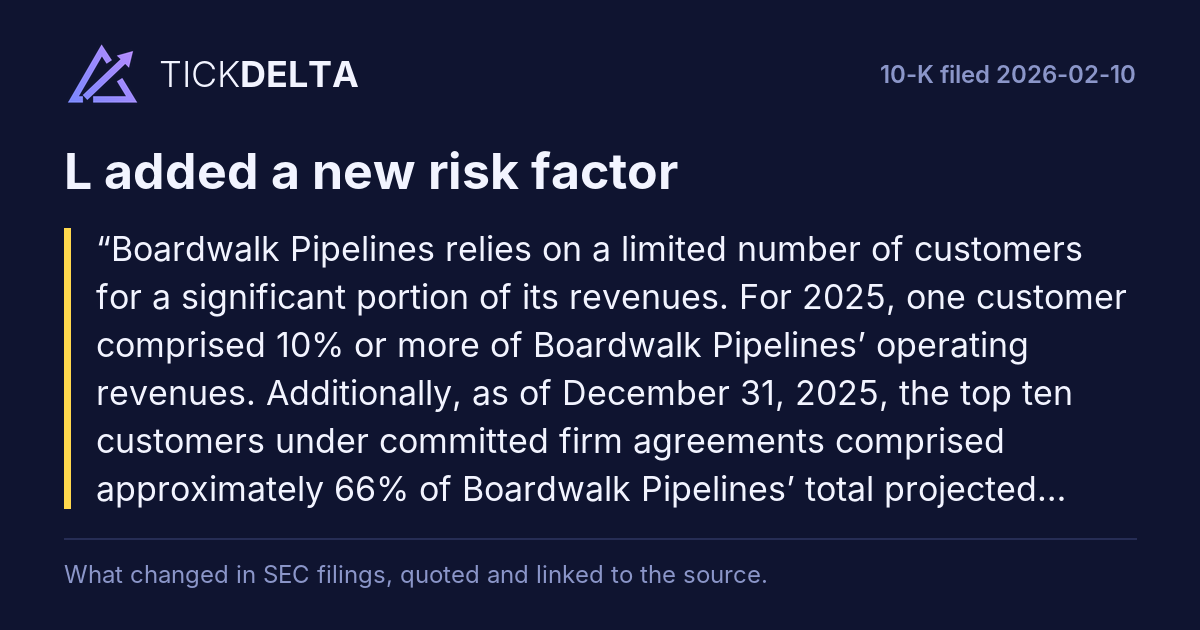
Boardwalk Pipelines relies on a limited number of customers for a significant portion of its revenues.
For 2025, one customer comprised 10% or more of Boardwalk Pipelines’ operating revenues. Additionally, as of December 31, 2025, the top ten customers under committed firm agreements comprised approximately 66% of Boardwalk Pipelines’ total projected operating revenues. If any of Boardwalk Pipelines’ significant customers have credit or financial problems that result in bankruptcy, a delay or failure to pay for services Boardwalk Pipelines provided, to post the required credit support for construction associated with Boardwalk Pipelines’ growth projects or existing contracts or to repay the gas they owe Boardwalk Pipelines, it could have a material adverse effect on Boardwalk Pipelines’ revenues, results of operations and financial condition.
Read in the 10-K ↗
Paragraphs in the 10-Q filed Nov 2, 2026 that were not in the one before
14 paragraphs in the 10-Q filed Nov 2, 2026 with nothing like them in the 10-Q filed Aug 3, 2026 (at least half the words must differ; new numbers alone do not count). Quoted exactly, grouped by the item heading above them. This is text that changed, not a judgement of how serious it is.
Financial statements and notes
In the third quarter of 2026, the Company entered into credit default swap index transactions that would potentially benefit from widening investment grade credit spreads associated with the underlying securities comprising the index. As of September 30, 2026, the notional amount of the Company’s credit default swap index investment was $ 4.3 billion. The derivative was measured using observable market inputs, including credit spreads, and the net asset was approximately $ 55 million and included in Short-term investments as of September 30, 2026. For the three and nine months ended September 30, 2026, Net investment income related to the position was $ 3 million.
Read in the 10-Q ↗
Annually in the third quarter, actuarial analysis is performed on policyholder morbidity, persistency, premium rate actions and expense experience. This analysis, combined with judgment, informs the setting of updated cash flow assumptions used to estimate the LFPB. Actuarial analysis includes predictive modeling, actual to expected experience comparisons and trend analysis. Applicable industry research is also considered.
Read in the 10-Q ↗
The cash flow assumption updates for the third quarter of 2026 resulted in a $ 173 million pretax increase in the LFPB. Included in the assumption updates were unfavorable cost of care inflation and morbidity impacts, partially offset by favorable premium rate actions.
Read in the 10-Q ↗
The cash flow assumption updates for the third quarter of 2025 resulted in a $ 7 million pretax increase in the LFPB. Included in the assumption updates were unfavorable incidence, claim closure and cost of care inflation impacts, offset by favorable premium rate actions.
Read in the 10-Q ↗
unfavorable net prior year loss reserve development and higher catastrophe losses, partially offset by higher net investment income.
Read in the 10-Q ↗
Show the other 9
Core results for Other Insurance Operations decreased $147 million for the three months ended September 30, 2026 as compared with the comparable 2025 period. Both periods include assumption updates as a result of the annual long-term care reserve reviews completed in the third quarter of each year.
Read in the 10-Q ↗
The cash flow assumption updates from the annual reserve review for the three months ended September 30, 2026 resulted in a pretax increase in long-term care reserves of $173 million, primarily driven by unfavorable cost of care inflation and morbidity impacts, partially offset by favorable premium rate actions. However, the unfavorable expected cash flows from the reserve assumption updates are almost entirely offset by a favorable economic impact from anticipated future investment cash flows from recent investment portfolio actions. Under GAAP accounting, the anticipated benefits of these portfolio actions are not immediately reflected in earnings, but instead are recognized through net investment income over time.
Read in the 10-Q ↗
The cash flow assumption updates from the annual reserve review for the three months ended September 30, 2025 resulted in a pretax increase in long-term care reserves of $7 million.
Read in the 10-Q ↗
The impact of the assumption updates as a result of the annual long-term care reserve reviews completed in the third quarter of each year is discussed in the three month summary above.
Read in the 10-Q ↗
The table below summarizes the estimated pretax impact on CNA’s results of operations from various hypothetical revisions to its LFPB reserve assumptions. CNA has assumed that revisions to such assumptions would occur in each policy type, age and duration within each long-term care product. The impact of each sensitivity is discrete and does not reflect the impact one factor may have on another or the mitigating impact from management actions, which may include additional future premium rate increases. Although such hypothetical revisions are not currently required or anticipated, CNA believes they could occur based on past variances in experience and its expectations of the ranges of future experience that could reasonably occur. Any actual adjustment would be dependent on the specific policies affected and,
Read in the 10-Q ↗
therefore, may differ from the estimates summarized below. The estimated impacts to results of operations in the table below are after consideration of any net premium ratio impacts.
Read in the 10-Q ↗
September 30, 2026 Estimated Reduction to Pretax Income (In millions) ────────────────────────────────────────────────────────────────────────────────────────────────────────────── Hypothetical revisions Morbidity: 2.5% increase in morbidity $ 320 5% increase in morbidity 640 Persistency: 5% decrease in active life mortality and lapse $ 190 10% decrease in active life mortality and lapse 380 Premium rate actions: 25% decrease in future unapproved rate increase premium $ 30 50% decrease in future unapproved rate increase premium 60
Read in the 10-Q ↗
As part of the annual reserve review, statutory long-term care reserve adequacy is evaluated by premium deficiency testing, by comparing statutory policy level reserves on a carried basis with best estimate reserves, which incorporates best estimate discount rate and liability assumptions in its determination. Statutory margin is the excess of policy level reserves on a carried basis over the corresponding reserves determined on a best estimate basis. As of September 30, 2026, CNA’s statutory long-term care margin was $1.3 billion.
Read in the 10-Q ↗
(e) The Carthage Crossing project is expected to increase the capacity of Boardwalk Pipelines’ pipeline system from Carthage, Texas, to North Louisiana through the addition of compression facilities and auxiliary equipment. This project is supported by a precedent agreement with a utility customer and could expand based on the results of Boardwalk Pipelines’ open season.
Read in the 10-Q ↗
The 10-Q's risk factors against the 10-K
Item 1A of the 10-Q filed Nov 2, 2026 against Item 1A of the 10-K filed Feb 10, 2026.
A 10-Q repeats only the risks that changed, so a 10-K paragraph that is missing from it is not counted as removed.
Added is a paragraph with nothing like it in the 10-K, Reworded a sentence that is in both with several words changed,
Quiet changes a sentence in both where one to four words changed and one is a hedge or a modal
(cut words struck through, new words highlighted and underlined).
Text on the page, not a score; each links to the filing at sec.gov.
What the 10-Q itself says about its risk factors:
Read in the 10-Q ↗
Our Annual Report on Form 10-K for the year ended December 31, 2025 includes a discussion of material risk factors facing the Company. There have been no material changes to such risk factors as of the date of this Report.
1 paragraph in the 10-Q's Item 1A, and none of them adds, rewords or quietly edits a paragraph of the 10-K's.