Paragraphs with nothing like them in last year's 10-K
Quoted exactly
4 paragraphs in Risk Factors of the 10-K filed Feb 26, 2026
with nothing like them in the 10-K filed Feb 21, 2025. Quoted exactly.
Paragraphs that were only edited are under 10-K change.
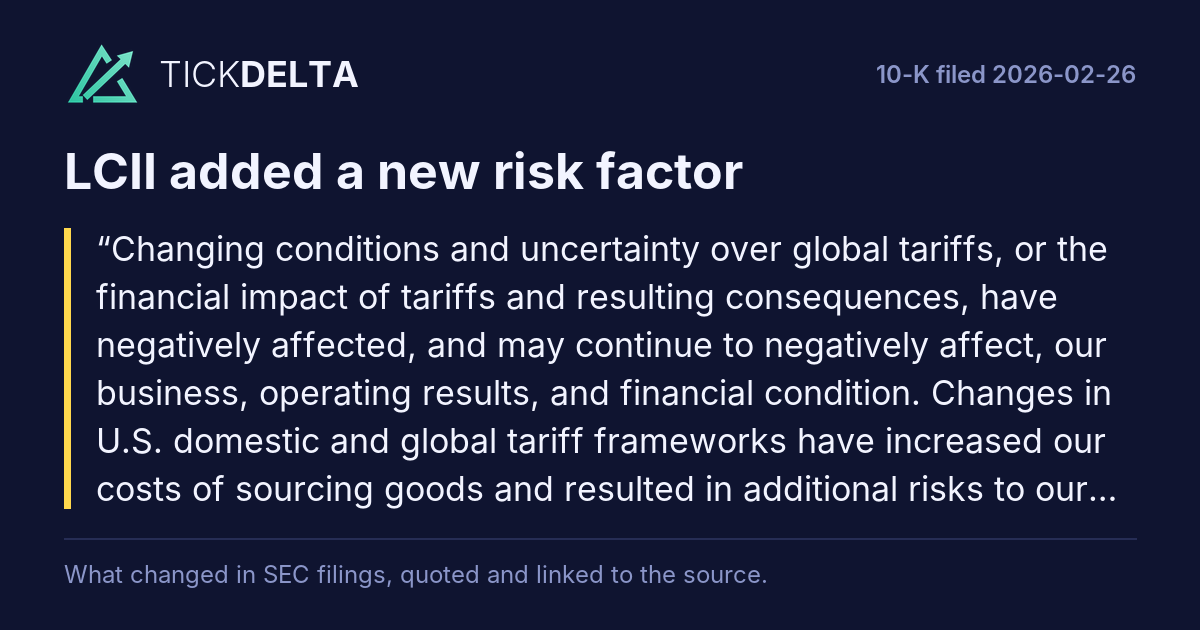
Changing conditions and uncertainty over global tariffs, or the financial impact of tariffs and resulting consequences, have negatively affected, and may continue to negatively affect, our business, operating results, and financial condition.
Changes in U.S. domestic and global tariff frameworks have increased our costs of sourcing goods and resulted in additional risks to our supply chain. The U.S. government has imposed significant tariffs impacting a wide variety of goods across multiple countries and indicated that additional tariffs may be imposed in the near future. In response, some countries have announced or imposed tariffs on goods made in the U.S. These actions resulted in higher material costs for us in 2025, which could continue or worsen, and pricing actions we have taken, or in the future may take, in light of material cost increases could negatively impact demand for our products, any of which could have a material adverse effect on our business, financial condition, results of operations and cash flow.
Further increasing uncertainty related to trade policies, on February 20, 2026, the U.S. Supreme Court ruled against the U.S. presidential administration’s use of tariffs under the International Emergency Economic Powers Act ("IEEPA"), and U.S. Customs and Border Protection halted collections of IEEPA tariffs on February 24, 2026. However, the decision creates uncertainty related to various aspects of the tariffs previously collected under the IEEPA, including whether, and if so, how, companies may be able to recover any portion of IEEPA tariffs previously paid. Further, not all tariffs announced throughout 2025 were impacted by this U.S. Supreme Court decision since many tariffs were imposed under other legal authorities that remain in effect and new tariffs may continue to be implemented through these other legal authorities. Additionally, in response to the U.S. Supreme Court ruling, the U.S. presidential administration imposed a new worldwide tariff effective for 150 days from February 24, 2026. The imposition of these new, worldwide tariffs, as well as the potential for further tariff actions by the U.S. presidential administration or others, represents a significant source of uncertainty and could have a material adverse effect on our business, financial condition, and results of operations.
In addition, political tensions and uncertainty as a result of rapidly changing trade policies could reduce trade volume, investment, technological exchange, and other economic activities between major international economies, resulting in a material adverse effect on global economic conditions and the stability of global financial markets, which could in turn have a material adverse impact on our business, financial condition, and results of operations.
Paragraphs in the 10-Q filed Nov 5, 2026 that were not in the one before
New in the latest 10-Q
3 paragraphs in the 10-Q filed Nov 5, 2026 with nothing like
them in the 10-Q filed Aug 5, 2026 (at least half the words must differ; new numbers alone do not count).
Quoted exactly, grouped by the item heading above them. This is text that changed, not a judgement of how serious it is.
Financial statements and notes
Number of Shares Weighted Average Price Outstanding at December 31, 2025 251,016 $ 114.55 Granted 53,193 133.20 Dividend equivalents 5,999 104.58 Forfeited (168,585) 114.94 Outstanding at September 30, 2026 141,623 $ 121.33
Read in the 10-Qopen_in_new
Risk Factors
Actions taken by parties who oppose the Mergers could, among other things, negatively impact our ability to complete the Mergers or the timing thereof.
Read in the 10-Qopen_in_new
On October 22, 2026, we received an unsolicited, non-binding proposal from Monomoy Capital Partners (“Monomoy”) to acquire all of the outstanding shares of our common stock for $101.00 per share in cash (the “Monomoy Proposal”), and on October 30, 2026, we announced that our Board of Directors, in consultation with outside financial and legal advisors, unanimously determined that the Monomoy Proposal does not constitute a superior proposal and is not reasonably likely to lead to a superior proposal. At this time, we are not aware of what, if any, actions Monomoy will take to further its unsolicited proposal or more generally express its opposition to the Mergers. Any actions taken by Monomoy or other third parties who oppose the Mergers, even if ultimately unsuccessful, could negatively impact our ability to complete the Mergers or the timing thereof. Some of our stockholders may be persuaded to vote against approval of the Mergers as a result of the Monomoy Proposal or other actions that may be taken by Monomoy or other third parties who oppose the Mergers, and consequently, the required stockholder approval may not be obtained. Moreover, the review and consideration of the Monomoy Proposal (and any similar proposal that Monomoy or another party may make in the future) has been, and may continue to be, a distraction for our management and employees, and have required, and may continue to require, the expenditure of time and resources by us. The Monomoy Proposal may also result in uncertainty for our current and potential business partners, which may cause them to change their business relationship with us or otherwise disrupt our business.
Read in the 10-Qopen_in_new
The 10-Q's risk factors against the 10-K
Item 1A of the 10-Q filed Nov 5, 2026 against Item 1A of the 10-K filed Feb 26, 2026.
A 10-Q repeats only the risks that changed, so a 10-K paragraph that is missing from it is not counted as removed.
Added is a paragraph with nothing like it in the 10-K, Reworded a sentence that is in both with several words changed,
Quiet changes a sentence in both where one to four words changed and one is a hedge or a modal
(cut words struck through, new words highlighted).
Text on the page, not a score; each links to the filing at sec.gov.
What the 10-Q itself says about its risk factors:Other than the risk factors set forth below, there have been no material changes to the matters discussed in Part I, Item 1A - Risk Factors in our Annual Report on Form 10-K as filed with the SEC on February 26, 2026.
Read in the 10-Qopen_in_new
Added10-Q Nov 5, 2026 vs 10-K Feb 26, 2026
We have identified certain additional risk factors in connection with the Merger Agreement and the Mergers. These risks and the other risks associated with the Mergers are more fully discussed in the joint proxy statement/prospectus Patrick and we filed with the SEC on October 19, 2026 in connection with the Mergers.
Read it in the 10-Q at sec.govopen_in_new
Added10-Q Nov 5, 2026 vs 10-K Feb 26, 2026
The Mergers are subject to conditions, including certain conditions that are beyond our and Patrick’s control and may not be satisfied at all or on a timely basis. Failure to complete the Mergers could have material and adverse effects on us.
Read it in the 10-Q at sec.govopen_in_new
Added10-Q Nov 5, 2026 vs 10-K Feb 26, 2026
Completion of the Mergers is subject to a number of conditions set forth in the Merger Agreement. Some of the conditions, such as approval by our stockholders and by Patrick stockholders and certain regulatory approvals, are beyond our and Patrick’s control, which make the completion and timing of the completion of the Mergers uncertain. In addition, the Merger Agreement contains certain termination rights for both us and Patrick, which if exercised, will also result in the Mergers not being consummated. Furthermore, the governmental authorities from which the regulatory approvals are required may impose conditions on the completion of the Mergers or require changes to the terms of the Merger Agreement.
Read it in the 10-Q at sec.govopen_in_new
Added10-Q Nov 5, 2026 vs 10-K Feb 26, 2026
If the Mergers are not completed for any reason, our ongoing business may be adversely affected and, without realizing any of the benefits of having completed the Mergers, we would be subject to a number of risks, including the following:
Read it in the 10-Q at sec.govopen_in_new
Added10-Q Nov 5, 2026 vs 10-K Feb 26, 2026
• we may experience negative reactions from the financial markets, including negative effects on our stock price;
Read it in the 10-Q at sec.govopen_in_new
Show the other 7
Added10-Q Nov 5, 2026 vs 10-K Feb 26, 2026
• we will have incurred substantial expenses and will be required to pay certain costs relating to the Mergers, including legal, accounting and other fees, whether or not the Mergers are completed; and
Read it in the 10-Q at sec.govopen_in_new
Added10-Q Nov 5, 2026 vs 10-K Feb 26, 2026
• our management team will have devoted substantial time and resources to matters relating to the Mergers, and would otherwise have devoted such time and resources to other opportunities that may have been beneficial to us, which could cause us to lag competitor advances.
Read it in the 10-Q at sec.govopen_in_new
Added10-Q Nov 5, 2026 vs 10-K Feb 26, 2026
In addition, if the Merger Agreement is terminated and we seek another merger or business combination, our stock price could decline, which could make it more difficult to find a party willing to offer equivalent or more attractive consideration than the consideration Patrick has agreed to provide in the Mergers.
Read it in the 10-Q at sec.govopen_in_new
Added10-Q Nov 5, 2026 vs 10-K Feb 26, 2026
We will be subject to business uncertainties and contractual restrictions while the Mergers are pending.
Read it in the 10-Q at sec.govopen_in_new
Added10-Q Nov 5, 2026 vs 10-K Feb 26, 2026
Uncertainty about the effect of the Mergers on our employees and customers may have an adverse effect on us. These uncertainties may impair our ability to attract, retain, and motivate key personnel until the Mergers are completed and could cause customers and others that deal with us to seek to change existing business relationships with us. In addition, subject to certain exceptions, we have agreed to operate our business in the ordinary course in all material respects and to refrain from taking certain actions that may adversely affect our ability to consummate the transactions contemplated by the Merger Agreement on a timely basis without the consent of Patrick. These restrictions may prevent us from pursuing attractive business
Read it in the 10-Q at sec.govopen_in_new
Added10-Q Nov 5, 2026 vs 10-K Feb 26, 2026
opportunities that may arise prior to the completion of the Mergers. Employee retention may be particularly challenging during the pendency of the Mergers, as employees may experience uncertainty about their roles with the combined company following the Mergers.
Read it in the 10-Q at sec.govopen_in_new
Added10-Q Nov 5, 2026 vs 10-K Feb 26, 2026
The Merger Agreement limits our and Patrick’s abilities to pursue alternatives to the Mergers and could discourage a potential competing acquiror or other strategic transaction partner from making a favorable alternative transaction proposal.
Read it in the 10-Q at sec.govopen_in_new
The first 12 of 30 are shown (at most 12 of each type).
Phrases used for the first time
Two-word phrases in Risk Factors of the 10-K filed Feb 26, 2026 that are in none of the 1 earlier 10-Ks stored, back to Feb 21, 2025
supreme court ×3trade policies ×2ieepa tariffs ×2tariffs previously ×2legal authorities ×2presidential administration ×2new worldwide ×2civil unrest ×2indentures governing ×2
Where each one is used
- supreme court: Further increasing uncertainty related to trade policies, on February 20, 2026, the U.S. Supreme Court ruled against the U.S. presidential administration’s use of tariffs under the International Emergency Economic Powers Act ("IEEPA"), and U.S. Customs and Border Protection halted collections of IEEPA tariffs on...
- trade policies: Further increasing uncertainty related to trade policies, on February 20, 2026, the U.S. Supreme Court ruled against the U.S. presidential administration’s use of tariffs under the International Emergency Economic Powers Act ("IEEPA"), and U.S. Customs and Border Protection halted collections of IEEPA tariffs on...
- ieepa tariffs: Further increasing uncertainty related to trade policies, on February 20, 2026, the U.S. Supreme Court ruled against the U.S. presidential administration’s use of tariffs under the International Emergency Economic Powers Act ("IEEPA"), and U.S. Customs and Border Protection halted collections of IEEPA tariffs on...
- tariffs previously: Further increasing uncertainty related to trade policies, on February 20, 2026, the U.S. Supreme Court ruled against the U.S. presidential administration’s use of tariffs under the International Emergency Economic Powers Act ("IEEPA"), and U.S. Customs and Border Protection halted collections of IEEPA tariffs on...
- legal authorities: Further increasing uncertainty related to trade policies, on February 20, 2026, the U.S. Supreme Court ruled against the U.S. presidential administration’s use of tariffs under the International Emergency Economic Powers Act ("IEEPA"), and U.S. Customs and Border Protection halted collections of IEEPA tariffs on...
- presidential administration: Further increasing uncertainty related to trade policies, on February 20, 2026, the U.S. Supreme Court ruled against the U.S. presidential administration’s use of tariffs under the International Emergency Economic Powers Act ("IEEPA"), and U.S. Customs and Border Protection halted collections of IEEPA tariffs on...
- new worldwide: Further increasing uncertainty related to trade policies, on February 20, 2026, the U.S. Supreme Court ruled against the U.S. presidential administration’s use of tariffs under the International Emergency Economic Powers Act ("IEEPA"), and U.S. Customs and Border Protection halted collections of IEEPA tariffs on...
- civil unrest: Epidemic outbreaks, terrorist acts, political events, and civil unrest could disrupt our business and result in lower sales and otherwise adversely affect our financial performance.
The 10-K at sec.govopen_in_new
Used at least twice, small words left out. Counted, not picked: a phrase can be new because the company renamed something.
Sources
Item 1A of each 10-K and 10-Q on EDGAR, quoted exactly. Each paragraph links to the filing at sec.gov.
Also
10-K change: what was reworded or cut, section by section.
Work with it
Excel workbook · CSV. Google Sheet that stays up to date: paste =IMPORTDATA("https://tickdelta.com/company/LCII/export.csv") into a cell.