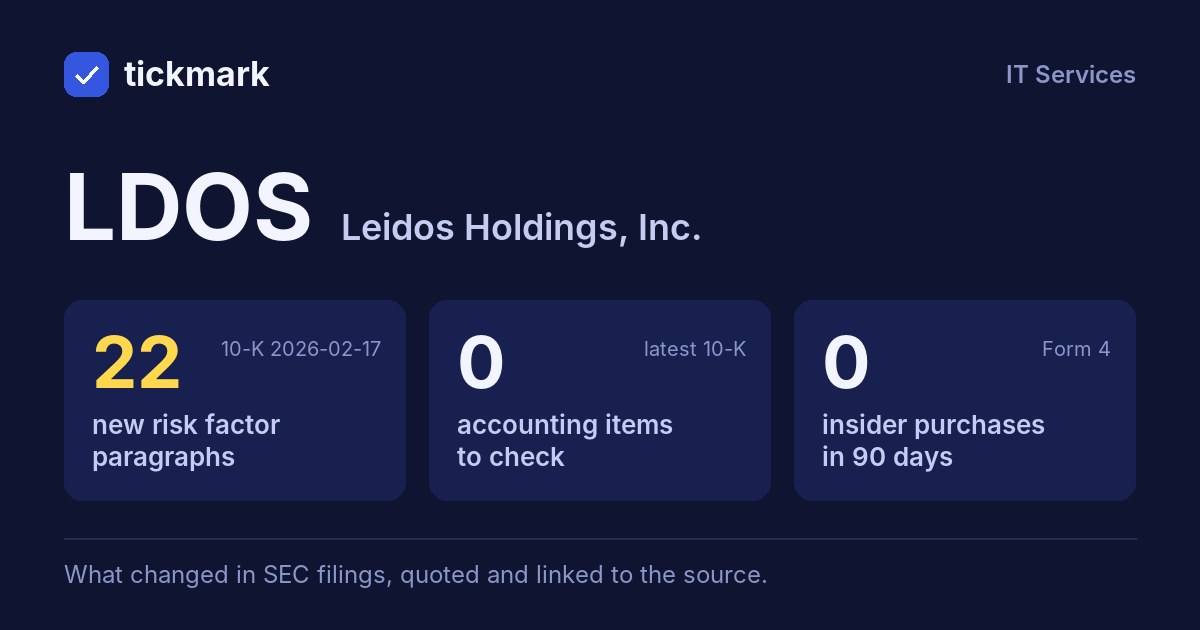
10-K 0001336920-26-000030 (2026-02-17) vs 10-K 0001336920-25-000006 (2025-02-11)
| Section | Compared text | Words now | Changed |
|---|
| Risk Factors | Item 1A | 20,043 |
15.1% |
| MD&A | Item 7 | 5,595 |
33.4% |
| Legal Proceedings | Item 3, via Note 21 – Commitments and Contingencies | 401 |
21.2% |
| Accounting Policies | Item 8, Note 3 – Summary of Significant Accounting Policies | 5,547 |
7.9% |
The redline: what was cut and what was added
In each section, the paragraph that changed most, marked against last year's 10-K:
cut words struck through, new words highlighted and underlined.
Risk Factors 332 words changed in this paragraph; it is 33% similar to last year's version.
As a government contractor and a provider of information technology services operating in multiple regulated industries and geographies, we and our service providers, suppliers and subcontractors collect, store, transmit, and otherwise process personal, confidential, proprietary, and sensitive information, including protected health information, personnel information, personal information, classified information, controlled unclassified information, intellectual property and financial information, concerning our business, employees, and customers. Therefore, we are continuously exposed to unauthorized attempts to compromise access, release or otherwise compromise such information through cyber-attacks and other information security threats, including, among other things, physical break-ins, theft, denial-of-service attacks, worms, computer viruses, software bugs, malicious or destructive code, social engineering, phishing attacks and impersonating authorized users, credential stuffing, account takeovers, insider threats, malfeasance or improper access by employees or service providers, human error, fraud, use of AI, “bots” or other automation software, or other similar disruptions. We are also exposed to hackers who have requested “ransom” in exchange for not disclosing information or restoring access to information or systems. These techniques may be perpetrated by internal bad actors, such as employees or contractors, or by third parties (including traditional computer hackers, persons involved with well-funded organized crime or state-sponsored actors). Any electronic or physical break-in or other security breach or compromise of our information technology systems and networks or facilities, or those of our service providers, suppliers, joint ventures or subcontractors, may jeopardize the confidentiality, integrity or availability of information, including personal, confidential, proprietary or sensitive information, stored or transmitted through these systems and networks or stored in those facilities. This could lead to disruptions in mission-critical systems, unauthorized access to or release of personal, confidential, proprietary, sensitive or otherwise protected information and corruption of data or systems. We could also be subject to operational downtimes, delays and other detrimental impacts on our operations or ability to provide products and services to our customers. We are also increasingly subject to customer-driven cybersecurity certification requirements, including but not limited to CMMC, which are expected to be necessary to win future contracts. Security incidents could also result in liability, trigger other obligations under such contracts, or increase the difficulty of winning future contracts. Many statutory requirements, both in the U.S. and abroad, also include different obligations for companies to provide notice of information security incidents involving certain types of information (including obligations to notify affected individuals and regulators in the event of cybersecurity breaches involving certain personal information), which could result from breaches of our service providers, our suppliers or subcontractors.
Source: Item 1A, 10-K 0001336920-26-000030 vs Item 1A, 10-K 0001336920-25-000006
MD&A 193 words changed in this paragraph; it is 35% similar to last year's version.
On FFP For contracts requiring which involve complex deliverables, such as system integration and cost-plus integration, we usually recognize revenue over time as the work is completed. For contracts with an FFP component or variable consideration, revenue is generally recognized over time fees, we measure progress using a method that measures the extent of progress towards completion of a performance obligation, principally using a cost-input method (referred to as the cost-to-cost method). Under the cost-to-cost an input method, whereby revenue is recognized based on the proportion percentage of total costs incurred to estimated date compared to total costs-at-completion (“EAC”), which require us to use estimates costs we anticipate by the end of the contract. Commonly referred to as the “cost-to-cost” method. To do this, we must estimate both the total revenue and cost associated with the total costs needed to design, manufacture build, and delivery of deliver our offerings products and services. A performance obligation’s EAC includes These cost estimates include all direct costs costs, such as materials, labor, subcontract costs, subcontractors, overhead and a ratable portion of general and administrative costs. expenses. If we determine that the estimated total expected cost of completing a performance obligation whose associated contract will be more than the total revenue is recognized using the cost-to-cost method exceeds the estimated transaction price, we expect to receive, we record the entire amount of the expected loss is recognized in operations in the period the loss is known. when identified.
Source: Item 7, 10-K 0001336920-26-000030 vs Item 7, 10-K 0001336920-25-000006
Accounting Policies 93 words changed in this paragraph; it is 51% similar to last year's version.
Our cash equivalents are primarily comprised of investments in several large institutional money market accounts, with original maturity of three months or less. Outstanding Effective fiscal 2025, we changed our policy to exclude outstanding payments are included within from “Cash and cash equivalents” and “Accounts payable and accrued liabilities” correspondingly on the consolidated balance sheets. At To reflect the change in accounting policy, we recast "Cash and cash equivalents" and "Accounts payable and accrued liabilities" on the consolidated balance sheet as of January 3, 2025, reducing both balances by $94 million from the previously reported amounts. The recast of the consolidated statement of cash flows for the year ended January 3, 2025, and December 29, 2023, $94 resulted in an increase of $43 million and $136 $22 million, respectively, of outstanding payments were included within “Cash and to net cash equivalents.” provided by operations.
Source: Item 8, Note 3 – Summary of Significant Accounting Policies, 10-K 0001336920-26-000030 vs Item 8, Note 3 – Summary of Significant Accounting Policies, 10-K 0001336920-25-000006
Every change, by type
Sentences and paragraphs of LDOS's Risk Factors and MD&A, 10-K 2026-02-17 against 10-K 2025-02-11.
Each links to the text at sec.gov.
Quiet changes are sentences kept from last year with one to four words changed, at least one of them a hedge, a modal or a qualifier
(may, could, will, not, significant, material…). A year or date rolling forward is not counted.
The full word list
adverse, adversely, all, although, anticipate, anticipates, any, approximately, believe, believes, can, cannot, certain, could, expect, expects, generally, however, if, intend, intends, largely, likely, many, material, materially, may, might, most, must, never, no, not, possible, primarily, probable, should, significant, significantly, some, substantial, substantially, unlikely, will, would
AddedRisk Factors
uJoint ventures, other strategic alliances, and strategic business transactions may not achieve intended results. We may experience operational challenges in integrating or segregating assets for such a venture or transaction.
Read it in 10-K 2026-02-17 at sec.gov ↗
AddedRisk Factors
In particular, the federal budget and debt ceiling are expected to continue to be the subject of considerable debate, which could have a significant impact on defense spending broadly and our programs in particular. The budget environment, including budget caps mandated by the Budget Control Act of 2011 (the “BCA”) for fiscal years 2022 and 2023, which were reinstituted with established budget caps for 2024 and 2025 under The Fiscal Responsibility Act of 2023, and uncertainty surrounding the debt ceiling and the appropriations process, remain significant short and long-term risks for the Company. Considerable uncertainty exists regarding how future budget and program decisions will unfold, including the defense spending priorities of the current administration and Congress, what challenges budget reductions (required by the BCA and otherwise) will present for the defense industry and whether annual appropriations bills for all agencies will be enacted in a timely manner.
Read it in 10-K 2026-02-17 at sec.gov ↗
AddedRisk Factors
The funding of U.S. government programs is subject to an annual congressional budget authorization and appropriations process. In years when the U.S. government does not complete its appropriations before the beginning of the new fiscal year on October 1, government operations are typically funded pursuant to a “continuing resolution,” which allows federal government agencies to operate at spending levels approved in the previous appropriations cycle but does not authorize new spending initiatives.
Read it in 10-K 2026-02-17 at sec.gov ↗
AddedRisk Factors
To the extent the U.S. Congress is unable to approve the annual federal budget before the expiration of a continuing resolution, funding for new projects may not be available and funding on contracts we are already performing may be delayed. If Congressional efforts to approve such funding fail, and Congress is unable to craft a long-term agreement on the U.S. government’s ability to incur indebtedness in excess of its current limits, the U.S. government may not be able to fulfill its current funding obligations and there could be significant disruption to all discretionary programs, which would have corresponding impacts on us and our industry. The use of a continuing resolution at prior-year funding levels may limit new contract starts, cancellation of planned new initiatives, constrain production rate increases, delay awards or extensions, and introduce funding uncertainty that could affect bidding, scheduling and profitability. In addition, a failure to complete the budget process and fund government operations pursuant to a continuing resolution may result in a U.S. government shutdown, which could result in us incurring substantial costs without reimbursement under our contracts. If a prolonged government shutdown were to occur, it could result in program cancellations, disruptions and/or stop work orders and could limit the U.S. government’s ability to effectively progress programs and to make timely payments, and our ability to perform on our U.S. government contracts and successfully compete for new work. The delay or cancellation of key programs or the delay of contract payments may have a material adverse effect on our revenue and operating results. In addition, when supplemental appropriations are required to operate the U.S. government or fund specific programs and the passage of legislation needed to approve any supplemental appropriation bill is delayed, the overall funding environment for our business could be adversely affected. We continuously review our operations in an attempt to identify programs potentially at risk from continuing resolutions or failure by the U.S. government to complete its appropriations process so that we can consider appropriate contingency plans.
Read it in 10-K 2026-02-17 at sec.gov ↗
AddedRisk Factors
on a contract, we may be at risk for reimbursement of those costs unless or until additional funds are obligated to the contract. In addition, if and when supplemental appropriations are required to operate the U.S. government or fund specific programs and passage of legislation needed to approve any supplemental appropriations bill is delayed, the overall funding environment for our business could be adversely affected.
Read it in 10-K 2026-02-17 at sec.gov ↗
AddedRisk Factors
In addition, proposed comprehensive reforms to the Federal Acquisition Regulations, including those contemplated under Executive Order 14275, “Restoring Common Sense to Federal Procurement,” issued on April 15, 2025, could create uncertainty in our contracting environment and impact our business. These reforms may result in changes to procurement processes, evaluation criteria, cost allowability, compliance obligations, or reporting requirements that could increase our administrative burden and operating costs. Transition period or inconsistencies in the implementation of new rules may delay contract awards, complicate bid strategies, or require modifications to existing contracting practices. In addition, to the extent the proposed reforms ultimately expand the ability of commercial firms to compete for defense and other federal contracts, we may face heightened competition from new market entrants with different cost structures, procurement models, or technological approach, which could pressure our pricing, reduce our win rates, or erode our market share. If we are unable to adapt efficiently to revised federal procurement requirements, our competitiveness, performance under existing contracts, and financial results could be adversely affected. The Company continues to evaluate the potential impact for any proposed or contemplated reforms.
Read it in 10-K 2026-02-17 at sec.gov ↗
AddedRisk Factors
As a government contractor and a provider of information technology services operating in multiple regulated industries and geographies, we and our service providers, suppliers and subcontractors collect, store, transmit, and otherwise process personal, confidential, proprietary, and sensitive information, including protected health information, personnel information, personal information, classified information, controlled unclassified information, intellectual property and financial information, concerning our business, employees, and customers. Therefore, we are continuously exposed to unauthorized attempts to compromise access, release or otherwise compromise such information through cyber-attacks and other
Read it in 10-K 2026-02-17 at sec.gov ↗
AddedRisk Factors
Additionally, if any of our employees, contractors, consultants, vendors or service providers use any third-party AI-powered software in connection with our business or the services they provide to us, it may lead to the inadvertent disclosure or incorporation of our confidential information into publicly available training sets, which may impact our ability to realize the benefit of, or adequately maintain, protect and enforce our intellectual property or confidential information, harming our
Read it in 10-K 2026-02-17 at sec.gov ↗
AddedRisk Factors
competitive position and business. Further, any output created by us using AI tools may not be subject to copyright protection, which may adversely affect our intellectual property rights in, or ability to commercialize or use, any such content. In the U.S., a number of civil lawsuits have been initiated related to the foregoing and other concerns, any one of which may, among other things, require us to limit the ways in which our AI systems are trained and may affect our ability to develop our AI-powered products and solutions. If we do not have sufficient rights to use the data or other material or content on which the AI tools we use rely, we also may incur liability through the violation of applicable laws and regulations, third-party intellectual property, data privacy, or other rights, or contracts to which we are a party.
Read it in 10-K 2026-02-17 at sec.gov ↗
AddedRisk Factors
As the utilization of AI becomes more prevalent, we anticipate that it will continue to present new or unanticipated ethical, reputational, technical, operational, legal, competitive and regulatory issues, among others. We expect that our incorporation of AI in our business will require additional resources, including the incurrence of additional costs, to develop and maintain our products and solutions and features to minimize potentially harmful or unintended consequences, to comply with applicable and emerging laws and regulations, to maintain or extend our competitive position, and to address any ethical, reputational, technical, operational, legal, competitive or regulatory issues which may arise as a result of any of the foregoing. As a result, the challenges presented with our use of AI could adversely affect our business, financial condition and results of operations.
Read it in 10-K 2026-02-17 at sec.gov ↗
AddedRisk Factors
Joint ventures, other strategic alliances, and strategic business transactions may not achieve intended results. We may experience operational challenges in integrating or segregating assets for such a venture or transaction.
Read it in 10-K 2026-02-17 at sec.gov ↗
AddedRisk Factors
We participate in joint ventures, including some instances where we are a minority owner and do not operate the assets, and may enter into other similar arrangements in the future. Although we have sought to protect our interests, joint ventures and strategic alliances inherently involve special risks and may not achieve the intended results. Whether or not we hold majority interests or maintain operational control in such arrangements, our joint venture and other business partners may take certain actions and positions, or experience difficulties, that may negatively impact us and/or our reputation, such as:
Read it in 10-K 2026-02-17 at sec.gov ↗
RemovedRisk Factors
exceed requirements, to the extent we do not, we will be unable to bid on such contract awards, which could adversely impact our revenue and our profitability.
Read it in 10-K 2025-02-11 at sec.gov ↗
RemovedRisk Factors
interruption insurance may be inadequate to compensate us for all losses resulting from any system or operational failure or disruption.
Read it in 10-K 2025-02-11 at sec.gov ↗
RewordedRisk Factors
In addition, negative publicity, including reports from the press sustained or recurring media coverage, social media coverage, commentary, or other public communications that criticize our business practices, the nature of our products or services, or the defense industry more broadly, regardless of accuracy or completeness, and which could pertain to employee or subcontractor misconduct, conflicts of interest, poor contract performance, deficiencies in investment, prioritization, and production, deficiencies in services, reports, products or other deliverables, security breaches or other security incidents or other aspects of our business, could harm our reputation with these agencies and with certain non-U.S. customers.
Read it in 10-K 2026-02-17 at sec.gov ↗
RewordedRisk Factors
While we have established policies, procedures, training programs, and other compliance controls designed to prevent and detect misconduct, individuals may circumvent these measures and we may not be effective, unable to prevent our employees, subcontractors, agents, suppliers, business partners or joint ventures and others working on our behalf from engaging in misconduct, fraud or other improper activities, exposing us to unforeseen risks or losses.
Read it in 10-K 2026-02-17 at sec.gov ↗
RewordedRisk Factors
We will may also be subject to numerous additional emerging and as yet unspecified cybersecurity requirements under the FAR and through other federal regulation, to include the DOD Cybersecurity Maturity Model Certification (“CMMC”) program, which, once implemented, will require successful assessment by a third party against specified cyber controls. regulations.
Read it in 10-K 2026-02-17 at sec.gov ↗
RewordedRisk Factors
For additional background on the regulations data privacy and security laws that apply to our business and the related compliance risks, see “Regulation” within Item 1 of this Annual Report on Form 10-K and the risk factor “Our business is subject to governmental review and investigation, which could adversely affect our financial position, operating results and growth prospects.” 10-K.
Read it in 10-K 2026-02-17 at sec.gov ↗
RewordedRisk Factors
Intelligence Community, either as a prime contractor or subcontractor to other contractors, represented approximately 49% of our total revenues for fiscal 2025 and 2023, and 48% of our total revenues for fiscal 2024, 49% of our total revenues for fiscal 2023 and 44% of our total revenues for fiscal 2022. 2024.
Read it in 10-K 2026-02-17 at sec.gov ↗
RewordedRisk Factors
In addition, our offerings cannot be tested and proven in all situations and are otherwise subject to unforeseen problems that could negatively affect revenue and profitability, such as problems with quality and workmanship, country of origin, delivery of subcontractor components or services, unplanned degradation of product performance, and unauthorized use or modifications of our products and services.
Read it in 10-K 2026-02-17 at sec.gov ↗
RewordedRisk Factors
We also may be limited in our ability to disclose or license such information and intellectual property to third parties and the U.S. government may also decline to make the intellectual property of others available to us under acceptable terms.
Read it in 10-K 2026-02-17 at sec.gov ↗
RewordedRisk Factors
See also the risk factor “Internal system or service failures, or failures in the systems or services of third parties on which we rely, could disrupt our business and impair our ability to effectively provide our services and products to our customers, which could damage our reputation and adversely affect our revenues and profitability.”
Read it in 10-K 2026-02-17 at sec.gov ↗
RewordedRisk Factors
For example, In Europe, the EU’s Artificial Intelligence Act (the “AI Act”), AI Act, which entered into force on August 1, 2024, began phasing-in 2025, establishes, among other things, a risk-based governance framework for regulating AI systems operating in the EU.
Read it in 10-K 2026-02-17 at sec.gov ↗
RewordedRisk Factors
Any failure or perceived failure by us, our service providers, suppliers, subcontractors, or other business partners to comply with applicable laws, regulations, our public privacy policies and other public statements about data privacy and security and other obligations in these areas could result in regulatory or government actions lawsuits against us (including civil claims, such as representative actions and other class action-type litigation), legal liability, monetary penalties, fines, sanctions, damages and other costs, orders to cease or change our processing of data, changes to our business practices, diversion of internal resources, and harm to our reputation, all of which could adversely affect our business, financial condition and results of operations.
Read it in 10-K 2026-02-17 at sec.gov ↗
RewordedRisk Factors
The FCPA or other applicable laws and regulations also require that we keep accurate books and records and maintain internal controls and compliance procedures designed to prevent any such actions.
Read it in 10-K 2026-02-17 at sec.gov ↗
RewordedRisk Factors
A finding of significant control deficiencies material weakness in our business system audits or other reviews can result in the suspension of payments or lower billing rates to our U.S. government customers until the control deficiencies are material weakness is corrected and the DCMA accepts our remediations.
Read it in 10-K 2026-02-17 at sec.gov ↗
Quiet changesRisk Factors
We recognize revenue on our service-based contracts primarily over time as there is a continuous transfer of control to the customer throughout the contract as we perform the promised services, which generally requires could require estimates of total costs at completion, fees earned on the contract, or both.
Read it in 10-K 2026-02-17 at sec.gov ↗
Quiet changesRisk Factors
In addition, our contracts generally typically indemnify our customers for third-party claims for intellectual property infringement by our services and products.
Read it in 10-K 2026-02-17 at sec.gov ↗
AddedMD&A
In this section, we discuss our financial condition, changes in financial condition and results of our operations for the year ended January 2, 2026, compared to the year ended January 3, 2025. For a discussion and analysis comparing our results for the year ended January 3, 2025, to the year ended December 29, 2023, see our Annual Report on Form 10-K for the year ended January 3, 2025, filed with the SEC on February 11, 2025, under Part II, Item 7 “Management’s Discussion and Analysis of Financial Condition and Results of Operations.”
Read it in 10-K 2026-02-17 at sec.gov ↗
AddedMD&A
uachieving annual revenue growth guided by our NorthStar 2030 strategy focusing on the growth pillars aligned with our customers’ priorities;
Read it in 10-K 2026-02-17 at sec.gov ↗
AddedMD&A
ucontinual improvements in the effectiveness and efficiency of our business processes driven by our enterprise transformation office leveraging artificial intelligence and automation; and
Read it in 10-K 2026-02-17 at sec.gov ↗
AddedMD&A
On February 3, 2026, the House of Representatives passed five of the six remaining appropriations bills to fund the federal government for fiscal year 2026. On February 13, 2026, the Homeland Security bill was not passed and DHS was shutdown until another continuing resolution is agreed upon.
Read it in 10-K 2026-02-17 at sec.gov ↗
AddedMD&A
Our effective tax rate was 23.4% in fiscal 2025 compared to 23.7% in fiscal 2024. The decrease to the effective tax rate was primarily due to a decrease in unrecognized tax benefits, partially offset by the impacts from cross-border taxes resulting from the H.R.1 Reconciliation Act, commonly referred to as the One Big Beautiful Bill Act (the “OBBBA”).
Read it in 10-K 2026-02-17 at sec.gov ↗
AddedMD&A
Effective fiscal 2025, we changed our backlog policy to include estimated future revenue on task orders expected to be awarded under sole source indefinite delivery/indefinite quantity ("IDIQ") contracts in our reported backlog. We believe this presentation provides enhanced visibility for investors and more accurately reflects the future revenues we expect to generate from our business.
Read it in 10-K 2026-02-17 at sec.gov ↗
AddedMD&A
Backlog represents the revenues we expect to recognize under negotiated contracts and unissued task orders on sole source IDIQ contracts, to the extent we believe their execution and funding to be probable. Backlog does not include potential task orders expected to be awarded under multiple award IDIQ contracts.
Read it in 10-K 2026-02-17 at sec.gov ↗
AddedMD&A
uNegotiated Unfunded Backlog. Negotiated unfunded backlog represents all remaining value on task orders that is not funded, including options, that we expect to recognize as well as expected future task orders under sole source IDIQ contracts.
Read it in 10-K 2026-02-17 at sec.gov ↗
AddedMD&A
(1)Amounts have been recast to include estimated future revenue on task orders expected to be awarded under sole source IDIQ contracts. As a result, unfunded backlog increased $4,836 million from our prior year annual report amounts.
Read it in 10-K 2026-02-17 at sec.gov ↗
AddedMD&A
Backlog at January 2, 2026, includes $149 million acquired through the acquisition of Kudu Dynamics within our National Security & Digital reportable segment.
Read it in 10-K 2026-02-17 at sec.gov ↗
AddedMD&A
On July 4, 2025, tax legislation was enacted as part of the OBBBA, implementing several corporate tax law changes as described above within Results of Operations. We anticipate our income tax payments will decrease by approximately $91 million in fiscal 2026, as compared to our estimates prior to the OBBBA enactment, due to the decrease in our estimated 2025 taxable income related to these changes. The actual decrease may be impacted by future guidance or interpretive rules issued by the U.S. Treasury, among other factors. We will continue to assess the effects on our liquidity as tax legislation evolves.
Read it in 10-K 2026-02-17 at sec.gov ↗
AddedMD&A
On January 23, 2026, Leidos, Inc. entered into a stock purchase agreement to acquire all of the shares of Entrust for a purchase price of $2.4 billion in cash, subject to customary adjustments for Entrust’s cash, debt, transaction expenses and net working capital. In connection with the stock purchase agreement, we entered into an agreement with Citigroup Global Markets Inc., which provides for a senior unsecured 364-day bridge loan facility in an aggregate principal amount of $1.4 billion. (See "Note 22—Subsequent Events" of the notes to the consolidated financial statements contained within this Annual Report on Form 10-K).
Read it in 10-K 2026-02-17 at sec.gov ↗
RemovedMD&A
uachieving annual revenue growth through internal collaboration and better leveraging of key differentiators across our company and the deployment of resources and investments into profitable growth markets;
Read it in 10-K 2025-02-11 at sec.gov ↗
RemovedMD&A
ucontinued improvement in our back-office infrastructure and related business processes for greater effectiveness and efficiency across all business functions; and
Read it in 10-K 2025-02-11 at sec.gov ↗
RemovedMD&A
On December 21, 2024, the U.S. federal government avoided a shutdown by passing into law a continuing resolution that provides government funding through March 14, 2025. The continuing resolution gives lawmakers additional time to consider the 12 appropriations bills for government fiscal year 2025. Failure to pass the appropriations bills or another continuing resolution by March 14, 2025, will result in a partial or complete federal government shutdown.
Read it in 10-K 2025-02-11 at sec.gov ↗
RemovedMD&A
Our effective tax rate was 23.7%, 48.4% and 21.8% in fiscal 2024, 2023 and 2022, respectively. The effective tax rate for fiscal 2024 was favorably impacted primarily by federal research tax credits and lower state income taxes, partially offset by an increase in unrecognized tax benefits. The effective tax rate for fiscal 2023 was unfavorably impacted primarily by non tax deductible goodwill impairments. The effective tax rate for fiscal 2022 was favorably impacted primarily by federal research tax credits and excess tax benefits related to employee stock-based payment transactions.
Read it in 10-K 2025-02-11 at sec.gov ↗
RemovedMD&A
In December 2021, the Organization for Economic Cooperation and Development enacted model rules for a new 15% global minimum tax framework (“Pillar Two”). Many governments around the world have enacted or are in the process of enacting Pillar Two legislation. The Pillar Two legislation became effective for certain jurisdictions beginning in fiscal 2024. We will continue to evaluate the impact of the rules as additional legislation gets enacted; however, there is not a material impact from jurisdictions where Pillar Two rules are currently in effect.
Read it in 10-K 2025-02-11 at sec.gov ↗
RemovedMD&A
Backlog represents the estimated amount of future revenues to be recognized under negotiated contracts. We segregate our backlog into two categories as follows:
Read it in 10-K 2025-02-11 at sec.gov ↗
RemovedMD&A
uNegotiated Unfunded Backlog. Negotiated unfunded backlog represents estimated amounts of revenue to be earned in the future from contracts for which funding has not been appropriated and unexercised priced contract options. Negotiated unfunded backlog does not include unexercised option periods and future potential task orders expected to be awarded under IDIQ, GSA Schedule or other master agreement contract vehicles, with the exception of certain IDIQ contracts where task orders are not competitively awarded and separately priced but instead are used as a funding mechanism, and where there is a basis for estimating future revenues and funding on future anticipated task orders.
Read it in 10-K 2025-02-11 at sec.gov ↗
RemovedMD&A
Year Ended January 3, December 29, December 30, 2025 2023 2022 Cost-reimbursement and fixed-price-incentive-fee 44% 48% 50% Firm-fixed-price 43% 39% 38% Time-and-materials and fixed-price-level-of-effort 13% 13% 12% Total 100% 100% 100%
Read it in 10-K 2025-02-11 at sec.gov ↗
RemovedMD&A
As of January 3, 2025, borrowings under our Credit Agreement were based on a Term Secured Overnight Financing Rate (“SOFR”) with a 0.10% Term SOFR adjustment and an applicable margin range from 1.00% to 1.50%. At January 3, 2025, the applicable margin for SOFR-denominated borrowings was 1.25%.
Read it in 10-K 2025-02-11 at sec.gov ↗
RemovedMD&A
On FFP contracts requiring system integration and cost-plus contracts with variable consideration, revenue is generally recognized over time using a method that measures the extent of progress towards completion of a performance obligation, principally using a cost-input method (referred to as the cost-to-cost method). Under the cost-to-cost method, revenue is recognized based on the proportion of total costs incurred to estimated total costs-at-completion (“EAC”), which require us to use estimates of the revenue and cost associated with the design, manufacture and delivery of our offerings and services. A performance obligation’s EAC includes all direct costs such as materials, labor, subcontract costs, overhead and a ratable portion of general and administrative costs. If the estimated cost of a performance obligation whose associated revenue is recognized using the cost-to-cost method exceeds the estimated transaction price, the entire amount of the loss is recognized in operations in the period the loss is known.
Read it in 10-K 2025-02-11 at sec.gov ↗
RemovedMD&A
Goodwill represents the excess of the fair value of consideration transferred, plus the fair value of any non-controlling interests in the acquiree, over the fair value of the net assets acquired and liabilities assumed as of the acquisition date. Goodwill is not amortized, but instead is tested annually, at the beginning of the fourth quarter, for impairment at the reporting unit level and may be tested more frequently if events or circumstances indicate that the carrying value may not be recoverable. As of January 3, 2025, and December 29, 2023, goodwill represented 46% and 48% of our total assets, respectively.
Read it in 10-K 2025-02-11 at sec.gov ↗
RemovedMD&A
Operations of the Security Enterprise Solutions (“SES”) reporting unit rely heavily on the sales and servicing of security and detection products, which prior to fiscal 2024, have been negatively impacted due to delays in airline travel infrastructure projects as customer budgets recover from the pandemic.
Read it in 10-K 2025-02-11 at sec.gov ↗
RewordedMD&A
Year Ended 2024 to 2023 2023 to 2022 (dollars in millions) January 2, January 3, December 29, December 30, Percent Percent 2026 2025 2023 2022 change change Revenues $ 17,174 $ 16,662 $ 15,438 $ 14,396 8% 7% 3% Cost of revenues 14,075 13,864 13,194 12,312 5% 7% 2% Selling, general and administrative expenses 999 983 942 951 4% (1)% 2% Acquisition, integration and restructuring costs 18 16 24 17 (33)% 41% Goodwill impairment charges — 596 — NM NM 13% Asset impairment charges 5 11 91 40 (88)% 128% (55)% Equity earnings of non-consolidated subsidiaries (32) (39) (30) (12) (30)% (150)% (18)% Operating income 2,109 1,827 621 1,088 194% (43)% 15% Non-operating expense, net (200) (188) (218) (202) (14)% (8)% (6)% Income before income taxes 1,909 1,639 403 886 NM (55)% 16% Income tax expense (447) (388) (195) (193) 99% 1% 15% Net income 1,462 1,251 208 693 NM (70)% 17% Less: net income (loss) income attributable to non-controlling interest 14 (3) 9 8 (133)% 13% (567)% Net income attributable to Leidos common stockholders $ 1,448 $ 1,254 $ 199 $ 685 NM (71)% 15% Operating margin 12.3 % 11.0 % 4.0 % 7.6 %
Read it in 10-K 2026-02-17 at sec.gov ↗
RewordedMD&A
The increase in operating income for fiscal 2024 2025 as compared to fiscal 2023, 2024, was primarily driven by impairment and restructuring charges of $689 million at the SES reporting unit in fiscal 2023, prior year write-downs on certain programs within our UK operations, program wins and a net increase in volumes, partially offset by the impact of write-downs on certain programs within our UK operations for which cost and schedule were rebaselined as well as the completion of certain programs. programs and increased in indirect expenses.
Read it in 10-K 2026-02-17 at sec.gov ↗
RewordedMD&A
The increase in revenues for fiscal 2024 2025 as compared to fiscal 2023, 2024, was primarily attributable to program wins and a net increase in volumes on certain programs, partially offset by the impact of wins, prior year write-downs on certain programs within our UK operations for which cost and schedule were rebaselined as well as the a $13 million favorable impact from exchange rate movements, partially offset by completion of certain programs.
Read it in 10-K 2026-02-17 at sec.gov ↗
RewordedMD&A
The increase was primarily due to a $625 $50 million increase in stock repurchases, a $35 $11 million increase in shares withheld for tax obligations, partially offset by a decrease of $291 million in net payments made on debt activities. activities, a $10 million increase in net capital distributions to our non-controlling interest, partially offset by a $12 million decrease in shares withheld for tax obligations.
Read it in 10-K 2026-02-17 at sec.gov ↗
RewordedMD&A
Year Ended 2024 to 2023 2023 to 2022 Commercial & International January 3, December 29, December 30, Percent change January 3, Percent change (dollars in millions) 2025 2023 2022 2025 Revenues $ 2,315 $ 2,252 $ 2,126 $ 1,900 6% 12% 3% Operating income (loss) 166 104 (560) 131 119% NM 60% Operating margin 7.2 % 4.6 % (26.3) % 6.9 %
Read it in 10-K 2026-02-17 at sec.gov ↗
RewordedMD&A
Year Ended 2024 to 2023 2023 to 2022 National Security & Digital January 2, January 3, December 29, December 30, Percent Percent (dollars in millions) 2026 2025 2023 2022 change change Revenues $ 7,611 $ 7,365 $ 7,196 $ 6,745 2% 7% 3% Operating income 760 720 672 606 7% 11% 6% Operating margin 10.0 % 9.8 % 9.3 % 9.0 %
Read it in 10-K 2026-02-17 at sec.gov ↗
RewordedMD&A
The increase in revenues operating income for fiscal 2024 2025 as compared to fiscal 2023, 2024, was primarily attributable due to operational efficiencies on certain programs and a net increase in volumes and case complexity write-ups primarily within the managed health services business, an increase in net write-ups on certain programs partially offset by increased general and program wins. administrative expenses.
Read it in 10-K 2026-02-17 at sec.gov ↗
RewordedMD&A
Non-operating expense, net increased by $16 $12 million for fiscal 2023 2025 as compared to fiscal 2022, 2024, primarily due to driven by a net increase in interest expense driven on borrowings, partially offset by higher interest rates and refinancing activities. a gain on an immaterial divested business that was not aligned to the Company's long term strategy.
Read it in 10-K 2026-02-17 at sec.gov ↗
RewordedMD&A
The increase in revenues for fiscal 2023 2025 as compared to fiscal 2022, 2024, was primarily attributable to program wins, a net increase in volumes on certain programs and program wins, $60 million recognized from the acquisition of Kudu Dynamics, partially offset by program completions and a net decrease in contract write-ups in the completion of certain contracts. current year.
Read it in 10-K 2026-02-17 at sec.gov ↗
RewordedMD&A
During In fiscal 2023, the SES reporting unit refined restructured its portfolio by discontinuing select product offerings and made strategic business decisions to exit certain product offerings, as well as cease ceasing operations in certain countries in order to better align the operations of the reporting unit with its strategic business plan.
Read it in 10-K 2026-02-17 at sec.gov ↗
RewordedMD&A
The increase in operating income for fiscal 2024 2025 as compared to fiscal 2023, 2024, was primarily attributable to program wins and improved program execution on certain programs, a net increase in volumes, partially offset by program completions and a one-time write-down related to program assets. net decrease in contract write-ups in the current year.
Read it in 10-K 2026-02-17 at sec.gov ↗
RewordedMD&A
The increase in operating income for fiscal 2024 2025 as compared to fiscal 2023, 2024, was primarily attributable to program wins and improved program execution on certain programs, partially offset by a net increase in volumes, a prior year one-time write-down related to program assets. assets, program wins and lower amortization expense.
Read it in 10-K 2026-02-17 at sec.gov ↗