Screener / SEC EDGAR /CIK 0000003570 /10-K filed Feb 26, 2026, compared with Feb 20, 2025 /Numbers from the XBRL of the 10-Ks
NYSE Utilities · Gas Utilities

Cheniere Energy, Inc. LNG

Compare with peers Embed
SEC comment letters, last 20 years

4 reviews of LNG's filings by SEC staff

UPLOAD and CORRESP
Reviews 4 latest letter Apr 11, 2025
Questions asked 17 each answered in the company's own letter
No closing letter 0 reviews without a letter saying the staff completed it

When the SEC's staff reviews a filing, it writes to the company with numbered questions, and the company answers each one in a letter. SEC publishes the exchange once the review is over, at least 20 business days later. A question is not an accusation; most reviews end with the company adding detail to its next filing.

How the reviews went

Every review on EDGAR, from the first staff letter to the letter that closes it

  1. 1. Staff letters 5 UPLOAD
  2. 2. Questions in them 17 numbered comments
  3. 3. Company replies 3 CORRESP
  4. 4. Reviews closed 4 of 4 closing letter

Half the closed reviews took 24 days or less from the first letter to the closing letter.

Form 10-K for the Fiscal Year ended December 31, 2024

2025-04-11 to 2025-05-02 · 1 question · 1 letter from the SEC, 1 from the company
Review closed 2025-05-02
Revenue
Note 2 - Summary of Significant Accounting Policies, page 60 · Revenue Recognition, page 61
SEC asked
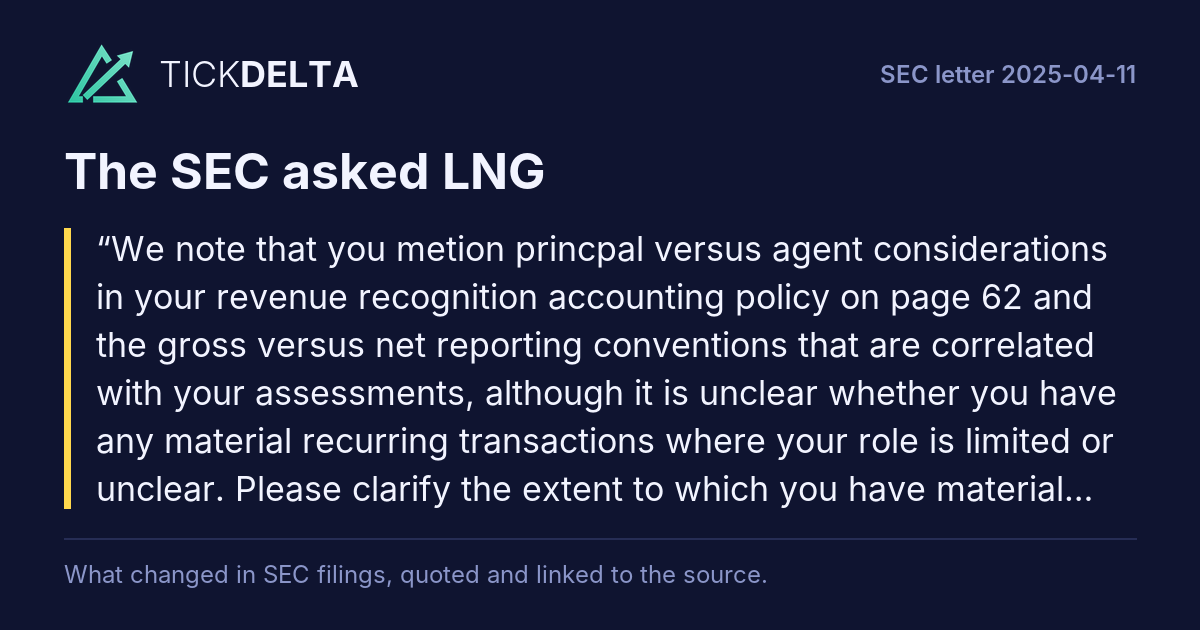
We note that you metion princpal versus agent considerations in your revenue recognition accounting policy on page 62 and the gross versus net reporting conventions that are correlated with your assessments, although it is unclear whether you have any material recurring transactions where your role is limited or unclear.
Rest of the question

Please clarify the extent to which you have material arrangments that are being reported on a net basis, or on a gross basis and that involve significant judgment in making a determination, based on the guidance in FASB ASC 606-10-55-36 to 55-40, and if so please identify and discuss the subjective areas of application, and how these types of arrangements were considered in formulating your disaggregated revenue disclosure based on the guidance in FASB ASC 606-10-50-5.

LNG answered
We respectfully acknowledge the Staff’s comment and advise the Staff that the Company had no material revenue arrangements reported on a net basis, and we have not identified matters involving significant judgment in our determination that revenue from contracts with customers should be reported on a gross basis.

Likewise, we respectfully advise the Staff that the Company believes its disclosure in Note 12 – Revenues in the 10-K, complies with the disaggregated revenue disclosure requirements set forth in FASB ASC 606-10-50-5 and -55-89 through -55-91.

We note the Staff’s reference to the
Rest of the answer

Company’s disclosure in Note 2 – Summary of Significant Accounting Policies (Revenue Recognition) in the 10-K that “we assess whether we are the principal or the agent in the arrangement. Arrangements where we have concluded that we act as a principal are presented within our Consolidated Statements of Operations on a gross basis, and arrangements where we have concluded that we act as an agent are presented within our Consolidated Statements of Operations on a net basis.”

Pursuant to the requirements set forth in FASB ASC 235-10-50-3 and in conformity with FASB ASC 606-10-55-36 through -55-40, the intent of our disclosure was to describe the accounting principles applied by the Company rather than limit solely to the material judgments as to the appropriateness of principles relating to recognition of revenue.

However, responsive to the Staff’s comment, we intend to modify prospective disclosure to clarify the absence or extent of material arrangements reported on a net basis, with conforming disclosure changes to the extent of material arrangements reported on a net basis or significant judgments thereto.

We hope that the foregoing has been responsive to the Staff’s comments, and we appreciate your assistance in our compliance with applicable disclosure requirements and in enhancing the overall disclosures in our filings. Should you have any questions or comments regarding our response, please feel free to contact me at (713) 375-5712.
Read in the reply
In its next report

First report after the company's reply of Apr 25, 2025: 10-Q filed May 8, 2025 ↗, against the 10-Q filed Oct 31, 2024 ↗.

Tickdelta does not hold the text of both reports, so they are not compared here.

Also in this review: closing letter, 2025-05-02

Form 10-K for the Fiscal Year ended December 31, 2022

2023-05-02 to 2023-05-26 · 1 question · 1 letter from the SEC, 1 from the company
Review closed 2023-05-26
Non-GAAP measuresLiquidity and cashIncome taxesDebt
Risks Relating to our Financial Matters · Our ability to declare and pay dividends and repurchase shares is subject to certain considerations., page 20
SEC asked
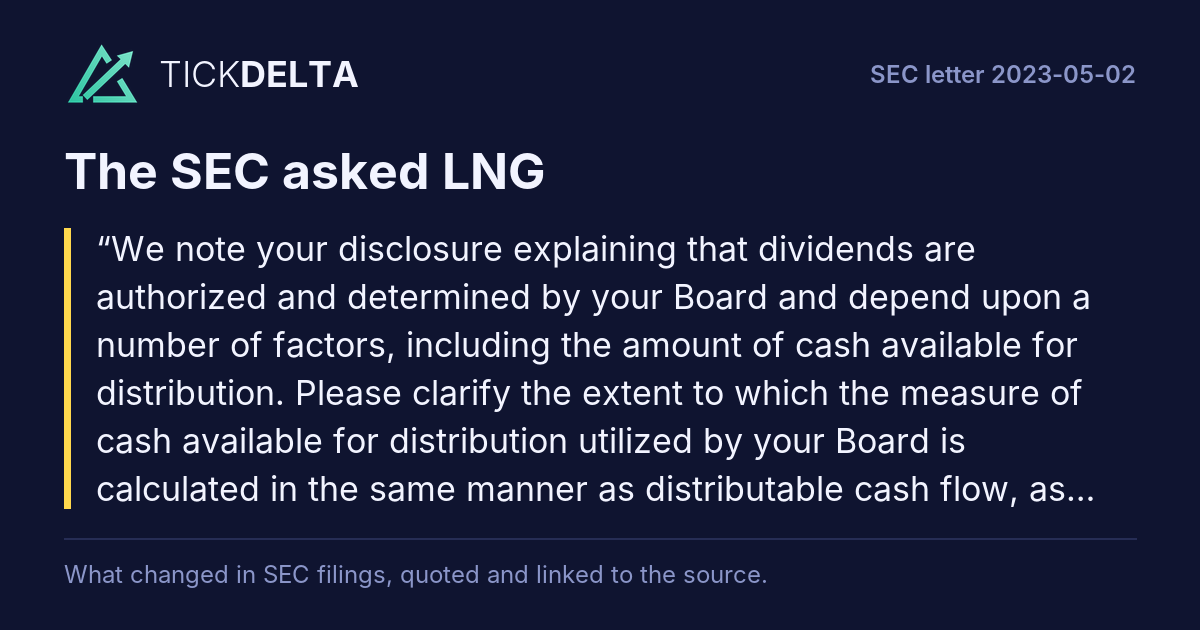
We note your disclosure explaining that dividends are authorized and determined by your Board and depend upon a number of factors, including the amount of cash available for distribution. Please clarify the extent to which the measure of cash available for distribution utilized by your Board is calculated in the same manner as distributable cash flow, as disclosed in the Form 8-K that you filed on February 23, 2023,
Rest of the question

and address the following points concerning the disclosures in your earnings release. • We note that your non-GAAP measure of distributable cash flow reflects deductions from net income for maintenance capital expenditures although you have combined such expenditures with income tax and other expense. Please revise this disclosure to separately identify each reconciling item, including the amounts that you characterize as maintenance capital expenditures, for each period. • Given that depreciation and amortization would ordinarily reflect an allocation of the costs of physical assets over their useful lives, tell us why maintenance capital expenditures would not approximate the amount of depreciation and amortization on an average long-term basis if this is the case. • Please disclose how your maintenance capital expenditures are computed and appropriately differentiated from expansion capital expenditures. • Given your disclosure indicating that distributable cash flow may be used to measure and estimate the ability of your assets to generate cash earnings after servicing your debt, paying cash taxes and expending sustaining capital, that could be used for discretionary purposes such as common stock dividends, stock repurchases, retirement of debt, or expansion capital expenditures, please clarify how expansion capital expenditures are appropriately characterized as discretionary, in your view, considering the financial obligations associated with your EPC contracts. In closing, we remind you that the company and its management are responsible for the accuracy and adequacy of their disclosures, notwithstanding any review, comments, action or absence of action by the staff.

LNG answered
We respectfully acknowledge the Staff’s comment and advise the Staff that the measure of cash available for distribution utilized by the Board of Directors is not intended to be an alternative to or proxy for Cheniere’s Distributable Cash Flow (“DCF”), as disclosed and defined in the Form 8-K that we filed on February 23, 2023.

We utilize DCF as a performance measure of the profitability that is available to our common stockholders which, at the discretion of our Board of Directors, could be deployed in the form of dividends, stock repurchases, retirement of debt, or expansion capital
Rest of the answer

expenditures. Because DCF is used by us and the investment community to evaluate the performance to the common equity holders as well as to measure the value of the common equity, it is closely aligned with corporate performance and investment valuation measures.

In contrast, the measure of cash available for distribution, as utilized by our Board of Directors and disclosed in our 10-K, is a liquidity measure that quantifies our ability to declare and pay dividends and repurchase shares, at a point in time, subsequent to satisfying our financial obligations as they come due, including amounts reserved for annual debt repayment and other cash outlays, including capital allocation goals, anticipated capital expenditures and cash reserves to provide for the proper conduct of business.

•We note that your non-GAAP measure of distributable cash flow reflects deductions from net income for maintenance capital expenditures although you have combined such expenditures with income tax and other expense. Please revise this disclosure to separately identify each reconciling item, including the amounts that you characterize as maintenance capital expenditures, for each period.

Response: We respectfully acknowledge the Staff’s comment and confirm that future filings will separately identify each reconciling item, including amounts characterized as maintenance capital expenditures, irrespective of quantitative significance.

•Given that depreciation and amortization would ordinarily reflect an allocation of the costs of physical assets over their useful lives, tell us why maintenance capital expenditures would not approximate the amount of depreciation and amortization on an average long-term basis if this is the case.

Response: We believe DCF has historically and continues to be an accurate and useful measure of cash generated from the operations of the Company, adjusted for non-controlling interest. Such measure of performance excludes depreciation and amortization (“D&A”) from the most comparable U.S. GAAP measure, net income attributable to common stockholders, and instead reduces net income attributable to common stock by maintenance capital expenditures.

We replace D&A with maintenance capital expenditures because we believe maintenance capital expenditures are more representative of the direct resource cost allocation of productive capacity to sustain the life of our consolidated production facility assets than D&A. This view is underpinned by (1) maintenance recommendations set forth by our engineering, construction, technology, and infrastructure suppliers, (2) regulatory, safety, and compliance requirements, and (3) our own knowledge and experience of project management and infrastructure. Use of maintenance capital expenditures, in our view, more closely aligns with multiple economic and operational variables, including inflation, market value of assets, economic returns, and technological advancements and appropriately segregates the conceptual basis of maintenance and expansion capital expenditures.

•Please disclose how your maintenance capital expenditures are computed and appropriately differentiated from expansion capital expenditures.

Response: Maintenance capital expenditure amounts included in the determination of DCF reflect the actual or accrued maintenance expenditures for each respective period. Maintenance capital expenditures are cash expenditures or accruals made to maintain, over the long-term, our operating capacity, system integrity, reliability and compliance with regulatory and safety requirements. Examples of maintenance capital expenditures include costs to refurbish and replace liquefied natural gas terminal assets. Maintenance capital expenditures represent the anticipated required reinvestment of cash into our existing infrastructure and, as such, reduces the cash generated from the operations of our infrastructure. Accordingly, we deduct these amounts from our DCF measure.

In contrast, expansion capital expenditures reflect actual or accrued expenditures to grow our business or expand or upgrade existing facilities. Examples of expansion capital expenditures, as described in our 10-K, include the expansion of our Corpus Christi LNG terminal for incremental production capacity. Unlike maintenance capital expenditures, expansion capital expenditures are expected to increase our asset base, operating income, and/or operating capacity over the long-term. As described in our 10-K, pursuit of accretive growth of our platform within defined capital investment parameters is one of the pillars of our long-term capital allocation priorities.

We designate each individual capital project at inception based on the nature of the project, and amounts are accumulated based on charges to the specific projects each period.

To provide greater clarity to stakeholders, we intend to expand our disclosure of DCF in future filings to distinguish characteristics between the two types of capital expenditures, noting:

“Capital spending for our business consists primarily of:

•Maintenance capital expenditures. These expenditures include costs which qualify for capitalization that are required to sustain property, plant, and equipment reliability and safety and to address environmental or other regulatory requirements rather than to generate incremental distributable cash flow; and

•Expansion capital expenditures. These expenditures are undertaken primarily to generate incremental distributable cash flow and include investment in accretive organic growth, acquisition or construction of additional complementary assets to grow our business, along with expenditures to enhance the productivity and efficiency of our existing facilities.”

We believe reconciling adjustments made in deriving our DCF measure are meaningful. Additionally, we believe that the expanded disclosure of maintenance capital and expansion capital expenditures will further describe the benefits realized from those expenditures.

•Given your disclosure indicating that distributable cash flow may be used to measure and estimate the ability of your assets to generate cash earnings after servicing your debt, paying cash taxes and expending sustaining capital, that could be used for discretionary purposes such as common stock dividends, stock repurchases, retirement of debt, or expansion capital expenditures, please clarify how expansion capital expenditures are appropriately characterized as discretionary, in your view, considering the financial obligations associated with your EPC contracts.

Response: We respectfully acknowledge the Staff’s comment and recognize expansion capital expenditures may encompass financial obligations from committed and effective contracts, including our EPC contracts. While our EPC contracts include termination rights, including for convenience, as described on Form 8-K filed with the Commission on March 1, 2022, and Exhibit 10.93 to our 10-K, we do not currently expect such right to be exercised.

Use of discretionary terminology was intended to highlight discretion by our Board of Directors and management to authorize expansion capital projects pursuant to our capital investment parameters, of which future expected generation of DCF is an underlying consideration.

To provide greater clarity to stakeholders, we intend to enhance disclosure in future filings to state: “We believe Distributable Cash Flow is a useful performance measure for management, investors and other users of our financial information to evaluate our performance and to measure and estimate the ability of our assets to generate cash earnings after servicing our debt, paying cash taxes and expending sustaining capital, that could be used for discretionary purposes considered for deployment by our Board of Directors pursuant to our capital allocation plan, such as by way of common stock dividends, stock repurchases, retirement of debt, or expansion capital expenditures. Distributable Cash Flow is not intended to represent cash flows from operations or net income (loss) as defined by U.S. GAAP and is not necessarily comparable to similarly titled measures reported by other companies.”

We believe this clarification, along with other enhancements highlighted herein, will provide additional clarity to stakeholders as to the reconciling components and purpose of DCF.

We hope that the foregoing has been responsive to the Staff’s comments, and we appreciate your assistance in our compliance with applicable disclosure requirements and in enhancing the overall disclosures in our filings. Should you have any questions or comments regarding our response, please feel free to contact me at (713) 375-5712.
Read in the reply
In its next report

First report after the company's reply of May 15, 2023: 10-Q filed Aug 3, 2023 ↗, against the 10-Q filed May 2, 2023 ↗.

Tickdelta does not hold the text of both reports, so they are not compared here.

Also in this review: closing letter, 2023-05-26

Form 10-K for the Fiscal Year Ended December 31, 2015

2016-12-15 to 2017-01-30 · 13 questions · 2 letters from the SEC, 1 from the company
Review closed 2017-01-30
Liquidity and cashGoodwill and impairmentCritical estimatesNon-GAAP measuresResults discussion (MD&A)
SEC letter of Dec 15, 2016 ↗ no reply letter on EDGAR
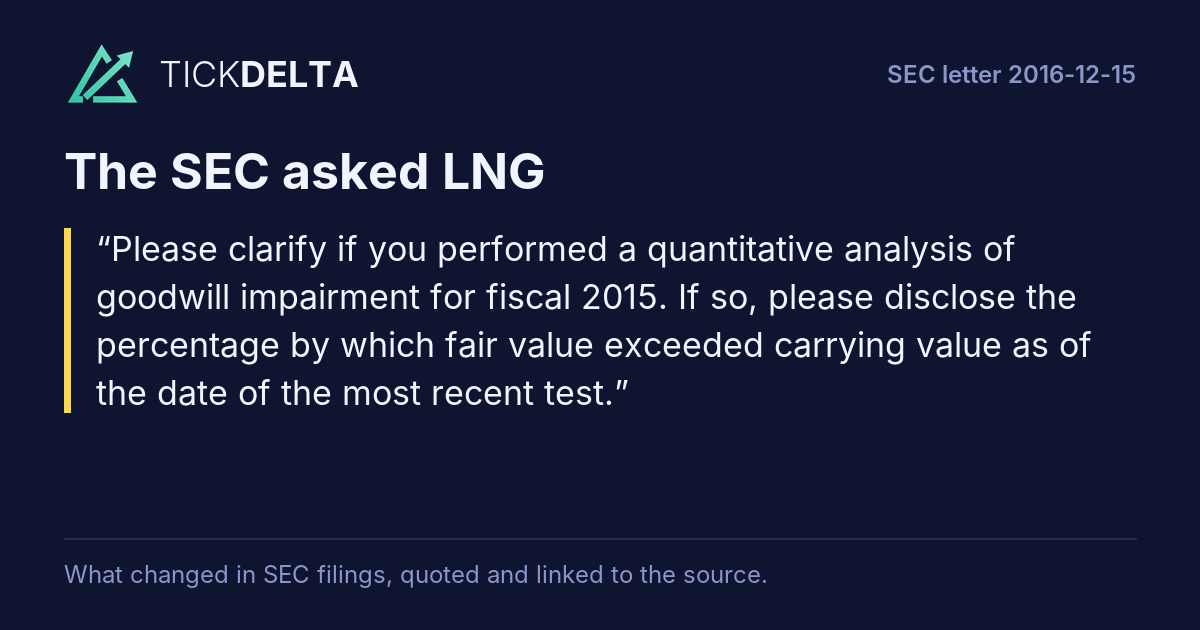
Summary of Critical Accounting Estimates · Goodwill, page 56
SEC asked (1)
Please clarify if you performed a quantitative analysis of goodwill impairment for fiscal 2015. If so, please disclose the percentage by which fair value exceeded carrying value as of the date of the most recent test.
LNG answered

No reply letter found.

Consolidated Balance Sheets, page 64
SEC asked (2)
Please tell us why your issued and outstanding share amounts are the same even though you have shares held in the treasury.
LNG answered

No reply letter found.

In its next report

First report after the SEC's letter of Dec 15, 2016: 10-K filed Feb 24, 2017 ↗, against the 10-K filed Feb 19, 2016 ↗.

Tickdelta does not hold the text of both reports, so they are not compared here.

Consolidated Statements of Cash Flows, page 68
SEC asked (3)
We note total share-based compensation stated in Note -13 Share-Based Compensation, does not agree to amounts disclosed in the statement of cash flows for fiscal year 2015. Please advise or revise.
LNG answered

No reply letter found.

In its next report

First report after the SEC's letter of Dec 15, 2016: 10-K filed Feb 24, 2017 ↗, against the 10-K filed Feb 19, 2016 ↗.

Tickdelta does not hold the text of both reports, so they are not compared here.

Consolidated Statements of Cash Flows, page 68
SEC asked (4)
Please tell us the nature of the other, net and other line items included in net cash used in operating activities and investing activities. Also, tell us your consideration of separately presenting material amounts include in those line items.
LNG answered

No reply letter found.

In its next report

First report after the SEC's letter of Dec 15, 2016: 10-K filed Feb 24, 2017 ↗, against the 10-K filed Feb 19, 2016 ↗.

Tickdelta does not hold the text of both reports, so they are not compared here.

Note 5 – Property, Plant and Equipment, page 78
SEC asked (5)
Please disclose actual depreciation expense for each year presented. Refer to ASC 36010-50-1. Also, please explain why the changes in the accumulated depreciation accounts from December 31, 2014 to December 31, 2015 do not equal the amount of depreciation and amortization disclosed on the statements of operations and cash flows.
LNG answered

No reply letter found.

In its next report

First report after the SEC's letter of Dec 15, 2016: 10-K filed Feb 24, 2017 ↗, against the 10-K filed Feb 19, 2016 ↗.

Tickdelta does not hold the text of both reports, so they are not compared here.

Cheniere Energy Partners, LP · Selected Financial Data, page 40
SEC asked (6)
It appears you inadvertently omitted net loss per common unit for fiscal year 2014. Please advise or revise. Refer to Item 301 of Regulation S-K.
LNG answered

No reply letter found.

In its next report

First report after the SEC's letter of Dec 15, 2016: 10-K filed Feb 24, 2017 ↗, against the 10-K filed Feb 19, 2016 ↗.

Tickdelta does not hold the text of both reports, so they are not compared here.

Note 15 – Net Income (Loss) Per Common Unit, page 89
SEC asked (7)
We note your disclosure that the impact of the beneficial conversion feature is also included in earnings per unit for the years ended December 31, 2015, 2014 and 2013. Please tell us how the amounts are included in the loss per unit and why you did not include a line item in your reconciliations for the years presented related to the amortization of the beneficial conversion feature.
Rest of the question

Additionally, tell us why no amortization of the beneficial conversion feature is shown in your consolidated statements of partners’ equity for fiscal years 2014 and 2013.

LNG answered

No reply letter found.

In its next report

First report after the SEC's letter of Dec 15, 2016: 10-K filed Feb 24, 2017 ↗, against the 10-K filed Feb 19, 2016 ↗.

Tickdelta does not hold the text of both reports, so they are not compared here.

Note 2 – Summary of Significant Accounting Policies · Accounting for Investment in Cheniere Partners, page 31
SEC asked (8)
Please provide us with your calculations of the changes in the suspended loss account from 2014 to 2015.
LNG answered

No reply letter found.

In its next report

First report after the SEC's letter of Dec 15, 2016: 10-K filed Feb 24, 2017 ↗, against the 10-K filed Feb 19, 2016 ↗.

Tickdelta does not hold the text of both reports, so they are not compared here.

Note 2 – Summary of Significant Accounting Policies · Accounting for Investment in Cheniere Partners, page 31
SEC asked (9)
Please disclose the nature of the impairment charge and the facts and circumstances that resulted in your conclusion to record the amount.
LNG answered

No reply letter found.

In its next report

First report after the SEC's letter of Dec 15, 2016: 10-K filed Feb 24, 2017 ↗, against the 10-K filed Feb 19, 2016 ↗.

Tickdelta does not hold the text of both reports, so they are not compared here.

Cheniere Energy, Inc., Cheniere Energy Partners LP Holdings, LLC, and Sabine Pass · Liquefaction, LLC
SEC asked (10)
You disclose a non-GAAP liquidity measure pre-tax CEI cash flow per share and pre-tax CEI cash flow per share (no CMI sales) which is inconsistent with Question 102.05 of the updated Compliance and Disclosure Interpretations related to Non-GAAP Measures issued May 17, 2016. Please tell us your consideration of the guidance in your presentation of these measures.
LNG answered

No reply letter found.

In its next report

First report after the SEC's letter of Dec 15, 2016: 10-K filed Feb 24, 2017 ↗, against the 10-K filed Feb 19, 2016 ↗.

Tickdelta does not hold the text of both reports, so they are not compared here.

Goodwill, page 56
SEC asked (1)
We read your response to comment 1. In future filings please disclose the percentage by which fair value exceeded carrying value as of the date of the most recent test or state that fair value substantially exceeds carrying value.
LNG answered
In future filings, the Company will disclose in its summary of critical accounting estimates either the percentage by which the estimated fair value of the Company’s LNG terminal reporting unit exceeded its carrying value as of the most recent fair value calculation date or that the fair value of the Company’s LNG terminal reporting unit substantially exceeds its carrying value as applicable.
Read in the reply
Consolidated Statements of Cash Flows, page 68
SEC asked (2)
We read your response to comment 3. Please reconcile for us the difference in sharebased compensation recorded in the consolidated statements of stockholders’ equity and amounts disclosed in the statement of cash flows for fiscal year 2015 and the 9 months ended September 30, 2016. We note the amounts of compensation capitalized for the respective periods.
Rest of the question

In this regard please explain the difference between total share-based compensation disclosed in the notes to your financial statements and the amounts recorded in the consolidated statements of stockholders’ equity.

LNG answered
The Company’s share-based compensation to employees and non-employee directors is derived from both equityand liability-classified awards which are accounted for pursuant to Financial Accounting Standards Board (“FASB”) Accounting Standards Codification (“ASC”) 718, Compensation - Stock Compensation.

Share-based compensation, as disclosed in the consolidated statements of cash flows for the year ended December 31, 2015 and the nine months ended September 30, 2016, reflects share-based compensation expense for both equityand liability awards and excludes capitalized compensation amounts.
Rest of the answer

In future filings, we will clearly specify that share-based compensation reported in the consolidated statements of cash flows reflects share-based compensation expense rather than total share-based compensation costs including capitalized compensation.

Pursuant to FASB ASC 230-10-45-18, Statement of Cash Flows, we present share-based compensation expense as an item reconciling net loss to net cash used in operating activities when applying the indirect method for presenting the consolidated statement of cash flows. We subsequently present the effects of deferral of past operating cash payments associated with liability awards as a change in operating assets and liabilities in determining net cash used in operating activities. Capitalized share-based compensation costs, to the degree settled in cash, are presented as part of net cash used in investing activities, and otherwise assessed for disclosure of material noncash investing activities pursuant to FASB ASC 230-10-50-3.

The consolidated statements of stockholders’ equity disclose share-based compensation associated with equity awards, including compensation capitalized, given recognition of compensation costs in stockholders’ equity.

A reconciliation of disclosed amounts is summarized below (in millions):

Year Ended December 31,

Nine Months Ended September 30,

Financial statement location

2015

2016

Total share-based compensation

Liability awards

$

105.7

61.1

Equity awards

Statements of Stockholders’ Equity

89.6

36.5

Subtotal

Notes

195.3

97.6

Capitalized share-based compensation

(22.9

)

(12.5

Total share-based compensation expense (1)

Notes/Statements of Cash Flows

172.4

85.1

(1)

As described in our response letter dated January 10, 2017, amounts disclosed in the consolidated statements of cash flows for the year ended December 31, 2015 exclude cash-settled liability awards recognized as share-based compensation expense.

Pursuant to disclosure requirements described in ASC 718-10-50-1 and -50-2, our consolidated financial statements separately disclose the grant of equity and liability instruments under multiple share-based payment arrangements to assist in understanding the Company’s use of share-based compensation.

Read in the reply
In its next report

First report after the company's reply of Jan 20, 2017: 10-K filed Feb 24, 2017 ↗, against the 10-K filed Feb 19, 2016 ↗.

Tickdelta does not hold the text of both reports, so they are not compared here.

Form 10-Q for the Quarterly Period Ended September 30, 2016
SEC asked (3)
We read your response to comment 9. It appears the impairment charge for the nine months ended September 30, 2016 was quantitatively material to income (loss) from operations and represented an unusual or infrequent event or transaction that materially affected the amount of reported income from continuing operations.
Rest of the question

As such, you should discuss the nature of the impairment charge and the facts and circumstances that resulted in your conclusion to record the amount in management’s discussion and analysis of financial condition and results of operations in future filings. Refer to Item 303(a)(3) of Regulation S-K.

LNG answered
In future filings, the Company will disclose the nature of the impairment charge and the facts and circumstances that resulted in its conclusion to record the amount pursuant to Item 303(a)(3) of Regulation S-K. We will add language similar to the below to management’s discussion and analysis of financial condition and results of operations:

The impairment expense recognized during the year ended December 31, 2016 related to a corporate airplane that was written down to fair value based on market-based appraisals, and ultimately sold by the end of the year.
Rest of the answer

The impairment was recognized due to the potential disposition of the airplane in connection with the Company having initiated organizational changes and the associated operational focus to implement a strategy for sustainable, long-term stockholder value creation through financially disciplined investment.

Read in the reply

Also in this review: closing letter, 2017-01-30

Form 10-K for the Fiscal Year Ended December 31, 2014

2015-11-02 to 2015-11-18 · 2 questions · 1 letter from the SEC, 0 from the company
Review closed 2015-11-18
Controls
SEC letter of Nov 2, 2015 ↗ no reply letter on EDGAR
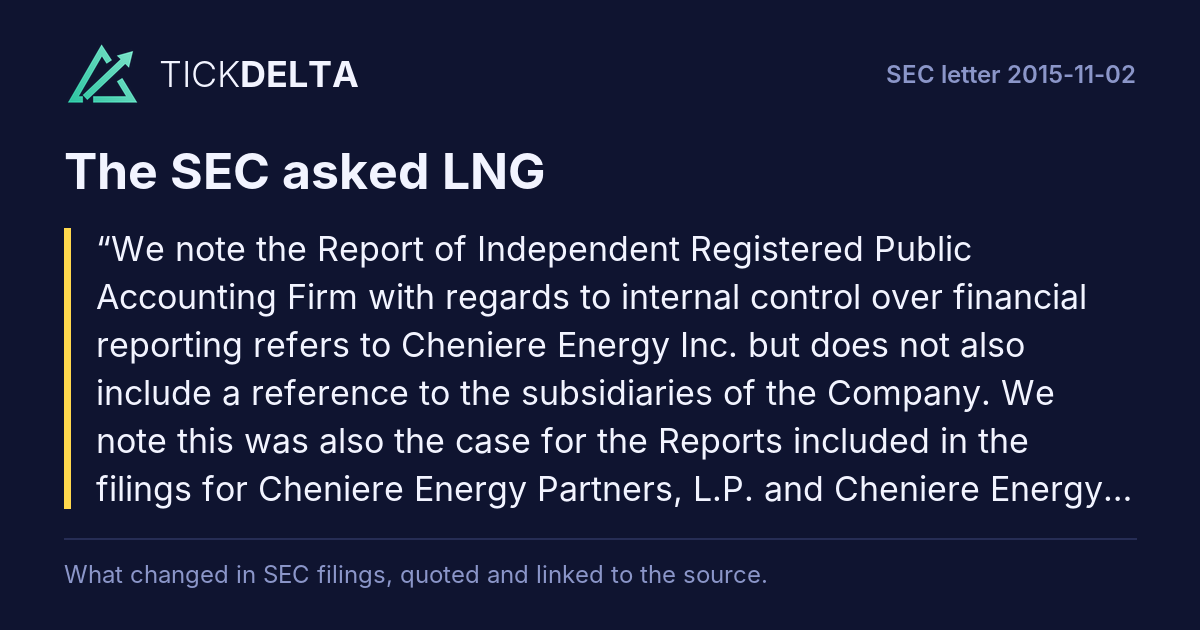
Reports of Independent Registered Public Accounting Firm · Internal Control Over Financial Reporting, page 64
SEC asked (1)
We note the Report of Independent Registered Public Accounting Firm with regards to internal control over financial reporting refers to Cheniere Energy Inc. but does not also include a reference to the subsidiaries of the Company. We note this was also the case for the Reports included in the filings for Cheniere Energy Partners, L.P. and Cheniere Energy Partners LP Holdings, LLC.
Rest of the question

Please have your auditor explain to us whether their audits included the subsidiaries of each registrant and why their reports did not include a reference to the subsidiaries.

LNG answered

No reply letter found.

In its next report

First report after the SEC's letter of Nov 2, 2015: 10-K filed Feb 19, 2016 ↗.

No earlier 10-K before the SEC's letter is in Tickdelta, so there is nothing to compare with.

Exhibits 31
SEC asked (2)
We note your Form 10-K for fiscal year ended December 31, 2014 contains management’s internal control report as required by Item 308(a) of Regulation S-K. As such, the certifications should include the introductory language in paragraph 4 and paragraph 4(b) that refers to the certifying officers' responsibility for establishing and maintaining internal control over financial reporting in order to conform exactly to
Rest of the question

the certification requirements outlined in Item 601(b)(31)(i) of Regulation S-K. Please file an amendment to include currently dated and signed certifications that include the language required by Item 601(b)(31)(i) of Regulation S-K. You may provide an abbreviated amendment that consists of a cover page, explanatory note, signature page and paragraphs 1, 2, 4 and 5 of the certification. Please note that this comment also applies to Form 10-Q for the quarters ended March 31, 2015 and June 30, 2015.

LNG answered

No reply letter found.

In its next report

First report after the SEC's letter of Nov 2, 2015: 10-K filed Feb 19, 2016 ↗.

No earlier 10-K before the SEC's letter is in Tickdelta, so there is nothing to compare with.

Also in this review: closing letter, 2015-11-18

Letters without questions

Other letters

UPLOAD and CORRESP
8 other letters: notices that a filing will not be reviewed, requests to declare a registration effective, and the like

From the SEC's correspondence on EDGAR: staff letters (form UPLOAD) and company letters (form CORRESP), 20 letters filed since 2015-11-02. Questions and answers are matched by their numbers; topics come from words in each question. The reports are compared word for word (same form, before the first SEC letter against the first report after the company's reply). No AI.

Sources

The SEC's correspondence on EDGAR: staff letters (form UPLOAD) and company letters (form CORRESP), matched question by question. No AI.

Also

Filings: the letters in the filing list.

Work with it

Excel workbook · CSV. Google Sheet that stays up to date: paste =IMPORTDATA("https://tickdelta.com/company/LNG/export.csv") into a cell.

Next in Owners and insiders:Insider trades
Esc

Type a ticker such as AAPL, a name, an investor such as Buffett, or a topic such as tariffs. ↑ ↓ to move, Enter to open.