LNTAlliant Energy
Alliant Energy maintains its principal executive offices in Madison, Wisconsin. 10-K, Item 1
- Headquarters
- Madison, WI
- Next results
- around Feb 19, 2027
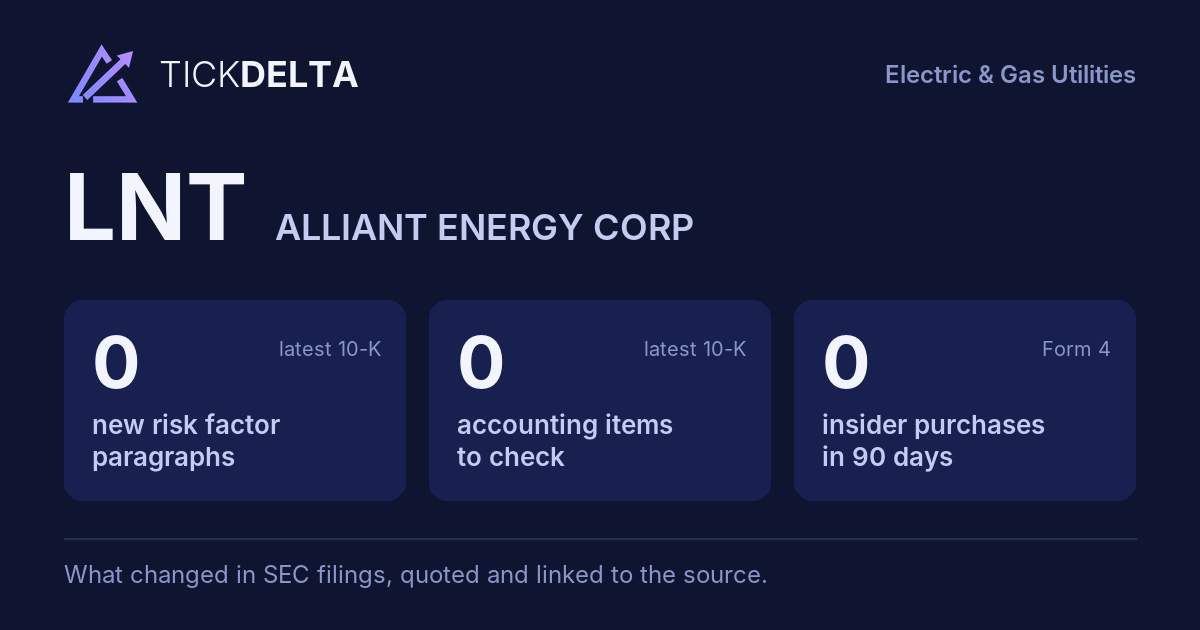
No new paragraphs in Risk Factors, or fewer than two 10-Ks to compare.
New in the latest 10-Q
29 paragraphs in the 10-Q filed Oct 30, 2026 with nothing like them in the 10-Q filed Jul 31, 2026 (at least half the words must differ; new numbers alone do not count). Quoted exactly, grouped by the item heading above them. This is text that changed, not a judgement of how serious it is.
10-Q
Number of shares outstanding of each class of common stock as of September 30, 2026:
Read in the 10-Q ↗
Financial statements and notes
In August 2026, IPL issued $ 500 million of 5.1 % senior debentures due 2031. The net proceeds from this issuance were used to reduce cash amounts received from its sale of accounts receivable program, reduce its outstanding commercial paper, including $50 million of commercial paper classified as long-term debt, and for general corporate purposes.
Read in the 10-Q ↗
NOTE 12 (e) Collective Bargaining Agreements - In May 2026, WPL’s collective bargaining agreement with International Brotherhood of Electrical Workers Local 965 expired. A new agreement was reached in September 2026, which expires May 31, 2030.
Read in the 10-Q ↗
IPL WPL September 30, 2026 December 31, 2025 September 30, 2026 December 31, 2025 Net payables to Corporate Services $154 $135 $92 $84
Read in the 10-Q ↗
Transfer of Gas Generation Assets - In the third quarter of 2026, WPL sold gas generation assets to IPL for $ 57 million, in connection with IPL’s development of a natural gas-fired EGU within its service territory. The transaction price was equal to WPL’s carrying value of the assets, and as a result, no gain or loss was recognized on the transaction. The transaction price is reflected in “Construction and acquisition expenditures” within investing activities in IPL’s statement of cash flows and “Other investing activities” within investing activities in WPL’s statement of cash flows for the nine months ended September 30, 2026. For Alliant Energy, the intercompany transaction is eliminated upon consolidation and therefore is not reflected in Alliant Energy’s statement of cash flows.
Read in the 10-Q ↗
• Over the next six years, Alliant Energy currently plans to develop and/or acquire energy resources to meet the growing energy demands of its customers, including approximately 2,800 MW of new natural gas resources, approximately 1,300 MW of new energy storage, approximately 1,300 MW of new renewable generation, improvements of approximately 280 MW at existing natural gas-fired EGUs, and refurbishments at approximately 450 MW of existing wind farms. Alliant Energy is currently evaluating the impact of potential additional large load growth customers and MISO’s resource adequacy requirements on its resource plans and will update these generation investment plans as needed in the future. Estimated capital expenditures for these planned projects for 2026 through 2030 are included in the “Generation” section in the construction and acquisition table in “Liquidity and Capital Resources.” Information on IPL’s and WPL’s regulatory filings and/or approvals for future generation and energy storage projects are as follows:
Read in the 10-Q ↗
• In October 2026, the PSCW issued an order authorizing WPL to construct a 2 billion cubic feet liquefied natural gas facility in Rock County, Wisconsin.
Read in the 10-Q ↗
• WPL currently plans to continue coal operations at Edgewater Unit 5 (414 MW) and Columbia Units 1 and 2 (595 MW in aggregate) at least through 2030 and will continue to monitor environmental regulatory developments and evaluate potential alternatives for these facilities to support system reliability, affordability and customer energy needs.
Read in the 10-Q ↗
• IPL and WPL have incurred development costs associated with certain renewable generation projects. Development of these projects is dependent upon customer interest, market conditions, regulatory approvals, permitting requirements, interconnection arrangements and other economic and operational factors. Changes in these factors may result in delays, modifications or discontinuation of development activities and could result in some or all of the related project development costs not being recoverable.
Read in the 10-Q ↗
IPL’s Retail Electric and Gas Rate Reviews (October 2024 Through September 2025 Forward-looking Test Period) - In August 2026, the IUC issued an order for IPL’s retail electric and gas subsequent proceeding, ordering IPL to maintain its current retail electric rates and to reduce annual base rates by $3 million for retail residential gas customers effective on October 6, 2026. The IUC also opened a separate docket to gather information to review IPL’s management efficiency.
Read in the 10-Q ↗
Planned Rate Review - WPL currently expects to file a retail electric and gas rate review with the PSCW in the second quarter of 2027 for the 2028/2029 forward-looking Test Period. The key drivers for the anticipated filing include revenue requirement impacts of increasing electric and gas rate base. Any rate changes granted from this pending request are expected to be effective on January 1, 2028, with a decision from the PSCW expected by the end of 2027.
Read in the 10-Q ↗
Clean Air Act Section 111(b) - In September 2026, the EPA finalized a rule partially repealing the 2024 revised standards under Section 111(b), which established carbon dioxide (CO2) emission limits from certain new and reconstructed fossil-fueled EGU combustion turbines that commence operation after May 23, 2023 with a capacity greater than 25 MW. The partial repeal removes standards based on carbon capture and storage that would have been effective by January 1, 2032. However, standards requiring low-emitting fossil-fuels and highly efficient EGU design technology with best operation and maintenance practices remain in effect for certain newly constructed fossil-fueled EGUs. The EPA also issued a supplemental proposal that would rescind the greenhouse gas findings for fossil-fueled EGUs and repeal the remaining CO2 regulations for fossil-fueled EGUs under Section 111 of the Clean Air Act. Alliant Energy, IPL and WPL are currently unable to predict with certainty the future outcome or impact of these matters, including resolution of ongoing or potential litigation.
Read in the 10-Q ↗
• In October 2026, legislation was enacted revising the Major Economic Growth Attraction program in Iowa for projects located in rural counties. The legislation allows the Iowa Economic Development Authority to provide either an investment tax credit of up to 10% of a qualifying investment for a project located in a rural county or investment tax credits of up to 5% of qualifying investments for up to two projects. The most significant provision of this program for Alliant Energy encourages economic development in IPL’s service territory by supporting certain projects with capital investments greater than $1 billion and may support the development of certain large load growth projects, including the proposed construction of a steel plant in Southeast Iowa.
Read in the 10-Q ↗
• In October 2026, IPL and WPL entered into loan guarantee agreements with the U.S. Department of Energy (DOE), who may guarantee borrowings of up to $3.5 billion and $1.6 billion, respectively. Refer to “U.S. Department of Energy Loan Guarantee Borrowings” in L iqui dity and Capital Resources for further details.
Read in the 10-Q ↗
Other Future Considerations - In addition to items discussed in this report, the following key items could impact Alliant Energy’s, IPL’s and WPL’s future financial condition or results of operations:
Read in the 10-Q ↗
• Common Stock - For the remainder of 2026, Alliant Energy currently expects to physically settle up to $650 million of outstanding forward sale agreements in aggregate under the 2025 and/or 2026 at-the-market offering programs (ATM programs). From 2027 through 2030, Alliant Energy currently expects to issue up to $2.7 billion of common stock in aggregate through the ATM programs, its Shareowner Direct Plan (approximately $25 million in common stock annually) and additional future equity offerings. Refer to Note 5 for further details of common stock issuances and settlements under the 2025 and 2026 ATM programs.
Read in the 10-Q ↗
• Long-term Debt - For the remainder of 2026, IPL and WPL currently expect to issue up to $200 million and $300 million of long-term debt, respectively, and in 2027, up to $1.3 billion and $500 million of long-term debt, respectively. Future IPL and WPL long-term debt issuances may include funding through the DOE Loan Guarantee Program. Refer to Liquidity and Capital Resources for further details of the program. In 2027, AEF and/or Alliant Energy at the parent company level expect to issue up to $1 billion of long-term debt in aggregate. AEF and WPL have $375 million and $300 million, respectively, of long-term debt maturing in 2027.
Read in the 10-Q ↗
• Common Stock Dividends - Alliant Energy announced a 5% increase in its targeted 2027 annual common stock dividend to $2.25 per share, which is equivalent to a quarterly rate of $0.5625 per share, beginning with the February 2027 dividend payment. The timing and amount of future dividends is subject to approval of quarterly dividend declarations from Alliant Energy’s Board of Directors, and is dependent upon earnings expectations, capital requirements, and general financial business conditions, among other factors.
Read in the 10-Q ↗
• Cash Flows from Operating Activities - Alliant Energy, IPL and WPL currently expect an increase in future cash flows from operating activities resulting from the transfer of future renewable tax credits to other corporate taxpayers. Refer to Note 8 for renewable tax credits transferred in October 2026. In addition, Alliant Energy, IPL and WPL currently expect an increase in future cash flows from operating activities resulting from higher retail electric sales in 2027 driven by large load growth customers. Alliant Energy and WPL also expect an increase in future cash flows from operating activities resulting from higher earnings on WPL’s increasing rate base.
Read in the 10-Q ↗
• Higher Earnings on Increasing Rate Base - Alliant Energy and WPL currently expect electric and gas utility revenues to increase in 2027 compared to 2026, primarily due to impacts from increasing revenue requirements related to investments in the utility business. IPL currently expects an increase in its effective income tax rate in 2027 compared to 2026 due to higher income before income taxes, partially offset by greater utilization of investment tax credits. Investment tax credits resulting from IPL energy storage projects placed in service and/or expected to be placed in service in 2026 and 2027 may be utilized to offset any revenue deficiency on an annual basis up to the earnings sharing mechanism threshold included in IPL’s retail electric rate review settlement agreement.
Read in the 10-Q ↗
• Sales Trends - Alliant Energy, IPL and WPL currently expect an increase in retail electric sales in 2027 compared to 2026 driven by large load growth customers, including data center customers and other economic development activities. Refer to “Growing Customer Demand” for further discussion.
Read in the 10-Q ↗
• Depreciation and Amortization Expense - Alliant Energy, IPL and WPL currently expect an increase in depreciation and amortization expense in 2027 compared to 2026 due to capital projects placed in service in 2026 and 2027.
Read in the 10-Q ↗
• Interest Expense - Alliant Energy, IPL and WPL currently expect an increase in interest expense in 2027 compared to 2026 due to financings completed in 2026 and planned in 2027.
Read in the 10-Q ↗
• Equity Income from Unconsolidated Investments - Alliant Energy’s equity earnings from certain corporate venture fund investments have increased during 2026 due to increased valuations of certain underlying investments within the venture funds. Refer to Note 4 for further details.
Read in the 10-Q ↗
• Allowance for Funds Used During Construction - Alliant Energy, IPL and WPL currently expect an increase in allowance for funds used during construction in 2027 compared to 2026 largely due to changes in construction work in progress balances related to construction activity on capital projects.
Read in the 10-Q ↗
(b) Refer to Note 14 for details of the transfer of gas generation assets from WPL to IPL.
Read in the 10-Q ↗
(c) Includes higher cash payments related to cost of removal obligations at IPL and WPL.
Read in the 10-Q ↗
Construction and Acquisition Expenditures - Construction and acquisition expenditures and financing plans are reviewed, approved and updated as part of the strategic planning process. Changes may result from a number of reasons, including changes in expected load growth, regulatory requirements, changing legislation, not obtaining favorable and acceptable regulatory approval on certain projects, changing costs of projects due to market conditions and the impact of tariffs, improvements in technology, and improvements to ensure resiliency and reliability of the electric and gas distribution systems. Alliant Energy, IPL and WPL have not yet entered into contractual commitments relating to the majority of their anticipated future construction and acquisition expenditures. As a result, they have some discretion with regard to the level and timing of these expenditures. Construction and acquisition expenditures for 2026 through 2030 are currently anticipated as follows (in millions), which are focused on adding renewable generation and energy storage projects, dispatchable thermal generation and Liquified Natural Gas (LNG) projects to meet growing customer demand for electricity and natural gas, including expected future data center growth from currently executed electric service agreements, and strengthening the resiliency and reliability of the electric and gas distribution systems. Alliant Energy, IPL and WPL are currently evaluating the impacts of tariffs, recently enacted legislation and additional potential large load growth customers on their resource plans, and will update their anticipated construction and acquisition expenditures as needed in the future. Cost estimates represent Alliant Energy’s, IPL’s and WPL’s portion of construction expenditures and exclude allowance for funds used during construction and capitalized interest, if applicable. Refer to “Customer Investments” for further discussion of certain key utility business projects impacting construction and acquisition plans, and the related regulatory filings.
Read in the 10-Q ↗
U.S. Department of Energy (DOE) Loan Guarantee Borrowings - In October 2026, IPL and WPL each entered into a loan guarantee agreement with the DOE. Under the agreements, the DOE may guarantee borrowings of up to $3.5 billion for IPL and up to $1.6 billion for WPL, subject to satisfaction of applicable conditions and requirements. The guaranteed financing is intended to support eligible energy infrastructure projects and could provide lower-cost financing for the benefit of IPL’s and WPL’s customers. No amounts have been borrowed under the loan guarantee agreements.
Read in the 10-Q ↗
The 10-Q's risk factors against the 10-K
Item 1A of the 10-Q filed Oct 30, 2026 against Item 1A of the 10-K filed Feb 20, 2026.
A 10-Q repeats only the risks that changed, so a 10-K paragraph that is missing from it is not counted as removed.
Added is a paragraph with nothing like it in the 10-K, Reworded a sentence that is in both with several words changed,
Quiet changes a sentence in both where one to four words changed and one is a hedge or a modal
(cut words struck through, new words highlighted and underlined).
Text on the page, not a score; each links to the filing at sec.gov.
What the 10-Q itself says about its risk factors:
Read in the 10-Q ↗
The risk factors described in Item 1A in the 2025 Form 10-K have not changed materially.
1 paragraph in the 10-Q's Item 1A, and none of them adds, rewords or quietly edits a paragraph of the 10-K's.
Work on LNT in a spreadsheet:
Excel workbook (a sheet per section, ten years by column, charts, links to the filings) ·
CSV.
For a Google Sheet that stays up to date, paste =IMPORTDATA("https://tickdelta.com/company/LNT/export.csv") into a cell.