tickdelta
Sign in

Tickdelta is free for now. Sign up and get Pro free

← Screener

LNTAlliant Energy

Utilities · Electric & Gas Utilities · Nasdaq

Alliant Energy maintains its principal executive offices in Madison, Wisconsin. 10-K, Item 1

Headquarters
Madison, WI
Next results
around Feb 19, 2027
Compare with peers → Embed

When the SEC's staff reviews a filing, it writes to the company with numbered questions, and the company answers each one in a letter. SEC publishes the exchange once the review is over, at least 20 business days later. Below: what the staff asked LNT, and the company's answer to each question, quoted from the letters. A question is not an accusation; most reviews end with the company adding detail to its next filing.

Form 10-K for the Fiscal Year Ended December 31, 2022

2023-11-28 to 2023-12-19 · 1 question · 1 letter from the SEC, 2 from the company
Review closed 2023-12-19
Non-GAAP measuresResults discussion (MD&A)
Management's Discussion and Analysis of Financial Condition and Results of Operations · Results of Operations, page 26
SEC asked
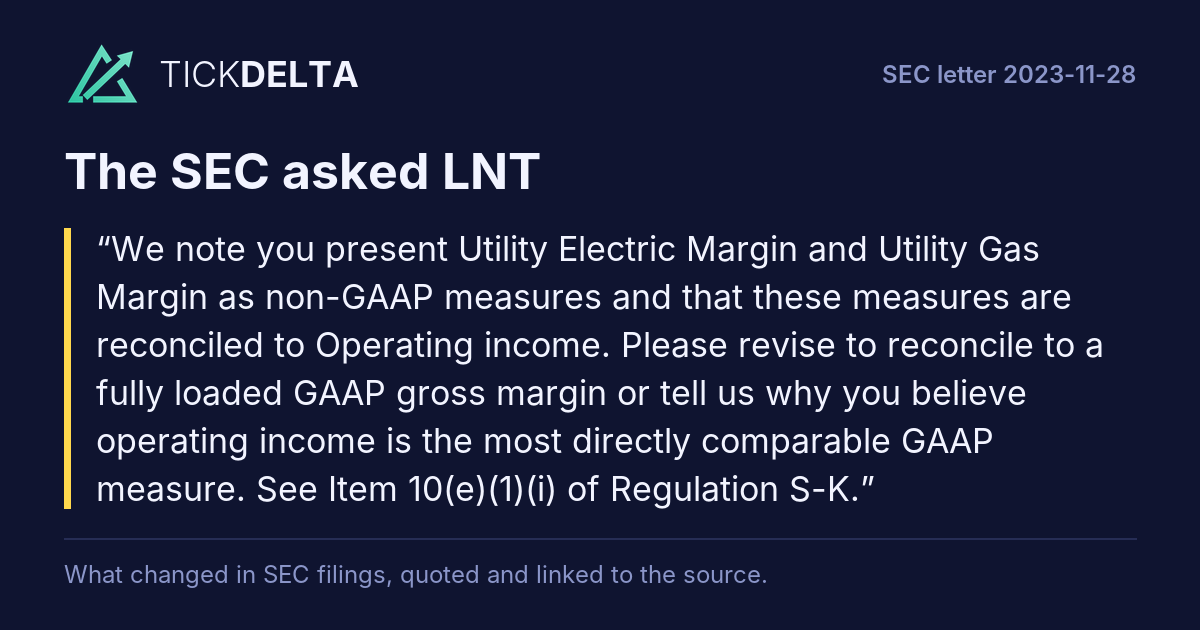
We note you present Utility Electric Margin and Utility Gas Margin as non-GAAP measures and that these measures are reconciled to Operating income. Please revise to reconcile to a fully loaded GAAP gross margin or tell us why you believe operating income is the most directly comparable GAAP measure. See Item 10(e)(1)(i) of Regulation S-K.
LNT answered
On behalf of our client, Alliant Energy Corporation (the “Company”), this letter confirms the Company’s request for an extension of time to respond to the comment letter from the Staff of the Division of Corporation Finance dated November 28, 2023, with respect to the above-referenced Annual Report on Form 10-K for the year ended December 31, 2022. As Ms. Lam discussed with a representative of the Company on December 1, 2023, the Company requires additional time to prepare its response and currently expects to respond no later than December 18, 2023. Read in the reply ↗
In its next report

First report after the company's reply of 2023-12-01: 10-K filed 2024-02-16 ↗, against the 10-K filed 2023-02-24 ↗.

Tickdelta does not hold the text of both reports, so they are not compared here.
Also in this review: company letter, 2023-12-15, closing letter, 2023-12-19
Form 10-K

2017-08-10 to 2017-08-24 · 1 question · 1 letter from the SEC, 1 from the company
Review closed 2017-08-24
Non-GAAP measuresResults discussion (MD&A)
Management’s Discussion and Analysis of Financial Condition and Results of Operations, page · Results of Operations, page 32
SEC asked
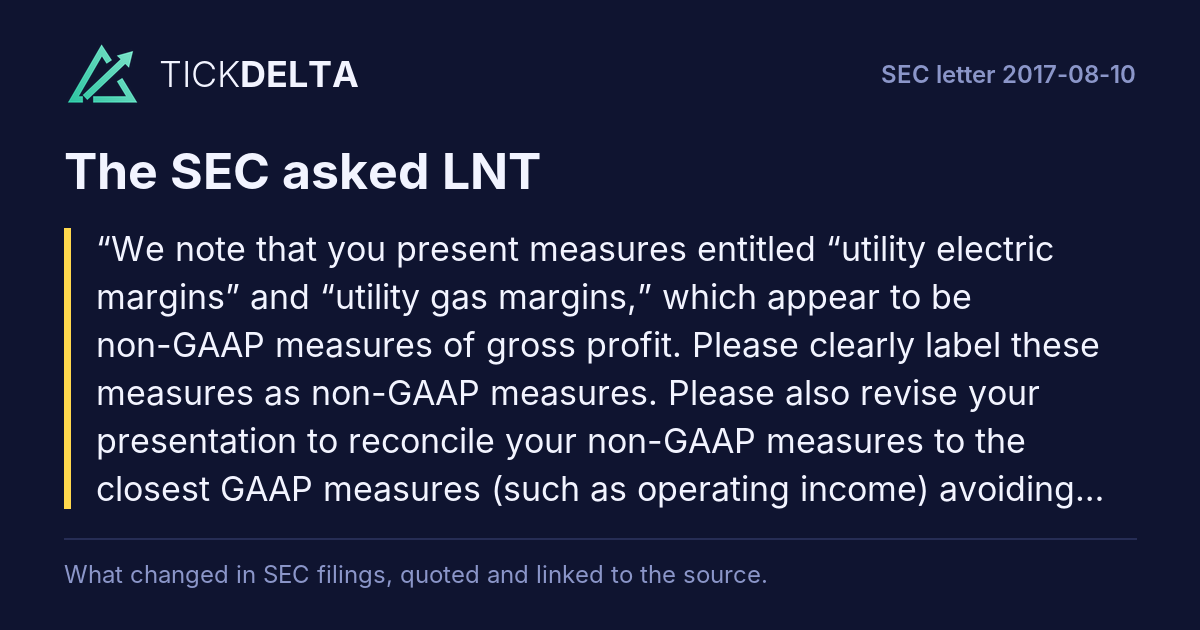
We note that you present measures entitled “utility electric margins” and “utility gas margins,” which appear to be non-GAAP measures of gross profit. Please clearly label these measures as non-GAAP measures. Please also revise your presentation to reconcile your non-GAAP measures to the closest GAAP measures (such as operating income) avoiding presentation of a full income statement reconciliation.
Rest of the question

Lastly, your reconciliation should begin with the GAAP measure so this non-GAAP measure does not receive undue prominence. See Question 102.10 of the updated Non-GAAP Compliance and Disclosure Interpretations issued on May 17, 2016.

LNT answered
Alliant Energy respectfully acknowledges the Staff’s comment and we will expand our disclosures in future filings to more clearly label these measures as non-GAAP measures of gross profit and provide a reconciliation to the most directly comparable GAAP measure, operating income. In addition, to give the GAAP measure of operating income greater prominence in our presentation, we will present operating income for the applicable periods immediately prior to the reconciliation table.
Rest of the answer

We will provide this expanded disclosure for Alliant Energy, Interstate Power and Light Company and Wisconsin Power and Light Company in our combined Form 10-Q and 10-K filings beginning with the Form 10-Q for the quarter ended September 30, 2017. An illustrative example of Alliant Energy’s proposed revised disclosures for the three years ending December 31, 2016, 2015 and 2014 is as follows:

Results of operations include financial information prepared in accordance with U.S. generally accepted accounting principles (“GAAP”) as well as utility electric margins and utility gas margins, which are not measures of financial performance under GAAP. Utility electric margins are defined as electric operating revenues less electric production fuel, purchased power and electric transmission service expenses. Utility gas margins are defined as gas operating revenues less cost of gas sold. Utility electric margins and utility gas margins are non-GAAP financial measures because they exclude other utility and non-regulated operating revenues, other operation and maintenance expenses, depreciation and amortization expenses, and taxes other than income tax expense.

Management believes that utility electric and gas margins provide a meaningful basis for evaluating and managing utility operations since electric production fuel, purchased power and electric transmission service expenses and cost of gas sold are generally passed through to customers, and therefore, result in changes to electric and gas operating revenues that are comparable to changes in such expenses. The presentation of utility electric and gas margins herein is intended to provide supplemental information for investors regarding operating performance. These utility electric and gas margins may not be comparable to how other entities define utility electric and gas margin. Furthermore, these measures are not intended to replace operating income as determined in accordance with GAAP as an indicator of operating performance.

The table below presents a reconciliation of utility electric and gas margins to the most directly comparable GAAP measure, operating income (in millions). In 2016, 2015 and 2014, operating income was $537.0 million, $577.0 million and $543.6 million, respectively.

Alliant Energy

2016

2015

2014

Electric utility operating revenues

$2,875.5

$2,770.5

$2,713.6

Electric production fuel and purchased power expenses

(854.0

)

(837.7

(877.2

Electric transmission service expense

(527.9

(485.3

(447.5

Utility Electric Margin (non-GAAP)

1,493.6

1,447.5

1,388.9

Gas utility operating revenues

355.4

381.2

517.5

Cost of gas sold

(194.3

(219.1

(327.8

Utility Gas Margin (non-GAAP)

161.1

162.1

189.7

Other utility operating revenues

48.6

57.9

66.1

Non-regulated operating revenues

40.5

44.0

53.1

Asset valuation charges for Franklin County wind farm

(86.4

—

Other operation and maintenance expenses

(606.5

(629.5

(665.0

Depreciation and amortization expenses

(411.6

(401.3

(388.1

Taxes other than income tax expense

(102.3

(103.7

(101.1

Operating income

$537.0

$577.0

$543.6

We greatly appreciate your prompt response to this letter. If you have any questions regarding this letter, please contact me at (608) 458-3449.

Read in the reply ↗
In its next report

First report after the company's reply of 2017-08-21: 10-Q filed 2017-11-03 ↗, against the 10-Q filed 2017-08-04 ↗.

Tickdelta does not hold the text of both reports, so they are not compared here.

Also in this review: closing letter, 2017-08-24

Form 10-K for the Fiscal Year Ended December 31, 2015

2016-07-18 to 2016-08-09 · 2 questions · 1 letter from the SEC, 1 from the company
Review closed 2016-08-09
Note 12(b) Equity-based Compensation Plans · Performance Units, page 132
SEC asked (1)
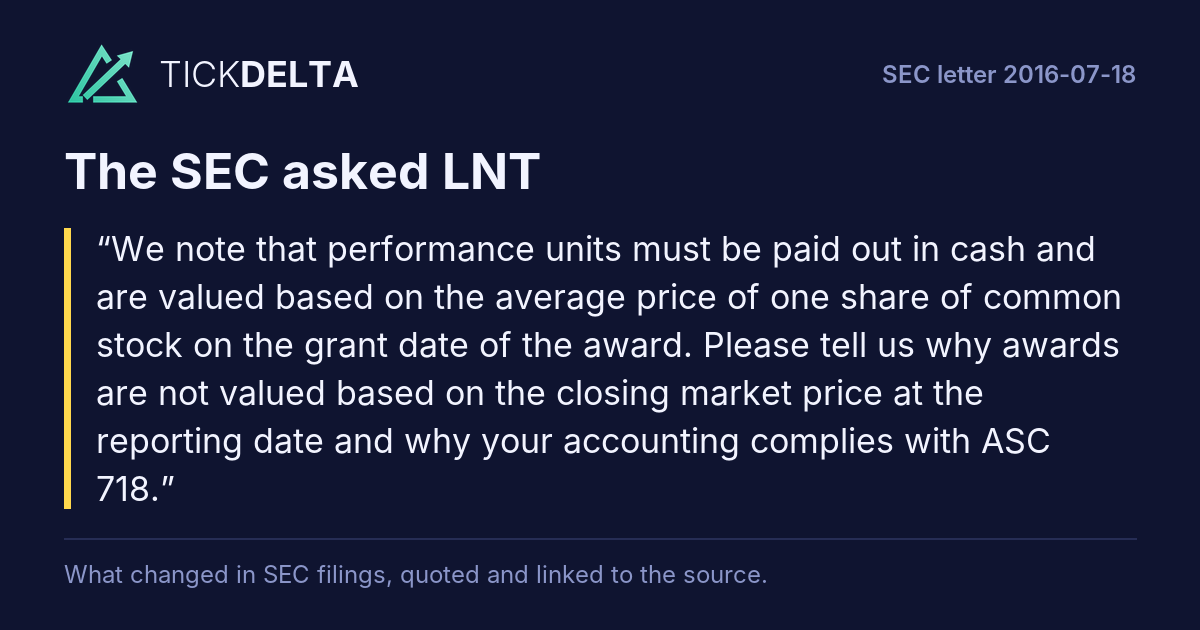
We note that performance units must be paid out in cash and are valued based on the average price of one share of common stock on the grant date of the award. Please tell us why awards are not valued based on the closing market price at the reporting date and why your accounting complies with ASC 718.
LNT answered
The Companies respectfully acknowledge the Staff’s comment and note that Alliant Energy’s, IPL’s and WPL’s accounting for performance unit awards is in accordance with ASC 718. The performance units are accounted for pursuant to ASC 718 because they are liability awards for which, in accordance with ASC 718-10-15-3, the “amounts are based, at least in part, on the price of the entity’s shares or other equity instruments.” Specifically, the final payout of the awards is, in part, based on Alliant Energy’s total shareholder return (TSR) relative to an investor-owned utility peer group.

The
Rest of the answer

awards are classified as liability awards as they have a mandatory cash payout. Per ASC 718-30-35-3, “A public entity shall measure a liability award under a share-based payment arrangement based on the award’s fair value remeasured at each reporting date until the date of settlement. Compensation cost for each period until settlement shall be based on the change (or a portion of the change, depending on the percentage of the requisite service that has been rendered at the reporting date) in the fair value of the instrument for each reporting period.” Accordingly, Alliant Energy, IPL and WPL account for performance unit awards by remeasuring the awards to fair value each reporting period and recognizing a portion of the change to compensation expense over the requisite service period. As a result, we have concluded our accounting is in accordance with ASC 718.

Per ASC 718-10-35-1 through 35-3 and related implementation guidance in ASC 718-10-55, share-based payment awards generally require the use of a fair-value-based measurement method. Fair value is defined in ASC 718-10-20 as the “amount at which an asset (or liability) could be bought (or incurred) or sold (or settled) in a current transaction between willing parties, that is, other than in a forced or liquidation sale.” In the absence of an observable market price, an entity should use a valuation technique to estimate the fair-value-based measure. In addition, because the performance units contain a market condition (Alliant Energy’s TSR relative to an investor-owned utility peer group), that market condition is reflected in determining the fair-value-based measurement of the awards each reporting period pursuant to ASC 718-10-30-14.

The incentive plan for performance units does not allow for participation in share price changes after the grant date (other than the market condition described above), which is why the fair value is tied to the grant-date stock price. Each participant has a target award dollar value and the number of units granted is determined based on the target value divided by the stock price at the grant date. Therefore, although the performance units are considered a share-based payment award due to the market condition, the value of each unit that vests is not correlated to changes in the stock price between the grant and vesting or settlement dates. That is, the value of each unit that vests is “fixed” based on the original grant-date stock price and changes in the stock price are only incorporated in the fair-value-based measure each reporting period for the market condition associated with Alliant Energy’s TSR.

Participants are awarded a target number of units that, if performance meets the threshold level, may vest anywhere between 50% of target (threshold) to 200% of target (maximum) based on Alliant Energy’s cumulative TSR performance relative to an investor-owned utility peer group. An example of the calculation of the cash payout upon vesting is as follows:

•

Participants receive awards to achieve a total target value of $500,000. The stock price on the grant date is $50, resulting in 10,000 target performance units granted. Final payout ranges from 0% to 200% based on Alliant Energy’s cumulative TSR relative to an investor-owned utility peer group over a three-year period.

At the end of the three-year performance period, assume Alliant Energy’s TSR was in the 60th percentile (which equates to 125% of the target units vesting). Assume also at the end of the three-year performance period that Alliant Energy’s stock price is $55.

The number of awards that vested at the end of the performance period is 12,500 (10,000 * 125%). The cash payout to participants would be 12,500 * $50 (grant-date stock price) = $625,000.

In the scenario above, participants know that the value of each unit that vests will be based on the stock price at the grant date and not the stock price at the vesting or settlement date. The payout uncertainty comes from the number of units that will vest at the end of the performance period, which is based on Alliant Energy’s cumulative TSR relative to an investor-owned utility peer group at the end of the three-year performance period. Each quarter Alliant Energy updates the market condition (the TSR assumption) used in its fair value calculation of the awards. We have determined that this measurement approach reflects the fair value of the performance units at each reporting period and is thus in accordance with ASC 718.

Performance units are immaterial to Alliant Energy’s, IPL’s and WPL’s financial statements. Currently there are two performance unit award years outstanding, 2014 and 2015. If the maximum payout were achieved for both award years the total value would be $4.2 million in aggregate. Compensation expense recorded for performance unit awards was $1.2 million for the year ended December 31, 2015 and $1.0 million for the six months ended June 30, 2016. We propose to revise the existing disclosure wording starting with the Companies’ 2016 second quarter Form 10-Q to the following:

“Compensation expense for performance shares and performance units is recorded ratably over the performance period based on the fair value of the awards at each reporting period.”

In addition, given the immateriality of the performance units, as part of the normal assessment process we undertake, we will evaluate the usefulness and relevance of this disclosure when preparing our 2016 Combined Form 10-K and may further revise this disclosure.

Read in the reply ↗
In its next report

First report after the company's reply of 2016-07-29: 10-Q filed 2016-08-02 ↗, against the 10-Q filed 2016-05-05 ↗.

Tickdelta does not hold the text of both reports, so they are not compared here.

Note 9(b) Equity-based Compensation Plans · Key Employee Performance Restricted Units, page 20
SEC asked (2)
We note that key employee performance restricted units must be paid out in cash, are accounted for as liability awards and are valued based on the closing market price of one share of common stock on the grant date of the award. Please tell us why awards are not valued based on the closing market price at the reporting date and why your accounting complies with ASC 718.
LNT answered
The Companies respectfully acknowledge the Staff’s comment and note that Alliant Energy’s, IPL’s and WPL’s accounting for Key Employee Performance Restricted Units (“KEPRU”) awards is not in the scope of ASC 718. The KEPRU’s are not accounted for pursuant to ASC 718 because while they are liability awards, pursuant to ASC 718-10-15-3, the amounts are not “based, at least in part, on the price of the entity’s shares or other equity instruments” nor do they “require or may require settlement by issuing the entity’s equity shares or other equity instruments.” Specifically, the final payout of
Rest of the answer

the awards is, in part, based on Alliant Energy’s net income achieved in year three of the performance period and not indexed to any of the Companies’ equity. While the number of units are based on Alliant Energy’s stock price on the grant date, the number of potential units and value of each unit are fixed on the grant date, similar to a bonus award. The awards are classified as liability awards as they have a mandatory cash payout. Accordingly, Alliant Energy, IPL and WPL account for its KEPRU awards by accruing the awards based on the probability of achieving performance targets each reporting period and recognizing such accrual to compensation expense over the requisite service period.

The incentive plan for KEPRUs does not allow for participation in any share price changes after the grant date, which is why the accrual is tied to the grant-date stock price. Each participant has a target award dollar value and the number of units granted is determined based on the target value divided by the stock price at the grant date. Therefore, the value of each unit that vests is not correlated to changes in the stock price between the grant and vesting or settlement dates. In addition, the number of units that vest is not correlated to changes in the stock price between the grant and vesting or settlement dates. Such number of units is based on Alliant Energy’s net income.

Participants are awarded a target number of units that, if performance meets the threshold level, may vest anywhere between 50% of target (threshold) to 200% of target (maximum) based on Alliant Energy’s net income achieved in year three of the performance period. The plan includes a funding scale where each net income level in the scale correlates to a different payout multiplier. An example of the calculation of the cash payout upon vesting is as follows:

Participants receive awards to achieve a total target value of $500,000 in aggregate. The stock price on the grant date is $50 resulting in 10,000 target KEPRUs granted. Final payout ranges from 0% to 200% based on Alliant Energy’s net income achieved in year three of the performance period.

At the end of the three-year performance period, assume Alliant Energy’s net income achieved the target payout funding level (which equates to the target number of units vesting or 100%). Assume also at the end of the three-year performance period that Alliant Energy’s stock price is $55.

The number of awards that vested at the end of the performance period is 10,000 (10,000 * 100%). The cash payout to participants would be 10,000 * $50 (grant-date stock price) = $500,000.

In the scenario above, participants know that the value of each unit that vests will be based on the stock price at the grant date and not the stock price at the vesting or settlement date. The payout uncertainty for participants comes from the number of units that will vest at the end of the performance period, which is based on Alliant Energy’s net income in year three. Each quarter Alliant Energy updates the payout multiplier assumption, which incorporates the probability of meeting performance targets in year three of the performance period. We have determined that this measurement approach reflects the appropriate accrual of the KEPRU’s at each reporting period.

KEPRU’s are immaterial to Alliant Energy’s, IPL’s and WPL’s financial statements. This was a new plan introduced to key employees in 2016. If the maximum payout were achieved the total value would be $3 million. Compensation expense recorded for KEPRUs was $0 for the year ended December 31, 2015 and $0.3 million for the six months ended June 30, 2016. We propose to revise the existing disclosure wording starting with the Companies’ 2016 second quarter Form 10-Q to the following:

“Each key employee performance restricted unit’s final value is based on the closing market price of one share of Alliant Energy’s common stock on the grant date of the award. Compensation expense is recorded ratably over the performance period based on a probability assessment of payouts for the awards at each reporting period.”

In addition, given the immateriality of the KEPRU’s, as part of the normal assessment process we undertake, we will evaluate the usefulness and relevance of this disclosure when preparing our 2016 Combined Form 10-K and may further revise this disclosure.

The Companies acknowledge that:

the Companies are responsible for the adequacy and accuracy of the disclosure in the filing;

Staff comments or changes to disclosure in response to Staff comments do not foreclose the Commission from taking any action with respect to the filing; and the Companies may not assert Staff comments as a defense in any proceeding initiated by the Commission or any person under the federal securities laws of the United States.

We greatly appreciate your prompt response to this letter. If you have any questions regarding this letter, please contact me at (608) 458-0528.

Read in the reply ↗
In its next report

First report after the company's reply of 2016-07-29: 10-Q filed 2016-08-02 ↗, against the 10-Q filed 2016-05-05 ↗.

Tickdelta does not hold the text of both reports, so they are not compared here.

Also in this review: closing letter, 2016-08-09

From the SEC's correspondence on EDGAR: staff letters (form UPLOAD) and company letters (form CORRESP), 10 letters filed since 2016-07-18. Questions and answers are matched by their numbers; topics come from words in each question. The reports are compared word for word (same form, before the first SEC letter against the first report after the company's reply). No AI.

Work on LNT in a spreadsheet: Excel workbook (a sheet per section, ten years by column, charts, links to the filings) · CSV. For a Google Sheet that stays up to date, paste =IMPORTDATA("https://tickdelta.com/company/LNT/export.csv") into a cell.