Screener / SEC EDGAR /CIK 0001521036 /10-K filed Feb 26, 2026, compared with Feb 26, 2025 /Numbers from the XBRL of the 10-Ks
Nasdaq Health care · Diagnostics

Lantheus Holdings, Inc. LNTH

Compare with peers Embed
New in the 10-K 37 paragraphs with nothing like them in the 10-K filed Feb 26, 2025 New in the 10-Q 32 paragraphs not in the 10-Q filed Aug 6, 2026 10-Q against the 10-K 51 risk factor paragraphs and sentences added or reworded

New risk paragraphs, branching off last year

Each branch is a paragraph in Risk Factors with nothing like it in the 10-K filed Feb 26, 2025. A box jumps to the paragraph as filed, below.

37 new

Paragraphs with nothing like them in last year's 10-K

Quoted exactly

37 paragraphs in Risk Factors of the 10-K filed Feb 26, 2026 with nothing like them in the 10-K filed Feb 26, 2025. Quoted exactly. Paragraphs that were only edited are under 10-K change.

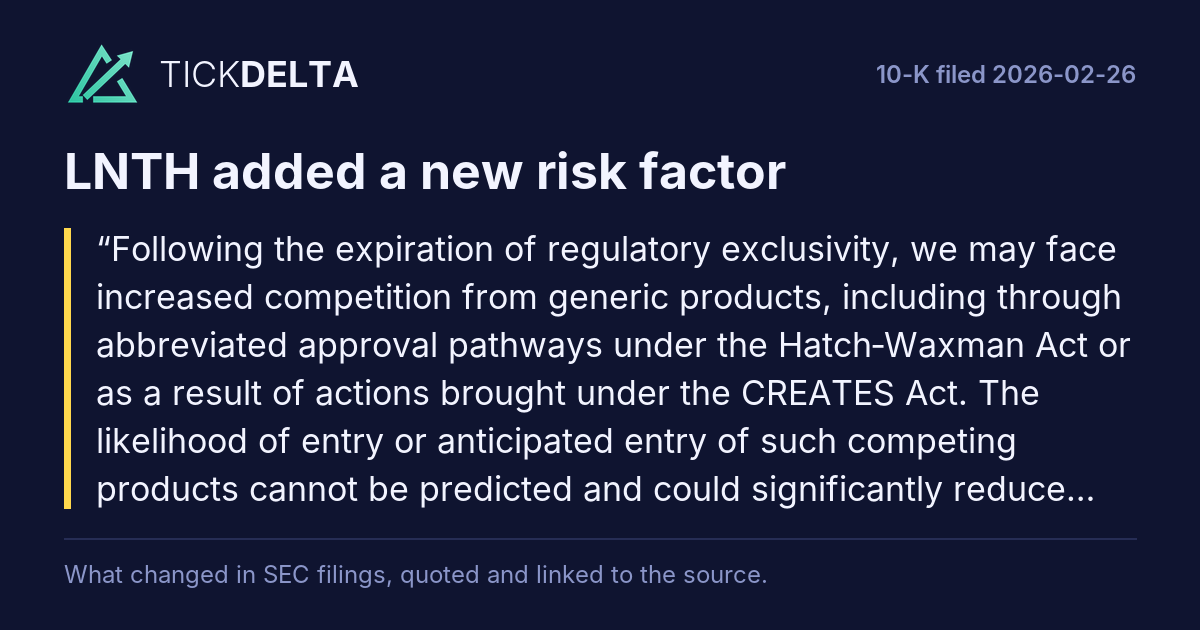
Following the expiration of regulatory exclusivity, we may face increased competition from generic products, including through abbreviated approval pathways under the Hatch‑Waxman Act or as a result of actions brought under the CREATES Act. The likelihood of entry or anticipated entry of such competing products cannot be predicted and could significantly reduce demand for our products, pressure pricing and reimbursement, and adversely affect our business, results of operations, and financial condition.

Read in the 10-K

Our ability to grow Neuraceq is dependent on (A) our ability to engage our existing PYLARIFY customers to introduce Neuraceq to those customers, (B) expanded geographical access to Neuraceq, which in turn depends on our ability to increase Neuraceq manufacturing capacity at existing manufacturing sites and add additional sites, (C) increased adoption and utilization of beta-amyloid PET and anti-amyloid therapeutics, (D) increased utilization based on the updated Neuraceq prescribing information indicating that Neuraceq can be used for patient selection for anti-amyloid therapies where the prescribing information for the therapy so states, (E) our ability to educate customers on the approved uses of Neuraceq, including its ability to quantify the degree of amyloid burden in the brain and (F) our ability to clinically differentiate Neuraceq from competitive products so that customers choose Neuraceq for appropriate patients because of its clinical attributes and despite the disparity in MUC payment rates for Neuraceq compared to other products used for traditional Medicare patients in the hospital outpatient setting.

Read in the 10-K

Ensuring adequate coding, coverage, and payment for Neuraceq is critical, including not only coverage from Medicare, Medicaid and other government payors, as well as private payors, but also appropriate payment levels to adequately cover our customers’ costs of using Neuraceq in PET/ CT imaging procedures. Neuraceq was approved by the FDA in 2014. When used for traditional Medicare patients in the hospital outpatient setting, Neuraceq is paid based on its MUC; however, Neuraceq currently competes with two commercially available F-18 beta-amyloid-targeting PET imaging agents from Eli Lilly and Co (“Lilly”) and GE Healthcare, and those other competitive imaging agents are currently being paid based on a higher MUC rate. While we have engaged with CMS to support the use of ASP instead of MUC, we can give no assurances that CMS will move to the use of ASP in the near term or that the availability of a higher MUC payment rate for other diagnostic radiopharmaceuticals will not continue to impact clinical decision making regarding which product to use for all patient populations, which could have an adverse effect on our business, results of operations, financial condition and cash flows.

In addition, growth and revenue contribution from Neuraceq will also depend on our ability to clinically differentiate Neuraceq from competitive products and to educate customers on the approved uses of Neuraceq, including its ability to quantify the degree of amyloid burden in the brain so that customers choose Neuraceq for appropriate patients because of its clinical attributes and despite the disparity in MUC payment rates for Neuraceq compared to other products used for traditional Medicare patients in the hospital outpatient setting. Further, certain currently approved therapeutic products in the United States require confirmation of the presence of amyloid beta pathology prior to initiating treatment. If this requirement in the prescribing information for these products were to change it could have an adverse effect on our business, results of operations, financial condition and cash flows.

Read in the 10-K

•For DEFINITY, our competitors currently include GE Healthcare and Bracco, as well as echocardiography without ultrasound enhancing agents and other non-echocardiography agents, and there is the potential for future competition from generic manufacturers who may submit regulatory applications using DEFINITY as the reference listed drug (RLD).

Read in the 10-K

In addition, in order to remain competitive, in certain circumstances, we provide customers with rebates, which we estimate as a reduction to revenue at the time revenue is recognized. Judgment is required in making these estimates. These rebates can include performance-based offers that are based on attaining contractually specified sales volumes, Medicaid rebate programs for our products, administrative fees of group purchasing organizations and certain distributor-related commissions. The calculation of the accrual for these rebates is based on an estimate of the third-party’s expected purchases and the resulting applicable contractual rebate to be earned over a contractual period and our estimates can vary by program, product, type of customer and geographic location. In determining the appropriate accrual amount, we consider the contractual terms, historical sales, and changes in sales trends. Specific rebates can impact year-over-year individual product revenue growth trends. If any of our assessments, assumptions, experiences or judgments are not indicative or accurate estimates of our future experience, our results could be impacted.

Read in the 10-K
Show the other 20

Reforms to the United States healthcare system, including changes to policies, guidelines and practices of regulatory authorities, may adversely affect our business.

Read in the 10-K

The full impact on our business of healthcare reforms and other new laws, or changes in existing laws, the interpretations of those laws, or changes to the way regulations and regulatory guidance has been implemented, amended and interpreted, is uncertain. Nor is it clear whether additional legislative or executive branch changes will be adopted or how those changes would affect our industry in general or our ability to successfully commercialize our products or develop or commercialize new products. For example, recent government actions, including reductions in staff and department reorganizations, including those at the FDA, could adversely affect the timing of anticipated regulatory actions or their outcome, and could change historical practices relating to the application or interpretation of regulations relevant to our operations in ways that could have an adverse effect on our business. It is unclear exactly how changes implemented by the U.S. government will affect the U.S. healthcare system, and what impact this will have on our business. If the reforms made by the OBBBA are implemented and result in predicted coverage losses, these changes could reduce the overall number of diagnostic medical imaging procedures performed, reduce reimbursement rates, or both. Additionally, changes in U.S. drug pricing policies, including initiatives that seek to link domestic prices to those paid in other countries under “most‑favored‑nation” pricing concepts, could increase pricing pressure on our products. Any such policies, if implemented or expanded, could reduce reimbursement levels, constrain pricing flexibility, and adversely affect our revenues and results of operations.

Read in the 10-K

For additional information regarding risk associated with legal proceedings other than those related to intellectual property, See “Our business and operations could be negatively affected by any pending or future securities litigation.”

Read in the 10-K

Competition in our industry for highly skilled scientific, healthcare and sales personnel is intense and we may compete with larger pharmaceutical companies that likely will have access to greater financial resources than we do. As we expand our product

Read in the 10-K

Changes to management or other key personnel, including the recent turnover in our leadership and senior management team, could have an adverse effect on our business.

Our success is substantially dependent upon the performance, contributions and expertise of our executive leadership, senior management team and other key personnel. Our executive leadership, senior management team and other key personnel play a significant role in formulating and executing on our long-term strategy, generating business and overseeing operations. We have experienced, and may continue to experience, significant executive management changes, including the consolidation of roles and responsibilities. Brian Markison, our former Chief Executive Officer (“CEO”), retired from the Company effective December 31, 2025, and Mary Anne Heino, the Chair of our Board of Directors, is serving as our CEO as of January 1, 2026 while the Board of Directors conducts a comprehensive search for our next CEO. Our former President, Paul Blanchfield, accepted a role with another company and left the Company in November 2025. We also have experienced and may continue to experience the departure and transition of other members of the leadership team.

These changes in our management team resulting from the hiring or departure of executives could disrupt our business and involve inherent risk. Any failure to find a timely and suitable replacement and ensure an effective transition within executive leadership, including the effective onboarding, assimilation, and retention of our management team and key employees, could hinder our strategic planning, business execution and future performance. In addition, executive leadership transition periods can be disruptive and may result in a loss of personnel with deep institutional or technical knowledge, or result in changes to business strategy or objectives, and may negatively impact our operations and relationships with employees and third-parties due to increased or unanticipated expenses, operational inefficiencies, uncertainty regarding changes in strategy, decreased employee morale and productivity, and increased turnover.

Read in the 10-K

The healthcare and diagnostic imaging industries are characterized by rapid and continuous technological change, evolving clinical practices, and shifting customer expectations. Our success depends on our ability to manage and improve our existing products, develop and commercialize new products and new indications, and respond effectively to competitive and technological developments. This requires, among other things, our ability to fund product development and lifecycle management initiatives; anticipate and respond to customer needs and competitive actions; collect, analyze, and derive meaningful insights from available data; obtain timely regulatory approvals; manufacture products efficiently and reliably; protect and leverage our intellectual property; and meaningfully differentiate our products in the marketplace.

To remain competitive, we must make substantial and ongoing investments in product development, whether through internal research and development efforts or through external licensing arrangements or acquisitions. If we are unable to effectively manage our existing products or successfully introduce new or improved products or indications on a timely basis, our business, results of operations, financial condition, and cash flows could be materially adversely affected.

Even if we successfully develop, manufacture, and obtain regulatory approval for new products or new indications for existing products, commercial success is not assured. Market acceptance of our products depends on numerous factors, including the availability and clinical positioning of competing products, the breadth of indications for which competitors’ products are approved, relative pricing, timing of market entry, our ability to enter into favorable commercial agreements, the effectiveness of our sales and distribution efforts, overall market conditions, and our ability to obtain and maintain adequate coding, coverage, and reimbursement, including the availability of TPT Status.

Read in the 10-K

In addition, reliable, comprehensive, and real‑time market data for certain products and indications is limited. As a result, we rely on a combination of historical sales data, information provided by third‑party manufacturing and distribution partners, third‑party medical claims data, primary market research, and other publicly available information to estimate market size, assess trends, and make strategic decisions. These assessments require assumptions that may be inaccurate, incomplete, or untimely. If our assumptions regarding market size, growth, adoption rates, or competitive dynamics are incorrect, we may make strategic or investment decisions—such as those relating to resource allocation, geographic expansion, or commercialization strategy—that fail to achieve their intended results, which could materially adversely affect our business, results of operations, financial condition, and cash flows.

The successful launch of a new pharmaceutical product is inherently uncertain, requires significant upfront investment and advance planning, and depends on coordinated execution across multiple functions. Product launches require accurate demand forecasting, reliable and timely product supply across complex manufacturing and distribution networks, effective educational and promotional efforts, and the timely achievement of favorable reimbursement and coverage decisions from payors. These activities involve substantial judgment and are subject to factors that are difficult to predict. If we misjudge demand, experience supply chain disruptions, fail to effectively educate healthcare providers, or are unable to secure timely and adequate reimbursement or coverage, a product launch may be delayed, adoption may be limited, or utilization may fall short of expectations. Because product launches involve significant upfront expenditures, delays or execution failures may be costly or difficult to remediate and could materially adversely affect our business, results of operations, financial condition, and cash flows.

Read in the 10-K

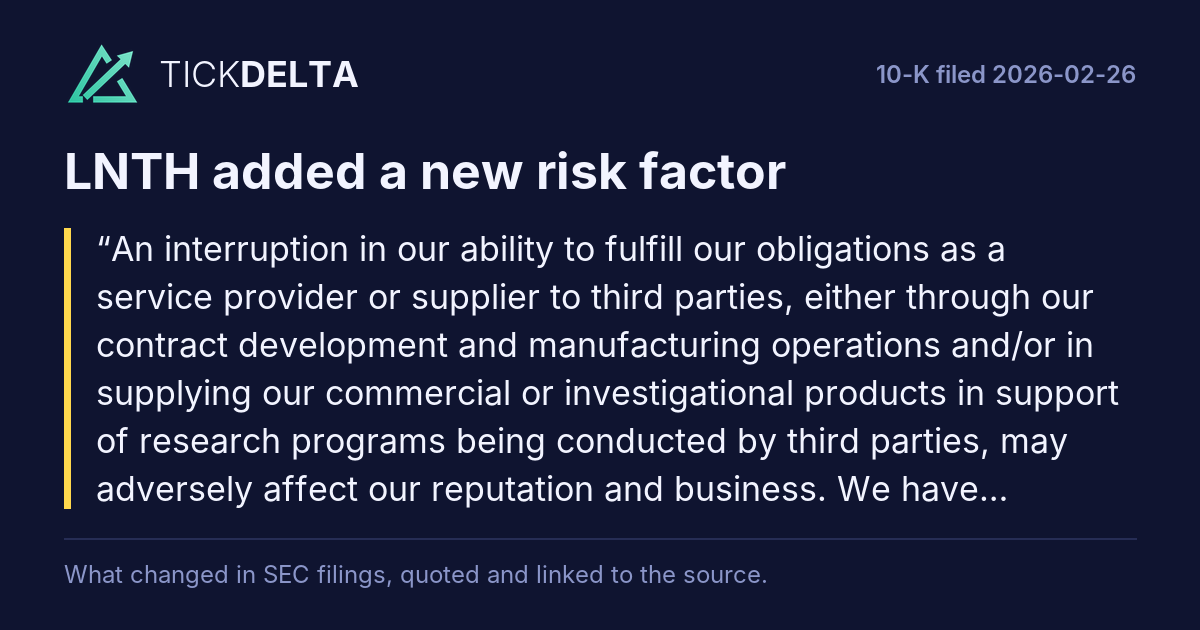
An interruption in our ability to fulfill our obligations as a service provider or supplier to third parties, either through our contract development and manufacturing operations and/or in supplying our commercial or investigational products in support of research programs being conducted by third parties, may adversely affect our reputation and business.

We have obligations to perform development and manufacturing services for third parties that have contracted with Evergreen for these services. These services are conducted out of a single location. Any disruption in our operations, any failure to timely and cost-effectively secure necessary personnel, components or materials, any failure to comply with the stringent regulations and requirements of the FDA and other regulatory authorities regarding the manufacture and development of radiopharmaceutical products, may cause us to fail to meet our contractual obligations and may adversely affect our business.

We also have contractual commitments to supply our investigational products and certain of our commercial products to third parties as part of their own research programs. Our ability to supply these products may depend upon the ability of PMFs to manufacture the products to meet the requirements of each research program, including that the product be available at the specific time of day required by the third-party’s research protocol, which may include locations both within and outside of the United States. We may have limited alternative PMF facilities in certain locations in the event one or more facility is unable to timely manufacture and supply the relevant products, and it may not be possible to timely manufacture the relevant products at required levels or at all, which may cause us to fail to meet our contractual obligations and may adversely affect our business and our reputation. These third-party research programs could be discontinued, which could adversely affect our business, results of operations, financial condition and cash flows.

Read in the 10-K

As a part of our growth strategy, we have made and may continue to make selected acquisitions of complementary businesses, such as our recent acquisitions of Life Molecular in July 2025 and Evergreen in April 2025. In addition, as part of our broader strategy, in May 2025, we announced that we had entered into a definitive agreement to sell our single-photon emission computerized tomography (“SPECT”) business to SHINE Technologies, LLC (“SHINE”), and we subsequently completed that disposition on January 1, 2026. These transactions, in addition to advancing our existing pipeline and focusing our operations, create multiple competing interests that are complex and time-consuming, which may distract our management and disrupt our ongoing business.

Our completed and any potential future acquisitions involve numerous risks and operational, financial, and managerial challenges, including the following, any of which could adversely affect our business, results of operations, financial condition and cash flows:

Read in the 10-K

•Difficulties in integrating new operations, technologies, products, and personnel, including the time it may take to effectively prioritize and communicate decisions across a broader organization and portfolio;

Read in the 10-K

Further, the disposition of our SPECT business to SHINE included providing certain transition services to SHINE for a period of time following the closing. Such transition services have been and may continue to be time consuming, and may distract personnel providing those services, including our management and disrupt our ongoing business. Additionally, there may be unforeseen expenses related to this divestiture, or we may fail to realize the expected benefits of this transaction, including potential future payments, which could adversely affect on our financial condition, results of operations and cash flows.

Read in the 10-K

Our operations use hazardous materials and produce hazardous wastes, including radioactive, chemical and, in certain circumstances, biological materials and wastes. We are subject to a variety of federal, state and local laws and regulations, as well as non-U.S. laws and regulations relating to the transport, use, handling, storage, exposure to and disposal of these materials and wastes. Environmental laws and regulations are complex, change frequently and have generally become more stringent over time.

Read in the 10-K

We deploy AI and other emerging technologies in various facets of our operations and we continue to explore further use cases for AI. The rapid advancement of these technologies presents opportunities for us in research, manufacturing, commercialization, and other business activities but also entails risks, including that AI-generated content, analyses, or recommendations we utilize could be deficient, or that our competitors may more quickly or effectively adopt AI capabilities. Our use of AI or other emerging technologies could also exacerbate regulatory, cybersecurity and other significant risks, all of which could adversely affect our business, results of operations, financial condition and cash flows.

Read in the 10-K

In August 2025, we announced that the FDA had accepted our New Drug Application (“NDA”) for a new formulation of our F-18 PSMA PET imaging agent, filed by our subsidiary Aphelion, and that the FDA set a Prescription Drug User Fee Act (“PDUFA”) target action date of March 6, 2026. The new formulation was designed to enhance product stability and increase batch production, with the potential to enhance supply flexibility and improve operating leverage across the network. If the NDA is approved, we plan to work closely with clinicians and PMF sites to ensure a smooth rollout of the new formulation, including providing clear guidance on ordering, handling, and clinical use to support continuity of care for patients, and we plan to apply for CMS reimbursement for the new formulation, including seeking three years of TPT Status; however, we can provide no assurance that the new formulation will be approved by the FDA, that we will meet our timeline for our planned rollout, or that we will obtain TPT Status. Even if we do receive NDA approval, all of the risks described above with respect to our ability to continue to generate substantial revenue from PYLARIFY, as well as the risk associated with launching a product, would also apply to our new formulation of our PSMA PET imaging agent, and we can provide no assurances that the anticipated increase in batch size or other expected improvements associated with the design of the new formulation will be realized or be viewed in the market as differentiating factors.

Read in the 10-K

In April 2025, we acquired Evergreen, including the rights to LNTH-2501. On October 30, 2025, we announced that the FDA had accepted our NDA for LNTH-2501 and has set a PDUFA target action date of March 29, 2026, but we can provide no assurance that LNTH-2501 will be approved by the FDA based on the data submitted or, if approved, that we will be successful in gaining post-approval market acceptance and adequate coding, coverage, and payment for LNTH-2501 or that our manufacturer will be able to successfully develop and scale the manufacturing capabilities to support the launch of LNTH-2501. Even if we do receive NDA approval, all of the risks described above with respect launching a product would apply to LNTH-2501. Additionally, LNTH-2501 is a kit product with a supply chain that differs from that of our other commercial products which may introduce additional operational complexity, coordination requirements, sourcing and supply risks, and we can provide no assurance that we will be able to successfully or timely launch LNTH-2501, achieve anticipated adoption, or realize expected commercial results.

Read in the 10-K

As part of our acquisition of Life Molecular, we acquired LNTH-2620, a next-generation radioactive tracer used in PET scans to detect and visualize tau protein tangles in the brain, a key biomarker for Alzheimer’s disease and other neurodegenerative disorders. LNTH-2620 is currently in a Phase 3 study.

Read in the 10-K

The Phase 3 registrational clinical trial for PNT2002, known as the “SPLASH” study, reached 100% of prespecified overall survival events. The results of the readout were comparable to the previously reported 46% and 75% readouts and remain confounded by the overwhelming number of patients who crossed over within the study to receive PNT2002. While we continue to review the available PNT2002 data, we do not currently plan to pursue an NDA or further invest in this asset, as a result, we may never realize future benefits from the related POINT License Agreement.

Read in the 10-K

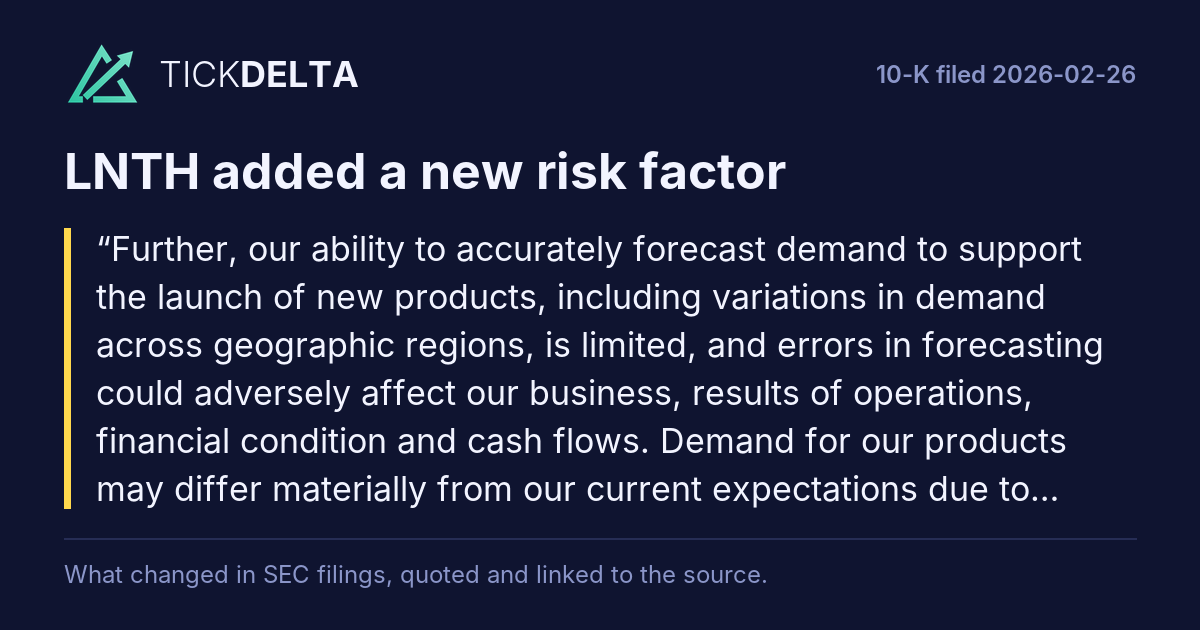
Further, our ability to accurately forecast demand to support the launch of new products, including variations in demand across geographic regions, is limited, and errors in forecasting could adversely affect our business, results of operations, financial condition and cash flows. Demand for our products may differ materially from our current expectations due to factors that are difficult to predict, including customer adoption rates, purchasing patterns, competitive offerings, pricing dynamics, reimbursement or regulatory considerations, and broader market conditions. The commercialization of our products relies on production across multiple manufacturing sites located in different regions of the United States. To meet anticipated customer demand, we must maintain appropriate levels of raw materials and manufacturing capacity at each of these sites. Accurately aligning regional demand forecasts with inventory levels across multiple locations requires complex planning and coordination, and any errors in forecasting or execution could result in excess or insufficient inventory at one or more sites. If we overestimate demand in a particular region, we may incur increased carrying costs, write‑downs or obsolescence of raw materials or finished goods, and inefficiencies in our manufacturing operations. Conversely, if we underestimate demand, we may experience supply shortages, production delays, missed sales opportunities, strained customer relationships, or damage to our reputation. In addition, shifting inventory or production capacity between sites may not be feasible on a timely or cost‑effective basis. Any of these outcomes could increase our costs, reduce our margins, delay or limit the successful adoption of the product, and materially and adversely affect our business, results of operations, and financial condition.

In addition, the successful acceptance and use of our diagnostic product candidates may depend in part on the successful development by pharmaceutical companies of disease-modifying treatments for the disease areas in which our product candidates are intended to be used, as well as the inclusion of our product candidates in the prescribing information or guidelines for such disease-modifying treatments.

Read in the 10-K

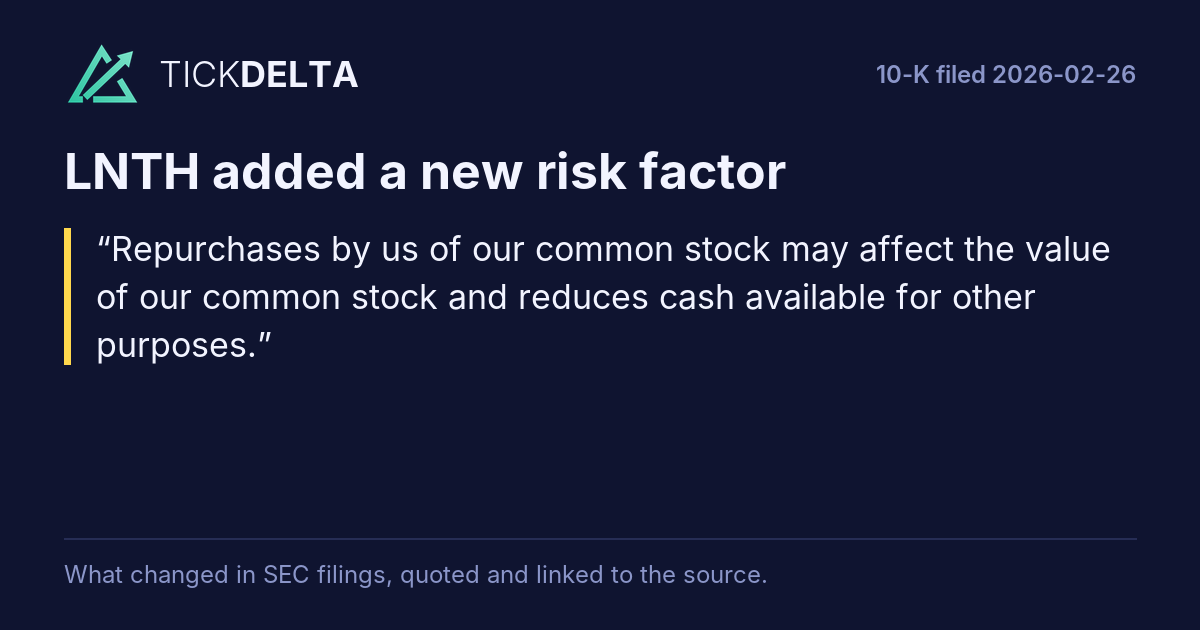
Repurchases by us of our common stock may affect the value of our common stock and reduces cash available for other purposes.

Read in the 10-K

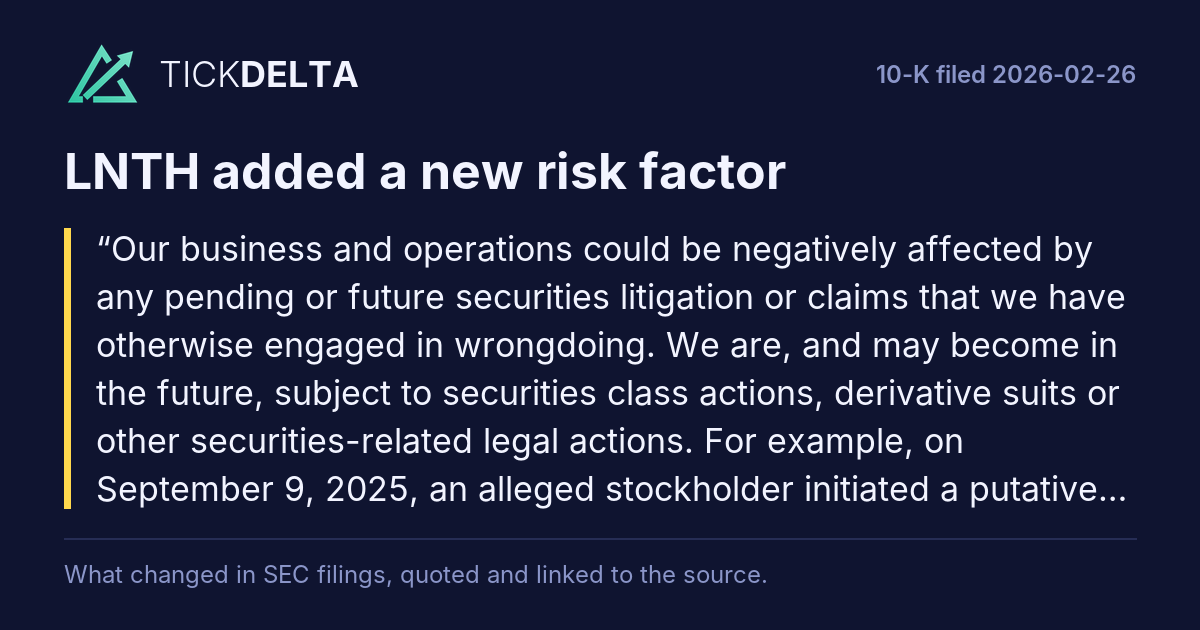
Our business and operations could be negatively affected by any pending or future securities litigation or claims that we have otherwise engaged in wrongdoing.

We are, and may become in the future, subject to securities class actions, derivative suits or other securities-related legal actions. For example, on September 9, 2025, an alleged stockholder initiated a putative securities class action against us in the United States District Court for the Southern District of New York, styled Margolis v. Lantheus Holdings, Inc., et al. The operative complaint also asserts claims against certain of our named executives. A related action, styled Indiana Pub. Ret. Sys. v. Lantheus Holdings, Inc., et al., was filed in the same court on November 5, 2025. Those actions are now consolidated into a single putative securities class action (captioned In re Lantheus Holdings, Inc. Secs. Litig.), the theory of which is that the defendants made materially false or misleading statements (or omitted material facts) in violation of the Exchange Act. Under the operative scheduling order in the case, the lead plaintiff may file an amended complaint by March 13, 2026. Additionally, on December 17, 2025, another alleged stockholder filed a shareholder derivative action in the same court, styled Lelchuk v. Heino et al., nominally on behalf of the Company and naming as defendants the current directors of our Board and the same officers named in the consolidated securities class action described above (a similar derivative complaint styled Jones v. Markison et al.,

was previously filed on October 31, 2025 but was voluntarily withdrawn without prejudice). The derivative complaint largely repeats the allegations asserted in the consolidated securities class action, and asserts claims for alleged breaches of fiduciary duties, aiding and abetting breach of fiduciary duty, unjust enrichment, waste of corporate assets, and violations of the Exchange Act. The plaintiff seeks damages and other relief on behalf of the Company. Because the outcome of litigation is uncertain, we cannot predict how or when these matters will ultimately be resolved. These actions, or any other stockholder litigation against us, could cause us to incur substantial costs defending the lawsuit. Such a lawsuit could also divert the time and attention of our management from our business, which could significantly harm our profitability and reputation.
Read in the 10-K

Paragraphs in the 10-Q filed Nov 5, 2026 that were not in the one before

New in the latest 10-Q

32 paragraphs in the 10-Q filed Nov 5, 2026 with nothing like them in the 10-Q filed Aug 6, 2026 (at least half the words must differ; new numbers alone do not count). Quoted exactly, grouped by the item heading above them. This is text that changed, not a judgement of how serious it is.

Financial statements and notes

(in years) Amortization ────────────────────────────────────────────────────────────────────────────────────────────────────────────────────────────────────────────────────────────────────── Amortizable: Trademarks 25 Straight-line $ 13,540 $ (12,509) $ 1,031 Customer relationships 5 Accelerated 102,958 (90,834) 12,124 Currently marketed products 9 - 10.5 Straight-line 492,800 (83,013) 409,787 Licenses 13 - 16 Straight-line 22,233 (14,167) 8,066 Developed technology 7 - 9 Straight-line 55,982 (13,211) 42,771 Total amortizable intangibles 687,513 (213,734) 473,779 Non-amortizable: In-process research and development Indefinite 249,000 - 249,000 Total intangibles, net $ 936,513 $ (213,734) $ 722,779 During the third quarter of 2026, the Company identified an impairment triggering event on its LNTH-2620 (previously referred to as PI-2620) and LNTH-2515 in-process research and development (“IPR&D”) intangible assets, and after completing the quantitative impairment test, recognized impairment charges of $21.0 million and $10.0 million, respectively. LNTH-2620 and LNTH-2515 were acquired in July 2025 with the acquisition of Lantheus Biosciences and had initial fair values of $21.0 million and $13.0 million, respectively, based on expected future cash flows on the date of acquisition. The impairment charges for LNTH-2620 and LNTH-2515 are included in research and development (“R&D”) expenses in the Company’s condensed consolidated statements of operations for the three and nine months ended September 30, 2026. On August 14, 2026, the Company announced that the FDA approved TAUKLARIFY (florquinitau F-18 injection), also referred to as MK-6240. As a result, the Company reassessed the existing development plan for LNTH-2620 and because there is no near-term plan to commercialize the asset, the Company determined that based on the updated analysis of the future cash flow, the value of the asset that remained was immaterial and therefore the Company recorded the full impairment in an amount equal to $21.0 million for the three and nine months ended September 30, 2026. During the third quarter of 2026, the Company performed an updated analysis of the future cash flows of LNTH-2515 and as a result, recognized an impairment charge of $10.0 million during the three and nine months ended September 30, 2026. The estimate of future cash flows used in impairment testing involves significant management judgment, and is based upon assumptions about expected future operating performance, economic conditions, market conditions and cost of capital. Inherent in estimating the future cash flows are uncertainties beyond our control, such as changes in capital markets. The actual cash flows could differ materially from management’s estimates due to changes in business conditions. The Company recorded amortization expense for its intangible assets of $16.7 million and $14.6 million for the three months ended September 30, 2026 and 2025, respectively, and $50.2 million and $30.6 million for the nine months ended September 30, 2026 and 2025, respectively.

Read in the 10-Q

capital and for other general corporate purposes and will bear interest at rates agreed between the Company and the lenders providing the Incremental Term Loans.

Read in the 10-Q

Following the filing on September 8, 2026 of the Company’s definitive proxy statement (the “Definitive Proxy Statement”) relating to the Merger (as defined below), three complaints were filed by purported stockholders against the Company and certain members of the Board in connection with the Merger. Two such complaints were filed in the Supreme Court of the State of New York, County of New York: Hamilton v. Lantheus Holdings, Inc., et al., Index No. 655291/2026, filed on September 16, 2026, and McDaniels v. Lantheus Holdings, Inc., et al., Index No. 655281/2026, filed on September 16, 2026, and one was filed in the Superior Court of the Commonwealth of Massachusetts, Middlesex County: Garfield v. Lantheus Holdings, Inc., et al., Civil Docket No. 2681CV02581, filed on September 25, 2026 (collectively, the “Merger Complaints”). The Merger Complaints generally alleged, among other things, that the Definitive Proxy Statement omitted or misrepresented certain material information and asserted claims under state common law.

Read in the 10-Q

In addition to the Merger Complaints, the Company has received sixteen demand letters from purported stockholders of the Company, two of which attached a draft complaint, making similar allegations to the Merger Complaints (the “Demand Letters”).

Read in the 10-Q

On October 2, 2026, solely to avoid the costs, burden, nuisance and uncertainties inherent in litigation and without admitting any liability or wrongdoing, the Company filed supplemental disclosures to the Definitive Proxy Statement. On October 14, 2026, the Company’s stockholders adopted the Merger Agreement (as defined below) and approved related proposals at a special meeting of stockholders. The Company believes the Merger Complaints and the Demand Letters are without merit. Additional demand letters or lawsuits may be received or filed in connection with the Merger. Because the outcome of litigation is uncertain, the Company cannot predict how or when these matters will ultimately be resolved.

Read in the 10-Q
Show the other 27

The Company has also agreed not to (i) initiate, solicit or knowingly facilitate or knowingly encourage the making of any proposal or offer that constitutes or would reasonably be expected to lead to, a Competing Proposal (as defined in the Merger Agreement), (ii) engage in, continue or otherwise participate in any discussions or negotiations regarding, or furnish to any person (other than the Parent or its representatives) any non-public information in connection with or for the purpose of knowingly facilitating or knowingly encouraging, a Competing Proposal or (iii) enter into any letter of intent, acquisition agreement, agreement in principle or similar agreement with respect to a Competing Proposal.

Read in the 10-Q

The consummation of the Merger is subject to the fulfillment or waiver of certain customary mutual closing conditions, including, among other things, (a) that no law or governmental order, injunction, decree or decision preventing the consummation of the Merger is in effect and no statute, rule or regulation shall have been enacted, entered, promulgated or enforced, and still be in effect, that prohibits or makes illegal

Read in the 10-Q

The Merger Agreement contains certain termination rights for each of the Company and the Parent, including, among others, the right of either party to terminate if the Merger is not consummated on or before 11:59 p.m. Eastern Time on May 2, 2027 (the “Outside Date”), subject to extension in certain circumstances (provided that the Outside Date shall not be extended beyond November 30, 2027), and the right of the Company, in certain circumstances, to terminate the Merger Agreement and accept a Superior Proposal. The Company will be required to pay the Parent a termination fee of $228.0 million in cash if the Merger Agreement is terminated (a) by the Parent because, prior to receipt of the requisite approval by the Company’s stockholders, the Board or any committee thereof makes a change to its recommendation of the Merger, (b) by the Company in order to enter into an alternative acquisition agreement with respect to a Superior Proposal or (c)(i)(A) by the Parent or the Company pursuant to the Outside Date termination right, (B) by the Parent or the Company because the Company stockholder approval was not obtained, or (C) by the Parent because of a willful breach of the Merger Agreement by the Company, and (ii) a bona fide Competing Proposal (as defined and so modified in the Merger Agreement) was publicly disclosed after the date of the Merger Agreement and prior to such termination and was not publicly withdrawn prior to such termination, and (iii) within 12 months after such termination, the Company enters into an alternative acquisition agreement with respect to such Competing Proposal (and such transaction is subsequently consummated) or consummates such a transaction. In no event will the Company be required to pay such termination fee more than once. The Parent will be required to pay the Company a general termination fee of $385.0 million or, alternatively, a regulatory termination fee of $100.0 million, in each case under specified circumstances, including, in the case of the regulatory termination fee, the termination of the Merger Agreement due to the failure to consummate the Merger by the Outside Date as a result of the failure to obtain certain required regulatory approvals or due to a final and non-appealable injunction or order relating to antitrust laws or foreign direct investment laws. In no event will Parent be required to pay both fees.

Read in the 10-Q

The Company incurred approximately $18.6 million in costs during the three and nine months ended September 30, 2026, consisting primarily of legal and other advisor costs related to the proposed Merger, which are included in general and administrative expenses in the Company’s condensed consolidated statements of operations.

Read in the 10-Q

For additional information regarding the Merger Agreement and the proposed Merger please see the Company’s Current Report on Form 8-K filed with the SEC on August 4, 2026 and Definitive Proxy Statement. A special meeting of the Company’s stockholders was held on October 14, 2026, at which, among other items, the Merger Agreement was adopted. See Note 20, “Subsequent Event” for more information on the results of the stockholders’ vote and the status of required regulatory approvals.

Read in the 10-Q

assigned to each class of assets acquired and liabilities assumed, as well as asset lives, can materially impact the Company’s condensed consolidated statements of operations.

Read in the 10-Q

On September 22, 2026, the Company announced that the FDA granted final approval for BRAVNETSA (lutetium Lu 177 dotatate), previously known as PNT2003, through the FDA’s ANDA pathway. BRAVNETSA is indicated for the treatment of adult patients with somatostatin receptor-positive gastroenteropancreatic neuroendocrine tumors (“GEP-NETs”), including foregut, midgut, and hindgut neuroendocrine tumors. Upon the FDA’s final approval of BRAVNETSA, the Company was required to pay POINT a $10.0 million regulatory milestone payment, which will be paid in the fourth quarter of 2026, and which the Company has included a charge for in R&D expenses of the Company’s condensed consolidated statements of operations for the three and nine months ended September 30, 2026, based on the current commercialization plans for the asset.

Read in the 10-Q

On February 6, 2023, the Company acquired Cerveau. Cerveau holds the rights under a license agreement to develop and commercialize MK-6240, a radiodiagnostic agent indicated for PET imaging of the brain in adults with cognitive impairment who are being evaluated for Alzheimer’s disease to identify patients with tau neurofibrillary tangle pathology. The Company determined that its acquisition of Cerveau did not meet the definition of a business combination and accounted for the transaction as an asset acquisition.

Read in the 10-Q

In February 2023, the Company made an up-front payment of approximately $35.3 million to the stockholders of Cerveau (the “Cerveau Stockholders”) and paid the Cerveau Stockholders an additional $10.0 million in May 2023 upon the successful completion of a technology transfer. On August 14, 2026, the Company announced that the FDA approved MK-6240 under the brand name TAUKLARIFY (florquinitau F-18 injection). As a result of the FDA approval, the Company was required to pay the Cerveau Stockholders a $13.0 million regulatory milestone payment, which was paid in September 2026, and is included in R&D expenses in the Company’s condensed consolidated statements of operations for the three and nine months ended September 30, 2026, based on the current commercialization plans for the asset. The Company is also required to pay Merck Sharp & Dohme Corp. a $1.3 million milestone payment upon the approval of the NDA. This amount will be paid in the fourth quarter of 2026 and was also included in R&D expenses in the Company’s condensed consolidated statements of operations for the three and nine months ended September 30, 2026.

Read in the 10-Q

20. Subsequent Events On October 14, 2026, the Company held a special meeting of stockholders, at which the Company’s stockholders voted to adopt the Merger Agreement. On October 21, 2026, the Company received a request for additional information and documentary materials (a “Second Request”) from the Federal Trade Commission (“FTC”) in connection with the FTC’s review of the Merger. The effect of a Second Request is to extend the waiting period imposed by the HSR Act until 30 days after the Company and the Parent each have substantially complied with the Second Request issued to it, unless that period is terminated sooner by the FTC. Completion of the Merger remains subject to the expiration or termination of the waiting period under the HSR Act and the satisfaction or waiver of the other closing conditions specified in the Merger Agreement. The Company and the Parent continue to expect to consummate the Merger in the first half of 2027.

Read in the 10-Q

the agreement, including the expiration or termination of the waiting period under the Hart-Scott-Rodino Antitrust Improvements Act of 1976, as amended (the “HSR Act”), which was extended on October 21, 2026 by the Federal Trade Commission (the “FTC”), and the receipt of other required antitrust and foreign direct investment approvals; (xv) statements about the expected time frame for completing the proposed Merger; (xvi) our and the Parent’s beliefs and expectations and statements about the benefits sought to be achieved by the proposed Merger; (xvii) the potential effects of the proposed Merger on us and the Parent, including on our relationships with customers, suppliers and employees, and the costs we have incurred and will incur in connection with the proposed Merger whether or not it is completed; (xviii) the possibility of any termination of the Merger Agreement, including in circumstances that would require us to pay a termination fee; and (xix) whether any payments will be made under the contingent value rights to be issued in the proposed Merger.

Read in the 10-Q

On September 28, 2026, we announced that the first patient has been dosed in SPARROW, a Phase 2/3 registrational trial evaluating LNTH-2401 (68Ga-DOTA-RM2). LNTH-2401 is an investigational Ga-68-labeled PET imaging agent that targets gastrin-releasing peptide receptor (“GRPR”), a biomarker that is highly expressed in many prostate cancers. SPARROW is an open-label, non-randomized, multicenter Phase 2/3 clinical trial evaluating investigational LNTH-2401 PET/computed tomography imaging in prostate cancer. The study consists of a Phase 2 dose optimization period followed by a Phase 3 diagnostic performance period.

Read in the 10-Q

On August 14, 2026, we announced that the FDA approved TAUKLARIFY (florquinitau F-18 injection), also referred to as MK-6240, a radiodiagnostic agent indicated for PET of the brain in adults with cognitive impairment who are being evaluated for Alzheimer’s disease to identify patients with tau neurofibrillary tangle pathology.

Read in the 10-Q

Following approval, we intend to continue to support the use of TAUKLARIFY in Alzheimer’s disease therapeutic programs through our Pharma Solutions business while assessing the appropriate path toward broader commercial availability. Our approach will remain aligned with the needs of our partners and informed by developments across the Alzheimer’s disease treatment landscape.

Read in the 10-Q

TAUKLARIFY’s approval is supported by two pivotal studies assessing its sensitivity and specificity. The data from these two studies analyzed TAUKLARIFY PET images from more than 500 subjects who participated in three clinical trials. The clinical trials included individuals with mild cognitive impairment, mild Alzheimer’s disease dementia and cognitively unimpaired individuals, enabling evaluation across a broad spectrum of cognitive function, including earlier stages of disease.

Read in the 10-Q

on conversion of the promissory note from Illuminated, with a principal amount of $70.0 million that bears no interest and has a maturity date of June 14, 2028 (“Installment Note”) of $2.5 million recorded during the nine months ended September 30, 2026.

Read in the 10-Q

Risk Factors

On October 21, 2026, we received a request for additional information and documentary materials (a “Second Request”) from the Federal Trade Commission (the “FTC”) in connection with the FTC’s review of the Merger. The effect of a Second Request is to extend the waiting period imposed by the HSR Act until 30 days after we and the Parent each have substantially complied with the Second Request issued to it, unless that period is terminated sooner by the FTC. Completion of the Merger remains subject to the expiration or termination of the waiting period under the HSR Act and the satisfaction or waiver of the other closing conditions specified in the Merger Agreement. Governmental authorities could seek to impose conditions on the Merger, including divestitures or other remedies, or seek to block it.

Read in the 10-Q

Litigation is common in connection with acquisitions of public companies in the United States, regardless of any merits related to the underlying acquisition. Following the filing of our definitive proxy statement relating to the Merger on September 8, 2026, three complaints were filed by purported stockholders against us and certain members of our Board in connection with the Merger (the “Merger Complaints”). The Merger Complaints generally alleged, among other things, that the definitive proxy statement omitted or misrepresented certain material information and asserted claims under state common law. In addition, we have received sixteen demand letters from purported stockholders,

Read in the 10-Q

two of which attached a draft complaint, making similar allegations to the Merger Complaints. On October 2, 2026, solely to avoid the costs, burden, nuisance and uncertainties inherent in litigation, and without admitting any liability or wrongdoing, we filed supplemental disclosures to the definitive proxy statement. On October 14, 2026, our stockholders adopted the Merger Agreement and approved related proposals at a special meeting of stockholders. We believe the complaints and demand letters are without merit.

Read in the 10-Q

As part of our acquisition of Lantheus Biosciences (formerly Life Molecular Imaging Limited), we acquired LNTH-2620 (previously referred to as PI-2620), a tau PET imaging agent. On August 14, 2026, we announced that the FDA approved TAUKLARIFY (florquinitau F-18 injection), also referred to as MK-6240. As a result, there is no near-term plan to commercialize the asset.

Read in the 10-Q

During 2024, we acquired Meilleur Technologies, Inc. (which has subsequently merged with and into Cerveau), which holds the rights under a license agreement to develop and commercialize NAV-4694, an investigational late-stage F-18-labeled PET imaging agent that targets beta amyloid in Alzheimer’s disease. NAV-4694 is currently in Phase 3 development and is also being used in academic and industry sponsored clinical trials.

Read in the 10-Q

Previously, we acquired MK-6240, an F-18-labeled PET imaging agent that targets tau tangles. On August 14, 2026, we announced that the FDA approved TAUKLARIFY (florquinitau F-18 injection), also referred to as MK-6240, for PET imaging of the brain in adults with cognitive impairment who are being evaluated for Alzheimer’s disease to identify patients with tau neurofibrillary tangle pathology. We intend to continue supporting the use of TAUKLARIFY in Alzheimer’s disease therapeutic programs through our Pharma Solutions business while assessing the appropriate path and timing toward broader commercial availability, but we can provide no assurance that we will be successful in the broader commercialization of TAUKLARIFY, including obtaining FDA approval for each PMF we select to manufacture TAUKLARIFY, obtaining adequate coding, coverage and payment, including TPT Status, for TAUKLARIFY and having physicians and customers adopt TAUKLARIFY.

Read in the 10-Q

While we believe that TAUKLARIFY, as a tau imaging agent, and NAV-4694, as a beta amyloid imaging agent, have the potential to expand our neurology franchise that also includes Neuraceq and could play an important role in diagnosing, staging and monitoring Alzheimer’s disease, we can give no assurance that we will be successful with continued development, regulatory approval and commercialization of these products and product candidates or that we will be able to resolve any disagreements with the counterparties to our license agreements or the former stockholders of the companies we acquired who could receive future milestone and royalty-based payments, including any disagreements over proprietary rights, contract interpretation or the preferred course of product research, development or marketing that might cause delays or termination of the license agreements, or might result in litigation or arbitration, which could be

Read in the 10-Q

time-consuming and expensive. In addition, the successful acceptance and use of these diagnostic products and product candidates will depend on the successful development by pharmaceutical companies of disease-modifying treatments for Alzheimer’s disease, as well as the inclusion of our products in the prescribing information or guidelines for such disease-modifying treatments.

Read in the 10-Q

We have recognized, and may in the future recognize, impairment charges on our acquired intangible assets, which could adversely affect our results of operations.

Read in the 10-Q

We have significant goodwill and intangible assets from our acquisitions, including the LMI Acquisition and the Evergreen Acquisition. During the third quarter of 2026, we recognized impairment charges of $21.0 million and $10.0 million on the LNTH-2620 and LNTH-2515 in-process research and development intangible assets, respectively, which we acquired with Lantheus Biosciences in July 2025. On August 14, 2026, we announced that the FDA approved TAUKLARIFY (florquinitau F-18 injection), also referred to as MK-6240. As a result, we reassessed the existing development plan for LNTH-2620 and because there is no near-term plan to commercialize the asset, we determined that based on the updated analysis of the future cash flow, the value of the asset that remained was immaterial and therefore we recorded the full impairment in an amount equal to $21.0 million for the three and nine months ended September 30, 2026.

Read in the 10-Q

Our impairment assessments rely on estimates of future cash flows that involve significant management judgment and uncertainties beyond our control, and actual cash flows could differ materially from our estimates. Clinical, regulatory or commercial setbacks, competition, lower-than-expected sales or changes in our development priorities could result in additional impairment charges. Those charges could be material and could adversely affect our results of operations in the period in which they are recorded.

Read in the 10-Q

The 10-Q's risk factors against the 10-K

Item 1A of the 10-Q filed Nov 5, 2026 against Item 1A of the 10-K filed Feb 26, 2026. A 10-Q repeats only the risks that changed, so a 10-K paragraph that is missing from it is not counted as removed. Added is a paragraph with nothing like it in the 10-K, Reworded a sentence that is in both with several words changed, Quiet changes a sentence in both where one to four words changed and one is a hedge or a modal (cut words struck through, new words highlighted). Text on the page, not a score; each links to the filing at sec.gov.

What the 10-Q itself says about its risk factors:There have been no material changes to the risk factors set forth in our Annual Report on Form 10-K (our “Form 10-K”) for the year ended December 31, 2025, except as set forth below:

Read in the 10-Q
Added10-Q Nov 5, 2026 vs 10-K Feb 26, 2026
We may not complete the pending transaction with Curium US Holdings LLC (the “Parent”) within the time frame we anticipate or at all, which could have an adverse effect on our business, financial results, operations and/or the market price of our common stock.

Read it in the 10-Q at sec.gov

Added10-Q Nov 5, 2026 vs 10-K Feb 26, 2026
On August 3, 2026, we entered into an Agreement and Plan of Merger (the “Merger Agreement”) with the Parent and Coco Merger Sub Inc. (the “Merger Sub”), pursuant to which, on the terms and subject to the conditions set forth in the Merger Agreement, the Merger Sub will merge with and into us and we will continue as the surviving corporation in such merger as a wholly-owned subsidiary of the Parent (the “Merger”).

Read it in the 10-Q at sec.gov

Added10-Q Nov 5, 2026 vs 10-K Feb 26, 2026
The completion of the Merger is subject to the fulfillment or waiver of certain customary mutual closing conditions, including, among other things, (i) the absence of any law or order by a governmental authority of competent jurisdiction prohibiting or otherwise making illegal the consummation of the Merger, (ii) the expiration or termination of the applicable waiting period (or any extensions thereof) under the Hart-Scott-Rodino Antitrust Improvements Act of 1976, as amended (the “HSR Act”), (iii) that no voluntary agreement between the parties and a governmental entity not to consummate the Merger shall be in effect and (iv) that certain other specified approvals, filings, notifications, clearances or expirations or terminations of waiting periods shall have occurred or been obtained, made or waived, as applicable. The obligation of each party to consummate the Merger is also conditioned upon (i) the accuracy of the other party’s representations and warranties, (subject, in certain cases, to certain customary materiality qualifications) and (ii) the other party’s performance or compliance in all material respects with its obligations under the Merger Agreement. In addition, the obligation of the Parent and Merger Sub to consummate the Merger is also conditioned upon no Company Material Adverse Effect (as defined in the Merger Agreement) having occurred that is continuing at the effective time of the Merger. In addition, we have certain customary termination rights pursuant to the Merger Agreement, including our right to terminate the Merger Agreement to accept a “Superior Proposal” (as defined in the Merger Agreement) subject to compliance with certain procedures specified in the Merger Agreement. As a result, we cannot assure you that all of the various closing conditions will be satisfied and that the Merger with the Parent will be completed, or that, if completed, it will be exactly on the terms set forth in the Merger Agreement or within the expected time frame.

Read it in the 10-Q at sec.gov

Added10-Q Nov 5, 2026 vs 10-K Feb 26, 2026
On October 21, 2026, we received a request for additional information and documentary materials (a “Second Request”) from the Federal Trade Commission (the “FTC”) in connection with the FTC’s review of the Merger. The effect of a Second Request is to extend the waiting period imposed by the HSR Act until 30 days after we and the Parent each have substantially complied with the Second Request issued to it, unless that period is terminated sooner by the FTC. Completion of the Merger remains subject to the expiration or termination of the waiting period under the HSR Act and the satisfaction or waiver of the other closing conditions specified in the Merger Agreement. Governmental authorities could seek to impose conditions on the Merger, including divestitures or other remedies, or seek to block it.

Read it in the 10-Q at sec.gov

Added10-Q Nov 5, 2026 vs 10-K Feb 26, 2026
If the Merger is not completed within the expected time frame or at all, we may be subject to a number of material risks. The price of our common stock may decline for a number of reasons, including because the market price may reflect expectations regarding completion of the Merger. We could also be required to pay the Parent a termination fee if the Merger Agreement is terminated under specific circumstances set forth in the Merger Agreement. The failure to complete the Merger also may result in negative publicity, a decline in investor confidence, stockholder litigation being brought against us, adverse impacts to our relationships with our existing and prospective employees, collaborators, customers, regulators, suppliers and other business partners, us being unable to recruit prospective employees or to retain and motivate existing employees, and adverse financial impacts due to costs incurred in connection with the Merger. We may also be required to devote significant time and resources to litigation related to any failure to complete the Merger or related to any enforcement proceeding commenced against us to perform our obligations under the Merger Agreement.

Read it in the 10-Q at sec.gov

Show the other 19
Added10-Q Nov 5, 2026 vs 10-K Feb 26, 2026
The pendency of the Merger with the Parent could adversely affect our business, financial results, operations and/or the market price of our common stock.

Read it in the 10-Q at sec.gov

Added10-Q Nov 5, 2026 vs 10-K Feb 26, 2026
Our efforts to complete the Merger could cause substantial disruptions in, and create uncertainty surrounding, our business, which may materially adversely affect our results of operations and our business. Uncertainty as to whether the Merger will be completed may affect our ability to recruit prospective employees or to retain and motivate existing employees. Employee retention may be particularly challenging while the Merger is pending because employees may experience uncertainty about their roles following consummation of the Merger. Our management’s and certain of our employees’ attention is being directed toward the completion of the Merger and thus is being diverted to some extent from our day-to-day operations or other strategic initiatives we might pursue. In addition, to the extent the FTC requires us to divest assets as a condition to completing the Merger, some of our management’s and certain of our employees’ attention would be directed towards negotiation and completion of such divestitures and the terms and conditions of such divestitures could be on terms less favorable to us than they might otherwise be if not done as a condition to completing the Merger.

Read it in the 10-Q at sec.gov

Added10-Q Nov 5, 2026 vs 10-K Feb 26, 2026
Uncertainty as to our future could adversely affect our business and our relationship with collaborators, customers, regulators, suppliers and other business partners. For example, collaborators, suppliers, and other counterparties may defer decisions concerning working with us, or seek to change existing business relationships with us. Changes to or termination of existing business relationships could adversely affect our results of operations and financial condition, as well as the market price of our common stock. The adverse effects of the pendency of the Merger could be exacerbated by any delays in completion of the Merger or termination of the Merger Agreement.

Read it in the 10-Q at sec.gov

Added10-Q Nov 5, 2026 vs 10-K Feb 26, 2026
Under the terms of the Merger Agreement, we have agreed to certain restrictions (unless approved by the Parent) on the operations of our business that could harm our business relationships, financial condition, operating results, cash flows and business, including restrictions with respect to our ability to, among other things, subject to certain specified exceptions: incur capital expenditures in excess of a specified aggregate amount for an applicable calendar year, incur or assume any long-term or short-term indebtedness for borrowed money or materially modify the terms of any indebtedness for borrowed money other than revolver borrowings or letters of credit in the ordinary course of business, commence any clinical study, except for select studies or discontinue, terminate or suspend any ongoing clinical study other than (i) for efficacy or safety reasons, (ii) as mandated by any health regulatory authority or (iii) pursuant to any discontinuation, termination or suspension, for bona fide business reasons. Because of these restrictions, we may be prevented or delayed from undertaking certain actions with respect to the conduct of our business that we might otherwise have taken if not for the Merger Agreement. Such restrictions could prevent or delay us from pursuing certain business opportunities that arise prior to the effective time of the Merger and are outside the ordinary course of business and could otherwise adversely affect our business and operations prior to completion of the Merger or could prevent or delay actions that could otherwise enable future growth.

Read it in the 10-Q at sec.gov

Added10-Q Nov 5, 2026 vs 10-K Feb 26, 2026
In certain instances, the Merger Agreement requires us to pay a termination fee to the Parent, which could require us to use available cash that would have otherwise been available for general corporate purposes.

Read it in the 10-Q at sec.gov

Added10-Q Nov 5, 2026 vs 10-K Feb 26, 2026
Under the terms of the Merger Agreement, we may be required to pay the Parent a termination fee of $228.0 million if the Merger Agreement is terminated under specific circumstances therein, including, but not limited to, in the event we accept and enter into an agreement for the consummation of a transaction which our Board of Directors (“Board”) determines is a Superior Proposal. If the Merger Agreement is terminated under such circumstances, the termination fee we would be required to pay under the Merger Agreement may require us to use available cash that would have otherwise been available for general corporate purposes and other uses. For these and other reasons, termination of the Merger Agreement could materially and adversely affect our business operations and financial condition, which in turn would materially and adversely affect the price of our common stock.

Read it in the 10-Q at sec.gov

Reworded10-Q Nov 5, 2026 vs 10-K Feb 26, 2026
On October 30, 2025, we announced that the FDA had accepted our NDA for If LNTH-2501 and has set a PDUFA target action date of March 29, 2026, but we can provide is approved, there is no assurance that LNTH-2501 will be approved by the FDA based on the data submitted or, if approved, guarantee that we will be successful in gaining post-approval market acceptance and adequate coding, coverage, and payment for LNTH-2501 or that our manufacturer will be able to successfully develop and scale the manufacturing capabilities to support the launch of LNTH-2501.

Read it in the 10-Q at sec.govThe 10-K sentence

Reworded10-Q Nov 5, 2026 vs 10-K Feb 26, 2026
While we continue to review the available PNT2002 data, we do not currently plan to pursue an NDA or further invest in this asset, as As a result, we may never realize any future benefits from the related POINT License Agreement.

Read it in the 10-Q at sec.govThe 10-K sentence

Reworded10-Q Nov 5, 2026 vs 10-K Feb 26, 2026
In addition, the successful acceptance and use of our these diagnostic products and product candidates may will depend in part on the successful development by pharmaceutical companies of disease-modifying treatments for the disease areas in which our product candidates are intended to be used, Alzheimer’s disease, as well as the inclusion of our product candidates products in the prescribing information or guidelines for such disease-modifying treatments.

Read it in the 10-Q at sec.govThe 10-K sentence

Reworded10-Q Nov 5, 2026 vs 10-K Feb 26, 2026
We may not, or may take longer to, realize the expected benefits and opportunities related to, investments we have made to develop PYLARIFY TruVu, our recently-approved new formulation of our prostate-specific membrane antigen (“PSMA”) PET positron emission tomography (“PET”) Imaging Agent.

Read it in the 10-Q at sec.govThe 10-K sentence

Reworded10-Q Nov 5, 2026 vs 10-K Feb 26, 2026
During 2024, we acquired Meilleur, (which has subsequently merged with and into Cerveau), which holds the rights under a license agreement to develop and commercialize NAV-4694, an investigational late-stage F-18-labeled PET imaging agent that targets beta amyloid in Alzheimer’s disease.

Read it in the 10-Q at sec.govThe 10-K sentence

Reworded10-Q Nov 5, 2026 vs 10-K Feb 26, 2026
The expected benefits and opportunities related to the POINT License Agreements and related agreements for the supply of PNT2003 by POINT may not be realized or may take longer to realize than expected due to, for example, challenges and uncertainties inherent in product research, development, manufacturing, regulatory approval, marketing and competition.

Read it in the 10-Q at sec.govThe 10-K sentence

Reworded10-Q Nov 5, 2026 vs 10-K Feb 26, 2026
In particular, activities under the POINT License Agreements may not result in viable products suitable for commercialization in a timely manner or at all, due to a variety of reasons, including any inability of the relevant parties to perform their commitments and obligations under the POINT License Agreements. Agreements, our ability to successfully defend the favorable U.S.

Read it in the 10-Q at sec.govThe 10-K sentence

The first 24 of 51 are shown (at most 12 of each type).

Phrases used for the first time

Two-word phrases in Risk Factors of the 10-K filed Feb 26, 2026 that are in none of the 1 earlier 10-Ks stored, back to Feb 26, 2025

new formulation ×9substantial revenue ×8research programs ×6additional pmf ×4already produce ×4based products ×4successfully complete ×4transfer process ×4process necessary ×4generate substantial ×4disease-modifying treatments ×4exchange act ×4end users ×3clinically differentiate ×3appropriate patients ×3nce regulatory ×3
Where each one is used
  • new formulation: Use of our radiopharmaceutical diagnostic products is dependent upon the availability of staff at imaging centers and hospitals and PET scanners in the market. Accordingly, our ability to continue to generate substantial revenue from PYLARIFY, grow Neuraceq, and successfully launch new PET diagnostic products,...
  • substantial revenue: Continued substantial revenue contribution from PYLARIFY is dependent on (A) the ability of positron emission tomography (“PET”) manufacturing facilities (“PMFs”) to manufacture PYLARIFY to meet product demand, including ensuring that PYLARIFY is available at the specific time of day preferred by the end-user, (B)...
  • research programs: Our ability to attract and retain employees and customers, to invest in and grow our business, to maintain our desired levels of costs of goods sold and operating expenses and to meet our financial obligations depends on our operating and financial performance, which, in turn, is subject to numerous factors,...
  • additional pmf: To manufacture PYLARIFY, we assembled and qualified a nationwide network of PMFs with radioisotope-producing cyclotrons that make F-18, which has a 110-minute half-life, so PYLARIFY is manufactured and distributed rapidly to end-users. Because each of the PMFs manufacturing these products is deemed by the U.S. Food...
  • already produce: To manufacture PYLARIFY, we assembled and qualified a nationwide network of PMFs with radioisotope-producing cyclotrons that make F-18, which has a 110-minute half-life, so PYLARIFY is manufactured and distributed rapidly to end-users. Because each of the PMFs manufacturing these products is deemed by the U.S. Food...
  • based products: To manufacture PYLARIFY, we assembled and qualified a nationwide network of PMFs with radioisotope-producing cyclotrons that make F-18, which has a 110-minute half-life, so PYLARIFY is manufactured and distributed rapidly to end-users. Because each of the PMFs manufacturing these products is deemed by the U.S. Food...
  • successfully complete: To manufacture PYLARIFY, we assembled and qualified a nationwide network of PMFs with radioisotope-producing cyclotrons that make F-18, which has a 110-minute half-life, so PYLARIFY is manufactured and distributed rapidly to end-users. Because each of the PMFs manufacturing these products is deemed by the U.S. Food...
  • transfer process: To manufacture PYLARIFY, we assembled and qualified a nationwide network of PMFs with radioisotope-producing cyclotrons that make F-18, which has a 110-minute half-life, so PYLARIFY is manufactured and distributed rapidly to end-users. Because each of the PMFs manufacturing these products is deemed by the U.S. Food...

The 10-K at sec.gov

Used at least twice, small words left out. Counted, not picked: a phrase can be new because the company renamed something.

What was taken out

21 paragraphs of last year's Risk Factors with nothing like them now. The longest are quoted.

Across all companies
We previously leased a small portion of our North Billerica campus to PerkinElmer for the manufacturing, finishing and packaging of certain radioisotopes, including Strontium-90, which has physical characteristics that make it more challenging to work with and dispose of than our own commercial radioisotopes, including a much longer half-life. PerkinElmer decommissioned its space and vacated the premises as of December 30, 2021. We are fully indemnified by PerkinElmer under our lease for any property damage or personal injury resulting from their activities in our facility. If any release...
In the 10-K filed Feb 26, 2025
The healthcare industry is characterized by continuous technological development resulting in changing customer preferences and requirements. The success of new product development depends on many factors, including our ability to fund development of new products or new indications for existing products, anticipate and satisfy customer needs, obtain timely regulatory approval based on performance of our products in development versus their clinical trial comparators, develop and manufacture products in a cost-effective and timely manner, maintain advantageous positions with respect to...
In the 10-K filed Feb 26, 2025
On December 18, 2023, we announced positive topline results from the Phase 3 registrational clinical trial for PNT 2002 (“SPLASH”). On September 15, 2024, we presented additional clinical data from initial topline results of SPLASH during the European Society of Medical Oncology Congress 2024. On November 6, 2024, we announced the completion of the second interim analysis for SPLASH at 75% of protocol pre-specified target OS events. Although the results the SPLASH trial met its primary endpoint, interim overall survival results were immature and results for both rPFS and OS at the second...
In the 10-K filed Feb 26, 2025
Although we have a globally diverse Mo-99 supply with IRE in Belgium, NTP in South Africa, and ANSTO in Australia, we still face supplier and logistical challenges in our Mo-99 supply chain. When one supplier experiences outages, we generally rely on Mo-99 supply from the other suppliers to limit the impact of the outages. We believe we effectively manage these various supply chain challenges, but depending on reactor and processor schedules and operations, at times we have not been able to fill some or all of the demand for our TechneLite generators on certain manufacturing days. A...
In the 10-K filed Feb 26, 2025

Sources

Item 1A of each 10-K and 10-Q on EDGAR, quoted exactly. Each paragraph links to the filing at sec.gov.

Also

10-K change: what was reworded or cut, section by section.

Work with it

Excel workbook · CSV. Google Sheet that stays up to date: paste =IMPORTDATA("https://tickdelta.com/company/LNTH/export.csv") into a cell.

Next:10-K change
Esc

Type a ticker such as AAPL, a name, an investor such as Buffett, or a topic such as tariffs. ↑ ↓ to move, Enter to open.