Added10-Q Oct 28, 2026 vs 10-K Feb 24, 2026
Except as set forth under Part II, Item 1A, “Risk Factors” in the Company’s Quarterly Report on Form
Each branch is a paragraph in Risk Factors with nothing like it in the 10-K filed Feb 24, 2025. A box jumps to the paragraph as filed, below.
12 paragraphs in Risk Factors of the 10-K filed Feb 24, 2026 with nothing like them in the 10-K filed Feb 24, 2025. Quoted exactly. Paragraphs that were only edited are under 10-K change.
In addition to the significant increase in the cost to motor carriers relating to commercial auto liability claims throughout the United States, there has also been a very significant increase throughout the United States in the number of, and potential loss exposure associated with, claims asserted against freight brokers in connection with accidents involving motor carriers the freight broker has engaged and contracted with to haul a shipment. The claims asserted against freight brokers often involve claims of
negligent selection of the motor carrier who was involved in the relevant accident. Within the transportation logistics industry, these matters are often referred to as “Broker Liability Claims.” For example, see the discussion of the Cabral Matter (as defined below) in Item 7, “Management’s Discussion and Analysis of Financial Condition and Results of Operations — Legal Proceedings.” There is currently significant legal uncertainty regarding Broker Liability Claims as state and federal courts across the United States are divided as to whether such claims are preempted by federal law under the FAAAA, or are subject to the “safety exception” under the FAAAA. The matter of Montgomery v. Caribe Transport II, LLC, in which the Company is not a party, is currently pending before the U.S. Supreme Court and may result in a ruling relating to federal preemption of Broker Liability Claims under the FAAAA. No assurances can be provided as to any such ruling by the U.S. Supreme Court, the timing thereof, or the impact any such ruling may have on pending or future Broker Liability Claims asserted against the Company, including the Cabral Matter.
Within the Company’s third party insurance arrangements providing excess coverage for commercial trucking liabilities, structured arrangements with third party reinsurers within a specific loss layer may include provisions that require additional payments of premium in the event of unfavorable loss experience or a refund of premium in the event of favorable loss experience. During the 2025 fiscal year, with respect to one such three-year commercial auto liability reinsurance arrangement relating to certain excess claims incurred between May 1, 2020 through April 30, 2023, the Company received $12,000,000 of cash payments from third party reinsurance providers in the form of a “no claims bonus” due to favorable loss experience with respect to claims incurred during the applicable policy period. As further described in Note 11 in the “Notes to Consolidated Financial Statements” in this Annual Report on Form 10-K, in connection with the Judgment (as defined below) in the Cabral Matter, the Company has recorded the “no claims bonus” within current insurance claims in the consolidated balance sheet as of December 27, 2025. The Company intends to vigorously appeal the Cabral Matter, including the Judgment; however, no assurances can be provided regarding whether the Company will ultimately be able to recognize a gain with respect to the “no claims bonus.” For more information about the Cabral Matter, see Item 7, “Management’s Discussion and Analysis of Financial Condition and Results of Operations – Legal Proceedings.”
As noted below in Item 1, “Legal, Tax, Regulatory and Compliance Risks — Regulatory and legislative changes,” several of the Operating Subsidiaries maintain a federal hazardous materials safety permit in connection with the Company’s transportation of hazardous substances. In the event the Company is involved in a spill or other accident involving hazardous substances, there is a release of hazardous materials while such hazardous materials are being transported by the Company, or Landstar is found to be in violation of or fail to comply with applicable environmental laws or regulations in connection with the transportation of hazardous materials, the Company could be subject to clean-up costs and liabilities, including substantial fines or penalties or civil and criminal liability, any of which could have a material adverse effect on the Company’s business and results of operations.
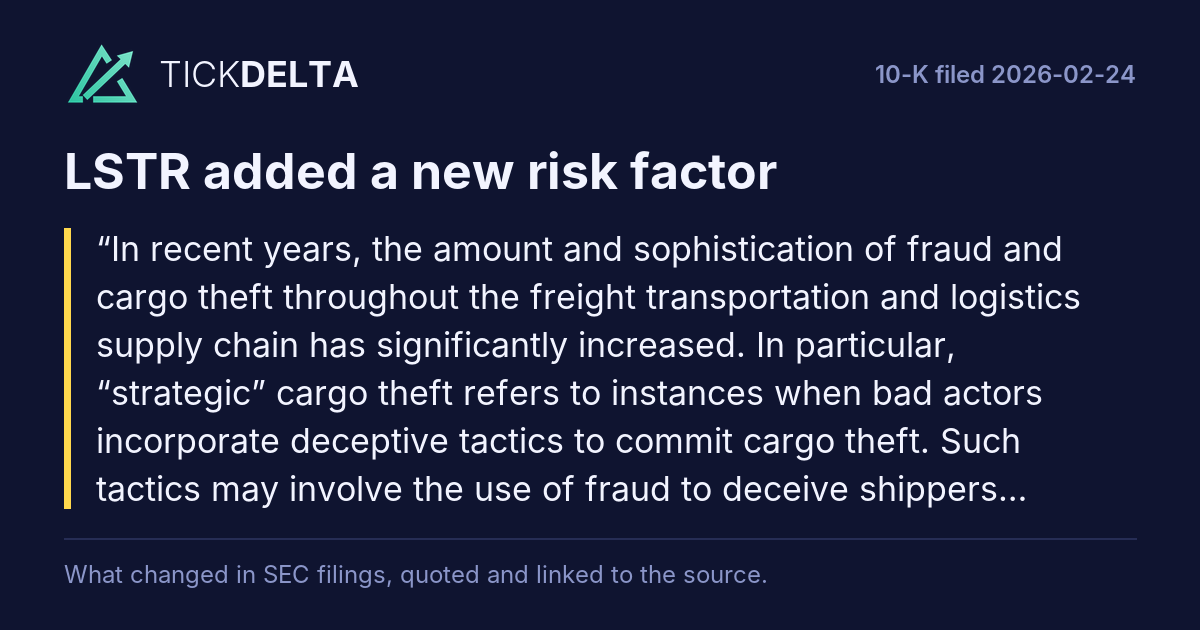
In recent years, the amount and sophistication of fraud and cargo theft throughout the freight transportation and logistics supply chain has significantly increased. In particular, “strategic” cargo theft refers to instances when bad actors incorporate deceptive tactics to commit cargo theft. Such tactics may involve the use of fraud to deceive shippers, brokers, and/or carriers using a combination of methods including identity theft and impersonation, fictitious track-and-trace information, fictitious proof of delivery information and fraudulent carrier schemes. The Company has experienced, and may continue to experience, increases in the amount of cargo theft, including strategic cargo theft, resulting in increased exposure to liability from cargo claims. The Company has also experienced, and may continue to experience, incidences of other types of supply chain fraud, for example the fraud referenced in Note 19 in the “Notes to Consolidated Financial Statements” in this Annual Report on Form 10-K.
A material increase in the frequency or severity of accidents, cargo claims, or workers’ compensation claims, claims in connection with the transportation of hazardous materials, or the material unfavorable development of existing claims could have a material adverse effect on Landstar’s business, cost of insurance and claims and its results of operations.
Adoption of artificial intelligence (“AI”). The Company uses, and will continue to expand its use of, machine learning and AI technologies to deliver services and operate its business. If the Company fails to successfully integrate AI into its digital ecosystem and business processes, or if it fails to keep pace with rapidly evolving AI technological developments, including attracting and retaining talented AI developers and programmers and cybersecurity personnel, the Company may face a competitive disadvantage. At the same time, the use or offering of AI technologies may result in new or expanded risks and liabilities, including enhanced government or regulatory scrutiny, litigation, privacy and compliance issues, ethical or confidentiality concerns, reputational harm, and security risks. It is not possible to predict all of the risks related to the use of AI, and changes in laws, rules, directives, and regulations governing the use of AI may adversely affect the Company’s ability to develop and use AI or subject it to legal liability. The cost of complying with laws and regulations governing AI could be significant and could increase our operating expenses, which could adversely affect our business, financial condition, and results of operations. Further, market demand and acceptance of AI technologies, including by our independent commission sales agents and BCO Independent Contractors, are uncertain, and we may be unsuccessful in efforts to further incorporate AI into our ecosystem of digital tools that are designed to: (i) assist Landstar independent commission sales agents in efficiently sourcing capacity, pricing transportation services and managing and analyzing the performance of their independent businesses, (ii) assist customers in meeting their transportation needs, (iii) assist third party capacity providers in identifying desirable freight opportunities and operating their independent businesses, and (iv) improve operational and administrative efficiency throughout the Company.
Acquisitions, Divestitures and Investments. The Company periodically considers acquisitions and equity investments that it believes are strategically important based on the potential that any such acquisition or investment candidate would further strengthen the Company’s strategic goals and service offerings. The Company makes no assurance that it will be able to successfully achieve its strategic goals as it relates to any such acquisition or investment. Further, the Company may have difficulties integrating acquired companies or efficiently managing divestitures. For potential acquisitions, success may depend upon efficiently integrating the acquired business into our existing systems and operations. If we complete a large acquisition or multiple acquisitions within a short period of time, we may experience heightened difficulties integrating the acquired companies. The Company would also be required to integrate these acquired businesses into our internal control environment, which may present challenges that are different than those presented by organic growth and that may be difficult to manage. If we are unable to successfully integrate and grow any acquired businesses and to realize contemplated revenue synergies and cost savings from such acquisitions, our business, prospects, results of operations, financial position, and cash flows could be materially and adversely affected.
During 2017, the Company established Landstar Metro, S.A.P.I. de C.V. (“Landstar Metro”), which acquired substantially all of the assets of the asset-light transportation logistics business of Fletes Avella, S.A. de C.V. Landstar Metro provides freight and logistics services within Mexico and in conjunction with Landstar’s U.S.-Mexico cross-border services. The Company’s initial investment in Landstar Metro was approximately $8.5 million. The carrying value of the Company’s investment in Landstar
Metro, as of December 27, 2025, was approximately $6.5 million, reflecting additional investment and the results of operations of Landstar Metro since inception, less non-cash impairment charges. Landstar Metro is subject to certain risks arising from doing business in Mexico, including: changes in Mexico’s economic strength; changes in trade agreements, US-Mexico trade relations, or the imposition of tariffs on imports from Mexico and related retaliatory tariffs that may be imposed by the Mexican government; disruptions related to port of entry restrictions; difficulties in enforcing contractual obligations; foreign currency fluctuations; theft or vandalism of equipment; and social, political, and economic instability. As previously disclosed in a Current Report on Form 8-K, filed with the SEC on August 13, 2025, in connection with an annual strategic review of the Company’s operations, the Company determined that Landstar Metro has not been able to meet the Company’s strategic or operational goals and expectations, and, in connection therewith, the Company entered into an arrangement with a financial advisor to actively market Landstar Metro and consider strategic alternatives for this business, which may involve a sale or other disposition in whole or in part of Landstar Metro. No assurances can be provided regarding any potential sale or other disposition of Landstar Metro and whether any additional non-cash impairment charges or other additional charges and expenses will be incurred by the Company in connection with this sale process or upon any ultimate disposition of Landstar Metro.
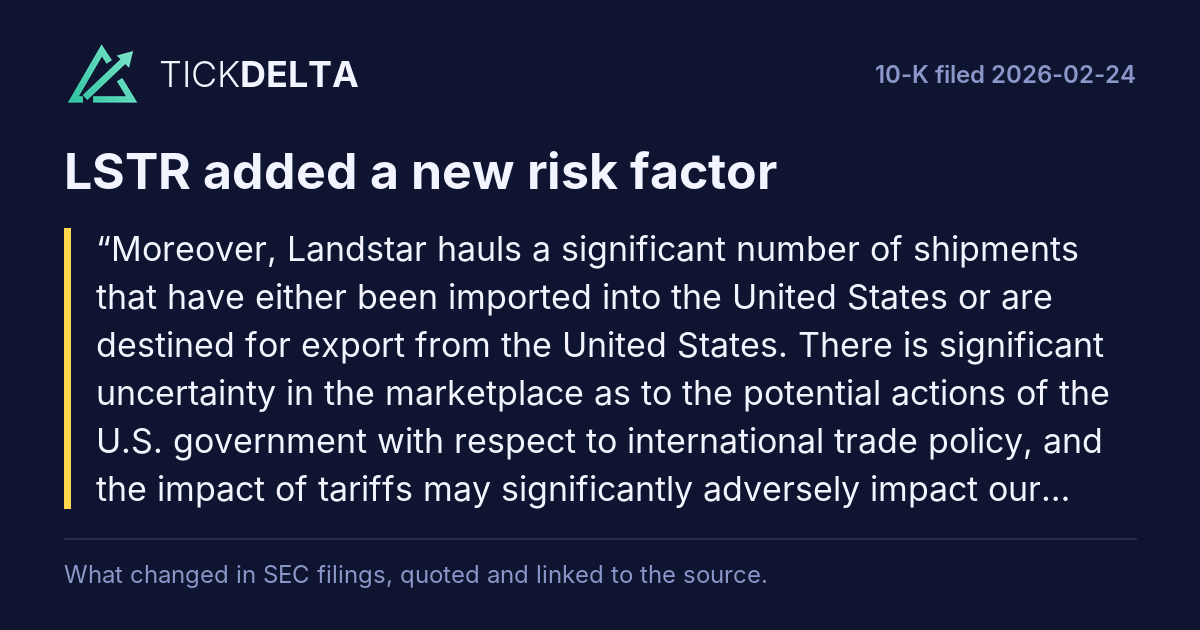
Moreover, Landstar hauls a significant number of shipments that have either been imported into the United States or are destined for export from the United States. There is significant uncertainty in the marketplace as to the potential actions of the U.S. government with respect to international trade policy, and the impact of tariffs may significantly adversely impact our customers, our industry, and our business. The U.S. government has made significant changes in U.S. trade policy, including the imposition on April 2, 2025, of a baseline tariff of 10% on product imports from almost all countries and individualized higher tariffs on certain other countries. While the announcement of the tariffs has been followed by announcements of limited exceptions and temporary pauses, certain foreign governments either have taken or are threatening to take retaliatory actions in response. The changes in U.S. trade policy and tariffs have caused uncertainty and volatility in financial markets. Further, there is potential for significant disruption with respect to trade between the United States and, respectively, Mexico and Canada, in connection with the anticipated review in 2026 of the United States-Mexico-Canada Agreement and related potential impacts on trade, tariffs and border duties and taxes throughout North America. Moreover, on February 20, 2026, the U.S. Supreme Court ruled that the U.S. government cannot use the International Emergency Economic Powers Act (“IEEPA”) to impose tariffs, overturning certain recent tariffs announced throughout 2025, including those on global imports from China, Canada and Mexico. This decision creates uncertainty about the immediate path forward for many supply chains, as billions of dollars in duties are now in question and the process for potential refunds remains unclear. Further, not all tariffs announced throughout 2025 will be impacted by this U.S. Supreme Court decision since many tariffs were imposed under other legal authorities that remain in effect and new tariffs may continue to be implemented through these other legal authorities. Tariffs or other trade restrictions may lead to continuing uncertainty and volatility in U.S. and global financial and economic conditions, declining consumer confidence, inflation or an economic slowdown. These tariffs or other trade restrictions, including corresponding actions taken by other countries in response to U.S. governmental actions or continuing uncertainty around the timing, scope, level, magnitude, duration and product range of tariffs, could have an adverse economic impact in the markets in which the Company operates, could cause reduced demand for the Company’s services and a reduction in the volume of shipments transported by the Company’s network, and could have a material adverse effect on Landstar’s results of operations.
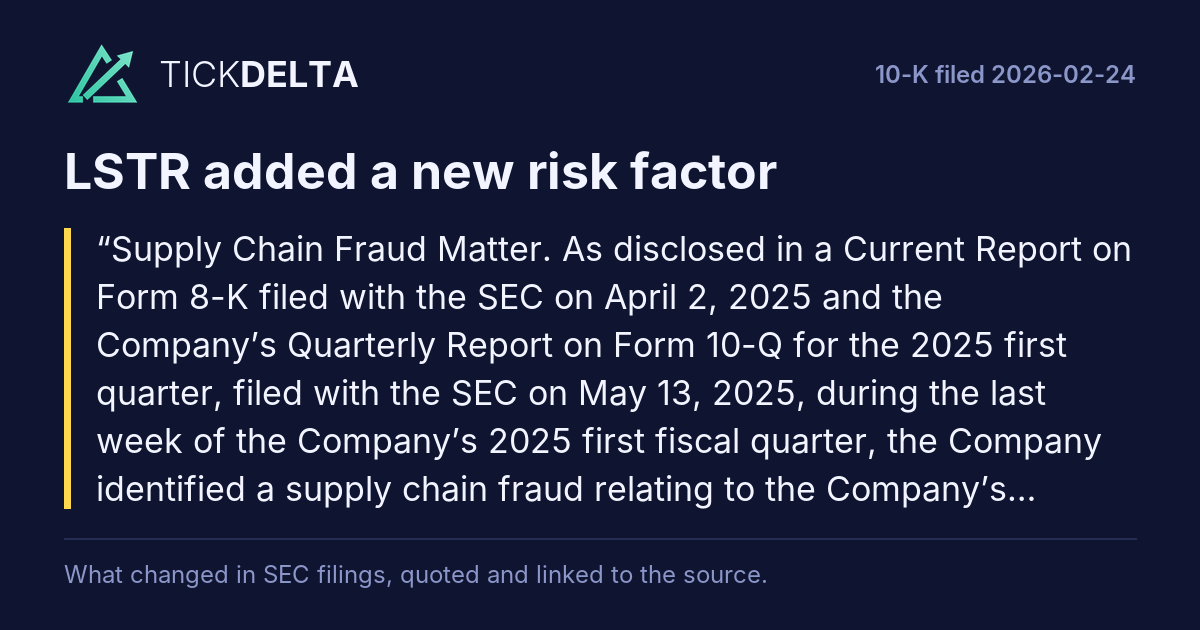
Supply Chain Fraud Matter. As disclosed in a Current Report on Form 8-K filed with the SEC on April 2, 2025 and the Company’s Quarterly Report on Form 10-Q for the 2025 first quarter, filed with the SEC on May 13, 2025, during the last week of the Company’s 2025 first fiscal quarter, the Company identified a supply chain fraud relating to the Company’s international freight forwarding operations (the “Supply Chain Fraud Matter”). The Supply Chain Fraud Matter did not involve the Company’s core North American truckload services. The Company’s financial results for the fiscal year ended December 27, 2025 included a $4.8 million pre-tax expense, or $0.10 per basic and diluted share, relating to this matter. This expense reflected the total anticipated aggregate adverse financial impact to Landstar relating to the fraud, net of certain actual and anticipated recoveries and before taking into account the cost of legal and other professional fees as well as additional potential recoveries in the future. No assurance can be provided with respect to the Company’s ability to collect anticipated recoveries relating to the Supply Chain Fraud Matter or the cost of legal and other professional fees that may be incurred by the Company in the future in connection with such collection efforts related to the Supply Chain Fraud Matter. The inability of the Company to recover additional amounts relating to the Supply Chain Fraud Matter could impose additional adverse financial impact and costs on the Company.
New in the latest 10-Q
19 paragraphs in the 10-Q filed Oct 28, 2026 with nothing like them in the 10-Q filed Jul 29, 2026 (at least half the words must differ; new numbers alone do not count). Quoted exactly, grouped by the item heading above them. This is text that changed, not a judgement of how serious it is.
Title of each class Trading Name of each exchange Symbol(s) on which registered Common Stock LSTR NASDAQ ─────────────────────────────────────────────────────────────────
Read in the 10-Q
(2) Share-based Payment Arrangements As of September 26, 2026, the Company has an employee equity incentive plan, the 2011 equity incentive plan (the “2011 EIP”). The Company also has a stock compensation plan for members of its Board of Directors, the 2022 Directors Stock Compensation Plan (the “2022 DSCP”). 6,000,000 shares of the Company’s common stock were authorized for issuance under the 2011 EIP and 200,000 shares of the Company’s common stock were authorized for issuance under the 2022 DSCP. The 2011 EIP and 2022 DSCP are each referred to herein as a “Plan,” and, collectively, as the “Plans.” Amount Thirty-Nine Weeks Ended Thirteen Weeks Ended September 26, September 27, September 26, September 27,
Read in the 10-Q
2026 2025 2026 2025 ────────────────────────────────────────────────────────────────────────────────────────────────────────────────────────────────────────────────────────────────────────────────────────── Total cost of the Plans during the period $ 8,443 $5,243 $ 3,023 $1,586 Amount of related income tax benefit recognized during the period (2,082) (1,179) (741) (387) Net cost of the Plans during the period $ 6,361 $4,064 $ 2,282 $1,199 Included in income tax benefits recognized in the thirty-nine-week periods ended September 26, 2026 and September 27, 2025 were (excess tax benefits) tax deficiencies from stock-based awards of ($14,000) and $106,000, respectively. As of September 26, 2026, there were 161,928 shares of the Company’s common stock reserved for issuance under the 2022 DSCP and 2,589,785 shares of the Company’s common stock reserved for issuance under the 2011 EIP. Restricted Stock Units The following table summarizes information regarding the Company’s outstanding restricted stock unit (“RSU”) awards with either a performance condition or a market condition under the Plans:
Read in the 10-Q
Thirty-Nine Weeks Ended September 26, 2026 September 27, 2025 Transportation Insurance Total Transportation Insurance Total
Read in the 10-Q
(7) Other Comprehensive Income The following table presents the components of and changes in accumulated other comprehensive loss, net of related income taxes, as of and for the thirty-nine-week period ended September 26, 2026 (in thousands): Unrealized Foreign Currency Total
Read in the 10-Q
The amortized cost and fair values of available-for-sale investments are as follows at September 26, 2026 and December 27, 2025 (in thousands):
Read in the 10-Q
Operating lease right-of-use assets Other assets $414 ───────────────────────────────────────────────────────────────────────────────────────────────────────────────────────────── Finance lease assets Operating property, less accumulated depreciation and amortization 114,427 Total lease assets $114,841 Liabilities: The following table reconciles the undiscounted cash flows for the finance and operating leases to the finance and operating lease liabilities recorded on the balance sheet at September 26, 2026 (in thousands): Finance Operating
Read in the 10-Q
Short-term investments include $53,683,000 in current maturities of investments held by the Company’s insurance segment at September 26, 2026. The non-current portion of the bond portfolio of $94,938,000 is included in other assets. The short-term investments, together with $30,018,000 of non-current investments, provide collateral for the $75,331,000 of letters of credit issued to guarantee payment of insurance claims. As of September 26, 2026, Landstar also had $34,786,000 of additional letters of credit outstanding under the Company’s Credit Agreement.
Read in the 10-Q
Third party insurance arrangements providing excess coverage for commercial trucking liabilities in excess of the Company’s self-insured retention, or applicable deductible, generally require that the Company fund settlement payments to claimants and seek reimbursement from the applicable third party insurance providers. In connection with settlements of claims in excess of the Company’s self-insured retention or applicable deductible, the Company accrues for the anticipated settlement payments and records a corresponding receivable for the amounts it expects to collect from its third party insurance providers following payment of those settlement amounts. The liability and the related receivable are presented on a gross basis. As of September 26, 2026, the Company’s consolidated balance sheet included an aggregate liability of $21,000,000 for anticipated settlement payments in excess of the Company’s self-insured retention or deductible. The Company believes collection of these receivables from its third party insurance providers is probable following its payment of the settlement amounts included in the accrual. The Company evaluates the collectability of these receivables based on the creditworthiness and surplus of the applicable third party insurance provider, its prior experience with that provider, and the contractual terms of the applicable insurance arrangement.
Read in the 10-Q
The unfavorable development of prior years’ claims during the thirty-nine-week period ended September 26, 2026 was primarily attributable to an increase in the Company’s actuarially determined claim reserves, several specific commercial trucking claims involving BCO Independent Contractors leased on with motor carrier subsidiaries of the Company, several specific truck brokerage claims and cargo loss experience as a result of fraud and theft in the supply chain.
Read in the 10-Q
As previously disclosed by the Company in current and periodic reports filed with the SEC, during the 2025 third quarter, the Company recorded certain non-cash, non-recurring impairment charges of $30,104,000 in the aggregate (the “Non-Cash Impairment Charges”). The Non-Cash Impairment Charges represented $0.66 per basic and diluted share. The Non-Cash Impairment Charges consisted of:
Read in the 10-Q
$16,142,000, or $0.35 per basic and diluted share, in impairment charges to goodwill and certain other assets related to the Company’s decision to actively market for sale Landstar Metro, S.A.P.I. de C.V. (“Landstar Metro”), the Company’s wholly-owned Mexican operating subsidiary, principally engaged in intra-Mexico truck transportation services. For additional information regarding the disposition of Landstar Metro, see Note 13 in the “Notes to Consolidated Financial Statements” in this ...
Read in the 10-Q
$8,963,000, or $0.20 per basic and diluted share, in impairment charges related to the decision to select one of the Company’s transportation management systems as its primary such system for truckload brokerage services and, in connection with that decision, wind down an alternative transportation management system used by Landstar Blue, LLC, one of the Company’s operating subsidiaries.
Read in the 10-Q
$4,999,000, or $0.11 per basic and diluted share, relating to the carrying value of a non-controlling equity investment made by the Company in 2022 in Cavnue, LLC, a privately held technology start-up company.
Read in the 10-Q
Impairment of intangibles and other assets was $30,104,000 in the 2025 thirty-nine-week period. This was attributable to the impairment matters referenced above under “Expenses - Impairment of intangible and other assets. ”
Read in the 10-Q
Impairment of intangibles and other assets was $30,104,000 in the 2025 thirteen-week period. This was attributable to the impairment matters referenced above under “Expenses - Impairment of intangible and other assets. ”
Read in the 10-Q
Except as set forth under Part II, Item 1A, “Risk Factors” in the Company’s Quarterly Report on Form
Read in the 10-Q
Fiscal Period Total Number of Average Price Total Number of Maximum Number of Paid Per Share (1) Shares Purchased Shares Purchased as Shares That May Yet
Read in the 10-Q
(1) The average price paid per share does not include the 1% excise tax on net stock repurchases, as applicable.
Read in the 10-Q
Item 1A of the 10-Q filed Oct 28, 2026 against Item 1A of the 10-K filed Feb 24, 2026.
A 10-Q repeats only the risks that changed, so a 10-K paragraph that is missing from it is not counted as removed.
Added is a paragraph with nothing like it in the 10-K, Reworded a sentence that is in both with several words changed,
Quiet changes a sentence in both where one to four words changed and one is a hedge or a modal
(cut words struck through, new words highlighted).
Text on the page, not a score; each links to the filing at sec.gov.
What the 10-Q itself says about its risk factors:For a discussion identifying risk factors and other important factors that could cause actual results to differ materially from those anticipated, see the discussions under Part I, Item 1A, “Risk Factors” in the Company’s Annual Report on Form
Read in the 10-Q
What the 10-Q itself says about its risk factors:for the quarterly period ended June 27, 2026, there have been no material changes to the Risk Factors described in Part I “Item 1A. Risk Factors” in the Company’s Annual Report on Form
Read in the 10-Q
Two-word phrases in Risk Factors of the 10-K filed Feb 24, 2026 that are in none of the 1 earlier 10-Ks stored, back to Feb 24, 2025
Used at least twice, small words left out. Counted, not picked: a phrase can be new because the company renamed something.
2 paragraphs of last year's Risk Factors with nothing like them now. The longest are quoted.
Item 1A of each 10-K and 10-Q on EDGAR, quoted exactly. Each paragraph links to the filing at sec.gov.
10-K change: what was reworded or cut, section by section.
Excel workbook · CSV. Google Sheet that stays up to date: paste =IMPORTDATA("https://tickdelta.com/company/LSTR/export.csv") into a cell.