Paragraph 36 · 36% changed
Every version of it
Screener
/
SEC EDGAR
/CIK 0001679273
/10-K filed Jul 24, 2026, compared with Jul 23, 2025
/Numbers from the XBRL of the 10-Ks
NYSE
Consumer staples · Packaged Foods
Lamb Weston Holdings, Inc. LW
The 10-K against last year's
118 changes: 33 added, 21 removed, 63 reworded, 1 quiet changes
10-K Jul 24, 2026 vs Jul 23, 2025
Risk Factors
17.4%
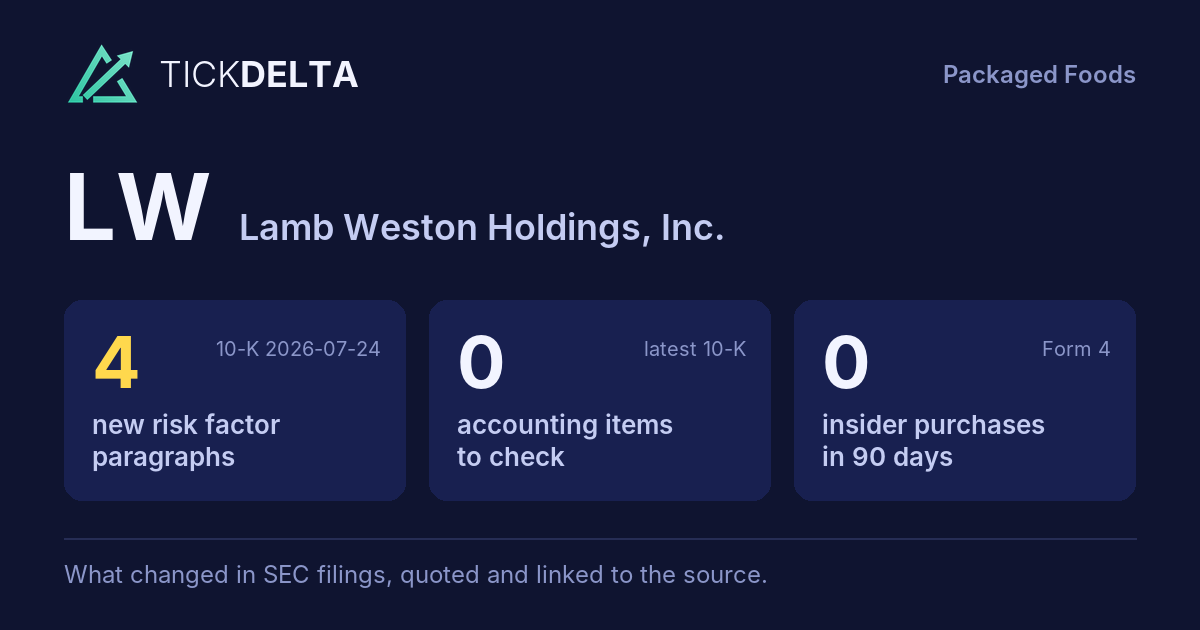
of the text changed · 10,481 words now · 4 new paragraphs, 6 gone
MD&A
44.7%
of the text changed · 5,549 words now · 29 new paragraphs, 15 gone
Legal Proceedings
8.9%
of the text changed · 1,475 words now
Accounting Policies
14.4%
of the text changed · 3,713 words now
10-K 0001679273-26-000026 (Jul 24, 2026) vs 10-K 0001679273-25-000049 (Jul 23, 2025)
Every paragraph, and how much of it changed
One bar per paragraph, in the order of the 10-K. Height and colour show the share of its words not in the closest paragraph a year earlier; the tallest bars are new paragraphs.
Risk Factors
101 paragraphs · 4 new · 44 reworded · 6 gone · 10-K Jul 24, 2026 against Jul 23, 2025
New paragraph
Reworded (5% of its words or more)
Same or nearly
Paragraph 35 · 33% changed
Every version of it
Some of our customers are large and sophisticated, with buying power and negotiating strength. These customers may be more capable of resisting price increases and more likely to demand lower pricing, increased promotional programs, or specialty tailored products. In addition, some of these customers (e.g., larger distributors and supermarkets) have the scale to develop supply chains that permit them to operate with reduced inventories or to develop and market their own brands. Shelf space at food retailers is not guaranteed, and large retail customers may choose to stock their own retailer and other economy brands that compete with some of our products. This could be exacerbated with a shift in consumer spending as a result of an economic downturn and consumers moving to private label or lower priced products. If the initiatives we undertake to counteract these pressures, including efficiency programs and investments in innovation and quality, are unsuccessful and we are unable to counteract the negotiating strength of these customers, our profitability could decline.
Paragraph 59 · 32% changed
Every version of it
Paragraph 5 · 30% changed
Every version of it
Paragraph 97 · 30% changed
Every version of it
The increasing concern over climate change and environmental sustainability also may result in more regional, federal, and/or global legal and regulatory requirements to reduce or mitigate the effects of greenhouse gases, as well as more stringent regulation of water rights. rights and usage. For example, new climate-related disclosure requirements in California such as Senate Bill 253 require companies doing business in California to report their greenhouse gas emissions. In the event that such regulation is enacted and is more aggressive than the sustainability measures that we are currently undertaking to monitor our emissions, improve our energy efficiency, and reduce, reclaim, and reuse water, we may be subject to curtailment or reduced access to resources or experience significant increases in our costs of operation and delivery. Specifically, regulatory limitations on water usage at our facilities could cause a decrease in production and/or an increase in costs. We have substantial operations in the states of Oregon and Washington, which have been steadily increasing their restrictions on water usage in manufacturing and food processing operations. If water available to our operations becomes scarce, or costs of acquiring and discharging water increase, we may incur increased production costs that we are unable or choose not to pass along to customers through increased prices, or face production constraints, which could adversely affect our business and financial results. In addition, increasing regulation of utility providers, fuel emissions, or fuel suppliers could substantially increase the distribution and supply chain costs of our products. Further, we Also, multiple states in the U.S. have implemented, or are considering implementing, extended producer responsibility laws that require the Company to enact policies and processes and will increase expenses, including through fees paid to state governments in connection with such laws. We may experience significant increases in our compliance costs, capital expenditures, and other financial obligations to adapt our business and operations to meet new regulations and standards. For example, in In fiscal 2026, we expect our capital expenditures to include included approximately $100 $90 million for environmental projects, largely focused on wastewater treatment at our production facilities. Further, we expect to spend about $500 million in the aggregate over the next six years to comply with government environmental regulations and permit limitations.
Paragraph 58 · 30% changed
Every version of it
Customer and consumer demand for our products may be impacted by weak economic conditions, recession, equity market volatility, or other negative economic factors in the U.S. or other countries. For example, the U.S. has experienced significantly heightened inflationary pressures since 2022. Historically, market demand for value-added frozen potato products has generally been balanced with industry capacity. However, in fiscal 2024 and continuing in fiscal 2025, recent years, we have experienced declines in sales volume as a result of a slowdown in restaurant traffic in North America America, Europe, and other key international markets as our customers and consumers respond to the cumulative effect of inflation on the cost of food consumed away from home. In addition, if the restaurant traffic trends continue to soften, we may experience sales declines and may have to decrease prices, all of which could have a material adverse impact on our business, financial condition, and results of operations. In fiscal 2025, we invested in price and trade support to compete in the increasingly competitive environment in both North America and other international markets, though there is no guarantee that such support will be sufficient. As additional industry capacity comes online, restaurant traffic declines, or market demand otherwise decreases, including as a result of inflation, we may face competitive pressures that would restrict our ability to increase or maintain prices, or we may lose market share. For example, during fiscal 2025, we have faced increased pricing pressure as additional industry capacity becomes operational, which capacity is also impacted by softening demand. Our profits would decrease as a result of a reduction in prices or sales volume.
Paragraph 40 · 25% changed
Every version of it
To serve our customers globally, we rely primarily on our international operations, but also in part on exports from the U.S. During fiscal 2026, 2025, and 2024, and 2023, export sales from the U.S. accounted for approximately 6%, 6% and 11%, respectively, of our total net sales. sales in each year. Circumstances beyond our control, such as retaliatory non-U.S. tariffs countermeasures, a labor dispute at a port, limited shipping container availability or workforce disruptions (such as disruptions that occurred during the COVID-19 pandemic), disruptions, have and could prevent us from exporting our products in sufficient quantities to meet certain customer opportunities. For example, during the latter half of fiscal 2022, limited shipping container availability along the U.S. West Coast and disruptions to ocean freight networks across the Pacific Ocean resulted in lower export volumes in our International segment. We have access to production outside of the U.S. through our facilities in Argentina, Australia, Austria, Canada, China, the Netherlands, and the United Kingdom, but we may be unsuccessful in mitigating any future disruption to export mechanisms. Our operations outside of the U.S. are also subject to export mechanisms in their regions and as such, are impacted by similar factors, including political or military conflicts, such as conflicts in the Middle East. For example, with the blockade of the Strait of Hormuz, we have experienced an increase in traffic at another key port of entry in the Middle East, resulting in higher costs and longer transit times. If this occurs, disruptions to our access to export mechanisms occur or continue for an extended period of time, we may be unable to adequately supply all our existing customers’ needs and new customer opportunities, which could adversely affect our business, financial condition, and results of operations.
Paragraph 7 · 25% changed
Every version of it
Paragraph 36 · 36% changed
Every version of it
10-K Jul 23, 2025Some of our customers are large and sophisticated, with buying power and negotiating strength. These customers may be more capable of resisting price increases and more likely to demand lower pricing, increased promotional programs, or specialty tailored products. In addition, some of these customers (e.g., larger distributors and supermarkets) have the scale to develop supply chains that permit them to operate with reduced inventories or to develop and market their own brands. Shelf space at food retailers is not guaranteed, and large retail customers may choose to stock their own retailer and other economy brands that compete with some of our products. This could be exacerbated with a shift in consumer spending as a result of an economic downturn and consumers moving to private label or lower priced products. If the initiatives we undertake to counteract these pressures, including efficiency programs and investments in innovation and quality, are unsuccessful and we are unable to counteract the negotiating strength of these customers, our profitability could decline.
10-K Jul 24, 2026
own brands. Shelf space at food retailers is not guaranteed, and large retail customers may choose to stock their own retail and other economy brands that compete with some of our products. This could be exacerbated with a shift in consumer spending as a result of an economic downturn and consumers moving to private label or lower priced products.
Paragraph 35 · 33% changed
Every version of it
10-K Jul 23, 2025
Some of our customers are large and sophisticated, with buying power and negotiating strength. These customers may be more capable of resisting price increases and more likely to demand lower pricing, increased promotional programs, or specialty tailored products. In addition, some of these customers (e.g., larger distributors and supermarkets) have the scale to develop supply chains that permit them to operate with reduced inventories or to develop and market their own brands. Shelf space at food retailers is not guaranteed, and large retail customers may choose to stock their own retailer and other economy brands that compete with some of our products. This could be exacerbated with a shift in consumer spending as a result of an economic downturn and consumers moving to private label or lower priced products. If the initiatives we undertake to counteract these pressures, including efficiency programs and investments in innovation and quality, are unsuccessful and we are unable to counteract the negotiating strength of these customers, our profitability could decline.
10-K Jul 24, 2026
Some of our customers are large and sophisticated, with buying power and negotiating strength. These customers may be more capable of resisting price increases and more likely to demand lower pricing, increased promotional programs, or specialty tailored products. In addition, some of these customers (e.g., larger distributors and supermarkets) have the scale to develop supply chains that permit them to operate with reduced inventories or to develop and market their
Paragraph 59 · 32% changed
Every version of it
10-K Jul 23, 2025Customer and consumer demand for our products may be impacted by weak economic conditions, recession, equity market volatility, or other negative economic factors in the U.S. or other countries. For example, the U.S. has experienced significantly heightened inflationary pressures since 2022. Historically, market demand for value-added frozen potato products has generally been balanced with industry capacity. However, in fiscal 2024 and continuing in fiscal 2025, we experienced declines in sales volume as a result of a slowdown in restaurant traffic in North America and other key international markets as our customers and consumers respond to the cumulative effect of inflation on the cost of food consumed away from home. In addition, if the restaurant traffic trends continue to soften, we may experience sales declines and may have to decrease prices, all of which could have a material adverse impact on our business, financial condition, and results of operations. In fiscal 2025, we invested in price and trade support to compete in the increasingly competitive environment in both North America and other international markets, though there is no guarantee that such support will be sufficient. As additional industry capacity comes online, restaurant traffic declines, or market demand otherwise decreases, including as a result of inflation, we may face competitive pressures that would restrict our ability to increase or maintain prices, or we may lose market share. For example, during fiscal 2025, we have faced increased pricing pressure as additional industry capacity becomes operational, which capacity is also impacted by softening demand. Our profits would decrease as a result of a reduction in prices or sales volume.
10-K Jul 24, 2026
and may have to decrease prices, all of which could have a material adverse impact on our business, financial condition, and results of operations. In fiscal 2026, we invested in price and trade support to compete in the increasingly competitive environment in both North America and other international markets, though there is no guarantee that such support will be sufficient. As additional industry capacity comes online, restaurant traffic declines, or market demand otherwise decreases, including as a result of inflation, we may face competitive pressures that would restrict our ability to increase or maintain prices, or we may lose market share. For example, during fiscal 2026, we faced increased pricing pressure as our international operations were challenged by an increasingly competitive market environment resulting from a significant surplus in the European potato market; local sourcing in developing regions such as the Middle East, China and India, which affected exports from Europe to those markets; and persistently lower restaurant traffic in key countries.
Paragraph 5 · 30% changed
Every version of it
10-K Jul 23, 2025During fiscal 2025, we continued to experience elevated commodity and supply chain costs, including the costs of labor, raw materials (such as potatoes, edible oil, grain and starch), energy, fuel, packaging materials, and other inputs necessary for the production and distribution of our products, as well as transportation and logistics costs. Commodity price increases, or a sustained interruption or other constraints in the supply or availability of key commodities, including necessary services such as transportation and warehousing, could adversely affect our business, financial condition, and results of operations. Our attempts to offset these cost pressures, such as through increases in the selling prices of some of our products, may not be successful or may not be sustainable. Higher product prices may result in reductions in sales volume, especially given the current highly competitive frozen potato product market and soft restaurant traffic and the volatility of the macroeconomic environment. To the extent that price increases are not sufficient to offset these increased costs adequately or in a timely manner, and/or if they result in significant decreases in sales volume, our business, financial condition, or results of operations may be adversely affected. Though we provide most of our customers with local/regional supply, products we manufacture at our one production facility in Canada and import to the U.S., as well as the 5% of our inputs, primarily edible oils and natural gas, that are sourced in Canada, are currently exempt from these tariffs as they are compliant with the United States-Mexico-Canada trading agreement. Despite the current exemptions, the implementation of new tariffs on imports from Canada, Mexico, China or other countries for an extended period and without specific exemptions for our products may adversely affect our business, financial condition and results of operations. Further, any retaliatory tariffs on U.S. products by other countries, or other trade protection measures by foreign countries in favor of their local producers of competing products, such as governmental subsidies, tax benefits, and other measures giving local producers a competitive advantage over Lamb Weston, may adversely affect our business and results of operations in those countries.
10-K Jul 24, 2026
Though we provide most of our customers with local/regional supply, products we manufacture at our one production facility in Canada and import to the U.S., as well as the 5% of our inputs, primarily edible oils and natural gas, that are sourced in Canada, are currently exempt from U.S. tariffs as they are compliant with the U.S.-Mexico-Canada trading agreement. Despite the current exemptions, the implementation of new tariffs on imports from Canada, Mexico, China or other countries for an extended period and without specific exemptions for our products or the termination of the U.S.-Mexico-Canada trading agreement may adversely affect our business, financial condition and results of operations. Further, any retaliatory tariffs on U.S. products by other countries, or other trade protection measures by foreign countries in favor of their local producers of competing products, such as governmental subsidies, tax benefits, and other measures giving local producers a competitive advantage over Lamb Weston, may adversely affect our business and results of operations in those countries.
Paragraph 97 · 30% changed
Every version of it
10-K Jul 23, 2025
The increasing concern over climate change also may result in more regional, federal, and/or global legal and regulatory requirements to reduce or mitigate the effects of greenhouse gases, as well as more stringent regulation of water rights. In the event that such regulation is enacted and is more aggressive than the sustainability measures that we are currently undertaking to monitor our emissions, improve our energy efficiency, and reduce, reclaim, and reuse water, we may be subject to curtailment or reduced access to resources or experience significant increases in our costs of operation and delivery. In addition, increasing regulation of utility providers, fuel emissions, or fuel suppliers could substantially increase the distribution and supply chain costs of our products. Further, we may experience significant increases in our compliance costs, capital expenditures, and other financial obligations to adapt our business and operations to meet new regulations and standards. For example, in fiscal 2026, we expect our capital expenditures to include approximately $100 million for environmental projects, largely focused on wastewater treatment at our production facilities. Further, we expect to spend about $500 million in the aggregate over the next six years to comply with government environmental regulations and permit limitations.
10-K Jul 24, 2026
The increasing concern over climate change and environmental sustainability also may result in more regional, federal, and/or global legal and regulatory requirements to reduce or mitigate the effects of greenhouse gases, as well as more stringent regulation of water rights and usage. For example, new climate-related disclosure requirements in California such as Senate Bill 253 require companies doing business in California to report their greenhouse gas emissions. In the event that such regulation is enacted and is more aggressive than the sustainability measures that we are currently undertaking to monitor our emissions, improve our energy efficiency, and reduce, reclaim, and reuse water, we may be subject to curtailment or reduced access to resources or experience significant increases in our costs of operation and delivery. Specifically, regulatory limitations on water usage at our facilities could cause a decrease in production and/or an increase in costs. We have substantial operations in the states of Oregon and Washington, which have been steadily increasing their restrictions on water usage in manufacturing and food processing operations. If water available to our operations becomes scarce, or costs of acquiring and discharging water increase, we may incur increased production costs that we are unable or choose not to pass along to customers through increased prices, or face production constraints, which could adversely affect our business and financial results. In addition, increasing regulation of utility providers, fuel emissions, or fuel suppliers could substantially increase the distribution and supply chain costs of our products. Also, multiple states in the U.S. have implemented, or are considering implementing, extended producer responsibility laws that require the Company to enact policies and processes and will increase expenses, including through fees paid to state governments in connection with such laws. We may experience significant increases in our compliance costs, capital expenditures, and other financial obligations to adapt our business and operations to meet new regulations and standards. In fiscal 2026, our capital expenditures included approximately $90 million for environmental projects, largely focused on wastewater treatment at our production facilities.
Paragraph 58 · 30% changed
Every version of it
10-K Jul 23, 2025
Customer and consumer demand for our products may be impacted by weak economic conditions, recession, equity market volatility, or other negative economic factors in the U.S. or other countries. For example, the U.S. has experienced significantly heightened inflationary pressures since 2022. Historically, market demand for value-added frozen potato products has generally been balanced with industry capacity. However, in fiscal 2024 and continuing in fiscal 2025, we experienced declines in sales volume as a result of a slowdown in restaurant traffic in North America and other key international markets as our customers and consumers respond to the cumulative effect of inflation on the cost of food consumed away from home. In addition, if the restaurant traffic trends continue to soften, we may experience sales declines and may have to decrease prices, all of which could have a material adverse impact on our business, financial condition, and results of operations. In fiscal 2025, we invested in price and trade support to compete in the increasingly competitive environment in both North America and other international markets, though there is no guarantee that such support will be sufficient. As additional industry capacity comes online, restaurant traffic declines, or market demand otherwise decreases, including as a result of inflation, we may face competitive pressures that would restrict our ability to increase or maintain prices, or we may lose market share. For example, during fiscal 2025, we have faced increased pricing pressure as additional industry capacity becomes operational, which capacity is also impacted by softening demand. Our profits would decrease as a result of a reduction in prices or sales volume.
10-K Jul 24, 2026
Customer and consumer demand for our products may be impacted by weak economic conditions, recession, equity market volatility, or other negative economic factors in the U.S. or other countries. For example, the U.S. has experienced significantly heightened inflationary pressures since 2022. Historically, market demand for value-added frozen potato products has generally been balanced with industry capacity. However, in recent years, we have experienced declines in sales volume as a result of a slowdown in restaurant traffic in North America, Europe, and other key international markets as our customers and consumers respond to the cumulative effect of inflation on the cost of food consumed away from home. In addition, if the restaurant traffic trends continue to soften, we may experience sales declines
Paragraph 40 · 25% changed
Every version of it
10-K Jul 23, 2025
To serve our customers globally, we rely primarily on our international operations, but also in part on exports from the U.S. During fiscal 2025, 2024, and 2023, export sales from the U.S. accounted for approximately 6%, 6% and 11%, respectively, of our total net sales. Circumstances beyond our control, such as retaliatory non-U.S. tariffs countermeasures, a labor dispute at a port, or workforce disruptions (such as disruptions that occurred during the COVID-19 pandemic), could prevent us from exporting our products in sufficient quantities to meet customer opportunities. For example, during the latter half of fiscal 2022, limited shipping container availability along the U.S. West Coast and disruptions to ocean freight networks across the Pacific Ocean resulted in lower export volumes in our International segment. We have access to production outside of the U.S. through our facilities in Argentina, Australia, Austria, Canada, China, the Netherlands, and the United Kingdom, but we may be unsuccessful in mitigating any future disruption to export mechanisms. If this occurs, we may be unable to adequately supply all our existing customers’ needs and new customer opportunities, which could adversely affect our business, financial condition, and results of operations.
10-K Jul 24, 2026
To serve our customers globally, we rely primarily on our international operations, but also in part on exports from the U.S. During fiscal 2026, 2025, and 2024, export sales from the U.S. accounted for approximately 6% of our total net sales in each year. Circumstances beyond our control, such as retaliatory non-U.S. tariffs countermeasures, a labor dispute at a port, limited shipping container availability or workforce disruptions, have and could prevent us from exporting our products in sufficient quantities to meet certain customer opportunities. We have access to production outside of the U.S. through our facilities in Argentina, Australia, Austria, Canada, China, the Netherlands, and the United Kingdom, but we may be unsuccessful in mitigating any future disruption to export mechanisms. Our operations outside of the U.S. are also subject to export mechanisms in their regions and as such, are impacted by similar factors, including political or military conflicts, such as conflicts in the Middle East. For example, with the blockade of the Strait of Hormuz, we have experienced an increase in traffic at another key port of entry in the Middle East, resulting in higher costs and longer transit times. If disruptions to our access to export mechanisms occur or continue for an extended period of time, we may be unable to adequately supply all our existing customers’ needs and new customer opportunities, which could adversely affect our business, financial condition, and results of operations.
Paragraph 7 · 25% changed
Every version of it
10-K Jul 23, 2025We also may not be successful in mitigating the effects of these cost increases through productivity initiatives or through our commodity hedging activity. Our future success and earnings growth depend in part on our ability to maintain the appropriate cost structure and operate efficiently in the highly competitive value-added frozen potato product category. We continue to implement profit-enhancing initiatives to improve the efficiency of our supply chain and general and administrative functions. These initiatives are focused on cost-saving opportunities in procurement, manufacturing, logistics, and customer service, as well as general and administrative functions. However, gaining additional efficiencies may become more difficult over time. In addition, there is currently no active derivatives market for potatoes in the U.S. Although we have experience in hedging against commodity price increases, these practices and experience reduce, but do not eliminate, the risk of negative profit impacts from commodity price increases. As a result, the risk management procedures that we use may not always work as we intend. To the extent we are unable to offset present and future cost increases, our business, financial condition, and results of operations could be materially and adversely affected.
10-K Jul 24, 2026
notably in Europe, and the volatility of the macroeconomic environment. If we are unable to increase prices, or if price increases are not sufficient, to offset these increased costs adequately or in a timely manner, and/or if they result in significant decreases in sales volume, our business, financial condition, or results of operations may be adversely affected. We continue to implement profit-enhancing initiatives to improve the efficiency of our supply chain and general and administrative functions. However, gaining additional efficiencies may become more difficult over time. In addition, there is currently no active derivatives market for potatoes in the U.S or Europe. Although we have experience in hedging against commodity price increases, these practices and experience reduce, but do not eliminate, the risk of negative profit impacts from commodity price increases. As a result, the risk management procedures that we use may not always work as we intend. To the extent we are unable to offset present and future cost increases, our business, financial condition, and results of operations could be materially and adversely affected.
MD&A
84 paragraphs · 29 new · 32 reworded · 15 gone · 10-K Jul 24, 2026 against Jul 23, 2025
New paragraph
Reworded (5% of its words or more)
Same or nearly
Paragraph 23 · 50% changed
Adjusted EBITDA declined $196.2 $112.8 million versus fiscal 2025 to $1,147.2 million. Adjusted EBITDA benefited $28.9 million from the prior 53rd week in fiscal year to $1,220.5 million, reflecting lower Adjusted Gross Profit partially offset by lower Adjusted SG&A. 2026.
Paragraph 6 · 49% changed
Paragraph 31 · 49% changed
Paragraph 35 · 47% changed
Investing activities used $648.0 $380.2 million of cash in fiscal 2025, 2026, compared with $984.1 $648.0 million in fiscal 2024. The decrease was 2025. Expenditures in fiscal 2026 primarily attributable related to reduced cash expenditures our investments to expand our french fry capacity in Argentina and other production facility modernization efforts. Expenditures in fiscal 2025 as primarily related to our strategic investments to expand our french fry capacity in the Netherlands, the U.S., and Argentina. The expansion projects in China and the U.S. were was completed in during the fourth quarter of fiscal 2024 and our capacity 2024, the expansion in the Netherlands was completed during the second quarter of fiscal 2025, and the expansion in Argentina was completed in the first half quarter of fiscal 2026. In addition, we had $26.0 million of proceeds from the sale of property, plant and equipment in fiscal 2026, an increase of $24.0 million over fiscal 2025. We expect our capacity expansion project in The prior year also included $21.1 million of gains from Argentina will begin production in August 2025. blue chip swap transactions.
Paragraph 49 · 45% changed
Critical accounting estimates are those that are most important to the portrayal of our financial condition and operating results. These estimates require management’s most difficult, subjective, or complex judgments. In many cases, the accounting treatment of a particular transaction is specifically dictated by GAAP with no need for the application of our judgment. In certain circumstances, however, the preparation of the Consolidated Financial Statements in conformity with GAAP requires us to use our judgment to make certain estimates and assumptions. These estimates affect the reported amounts of assets and liabilities and disclosures of contingent assets and liabilities at the date of the Consolidated Financial Statements and the reported amounts of net sales and expenses during the reporting period. We have identified the estimates described below as our critical accounting estimates. See Note 1 to the Consolidated Financial Statements for a detailed discussion of significant accounting policies. We review the development, selection, and disclosure of our critical accounting estimates with the Audit Committee of our Board.
Paragraph 25 · 45% changed
International Segment Adjusted EBITDA declined $78.2 $142.9 million to $253.7 $114.7 million. Higher net The decrease primarily reflects lower sales excluding FX, price/mix and lower Adjusted SG&A were offset by an increase in higher manufacturing costs per pound, including mid-to-high single-digit increases in raw potato costs, primarily in the first half of the year and driven by a an incremental costs $33.1 million charge related to the start-up of the new production line in the Netherlands. Higher warehouse inventories also led a mid-to-high single-digit increase in warehousing costs. These costs more than offset lapping a $9.9 million charge for the write-off write-offs of excess raw potatoes, approximately $9 million, net lower utilization of allocated losses related to our international production facilities, and start-up expenses for our new plant in Argentina. These were partially offset by benefits from cost savings initiatives. International Segment Adjusted EBITDA benefited $4.0 million from the voluntary product withdrawal, and an approximately $5 million negative impact related to the ERP transition 53rd week in the prior year. fiscal 2026.
Paragraph 68 · 44% changed
Paragraph 22 · 44% changed
Adjusted SG&A declined $67.9 $6.0 million versus the prior fiscal year to $633.5 $598.4 million. Adjusted SG&A declined $30.3 million to $643.9 million, primarily related to lapping higher expenses associated with the ERP transition in the prior year, a $13.9 million decrease in advertising and promotion expenses, and the benefit of cost Cost savings associated with the FY25 Restructuring Plan, our Focus to Win strategy were partially offset by $14.6 higher operating expenses and $18.8 million of incremental depreciation and amortization expense primarily write-offs related to our ERP transition in the prior year and higher compensation and benefit expenses. previously capitalized costs associated with projects no longer under development.
Paragraph 23 · 50% changed
10-K Jul 23, 2025
Adjusted EBITDA declined $196.2 million from the prior fiscal year to $1,220.5 million, reflecting lower Adjusted Gross Profit partially offset by lower Adjusted SG&A.
10-K Jul 24, 2026
Adjusted EBITDA declined $112.8 million versus fiscal 2025 to $1,147.2 million. Adjusted EBITDA benefited $28.9 million from the 53rd week in fiscal 2026.
Paragraph 6 · 49% changed
10-K Jul 23, 2025A detailed review of our fiscal 2025 performance compared to fiscal 2024 is included in the “Results of Operations” and “Non-GAAP Financial Measures” sections below. For more information related to the FY25 Restructuring Plan, see Note 4, Restructuring, of the Notes to Consolidated Financial Statements in “Part II, Item 8. Financial Statements” of this Form 10-K.
10-K Jul 24, 2026
The following highlights our financial results for fiscal 2026. For more information, refer to the “Results of Operations” and “Non-GAAP Financial Measures” sections below.
Paragraph 31 · 49% changed
10-K Jul 23, 2025We ended fiscal 2025 with $70.7 million of cash and cash equivalents and approximately $1.2 billion of availability under our revolving credit facility. We believe we have sufficient liquidity to meet our business requirements for at least the next 12 months and the foreseeable future thereafter.
10-K Jul 24, 2026
As of May 31, 2026, we had $68.2 million of cash and cash equivalents, with $1,284.3 million additional amounts available for borrowing under our revolving credit facility. We believe we have sufficient liquidity to meet our business requirements for the next 12 months and the foreseeable future thereafter. Cash generated by operations, supplemented by our cash and cash equivalents and availability under our revolving credit facility, are our primary sources of liquidity for funding our business requirements. Our funding requirements include capital expenditures, changes in working capital, and returning cash to stockholders in the form of cash dividends and share repurchases. These expenditures could increase or decrease as a result of our financial results, future economic conditions, supply chain constraints for equipment, our regulatory compliance requirements, and other factors. At May 31, 2026, we had commitments for capital expenditures of $152.8 million.
Paragraph 35 · 47% changed
10-K Jul 23, 2025
Investing activities used $648.0 million of cash in fiscal 2025, compared with $984.1 million in fiscal 2024. The decrease was primarily attributable to reduced cash expenditures in fiscal 2025 as our strategic capacity expansion projects in China and the U.S. were completed in fiscal 2024 and our capacity expansion in the Netherlands was completed in the first half of fiscal 2025. We expect our capacity expansion project in Argentina will begin production in August 2025.
10-K Jul 24, 2026
Investing activities used $380.2 million of cash in fiscal 2026, compared with $648.0 million in fiscal 2025. Expenditures in fiscal 2026 primarily related to our investments to expand our french fry capacity in Argentina and other production facility modernization efforts. Expenditures in fiscal 2025 primarily related to our investments to expand our french fry capacity in the Netherlands, the U.S., and Argentina. The expansion in the U.S. was completed during the fourth quarter of fiscal 2024, the expansion in the Netherlands was completed during the second quarter of fiscal 2025, and the expansion in Argentina was completed in the first quarter of fiscal 2026. In addition, we had $26.0 million of proceeds from the sale of property, plant and equipment in fiscal 2026, an increase of $24.0 million over fiscal 2025. The prior year also included $21.1 million of gains from Argentina blue chip swap transactions.
Paragraph 49 · 45% changed
10-K Jul 23, 2025
Critical accounting estimates are those that are most important to the portrayal of our financial condition and operating results. These estimates require management’s most difficult, subjective, or complex judgments. In many cases, the accounting treatment of a particular transaction is specifically dictated by GAAP with no need for the application of our judgment. In certain circumstances, however, the preparation of the Consolidated Financial Statements in conformity with GAAP requires us to use our judgment to make certain estimates and assumptions. These estimates affect the reported amounts of assets and liabilities and disclosures of contingent assets and liabilities at the date of the Consolidated Financial Statements and the reported amounts of net sales and expenses during the reporting period. We have identified the estimates described below as our critical accounting estimates. See Note 1 to the Consolidated Financial Statements for a detailed discussion of significant accounting policies. We review the development, selection, and disclosure of our critical accounting estimates with the Audit Committee of our Board.
10-K Jul 24, 2026
Critical accounting estimates are those that are most important to the portrayal of our financial condition and operating results. These estimates require management’s most difficult, subjective, or complex judgments. We review the development, selection, and disclosure of our critical accounting estimates with the Audit Committee of our Board.
Paragraph 25 · 45% changed
10-K Jul 23, 2025
International Segment Adjusted EBITDA declined $78.2 million to $253.7 million. Higher net sales and lower Adjusted SG&A were offset by an increase in manufacturing costs per pound, including mid-to-high single-digit increases in raw potato costs, primarily in the first half of the year and incremental costs related to the start-up of the new production line in the Netherlands. Higher warehouse inventories also led a mid-to-high single-digit increase in warehousing costs. These costs more than offset lapping a $9.9 million charge for the write-off of excess raw potatoes, approximately $9 million, net of allocated losses related to the voluntary product withdrawal, and an approximately $5 million negative impact related to the ERP transition in the prior year.
10-K Jul 24, 2026
International Segment Adjusted EBITDA declined $142.9 million to $114.7 million. The decrease primarily reflects lower sales excluding FX, price/mix and higher manufacturing costs per pound, driven by a an incremental $33.1 million charge related to the write-offs of excess raw potatoes, lower utilization of our international production facilities, and start-up expenses for our new plant in Argentina. These were partially offset by benefits from cost savings initiatives. International Segment Adjusted EBITDA benefited $4.0 million from the 53rd week in fiscal 2026.
Paragraph 68 · 44% changed
10-K Jul 23, 2025i.Restructuring plan expenses of $185.8 million ($143.7 million after-tax, or $1.01 per share) related to the FY25 Restructuring Plan announced on October 1, 2024, for fiscal 2025. Further information on the FY25 Restructuring Plan is provided in Note 4, Restructuring, of the Notes to Consolidated Financial Statements in “Part II, Item 8. Financial Statements and Supplementary Data” of this Form 10-K.
10-K Jul 24, 2026
i.Fiscal 2026 included Cost Savings Program, Restructuring Plan, and other expenses of $111.6 million ($98.1 million after-tax, or $0.71 per share) related to the Cost Savings Program announced on July 23, 2025 and the Restructuring Plan announced on October 1, 2024. Fiscal 2025 included $185.8 million ($143.7 million after-tax, or $1.01 per share) of expenses related to the Cost Savings Program, Restructuring Plan, and other expenses;
Paragraph 22 · 44% changed
10-K Jul 23, 2025
SG&A declined $67.9 million versus the prior fiscal year to $633.5 million. Adjusted SG&A declined $30.3 million to $643.9 million, primarily related to lapping higher expenses associated with the ERP transition in the prior year, a $13.9 million decrease in advertising and promotion expenses, and the benefit of cost savings associated with the FY25 Restructuring Plan, partially offset by $14.6 million of incremental depreciation and amortization expense primarily related to our ERP transition in the prior year and higher compensation and benefit expenses.
10-K Jul 24, 2026
Adjusted SG&A declined $6.0 million versus the prior year to $598.4 million. Cost savings associated with our Focus to Win strategy were partially offset by higher operating expenses and $18.8 million of write-offs related to previously capitalized costs associated with projects no longer under development.
A paragraph is matched with the one last year that shares the most of its words; under half in common makes it new. The paragraphs shown are the 8 reworded the most in each section.
The paragraph that changed most in each section
The redline
Marked against last year's 10-K: cut words struck through, new words highlighted.
Risk Factors320 words changed in this paragraph; it is 34% similar to last year's version.
Source: Item 1A, 10-K 0001679273-26-000026 vs Item 1A, 10-K 0001679273-25-000049
Accounting Policies170 words changed in this paragraph; it is 35% similar to last year's version.
Source: Item 8, Note 1 – NATURE OF OPERATIONS AND SUMMARY OF SIGNIFICANT ACCOUNTING POLICIES, 10-K 0001679273-26-000026 vs Item 8, Note 1 – NATURE OF OPERATIONS AND SUMMARY OF SIGNIFICANT ACCOUNTING POLICIES, 10-K 0001679273-25-000049
MD&A133 words changed in this paragraph; it is 40% similar to last year's version.
Investing activities used $648.0 $380.2 million of cash in fiscal 2025, 2026, compared with $984.1 $648.0 million in fiscal 2024. The decrease was 2025. Expenditures in fiscal 2026 primarily attributable related to reduced cash expenditures our investments to expand our french fry capacity in Argentina and other production facility modernization efforts. Expenditures in fiscal 2025 as primarily related to our strategic investments to expand our french fry capacity in the Netherlands, the U.S., and Argentina. The expansion projects in China and the U.S. were was completed in during the fourth quarter of fiscal 2024 and our capacity 2024, the expansion in the Netherlands was completed during the second quarter of fiscal 2025, and the expansion in Argentina was completed in the first half quarter of fiscal 2026. In addition, we had $26.0 million of proceeds from the sale of property, plant and equipment in fiscal 2026, an increase of $24.0 million over fiscal 2025. We expect our capacity expansion project in The prior year also included $21.1 million of gains from Argentina will begin production in August 2025. blue chip swap transactions.
Source: Item 7, 10-K 0001679273-26-000026 vs Item 7, 10-K 0001679273-25-000049
Legal Proceedings122 words changed in this paragraph; it is 78% similar to last year's version.
In June 2024, two putative class actions were filed in the U.S. District Court for the District of Idaho against the Company and certain of our current and former executive officers alleging violations of the federal securities laws. The lawsuits were consolidated in November 2024. The amended consolidated complaint alleges the defendants made misrepresentations and omissions regarding the design and implementation of our enterprise resource planning (“ERP”) system and the Company’s pricing practices. The complaint asserts claims on behalf of a proposed class of purchasers of the Company’s common stock between July 25, 2023 and December 19, 2024. On April 25, 2025, defendants filed a motion to dismiss. Briefing On May 12, 2026, the court granted the motion in part and denied it in part. The court dismissed claims related to certain ERP-related statements and in turn shortened the potential class period. The court also dismissed all claims related to the Company’s pricing practices. The plaintiffs filed a second amended complaint on June 11, 2026. Defendants’ response to the second amended complaint is ongoing and no hearing date has been set. due August 10, 2026. In June 2025, a purported Company stockholder filed a verified stockholder derivative complaint (nominally on behalf of the Company) against certain of our current and former directors and officers, alleging violations of the federal securities laws and breach of fiduciary duty stemming from the same or similar purported misrepresentations and omissions regarding the design and implementation of our enterprise resource planning system as the putative class actions. In June 2026, a similar stockholder derivative complaint was filed by another purported Company stockholder. The derivative lawsuits have been consolidated for all pre-trial proceedings and trial and stayed pending resolution of the motion to dismiss the second amended complaint in the securities class action. We believe the lawsuits lack merit and intend to vigorously defend against the allegations. We are currently unable to predict the outcome of this matter or estimate the range of potential loss, if any, that may result.
Source: Item 3, via Note 14 – COMMITMENTS, CONTINGENCIES, GUARANTEES, AND LEGAL PROCEEDINGS, 10-K 0001679273-26-000026 vs Item 3, via Note 14 – COMMITMENTS, CONTINGENCIES, GUARANTEES, AND LEGAL PROCEEDINGS, 10-K 0001679273-25-000049
Sentences and paragraphs added, removed or reworded
Every change, by type
Sentences and paragraphs of LW's Risk Factors and MD&A, 10-K Jul 24, 2026 against 10-K Jul 23, 2025. Each links to the text at sec.gov.
Quiet changes are sentences kept from last year with one to four words changed, at least one of them a hedge, a modal or a qualifier (may, could, will, not, significant, material…). A year or date rolling forward is not counted.
The full word list
adverse, adversely, all, although, anticipate, anticipates, any, approximately, believe, believes, can, cannot, certain, could, expect, expects, generally, however, if, intend, intends, largely, likely, many, material, materially, may, might, most, must, never, no, not, possible, primarily, probable, should, significant, significantly, some, substantial, substantially, unlikely, will, would
AddedRisk Factors
We continue to experience elevated commodity and supply chain costs, including the costs of labor, raw materials (such as edible oil, grain and starch), energy, fuel, packaging materials, and other inputs necessary for the production and distribution of our products, as well as transportation and logistics costs. Since late February 2026, disruptions to shipping routes and heightened geopolitical tensions in the Middle East have contributed to increased volatility in global commodity and transportation markets. While the duration of the conflicts in the Middle East remains uncertain, prolonged instability could further raise input and logistics costs and affect related demand in certain markets. Commodity price increases, or a sustained interruption or other constraints in the supply or availability of key commodities, including necessary services such as transportation and warehousing, could adversely affect our business, financial condition, and results of operations.
Read it in 10-K Jul 24, 2026 at sec.gov
AddedRisk Factors
Our attempts to offset these cost pressures, such as through increases in the selling prices of some of our products, productivity initiatives or through our commodity hedging activity, may not be successful or sustainable. Our future success and earnings growth depend in part on our ability to maintain the appropriate cost structure and operate efficiently in the highly competitive value-added frozen potato product category. Higher product prices may result in reductions in sales volume, especially given the current highly competitive frozen potato product market and soft restaurant traffic, most
Read it in 10-K Jul 24, 2026 at sec.gov
AddedRisk Factors
In addition, although we do not have material operations in the Middle East, the ongoing conflicts and any further escalation, including additional military actions, retaliatory measures, sanctions, disruptions to trade or transportation routes, cyberattacks, or other governmental or market responses, has and could continue to lead to significant disruption of global energy supply and availability and increases in global energy prices, heighten inflationary pressures on our input costs and supply chain, adversely affect global supply chains, energy markets, commodity prices, currency exchange rates, financial markets and overall macroeconomic conditions, and adversely impact customer spending patterns in the markets in which we operate.
Read it in 10-K Jul 24, 2026 at sec.gov
AddedRisk Factors
water in certain regions caused by droughts or other factors could increase competition for land and resources in areas that have more favorable growing conditions, and thereby increase costs for such land and resources.
Read it in 10-K Jul 24, 2026 at sec.gov
RemovedRisk Factors
RemovedRisk Factors
RemovedRisk Factors
RemovedRisk Factors
Show the other 51
RemovedRisk Factors
RemovedRisk Factors
RewordedRisk Factors
For example, most recently in fiscal 2025, 2026, we had an oversupply of potatoes, largely attributable to continued soft restaurant traffic trends in North America Europe, as well as significant surplus in the European potato market due to expanded potato acreage and other key international markets, a robust crop of potatoes during the last growing season, which resulted in the write-off of excess raw potatoes that adversely affected our financial results.
Read it in 10-K Jul 24, 2026 at sec.gov
RewordedRisk Factors
In addition, the financial condition of our significant customers, including restaurants, distributors and retailers, are affected by events that are largely beyond our control, such as the impacts of past and possible future pandemics or other contagious outbreaks, and political or military conflicts, such as the war in Ukraine or conflicts in the Middle East. control.
Read it in 10-K Jul 24, 2026 at sec.gov
RewordedRisk Factors
Any delay or failure (perceived or actual) to achieve our goals with respect to reducing our impact on the environment or perception of a delay or failure to act responsibly with respect to the environment or to effectively respond to regulatory requirements concerning climate change can lead to adverse publicity, which could damage our reputation, as well as expose us to enforcement actions and litigation.
Read it in 10-K Jul 24, 2026 at sec.gov
RewordedRisk Factors
In addition, if the restaurant traffic trends continue to soften, we may experience sales declines and may have to decrease prices, all of which could have a material adverse impact on our business, financial condition, and results of operations.
Read it in 10-K Jul 24, 2026 at sec.gov
RewordedRisk Factors
In addition, we perform a similar assessment upon the occurrence of events or changes in circumstances which may indicate that the carrying amount of the assets may not be fully recoverable, measured by comparing their net book value to the fair value of the assets for goodwill and other intangible assets and their net book value to the undiscounted projected future cash flows generated by their use. use for other long-lived assets.
Read it in 10-K Jul 24, 2026 at sec.gov
RewordedRisk Factors
Negative or inaccurate posts or comments about us, our brands, or our products on social or digital media or inaccurate information contained in shopping, health or product evaluation applications which may use outputs derived from artificial intelligence applications could damage our reputation and our brands.
Read it in 10-K Jul 24, 2026 at sec.gov
RewordedRisk Factors
For example, after the ERP transition implementation of a new enterprise resource planning (“ERP”) system in our fiscal third quarter 2024, we experienced temporary reduced visibility into finished goods inventories at our distribution centers, which affected our ability to fill customer orders. orders, causing a decline in our sales volume and margins.
Read it in 10-K Jul 24, 2026 at sec.gov
RewordedRisk Factors
These commodities are subject to price volatility and fluctuations in availability caused by many factors, including: changes in global supply and demand, governmental incentives and controls (including import/export restrictions, such as new or increased tariffs, sanctions, quotas or trade barriers including the tariffs and surcharges announced by the U.S. in April throughout 2025 and 2026 on U.S. imports, and any corresponding retaliatory tariffs imposed by foreign governments on U.S. exports, as well as selective tariff exemptions), weather conditions (including any potential effects of climate change), fire, natural disasters (such as a hurricane, tornado, earthquake, wildfire or flooding), disease or pests, agricultural uncertainty, water stress, health epidemics or pandemics or other contagious outbreaks, as was the case with the COVID-19 pandemic, limited or sole sources of supply, inflation, political uncertainties, acts of terrorism, governmental instability, war or other conflicts (such as the war in Ukraine, conflicts in the Middle East and East, tensions between China and Taiwan), Taiwan and recent geopolitical developments in Venezuela), or currency exchange rates.
Read it in 10-K Jul 24, 2026 at sec.gov
RewordedRisk Factors
Of the hourly employees who are represented by these contracts, 65% 74% are party to a collective bargaining agreement currently in negotiations or scheduled to expire over the course of the next twelve months.
Read it in 10-K Jul 24, 2026 at sec.gov
RewordedRisk Factors
Circumstances beyond our control, such as retaliatory non-U.S. tariffs countermeasures, a labor dispute at a port, limited shipping container availability or workforce disruptions (such as disruptions that occurred during the COVID-19 pandemic), disruptions, have and could prevent us from exporting our products in sufficient quantities to meet certain customer opportunities.
Read it in 10-K Jul 24, 2026 at sec.gov
RewordedRisk Factors
If this occurs, disruptions to our access to export mechanisms occur or continue for an extended period of time, we may be unable to adequately supply all our existing customers’ needs and new customer opportunities, which could adversely affect our business, financial condition, and results of operations.
Read it in 10-K Jul 24, 2026 at sec.gov
RewordedRisk Factors
Quiet changesRisk Factors
We consider our intellectual property rights to be a significant and valuable material aspect of our business.
Read it in 10-K Jul 24, 2026 at sec.gov
AddedMD&A
In fiscal 2026, we delivered a solid year, led by strong volume and share growth in North America, while making meaningful progress in executing our Focus to Win strategy.
Read it in 10-K Jul 24, 2026 at sec.gov
AddedMD&A
Internationally, volume grew in Asia Pacific, and Latin America, which more than offset volume losses in EMEA. Increased competition, softer demand and the disruption of shipments in the Middle East due to the conflict in Iran resulted in a challenging year for the EMEA region. We continue to actively manage these issues.
Read it in 10-K Jul 24, 2026 at sec.gov
AddedMD&A
We are encouraged by our momentum with customers, including new wins and continued strengthening of existing relationships, notably in North America. The quality and depth of our relationships combined with our focus on service, consistent delivery and exceptional product quality are contributing to share gains in North America.
Read it in 10-K Jul 24, 2026 at sec.gov
AddedMD&A
We advanced our executing with excellence strategic pillar through supply chain and manufacturing operating improvements. The significant productivity gains lowered our cost per pound and generated cost savings to offset inflation and unexpected costs.
Read it in 10-K Jul 24, 2026 at sec.gov
AddedMD&A
Our Cost Savings Program exceeded its first year milestone of $100 million in savings. Based on the success of the program to date in delivering structural savings to supply chain and reducing SG&A, we will continue to pursue additional opportunities to improve our cost structure and capital efficiency.
Read it in 10-K Jul 24, 2026 at sec.gov
AddedMD&A
Our disciplined approach to working capital resulted in $942.9 million in cash provided by operating activities. We have completed our capital growth initiatives, opening our new facility in Argentina to serve the growing Latin America market, and reduced structural capital intensity, lowering capital expenditures by $240.6 million from the prior year, to $410.1 million. Finally, we returned a total of $320.7 million to shareholders through $207.5 million in cash dividends and $113.2 million in repurchases of common stock.
Read it in 10-K Jul 24, 2026 at sec.gov
AddedMD&A
We have additional strategic work underway to focus our resources on our goal of generating sustainable long-term value for shareholders.
Read it in 10-K Jul 24, 2026 at sec.gov
AddedMD&A
In fiscal 2027, we believe customers and consumers will continue to prioritize french fries as a menu and at home item. Our outlook assumes global restaurant traffic will be flat. We expect low single-digit sales volume growth and a low single-digit decline in price/mix for the full year. Net sales are expected to be flat to up slightly on a comparable weeks basis. As a result of cost savings, improved efficiencies and lapping one-time items, earnings growth is expected to outpace sales growth. Fiscal 2027 is a 52-week period versus a 53-week period in fiscal 2026.
Read it in 10-K Jul 24, 2026 at sec.gov
AddedMD&A
With growth investments behind us, cash used for capital expenditures, excluding acquisitions if any, is expected to be approximately $380 million to $410 million and cash from operations is expected in the range of $750 million to $800 million.
Read it in 10-K Jul 24, 2026 at sec.gov
AddedMD&A
53-Week Fiscal Year Ended May 31, 2026 Compared to 52-Week Fiscal Year Ended May 25, 2025
Read it in 10-K Jul 24, 2026 at sec.gov
AddedMD&A
Net sales for fiscal 2026 increased $161.0 million, or 2%, to $6,612.3 million compared to the prior year. Fiscal 2026 benefited from a favorable foreign currency (“FX”) impact of $123.1 million or 1%. Sales volume increased 7% driven by volume increases in North America, APAC, and Latin America. Price/mix declined 6% driven by continued price and trade support for our customers and volume wins in lower priced, highly competitive channels. Fiscal 2026 also benefited $127.1 million from the 53rd week in the fiscal year.
Read it in 10-K Jul 24, 2026 at sec.gov
AddedMD&A
North America segment net sales for fiscal 2026, which includes all sales to customers in the U.S., Canada, and Mexico, increased $130.0 million, or 3%, to $4,395.2 million compared to fiscal 2025. Sales volume increased 9% compared to the prior year driven by strong customer retention and contract wins in fiscal 2026. Price/mix declined 6%, reflecting new contract prices and the carryover impact of fiscal 2025 customer support. Fiscal 2026 also benefited $86.4 million from the 53rd week in the fiscal year.
Read it in 10-K Jul 24, 2026 at sec.gov
RemovedMD&A
RemovedMD&A
RemovedMD&A
RemovedMD&A
RemovedMD&A
RemovedMD&A
RemovedMD&A
RemovedMD&A
RemovedMD&A
RemovedMD&A
RemovedMD&A
RemovedMD&A
RewordedMD&A
(b) Cost Savings Program, Restructuring Plan Plan, and other expenses 75.3 7.6 — 10.5 13.5 — Shareholder activism expense — (5.2) (4.0) 0.9 — Pension settlement — (14.2) 3.2 — Total adjustments 61.9 10.4 10.5 (22.5) (66.2) 17.9 — Adjusted (a) $ 1,460.5 1,337.2 $ 643.9 598.4 $ 25.7 146.0 $ 7.5 Fiscal Year Ended May 26, 2024 25, 2025 As reported $ 1,766.7 1,398.6 $ 701.4 633.5 $ 26.0 143.1 $ 15.2 Unrealized derivative gains and losses (28.7) (3.8) (b) (13.4) 9.7 (5.9) — Foreign currency exchange losses (b) — (28.6) (15.2) 4.3 — Blue chip swap transaction gains (b) — 18.0 21.1 (1.1) — Stock-based compensation (b) — (39.5) 6.1 — Items impacting comparability:
Read it in 10-K Jul 24, 2026 at sec.gov
RewordedMD&A
(in millions) Total Payable within 12 Months Short-term borrowings Total debt and long-term debt, including current portion financing obligations (a) $ 4,148.2 3,928.7 $ 448.6 320.0 Interest on long-term debt (b) 876.9 184.4 691.1 174.7 Leases (a) 150.5 28.8 144.0 32.4 Purchase obligations and capital commitments (a) 1,011.0 309.0 1,179.0 363.5 Total $ 6,186.6 5,942.8 $ 970.8 890.6
Read it in 10-K Jul 24, 2026 at sec.gov
RewordedMD&A
Management believes that presenting these non-GAAP financial measures provide provides investors with useful supplemental information because they (i) provide meaningful supplemental information regarding financial performance by excluding impacts of foreign currency exchange rates translation and unrealized mark-to-market derivative gains and losses and other items affecting comparability between periods, (ii) permit investors to view our operating and financial performance using the same tools that management uses to budget, evaluate performance across periods and to make budgeting, operating and strategic decisions, and evaluate our core operating performance across periods, and (iii) otherwise provide supplemental information that may be useful to investors in evaluating our operating and financial results. performance.
Read it in 10-K Jul 24, 2026 at sec.gov
RewordedMD&A
For the Fiscal Years Ended May (in millions) 2026 2025 2024 Net income (a) $ 290.0 $ 357.2 $ 725.5 Interest expense, net 180.5 180.0 135.8 Income tax expense 128.1 143.1 230.0 Income from operations including equity method investment earnings 598.6 680.3 1,091.3 Depreciation and amortization (b) 400.9 378.2 306.2 Unrealized derivative gains (20.1) (23.1) (24.9) Foreign currency exchange (gains) losses (8.2) 15.2 28.6 Blue chip swap transaction gains — (21.1) (18.0) Stock based compensation 46.2 39.5 Items impacting comparability:
Read it in 10-K Jul 24, 2026 at sec.gov
RewordedMD&A
Cost Savings Program, Restructuring Plan Plan, and other expenses 111.6 185.8 — Shareholder activism expense 4.0 5.2 Pension termination 14.2 — Inventory step-up from acquisition — 20.7 Integration and acquisition-related items, net — 12.8 Adjusted EBITDA $ 1,220.5 1,147.2 $ 1,416.7 1,260.0
Read it in 10-K Jul 24, 2026 at sec.gov
RewordedMD&A
Refer to “Non-GAAP Financial Measures” below for the definitions of Adjusted EBITDA, Adjusted Gross Profit, Adjusted SG&A, and Adjusted Income Tax Expense (Benefit), Adjusted Equity Method Investment Earnings, net sales excluding FX, and net sales excluding FX and extra week, and a reconciliation of these non-GAAP financial measures to their most directly comparable GAAP financial measures, net income, gross profit, SG&A, and equity method investment earnings, earnings and net sales, as applicable.
Read it in 10-K Jul 24, 2026 at sec.gov
RewordedMD&A
Adjusted Equity method investment earnings from unconsolidated joint ventures Method Investment Earnings were $15.2 $7.5 million and $26.0 $25.7 million for fiscal 2025 2026 and 2024, 2025, respectively.
Read it in 10-K Jul 24, 2026 at sec.gov
RewordedMD&A
The results for the current and prior fiscal years year reflect earnings associated with the Company's 50 percent our 50% interest in Lamb Weston/RDO Frozen, an unconsolidated potato processing joint venture in Minnesota. Frozen.
Read it in 10-K Jul 24, 2026 at sec.gov
RewordedMD&A
RewordedMD&A
The following tables reconcile gross profit to Adjusted Gross Profit, SG&A to Adjusted SG&A, income tax expense (benefit) to Adjusted Income Tax Expense (Benefit), and Equity Method Investment Earnings equity method investment earnings to Adjusted Equity Method Investment Earnings:
Read it in 10-K Jul 24, 2026 at sec.gov
RewordedMD&A
During fiscal 2025, 2026, cash provided by operating activities increased $70.1 $74.6 million to $868.3 million, compared to $798.2 million for fiscal 2024. $942.9 million.
Read it in 10-K Jul 24, 2026 at sec.gov
RewordedMD&A
Sources
The two latest 10-Ks on EDGAR, section by section. Each change links to the text at sec.gov.
Also
New risk factors: paragraphs with nothing like them last year, quoted in full.
Work with it
Excel workbook · CSV. Google Sheet that stays up to date: paste =IMPORTDATA("https://tickdelta.com/company/LW/export.csv") into a cell.