Screener / SEC EDGAR /CIK 0001679273 /10-K filed Jul 24, 2026, compared with Jul 23, 2025 /Numbers from the XBRL of the 10-Ks
NYSE Consumer staples · Packaged Foods

Lamb Weston Holdings, Inc. LW

Compare with peers Embed
SEC comment letters, last 20 years

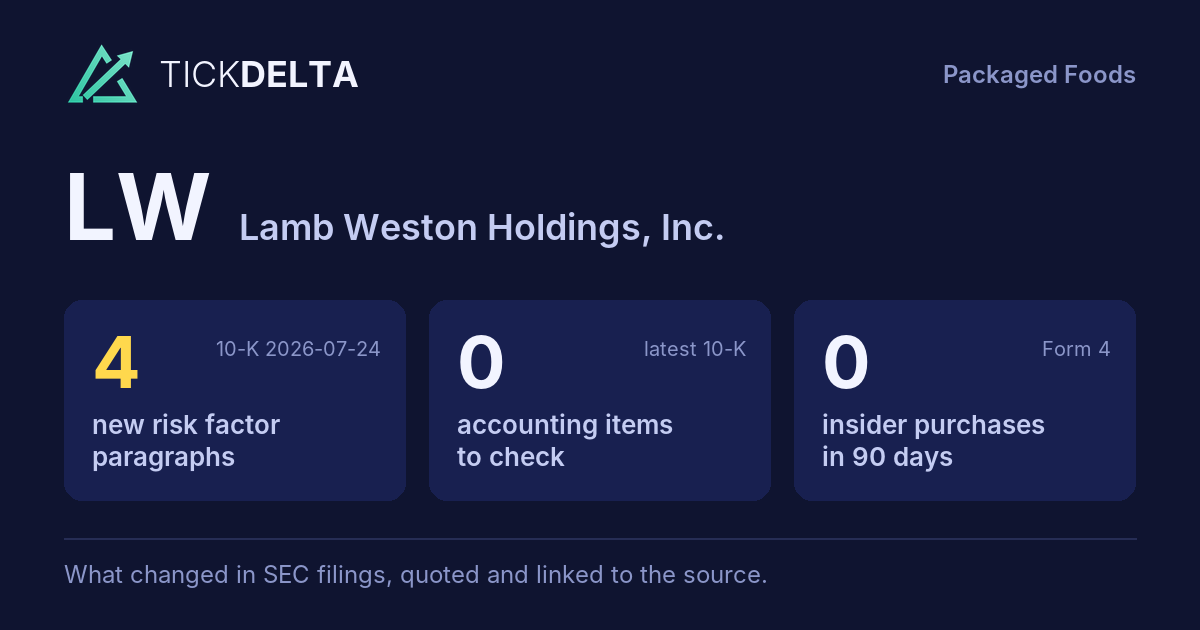
5 reviews of LW's filings by SEC staff

UPLOAD and CORRESP
Reviews 5 latest letter Mar 13, 2024
Questions asked 60 each answered in the company's own letter
No closing letter 1 reviews without a letter saying the staff completed it

When the SEC's staff reviews a filing, it writes to the company with numbered questions, and the company answers each one in a letter. SEC publishes the exchange once the review is over, at least 20 business days later. A question is not an accusation; most reviews end with the company adding detail to its next filing.

How the reviews went

Every review on EDGAR, from the first staff letter to the letter that closes it

  1. 1. Staff letters 9 UPLOAD
  2. 2. Questions in them 60 numbered comments
  3. 3. Company replies 8 CORRESP
  4. 4. Reviews closed 4 of 5 closing letter

Half the closed reviews took 26 days or less from the first letter to the closing letter.

Form 10-K for the Year Ended May 28, 2023

2024-03-13 to 2024-04-08 · 6 questions · 2 letters from the SEC, 2 from the company
Review closed 2024-04-08
Non-GAAP measuresSegmentsIncome taxesRevenueResults discussion (MD&A)InventoryDerivatives and hedgingAcquisitions
Exhibit 99.1 Earnings Release · Reconciliation of Non-GAAP Financial Measures, page 13
SEC asked (1)
We note from your disclosure on page 15 that you reconcile income from operations by segment to Adjusted EBITDA by segment. Please note that income from operations by segment does not appear to be a GAAP financial measure and therefore it would not be appropriate to disclose these amounts by segment or to use as a starting point for the reconciliation of Segment Adjusted EBITDA.
Rest of the question

Please revise future filings accordingly. Note 12. Segments, page 15

LW answered
The Company notes the Staff’s comment and has considered the requirements of Item 10(e) of Regulation S-K as it relates to the reconciliation of non-GAAP financial measures on page 15 of the Company’s Earnings Release included as Exhibit 99.1 to the Form 8-K (the “Earnings Release”). We included this disclosure to provide investors with additional information related to adjustments made in each operating segment to calculate Segment Adjusted EBITDA, which is the metric our Chief Executive Officer (who is our chief operating decision maker (CODM)), uses to assess operating performance and make
Rest of the answer

resource allocation decisions at the segment level. In doing so, we acknowledge we presented a non-GAAP metric, “segment income from operations,” and did not identify this metric as a non-GAAP financial measure. In future earnings releases, the Company will remove the tables on page 15 in their entirety and revise the table reconciling net income to total company Adjusted EBITDA (appearing on page 14 of the Earnings Release) to include a reconciliation of Segment Adjusted EBITDA to total company Adjusted EBITDA as follows (which for illustrative purposes, would have been included on page 14 of the Earnings Release):

For the Thirteen Weeks Ended For the Twenty-Six Weeks Ended

(in millions) November 26, 2023 November 27, 2022 November 26, 2023 November 27, 2022

Net income $ 215.0 $ 103.1 $ 449.8 $ 335.0

Interest expense, net 29.1 24.6 59.8 50.6

Income tax expense 66.2 36.8 136.1 110.5

Income from operations including equity method investment earnings 310.3 164.5 645.7 496.1

Depreciation and amortization 71.2 59.8 142.0 117.4

Unrealized derivative losses (gains) 1.6 (0.4) (25.7) 3.6

Unconsolidated joint venture unrealized derivative losses (gains) — 130.1 — (14.4)

Foreign currency exchange losses (gains) (9.2) 1.4 (1.8) 2.4

Items impacting comparability:

Read in the reply
In its next report

First report after the company's reply of Mar 21, 2024: 10-Q filed Apr 4, 2024 ↗, against the 10-Q filed Jan 4, 2024 ↗.

Tickdelta does not hold the text of both reports, so they are not compared here.

Exhibit 99.1 Earnings Release · Reconciliation of Non-GAAP Financial Measures, page 13
SEC asked (2)
We note that in your disclosure of segment profitability you disclose Adjusted EBITDA by segment, and then reconcile that amount to income (loss) loss from operations including equity method investment earnings, by segment. Please tell us which measure is the measure of profitability used by the CODM to measure performance and allocate resources to the segment.
Rest of the question

Please note that if the segment measure is Adjusted EBITDA, the total of the reportable segments’ Adjusted EBITDA should be reconciled to consolidated income before taxes and each amount of segment Adjusted EBITDA should not be reconciled to another segment profitability measure. See guidance in ASC 280-1050-27 through 28, and 280-10-50-30

LW answered
The Company notes the Staff’s comment and has considered the requirements of ASC 280, Item 10(e) of Regulation S-K and Question 104.04 of the Compliance and Disclosure Interpretations (C&DI) as it relates to Note 12, Segments, appearing in the Form 10-Q. The CODM uses Segment Adjusted EBITDA to assess operating performance and make resource allocation decisions at the segment level.

In Note 12, a reconciliation was prepared in accordance with ASC 280-50-30 to reconcile Adjusted EBITDA to net income, the most directly comparable GAAP metric.
Rest of the answer

As part of this reconciliation, we presented a subtotal line “income (loss) from operations including equity method investment earnings,” which was included to make it easier for investors to view and use the information presented. In doing so, we acknowledge that we presented a non-GAAP metric without identifying it as a non-GAAP financial measure. Since the measure "income (loss) from operations including equity method investment earnings" is not used by the CODM to make decisions regarding resource allocations, we will remove the subtotal in future filings. We also will revise Note 12 in future filings to reconcile Segment Adjusted EBITDA to net income, the most directly comparable GAAP measure, as follows (which for illustrative purposes, would have been included on page 15 of the Form 10-Q):

Read in the reply
In its next report

First report after the company's reply of Mar 21, 2024: 10-Q filed Apr 4, 2024 ↗, against the 10-Q filed Jan 4, 2024 ↗.

Tickdelta does not hold the text of both reports, so they are not compared here.

Exhibit 99.1 Earnings Release · Reconciliation of Non-GAAP Financial Measures, page 13
SEC asked (3)
In light of the segment realignment and change to two operating and reportable segments from four operating and reportable segments, please tell us how you have considered disclosing revenue into more detailed categories for purposes of your disaggregated revenue disclosure under ASC 606-10-50-5.
LW answered
The Company notes the Staff’s comment and has considered the requirements of ASC 606-10-50-5, specifically the reporting requirements regarding disaggregation of revenue. This guidance requires an entity to disaggregate revenue from contracts with customers into categories that depict how the nature, amount, timing and uncertainty of revenue and cash flows are affected by economic factors.
Rest of the answer

Entities also should consider how information about the entity’s revenue has been presented for other purposes, including disclosures presented outside the financial statements, information regularly reviewed by the CODM for evaluating performance of operating segments, and other information used by the entity to evaluate performance or make resource decisions.

In accordance with the guidance provided in ASC 606-10-55-91, examples of disaggregated categories could include type of goods or service, geographic region, market or customer type, type of contract, contract duration, timing of transfer of goods, or sales channels. As outlined below, the Company has assessed these categories and determined that the Company should report revenue at the North America and International segment level, which aligns with the level at which the CODM evaluates the financial performance of the Company and the level reviewed to make decisions regarding resource allocation matters.

In fiscal 2024, we moved from four operating and reportable segments to two. We made this change following the acquisition of the remaining 50% interest in Lamb-Weston/Meijer v.o.f (“LW EMEA”), which we completed in the fourth quarter of fiscal 2023. As part of these changes, the executive leadership team made structural management changes that included the appointment of segment presidents for North America and International, with responsibility to manage the business segments separately. The rationale behind these changes, and the operating and reportable segment realignment, relates to differences in the go to market strategy and supply chain operations in North America and International, which increased after the acquisition of the remaining 50% of LW EMEA. While the frozen potato products sold across the Company are similar in nature, the differences between the North America and International operations and strategic priorities are significant due to differences in grower contracting, customer and consumer preferences and product distribution. For example, in North America, a higher percentage of the potato crop is contracted with large growers, whereas we contract mostly with smaller growers in countries in the International segment. Potato varieties are also different in North America compared with other locations globally. In addition, in North America, we sell the products through a network of internal sales personnel and national and regional distributors, whereas in the International segment, sales are focused on individual customers through importers or small local distributors.

The CODM focuses his review on information related to volume, net sales, and Adjusted EBITDA at the North America and International segment levels. In this regard, the CODM is not provided with any information that disaggregates revenue by customer type, channel or any other category. The Company discloses information in reports it furnishes and files with the SEC consistent with the manner in which the CODM reviews information about the business to assess financial performance and make decisions regarding resource allocations. As such, the Company includes disclosures in its SEC filings and earnings releases that discuss the drivers of net sales within the Company’s North America and International segments, including price/mix and volume. In addition, while the Company occasionally discusses information related to overall trends affecting supply and demand for its products during earnings calls, such as “restaurant traffic is overall flat,” or “global frozen potato category continues to be solid,” or discusses traffic in a specific sales channel, such as quick service or full service restaurants, the Company follows these remarks with discussion of how the industry and/or competitive landscape affects the North America and International segments, which aligns with how the CODM evaluates business performance. Further, the Company describes its business and financial results to investors, analysts, and the Company’s Board of Directors by reference to the two segments, North America and International.

Accordingly, based on the Company’s review and evaluation of the requirements of ASC 606-10-50-5, including as described above, the Company believes it does not meet the criteria for disaggregating revenue at levels below our reportable segments of North America and International.

Read in the reply
In its next report

First report after the company's reply of Mar 21, 2024: 10-Q filed Apr 4, 2024 ↗, against the 10-Q filed Jan 4, 2024 ↗.

Tickdelta does not hold the text of both reports, so they are not compared here.

Management's Discussion and Analysis of Financial Condition and Results of Operations · Gross Profit and Product Contribution Margin, page 35
SEC asked (4)
We note your disclosure in the second paragraph that “excluding these items, gross profit increased $645.8 million, or 78%, to $1477.8 million.” Please note that whenever you disclose an amount that is not calculated in accordance with GAAP, such as this $1477.8 million gross profit amount, which excludes adjustments for inventory step-up and unrealized losses on hedging contracts, the measures should be labeled as
Rest of the question

Non-GAAP. We also note that in the narrative discussion of the results of operations, you disclose amounts for an adjusted product contribution margin, SG&A expenses, interest expense, and effective tax rates, which should all be labeled as Non-GAAP amounts. Please revise accordingly. See guidance in Item 10(e)(1)(ii)(E) of Regulation S-K and Question 100.05 of the SEC Staff's Compliance and Disclosure Interpretations on Non-GAAP Financial Measures.

LW answered
The Company notes the Staff’s comment and has considered the requirements of Item 10(e)(1)(ii)(E) of Regulation S-K and Question 100.05 of the CD&I as it relates to “Management’s Discussion and Analysis of Financial Condition and Results of Operations – Gross Profit and Product Contribution Margin” included in the Form 10-K. The Company acknowledges that non-GAAP financial measures must be labeled and clearly described in such presentations.
Rest of the answer

In this regard, we respectfully submit that the Company described the adjustments related to gross profit in the paragraph immediately preceding the discussion to allow the reader to understand the calculation of gross profit excluding the items, in the Form 10-K. Similarly, in the paragraphs describing product contribution, selling, general and administrative (SG&A) expenses, interest expense and the effective tax rate, we describe the adjusting items within each paragraph. We recognize that we did not properly identify the amounts after adjustments, as non-GAAP financial measures.

In future filings, the Company will label adjusted gross profit and adjusted SG&A expenses, and any other applicable metrics, as non-GAAP financial measures. We will also reconcile these measures to the most directly comparable GAAP financial measure in accordance with Item 10(e)(1)(i)(A-B), and we intend to include those reconciliations in tabular as opposed to narrative form. For illustrative purposes, we have included below an example of the type of table we would include in future SEC filings when presenting this type of information. We have based these illustrative disclosures on information for the fiscal year ended May 28, 2023.

For the Fiscal Years Ended May

2023 2022 2023 2022 2023 2022 2023 2022 2023 2022

(in millions, except per share amounts) Gross Profit SG&A Income from Operations Net Income Diluted EPS

As reported $ 1,432.1 $ 832.0 $ 550.0 $ 387.6 $ 882.1 $ 444.4 $ 1,008.9 $ 200.9 $ 6.95 $ 1.38

LW EMEA acquisition-related items:

Read in the reply
In its next report

First report after the company's reply of Mar 21, 2024: 10-Q filed Apr 4, 2024 ↗, against the 10-Q filed Jan 4, 2024 ↗.

Tickdelta does not hold the text of both reports, so they are not compared here.

General
SEC asked (5)
We note that on March 1, 2023 you furnished a Form 8-K announcing the completion of the acquisition of LW EMEA. We also note that this 8-K indicates that financial statements of the acquired business are not required to be filed.
Rest of the question

Please explain to us how you determined that this acquisition was not significant under Rule 3-05 of Regulation S- X and therefore you did not need to file audited financial statements of the acquired entity.

LW answered
The Company notes the Staff’s comment and has reviewed the requirements of Rule 3-05 of Regulation S-X in connection with its evaluation of whether audited financial statements of the Company’s former joint venture, LW EMEA, were required in connection with the Company’s acquisition of the remaining equity interests in that joint venture.
Rest of the answer

In this regard, we specifically focused on the following guidance provided in the SEC’s Financial Reporting Manual:

2020.3 Significance Implementation - Business Combination Achieved in Stages or Step Acquisition of a Rule 11-01(d) Business – General - If a registrant increases its investment in a business relative to the prior year, base the tests of significance on the increase in the registrant's proportionate interest in assets and net income during the year, rather than the cumulative interest to date. However, step acquisitions which are part of a single plan to be completed within a twelve-month period should be aggregated.

Prior to the completion of the Company’s acquisition of the remaining equity interests in LW EMEA on February 28, 2023, the Company accounted for its ownership interest in the joint venture under equity method of accounting as we previously owned 50% of the joint venture. The LW EMEA acquisition was not part of a single plan that would require multiple acquisitions to be aggregated for purposes of the required significance tests. In assessing significance in connection with its financial reporting requirements, the Company reflected the acquisition of the incremental 50% of LW EMEA (i.e., increasing the Company's ownership of LW EMEA from 50% to 100%) as the increase in its proportionate interest in LW EMEA for purposes of the relevant asset and income tests. The results of the Company’s significance calculations relating to the LW EMEA acquisition are as follows:

Test Calculation Result

Asset 9%

Investment 7%

Income 9%

Revenue 13%

The results under these significance tests did not exceed the thresholds that would require disclosure of additional financial information under Rule 3-05 of Regulation S-X. As a result, the Company was not required to present separate audited financial statements of LW EMEA in connection with the acquisition.

Read in the reply
Response Letter Dated March 21, 2024 · Note 12. Segments, page 15
SEC asked
We note from your response to our prior comment 2, that you will revise the reconciliation of your segment profitability measure to remove the line item for income (loss) from operations including equity method investment earnings. Please note that the reconciliation should also be revised to total the segment measures of profitability and to reconcile to income before income taxes, rather than net income.
Rest of the question

See guidance in ASC 280-10-50-30(b).

LW answered
The Company notes the Staff’s comment and has considered the requirements of ASC 280-10-50-30(b) in connection with the revisions to the reconciliation of our segment profitability measure. As part of these revisions, we will present totals of our segment measures of profitability and reconcile Segment Adjusted EBITDA to income before income taxes in our future filings.
Rest of the answer

In this regard, we have made these revisions in Note 12 of the notes to our consolidated financial statements in our Form 10-Q for the quarter ended February 25, 2024 that we filed with the SEC on April 4, 2024 (the “Q3 2024 Form 10-Q”). Please see Note 12 on page 15 of the Q3 2024 Form 10-Q for our revised presentation. Please also note that we have continued to include a further reconciliation of Income before income taxes to Net income in Note 12 to match our Consolidated Statements of Earnings as we believe that providing this further reconciliation is helpful to readers of our financial statements.

Read in the reply
In its next report

First report after the company's reply of Apr 4, 2024: 10-K filed Jul 24, 2024 ↗, against the 10-K filed Jul 25, 2023 ↗.

Tickdelta does not hold the text of both reports, so they are not compared here.
Also in this review: closing letter, 2024-04-08
Form 10-K for the Fiscal Year Ended May 31, 2020

2021-02-23 to 2021-02-26 · 3 questions · 1 letter from the SEC, 0 from the company
Review closed 2021-02-26
Non-GAAP measuresSegments
SEC letter of Feb 23, 2021 ↗ no reply letter on EDGAR
Fiscal Year Ended Mary 31, 2020 Compared to Fiscal Year ended May 26, 2019 · Product Contribution Margin, page 30
SEC asked (1)
We refer to your presentation of Product Contribution Margin. Product Contribution Margin by segment representing measures reported to the CODM for segment reporting purposes is permissible under ASC 280, however, disclosure of the measure on a consolidated basis outside of the ASC 280 footnote to the consolidated financial statements represents a non-GAAP financial measure for which you are required to comply with
Rest of the question

the disclosure requirements outlined in Item 10(e) of Regulation S-K. Please revise to include all relevant disclosures required by Item 10(e)(i)(C)-(D) of Regulation S- K. Refer to Question 104.04 of the SEC's Division of Corporation Finance C&DI's on Non-GAAP Financial Measures for further guidance.

LW answered

No reply letter found.

In its next report

First report after the SEC's letter of Feb 23, 2021: 10-Q filed Apr 7, 2021 ↗, against the 10-Q filed Jan 7, 2021 ↗.

Tickdelta does not hold the text of both reports, so they are not compared here.

Reconciliations of Non-GAAP Financial Measures to Reported Amounts, page 28
SEC asked (2)
We note your presentation of the non-GAAP measures "EBITDA" which adjusts for equity method investment earnings and "EBITDA from unconsolidated joint ventures." Please note that EBITDA, by definition, should only reflect adjustments for interest, taxes, depreciation and amortization.
Rest of the question

In this regard, please revise to remove other adjustments from your calculation of EBITDA or alternatively, you may revise the title your non-GAAP measure to distinguish it from EBITDA. Please refer to Question 103.01

LW answered

No reply letter found.

In its next report

First report after the SEC's letter of Feb 23, 2021: 10-Q filed Apr 7, 2021 ↗, against the 10-Q filed Jan 7, 2021 ↗.

Tickdelta does not hold the text of both reports, so they are not compared here.

of the SEC's Division of Corporation Finance C&DI's on Non-GAAP Financial Measures · for further guidance. Your 8-K earnings releases should be similarly revised. Exhibit 99.1, page 1
SEC asked (3)
Please revise your bullet points regarding your second quarter 2021 highlights to also present the most directly comparable GAAP measure to EBITDA with equal or greater prominence. Please refer to Question 102.10 of the SEC's Division of Corporation Finance C&DI's on Non-GAAP Financial Measures for further guidance.
Rest of the question

In closing, we remind you that the company and its management are responsible for the accuracy and adequacy of their disclosures, notwithstanding any review, comments, action or absence of action by the staff.

LW answered

No reply letter found.

In its next report

First report after the SEC's letter of Feb 23, 2021: 10-Q filed Apr 7, 2021 ↗, against the 10-Q filed Jan 7, 2021 ↗.

Tickdelta does not hold the text of both reports, so they are not compared here.

Also in this review: closing letter, 2021-02-26

Form 10-K

2020-02-10 to 2020-02-18 · 2 questions · 1 letter from the SEC, 1 from the company
Review closed 2020-02-18
Revenue
Notes to the Financial Statements · Note 2. Revenue From Contracts With Customers, page 64
SEC asked (1)
We note your disclosure that generally, you recognize revenue on a point in time basis when the customer takes title to the goods and assumes the risks, rewards, or control of the goods. However, you recognize revenue over time for customized products as they are produced and you have a purchase order providing a legally enforceable right to payment for the goods.
Rest of the question

For performance obligations which you satisfy over time, please tell us, and revise to disclose the method used to recognize revenue (for example, a description of the output methods or input methods used and how those methods are applied), and an explanation of why the methods used provide a faithful depiction of the transfer of goods or services. See guidance in ASC 606-10-50-18.

LW answered
The Company notes the Staff’s comment and has considered the guidance in ASC 606-10-50-18. We respectfully refer the Staff to Note 2. Revenue From Contracts With Customers, specifically the two paragraphs on page 65 of our Form 10-K appearing under the table titled “Combined and Consolidated Statements of Cash Flows,” which explain our rationale for recognizing revenue for our customized products over time, as the goods are produced:

“. . . there are certain products that we manufacture to customers’ unique recipes (customized products).
Rest of the answer

Due to the costs associated with reworking, transporting, and repackaging these products, we concluded that these products do not have an alternative future use at a reasonable profit margin under the new revenue standard.

The customized product sales are covered by purchase orders. Once the customized product is manufactured per the purchase order, we have an enforceable right to payment for the products. As such, the adoption of ASC 606 resulted in the acceleration of revenue for customized products at the time we have a legally enforceable right to payment since these products do not have an alternative use at a reasonable profit margin. Sales of customized products are generally recurring, thereby limiting the net impact of the adoption of the new revenue standard.”

In future filings, we will replace the second sentence of the second paragraph quoted from the Form 10-K above with the following: “[w]e recognize revenue for customized products over time, utilizing an output method based on products produced. This is because once a customized product is manufactured pursuant to a purchase order, we have an enforceable right to payment for that product.”

Read in the reply
In its next report

First report after the company's reply of Feb 13, 2020: 10-Q filed Apr 1, 2020 ↗, against the 10-Q filed Jan 3, 2020 ↗.

Tickdelta does not hold the text of both reports, so they are not compared here.

Notes to the Financial Statements · Note 2. Revenue From Contracts With Customers, page 64
SEC asked (2)
Please tell us, and revise to disclose the nature of your significant payment terms, including whether any of your contracts have significant financing components. Also, please disclose any obligations for returns or refunds. See guidance in ASC 606-10-5012.
LW answered
The Company notes the Staff’s comment and has considered the guidance in ASC 606-10-50-12. We respectfully refer the Staff to Note 2. Revenue From Contracts With Customers, specifically the paragraph on page 65 of our Form 10-K under “Segment Information,” where we state “[t]he nature of our contracts can vary based on the business, customer type, and region; however, in all instances it is our customary business practice to receive a valid order from the customer, in which each party’s rights and related payment terms are clearly identifiable.” In future filings, we will enhance our
Rest of the answer

disclosure to include the following:

“Our payment terms are consistent with industry standards and generally include early pay discounts. Amounts billed and due from customers are short-term in nature and are classified as receivables, since payments are unconditional and only the passage of time is required before payments are due. We generally do not offer financing to our customers. We also do not provide a general right of return. However, customers may seek to return defective or non-conforming products. Following a customer return, we may offer remedies, including cash refunds, credit towards future purchases, or product replacement. As a result, customers’ right of return and related refund or product liabilities are estimated and recorded as reductions in revenue.”

Read in the reply
In its next report

First report after the company's reply of Feb 13, 2020: 10-Q filed Apr 1, 2020 ↗, against the 10-Q filed Jan 3, 2020 ↗.

Tickdelta does not hold the text of both reports, so they are not compared here.

Also in this review: closing letter, 2020-02-18

Form 10-K for the Fiscal Year Ended May 28, 2017

2018-01-29 to 2018-02-26 · 1 question · 1 letter from the SEC, 1 from the company
Review closed 2018-02-26
Non-GAAP measuresResults discussion (MD&A)
Management’s Discussion and Analysis of Financial Condition and Results of Operations, page · Executive Summary, page 27
SEC asked
Beginning with the Form 10-Q for the fiscal quarter ended August 27, 2017 and continuing through this Form 10-Q, you present Adjusted Diluted EPS in your executive summary without disclosing (i) the most directly comparable GAAP measure, (ii) the corresponding reconciliation of the non-GAAP measure to such GAAP measure, and (iii) the usefulness of such measure to investors.
Rest of the question

The measure appears to be presented with greater prominence than GAAP measures. Revise your presentation to address the inconsistencies with Items 10(e)(1)(i)(A) through (C) of Regulation S-K and the updated Compliance and Disclosure Interpretations (C&DI) issued on May 17, 2016, in particular C&DI 102.10.

LW answered
The Company notes the Staff’s comment and has considered the requirements of Items 10(e)(1)(i)(A) through (C) of Regulation S-K and the updated Compliance and Disclosure Interpretations (C&DI). We respectfully submit that the Company provided diluted earnings per share, the most directly comparable GAAP measure to Adjusted Diluted EPS, in the second bullet of the Executive Summary on page 27 of the Form 10-Q. In addition, the Company discloses information sufficient to calculate Adjusted Diluted EPS on pages 9 and 27 of the Form 10-Q.
Rest of the answer

However, we recognize that the Company did not provide a corresponding reconciliation nor explain the usefulness of this measure to investors in the Form 10-Q. In future filings, the Company undertakes to include a reconciliation of Adjusted Diluted EPS to diluted EPS and explain the reasons we believe this measure is important to investors, in a manner consistent with the Company’s disclosure of such information in its quarterly earnings releases.

Read in the reply
In its next report

First report after the company's reply of Feb 1, 2018: 10-Q filed Apr 5, 2018 ↗, against the 10-Q filed Jan 4, 2018 ↗.

Tickdelta does not hold the text of both reports, so they are not compared here.

Also in this review: closing letter, 2018-02-26

Form 10-12B

2016-08-09 to 2016-10-17 · 48 questions · 4 letters from the SEC, 4 from the company
No closing letter
Results discussion (MD&A)SegmentsRisk factorsLiquidity and cashExecutive payPensionsRevenueChinaDebtCritical estimatesNon-GAAP measuresLegal and contingencies
Information Statement filed as Exhibit 99.1 · Summary, page 1
SEC asked (1)
Please provide us with supplemental support for industry and market statistics, including objective substantiation for each statement here and in your business section that describes your competitive position in your industry and your leadership position.
Rest of the question

For example, we note your statement on pages 1 and 63 that you are “the number one supplier of value-added frozen potato products” and your statement on pages 2 and 63 that you are “the North American frozen potato category leader.” Disclose the quantitative metric or metrics used to make such determinations. If you do not have independent support for a statement, please either revise the language to make clear the basis for the statement or delete it.

LW answered
We respectfully advise the Staff that, in response to the Staff’s comment, we have revised certain statements regarding our competitive position in our industry and our leadership position in the Amendment. In response to the Staff’s comment and concurrent with the filing of the Amendment, we are supplementally providing to the Staff, under separate cover, independent support for industry and market statistics included in the Amendment, including objective substantiation for each statement that describes

United States Securities and Exchange Commission

Page our competitive position in our
Rest of the answer

industry and our leadership position. To expedite the Staff’s review, we have annotated the support for each such statement with cross-references to the supporting document and have highlighted the relevant portion or section of each supporting document submitted to the Staff.

Read in the reply
Information Statement filed as Exhibit 99.1 · Summary, page 1
SEC asked (2)
Please revise to indicate that all subjective statements in your filing represent management’s belief. As one example, you state on page 2 that you have “developed customer intimacy with [y]our key accounts over time through a focus on world-class customer service and customer-focused innovation.”
LW answered
We respectfully advise the Staff that, in response to the Staff’s comment, we have revised all subjective statements in the Amendment to indicate that such statements represent management’s belief.

Risk Factors,
Read in the reply
Risk Factors, page 13
SEC asked (3)
We note that you plan to enter into several related party agreements with ConAgra Foods, Inc., including the Separation and Distribution Agreement, Employee Matters Agreement, Transition Services Agreement, and Trademark License Agreement.
Rest of the question

Please include risk factor disclosure specifically addressing the fact that these agreements were not negotiated on an arm’s length basis and describing the risks arising from any conflicts of interest in negotiating and performing under the agreements, or tell us why you believe such disclosure is not material.

LW answered
We respectfully advise the Staff that, in response to the Staff’s comment, we have included risk factor disclosure in the Amendment specifically addressing the fact that several related-party agreements with ConAgra Foods, Inc., including the Separation and Distribution Agreement, Employee Matters Agreement, Transition Services Agreement, and Trademark License Agreement, were negotiated in the context of a parent-subsidiary relationship prior to the spinoff and describing the risks arising from any conflicts of interest in negotiating and performing under the agreements.
Read in the reply
Our future debt may limit cash flow available . . . , page 19
SEC asked (4)
Please revise to disclose the amount and material terms of the debt that you expect to incur in connection with the spinoff.
LW answered
We respectfully advise the Staff that, in response to the Staff’s comment, we have revised our disclosure in the Amendment, including in the “Risk Factors” section, to disclose the amount of the debt that we expect to incur in connection with the spinoff. We are in the early stages of discussing the terms of such debt with potential lenders. Accordingly, we will provide more information regarding the material terms of the debt that we expect to incur in an amendment to the Registration Statement when known.
Read in the reply
Our business relies on a potato crop . . . , page 19
SEC asked (5)
You state here that the European growing regions for the necessary potatoes are concentrated in “Northwestern Europe.” Additionally, in the last risk factor on page 20 you indicate that you source potatoes from various countries abroad and that severe weather conditions may affect potato crop performance.
Rest of the question

Please disclose the specific country or countries where the growing regions are located or tell us why this disclosure is not material. As applicable, please revise your “Raw Materials” disclosure on page 67.

LW answered
We respectfully advise the Staff that, in response to the Staff’s comment, we have revised the disclosure in the Amendment to provide the specific country or countries where the growing regions are located, and have revised our “Raw Materials” disclosure accordingly.
Read in the reply
Management’s Discussion and Analysis, page 45
SEC asked (6)
Please include an overview providing a balanced, executive level discussion that identifies the most significant matters with which management is concerned in evaluating your financial condition and results of operations.
Rest of the question

This discussion should:  Provide insight into material opportunities, challenges and risks such as those presented by known material trends and uncertainties for certain of your products and services; and  Identify material demands, commitments, events or uncertainties that will have, or are reasonably likely to have, a material impact on your financial condition, operating performance, revenues and/or income, or result in your liquidity decreasing or increasing in any material way and provide additional information about the quality and variability of your earnings and cash flows so that investors can ascertain the likelihood of the extent past performance is indicative of future performance.

LW answered
We respectfully advise the Staff that, in response to the Staff’s comment, we have revised the disclosure in the Amendment to include an overview providing a balanced, executive level discussion that identifies the most significant matters with which management is concerned in evaluating our financial condition and results of operations.
Read in the reply
Results of Operations, page 48
SEC asked (7)
In various places in your MD&A, you attribute the change in reported amounts to multiple factors without indicating the amount contributed by each factor. For example, you state “Global net sales increased as a result of strong growth domestically, driven by organic growth and new business with major chains, as well as internationally due to the lapping of the West Coast labor dispute in the year ago period, the
Rest of the question

full-year impact of fiscal 2015 new business, additional new channel penetration in Mexico, and organic and ramp-up growth in China.” Revise the analysis of your operating results to quantify the effect of each factor identified as the cause of a material change to the amounts presented as part of your financial statements. Refer to Item 303(a)(3) of Regulation S-K and FRC 501.04.

LW answered
We respectfully advise the Staff that, in response to the Staff’s comment, we have revised the analysis of our operating results in the

Amendment to quantify, to the extent practical, the effect of each factor identified as the cause of a material change to the amounts presented as part of our financial statements.
Read in the reply
Results of Operations, page 48
SEC asked (8)
Please separately discuss and quantify the factors impacting your cost of goods sold from period to period, rather than limiting your discussion solely to that of the broader “product contribution margin” metric.
LW answered
We respectfully advise the Staff that, in response to the Staff’s comment, we have revised the disclosure in the Amendment to separately discuss and quantify the factors impacting our cost of goods sold from period to period, rather than limiting the discussion solely to that of the broader

“product contribution margin” metric.
Read in the reply
Liquidity and Capital Resources, page 54 · Cash Flows, page 55
SEC asked (9)
Please describe your material commitments for capital expenditures as of the end of the latest fiscal period. Refer to Item 303(a)(2)(i) of Regulation S-K. For example, please discuss the “significant plant expansions and improvements” that you reference in the third full paragraph of page 55.
LW answered
We respectfully advise the Staff that we do not believe that we had material commitments for capital expenditures as of the end of the latest fiscal period, but we have revised the disclosure in the Amendment to provide additional disclosure regarding planned capital expenditures.
Read in the reply
Obligations and Commitments, page 56
SEC asked (10)
In footnote 1 to your tabular summary of contractual obligations, you note that the Purchase obligations line item “[e]xcludes purchase commitments under potato supply agreements due to uncertainty of pricing and quantity.” As this information is available and disclosed on page F-23, please revise the footnote to disclose the amount you paid under the terms of the potato supply agreement during fiscal 2016 (once
Rest of the question

available), 2015, and 2014 or provide a cross-reference to page F-23.

LW answered
We respectfully advise the Staff that, in response to the Staff’s comment, we have revised footnote 1 to our summary of contractual obligations in the Amendment to disclose the amount we paid under the terms of the potato supply agreement during fiscal 2016, 2015, and 2014. Supplementally, we advise the staff that the information disclosed in the notes to the financial statements is limited to certain types of potato supply agreements involving either potential guarantees of grower indebtedness or grower advances and, accordingly, we have determined not to provide a cross-reference to the
Rest of the answer

financial statements.

Read in the reply
Critical Accounting Estimates, page 58
SEC asked (11)
The disclosures of your critical accounting policies and estimates appear to be more descriptive of the accounting policies utilized, rather than any specific uncertainties underlying your estimates. Please revise your disclosures to address the material implications of the uncertainties that are associated with the methods, assumptions and estimates underlying your critical accounting estimates.
Rest of the question

Specifically, you should provide the following: (a) An analysis of the uncertainties involved in applying the principle and the variability that is reasonably likely to result from its application. (b) An analysis of how you arrived at the measure and how accurate the estimate or underlying assumptions have been in the past. (c) An analysis of your specific sensitivity to change based on outcomes that are reasonably likely to occur and have a material effect. Please refer to FRC Section 501.14 for further guidance.

LW answered
We respectfully advise the Staff that, in response to the Staff’s comment, we have revised our disclosure in the Amendment to address the material implications of the uncertainties that are associated with the methods, assumptions and estimates underlying our critical accounting estimates. Additionally, we respectfully advise the Staff, on a supplemental basis, of the following relating to our critical accounting estimate disclosures.

1.
Rest of the answer

The assets and liabilities of the parent company pension plans will not be assumed by Lamb Weston, and only the service cost of the related pension plans of the parent company have been fully included in the results of operations of Lamb Weston. The portion of pension expense comprised of expected return on plan assets, interest cost, amortization of prior service cost, and amortization of actuarial gains and/or losses applicable to Lamb Weston employees is included in the indirect pool of selling, general and administrative costs of the parent company, and were allocated to Lamb Weston based on the methodology described in Cost Allocations. Accordingly, sensitivity analyses of the impact of changes in the assumptions used have no impact on Lamb Weston’s assets and liabilities, and only the assumptions used to determine the service cost component of pension expense have a direct impact on our results of operations, except to the extent the other components of pension expense were allocated as part of the pool of selling, general and administrative costs of the parent company.

2. The fair value of each reporting unit of Lamb Weston is currently estimated to exceed its respective carrying value by a very wide margin (in excess of 100%). Accordingly, unless the sensitivity analyses were to utilize very large and unrealistic changes in assumptions, there would be no impact to our financial statements.

Read in the reply
Key Business Strengths, page 63
SEC asked (12)
We note the compound annual growth rate for the sale of frozen processed potatoes and the general reference to industry-wide, export volumes of frozen potatoes internationally. Please provide us with supplemental support for the industry and market statistics in this section.
LW answered
We respectfully advise the Staff that, in response to the Staff’s comment and concurrent with the filing of the Amendment, we are supplementally providing to the Staff, under separate cover, supplemental support for the industry and market statistics in this section, including objective substantiation for each statement that describes our competitive position in our industry and our leadership position.
Rest of the answer

To expedite the Staff’s review, we have annotated the support for each such statement with cross-references to the supporting document and have highlighted the relevant portion or section of each supporting document submitted to the Staff.

Read in the reply
Industry Segments and Geographical Financial Information, page 65 · Global, page 65
SEC asked (13)
You state here and elsewhere that McDonald’s Corporation and its affiliates accounted for approximately 12% of your combined net sales for fiscal 2016. Please file your sales agreement with McDonald’s Corporation, or provide your analysis as to why you are not required to do so under Item 601(b)(10) of Regulation S-K.
LW answered
We respectfully advise the Staff that, in response to the

Staff’s comment, we do not believe that we are party to any agreements with McDonald’s Corporation or its affiliates that are required to be filed under Item 601(b)(10) of Regulation S-K. Although ConAgra Foods, Inc. (“ConAgra”) has entered into a Business Relationship and Confidentiality Agreement, dated June 9,

2009, with McDonald’s USA, LLC to develop products and services on an ongoing basis, neither ConAgra nor we have entered into ongoing sales agreements with McDonald’s Corporation or its affiliates.
Rest of the answer

Rather than rely on a single agreement, we sell our products to McDonald’s Corporation and its affiliates pursuant to various purchase orders. Each of these purchase orders is of a type that ordinarily accompanies the kind of business conducted by us and has been entered into in the ordinary course of business. We respectfully advise the Staff that we are not “substantially dependent” on such purchase orders and such purchase orders do not provide for obligations that are material to us. Accordingly, we do not believe that any of our sales agreements with McDonald’s Corporation or its affiliates, including our purchase orders, constitute material agreements under Item 601(b)(10) of Regulation S-K, and therefore no such sales agreements are required to be filed as an exhibit to the Registration Statement.

Read in the reply
Relationship with ConAgra after the Spinoff, page 70 · Agreements between ConAgra and Us, page 70
SEC asked (14)
Please revise to clarify whether the indemnification provisions you reference are subject to any cap.
LW answered
We respectfully advise the Staff that, in response to the Staff’s comment, we have revised the disclosure in the Amendment to clarify whether the indemnification provisions we reference in the Amendment are subject to any cap.
Read in the reply
Management, page 74
SEC asked (15)
For each of your directors, please briefly discuss the specific experience, qualifications, attributes, or skills that led to the decision that he or she is suited to serve as a director of the company. Refer to Item 401(e)(1) of Regulation S-K.
LW answered
We respectfully advise the Staff that, in response to the Staff’s comment, we have revised the disclosure in the Amendment to include a brief discussion of the specific experience, qualifications, attributes, or skills that led to the decision that each named director is suited to serve as a director of the Company.
Read in the reply
Agreement with Significant Stockholder, page 74
SEC asked (16)
We note that ConAgra has entered into a cooperation agreement with one of its significant stockholders, JANA Partners LLC, pursuant to which JANA Partners has the right to designate two individuals to your board of directors. It appears that you will have a beneficial interest in this agreement.
Rest of the question

As such, please file the agreement with your registration statement on Form 10 pursuant to Item 601(b)(10)(i) of Regulation S-K.

LW answered
We respectfully advise the Staff that, in response to the Staff’s comment, we have filed the cooperation agreement between ConAgra and JANA Partners LLC as an exhibit to the Registration Statement pursuant to Item 601(b)(10)(i) of Regulation S-K.
Read in the reply
Compensation Discussion and Analysis, page 77
SEC asked (17)
Please amend to include your Compensation, Discussion and Analysis disclosure. Refer to Item 402 of Regulation S-K.
LW answered
We respectfully advise the Staff that, in response to the Staff’s comment, we have included our Compensation, Discussion and Analysis disclosure in the Amendment.
Read in the reply
Notes to Combined Financial Statements, page F-8 · Note 7. Variable Interest Entities, page F-16
SEC asked (18)
Disclosure indicates that you have a 49.99% interest in Lamb Weston BSW, LLC (“Lamb Weston BSW”), a potato processing venture with Ochoa Ag Unlimited Foods, Inc. (“Ochoa”). Lamb Weston BSW is deemed to be a variable interest entity, and as you are the primary beneficiary, the financial results of Lamb Weston BSW are consolidated. Please provide us with your accounting analysis of this arrangement.
Rest of the question

In your response, please cite the relevant authoritative accounting guidance.

LW answered
We respectfully advise the

Staff that, in response to the Staff’s comment, we have analyzed the accounting treatment of our 49.99% ownership interest in Lamb Weston BSW, LLC (“Lamb Weston BSW”) under the guidance provided in ASC 810, Consolidation. The initial step in our accounting analysis takes place under ASC 810-10-15-14, under which we determined that Lamb Weston BSW is a Variable Interest Entity.
Rest of the answer

ASC 810-10-15-14 provides that a legal entity shall be subject to consolidation under the guidance in the Variable Interest Entities Subsections of the guidance if, by design, both of the following conditions are present:

The voting rights of some investors are not proportional to their obligations to absorb the expected losses of the legal entity, their rights to receive the expected residual returns of the legal entity, or both.

Substantially all of the legal entity’s activities (for example, providing financing or buying assets) either involve or are conducted on behalf of an investor that has disproportionately few voting rights.

As we have disclosed in Note 7, Variable Interest Entities, “Under certain circumstances, Lamb Weston could be required to compensate Ochoa for lost profits resulting from significant production shortfalls (“production shortfalls”). Commencing on June 1, 2018, or on an earlier date under certain circumstances, Lamb Weston has a contractual right to purchase the remaining equity interest in Lamb Weston BSW from Ochoa (the “call option”). Lamb Weston is currently subject to a contractual obligation to purchase all of Ochoa’s equity investment in Lamb Weston BSW at the option of

Ochoa (the “put option”). The purchase prices under the call option and the put option (the “options”) are based on the book value of Ochoa’s equity interest at the date of exercise, as modified by an agreed-upon rate of return for the holding period of the investment balance.”

We have also disclosed in Note 7 that ConAgra Foods has historically provided direct financing to Lamb Weston BSW in the form of a promissory note from Lamb Weston BSW, and in connection with the refinancing of this debt with a third party in fiscal 2016, Lamb Weston has provided its guarantee of Lamb Weston BSW’s performance under this debt.

We determined that our obligation to compensate Ochoa for production shortfalls, and the financing support we provide to Lamb Weston BSW, represent variable interests in Lamb Weston BSW that create obligations to absorb expected losses of the legal entity. Although we have only a 50% voting interest in the entity, the variable interests cited expose us to a greater than 50% obligation to absorb expected losses of the entity. As a result, we have determined that condition one of the cited guidance is met.

Further, we have concluded that substantially all of Lamb Weston BSW’s activities either involve or are conducted on behalf of the Company and therefore condition two of the cited guidance is met. In making this assessment, we considered the following factors (which are more fully discussed below): 1) the Company is the exclusive sales agent for Lamb Weston BSW, which has no independent sales function; 2) all Lamb Weston BSW products are sold under the trade names of the Company (Lamb Weston BSW’s products provide approximately 4% of the Company’s total annual sales); 3) the products manufactured by Lamb Weston BSW are similar to those manufactured by the Company in its other facilities and the primary purpose of the entity is to manufacture products exclusively for the Company; and 4) the other investor, Ochoa, can put its interests in the entity to the Company and the

Company can, beginning on June 1, 2018, purchase Ochoa’s interests in the entity.

Accordingly, we determined that Lamb Weston BSW is a Variable

Interest Entity (“VIE”). Per ASC 810-10-25-1, “consolidation is appropriate if a reporting entity has a controlling financial interest in another entity and a specific scope exception does not apply.

Per ASC 810-10-65-2, a reporting entity shall be deemed to have a controlling financial interest in a VIE if it has both of the following characteristics:

The power to direct the activities of a VIE that most significantly impact the VIE’s economic performance, and

The obligation to absorb losses of the VIE that could potentially be significant to the VIE or the right to receive benefits from the VIE that could potentially be significant to the VIE.”

Our accounting analysis concludes that both of these characteristics are present with Lamb Weston BSW.

A management committee comprised of two members from Ochoa and two from the Company generally manage the business decisions of Lamb Weston BSW. However, the

Company is the exclusive sales agent for Lamb Weston BSW and Lamb Weston BSW does not have any independent sales and marketing employees or capabilities. The Company exercises control over the sales activities with minimal involvement or oversight of Ochoa. The Lamb Weston BSW operating agreement provides the Company with a significant amount of latitude in carrying out its sales and marketing responsibilities and simply requires that they be “generally consistent with the level and manner in which such services are provided for Lamb Weston’s other potato production facilities.” The Company also has significant latitude in determining the pricing of the finished product sales to the Company’s existing customer base and agrees to purchase and take title to all finished products before reselling such products to third-party customers. Lamb Weston BSW does not have any external customer relationships. The price paid by the Company to Lamb Weston BSW for the finished products is the price the Company charges its third-party customers, less the sales commission payable to the Company. The Company bears the risk of credit loss on sales to its third-party customers and Lamb Weston BSW does not absorb any credit losses.

The Company also exercises significant control over the production process, due to its expertise and ownership of intellectual property associated with the production processes utilized in the operation of Lamb Weston BSW’s plant, coupled with the absence of significant involvement or oversight exercised by Ochoa. As further evidence of the

Company’s power to direct the production activities, the operating agreement requires the Company to pay Ochoa for lost profits in certain circumstances in which the plant does not operate a certain number of production days within a given year.

Notwithstanding the oversight of the management committee, the Company believes that its power to direct the sales and production activities are significant.

Also, the Company notes that the exercise of either the put option or the call option would result in the Company owning the entire business, and the put option is currently exercisable by Ochoa. The Company believes this is an indication that the design of the entity was intended to provide the Company with the ability to direct the activities of the entity that most significantly impact the entity’s economic performance.

As described previously, the variable interests held by the Company oblige the Company to absorb losses of the entity that could potentially be significant to the entity.

Accordingly, the Company concluded that it has a controlling financial interest in Lamb Weston BSW and thus, under ASC 810-10-25-1, consolidation is appropriate.

Read in the reply
Notes to Combined Financial Statements, page F-8 · Note 7. Variable Interest Entities, page F-16
SEC asked (19)
We note the non-controlling interest in Lamb Weston BSW is subject to a put option, which is recorded a $41.6 million liability as of May 31, 2015. On a supplemental basis, please provide us with additional information to support your accounting treatment as a liability versus equity. In your response, tell us how you considered the guidance of FASB ASC 480 and ASC 810-10-45-15 through 17A.
LW answered
We respectfully advise the

Staff on a supplemental basis that, in evaluating the accounting treatment of the non-controlling interest in Lamb Weston BSW, we first considered whether the redemption features, the put option exercisable by Ochoa and call option exercisable by the Company represent freestanding financial instruments. The options were established within the same contract as the equity interest at the time of the formation of the entity and cannot be legally detached or separately exercisable.
Rest of the answer

Further, the options do not permit net settlement and there is no other class of stock of Lamb Weston BSW. Therefore, we concluded, in accordance with ASC 480-10-15, that the options were not freestanding financial instruments.

We also considered whether the non-controlling interest represented a mandatorily redeemable financial instrument under ASC 480-10-25. We concluded that the non-controlling interest is not mandatorily redeemable because it does not embody an unconditional obligation requiring the Company to redeem the instrument at a specified or determinable date or upon an event that is certain to occur. The put option is currently exercisable any time at the option of the holder and there is no expiration date.

We also considered whether the non-controlling interest with the embedded options should be accounted for as a debt obligation in accordance with ASC 480-10-55-53. The exercise prices of the options are based upon a formula that includes the book value of the interest holder’s equity interest, plus a stated rate of return thereon (the rate of return differs for the put and the call options). The exercise prices do not convey a right of the Company to call the non-controlling interest holder’s interest at a fixed price at a stated future date, nor the right of the non-controlling interest holder to put the non-controlling interest holder’s interest at a fixed price a stated future date. The stated rate of return included in the formula upon which the exercise prices are based is not applied to a pre-determinable “principal” amount and is not certain of ultimate realization by the non-controlling interest holder. Based on these facts, we determined that the non-controlling interest does not represent a debt obligation of the Company.

We also evaluated whether the redemption features should be separated from the non-controlling interest and accounted for as a derivative under ASC 815-15-25. Due to several factors, including the inability for the options to be net settled, we concluded the redemption features should not be accounted for as derivatives.

After reaching the stated conclusions on the four cited analyses, we applied the guidance of ASC 480-10-S99.

The existence of the put option results in a non-controlling interest that is redeemable upon the occurrence of an event that is not solely within the control of the issuer. Such an instrument is required to be recognized outside of permanent equity. Although the guidance indicates that the balance sheet presentation is to be in a position between liabilities and permanent equity (“mezzanine” equity), based upon the materiality of the amount, the Company has presented the non-controlling interest as a noncurrent liability in its combined balance sheet and included detailed disclosures as to the composition of the Company’s noncurrent liabilities within the footnotes to the combined financial statements.

Read in the reply
Note 15. Pension Benefits, F-26
SEC asked (20)
We note your disclosure here and within Critical Accounting Estimates, which states employee-related benefits have been recorded in the financial statements as though you participated in a multiemployer pension plan. However, you also disclose the proportionate share of the pension costs that are directly attributable to Lamb Weston have been recorded in the financial statements.
Rest of the question

Please clarify how you have accounted for these expenses in your financial statements. In your response, please tell us whether you expect the Lamb Weston employees will continue to participate in the plans of ConAgra Foods after the spinoff.

LW answered
We respectfully advise the Staff that, in response to the Staff’s comment, we have clarified our disclosure in the Amendment as to how we have accounted for these expenses in our financial statements.

Additionally, the Company respectfully advises the Staff, on a supplemental basis, that employees of the Company who participate in pension plans sponsored by the parent of the Company will cease to participate in these plans on the date upon which the Company’s spinoff from its parent is completed.
Rest of the answer

Current participants in the salaried employee pension plans of the parent company will not accrue additional benefits under a defined benefit pension plan after the spinoff. Certain hourly participants in pension plans of the parent company (whose employment is governed under collectively bargained agreements) are expected to receive continuing accrual of benefits under a new pension plan or plans to be established by the Company at the time of the spinoff. The parent is expected to retain the obligation for the payment of related benefits accrued through the date of the spinoff.

We included the pension service cost of Company employees within selling, general and administrative expenses or cost of goods sold, depending upon the role of the applicable employee, in a manner similar to the manner in which such expenses would be recognized under a multiemployer pension plan. Because the Company will not assume the existing plan assets or liabilities from ConAgra, upon the completion of the spinoff, the portion of pension expense comprised of expected return on plan assets, interest cost, amortization of prior service cost, and amortization of actuarial gains and/or losses applicable to Company employees are included in the indirect pool of selling, general and administrative costs of ConAgra. These amounts were allocated to the Company based on the methodology described in Cost Allocations under the Critical Accounting Estimates section of

Management’s Discussion and Analysis.

Read in the reply
Note 19. Business Segments and Related Information, F-28
SEC asked (21)
Please expand your disclosure and tell us in more detail about the factors used to identify your reportable segments, address your internal organizational structure, and identify the types of products from which each reportable segment derives its revenues. Your revised disclosure should explain your basis for organization. For example, the differences among your segments are currently unclear.
Rest of the question

Specifically, your disclosure states the Global reporting segment includes restaurant chains and international customers comprised of foodservice distributors and retailers, and does not explain why these operations are not included within your Foodservice and Retail reporting segments. Refer to FASB ASC 280-10-50-21.

LW answered
We respectfully advise the Staff that, in accordance with Accounting Standards Codification (ASC) 280, Segment Reporting, we considered that an operating segment is a component of a public entity that has all of the following characteristics:

It engages in business activities from which it may earn revenues and incur expenses (including revenues and expenses relating to transactions with other components of the same public entity).

Its operating results are regularly reviewed by the public entity’s chief operating decision maker (CODM) to make decisions about resources to be allocated to
Rest of the answer

the segment and assess its performance.

3. Its discrete financial information is available.

We have determined that we have four operating segments, all of which are reportable segments, meeting the requirements as outlined in ASC 280: Global, Foodservice, Retail, and Other. The chief operating decision maker (CODM) receives periodic management reporting under this segment structure which enables operating decisions, performance assessment, and resource allocation decisions at the segment level. The reportable segments are each managed by a general manager and supported by a cross functional team assigned to support the segment.

The Global segment includes results of operations associated with the Company’s business with very large chain restaurant customers, whether those results are generated in the United States or abroad. Sales to large restaurant chains account for the vast majority of Global segment sales. In addition to top Global chains, this segment also serves all customer channels located outside the United

States and Canada, even if such customer channels would fit the description of a Foodservice or Retail customer, but for geography. This duplication of customer channels across segments is because of the diversity of our customers outside of the

United States and Canada. Placing all non-U.S. and non-Canadian customer channels into one segment best aligns our segments with how customer decisions are made and how resources are allocated in local markets. We have provided additional disclosure to our Global segment description to clarify this point. The segment’s product portfolio includes frozen potatoes, and frozen sweet potatoes; smaller products in the portfolio include frozen appetizers. Products are sold under the Lamb Weston® brand, as well as many customer labels.

The Foodservice segment includes sales to broad line foodservice distribution customers in the United States and Canada. Sales to these customers account for the vast majority of this segment’s sales. The ultimate purchasers of our products (i.e., customers of the broad line foodservice customers), include businesses, primary, secondary and post-secondary educational institutions, independent restaurants, regional chain restaurants, and convenience stores. The segment’s product portfolio includes frozen potatoes and frozen sweet potatoes; the segment’s sales also include sales of frozen appetizer items. Products are sold under the Lamb Weston® brand, as well as customer labels.

The Retail segment includes sales to grocery, mass, club, and specialty retailers primarily in the United States. The segment’s products are sold in the freezer section, and are also found in the prepared foods (i.e., deli) section of many retailers. The segment’s product portfolio includes consumer facing frozen specialty potato and frozen sweet potato items that are sold under the retailer’s own brands and licensed equities such as Alexia®, which will be licensed from ConAgra, and the brand names of major North American restaurant chains.

The Other segment primarily includes equity method earnings from our unconsolidated joint ventures, Lamb Weston Meijer and Lamb Weston RDO. The segment also includes the consolidated results of operations from our frozen vegetable business and dairy business.

Read in the reply
Note 19. Business Segments and Related Information, F-28
SEC asked (22)
Expand your current disclosure to define product contribution margin. In your revised disclosure, please identify and describe the “other selling, general and administrative expenses” reconciling line item to clarify how you calculate the reportable segment measure of profit or loss. Refer to FASB ASC 280-10-50-31.
LW answered
We respectfully advise the Staff that, in response to the Staff’s comment, we have expanded our disclosure in the Amendment to define product contribution margin and have identified and described the “other selling, general and administrative expenses” reconciling line item to clarify how we calculate the reportable segment measure of profit or loss.
Read in the reply
Note 19. Business Segments and Related Information, F-28
SEC asked (23)
Disclose the revenues from external customers for each product or each group of similar products. Refer to FASB ASC 280-10-50-40.
LW answered
We respectfully advise the Staff that, in response to the Staff’s comment, we have revised the disclosure in the Amendment to disclose the revenues from external customers for each product or each group of similar products.

* * * * * * * * *

In connection with the above response, we acknowledge that:

we are responsible for the adequacy and accuracy of the disclosure in our filings;

Staff comments or changes to disclosure in response to Staff comments do not foreclose the Commission from taking any action with respect to the filings; and we may not assert Staff comments as a defense in any
Rest of the answer

proceeding initiated by the Commission or any person under the federal securities laws of the United States.

Read in the reply
Information Statement filed as Exhibit 99.1 · General
SEC asked (1)
We note your references throughout your filing to the Lamb-Weston Meijer, Lamb Weston RDO, and Lamb Weston BSW joint ventures. For each joint venture, please identify the joint venture partner and file the related joint venture agreement.
LW answered
We respectfully advise the Staff that, in response to the Staff’s comment, we have revised our disclosure in the Amendment to identify the joint venture partners.

We respectfully advise the Staff that, in response to the Staff’s comment, we do not believe that the joint venture agreements with:

(i) Lamb-Weston/Meijer v.o.f.
Rest of the answer

(“Lamb-Weston Meijer”), a Netherlands joint venture with Meijer Frozen Foods B.V.; (ii) Lamb-Weston/RDO Frozen (“Lamb-Weston RDO”), a potato processing venture with RDO Frozen Co.; and

(iii) Lamb Weston BSW, LLC (“Lamb-Weston BSW” and, collectively with Lamb-Weston Meijer and Lamb-Weston RDO, the “joint ventures”), a potato processing venture with Ochoa Ag Unlimited Foods, Inc., are required to be filed under Item 601(b)(10) of Regulation S-K. We refer to the agreements with each joint venture, collectively, as the “joint venture agreements.”

Item 601(b)(10)(ii) provides that “[i]f the contract is such as ordinarily accompanies the kind of business conducted by the registrant and its subsidiaries, it will be deemed to have been made in the ordinary course of business and need not be filed unless it falls within one or more of the following

United States Securities and Exchange Commission

Page categories, in which case it shall be filed except where immaterial in amount or significance: . . . . (B) Any contract upon which the registrant’s business is substantially dependent, as in the case of continuing contracts . . . . to purchase the major part of registrant’s requirements of goods, services or raw materials . . . .”

Although we conduct meaningful business through the joint ventures, the additional references provided in Amendment No. 1 to the

Registration Statement regarding the joint ventures were meant to clarify our statements regarding our market position given that the sales statistics supporting such statements take into account sales through the joint ventures. We currently augment our internal production and marketing capabilities for frozen potato products with our joint venture relationships, and the joint ventures represent additional avenues for us to produce and market frozen potato products, particularly in markets outside of the United States. However, we are not substantially dependent on any joint venture for production or marketing of frozen potato products, either individually or in the aggregate. For fiscal 2016, Lamb-Weston Meijer, Lamb-Weston

RDO and Lamb-Weston BSW contributed approximately 9%, 3% and 2%, respectively, of our consolidated Adjusted EBITDA.

We respectfully advise the Staff that we are not “substantially dependent” on any of the joint venture agreements and none of the joint venture agreements provides for obligations that are material to us. Accordingly, we do not believe that any of our joint venture agreements constitutes a material agreement under Item 601(b)(10), and therefore none of the joint venture agreements is required to be filed as an exhibit to the Registration Statement. Additionally, we respectfully advise the

Staff that the joint venture agreements otherwise contain customary terms and providing the joint venture agreements as exhibits would not provide investors with any additional material information not currently included in the Registration

Statement.

We will continue to be mindful of the requirements of Item 601(b)(10) as we evaluate the materiality of the joint venture agreements for future filings, including whether or not we are dependent upon the joint ventures, whether the joint ventures are material to our long-term production or distribution and sales strategy and the percentage of production and sales that we receive through the joint ventures as compared to other sources of production and sales.

Read in the reply
Summary, page 1
SEC asked (2)
We reissue our prior comment 1 in part. Please disclose the quantitative metric you have used as the basis for your statement in the second sentence of the first full paragraph on pages 1 and 67 that you are “the number one supplier of value-added frozen potato products.”
LW answered
We respectfully advise the Staff that, in response to the Staff’s comment, we have revised our disclosure in the Amendment to clarify that we are the number one supplier of value-added frozen potato products by market share. Please note that support for this statement was previously provided to the Staff as Exhibit A to our supplemental letter dated August 26, 2016.
Read in the reply
Questions and Answers about the Spinoff, page 8
SEC asked (3)
We note your disclosure on page 11 that “it is currently anticipated that each outstanding ConAgra equity award held by a Lamb Weston employee as of the spinoff will be adjusted or converted into an award with respect to Lamb Weston common stock.” Please add a risk factor or expand an existing risk factor to discuss the potentially dilutive effect of this arrangement.
LW answered
We respectfully advise the Staff that, in response to the Staff’s comment, we have revised our disclosure in the Amendment to expand an existing risk factor to discuss the potentially dilutive effect of this arrangement.
Read in the reply
“Our future debt may limit cash flow available . . . ,” page 19
SEC asked (4)
We note your revisions here and on page 50 in response to our prior comment 4. We further note that you expect to incur a substantial amount of debt in connection with the spinoff. When known, please disclose here and in your Liquidity and Capital Resources section the material terms of the agreements that will govern your term loan and revolving credit facility and of the indenture that will govern your senior
Rest of the question

notes.

LW answered
We respectfully advise the Staff that, in response to the Staff’s comment, we have revised our disclosure in the Amendment to disclose the expected material terms of the agreements that will govern our term loan and revolving credit facility, as well as the indenture that will govern our senior notes.
Read in the reply
Unaudited Pro Forma Combined Financial Data, page 44
SEC asked (5)
Pro forma adjustment (D) reflects employee related costs based upon the expected provisions of the employee matters agreement. Please tell us how the expected provisions of the employee matters agreement are (1) directly attributable to the spinoff, (2) expected to have a continuing impact and (3) factually supportable. Refer to Regulation S-X, Rule 11-02(b)(6) for further guidance.
LW answered
We respectfully advise the Staff that, in response to the Staff’s comment, we have revised our disclosure in the Amendment to further explain the expected provisions of the employee matters agreement and how the related impacts reflected in the pro forma adjustment are (i) directly attributable to the spinoff,

(ii) expected to have a continuing impact and (iii) factually supportable.
Read in the reply
Unaudited Pro Forma Combined Financial Data, page 44
SEC asked (6)
We note your discussion in pro forma adjustment (I) regarding the potential dilutive effect of stock-based awards. Please tell us how the nature of this adjustment meets the requirements of Regulation S-X, Rule 11-02(b)(6). Management’s Discussion and Analysis of Financial Condition and Results of Operations,
LW answered
We respectfully advise the Staff on a supplemental basis that we have given consideration to the provisions of Rule 11-02 (b)(6) of Regulation

S-X, which states that pro forma adjustments should only give effect to events that are (i) directly attributable to the transaction, (ii) expected to have a continuing impact on the registrant, and (iii) factually supportable. We believe that the contemplated modifications of existing ConAgra Foods, Inc. (“ConAgra”) stock-based awards held by Lamb Weston employees meet these criteria.
Rest of the answer

However, we acknowledge that the actual number and terms of potential dilutive shares of common stock underlying Lamb Weston stock-based awards to be issued in connection with the adjustment of outstanding ConAgra stock-based awards will not be determined until the distribution date and therefore, requires that the associated impact be estimated for purposes of the pro forma financial statements. In the absence of this information, we believe that the approach taken to estimate the effect by reflecting a proportionate share of historical dilution of ConAgra common stock

(based upon the proportion of Lamb Weston employee awards to the total number of ConAgra awards) provides a reasonable basis to illustrate the likely impacts of these potentially dilutive equity awards on Lamb Weston’s earnings per share.

Alternatively, should the Staff so request, we will remove this adjustment and only include qualitative disclosure of this information within the notes to the pro forma financial information.

Read in the reply
Results of Operations, page 52
SEC asked (7)
The presentation of total product contribution margin is a non-GAAP financial measure because it has been disclosed outside the context of FASB ASC 280. Please remove the total line item from your table or revise your disclosures to provide the required information under Item 10(e) of Regulation S-K. Refer to Question 104.04 of the updated Compliance and Disclosure Interpretations issued on May 17, 2016.
LW answered
We respectfully advise the Staff that, in response to the Staff’s comment, we have revised our disclosure in the Amendment to remove the total line from the table of product contribution margin, thereby eliminating the non-GAAP financial measure.
Read in the reply
Results of Operations, page 52
SEC asked (8)
Please expand your discussion of the changes in product contribution margin from period to period to also address underlying changes in advertising and promotion spending from period to period.
LW answered
We respectfully advise the Staff that, in response to the Staff’s comment, we have revised our disclosure in the Amendment to add a discussion of changes in advertising and promotion spending during the relevant periods.
Read in the reply
Compensation Discussion and Analysis, page 82
SEC asked (9)
Please file the ConAgra Foods long-term incentive plan as an exhibit to your registration statement.
LW answered
We respectfully advise the Staff that, in response to the Staff’s comment, we have filed the ConAgra Foods, Inc. 2008 Performance Share

Plan, effective July 16, 2008, ConAgra Foods 2009 Stock Plan and the ConAgra Foods, Inc. 2014 Stock Plan as exhibits to the Registration Statement.
Read in the reply
Long-Term Incentive Plan, page 90
SEC asked (10)
On page 92, you disclose that the ConAgra Human Resources Committee eliminated the ConAgra net sales growth goal for the 2016 tranche of the fiscal 2016 to 2018 PSP because the Committee determined that ConAgra profit improvement was a more important focus area for the near-term. Please revise your disclosure to explain why the ConAgra Human Resources Committee made that determination.
LW answered
We respectfully advise the Staff that, in response to the Staff’s comment, we have revised our disclosure in the Amendment to explain why the ConAgra Human Resources Committee determined that ConAgra profit improvement was a more important focus area for the near-term.
Read in the reply
Executive Compensation, page 99
SEC asked (11)
Please provide disclosure regarding Mr. Werner’s compensation for the last three completed fiscal years, as this information appears to have been previously required to be provided by ConAgra. Refer to Item 402(c)(1) of Regulation S-K and related Instruction 1.
LW answered
We respectfully advise the Staff that, in response to the Staff’s comment, we did not provide disclosure relating to

Mr. Werner’s compensation for the last three completed fiscal years in reliance on

Compliance & Disclosure Interpretation Question 119.01. Compliance & Disclosure Interpretation Question 119.01 provides that if a person was not a named executive officer in fiscal years 1 and 2, but becomes a named executive officer in fiscal year 3, only compensation for fiscal year 3 is required to be provided in the Summary Compensation Table. Mr.
Rest of the answer

Werner first became a named executive officer of ConAgra for fiscal year 2016, so we have not included compensation information for years prior to fiscal year 2016 for which Mr. Werner was not a named executive officer of ConAgra.

Read in the reply
Potential Payments upon Termination or Change of Control, page 106 · Change of Control Program, page 109
SEC asked (12)
Please clarify whether the separation of ConAgra’s potato business into Lamb Weston would trigger change in control payments to Mr. Werner.
LW answered
We respectfully advise the Staff that, in response to the Staff’s comment, we have revised our disclosure in the Amendment to clarify that the separation of ConAgra’s potato business into Lamb Weston will not trigger change in control payments to Mr. Werner.
Read in the reply
Notes to Combined Financial Statements, page F-8 · Note 13. Contingencies, page F-23
SEC asked (13)
In your response to prior comment 10, you state the information disclosed in the footnotes is limited to certain potato supply agreements. Please expand your footnote disclosures or tell us why such disclosures regarding other potato supply agreements are not required. Refer to FASB ASC 440-10-50.
LW answered
We respectfully advise the Staff on a supplemental basis that we have given consideration to the disclosure requirements of FASB ASC 440-10-50. The other potato supply agreements referenced in our response to the Staff’s prior comment 10 represent purchases under annually negotiated supply agreements. Accordingly, those agreements that do not have a remaining term in excess of one year and are thereby exempt from disclosure requirements of FASB ASC 440-10-50.
Read in the reply
Note 15. Pension Benefits, page F-26
SEC asked (14)
We have reviewed your response to prior comment 20. Please expand your disclosures here to provide a general description of the plans in which Lamb Weston employees participate and the nature of the benefits provided. Additionally, disclose the amounts recorded in your financial statements that were allocated to you for each fiscal year presented.
Rest of the question

Your disclosures should identify the line items in which these amounts are presented and address any material differences in amounts, such as the $59.5 million write-off of actuarial losses noted on page 54.

LW answered
We respectfully advise the Staff that, in response to the Staff’s comment, we have revised our disclosure in the Amendment to provide a general description of the plans in which Lamb Weston employees participate and the nature of the benefits provided. Additionally, we have added disclosure of the allocated amounts recorded in our financial statements for each fiscal year presented.
Read in the reply
Note 15. Pension Benefits, page F-26
SEC asked (15)
On a similar matter, we note you have recorded a $4.0 million gain reclassified from accumulated other comprehensive income related to the settlement of a pension plan of an international potato venture, as disclosed on page F-11. Clarify whether these amounts relate to the pension plans sponsored by ConAgra or to an investment you have accounted for under the equity method.
Rest of the question

Please revise your disclosures throughout your filing to clearly identify the nature of all pension related expenses, such as whether they relate to the plans sponsored by ConAgra or the plans of your joint ventures as accounted for under FASB ASC 323-10-35-18.

LW answered
We respectfully advise the Staff that, in response to the

Staff’s comment, we have revised our disclosure in the Amendment to clarify that the referenced amount relates to a pension plan sponsored by an equity method investee. Further, we have revised our disclosures in the Amendment to more clearly identify the nature of pension related expenses.
Read in the reply
Note 18. Investments in Joint Ventures, page F-28
SEC asked (16)
Expand your footnote to identify the name and percentage ownership of each entity accounted for under the equity method and other disclosures required by FASB ASC 323-10-50-3.
LW answered
We respectfully advise the Staff that, in response to the Staff’s comment, we have revised our disclosure in the Amendment to provide additional disclosures pursuant to FASB ASC 323-10-50-3.
Read in the reply
Note 19. Business Segments and Related Information, F-28
SEC asked (17)
We note your response to our prior comment 21. Expand your revised disclosure to address the factors used to identify your reportable segments and explain your basis for organization. Refer to FASB ASC 280-10-50-21.
LW answered
We respectfully advise the Staff that, in response to the Staff’s comment, we have revised our disclosure in the Amendment to address the factors we used to identify our reportable segments and explain how we are organized.

Oral Comment. Subsequent to the issuance of the Comment Letter, the Staff orally asked whether the disclosure on page 89 that “adjusted net sales growth below 2.4% during fiscal 2016 was designed not to be rewarded under this aspect of the plan” was a typographical error given the disclosure that the secondary metric was designed to provide additional funding if adjusted
Rest of the answer

net sales growth of 3.4% or more was achieved for the 2016 fiscal year.

Response: We respectfully advise the Staff that there was not a typographical error on page 89; however, in response to the Staff’s comment, we have revised our disclosure in the Amendment to clarify the net sales growth secondary metric.

* * * * * * * * *

In connection with the above response, we acknowledge that:

• we are responsible for the adequacy and accuracy of the disclosure in our filings;

Staff comments or changes to disclosure in response to Staff comments do not foreclose the Commission from taking any action with respect to the filings; and we may not assert Staff comments as a defense in any proceeding initiated by the Commission or any person under the federal securities laws of the United States.

Read in the reply
Information Statement filed as Exhibit 99.1 · Unaudited Pro Forma Combined Financial Data, page 44
SEC asked (1)
We note your response to prior comment 6, which states certain pro forma adjustments have been calculated assuming a distribution ratio of one Lamb Weston common share for every one ConAgra Foods, Inc. common share. Please confirm that you will update the information disclosed related to pro forma adjustments (C), (G), (H) and (I) once the actual distribution ratio has been determined.
LW answered
We respectfully advise the Staff that, in response to the Staff’s comment, we have updated the information disclosed in the Amendment related to pro forma adjustments (C), (G), (H) and (I) based on the proposed final distribution ratio of one Company common share for every three ConAgra Foods, Inc. (“ConAgra”) common shares.
Read in the reply
Relationship with ConAgra after the Spinoff, page 75
SEC asked (2)
We note that you have deleted from page 78 an undertaking to describe the services to be provided pursuant to your transition services agreement with ConAgra in an amendment to your information statement. We also note that you have deleted a similar undertaking regarding disclosure of other arrangements between you and ConAgra from page 79.
Rest of the question

However, it appears that you have not revised your filing to include such disclosures. Please expand your disclosure in this section to describe the services and fees to be provided pursuant to your transition services agreement, as well as any other arrangements between you and ConAgra.

LW answered
We respectfully advise the Staff that, in response to the Staff’s comment, we have expanded our disclosure in this section to describe the services to be provided pursuant to the transition services agreement. With respect to the fees to be paid pursuant to the transition services agreement, we respectfully advise the Staff that, given the breadth of services, it would be impractical to specify the fees in detail and therefore our disclosure continues to describe that the fees will be based on the direct and indirect costs associated with rendering those services.
Rest of the answer

We also respectfully advise the Staff that, except as described in the Amendment, we do not expect to have any additional material arrangements between ConAgra and us that are required to be described in the Amendment.

Read in the reply
Compensation Discussion & Analysis, page 84
SEC asked (3)
We note your response to our prior comment 9. We also note your description of the management incentive plan in this section. Please file or incorporate by reference the 2014 Executive Incentive Plan that ConAgra Foods filed as Exhibit 10.2 to its current report on Form 8-K filed on September 22, 2014 or tell us why you are not required to do so.
LW answered
We respectfully advise the Staff that, in response to the Staff’s comment, we have incorporated by reference the ConAgra Foods,

Inc. 2014 Executive Incentive Plan as an exhibit to the Registration Statement.
Read in the reply
Management Incentive Plan, page 90
SEC asked (4)
With regard to the secondary metric of net sales growth, you state that the additional payout under this metric was designed to provide an additional 20 points of funding if adjusted net sales growth of 3.4% or more was achieved for the 2016 fiscal year, “with lesser additional funding provided for adjusted net sales growth at or above 2.4% but below 3.4%.” Please quantify the amount of additional funding provided
Rest of the question

for adjusted net sales growth at or above 2.4% but below 3.4%.

LW answered
We respectfully advise the Staff that, in response to the Staff’s comment, we have amended the disclosure in the Amendment to quantify the amount of additional funding provided for adjusted net sales growth at or above 2.4% but below 3.4%.
Read in the reply
Our Anticipated Compensation Program, page 101
SEC asked (5)
You provide on page 101 disclosure regarding your letter agreement with Ms. Carter. Please also file the agreement as an exhibit to your registration statement. Refer to Item 601(b)(10)(ii)(A) of Regulation S-K.
LW answered
We respectfully advise the Staff that, in response to the Staff’s comment, we have filed the letter agreement with Ms. Carter as an exhibit to the Registration Statement.

* * * * * * * * *

In connection with the above response, we acknowledge that:

• we are responsible for the adequacy and accuracy of the disclosure in our filings;

Staff comments or changes to disclosure in response to Staff comments do not foreclose the Commission from taking any action with respect to the filings; and we may not assert Staff comments as a defense in any proceeding initiated by the Commission or any
Rest of the answer

person under the federal securities laws of the United States.

Read in the reply
Risk Factors, page 14 · Risks Relating to Ownership of Our Common Stock, page 27
SEC asked (1)
We note that Section 2 of Article XI of your amended and restated bylaws appears to set forth an exclusive forum provision. Please expand your disclosure here or elsewhere as appropriate to discuss this exclusive forum provision and any related material impact on you and your shareholders.
Rest of the question

In this regard, please discuss whether such provisions may limit a shareholder’s ability to bring a claim in a judicial forum that it finds favorable for disputes with directors, officers or other employees, and may discourage lawsuits with respect to such claims.

LW answered
We respectfully advise the Staff that, in response to the Staff’s comment, we have expanded our disclosure to include a risk factor relating to the exclusive forum provision in our amended and restated bylaws.
Read in the reply
Unaudited Pro Forma Combined Financial Data, page 47
SEC asked (2)
Please update the description of pro forma adjustment (D) on page 50 to include the expanded disclosure provided in your prior amendment and in response to comment 5 of our letter dated September 9, 2016.
LW answered
We respectfully advise the Staff that, in response to the Staff’s comment, we have revised our disclosure to include the expanded disclosure provided in response to comment 5 of the Staff’s letter dated September 9, 2016.
Read in the reply
Financial Statements · Unaudited Combined Statements of Comprehensive Income, page F-33
SEC asked (3)
Please revise the line item description for pension and post-employment obligations to identify these amounts as related to your equity method investees, similar to the revisions provided in your prior amendment and in response to comment 15 of our letter dated September 9, 2016.
LW answered
We respectfully advise the Staff that, in response to the Staff’s comment, we have revised the line item description for pension and post-employment obligations to identify these amounts as related to our equity method investees.

* * * * * * * * *

In connection with the above response, we acknowledge that:

• we are responsible for the adequacy and accuracy of the disclosure in our filings;

Staff comments or changes to disclosure in response to Staff comments do not foreclose the Commission from taking any action with respect to the filings; and we may not assert Staff comments as a
Rest of the answer

defense in any proceeding initiated by the Commission or any person under the federal securities laws of the United States.

Read in the reply

Also in this review: request for more time, Aug 22, 2016

Letters without questions

Other letters

UPLOAD and CORRESP
2 other letters: notices that a filing will not be reviewed, requests to declare a registration effective, and the like

From the SEC's correspondence on EDGAR: staff letters (form UPLOAD) and company letters (form CORRESP), 24 letters filed since 2016-08-09. Questions and answers are matched by their numbers; topics come from words in each question. The reports are compared word for word (same form, before the first SEC letter against the first report after the company's reply). No AI.

Sources

The SEC's correspondence on EDGAR: staff letters (form UPLOAD) and company letters (form CORRESP), matched question by question. No AI.

Also

Filings: the letters in the filing list.

Work with it

Excel workbook · CSV. Google Sheet that stays up to date: paste =IMPORTDATA("https://tickdelta.com/company/LW/export.csv") into a cell.

Next in Owners and insiders:Insider trades
Esc

Type a ticker such as AAPL, a name, an investor such as Buffett, or a topic such as tariffs. ↑ ↓ to move, Enter to open.