Paragraph 43 · 50% changed
Every version of it
Screener
/
SEC EDGAR
/CIK 0001759509
/10-K filed Feb 11, 2026, compared with Feb 14, 2025
/Numbers from the XBRL of the 10-Ks
Nasdaq
Industrials · Business Services
Lyft, Inc. LYFT
The 10-K against last year's
284 changes: 29 added, 53 removed, 199 reworded, 3 quiet changes
10-K Feb 11, 2026 vs Feb 14, 2025
Risk Factors
18.6%
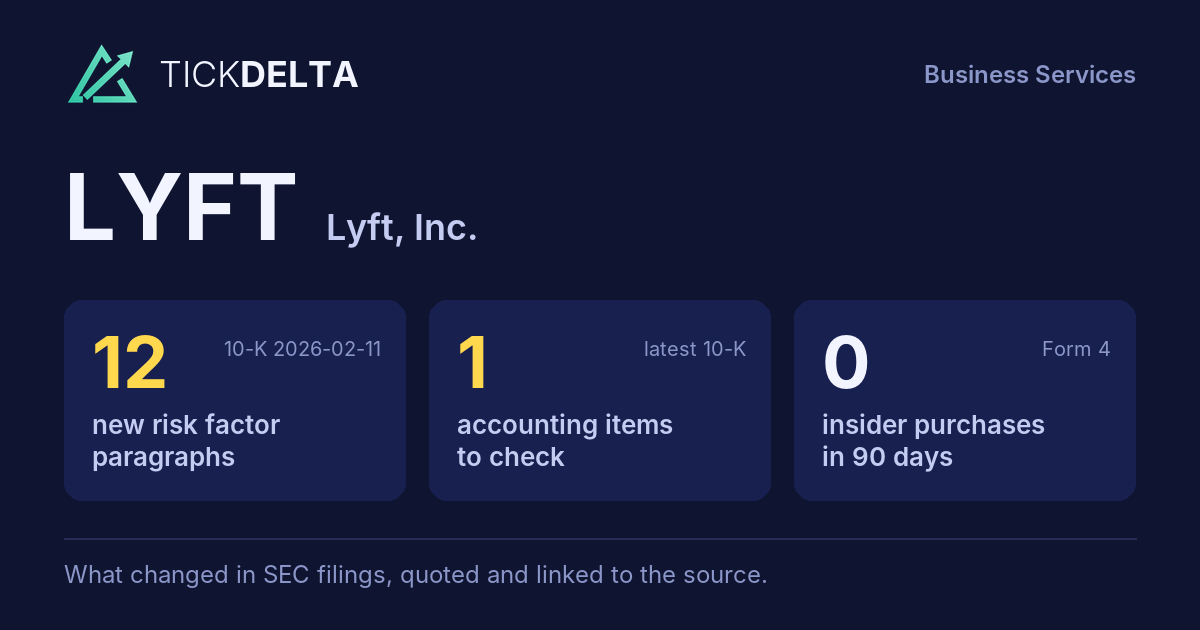
of the text changed · 34,172 words now · 12 new paragraphs, 28 gone
MD&A
42.0%
of the text changed · 8,083 words now · 17 new paragraphs, 25 gone
Legal Proceedings
27.2%
of the text changed · 2,876 words now
Accounting Policies
20.4%
of the text changed · 6,790 words now
10-K 0001628280-26-006960 (Feb 11, 2026) vs 10-K 0001759509-25-000025 (Feb 14, 2025)
Every paragraph, and how much of it changed
One bar per paragraph, in the order of the 10-K. Height and colour show the share of its words not in the closest paragraph a year earlier; the tallest bars are new paragraphs.
Risk Factors
349 paragraphs · 12 new · 145 reworded · 28 gone · 10-K Feb 11, 2026 against Feb 14, 2025
New paragraph
Reworded (5% of its words or more)
Same or nearly
Paragraph 27 · 49% changed
Every version of it
Paragraph 93 · 49% changed
Every version of it
While we continue to maintain that drivers on our platform are not employees in legal and administrative proceedings, our arguments may ultimately be unsuccessful. A determination in, resolution of, or settlement of, any legal proceeding, whether we are party to such legal proceeding or not, that involves our industry, could harm our business, financial condition and results of operations. For example, classifies a determination related to driver classification matters, whether we are party to such determination or not, could cause utilizing a ridesharing platform as an employee, may require us to incur significant expenses or require substantial changes to our business model. revise
Paragraph 251 · 49% changed
Every version of it
Paragraph 317 · 48% changed
Every version of it
Paragraph 311 · 47% changed
Every version of it
A failure by us to comply with the covenants or payment requirements specified in our credit agreement could result in an event of default under the agreement, which would give the lenders the right to terminate their commitments to provide additional loans under our revolving credit facility and to declare all borrowings outstanding, together with accrued and unpaid interest and fees, to be immediately due and payable. If the debt under our revolving credit facility were to be accelerated, we may not have sufficient cash or be able to borrow sufficient funds to refinance the debt or sell sufficient assets to repay the debt, which could immediately adversely affect our business, cash flows, results of operations, and financial condition. Even if we were able to obtain new financing or negotiate an amendment, waiver or consent under our existing credit agreement, it may contain additional restrictions, or not be on commercially reasonable terms or on terms that are acceptable to us.
Paragraph 62 · 47% changed
Every version of it
Paragraph 124 · 47% changed
Every version of it
Paragraph 43 · 50% changed
Every version of it
10-K Feb 14, 2025While we remain focused on operating efficiently, our expenses will likely increase in the future as we develop and launch new offerings and platform features, expand in existing and new markets and continue to invest in our platform and customer engagement. In addition, certain costs, such as insurance and driver pay and incentives have increased or fluctuated as a result of the COVID-19 pandemic, macroeconomic factors and the development and maturation of our business and the rideshare industry, and may continue to do so. We may be unable to accurately predict these costs and our investments may not result in increased revenue or growth in our business. For example, we have incurred and will continue to incur additional costs and expenses associated with the passage of Proposition 22 in California, HB 2076 in Washington, and elsewhere, and implementation of operational changes as part of agreements with the New York and Massachusetts Attorneys General, including providing drivers in these states with new earnings opportunities and protections, including contributions towards on-the-job injury insurance, other benefits and minimum guaranteed earnings. In addition, various jurisdictions have introduced legislation setting high earnings standards and increasing other costs to the business including insurance. Due to various factors, including inflation, we anticipate that our insurance costs will continue to increase and will impact our profitability. Furthermore, we have expanded over time to include more asset-intensive offerings such as our network of Light Vehicles and Flexdrive. These offerings and programs require significant capital investments and recurring costs, including debt payments, maintenance, depreciation, asset life and asset replacement costs, and if we are not able to maintain sufficient levels of utilization of such assets, such offerings are otherwise not successful or we decide to shut down any such offerings, our investments may not generate sufficient returns and our financial condition may be adversely affected. In addition to the above, a determination in, resolution of, or settlement of, any legal proceeding related to driver classification matters may require us to significantly alter our existing business model and operations (including potentially suspending or ceasing operations in impacted jurisdictions), increase our costs and impact our ability to add qualified drivers to our platform and grow our business, which could have an adverse effect on our business, financial condition and results of operations, and our ability to achieve or maintain profitability in the future. Additionally, stock-based compensation expense related to restricted stock units (“RSUs”) and other equity awards is expected to continue to be a significant expense for the foreseeable future, and as of December 31, 2024, we had $160.4 million of unrecognized stock-based compensation expense related to all unvested awards, net of estimated forfeitures, that will be recognized over a weighted-average period of approximately 1.0 year. Any failure to increase our revenue sufficiently to keep pace with our investments and other expenses could prevent us from achieving or maintaining profitability or positive cash flow on a consistent basis. If we are unable to successfully address these risks and challenges as we encounter them, our business, financial condition and results of operations could be adversely affected.
10-K Feb 11, 2026
in the future. Additionally, stock-based compensation expense related to RSUs and other equity awards is expected to continue to be a significant expense for the foreseeable future, and as of December 31, 2025, we had $140.5 million of unrecognized stock-based compensation expense related to all unvested awards, net of estimated forfeitures, that will be recognized over a weighted-average period of approximately 8 months. Any failure to increase our revenue sufficiently to keep pace with our investments and other expenses could prevent us from achieving or maintaining profitability or positive cash flow on a consistent basis. If we are unable to successfully address these risks and challenges as we encounter them, our business, financial condition and results of operations could be adversely affected.
Paragraph 27 · 49% changed
Every version of it
10-K Feb 14, 2025While we have primarily focused on ridesharing since our ridesharing marketplace launched in 2012, our business continues to evolve. We regularly expand our platform features, offerings and services and change our pricing methodologies. Through the acquisition of PBSC Urban Solutions Inc. ("PBSC") in May 2022, we expanded our business to include licensing of certain of our technology and sales of bikes and stations. In recent periods, we have also reevaluated and changed our cost structure and focused our business model. For example, in February 2023, we closed the sale of our vehicle service center business. Our evolving business, industry and markets make it difficult to evaluate our future prospects and the risks and challenges we may encounter. Risks and challenges we have faced and expect to face include our ability to:
10-K Feb 11, 2026
Since our ridesharing marketplace launched in 2012, we have primarily focused on ridesharing, particularly in North America. However, our business and strategy continue to evolve. We regularly expand our platform features, offerings and services and change our pricing methodologies, and we have recently engaged in more significant expansion of our operations to new geographies and new offerings. In July 2025, we expanded our operations beyond North America, entering nine new countries and more than 180 cities through our acquisition of Freenow, a leading European multimodal app with taxi offering at its core. In October 2025, we acquired TBR, a global luxury chauffeuring company that operates in thousands of cities worldwide. Our evolving business, industry and markets make it difficult to evaluate our future prospects and the risks and challenges we may encounter including our ability to:
Paragraph 93 · 49% changed
Every version of it
10-K Feb 14, 2025
A determination in, resolution of, or settlement of, any legal proceeding, whether we are party to such legal proceeding or not, that involves our industry, could harm our business, financial condition and results of operations. For example, a determination related to driver classification matters, whether we are party to such determination or not, could cause us to incur significant expenses or require substantial changes to our business model.
10-K Feb 11, 2026
While we continue to maintain that drivers on our platform are not employees in legal and administrative proceedings, our arguments may ultimately be unsuccessful. A determination in, resolution of, or settlement of, any legal proceeding, whether we are party to such legal proceeding or not, that classifies a driver utilizing a ridesharing platform as an employee, may require us to revise
Paragraph 251 · 49% changed
Every version of it
10-K Feb 14, 2025particularly any new or modified laws or regulations that require enhanced protection of data or new obligations with regard to data retention, transfer or disclosure, could greatly increase the cost of providing our offerings, require significant changes to our operations and our data processing practices and policies, may require us to incur additional compliance-related costs and expenses, and may even prevent us from providing certain offerings in jurisdictions in which we currently operate and in which we may operate in the future.
10-K Feb 11, 2026
We receive, transmit, store and otherwise process a large volume of personal information and other data relating to users on our platform, as well as other individuals such as our employees. Numerous local, municipal, state, federal and international laws and regulations address privacy, data protection and the collection, storing, sharing, use, disclosure and other processing of certain data. The scope of these laws and regulations may continually change, through new legislation, amendments to existing legislation and changes in enforcement, and may be inconsistent from one jurisdiction to another. New or modified laws or regulations relating to privacy, data protection or information security, particularly such laws or regulations that require enhanced protection of data or new data retention, transfer or disclosure obligations, could greatly increase the cost of providing our offerings, require significant changes to our operations and our data processing practices and policies, and require us to incur additional compliance-related costs and expenses, and may prevent us from providing certain offerings in certain jurisdictions. In addition, our Lyft Ads efforts provide third-party promotional advertisements, including those that may be personalized to users. Current law and regulations, and potential changes in the law or regulatory landscape, limit and/or prohibit activities, and could further limit and/or prohibit activities in regard to any current and new offerings we undertake.
Paragraph 317 · 48% changed
Every version of it
10-K Feb 14, 2025The Tax Cuts and Jobs Act of 2017, or the Tax Act, as modified by the Coronavirus Aid, Relief, and Economic Security (“CARES”) Act, among other things, limited the use of NOLs arising in tax years beginning after December 31, 2017 to 80% of taxable income for tax years beginning after December 31, 2020. Not all states conform to the Tax Act or CARES Act. In future years, if and when a net deferred tax asset is recognized related to our NOLs, these changes may significantly impact our valuation allowance assessments for NOLs generated after December 31, 2017.
10-K Feb 11, 2026
Under current law, the use of federal NOLs arising in tax years beginning after December 31, 2017 is limited to 80% of taxable income. Not all states conform to this provision. In future years, this provision may limit the usability of our NOLs generated after December 31, 2017.
Paragraph 311 · 47% changed
Every version of it
10-K Feb 14, 2025
A failure by us to comply with the covenants or payment requirements specified in our credit agreement could result in an event of default under the agreement, which would give the lenders the right to terminate their commitments to provide additional loans under our revolving credit facility and to declare all borrowings outstanding, together with accrued and unpaid interest and fees, to be immediately due and payable. If the debt under our revolving credit facility were to be accelerated, we may not have sufficient cash or be able to borrow sufficient funds to refinance the debt or sell sufficient assets to repay the debt, which could immediately adversely affect our business, cash flows, results of operations, and financial condition. Even if we were able to obtain new financing or negotiate an amendment, waiver or consent under our existing credit agreement, it may contain additional restrictions, or not be on commercially reasonable terms or on terms that are acceptable to us.
10-K Feb 11, 2026
A failure by us to comply with the covenants or payment requirements specified in our credit agreement could result in an event of default under the agreement, which would give the lenders the right to terminate their commitments to provide additional
Paragraph 62 · 47% changed
Every version of it
10-K Feb 14, 2025The amount of one or more auto-related claims or operations-related claims has exceeded and could continue to exceed our applicable aggregate coverage limits, for which we have borne and could continue to bear a portion of the excess, in addition to amounts already incurred in connection with deductibles, self-insured retentions or otherwise paid by our insurance subsidiary. Insurance providers have raised premiums and deductibles for many types of coverages and for a variety of commercial risks and are likely to do so in the future. As a result, our insurance and claims expenses could increase, or we may decide to raise our deductibles or self-insured retentions when our policies are renewed or replaced to manage pricing pressure. Our business, financial condition and results of operations could be adversely affected if (i) cost per claim, premiums or the number of claims significantly exceeds our historical experience, (ii) we experience a claim in excess of our coverage limits, (iii) our insurance providers fail to pay on our insurance claims, (iv) we experience a claim for which coverage is not provided, (v) the number of claims and average claim cost under our deductibles or self-insured retentions differs from historic averages, (vi) an insurance policy is canceled or non-renewed, or (vii) other insurance providers for drivers on our platform become insolvent.
10-K Feb 11, 2026
insurance claims, (iv) we experience a claim for which coverage is not provided, (v) the number of claims and average claim cost under our deductibles or self-insured retentions differs from historic averages, (vi) an insurance policy is canceled or non-renewed, or (vii) other insurance providers for drivers on our platform become insolvent.
Paragraph 124 · 47% changed
Every version of it
10-K Feb 14, 2025Changes in U.S. and foreign tax laws could have a material adverse effect on our business, cash flow, results of operations or financial conditions.
10-K Feb 11, 2026
large deductible or co-insurance requirements, could have an adverse effect on our reputation, brand, business, financial condition and results of operations.
MD&A
119 paragraphs · 17 new · 64 reworded · 25 gone · 10-K Feb 11, 2026 against Feb 14, 2025
New paragraph
Reworded (5% of its words or more)
Same or nearly
Paragraph 27 · 49% changed
Sales and marketing expenses primarily consist of rider incentives, personnel-related compensation costs, certain driver incentives for referring new drivers or riders, incentives, advertising expenses, rider refunds refunds, amortization of certain intangible assets and marketing partnerships with third parties. Sales and marketing costs are expensed as incurred. Incentive programs are intended to improve our marketplace. In the second quarter of 2025, we determined that certain components should be excluded from our disclosure of incentives. Accordingly, prior period amounts disclosed have been changed to conform to current period presentation.
Paragraph 107 · 47% changed
We recognize revenue upon completion of a ride as the single performance obligation is satisfied and we have the right to receive payment for the services rendered upon the completion of the ride. We evaluate the presentation of revenue on a gross versus net basis based on whether we act as a principal by controlling the transportation service provided to the rider or whether we act as an agent by arranging for third parties to provide the service to the rider. We facilitate the provision of a transportation service by a driver to a rider (the driver’s customer) Judgment is required in order for the driver to fulfill their contractual promise to the rider. The driver fulfills their promise to provide a transportation service to their customer through use of the Lyft Platform. While we facilitate setting the price for transportation services, the drivers this assessment, and riders have the discretion in accepting the transaction price through the platform. We do not control the transportation services being provided to the rider nor do we have inventory risk related to the transportation services. As a result, most cases, we act as an agent in facilitating the ability for of a driver to provide a transportation service to a rider. Revenue generated in these cases is reported on a net basis, reflecting the service fees and commissions owed to us from the drivers as revenue, and not the gross amount collected from the rider. In certain markets, we act as a principal for transportation services as we control the services provided. Revenue generated in these markets is reported on a gross basis reflecting the gross amount collected from the rider, with payments to the drivers recorded within cost of revenue.
Paragraph 21 · 45% changed
Revenue consists of revenue recognized from fees paid by drivers for use of our Lyft Platform offerings, and gross amounts collected from riders in certain markets where we control the transportation services provided, Concierge platform fees from organizations that use our Concierge offering, subscription fees paid by riders to access transportation options through the Lyft Platform, revenue from bikes and bike station hardware and software sales, revenue from licensing and data access agreements and revenue from arrangements to provide advertising services to third parties that are interested in reaching users of our platform. Revenue derived from these offerings is recognized in accordance with ASC 606 as described in the Critical Accounting Policies and Estimates below and in Note 2 of the notes to our consolidated financial statements.
Paragraph 11 · 44% changed
We define Active Riders as all unique riders who take have taken at least one ride during a quarter where the Lyft Platform processes the transaction. An Active Rider is identified by a unique phone number. If a rider has two mobile phone numbers or changed their phone number and that rider took rides using both phone numbers during the quarter, that person would count as two Active Riders. If a rider has a personal and business profile tied to the same mobile phone number, that person would be considered a single Active Rider. quarter. If a ride has been is requested by an another organization using our Concierge offering or person for the benefit of a rider, we exclude this that rider is only included in the calculation of Active Riders unless if the ride is accessible in that the rider’s Lyft App. apps.
Paragraph 98 · 42% changed
Paragraph 100 · 41% changed
The following table summarizes our contractual obligations and commitments as of December 31, 2024 2025 (in millions): Payments Due by Period Total(2) 12 months or less Thereafter Operating lease commitments $ 228.0 $ 35.3 $ 192.7 Financing lease commitments 94.2 35.3 58.9 Long-term debt, including current maturities(1) 995.0 429.1 566.0 Other noncancelable agreements 109.3 10.2 99.1
Paragraph 20 · 41% changed
The improvements in net income (loss) as a percentage of Gross Bookings and Adjusted EBITDA margin (calculated as a percentage of Gross Bookings) in the year ended December 31, 2024 2025 as compared to the year ended December 31, 2023 2024 were due primarily to Rides growth due to competitive pricing a $2.9 billion benefit from the release of our valuation allowance of U.S. federal and improved marketplace health. Additionally, our net income (loss) certain state deferred tax assets in the year ended December 31, 2024 included a $29.6 million gain related to a lease termination which positively impacted net income (loss) as a percentage fourth quarter of Gross Bookings in the year ended December 31, 2024, but did not have a similar impact in 2023. 2025.
Paragraph 117 · 39% changed
Paragraph 27 · 49% changed
10-K Feb 14, 2025
Sales and marketing expenses primarily consist of rider incentives, personnel-related compensation costs, driver incentives for referring new drivers or riders, advertising expenses, rider refunds and marketing partnerships with third parties. Sales and marketing costs are expensed as incurred.
10-K Feb 11, 2026
Sales and marketing expenses primarily consist of rider incentives, personnel-related compensation costs, certain driver incentives, advertising expenses, rider refunds, amortization of certain intangible assets and marketing partnerships with third parties. Sales and marketing costs are expensed as incurred. Incentive programs are intended to improve our marketplace. In the second quarter of 2025, we determined that certain components should be excluded from our disclosure of incentives. Accordingly, prior period amounts disclosed have been changed to conform to current period presentation.
Paragraph 107 · 47% changed
10-K Feb 14, 2025
We evaluate the presentation of revenue on a gross versus net basis based on whether we act as a principal by controlling the transportation service provided to the rider or whether we act as an agent by arranging for third parties to provide the service to the rider. We facilitate the provision of a transportation service by a driver to a rider (the driver’s customer) in order for the driver to fulfill their contractual promise to the rider. The driver fulfills their promise to provide a transportation service to their customer through use of the Lyft Platform. While we facilitate setting the price for transportation services, the drivers and riders have the discretion in accepting the transaction price through the platform. We do not control the transportation services being provided to the rider nor do we have inventory risk related to the transportation services. As a result, we act as an agent in facilitating the ability for a driver to provide a transportation service to a rider.
10-K Feb 11, 2026
We recognize revenue upon completion of a ride as the single performance obligation is satisfied and we have the right to receive payment for the services rendered upon the completion of the ride. We evaluate the presentation of revenue on a gross versus net basis based on whether we act as a principal by controlling the transportation service provided to the rider or whether we act as an agent by arranging for third parties to provide the service to the rider. Judgment is required in this assessment, and in most cases, we act as an agent in facilitating the ability of a driver to provide a transportation service to a rider. Revenue generated in these cases is reported on a net basis, reflecting the service fees and commissions owed to us from the drivers as revenue, and not the gross amount collected from the rider. In certain markets, we act as a principal for transportation services as we control the services provided. Revenue generated in these markets is reported on a gross basis reflecting the gross amount collected from the rider, with payments to the drivers recorded within cost of revenue.
Paragraph 21 · 45% changed
10-K Feb 14, 2025
Revenue consists of revenue recognized from fees paid by drivers for use of our Lyft Platform offerings, Concierge platform fees from organizations that use our Concierge offering, subscription fees paid by riders to access transportation options through the Lyft Platform, revenue from bikes and bike station hardware and software sales, revenue from licensing and data access agreements and revenue from arrangements to provide advertising services to third parties that are interested in reaching users of our platform. Revenue derived from these offerings is recognized in accordance with ASC 606 as described in the Critical Accounting Policies and Estimates below and in Note 2 of the notes to our consolidated financial statements.
10-K Feb 11, 2026
Revenue consists of revenue recognized from fees paid by drivers for use of our Lyft Platform offerings, and gross amounts collected from riders in certain markets where we control the transportation services provided, Concierge platform fees from organizations that use our Concierge offering, subscription fees paid by riders to access transportation options through the Lyft
Paragraph 11 · 44% changed
10-K Feb 14, 2025
We define Active Riders as all riders who take at least one ride during a quarter where the Lyft Platform processes the transaction. An Active Rider is identified by a unique phone number. If a rider has two mobile phone numbers or changed their phone number and that rider took rides using both phone numbers during the quarter, that person would count as two Active Riders. If a rider has a personal and business profile tied to the same mobile phone number, that person would be considered a single Active Rider. If a ride has been requested by an organization using our Concierge offering for the benefit of a rider, we exclude this rider in the calculation of Active Riders unless the ride is accessible in that rider’s Lyft App.
10-K Feb 11, 2026
We define Active Riders as all unique riders who have taken at least one ride during the quarter. If a ride is requested by another organization or person for the benefit of a rider, that rider is only included in the calculation of Active Riders if the ride is accessible in the rider’s Lyft apps.
Paragraph 98 · 42% changed
10-K Feb 14, 2025EBITDA and Adjusted Net Income (Loss) amounts. Refer to Note 15 “Restructuring” to the consolidated financial statements for information regarding these restructuring plans.
10-K Feb 11, 2026
12 “Common Stock and Employee Stock Plans” and Note 16 “Subsequent Events” to the consolidated financial statements for information regarding these programs.
Paragraph 100 · 41% changed
10-K Feb 14, 2025
The following table summarizes our contractual obligations and commitments as of December 31, 2024 (in millions): Payments Due by Period Total(2) 12 months or less Thereafter Operating lease commitments $ 228.0 $ 35.3 $ 192.7 Financing lease commitments 94.2 35.3 58.9 Long-term debt, including current maturities(1) 995.0 429.1 566.0 Other noncancelable agreements 109.3 10.2 99.1
10-K Feb 11, 2026
The following table summarizes our contractual obligations and commitments as of December 31, 2025 (in millions):
Paragraph 20 · 41% changed
10-K Feb 14, 2025
The improvements in net income (loss) as a percentage of Gross Bookings and Adjusted EBITDA margin (calculated as a percentage of Gross Bookings) in the year ended December 31, 2024 as compared to the year ended December 31, 2023 were due primarily to Rides growth due to competitive pricing and improved marketplace health. Additionally, our net income (loss) in the year ended December 31, 2024 included a $29.6 million gain related to a lease termination which positively impacted net income (loss) as a percentage of Gross Bookings in the year ended December 31, 2024, but did not have a similar impact in 2023.
10-K Feb 11, 2026
The improvements in net income as a percentage of Gross Bookings and Adjusted EBITDA margin (calculated as a percentage of Gross Bookings) in the year ended December 31, 2025 as compared to the year ended December 31, 2024 were due primarily to a $2.9 billion benefit from the release of our valuation allowance of U.S. federal and certain state deferred tax assets in fourth quarter of 2025.
Paragraph 117 · 39% changed
10-K Feb 14, 2025The Company records a valuation allowance to reduce its deferred tax assets to the net amount that it believes is more-likely-than-not to be realized. We consider all available evidence, both positive and negative, including historical levels of income, expectations and risks associated with estimates of future taxable income and ongoing tax planning strategies in assessing the need for a valuation allowance. We have a valuation allowance for our U.S. deferred tax assets, including federal and state net operating loss
10-K Feb 11, 2026
We record a valuation allowance to reduce deferred tax assets to the net amount that we believe is more-likely-than-not to be realized. In assessing the need for a valuation allowance, we consider all available evidence, both positive and negative, including historical profitability, expectations and risks associated with future taxable income, and ongoing tax planning strategies. We weigh positive and negative evidence based on the extent to which it can be objectively verified. The assessment of the valuation allowance requires significant management judgment regarding future profitability, which may change due to many factors, including future market conditions and our ability to successfully execute business plans. Changes in our assessment of the realizability of deferred tax assets could result in adjustments to the valuation allowance and corresponding impacts to our income tax provision in future periods.
A paragraph is matched with the one last year that shares the most of its words; under half in common makes it new. The paragraphs shown are the 8 reworded the most in each section.
The paragraph that changed most in each section
The redline
Marked against last year's 10-K: cut words struck through, new words highlighted.
MD&A414 words changed in this paragraph; it is 32% similar to last year's version.
We plan to continue to focus on and actively manage our cash balances and liquidity, capital expenditures, working capital and operating expenses. In particular, we continue to actively monitor the impact of the uncertain macroeconomic environment, including credit markets, inflation and interest rates, and have made adjustments to our expenses and cash flow. Our future capital requirements will depend on many factors, including, but not limited to to, our growth, the effectiveness of our efforts to align our expenses with our current operating needs and short-term commitments, our ability to attract and retain drivers and riders on our platform, the continuing market acceptance of our offerings, the timing and extent of spending to support our efforts to develop our platform, actual insurance payments for which we have made reserves, and the expansion of sales and marketing activities, as well as satisfaction of our obligations with respect to any indebtedness. Further, we may See the section titled “Risk Factors” including the subsection titled “Risk Factors—Risks Related to Financing and Transactional Factors” included in the future enter into arrangements to acquire or invest in businesses, products, services and technologies. For example, we intend to invest further in EVs in order to achieve compliance with the California Clean Miles Standard which sets the target that 90% Part 1, Item 1A of rideshare miles in California must be in EVs by the end this Annual Report on Form 10-K for additional discussion of 2030; the Massachusetts’ Climate Bill; New York City's goal to get to 100% of rideshare rides in EVs or wheelchair accessible vehicles by 2030, and the City of Toronto’s push to bring the industry to 100% electric by 2030. In addition, in February 2025, we announced risks that our board of directors had authorized a program for the repurchase of up to $500 million of our Class A common stock. Repurchases may be made from time to time through open market purchases or through privately negotiated transactions subject to market conditions, applicable legal requirements and other relevant factors. Refer to Note 17 “Subsequent Events” to the consolidated financial statements for additional information regarding this repurchase program. From time to time, we have and we may in the future seek additional equity or debt financing to fund capital expenditures, strategic initiatives or investments and our ongoing operations, or to refinance our existing or future indebtedness. In the event that we decide, or are required, to seek additional financing from outside sources, we may not be able to raise it on terms acceptable to us or at all. The terms of any additional financings or refinancings may place limits on our financial and operating flexibility. If we raise additional funds through further issuances of equity or equity-linked securities, our existing stockholders could suffer dilution in their percentage ownership of us, and any new securities we issue could have rights, preferences and privileges senior to those of holders of our common stock. If we are unable to raise additional capital when desired, our business, financial condition and results of operations could be adversely affected. business faces.
Source: Item 7, 10-K 0001628280-26-006960 vs Item 7, 10-K 0001759509-25-000025
Risk Factors296 words changed in this paragraph; it is 66% similar to last year's version.
Our success is dependent in part upon protecting our intellectual property rights and technology (such as code, information, data, processes and other forms of information, knowhow and technology), or “intellectual property,” and as we grow, we expect to continue to develop intellectual property that is important for our existing or future business. We rely on a combination of patents, copyrights, trademarks, service marks, trade dress, trade secret laws and contractual restrictions to establish and protect our intellectual property. However, the steps we take to protect our intellectual property may not be sufficient or effective, and may vary by jurisdiction. Even if we do detect violations, we may need to engage in litigation to enforce our rights. Any enforcement efforts we undertake, including litigation, could be time-consuming and expensive and could divert management attention. While we take precautions designed to protect our intellectual property, it may still be possible for competitors and other unauthorized third parties to copy our technology, reverse engineer our data and use our proprietary information to create or enhance competing solutions and services, which could adversely affect our position in our rapidly evolving and highly competitive industry. Some license provisions that protect against unauthorized use, copying, transfer and disclosure of our technology may be unenforceable under the laws of certain jurisdictions and foreign countries. The laws of some countries do not provide the same level of protection of our intellectual property as do the laws of the United States U.S. and effective intellectual property protections may not be available or may be limited in foreign countries. Our domestic and international intellectual property protection and enforcement strategy is influenced by many considerations including costs, where we have business operations, where we might have business operations in the future, legal protections available in a specific jurisdiction, and/or other strategic considerations. As such, we do not have identical or analogous intellectual property protection in all jurisdictions, which could risk freedom to operate in certain jurisdictions if we were to expand. jurisdictions. As we expand our international activities, our exposure to unauthorized use, copying, transfer and disclosure of proprietary information will likely increase. We may need to expend additional resources to protect, enforce or defend our intellectual property rights domestically or internationally, which could impair our business or adversely affect our domestic or international operations. We enter into confidentiality and invention assignment agreements with our employees and consultants and enter into confidentiality agreements with our third-party providers and strategic partners. We cannot assure you that these agreements will be effective in controlling access to, and use and distribution of, our platform and proprietary information. Further, these agreements may not prevent our competitors from independently developing technologies that are substantially equivalent or superior to our offerings. Competitors and other third parties may also attempt to access, aggregate, and/or reverse engineer our data which would compromise our trade secrets and other rights. We also enter into strategic partnerships, joint development and other similar agreements with third parties where intellectual property arising from such partnerships may be jointly-owned or may be transferred or licensed to the counterparty. Such arrangements may limit our ability to protect, maintain, enforce or commercialize such intellectual property rights, including requiring agreement with or payment to our joint development partners before protecting, maintaining, licensing or initiating enforcement of such intellectual property rights, and may allow such joint development partners to register, maintain, enforce or license such intellectual property rights in a manner that may affect the value of the jointly-owned intellectual property or our ability to compete in the market.
Source: Item 1A, 10-K 0001628280-26-006960 vs Item 1A, 10-K 0001759509-25-000025
Legal Proceedings151 words changed in this paragraph; it is 50% similar to last year's version.
In 2018, the New Jersey Department of Labor & Workforce Development (“NJDOL”) opened an audit reviewing whether drivers were independent contractors or employees for purposes of determining whether unemployment insurance regulations apply from for 2014 through March 31, 2018. 2017; in 2022, the NJDOL opened a similar audit for 2019 through 2021. The NJDOL issued an assessment for 2014 through 2017 on June 4, 2019 2019, and subsequently issued an updated assessment assessments for this time period on March 31, 2021. On 2021 and August 2, 2024, the NJDOL issued a revised assessment, which is based upon a different methodology. The assessment was calculated through April 30, 2019, but only calculated the alleged contributions, penalties, and interests owed from 2014 through 2017. 2024. The Company filed a petition to challenge the assessment, assessments and is awaiting a hearing. The Company has also submitted payment for later notified the principal revised amount of NJDOL that it would pay the assessment to stop interest from accruing on this amount. While under protest; as of September 30, 2025, the assessment was paid under protest. The audit for 2019 through 2021 remains open. The ultimate resolution of this matter is uncertain, the Company recorded an accrual for this matter reflected within accrued uncertain and other current liabilities on the consolidated balance sheet as any possible loss or range of December 31, 2024. loss cannot be reasonably estimated.
Source: Item 3, via Note 10 – Commitments and Contingencies, 10-K 0001628280-26-006960 vs Item 3, via Note 10 – Commitments and Contingencies, 10-K 0001759509-25-000025
Accounting Policies129 words changed in this paragraph; it is 33% similar to last year's version.
In November 2023, September 2025, the FASB issued ASU No. 2023-07, “Segment Reporting (Topic 280): 2025-06, “Intangibles - Goodwill and Other - Internal-Use Software (Subtopic 350-40): Targeted Improvements to Reportable Segment Disclosures”, the Accounting for Internal-Use Software”, which amends updates the capitalization criteria for internal-use software development costs and enhances the disclosure requirements for reportable segments. All disclosure requirements under this removes references to software development stages. This standard will also be required for public entities with a single reportable segment. This new standard became is effective for fiscal years annual periods beginning after December 15, 2023 2027, and for interim periods within fiscal years beginning after December 15, 2024. those annual reporting periods. Early adoption is permitted. The standard should be applied using a prospective, retrospective, or a modified transition approach. The Company adopted is currently evaluating the impact of this standard in the fourth quarter of 2024, which did not have a material impact on the consolidated financial statements and related disclosures. statements.
Source: Item 8, Note 2 – Summary of Significant Accounting Policies, 10-K 0001628280-26-006960 vs Item 8, Note 2 – Summary of Significant Accounting Policies, 10-K 0001759509-25-000025
Sentences and paragraphs added, removed or reworded
Every change, by type
Sentences and paragraphs of LYFT's Risk Factors and MD&A, 10-K Feb 11, 2026 against 10-K Feb 14, 2025. Each links to the text at sec.gov.
Quiet changes are sentences kept from last year with one to four words changed, at least one of them a hedge, a modal or a qualifier (may, could, will, not, significant, material…). A year or date rolling forward is not counted.
The full word list
adverse, adversely, all, although, anticipate, anticipates, any, approximately, believe, believes, can, cannot, certain, could, expect, expects, generally, however, if, intend, intends, largely, likely, many, material, materially, may, might, most, must, never, no, not, possible, primarily, probable, should, significant, significantly, some, substantial, substantially, unlikely, will, would
AddedRisk Factors
•our share repurchase programs, including our ability to realize anticipated long-term stockholder value;
Read it in 10-K Feb 11, 2026 at sec.gov
AddedRisk Factors
Our independently managed subsidiary, Flexdrive operates a portion of the Express Drive vehicle rental program for drivers and sources its fleet from a range of auto manufacturers. In addition, we have established environmental programs that may limit the range of auto manufacturers or vehicles that Flexdrive can source or purchase from. To the extent that any of these auto manufacturers
Read it in 10-K Feb 11, 2026 at sec.gov
AddedRisk Factors
•our failure to increase the number of riders who engage with Lyft Ads or changes in viewer demographics that impact advertiser spend;
Read it in 10-K Feb 11, 2026 at sec.gov
AddedRisk Factors
We are currently subject to some foreign currency exchange risk because our international revenue, as well as costs and expenses denominated in foreign currencies, expose us to the risk of fluctuations in foreign currency exchange rates against the U.S. dollar. Freenow conducts all of its operations outside of the U.S. through its German parent company and TBR conducts a majority of its operations, including its U.S. business, through its United Kingdom (the “U.K.”) parent company. Freenow and TBR each have subsidiaries or affiliates, which also operate in their respective local currencies. As a result, our international operations will account for a more significant portion of our overall operations, and our exposure to fluctuations in foreign currency exchange rates will increase. Because our consolidated financial statements will continue to be presented in U.S. dollars, the local currencies will be translated into U.S. dollars at the applicable exchange rates for inclusion in our consolidated financial statements, thereby increasing the foreign exchange risk.
Read it in 10-K Feb 11, 2026 at sec.gov
AddedRisk Factors
We may not realize the anticipated long-term stockholder value of our share repurchase programs, and any failure to repurchase our Class A common stock after we have announced our intention to do so may negatively impact our stock price.
Read it in 10-K Feb 11, 2026 at sec.gov
AddedRisk Factors
In February 2026, we authorized a new share repurchase program for the repurchase of up to $1.0 billion of the Company’s Class A common stock, in addition to amounts remaining available under our existing repurchase program under which we were authorized to repurchase a total of $750 million of the Company’s Class A common stock. Under existing or any future share repurchase programs, we may make share repurchases through a variety of methods, including open share market purchases or privately negotiated transactions, in accordance with applicable federal securities laws. Our share repurchase programs generally have no time limit, do not obligate us to repurchase any specific number of shares, and may be suspended at any time at our discretion and without prior notice. The timing and amount of repurchases, if any, will be subject to liquidity, stock price, business and market conditions, compliance with applicable legal requirements, such as Delaware surplus and solvency tests, management discretion, and other relevant factors. Any failure to repurchase stock after we have announced our intention to do so may negatively impact our reputation and investor confidence in us and may negatively impact our stock price. The existence of a share repurchase program could cause our stock price to be higher than it otherwise would be and could potentially reduce the market liquidity for our stock. Although these programs are intended to enhance long-term stockholder value, there is no assurance they will do so because the
Read it in 10-K Feb 11, 2026 at sec.gov
AddedRisk Factors
market price of our Class A common stock may decline below the levels at which we repurchased shares and short-term stock price fluctuations could reduce the effectiveness of our repurchase programs. Repurchasing our Class A common stock will reduce the amount of cash we have available to fund working capital, capital expenditures, strategic acquisitions or business opportunities, and other general corporate requirements, and we may fail to realize the anticipated long-term stockholder value of these share repurchase programs.
Read it in 10-K Feb 11, 2026 at sec.gov
AddedRisk Factors
In addition, with the breadth of our geographic scope, the classification of our drivers that utilize our platform as independent contractors may be subject to challenge in non-US jurisdictions, especially following our recent acquisitions. For example, the EU’s Platform Work Directive, which entered into force in December 2024, requires EU member states to transpose its requirements to their national laws, including enacting new national laws for determining worker classification of platform workers, and may involve differing implementation by the various member states. Such EU-wide legislative reforms may adversely affect our ability to operate our current independent contractor model within the European Economic Area.
Read it in 10-K Feb 11, 2026 at sec.gov
Show the other 67
AddedRisk Factors
Further, as we continue to expand our offerings and user base, and as we expand into new geographies, such as in connection with our acquisition of Freenow, we will become subject to additional laws and regulations relating to privacy, data protection, and information security. For example, Freenow operates in the EU and in the U.K. Examples of laws applicable to Freenow in the EU and the U.K. are the EU General Data Protection Regulation and the U.K.’s Data Protection Act and General Data Protection Regulation, which apply to the processing of personal data in the EU and U.K., respectively. Each of these jurisdictions’ data protection regimes provides for substantial obligations applicable to the collection, use, transfer (including to the U.S.) and the processing of other personal data and imposes significant penalties for noncompliance. The EU also has adopted numerous laws and regulations relating to cybersecurity that may apply to certain Lyft subsidiaries. Expansion of our offerings may include partnerships and data sharing or transfers that could be subject to Title 28 of the U.S. Code of Federal Regulations Part 202, which prohibits or restricts certain transactions that involve bulk transfer of certain U.S. data to countries of concern and imposes significant penalties for noncompliance.
Read it in 10-K Feb 11, 2026 at sec.gov
AddedRisk Factors
The application of indirect taxes, such as payroll tax, sales and use tax, value-added tax, goods and services tax, business tax and gross receipts tax, to businesses like ours and to drivers is a complex and evolving issue. Significant judgment is required on an
Read it in 10-K Feb 11, 2026 at sec.gov
AddedRisk Factors
Additionally, we are or may become subject to emerging climate-related policies such as California’s Clean Miles Standard and Incentive Program that imposes certain greenhouse gas and EV requirements on the TNC industry, and California climate-related reporting requirements such as California’s Senate Bill 253 (SB 253), Senate Bill 261 (SB 261) and Senate Bill 219 (SB 219). Massachusetts, New York City and Toronto are developing or have developed rules to address the environmental impact of rideshare. In the EU, the Corporate Sustainability Reporting Directive (“CSRD”), which was adopted in 2022 and significantly amended in 2025, imposes requirements on certain companies to disclose information regarding certain environmental, social and governance practices. While we have assessed that we will not be in scope for CSRD in 2026, we will continue to monitor and evaluate as our business in the EU grows. Further, other jurisdictions are likely to consider similar rules, regulations and/or reporting requirements in the future. Efforts to comply with these policies and reporting requirements are likely to increase our costs, including costs related to reporting, the implementation of extensive internal controls processes and procedures regarding matters that have not been subject to such levels of controls in the past, and impose increased oversight obligations on our management and board of directors, as well as require us to hire third party experts. Any failure to meet the requirements could impact our ability to operate in the applicable jurisdiction. Failure to comply could also harm our reputation and brand.
Read it in 10-K Feb 11, 2026 at sec.gov
AddedRisk Factors
As part of our long-term strategies to address climate risks and climate regulation, which we believe includes market shifts toward EVs and lower carbon-based business models, we often advocate for EV programs that can be efficiently accessed by drivers
Read it in 10-K Feb 11, 2026 at sec.gov
RemovedRisk Factors
RemovedRisk Factors
RemovedRisk Factors
RemovedRisk Factors
RemovedRisk Factors
RemovedRisk Factors
RemovedRisk Factors
RemovedRisk Factors
RemovedRisk Factors
RemovedRisk Factors
RemovedRisk Factors
RemovedRisk Factors
RewordedRisk Factors
Our business, financial condition and results of operations could be adversely affected if (i) cost per claim, premiums or the number of claims significantly exceeds our historical experience, (ii) we experience a claim in excess of our coverage limits, (iii) our insurance providers fail to pay on our insurance claims, (iv) we experience a claim for which coverage is not provided, (v) the number of claims and average claim cost under our deductibles or self-insured retentions differs from historic averages, (vi) an insurance policy is canceled or non-renewed, or (vii) other insurance providers for drivers on our platform become insolvent.
Read it in 10-K Feb 11, 2026 at sec.gov
RewordedRisk Factors
RewordedRisk Factors
Additionally, we have invested and from time to time we will continue to invest resources in an attempt to influence or challenge legislation and other regulatory matters pertinent to our operations, particularly those related to the ridesharing industry, which may negatively impact the legal and administrative proceedings challenging the classification of drivers on our platform as independent contractors if we are unsuccessful or lead to additional costs and expenses even if we are successful.
Read it in 10-K Feb 11, 2026 at sec.gov
RewordedRisk Factors
In connection with the issuance of our 2029 Notes and 2030 Notes, we entered into the capped call transactions (the “Capped Calls”) with certain of the initial purchasers of the 2025 Notes or their respective affiliates for the 2025 Notes, “2029 Capped Calls” and “2030 Capped Calls”, respectively) with certain financial institutions for the 2029 Notes (the “option counterparties”).
Read it in 10-K Feb 11, 2026 at sec.gov
RewordedRisk Factors
For example, the United States U.S. passed the Inflation Reduction Act in 2022, which introduced a 1% excise tax on stock buybacks that could impact has impacted us in connection with a settlement the settlements of the capped call transactions. transactions and has increased the cost to us of share repurchases, which could reduce the number of shares we repurchase.
Read it in 10-K Feb 11, 2026 at sec.gov
RewordedRisk Factors
RewordedRisk Factors
In recent periods, the automotive insurance industry has experienced rising costs due to, among other things, inflation, supply chain challenges, insurance fraud, and the cost of medical care, which has harmed our business, financial condition and results of operations, including through increased insurance renewal costs, and we expect it to continue to negatively impact the automotive insurance industry and our business, financial condition and results of operations.
Read it in 10-K Feb 11, 2026 at sec.gov
RewordedRisk Factors
Additionally, Shared Rides, a limited-scope offering for business-to-business partnerships in select markets, as well as for rides originating at airports in select markets (in addition to rides to and from the airport in one market) as part of a pilot offering, enables unrelated parties traveling along similar routes to generate a discounted fare at the cost of possibly longer travel times.
Read it in 10-K Feb 11, 2026 at sec.gov
RewordedRisk Factors
If we raise additional funds through the issuance of equity, equity-linked or debt securities, such as our 1.50% convertible senior notes due 2025 (the “2025 Notes”) and 0.625% convertible senior notes due 2029 (the “2029 Notes” together with the 2025 Notes, the “Notes”), Notes”) and convertible senior notes due 2030 (the “2030 Notes”), those securities may have rights, preferences or privileges senior to those of our Class A common stock, and our existing stockholders may experience dilution.
Read it in 10-K Feb 11, 2026 at sec.gov
RewordedRisk Factors
A determination in, resolution of, or settlement of, any legal proceeding, whether we are party to such legal proceeding or not, that involves our industry, could harm our business, financial condition and results of operations. classifies a driver utilizing a ridesharing platform as an employee, may require us to revise
Read it in 10-K Feb 11, 2026 at sec.gov
RewordedRisk Factors
AWS’ facilities are vulnerable to damage or interruption from natural disasters, cyberattacks, terrorist attacks, power outages and similar events or acts of misconduct. misconduct, and AWS has experienced, and caused their users to experience, service outages and interruptions for a variety of reasons which has impacted us in the past.
Read it in 10-K Feb 11, 2026 at sec.gov
RewordedRisk Factors
Our main ridesharing competitor in the United States U.S. and Canada is Uber, and in Europe, our main competitors for app-based intermediation services for taxi and private hire vehicles are Uber and Bolt, though we also compete with other transportation network companies TNCs and taxicab and livery companies, as well as traditional automotive manufacturers and technology companies.
Read it in 10-K Feb 11, 2026 at sec.gov
Quiet changesRisk Factors
If drivers are unsatisfied with certain of our partners, including our third-party vehicle rental partners, our ability to attract and retain qualified drivers and to increase their utilization of our platform could be adversely affected.
Read it in 10-K Feb 11, 2026 at sec.gov
Quiet changesRisk Factors
Any of the foregoing risks could adversely affect harm our business, financial condition and results of operations.
Read it in 10-K Feb 11, 2026 at sec.gov
Quiet changesRisk Factors
Any of the foregoing risks could harm adversely affect our business, financial condition and results of operations.
Read it in 10-K Feb 11, 2026 at sec.gov
AddedMD&A
(1)Net income for the year ended December 31, 2025 includes a $2.9 billion benefit from the release of our valuation allowance of U.S. federal and certain state deferred tax assets in the fourth quarter of 2025.
Read it in 10-K Feb 11, 2026 at sec.gov
AddedMD&A
On July 31, 2025, we completed the previously announced acquisition of Freenow, a European multimodal application with a taxi offering at its core. The acquisition marked Lyft’s first expansion outside of North America, beyond bikes and scooters. The Company paid approximately €205.9 million ($236.8 million) in cash, inclusive of closing adjustments. Refer to Note 4 “Acquisitions” to the consolidated financial statements included in Part II, Item 8 of this Annual Report on Form 10-K for information regarding the acquisition.
Read it in 10-K Feb 11, 2026 at sec.gov
AddedMD&A
On October 14, 2025, we completed the acquisition of TBR, a global premium ground transportation and chauffeur service company, for a total purchase price of approximately £86.4 million ($115.2 million), inclusive of an immaterial amount of contingent consideration. Refer to Note 4 “Acquisitions” to the consolidated financial statements included in Part II, Item 8 of this Annual Report on Form 10-K for information regarding the acquisition.
Read it in 10-K Feb 11, 2026 at sec.gov
AddedMD&A
In the first quarter of 2025, we updated the definition of Active Riders to simplify the definition and better align the metric with future scaling of our business. Additionally, unique riders were previously identified by phone number and are now identified through a unique internal identifier. The change was adopted prospectively and periods prior to the first quarter of 2025 were not changed as the impact was not material.
Read it in 10-K Feb 11, 2026 at sec.gov
AddedMD&A
For the year ended December 31, 2025, we recognized an income tax benefit of $2.9 billion, primarily due to the release of the valuation allowance on our U.S. federal and state net deferred tax assets.
Read it in 10-K Feb 11, 2026 at sec.gov
AddedMD&A
As of December 31, 2025, we have demonstrated sustained profitability in the U.S. based on pre-tax book income adjusted for permanent book-to-tax differences. After weighing all available positive and negative evidence, including the objective and verifiable evidence described above and anticipated future earnings, we concluded that it is more-likely-than-not that all of our U.S. federal and the majority of our state deferred tax assets will be realizable. We continue to maintain a valuation allowance against our California R&D credits as we do not believe their realization is more-likely-than-not, as we expect R&D tax credit generation to exceed our ability to use these credits in future periods.
Read it in 10-K Feb 11, 2026 at sec.gov
AddedMD&A
(Benefit from) provision for income taxes decreased $2.9 billion in 2025 as compared to the prior year primarily due to the release of our valuation allowance of U.S. federal and certain state deferred tax assets in the fourth quarter of 2025.
Read it in 10-K Feb 11, 2026 at sec.gov
AddedMD&A
•costs related to acquisitions, divestitures and other corporate matters, if any;
Read it in 10-K Feb 11, 2026 at sec.gov
AddedMD&A
•certain legal, tax, and regulatory reserve changes and settlements, if any; and
Read it in 10-K Feb 11, 2026 at sec.gov
AddedMD&A
We exclude certain costs related to acquisitions including due diligence costs, professional fees in connection with an acquisition, certain financing costs, and certain integration-related expenses. These expenses are unpredictable, and depend on factors that may be outside of our control and are not reflective of our ongoing core operations. In addition, the size and complexity of an acquisition, which often drives the magnitude of costs related to acquisitions, may not be indicative of such future costs. We believe excluding costs related to acquisitions, divestitures and other corporate matters facilitates the comparison of our financial results to our historical operating results and to other companies in our industry.
Read it in 10-K Feb 11, 2026 at sec.gov
AddedMD&A
Certain legal, tax, and regulatory reserve changes and settlements are primarily related to certain reserves and/or settlements for significant legal proceedings or governmental investigations and the associated fees. These matters have limited precedent, cover extended historical periods and are unpredictable in both magnitude and timing, therefore are distinct from normal, recurring legal, tax and regulatory matters and related expenses incurred in our ongoing operating performance.
Read it in 10-K Feb 11, 2026 at sec.gov
AddedMD&A
(2)Includes a $2.9 billion benefit from the release of our valuation allowance of U.S. federal and certain state deferred tax assets in fourth quarter of 2025.
Read it in 10-K Feb 11, 2026 at sec.gov
RemovedMD&A
RemovedMD&A
RemovedMD&A
RemovedMD&A
RemovedMD&A
RemovedMD&A
RemovedMD&A
RemovedMD&A
RemovedMD&A
RemovedMD&A
RemovedMD&A
RemovedMD&A
RewordedMD&A
Year Ended December 31, 2025 2024 2023 % Change (in millions, except percentages) GAAP Financial Measures Revenue $ 5,786.0 6,316.3 $5,786.0 9% Net income(1) $ 4,403.6 31% Total costs and expenses $ 5,904.9 $ 4,879.2 21% Loss from operations $ (118.9) $ (475.6) 75% 2,844.0 $22.8 NM Net income (loss) $ 22.8 $ (340.3) 107% Net income (loss) as a percentage of revenue 0.4 45.0 % (7.7) % 0.4% Net cash provided by (used in) operating activities $ 849.7 $ (98.2) 965% Net cash (used in) provided by investing activities $ (518.0) $ 599.8 (186)% Net cash used in financing activities $ (155.9) $ (122.1) (28)% 1,168.4 $849.7 38% Key Metrics and Non-GAAP Financial Measures Active Riders for the fourth quarter 29.2 24.7 22.4 10% 18% Rides 945.5 828.3 709.0 17% 14% Gross Bookings $ 16,099.4 18,507.0 $16,099.4 15% Adjusted EBITDA(2) $ 13,775.2 17% Adjusted EBITDA(1) $ 382.4 $ 222.4 72% 528.8 $382.4 38% Net income (loss) as a percentage of Gross Bookings 0.1 15.4 % (2.5) % 0.1% Adjusted EBITDA margin (calculated as a percentage of Gross Bookings) 2.4 2.9 % 1.6 % Adjusted Net Income(1)(2) $ 391.5 $ 250.7 56% 2.4% Free cash flow(1)(3) flow(2)(3) $ 766.3 $ (248.1) 409% 1,115.6 $766.3 46%
Read it in 10-K Feb 11, 2026 at sec.gov
RewordedMD&A
Interest expense(1) 25.5 34.7 29.7 Other (income) expense, income, net (155.9) (173.2) (170.1) Provision (Benefit from) provision for (benefit from) income taxes taxes(2) (2,897.3) 2.6 8.6 Depreciation and amortization 135.2 148.9 116.5 Stock-based compensation 322.3 330.9 484.5 Payroll tax expense related to stock-based compensation 13.0 14.8 12.5 Sublease income 0.9 3.5 4.8 Costs related to acquisitions, divestitures and other corporate matters 29.4 — Certain legal, tax, and regulatory reserve changes and settlements 211.6 — Gain from lease termination(2) termination — (29.6) Restructuring charges(3) — Restructuring charges(3)(4) 26.9 76.2 Adjusted EBITDA(5) EBITDA(4) $ 528.8 $ 382.4 $ 222.4 Gross Bookings $ 18,507.0 $ 16,099.4 13,775.2 Net income (loss) as a percentage of Gross Bookings 15.4 % 0.1 % (2.5) % Adjusted EBITDA margin (calculated as a percentage of Gross Bookings) 2.9 % 2.4 % 1.6 %
Read it in 10-K Feb 11, 2026 at sec.gov
RewordedMD&A
Cash provided by investing activities was $599.8 $406.7 million for the year ended December 31, 2023, 2025, which primarily consisted of purchases of marketable securities of $3.3 billion, cash paid for the acquisition of Freenow and TBR of $307.3 million, net of cash acquired and purchases of property and equipment of $52.8 million, partially offset by proceeds from sales and maturities of marketable securities of $3.9 $4.1 billion and the sale of property and equipment of $92.6 million, partially offset by purchases of marketable securities of $3.3 billion and purchases of property and equipment of $149.8 $52.9 million.
Read it in 10-K Feb 11, 2026 at sec.gov
RewordedMD&A
Revenue consists of revenue recognized from fees paid by drivers for use of our Lyft Platform offerings, and gross amounts collected from riders in certain markets where we control the transportation services provided, Concierge platform fees from organizations that use our Concierge offering, subscription fees paid by riders to access transportation options through the Lyft Platform, revenue from bikes and bike station hardware and software sales, revenue from licensing and data access agreements and revenue from arrangements to provide advertising services to third parties that are interested in reaching users of our platform.
Read it in 10-K Feb 11, 2026 at sec.gov
RewordedMD&A
RewordedMD&A
Year Ended December 31, 2025 2024 2023 Revenue 100.0 % 100.0% Costs and expenses Cost of revenue 58.5 57.7 57.8 Operations and support 7.6 7.7 9.7 Research and development 7.1 6.9 12.6 Sales and marketing 13.9 13.6 10.9 General and administrative 15.9 16.2 19.8 Total costs and expenses 103.0 102.1 110.8 Loss from operations (3.0) (2.1) (10.8) Interest expense (0.3) (0.5) (0.6) Other income, net 2.5 3.0 (Loss) income (expense), net 3.0 3.9 Income (loss) before income taxes (0.8) 0.4 (7.5) Provision (Benefit from) provision for (benefit from) income taxes (45.9) — 0.2 Net income (loss) 0.4 45.0 % (7.7)% 0.4%
Read it in 10-K Feb 11, 2026 at sec.gov
RewordedMD&A
We expect to see cost of revenue increase in the near term on a year-over-year basis due to higher insurance costs driven by recent economic factors and the renewals of our third party insurance agreements. agreements, but we expect total insurance costs will increase at a lower rate than they have historically as a result of a recently passed rideshare insurance reform bill, SB 371, which is expected to reduce our insurance rate in California.
Read it in 10-K Feb 11, 2026 at sec.gov
RewordedMD&A
The increase in Rides Gross Bookings in the year ended December 31, 2024 2025 as compared to the year ended December 31, 2023 2024 was due primarily to our improved marketplace health which also resulted international expansion and growth in both Rides and Active Riders reaching all-time highs and Rides which benefited from continued improvements in the fourth quarter of 2024. marketplace health.
Read it in 10-K Feb 11, 2026 at sec.gov
RewordedMD&A
The improvements in net income (loss) as a percentage of Gross Bookings and Adjusted EBITDA margin (calculated as a percentage of Gross Bookings) in the year ended December 31, 2024 2025 as compared to the year ended December 31, 2023 2024 were due primarily to Rides growth due to competitive pricing a $2.9 billion benefit from the release of our valuation allowance of U.S. federal and improved marketplace health. certain state deferred tax assets in fourth quarter of 2025.
Read it in 10-K Feb 11, 2026 at sec.gov
RewordedMD&A
There were also increases of $71.4 $29.6 million in transaction fees due to higher ride volume, $19.6 million in depreciation and $16.8 million in Flexdrive related costs due to decreased gains from the sale of vehicles in 2024 as compared to 2023. volume.
Read it in 10-K Feb 11, 2026 at sec.gov
RewordedMD&A
Payments Due by Period Total(2) 12 months or less Thereafter Operating lease commitments $ 228.0 232.9 $ 35.3 38.2 $ 192.7 194.7 Financing lease commitments 94.2 35.3 58.9 81.2 38.8 42.4 Long-term debt, including current maturities(1) 995.0 429.1 566.0 Other noncancelable agreements 109.3 10.2 99.1 1,053.0 50.6 1,002.4 Purchase commitments 672.6 146.4 526.2
Read it in 10-K Feb 11, 2026 at sec.gov
RewordedMD&A
Sources
The two latest 10-Ks on EDGAR, section by section. Each change links to the text at sec.gov.
Also
New risk factors: paragraphs with nothing like them last year, quoted in full.
Work with it
Excel workbook · CSV. Google Sheet that stays up to date: paste =IMPORTDATA("https://tickdelta.com/company/LYFT/export.csv") into a cell.