Added10-Q Nov 6, 2026 vs 10-K Feb 11, 2026
• our reliance on key personnel and our ability to attract and retain personnel;
Each branch is a paragraph in Risk Factors with nothing like it in the 10-K filed Feb 14, 2025. A box jumps to the paragraph as filed, below.
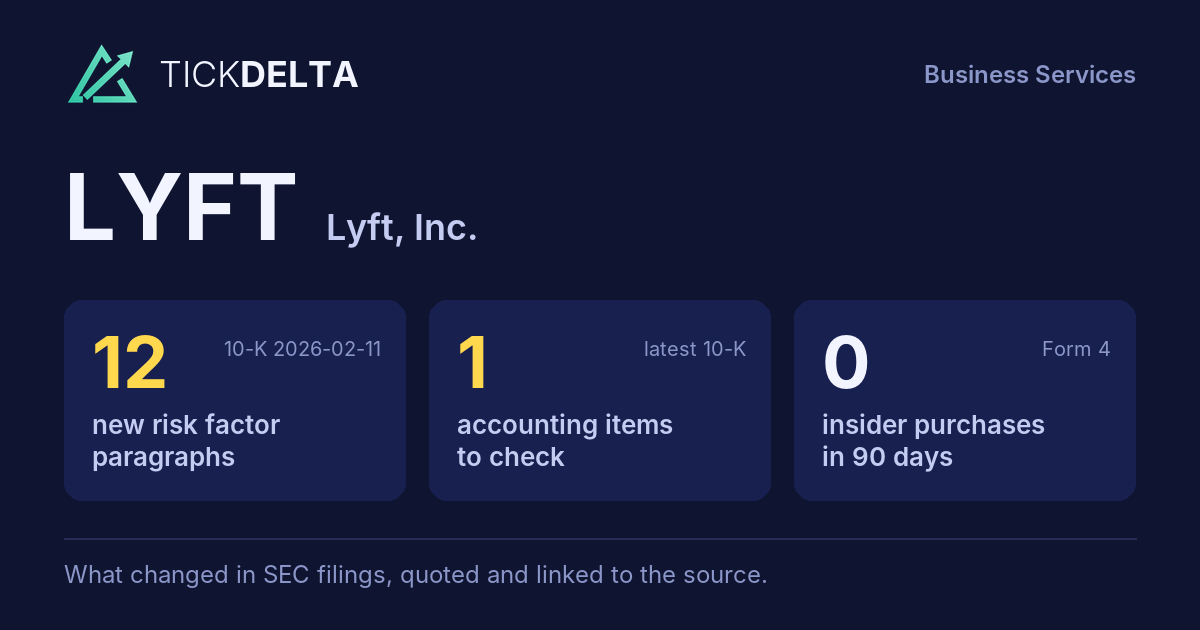
12 paragraphs in Risk Factors of the 10-K filed Feb 11, 2026 with nothing like them in the 10-K filed Feb 14, 2025. Quoted exactly. Paragraphs that were only edited are under 10-K change.
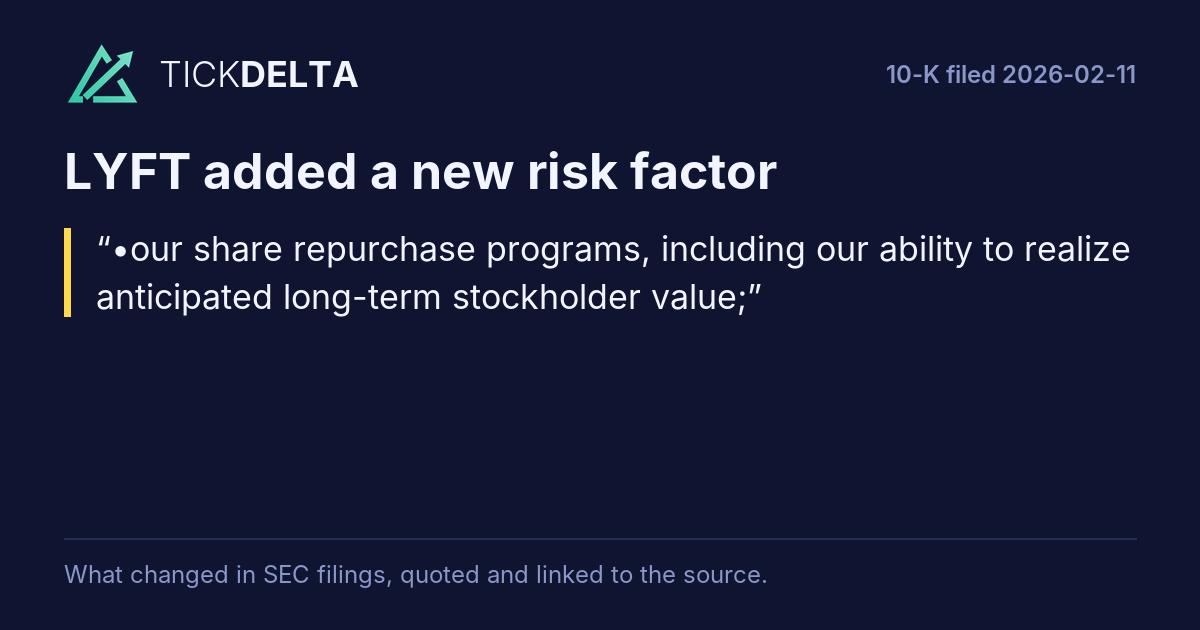
•our share repurchase programs, including our ability to realize anticipated long-term stockholder value;
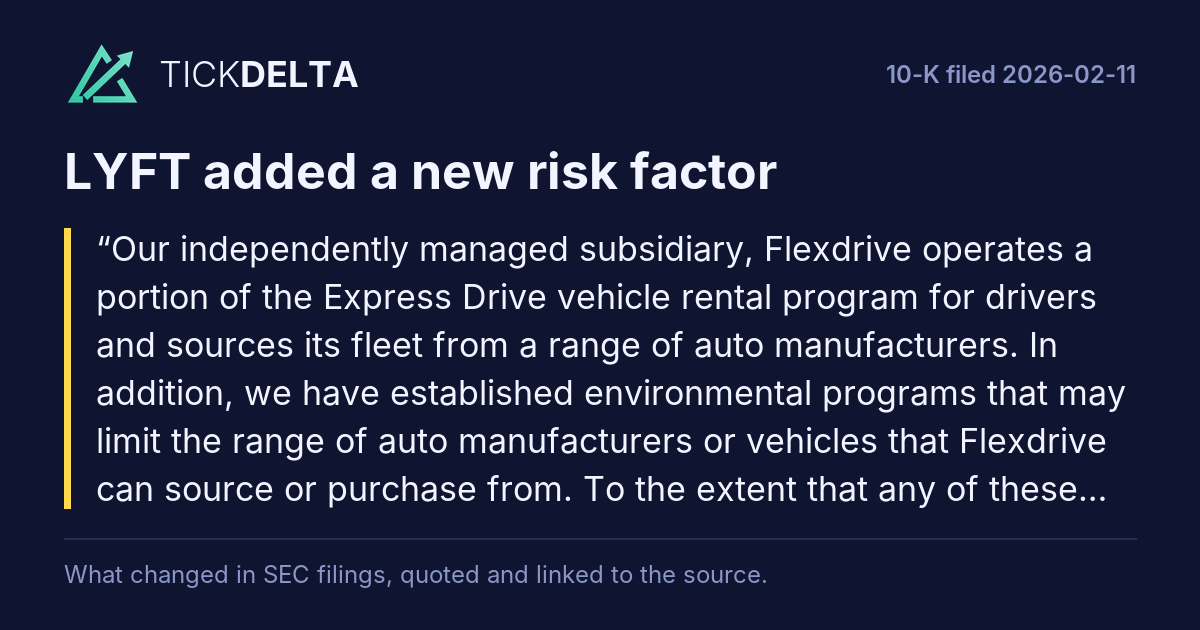
Our independently managed subsidiary, Flexdrive operates a portion of the Express Drive vehicle rental program for drivers and sources its fleet from a range of auto manufacturers. In addition, we have established environmental programs that may limit the range of auto manufacturers or vehicles that Flexdrive can source or purchase from. To the extent that any of these auto manufacturers
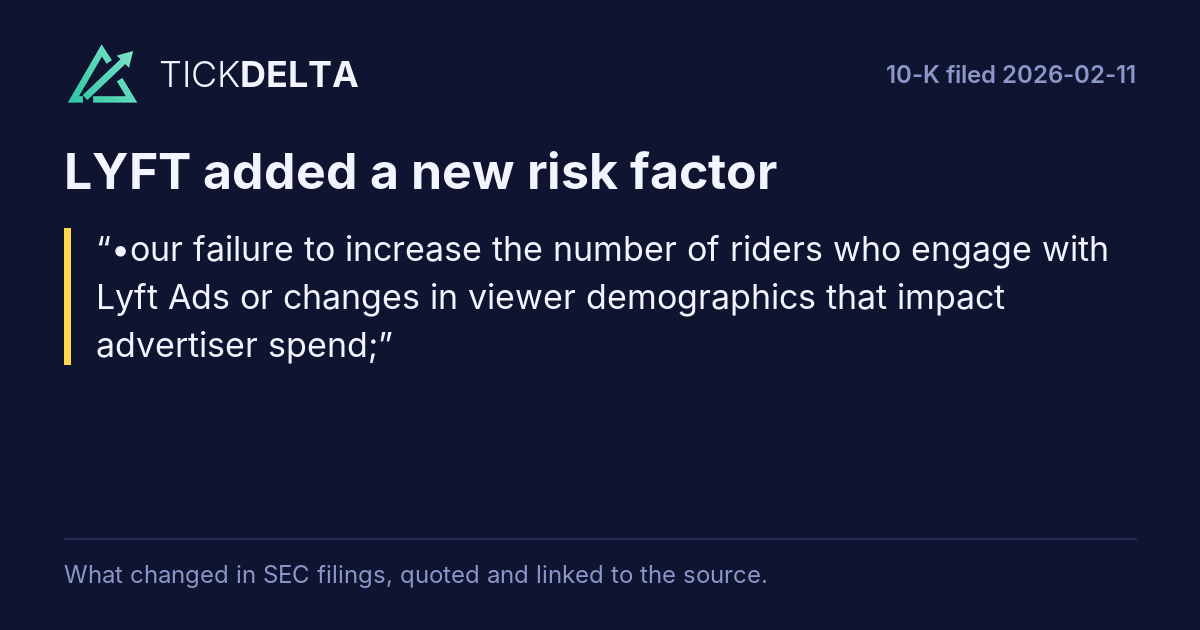
•our failure to increase the number of riders who engage with Lyft Ads or changes in viewer demographics that impact advertiser spend;
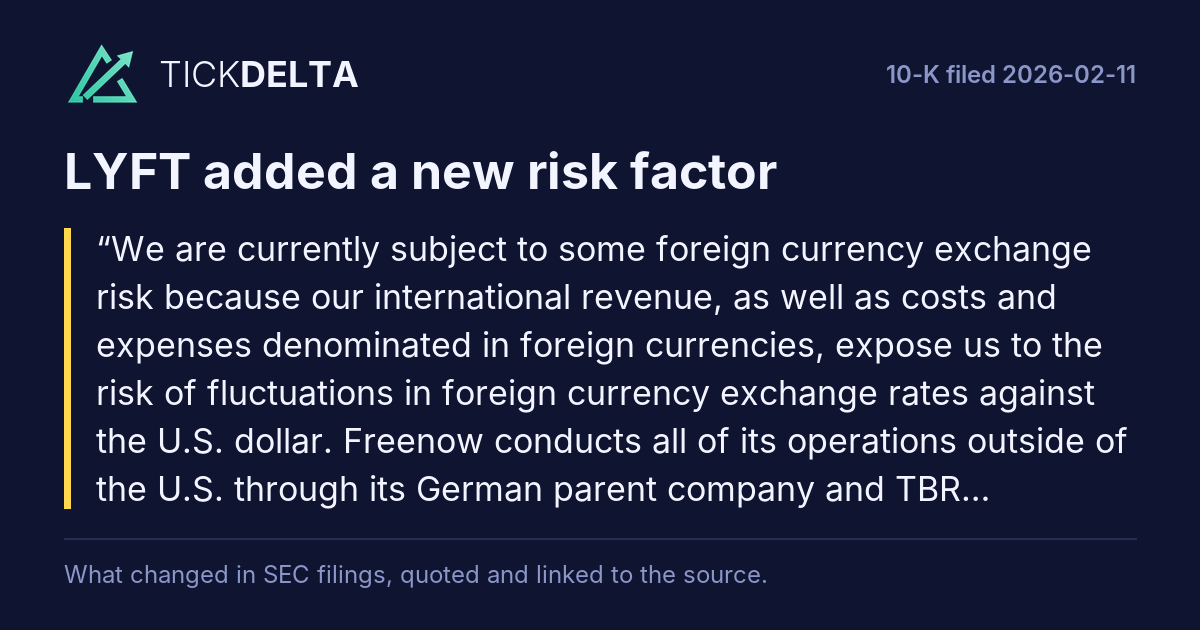
We are currently subject to some foreign currency exchange risk because our international revenue, as well as costs and expenses denominated in foreign currencies, expose us to the risk of fluctuations in foreign currency exchange rates against the U.S. dollar. Freenow conducts all of its operations outside of the U.S. through its German parent company and TBR conducts a majority of its operations, including its U.S. business, through its United Kingdom (the “U.K.”) parent company. Freenow and TBR each have subsidiaries or affiliates, which also operate in their respective local currencies. As a result, our international operations will account for a more significant portion of our overall operations, and our exposure to fluctuations in foreign currency exchange rates will increase. Because our consolidated financial statements will continue to be presented in U.S. dollars, the local currencies will be translated into U.S. dollars at the applicable exchange rates for inclusion in our consolidated financial statements, thereby increasing the foreign exchange risk.
We may not realize the anticipated long-term stockholder value of our share repurchase programs, and any failure to repurchase our Class A common stock after we have announced our intention to do so may negatively impact our stock price.
In February 2026, we authorized a new share repurchase program for the repurchase of up to $1.0 billion of the Company’s Class A common stock, in addition to amounts remaining available under our existing repurchase program under which we were authorized to repurchase a total of $750 million of the Company’s Class A common stock. Under existing or any future share repurchase programs, we may make share repurchases through a variety of methods, including open share market purchases or privately negotiated transactions, in accordance with applicable federal securities laws. Our share repurchase programs generally have no time limit, do not obligate us to repurchase any specific number of shares, and may be suspended at any time at our discretion and without prior notice. The timing and amount of repurchases, if any, will be subject to liquidity, stock price, business and market conditions, compliance with applicable legal requirements, such as Delaware surplus and solvency tests, management discretion, and other relevant factors. Any failure to repurchase stock after we have announced our intention to do so may negatively impact our reputation and investor confidence in us and may negatively impact our stock price. The existence of a share repurchase program could cause our stock price to be higher than it otherwise would be and could potentially reduce the market liquidity for our stock. Although these programs are intended to enhance long-term stockholder value, there is no assurance they will do so because the
market price of our Class A common stock may decline below the levels at which we repurchased shares and short-term stock price fluctuations could reduce the effectiveness of our repurchase programs. Repurchasing our Class A common stock will reduce the amount of cash we have available to fund working capital, capital expenditures, strategic acquisitions or business opportunities, and other general corporate requirements, and we may fail to realize the anticipated long-term stockholder value of these share repurchase programs.
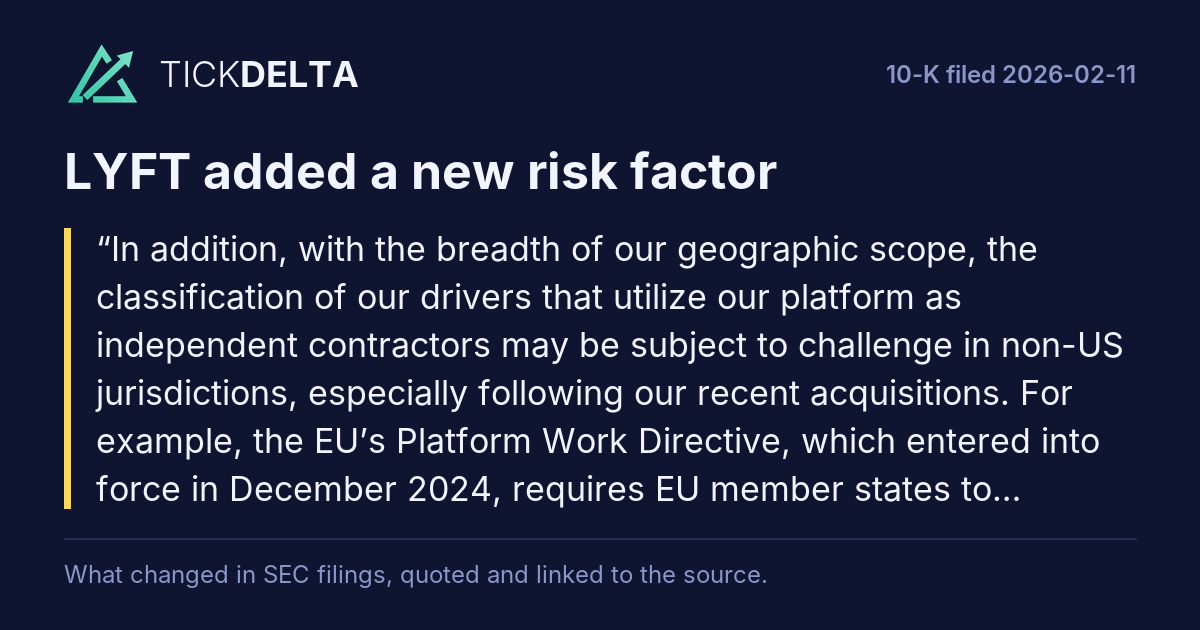
In addition, with the breadth of our geographic scope, the classification of our drivers that utilize our platform as independent contractors may be subject to challenge in non-US jurisdictions, especially following our recent acquisitions. For example, the EU’s Platform Work Directive, which entered into force in December 2024, requires EU member states to transpose its requirements to their national laws, including enacting new national laws for determining worker classification of platform workers, and may involve differing implementation by the various member states. Such EU-wide legislative reforms may adversely affect our ability to operate our current independent contractor model within the European Economic Area.
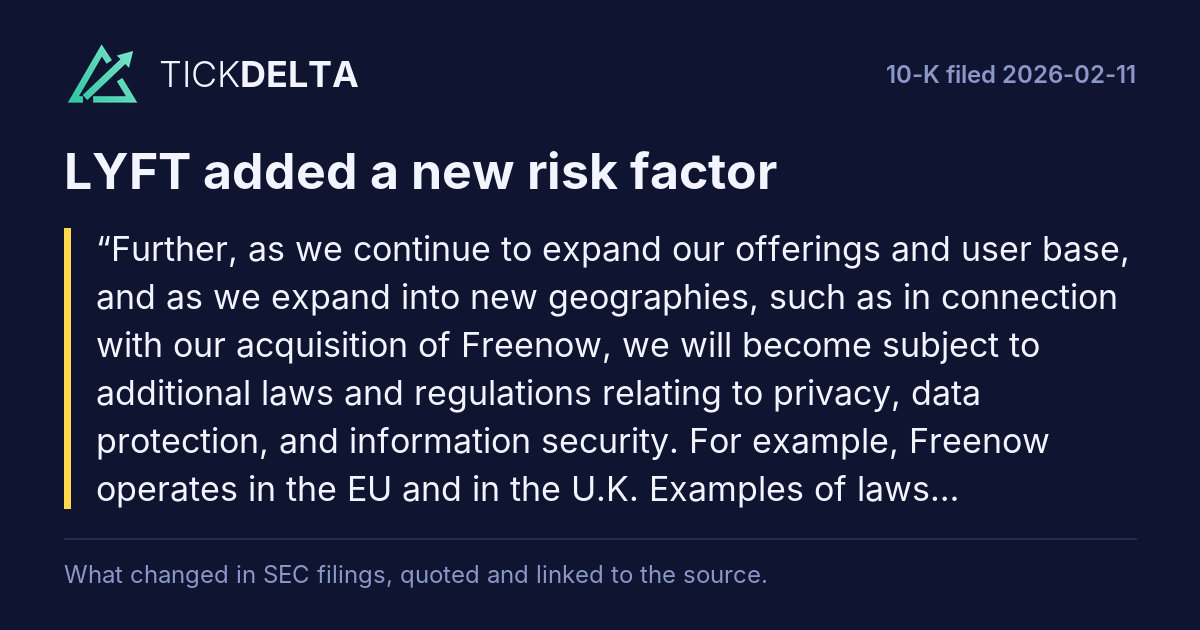
Further, as we continue to expand our offerings and user base, and as we expand into new geographies, such as in connection with our acquisition of Freenow, we will become subject to additional laws and regulations relating to privacy, data protection, and information security. For example, Freenow operates in the EU and in the U.K. Examples of laws applicable to Freenow in the EU and the U.K. are the EU General Data Protection Regulation and the U.K.’s Data Protection Act and General Data Protection Regulation, which apply to the processing of personal data in the EU and U.K., respectively. Each of these jurisdictions’ data protection regimes provides for substantial obligations applicable to the collection, use, transfer (including to the U.S.) and the processing of other personal data and imposes significant penalties for noncompliance. The EU also has adopted numerous laws and regulations relating to cybersecurity that may apply to certain Lyft subsidiaries. Expansion of our offerings may include partnerships and data sharing or transfers that could be subject to Title 28 of the U.S. Code of Federal Regulations Part 202, which prohibits or restricts certain transactions that involve bulk transfer of certain U.S. data to countries of concern and imposes significant penalties for noncompliance.
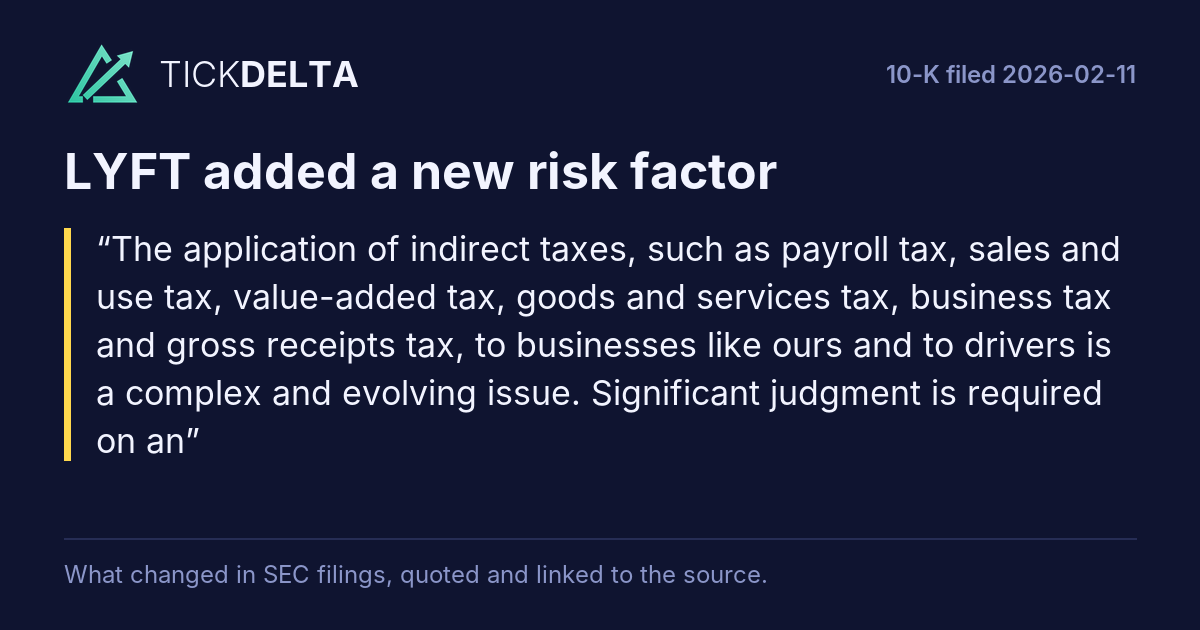
The application of indirect taxes, such as payroll tax, sales and use tax, value-added tax, goods and services tax, business tax and gross receipts tax, to businesses like ours and to drivers is a complex and evolving issue. Significant judgment is required on an
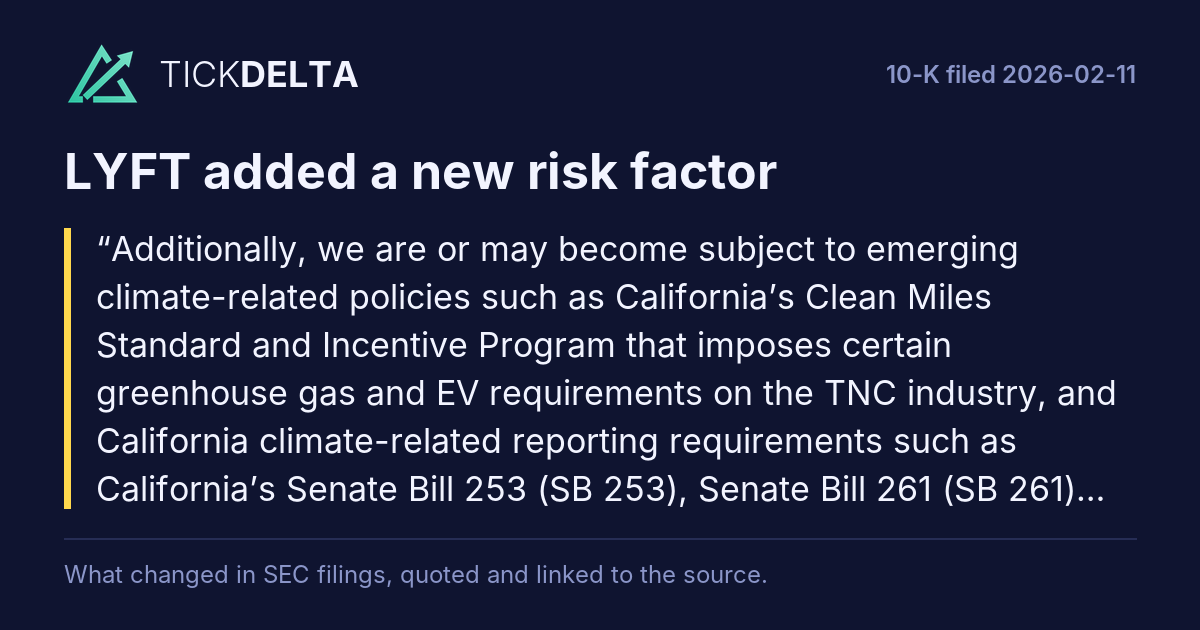
Additionally, we are or may become subject to emerging climate-related policies such as California’s Clean Miles Standard and Incentive Program that imposes certain greenhouse gas and EV requirements on the TNC industry, and California climate-related reporting requirements such as California’s Senate Bill 253 (SB 253), Senate Bill 261 (SB 261) and Senate Bill 219 (SB 219). Massachusetts, New York City and Toronto are developing or have developed rules to address the environmental impact of rideshare. In the EU, the Corporate Sustainability Reporting Directive (“CSRD”), which was adopted in 2022 and significantly amended in 2025, imposes requirements on certain companies to disclose information regarding certain environmental, social and governance practices. While we have assessed that we will not be in scope for CSRD in 2026, we will continue to monitor and evaluate as our business in the EU grows. Further, other jurisdictions are likely to consider similar rules, regulations and/or reporting requirements in the future. Efforts to comply with these policies and reporting requirements are likely to increase our costs, including costs related to reporting, the implementation of extensive internal controls processes and procedures regarding matters that have not been subject to such levels of controls in the past, and impose increased oversight obligations on our management and board of directors, as well as require us to hire third party experts. Any failure to meet the requirements could impact our ability to operate in the applicable jurisdiction. Failure to comply could also harm our reputation and brand.
As part of our long-term strategies to address climate risks and climate regulation, which we believe includes market shifts toward EVs and lower carbon-based business models, we often advocate for EV programs that can be efficiently accessed by drivers
New in the latest 10-Q
8 paragraphs in the 10-Q filed Nov 6, 2026 with nothing like them in the 10-Q filed Aug 7, 2026 (at least half the words must differ; new numbers alone do not count). Quoted exactly, grouped by the item heading above them. This is text that changed, not a judgement of how serious it is.
(2) Includes a deferred gain of $ 54.3 million related to certain transactions recognized on the condensed consolidated balance sheet as of September 30, 2026.
Read in the 10-Q
Superior Court. On September 30, 2026, the Company reached an agreement with the plaintiffs in the coordinated cases (the “Settlement Agreement”), subject to approval by the court, to resolve the allegations that the Company misclassified drivers in California for the period from April 5, 2016 through December 15, 2020 (the “Covered Period”) as independent contractors in violation of California law. Under the terms of the Settlement Agreement, the plaintiffs agree to release the Company from all claims that are or could have been asserted based on alleged misclassification of drivers or other alleged violations of labor laws by the Company during the Covered Period, for a total of $ 272.5 million (inclusive of attorneys’ fees, costs and expenses). The Company can elect to make settlement payments over four years, with 5 % simple interest accruing after the first year, subject to a maximum amount of $ 12.4 million in interest. The Settlement Agreement does not include prepayment penalties or prospective operational commitments. The plaintiffs filed a motion for approval of the settlement with the court on September 30, 2026. On October 29, 2026, the court heard argument on the approval motion, requested additional information from the parties, and set a second approval hearing for November 20, 2026. While the ultimate resolution of this matter is uncertain, the amounts accrued are recorded within accrued and other current liabilities and other liabilities on the condensed consolidated balance sheet and a corresponding charge was recognized on the condensed consolidated statement of operations, allocated between a reduction to revenue and general and administrative expenses as of September 30, 2026.
Read in the 10-Q
The Company has been engaged in a dispute with the City and County of San Francisco regarding the application of gross receipts taxes to rideshare. The parties have reached a settlement agreement in principle, subject to requisite governmental approvals, to resolve this dispute.
Read in the 10-Q
for the Express Drive Program, has been and could be adversely affected, resulting in reduced utilization of the vehicles in the fleets, which would adversely affect our profitability.
Read in the 10-Q
business. Furthermore, if any issues in complying with those requirements are identified, we may incur additional costs rectifying those or new issues, and the existence of these issues could adversely affect our reputation or investor perceptions of it.
Read in the 10-Q
complaint asserting a cause of action arising under the Securities Act against any person in connection with any offering of our securities, including, without limitation and for the avoidance of doubt, any auditor, underwriter, expert, control person or other defendant.
Read in the 10-Q
10.1+ Employment Letter Agreement between Lyft, Inc. and Michael Brous, dated as of September 7, 2026.
Read in the 10-Q
10.2+ Consulting Agreement between Lyft, Inc. and Erin Brewer, dated as of September 8, 2026.
Read in the 10-Q
Item 1A of the 10-Q filed Nov 6, 2026 against Item 1A of the 10-K filed Feb 11, 2026.
A 10-Q repeats only the risks that changed, so a 10-K paragraph that is missing from it is not counted as removed.
Added is a paragraph with nothing like it in the 10-K, Reworded a sentence that is in both with several words changed,
Quiet changes a sentence in both where one to four words changed and one is a hedge or a modal
(cut words struck through, new words highlighted).
Text on the page, not a score; each links to the filing at sec.gov.
The first 26 of 70 are shown (at most 12 of each type).
Two-word phrases in Risk Factors of the 10-K filed Feb 11, 2026 that are in none of the 1 earlier 10-Ks stored, back to Feb 14, 2025
Used at least twice, small words left out. Counted, not picked: a phrase can be new because the company renamed something.
28 paragraphs of last year's Risk Factors with nothing like them now. The longest are quoted.
Item 1A of each 10-K and 10-Q on EDGAR, quoted exactly. Each paragraph links to the filing at sec.gov.
10-K change: what was reworded or cut, section by section.
Excel workbook · CSV. Google Sheet that stays up to date: paste =IMPORTDATA("https://tickdelta.com/company/LYFT/export.csv") into a cell.