Screener / SEC EDGAR /CIK 0001056696 /10-K filed Feb 4, 2026, compared with Feb 7, 2025 /Numbers from the XBRL of the 10-Ks
Nasdaq Technology · Software

Manhattan Associates Inc MANH

Compare with peers Embed
SEC comment letters, last 20 years

5 reviews of MANH's filings by SEC staff

UPLOAD and CORRESP
Reviews 5 latest letter Nov 30, 2023
Questions asked 15 each answered in the company's own letter
No closing letter 0 reviews without a letter saying the staff completed it

When the SEC's staff reviews a filing, it writes to the company with numbered questions, and the company answers each one in a letter. SEC publishes the exchange once the review is over, at least 20 business days later. A question is not an accusation; most reviews end with the company adding detail to its next filing.

How the reviews went

Every review on EDGAR, from the first staff letter to the letter that closes it

  1. 1. Staff letters 6 UPLOAD
  2. 2. Questions in them 15 numbered comments
  3. 3. Company replies 6 CORRESP
  4. 4. Reviews closed 5 of 5 closing letter

Half the closed reviews took 34 days or less from the first letter to the closing letter.

Form 10-K for the Fiscal Year Ended December 31, 2022

2023-11-30 to 2024-01-02 · 6 questions · 2 letters from the SEC, 2 from the company
Review closed 2024-01-02
RevenueResults discussion (MD&A)
Business Overview · Revenue, page 23
SEC asked (1)
You disclose on page 13 that you are dependent on new customers as well as your installed customer base to purchase additional cloud subscriptions and professional services. You further disclose that if customers decide to discontinue the cloud subscription or reduce the scope of their professional services agreements, your revenue could decrease significantly.
Rest of the question

Please tell us and revise to include a quantified discussion of the metrics or measures you use to monitor your ability to attract new customers, sell additional services to existing customers, and renew cloud subscription and maintenance contracts, such as number of customers, renewal rates, and expansion rates. Refer to SEC Release 33-10751.

MANH answered
The Company would like to call the Staff’s attention to the Cloud Subscriptions and Software License revenue paragraph on page 23 where the Company notes that cloud subscription revenue and remaining performance obligation (RPO) growth are the leading indicators of its business performance. In future filings, the Company intends to add a separate section in the MD&A, currently expected to be substantially as set forth below, to highlight these metrics more clearly.

Additionally, due to the Company’s recent transition to a Cloud-based model, only a small number of the Company’s cloud
Rest of the answer

subscriptions have come up for renewal to date. The Company expects renewals to increase in the coming years at which point the Company expects that it will begin to track and disclose retention rates as an additional key performance metric.

Key Performance Metrics

We regularly review metrics to evaluate our business, measure our performance, identify trends affecting our business, formulate financial projections and make strategic decisions. We believe cloud subscriptions revenue growth and RPO growth are the leading indicators of our business performance, primarily derived from cloud subscription fees that customers pay for our Unified Omnichannel Commerce and Digital Supply Chain solutions.

Cloud Subscriptions Revenue Growth

Our cloud revenue growth provides insight into our ability to maintain and grow our cloud customer base. Total cloud revenue increased from $122.2 million in 2021 to $176.5 million in 2022, representing a 44% year-over-year increase. Total cloud revenue increased from $79.8 million in 2020 to $122.2 million in 2021, representing a 53% year-over-year increase. Cloud revenue growth is being driven by strong demand for our cloud offerings.

Remaining performance obligations

Transaction price allocated to RPO represents contracted revenue that has not yet been recognized, which includes deferred revenue and non-cancelable amounts that we expect to invoice and recognize as revenue in future periods. Substantially all of our RPO represents cloud native subscriptions with a non-cancelable term greater than one year. Maintenance contracts typically are for one year and not included in RPO. RPO provides insight into our contracted backlog of future business. As of December 31, 2022, our RPO was approximately $1.05 billion, an increase of 50% over December 31, 2021.

Results of Operations

Revenue, page 28

You disclose that cloud subscription revenue increased on customers demand for your SaaS offerings and that your customers increasingly prefer cloud solutions, including existing customers that are migrating from on-premise to cloud offerings. Further, you disclose that service revenue was primarily driven by adoption and implementation of your cloud solutions. Please tell us and revise to disclose the amount or percentage of the increase in these revenue streams attributable to new versus existing customers and those migrating from on-premise to cloud offerings, in order to provide better context to your results. Refer to Section III.B of SEC Release 33-8350.

The Company would like to call the Staff’s attention to page 24 in the revenue discussion where it states that the percentage mix of new to existing customers for cloud subscriptions and software license sales taken together was approximately 40/60 in 2022. As mentioned above, only a small number of the Company’s cloud subscriptions have come up for renewal to date. The Company expects renewals to increase in the coming years at which point we expect we will begin to track and disclose retention rates.

As stated on page 24, our services revenue growth is contingent on cloud sales and customer upgrade cycles. The Company will disclose in future filings the percentage of professional services revenue that relates to cloud subscriptions. From 2020 to 2022, the percentage of professional services revenue that related to cloud subscriptions increased from approximately 25% in 2020 to over 50% in 2022 and continues to increase in 2023.

Notes to Consolidated Financial Statements

Note 1. Organization, Consolidation and Summary of Significant Accounting Policies

Remaining Performance Obligations, page 49

You disclose approximately $1,051.5 million of revenue is expected to be recognized from remaining performance obligations, approximately 40% over the next 24 months with the balance recognized thereafter. Please tell us and revise to better explain when the other 60% will be recognize as revenue, on a quantitative basis or by providing qualitative information. Refer to ASC 606-10-50-13.

In future filings, the Company will revise its disclosure to clarify that most of the remaining balance will be recognized in the following 36 months.

Read in the reply
Results of Operations · Revenue, page 28
SEC asked (2)
You disclose that cloud subscription revenue increased on customers demand for your SaaS offerings and that your customers increasingly prefer cloud solutions, including existing customers that are migrating from on-premise to cloud offerings. Further, you disclose that service revenue was primarily driven by adoption and implementation of your cloud solutions.
Rest of the question

Please tell us and revise to disclose the amount or percentage of the increase in these revenue streams attributable to new versus existing customers and those migrating from on-premise to cloud offerings, in order to provide better context to your results. Refer to Section III.B of SEC Release 33-8350.

MANH answered
Please tell us and revise to disclose whether commissions are earned on cloud subscription renewals. If so, disclose whether they are commensurate with the commissions earned on the initial contract and how you account for such commissions. Refer to ASC 340-40-35-1 and 340-40-50.

Commissions are earned on cloud subscription renewals, but they are not commensurate with the commission earned on the initial contract. As such, renewal commissions are amortized over the contractual renewal period. The Company will revise its future filings to provide additional clarification.
Read in the reply
Note 1. Organization, Consolidation and Summary of Significant Accounting Policies · Remaining Performance Obligations, page 49
SEC asked (3)
You disclose approximately $1,051.5 million of revenue is expected to be recognized from remaining performance obligations, approximately 40% over the next 24 months with the balance recognized thereafter. Please tell us and revise to better explain when the other 60% will be recognize as revenue, on a quantitative basis or by providing qualitative information. Refer to ASC 606-10-50-13.
MANH answered

No numbered answer found in the reply. Read the reply ↗

In its next report

First report after the company's reply of Dec 12, 2023: 10-K filed Feb 6, 2024 ↗, against the 10-K filed Feb 6, 2023 ↗.

Tickdelta does not hold the text of both reports, so they are not compared here.

Deferred Commissions, page 49
SEC asked (4)
Please tell us and revise to disclose whether commissions are earned on cloud subscription renewals. If so, disclose whether they are commensurate with the commissions earned on the initial contract and how you account for such commissions. Refer to ASC 340-40-35-1 and 340-40-50.
MANH answered

No numbered answer found in the reply. Read the reply ↗

In its next report

First report after the company's reply of Dec 12, 2023: 10-K filed Feb 6, 2024 ↗, against the 10-K filed Feb 6, 2023 ↗.

Tickdelta does not hold the text of both reports, so they are not compared here.

Results of Operations · Revenue, page 28
SEC asked (1)
We note your response to prior comment 2 and acknowledge the disclosure on page 24. While that disclosure indicates the mix of new to existing customers for cloud subscriptions and software license for sales in 2022, it is not clear what comprises the year over year growth in cloud subscription revenue.
Rest of the question

Therefore, as previously requested, please tell us and revise to disclose the amount or percentage of the increase in cloud subscription revenue attributable to new versus existing customers including those that are migrating from on-premise offerings to cloud offerings, in order to provide better context to your results of operations discussion.

MANH answered
In drafting MD&A, the Company is mindful that the Staff’s 2003 MD&A Interpretative Release, 34-48960, instructs that one of the principal objectives of MD&A is “to provide a narrative explanation of a company's financial statements that enables investors to see the company through the eyes of management.”

Management focuses on the total value of non-cancelable cloud subscriptions and license fees signed during each period by new versus existing customers rather than revenue.
Rest of the answer

Approximately 40% of the total value of non-cancelable cloud subscriptions signed during 2022 was with new customers and 60% was with existing customers. In future filings, the Company will clarify that its percentage mix disclosure is by contract value.

For 2020, 2021, and 2022, revenue recognized from first time cloud customers (defined as customers with no prior active cloud subscriptions) during the year in which their initial cloud subscription began was 13%, 11%, and 7% of total cloud revenue, respectively. The Company will include these percentages of new customer cloud revenue in future filings, but respectfully proposes not to disclose period-to-period growth amounts or percentages as the Company does not view them as material for the reasons set forth in this response.

Management focuses on contract value because our customers contract for multi-year subscriptions which typically increase in scope and price over the term, and thus revenue recognized during the year when the contract is signed tends to be small relative to the total contract value, as can be seen from the percentages in the preceding paragraph. This is because revenue recognized in the initial year excludes revenue beyond the first year of the contract and excludes revenue from additional solutions sold to the customer in future years. Finally, revenue recognized in the initial year could be skewed by the timing of the start date of the subscription during the year. For these reasons, the Company believes that the percentage of total value of non-cancelable cloud subscriptions signed during each period with new versus existing customers is more helpful to investors in assessing business performance.

Read in the reply
Results of Operations · Revenue, page 28
SEC asked (2)
You indicate in your response to prior comment 2 that you will disclose in future filings the percentage of professional services revenue that relates to cloud subscriptions, which was approximately 25% in 2020 and over 50% in 2022. Please tell us and revise to disclose the actual percentages for fiscal 2021 and 2022, and explain the types of professional services that comprise the remaining amounts.
Rest of the question

Further, as previously requested, in order to better explain the year over year growth in service revenue, tell us and revise to disclose the amount or percentage of the increase attributable to new versus existing customers.

MANH answered
The percentage of professional services revenue that relates to cloud subscriptions in 2020, 2021, and 2022 was approximately 25%, 40% and 55%, respectively. The remainder of our professional services revenue relates to implementations, ongoing support, and upgrades of licensed software.

For 2020, 2021, and 2022, revenue from new customer cloud-based professional services (defined as customers with no prior active cloud subscriptions) recognized during the year in which their initial cloud subscription began was 7%, 14%, and 12%, respectively, of total professional services revenue.
Rest of the answer

The Company will include these percentages of new customer cloud-based professional services revenue in future filings, but respectfully proposes not to disclose growth amounts or percentages as the Company does not view them as material for the reasons set forth below.

As with our cloud software subscriptions, customers often continue to purchase our professional services beyond their initial implementation to roll out additional locations, implement additional features and functionality, and implement additional products, as well as for general support. Revenue recognized from new customer cloud-based professional services excludes those services we provided after the year in which the initial cloud subscription began. Further, as with revenue attributable to new customer cloud-based subscription services, the revenue attributable to new customer cloud-based professional services could be skewed by the timing of the start date of the subscription during the year.
Read in the reply

Also in this review: closing letter, 2024-01-02
Form 10-K for the Fiscal Year Ended December 31, 2017

2018-06-13 to 2018-07-10 · 2 questions · 1 letter from the SEC, 1 from the company
Review closed 2018-07-10
Revenue
Notes to Consolidated Financial Statements (unaudited) · Note 2. Revenue Recognition, page 9
SEC asked (1)
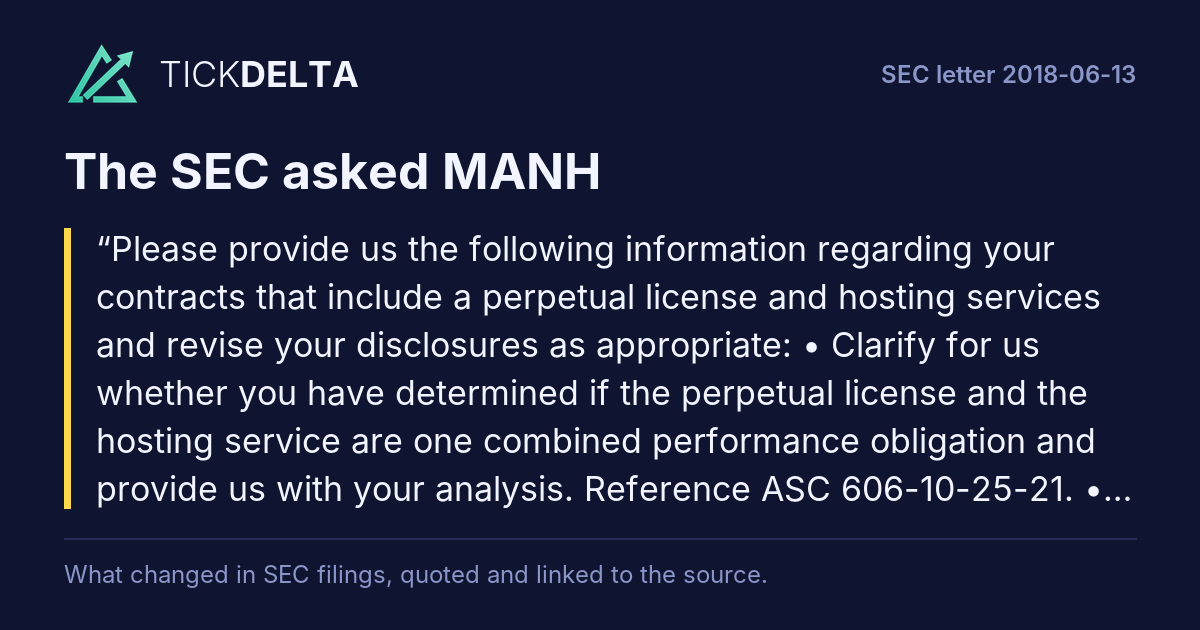
Please provide us the following information regarding your contracts that include a perpetual license and hosting services and revise your disclosures as appropriate: • Clarify for us whether you have determined if the perpetual license and the hosting service are one combined performance obligation and provide us with your analysis. Reference ASC 606-10-25-21.
Rest of the question

• If the perpetual license and the hosting service are one combined performance obligation, tell us the period of time over which you are recognizing revenue for the combined performance obligation. If this period is longer than your initial hosting period, please explain the basis for this determination. • Tell us if you have identified the material right as a separate performance obligation. If you have combined the material right with the perpetual license and hosting service, please tell us how you made this determination. Reference ASC 606-10-55-42. • Tell us the period of time over which you are recognizing revenue for your material right. If this period begins prior to the time the additional hosting services are provided or when the material right expires, please explain to us the basis for this determination. Reference ASC 606-10-55-42. • Lastly, tell us how significant these arrangements are and whether you anticipate they will grow similar to the anticipated growth in your cloud subscription offerings.

MANH answered
Revenue for arrangements that include a perpetual license with hosting services was less than 1% of total revenue for the twelve months ended December 31, 2017, and three months ended March 31, 2018. The Company’s objective is to focus on growing its cloud subscription revenue through software-as-a-service arrangements rather than hosted perpetual license arrangements.
Rest of the answer

The hosted perpetual license arrangement is a transitory offering.

We have concluded that our hosted perpetual license arrangements do not involve a software license performance obligation distinct from the hosting services obligation. Instead, under applicable accounting principles, the hosted perpetual license arrangements are a single performance obligation to provide hosting services. The customer’s option to renew the hosting services after the initial term, however, is a material right and a separate obligation from the hosted software services arrangement.

Under ASC 606-10-55-54, licenses of intellectual property include licenses of software, other than software subject to a hosting arrangement that does not meet the criteria in paragraph 985-20-15-5. ASC 985-20-15-5 provides that software subject to a hosting arrangement is within the scope of that subtopic only if the customer has the contractual right to take possession of the software at any time during the hosting period without significant penalty, and it is feasible for the customer to either run the software on its own hardware or contract with another party unrelated to the vendor to host the software. ASC 985-20-15-6 explains that the term “significant penalty” contains two distinct concepts: the ability to take delivery of the software without incurring significant cost, and the ability to use the software separately without a significant diminution in utility or value.

Our customer contracts for a perpetual license and hosting services require the customer pay fees for the initial hosting term (typically three years) even if it chooses to cancel the hosting arrangement. We have concluded that those fees, which exceed 10% of the total contract consideration at the contract’s inception, represent a significant cost and penalty to the customer to take possession of and utilize the software itself. Therefore, we have concluded that these contracts do not include a software license under ASC 606-10-55-54 and are services arrangements.

Additionally, because these customers are not required to again pay the perpetual license fee upon renewal of the hosting services, we have concluded that the customer’s option to renew the hosting services is a material right, and consequently a separate performance obligation, in accordance with ASC 606-10-55-42, as the consideration is materially less than that charged to new customers purchasing a perpetual license with hosting services. We apply the practical alternative to estimating the value of the material right for the renewals provided by ASC 606-10-55-45 of allocating the transaction price to the optional goods or services by reference to the goods or services expected to be provided and the corresponding expected consideration. We have estimated a five-year contract life to determine the value of the material right. We base our estimate on the rate of technological change in our software tied to our ongoing commitment to innovation and product enhancement. This life is consistent with the period we use in our legacy GAAP accounting.

We recognize the value allocated to the single hosted software services obligation over the initial hosting term. We recognize the value allocated to the separate material right over the renewal periods if and when the customer exercises the renewal options.

In future filings, we propose to modify our disclosures regarding hosted perpetual license arrangements substantially in the following manner:

“For contracts that include a perpetual license and hosting services, we generally consider the arrangement as an overall service, recognized over the initial hosting term. The software license fee typically due at the outset of the arrangement is not payable again if the customer renews the hosting services, so that the customer’s option to renew the hosting services is a material right, the revenue from which, if the option is exercised, we will recognize over the applicable renewal period.”

Read in the reply
In its next report

First report after the company's reply of Jun 26, 2018: 10-Q filed Jul 26, 2018 ↗, against the 10-Q filed Apr 27, 2018 ↗.

Tickdelta does not hold the text of both reports, so they are not compared here.

Notes to Consolidated Financial Statements (unaudited) · Note 2. Revenue Recognition, page 9
SEC asked (2)
You indicate the selling price of your software is highly variable and therefore you estimate the standalone selling price for software licenses using the residual approach. Please provide a comprehensive, quantitative discussion of such variability to support your conclusion.
MANH answered
Under ASC 606-10-32-34(c), an entity may use the residual approach to estimate standalone selling price (SSP) by referencing the total transaction price less the sum of the observable standalone selling prices of other goods or services promised in the contract if the entity sells the same good or service to other customers (at or near the same time) for a broad range of amounts (that is, the selling price is highly variable because a representative standalone selling price is not discernible from past transactions or other observable evidence).
Rest of the answer

To determine if the Company’s software pricing is highly variable, we reviewed ***. We further stratified our analysis ***, noting that ***. The table below summarizes *** from January 1, 2017, through March 31, 2018.

***Table Redacted Pursuant to Rule 83 Confidentiality Request***

We also consider the guidance in BC 273 when applying the residual approach and evaluate whether the outcome of the residual approach would allocate an unrealistic amount to the software. The Company believes the outcome is reasonable, as it does not result in SSP estimates of little to no consideration for the software in the transactions.

Read in the reply
In its next report

First report after the company's reply of Jun 26, 2018: 10-Q filed Jul 26, 2018 ↗, against the 10-Q filed Apr 27, 2018 ↗.

Tickdelta does not hold the text of both reports, so they are not compared here.

Also in this review: closing letter, 2018-07-10

Form 10-K for the Fiscal Year Ended December 31, 2014

2015-04-16 to 2015-06-11 · 1 question · 1 letter from the SEC, 1 from the company
Review closed 2015-06-11
RevenueNon-GAAP measuresExecutive pay
Executive Compensation · Principal Elements of Executive Compensation, page 14
SEC asked
We note that the corporate performance measures used to determine fiscal 2014 bonus awards under your annual short-term cash incentive plan were consolidated revenue and adjusted EPS. In your response letter, please disclose the targets established for both performance measures for 2014 and the company’s actual performance against the targets.
Rest of the question

Also, please confirm that you will provide similar disclosure in future filings. Refer to Item 402(b)(2)(v) of Regulation S-K. To the extent you believe that disclosure of the targets is not required because it would result in competitive harm such that you may omit this information under Instruction 4 to Item 402(b) of Regulation S-K, please provide in your response letter a detailed explanation of such conclusion. In this regard, we note the response in your letter dated March 3, 2009 to a similar comment issued on your Form 10-K for the fiscal year ended December 31, 2007. Please note that where performance targets are tied to company-wide financial results that are publicly reported, we generally expect companies to disclose the targets if material to their compensation policies and decisions after those financial results have been disclosed. It is unclear to us what insights competitors can draw about a company’s planned investments or future projected growth a competitor from historical performance targets that it could not also draw from actual results and or the company’s participation in the market place.

MANH answered
As the Staff observes in its comment, the 2014 cash incentive opportunity under the Company’s annual short-term cash incentive plan was based on the Company’s consolidated revenue and adjusted earnings per share (“adjusted EPS”) for fiscal year 2014. The two factors were weighted equally.

As the Company discussed in its definitive Proxy Statement filed on April 10, 2015, for plan target purposes, consolidated revenue excludes hardware and other revenue to minimize risk of low margin revenue lines skewing incentive plan payout percentages.
Rest of the answer

Adjusted EPS, when applicable, excludes the following items from GAAP earnings per share: amortization of intangible assets, equity-based compensation expenses, restructuring charges, asset impairment charges and related recoveries, sales tax recoveries, and unusual tax adjustments. All non-GAAP measures are reconciled to the related GAAP measures in accordance with SEC rules and disclosed in our quarterly 8-K earnings release filings. In addition, when the Company establishes its annual budget, it does not plan for Common Stock repurchases. As a result, the earnings per share benefit from Common Stock repurchases, if applicable, is eliminated from the calculation of adjusted EPS for plan purposes.

Further, for plan purposes, consolidated revenue and adjusted EPS objectives are determined on a constant currency basis (i.e. actual financial results are translated to U.S. dollars at budgeted U.S. dollar exchange rates).

The Company’s target incentive goal amounts for consolidated revenue and adjusted EPS for fiscal year 2014, calculated as described above, were $422.3 million and $1.05, respectively. The Company actually achieved consolidated revenue and adjusted EPS incentive goals for fiscal year 2014 of $445.9 million and $1.17, respectively, resulting in annual cash incentives being earned by all Company plan participants at 144% of target.

The Company will provide similar disclosure in future filings, as applicable.

* * * * * *

The Company acknowledges that:

· the Company is responsible for the adequacy and accuracy of the disclosure in the filing;

Staff comments or changes to disclosure in response to comments do not foreclose the Commission from taking any action with respect to the filing; and the Company may not assert Staff comments as a defense in any proceeding initiated by the Commission or any person under the federal securities laws of the United States.

The Staff is requested to direct any further questions regarding these filings and this letter to the undersigned at (678) 597-7115. Thank you.

Read in the reply
In its next report

First report after the company's reply of May 1, 2015: 10-Q filed Jul 28, 2015 ↗, against the 10-Q filed Oct 29, 2014 ↗.

Tickdelta does not hold the text of both reports, so they are not compared here.

Also in this review: closing letter, 2015-06-11

Form 10-K for the Fiscal Year Ended December 31, 2012

2013-05-15 to 2013-06-26 · 2 questions · 1 letter from the SEC, 1 from the company
Review closed 2013-06-26
Results discussion (MD&A)Liquidity and cashIncome taxesNon-GAAP measures
Management’s Discussion and Analysis of Financial Condition and Results of Operations · Liquidity and Capital Resources, page 37
SEC asked (1)
We note that as of December 31, 2012, you had undistributed earnings of foreign subsidiaries of $29.5 million that, if repatriated, would be subject to income taxes in the U.S. as well as foreign withholding taxes. To the extent you have cash and cash equivalents held by foreign subsidiaries, please tell us and disclose the amount of such cash and cash equivalents in future filings.
Rest of the question

Notwithstanding your disclosures under note 3 to the consolidated financial statements, please also tell us what consideration was given to disclosing the potential income tax consequences of repatriating undistributed earnings of foreign subsidiaries. Please refer to Item 303(a)(1) of Regulation S-K and Section IV of SEC Release 33-8350.

MANH answered
At December 31, 2012, the Company’s cash and investments totaled $103.0 million, of which $35.2 million was held by foreign subsidiaries. We will disclose this in future filings.

In addition, we have considered the Staff’s comments regarding Section IV of SEC Release 33-8350 requiring companies to disclose liquidity and capital resources, including a “discussion and analysis of known trends and uncertainties.” We intend to further enhance our future disclosure in the Liquidity and Capital Resources discussion to address the potential impact of repatriating undistributed earnings of the
Rest of the answer

Company’s foreign subsidiaries, similar to the disclosure in Note 3. Included below is an example of such enhanced future disclosure as of December 31, 2012:

Our consolidated cash and investments as of December 31, 2012 was $103.0 million with $35.2 million held by our foreign subsidiaries.

We believe that our cash balances and positive operating cash flow in the U.S. are sufficient to fund our current and projected liquidity needs in the U.S. for the foreseeable future. For our foreign subsidiaries, it is the Company’s intent to reinvest undistributed earnings, totaling $29.5 million at December 31, 2012, and indefinitely postpone their remittance to the U.S. In the future, if we elect to repatriate the unremitted earnings of our foreign subsidiaries in the form of dividends or otherwise, we would be subject to additional U.S. income taxes which could result in a higher effective tax rate.

Read in the reply
In its next report

First report after the company's reply of May 24, 2013: 10-Q filed Jul 31, 2013 ↗, against the 10-Q filed Apr 30, 2013 ↗.

Tickdelta does not hold the text of both reports, so they are not compared here.

Management’s Discussion and Analysis of Financial Condition and Results of Operations · Liquidity and Capital Resources, page 37
SEC asked (2)
We note your discussion of the non-GAAP measure “free cash flow” in your fourth quarter 2012 earnings call on January 19, 2013; however we are unable to locate the reconciliation of this non-GAAP measure to the most comparable GAAP measure on your website or in your earnings release.
Rest of the question

Please tell us your consideration for including a reconciliation of this non-GAAP measure in accordance with the guidance in Item 100 of Regulation G.

MANH answered
The reference to “free cash flow” in our fourth quarter 2012 earnings call was an isolated occurrence, and that measure was not referred to in our first quarter 2013 earnings call. Our free cash flow mentioned in the fourth quarter 2012 earnings call is defined as cash flow from operations less capital expenditures, both as reported on the face of our Statement of Cash

Flows.

The Company acknowledges its obligations under Regulation G.
Rest of the answer

In future filings, the Company will either omit any discussion of the non-GAAP measure of “free cash flow” in its earnings conferences, or else comply fully with Regulation G, including by disclosing the most directly comparable GAAP measure and by providing a reconciliation to such measure, either on the conference itself or by reference to a reconciliation on the Company’s website. The Company submits that its failure to provide a reconciliation in connection with its fourth quarter 2012 conference call was relatively immaterial in that the Company uses the most common definition of this particular non-GAAP measure, and it is a simple calculation using inputs from the face of the cash flow statement.

*****

The

Company acknowledges that: (i) it is responsible for the adequacy and accuracy of the disclosure in its filings; (ii) Staff comments or changes to disclosure in response to Staff comments do not foreclose the Commission from taking any action with respect to its filings and (iii) it may not assert Staff comments as a defense in any proceeding initiated by the Commission or any person under the federal securities laws of the United States.

The Staff is requested to direct any further questions regarding these filings and this letter to the undersigned at (678) 597-7115.

Thank you.

Read in the reply
In its next report

First report after the company's reply of May 24, 2013: 10-Q filed Jul 31, 2013 ↗, against the 10-Q filed Apr 30, 2013 ↗.

Tickdelta does not hold the text of both reports, so they are not compared here.

Also in this review: closing letter, 2013-06-26

Form 10-K for the Fiscal Year Ended December 31, 2010

2011-08-03 to 2011-09-06 · 4 questions · 1 letter from the SEC, 1 from the company
Review closed 2011-09-06
RevenueRisk factors
Note 1. Organization and Summary of Significant Accounting Policies · Revenue Recognition, page 53
SEC asked (1)
We note with regard to certain service contracts your disclosure indicating that “revenue related to fixed-fee based contracts is recognized on a proportional performance basis based on the hours incurred on discrete projects within an overall services arrangement.” Please clarify the nature of your fixed-fee based contracts and why you believe it is appropriate to apply a proportional performance model based on
Rest of the question

input measures. Please note that the application of a proportional performance model is typically based on output measures as opposed to the level of costs associated with the act or input measures.

MANH answered
ATLANTA AUGUSTA CHARLOTTE DENVER DUBAI NEW YORK OAKLAND PALO ALTO RALEIGH SAN

DIEGO SAN FRANCISCO SEATTLE STOCKHOLM TAIPEI TOKYO WALNUT CREEK WASHINGTON, DC

WINSTON-SALEM

For the vast majority of the Company’s professional services revenue, the Company bills on an hourly basis and recognizes revenue as services are performed. The Company however occasionally provides professional services for a fixed price which is determined based on the number of hours estimated to complete the project.
Rest of the answer

The Company has extensive professional services experience gained from more than 300 annual implementations of its software worldwide and is able to use this experience to accurately estimate the effort needed to complete current projects.

The Company recognizes revenue related to these fixed fee services arrangements on a proportional performance basis. The Company has determined that output measures, or services delivered, approximate the input measures associated with fixed fee services arrangements.

The Company bases proportional performance on the hours of professional services included in the arrangement as this represents a specified number of similar acts to determine performance. The Company’s professional services organization provides customers with supply chain expertise and assistance in planning and implementing the Company’s software solutions. The Company partners with its customers throughout the projects to provide continual knowledge transfer and collaborate on best practice protocols and processes.

Therefore, the Company believes that using the efforts-expended input measure of labor hours in its fixed fee professional services arrangements is the best approximation of its pattern of performance and value transferred to a customer under these arrangements.

Read in the reply
In its next report

First report after the company's reply of Aug 9, 2011: 10-Q filed Oct 28, 2011 ↗.

No earlier 10-Q before the SEC's letter is in Tickdelta, so there is nothing to compare with.

Note 1. Organization and Summary of Significant Accounting Policies · Revenue Recognition, page 53
SEC asked (2)
We note your risk factor on page 16 regarding the potential deferral of license revenue as a result of extended payment terms and future software functionality deliverables. Please clarify your revenue recognition policy related to extended payment terms and specified future upgrades.
Rest of the question

As it relates to extended payment term arrangements, tell us how you considered the fixed and determinable and collectibility criteria in determining your revenue recognition policy related to such arrangements and your consideration for the guidance in ASC 985-605-25-32 through 35. For arrangements that include future software functionality deliverables, please tell us how you considered the guidance in ASC 985-605-25-44 through 46 related to specified upgrade or enhancement rights.

MANH answered
Payment terms for the Company’s software licenses vary. The terms range from due upon contract execution to due over a number of months in certain cases. Each contract is evaluated individually to determine whether the fees in the contract are fixed and determinable. The Company has an established history of collecting under the terms of its software license contracts without providing refunds or concessions to its customers.

Therefore, the Company has determined that the presence of payment terms which extend beyond contract execution in a particular contract do not preclude the conclusion
Rest of the answer

that the fees in the contract are fixed and determinable.

Although infrequent, when payment terms in a contract extend beyond twelve months, the

Company has determined, in accordance with ASC 985-605-25-34, that such fees are not fixed and determinable and recognizes revenue as payments become due provided that all other conditions for revenue recognition have been met in accordance with ASC 985-605. The

Company also assesses the probability of collecting from each customer at the outset of the arrangement based on a number of factors, including the customer’s payment history, the customer’s current creditworthiness as reflected in credit checks, and other pertinent country or industry economic risk. If in the Company’s judgment collection of a fee is not probable, the Company recognizes revenue as cash is collected, provided that all other conditions for revenue recognition have been met in accordance with ASC 985-605.

If an arrangement includes future software functionality deliverables, the Company accounts for these deliverables as a separate element of the arrangement. Because the Company does not sell these deliverables on a standalone basis, the Company is not able to establish vendor-specific objective evidence of the fair value of these deliverables. As a result, in accordance with ASC 985-605-25-46, the Company defers all revenue under the arrangement until the future functionality has been delivered to the customer.

In future filings, the Company will expand its disclosure, consistent with the responses above, regarding the deferral of license fees for contracts with payment terms extending beyond twelve months and contracts with future software functionality deliverables in its revenue recognition policy disclosure under critical accounting policies in the Management’s

Discussion and Analysis section and in the notes to the financial statements.

Read in the reply
In its next report

First report after the company's reply of Aug 9, 2011: 10-Q filed Oct 28, 2011 ↗.

No earlier 10-Q before the SEC's letter is in Tickdelta, so there is nothing to compare with.

Note 1. Organization and Summary of Significant Accounting Policies · Revenue Recognition, page 53
SEC asked (3)
We note your discussion on page 33 that your revenue consists of fees generated from licensing and hosting of software. Please clarify the terms of your hosting arrangements including your analysis under ASC 985-605-55-119 through 125 in determining the accounting literature you are relying on related to your revenue recognition policy for these arrangements.
MANH answered
The Company’s hosting revenue represents approximately 1% of its total revenue for 2010,

2009, and 2008, respectively. The Company offers hosting services on certain of its software products under arrangements in which the end users typically do not have the contractual right to take possession of the software.
Rest of the answer

According to ASC 985-605-55-121, ASC

985-605 only applies to hosting arrangements in which the customer has the contractual right to take possession of the software at any time during the hosting period without significant penalty and it is feasible for the customer to either run the software on its own hardware or contract with another party unrelated to the vendor to host the software. Thus, the

Company recognizes revenue from these arrangements pursuant to SAB Topic 13 and ASC 605-25.

The Company recognizes the entire arrangement fee ratably over the hosting term which is generally renewed on an annual basis. The Company did not enter into any new hosting arrangements in 2010, 2009, or 2008 in which the customer had the contractual right to take possession of the software.

Read in the reply
In its next report

First report after the company's reply of Aug 9, 2011: 10-Q filed Oct 28, 2011 ↗.

No earlier 10-Q before the SEC's letter is in Tickdelta, so there is nothing to compare with.

Exhibits 31.1 and 31.2
SEC asked (4)
We note that the identification of the certifying individual at the beginning of each of the certifications required by Exchange Act Rule 13a-14(a), filed with your annual report on Form 10-K and your report on Forms 10-Q for the quarters ended March 31, 2011 and June 30, 2011, also include the title of the certifying individual.
Rest of the question

Please revise future filings to omit the certifying individual’s title at the beginning of the certification to conform to the language required by Item 601(b)(31) of Regulation S-K. Please note that the certifications may not be changed in any respect from the language of Item 601(b)(31) of Regulation S-K, even if the change would appear to be inconsequential in nature. For guidance, please refer to Section II.B.4 of SEC Release No. 33-8124.

MANH answered
In future filings, the Company will omit the certifying individual’s title at the beginning of the certification, per the Staff’s comment.

* * * * * *

The Company acknowledges that:

• the Company is responsible for the adequacy and accuracy of the disclosure in the filing;

Staff comments or changes to disclosure in response to comments do not foreclose the

Commission from taking any action with respect to the filing; and the Company may not assert Staff comments as a defense in any proceeding initiated by the Commission or any person under the federal securities laws of the United
Rest of the answer

States.

Please copy the undersigned on any subsequent correspondence concerning the Staff’s comments, and please do not hesitate to call the undersigned at (404) 815-6051 with any questions or comments.

Read in the reply
In its next report

First report after the company's reply of Aug 9, 2011: 10-Q filed Oct 28, 2011 ↗.

No earlier 10-Q before the SEC's letter is in Tickdelta, so there is nothing to compare with.

Also in this review: closing letter, 2011-09-06

From the SEC's correspondence on EDGAR: staff letters (form UPLOAD) and company letters (form CORRESP), 17 letters filed since 2011-08-03. Questions and answers are matched by their numbers; topics come from words in each question. The reports are compared word for word (same form, before the first SEC letter against the first report after the company's reply). No AI.

Sources

The SEC's correspondence on EDGAR: staff letters (form UPLOAD) and company letters (form CORRESP), matched question by question. No AI.

Also

Filings: the letters in the filing list.

Work with it

Excel workbook · CSV. Google Sheet that stays up to date: paste =IMPORTDATA("https://tickdelta.com/company/MANH/export.csv") into a cell.

Next in Owners and insiders:Insider trades
Esc

Type a ticker such as AAPL, a name, an investor such as Buffett, or a topic such as tariffs. ↑ ↓ to move, Enter to open.