Paragraph 185 · 44% changed
Every version of it
Screener
/
SEC EDGAR
/CIK 0001910139
/10-K filed Feb 12, 2026, compared with Feb 13, 2025
/Numbers from the XBRL of the 10-Ks
Nasdaq
Technology · Software
Mobileye Global Inc. MBLY
The 10-K against last year's
140 changes: 36 added, 18 removed, 85 reworded, 1 quiet changes
10-K Feb 12, 2026 vs Feb 13, 2025
Risk Factors
8.6%
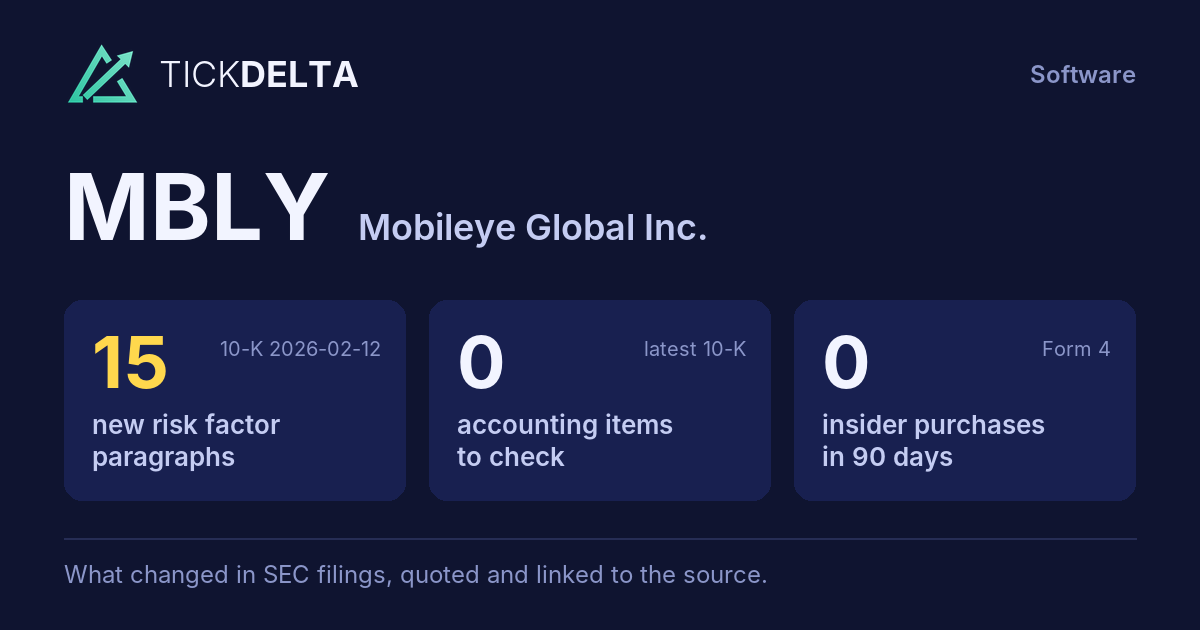
of the text changed · 29,175 words now · 15 new paragraphs, 2 gone
MD&A
26.5%
of the text changed · 12,442 words now · 21 new paragraphs, 16 gone
Legal Proceedings
31.4%
of the text changed · 1,441 words now
Accounting Policies
16.3%
of the text changed · 6,361 words now
10-K 0001104659-26-014300 (Feb 12, 2026) vs 10-K 0001410578-25-000127 (Feb 13, 2025)
Every paragraph, and how much of it changed
One bar per paragraph, in the order of the 10-K. Height and colour show the share of its words not in the closest paragraph a year earlier; the tallest bars are new paragraphs.
Risk Factors
280 paragraphs · 15 new · 71 reworded · 2 gone · 10-K Feb 12, 2026 against Feb 13, 2025
New paragraph
Reworded (5% of its words or more)
Same or nearly
Paragraph 112 · 39% changed
Every version of it
Paragraph 167 · 37% changed
Every version of it
Not all of our directors or officers are residents of the United States, and most of their and our assets are located outside the United States. Service of process upon our non-U.S. resident directors and officers and enforcement of judgments obtained in the United States against us or our non-U.S. our directors and officers may be difficult to obtain within the United States. Additionally, we have been informed by our legal counsel in Israel that it may be difficult to assert claims under U.S. securities laws in original actions instituted in Israel or obtain a judgment based on the civil liability provisions of U.S. federal securities laws. Israeli courts may refuse to hear a claim based on a violation of U.S. securities laws against us or our non-U.S. officers and directors because Israel may not be the most appropriate forum to bring such a claim. In addition, even if an Israeli court agrees to hear a claim, it may determine that Israeli law and not U.S. law is applicable to the claim. If U.S. law is found to be applicable, then the content of applicable U.S. law must be proved as a fact, which can be a time-consuming and costly process. Certain matters of procedure will also be governed by Israeli law. There is little binding case law in Israel addressing the matters described above. Additionally, Israeli courts might not enforce judgments rendered outside Israel, which may make it difficult to collect on judgments rendered against us or our non-U.S. officers and directors.
Paragraph 104 · 36% changed
Every version of it
We have experienced data breaches, cyberattacks, attempts to breach our systems, and other similar incidents, none of which have resulted in a material adverse impact to our business or operations, but there can be no guarantee we will not experience an incident that would have such an impact. Such incidents, whether or not successful, could result in our incurring significant costs related to, for example, rebuilding internal systems, writing down inventory value, implementing additional threat protection measures, providing modifications to our solutions, defending against litigation, responding to regulatory inquiries or actions, paying damages, providing customers with incentives to maintain the business relationship, or taking other remedial steps with respect to third parties, as well as reputational harm. Recent regulatory developments enhance cybersecurity disclosure and incident reporting requirements, and may increase the likelihood that cybersecurity incidents result in regulatory inquiries, reporting obligations, or enforcement actions. In addition, cybersecurity threats are constantly evolving, including through the use of AI, thereby increasing the difficulty of successfully defending against them or implementing adequate preventative measures. As a result of and following the COVID-19 pandemic, remote work and remote access to our network and systems have increased significantly, which also increases our cybersecurity attack surface. There has also been an increase in cyberattack volume, frequency, and sophistication driven by the global enablement of remote workforces. We seek to detect and investigate unauthorized attempts and attacks against our network and solutions and to prevent their recurrence where practicable through changes to our internal processes and tools and changes or updates to our solutions. However, despite the implementation of preventative and detective security controls, we, and the third parties upon which we rely, remain potentially vulnerable to additional known or unknown cybersecurity threats. In some instances, we, our suppliers, our customers, and end users, can be unaware of an incident or its magnitude and effects. Even when a security breach is detected, the full extent of the breach may not be determined, and even if determined, a full investigation may require time and resources. Any actual or perceived security incident could result in, among other things, unfavorable publicity, governmental or regulatory inquiry and oversight, difficulty in marketing our services, allegations by our customers that we have not performed our contractual obligations, litigation by affected parties, including our customers, and possible financial obligations for damages related to the theft or misuse of such information or inventory, any of which would adversely affect our business, results of operations, and financial condition.
Paragraph 76 · 35% changed
Every version of it
The success of our AMaaS and robotaxi solutions will depend on their effective deployment and operation by third parties. parties, and may be adversely affected by regulatory developments, safety incidents, negative media coverage or public perception.
Paragraph 192 · 35% changed
Every version of it
As a result of changes in Intel’s ownership of our outstanding common stock due to the Secondary Offering, Share Repurchase and Conversion (each as defined in the MD&A), we were deconsolidated from Intel’s U.S. domestic consolidated income tax return effective July 11, 2025 (the “Tax Deconsolidation”). As a result of the Tax Deconsolidation, starting on July 12, 2025, the computation of cash payable between the Company and Intel, under the Amended and Restated Tax Sharing Agreement, is no longer applicable with respect to U.S. federal and applicable state income taxes. However, other obligations of the parties under the Amended and Restated Tax Sharing Agreement remain in effect. We have were previously been included in the Consolidated Group for the most recent annual period periods prior to July 12, 2025 and expect to thereafter no longer will be included in the Consolidated Group going forward. Each member of a consolidated group during any part of a consolidated return year is jointly and severally liable for tax on the consolidated return of such year and for any subsequently determined deficiency thereon. Similarly, in some jurisdictions, each member of a consolidated, combined or unitary group for state, local, or foreign income tax purposes is jointly and severally liable for the state, local, or foreign income tax liability of each other member of the consolidated, combined or unitary group. Accordingly, for any period in which we are included in the Consolidated Group or any Combined Group, we could be liable in the event that any income tax liability was incurred, but not discharged, by any other member of any such group.
Paragraph 114 · 33% changed
Every version of it
Paragraph 154 · 31% changed
Every version of it
Trade disputes and protectionist measures, or continued uncertainty about such matters, could result in declining consumer confidence and slowing economic growth or recession, and could cause our customers to reduce, cancel, or alter the timing of their purchases with us. Sustained Such changes in global tariff policies, import/export controls or related trade restrictions could increase our costs or disrupt the supply of components used in our solutions or in our customers’ products. Our reliance on a global semiconductor and electronics supply chain means that new or expanded tariffs, retaliatory measures or shits in trade policy may lead to higher procurement expenses, longer lead times or the need to qualify alternative suppliers. These factors could adversely affect our production schedules, margins and our customers’ demand for products incorporating our technology. Additionally, sustained geopolitical tensions could lead to long-term changes in global trade and technology supply chains, and decoupling of global trade networks, which could adversely affect our business, results of operations, and financial condition.
Paragraph 185 · 44% changed
Every version of it
10-K Feb 13, 2025●Sale of our products on favorable terms. Under the terms of the Master Transaction Agreement we entered into with Intel in connection with the Mobileye IPO, so long as Intel holds at least 20% of our common stock, we will sell Intel our commercially available products, including EyeQ™ SoCs, for internal use, but not for resale on a standalone or bundled basis. We and Intel also agree pursuant to the Master Transaction Agreement to hold the other in most favored status with respect to products purchased or sold for internal use, meaning that the product prices, terms, warranties, and benefits provided between us and Intel shall be comparable to or better than the equivalent terms being offered by the party providing the products to any single, present customer of such party.
10-K Feb 12, 2026
meaning that the product prices, terms, warranties, and benefits provided between us and Intel shall be comparable to or better than the equivalent terms being offered by the party providing the products to any single, present customer of such party.
Paragraph 112 · 39% changed
Every version of it
10-K Feb 13, 2025Catastrophic events can adversely affect our business, results of operations, and financial condition.
10-K Feb 12, 2026
security and systems may result in fines, penalties, and damages, harm our reputation, and adversely affect our business, results of operations, and financial condition.
Paragraph 167 · 37% changed
Every version of it
10-K Feb 13, 2025
Not all of our directors or officers are residents of the United States, and most of their and our assets are located outside the United States. Service of process upon our non-U.S. resident directors and officers and enforcement of judgments obtained in the United States against us or our non-U.S. our directors and officers may be difficult to obtain within the United States. Additionally, we have been informed by our legal counsel in Israel that it may be difficult to assert claims under U.S. securities laws in original actions instituted in Israel or obtain a judgment based on the civil liability provisions of U.S. federal securities laws. Israeli courts may refuse to hear a claim based on a violation of U.S. securities laws against us or our non-U.S. officers and directors because Israel may not be the most appropriate forum to bring such a claim. In addition, even if an Israeli court agrees to hear a claim, it may determine that Israeli law and not U.S. law is applicable to the claim. If U.S. law is found to be applicable, then the content of applicable U.S. law must be proved as a fact, which can be a time-consuming and costly process. Certain matters of procedure will also be governed by Israeli law. There is little binding case law in Israel addressing the matters described above. Additionally, Israeli courts might not enforce judgments rendered outside Israel, which may make it difficult to collect on judgments rendered against us or our non-U.S. officers and directors.
10-K Feb 12, 2026
Not all of our directors or officers are residents of the United States, and most of their and our assets are located outside the United States. Service of process upon our non-U.S. resident directors and officers and enforcement of judgments obtained in the United States against us or our non-U.S. our directors and officers may be difficult to obtain within the United States. Additionally, we have been informed by our legal counsel in Israel that it may be difficult to assert claims under U.S. securities laws in original actions instituted in
Paragraph 104 · 36% changed
Every version of it
10-K Feb 13, 2025
We have experienced data breaches, cyberattacks, attempts to breach our systems, and other similar incidents, none of which have resulted in a material adverse impact to our business or operations, but there can be no guarantee we will not experience an incident that would have such an impact. Such incidents, whether or not successful, could result in our incurring significant costs related to, for example, rebuilding internal systems, writing down inventory value, implementing additional threat protection measures, providing modifications to our solutions, defending against litigation, responding to regulatory inquiries or actions, paying damages, providing customers with incentives to maintain the business relationship, or taking other remedial steps with respect to third parties, as well as reputational harm. In addition, cybersecurity threats are constantly evolving, including through the use of AI, thereby increasing the difficulty of successfully defending against them or implementing adequate preventative measures. As a result of and following the COVID-19 pandemic, remote work and remote access to our network and systems have increased significantly, which also increases our cybersecurity attack surface. There has also been an increase in cyberattack volume, frequency, and sophistication driven by the global enablement of remote workforces. We seek to detect and investigate unauthorized attempts and attacks against our network and solutions and to prevent their recurrence where practicable through changes to our internal processes and tools and changes or updates to our solutions. However, despite the implementation of preventative and detective security controls, we, and the third parties upon which we rely, remain potentially vulnerable to additional known or unknown cybersecurity threats. In some instances, we, our suppliers, our customers, and end users, can be unaware of an incident or its magnitude and effects. Even when a security breach is detected, the full extent of the breach may not be determined, and even if determined, a full investigation may require time and resources. Any actual or perceived security incident could result in, among other things, unfavorable publicity, governmental or regulatory inquiry and oversight, difficulty in marketing our services, allegations by our customers that we have not performed our contractual obligations, litigation by affected parties, including our customers, and possible financial obligations for damages related to the theft or misuse of such information or inventory, any of which would adversely affect our business, results of operations, and financial condition.
10-K Feb 12, 2026
We have experienced data breaches, cyberattacks, attempts to breach our systems, and other similar incidents, none of which have resulted in a material adverse impact to our business or operations, but there can be no guarantee we will not experience an incident that would have such an impact. Such incidents, whether or not successful, could result in our incurring significant costs related to, for example, rebuilding internal systems, writing down inventory value, implementing additional threat protection measures, providing modifications to our solutions, defending against litigation, responding to regulatory inquiries or actions, paying damages, providing customers with incentives to maintain the business relationship, or taking other remedial steps with respect to third parties, as well as reputational harm. Recent regulatory developments enhance cybersecurity disclosure and incident reporting requirements, and may increase the likelihood that cybersecurity incidents result in regulatory inquiries, reporting obligations, or enforcement actions. In addition, cybersecurity threats are constantly evolving, including through the use of AI, thereby increasing the difficulty of successfully
Paragraph 76 · 35% changed
Every version of it
10-K Feb 13, 2025
The success of our AMaaS solutions will depend on their effective deployment and operation by third parties.
10-K Feb 12, 2026
The success of our AMaaS and robotaxi solutions will depend on their effective deployment and operation by third parties, and may be adversely affected by regulatory developments, safety incidents, negative media coverage or public perception.
Paragraph 192 · 35% changed
Every version of it
10-K Feb 13, 2025
We have previously been included in the Consolidated Group for the most recent annual period and expect to be included in the Consolidated Group going forward. Each member of a consolidated group during any part of a consolidated return year is jointly and severally liable for tax on the consolidated return of such year and for any subsequently determined deficiency thereon. Similarly, in some jurisdictions, each member of a consolidated, combined or unitary group for state, local, or foreign income tax purposes is jointly and severally liable for the state, local, or foreign income tax liability of each other member of the consolidated, combined or unitary group. Accordingly, for any period in which we are included in the Consolidated Group or any Combined Group, we could be liable in the event that any income tax liability was incurred, but not discharged, by any other member of any such group.
10-K Feb 12, 2026
As a result of changes in Intel’s ownership of our outstanding common stock due to the Secondary Offering, Share Repurchase and Conversion (each as defined in the MD&A), we were deconsolidated from Intel’s U.S. domestic consolidated income tax return effective July 11, 2025 (the “Tax Deconsolidation”). As a result of the Tax Deconsolidation, starting on July 12, 2025, the computation of cash payable between the Company and Intel, under the Amended and Restated Tax Sharing Agreement, is no longer applicable with respect to U.S. federal and applicable state income taxes. However, other obligations of the parties under the Amended and Restated Tax Sharing Agreement remain in effect. We were previously included in the Consolidated Group for periods prior to July 12, 2025 and thereafter no longer will be included in the Consolidated Group going forward. Each member of a consolidated group during any part of a consolidated return year is jointly and severally liable for tax on the consolidated return of such year and for any subsequently determined deficiency thereon. Similarly, in some jurisdictions, each member of a consolidated, combined or unitary group for state, local, or foreign income tax purposes is jointly and severally liable for the state, local, or foreign income tax liability of each other member of the consolidated, combined or unitary group. Accordingly, for any period in which we are included in the Consolidated Group or any Combined Group, we could be liable in the event that any income tax liability was incurred, but not discharged, by any other member of any such group.
Paragraph 114 · 33% changed
Every version of it
10-K Feb 13, 2025Data privacy is subject to frequently changing rules and regulations, which sometimes conflict among the various jurisdictions and countries in which we provide services. We are subject to a variety of local, state, national and international laws, directives, and regulations that apply to the collection, use, retention, protection, security, disclosure, transfer, and other processing of personal data in the different jurisdictions in which we operate (“Data Protection Laws”). Any failure by us or our vendors or other business partners to comply with our public privacy notice or with U.S. federal, state, local, Israeli, Chinese, or other foreign or international Data Protection Laws could result in regulatory or litigation-related actions against us, legal liability, fines, damages, ongoing audit requirements, and other significant costs. Global privacy legislation, enforcement, and policy activity in this area are rapidly expanding and creating a complex regulatory compliance environment. Because many Data Protection Laws are new or subject to recent revisions or updates, there is often little clarity as to their interpretation or best practices for compliance, as well as a lack of precedent for the scope of enforcement. Costs to comply with Data Protection Laws and implement appropriate privacy and data protection measures are significant, and may require us to change our business practices and compliance manners. Any noncompliance could adversely affect our ability to collect, analyze, and store data, expose us to significant monetary penalties, damage to our reputation, result in suspension of online services or sites in certain countries, and even result in criminal sanctions. Even our inadvertent failure to comply with Data Protection Laws could result in audits, regulatory inquiries, or proceedings against us by governmental entities or other third parties. Any inability to adequately address data privacy or data protection, or other information security-related concerns, including in each case in respect of our use of AI technologies, even if unfounded, to successfully negotiate privacy, data protection, or information security-related contractual terms with customers, or to comply and demonstrate compliance with Data Protection Laws, could result in additional cost and liability to us, harm our reputation and brand, and could adversely affect our business, results of operations, and financial condition.
10-K Feb 12, 2026
Costs to comply with Data Protection Laws and implement appropriate privacy and data protection measures are significant, and may require us to change our business practices and compliance manners. Any noncompliance could adversely affect our ability to collect, analyze, and store data, expose us to significant monetary penalties, damage to our reputation, result in suspension of online services or sites in certain countries, and even result in criminal sanctions. Even our inadvertent failure to comply with Data Protection Laws could result in audits, regulatory inquiries, or proceedings against us by governmental entities or other third parties. Any inability to adequately address data privacy or data protection, or other information security-related concerns, including in each case in respect of our use of AI technologies (which are subject to increasing regulatory scrutiny and, in certain jurisdictions, new compliance frameworks applicable to high-risk or large-scale AI deployments), even if unfounded, to successfully negotiate privacy, data protection, or information security-related contractual terms with customers, or to comply and demonstrate compliance with Data Protection Laws, could result in additional cost and liability to us, harm our reputation and brand, and could adversely affect our business, results of operations, and financial condition.
Paragraph 154 · 31% changed
Every version of it
10-K Feb 13, 2025
Trade disputes and protectionist measures, or continued uncertainty about such matters, could result in declining consumer confidence and slowing economic growth or recession, and could cause our customers to reduce, cancel, or alter the timing of their purchases with us. Sustained geopolitical tensions could lead to long-term changes in global trade and technology supply chains, and decoupling of global trade networks, which could adversely affect our business, results of operations, and financial condition.
10-K Feb 12, 2026
Trade disputes and protectionist measures, or continued uncertainty about such matters, could result in declining consumer confidence and slowing economic growth or recession, and could cause our customers to reduce, cancel, or alter the timing of their purchases with us. Such changes in global tariff policies, import/export controls or related trade restrictions could increase our costs or disrupt the supply of components used in our solutions or in our customers’ products. Our reliance on a global semiconductor and electronics supply chain means that new or expanded tariffs, retaliatory measures or shits in trade policy may lead to higher procurement expenses, longer lead times or the need to qualify alternative suppliers. These factors could adversely affect our production schedules, margins and our customers’ demand for products incorporating our technology. Additionally, sustained geopolitical tensions could lead to long-term changes in global trade and technology supply chains, and decoupling of global trade networks, which could adversely affect our business, results of operations, and financial condition.
MD&A
150 paragraphs · 21 new · 67 reworded · 16 gone · 10-K Feb 12, 2026 against Feb 13, 2025
New paragraph
Reworded (5% of its words or more)
Same or nearly
Paragraph 100 · 47% changed
Paragraph 145 · 47% changed
Paragraph 108 · 44% changed
Our Adjusted Gross Margin decreased from 70% for 2023 to was 68% for 2024. The decrease both in 2024 and in 2025. This was primarily due to the downward impact of the increased a higher EyeQ™-related cost per unit given the different mix of our EyeQ™ SoCs due to mix effects. The decrease products sold which was also related to fully offset by the higher percentage of revenue attributable attributed to Supervision™. EyeQ™.
Paragraph 57 · 42% changed
During the years presented in our consolidated financial statements, certain components of our business operations were included in the consolidated U.S. tax return filed by Intel. We also file certain foreign income tax returns on a separate basis, distinct from Intel. The Following the Secondary Offering, which resulted in the Tax Deconsolidation (see Note 1 to the consolidated financial statements), the Company is no longer included in Intel’s U.S. federal consolidated income tax return and will be filing its own U.S. federal income tax returns for periods beginning July 12, 2025 onwards. Since prior to the Tax Deconsolidation, the Company’s income tax provision included in our consolidated financial statements has been was calculated using the separate return method method, as if we the Company had filed our its own tax returns. We present tax loss and tax credit carry-forward amounts that have not been utilized by Intel only to the extent such tax attributes can be claimed as a benefit consistent with our separate tax return method approach. The use of the separate return method may result in differences between our U.S. federal income tax returns, the Tax Deconsolidation event does not have a material impact on the Company’s tax provision compared to Intel’s consolidated income tax provision. for the year ended December 27, 2025.
Paragraph 66 · 42% changed
Research and development expenses, net, in 2024, 2025, increased by $194 $68 million, or 22%, 6%, compared to 2023. 2024. This increase was primarily due to an increase in payroll and related expenses, resulting from an increase in average research and development headcount of 348 employees, 147 employees and an increase the costs related to the reduction in share-based compensation, which workforce implemented during the fourth quarter of 2025. This was partially offset by military duty reserve refunds from the state of Israel. In addition, there was an increase a decrease in direct expenses including professional services mostly related to investments attributable the wind-down of the Lidar R&D Unit that took place in 2024, in addition to new product development and also an increase in depreciation costs associated with the new campus and additional sites. lower share-based compensation.
Paragraph 22 · 40% changed
Paragraph 39 · 38% changed
Paragraph 144 · 38% changed
Certain components of the Company’s business operations were included in the consolidated U.S. domestic income tax return filed by Intel. The Company also files various foreign income tax returns on a separate basis, distinct from Intel. The Following the Secondary Offering, which resulted in the Tax Deconsolidation (see also Note 1 General), the Company is no longer included in the Parent’s U.S. domestic consolidated federal and applicable state income tax returns and will be filing its own U.S. corporate income tax returns for periods beginning July 12, 2025 onwards. Prior to the Tax Deconsolidation event, the income tax provision included in the Company’s consolidated financial statements has been was calculated using the separate return method, as if the Company had filed its own U.S. corporate income tax returns. The Company has entered into the Tax Sharing Agreement with Intel that establishes the respective rights, responsibilities and obligations of the Company and Intel with respect to tax matters and, therefore, ultimately governs the amount payable to Intel with respect to income taxes.
Paragraph 100 · 47% changed
10-K Feb 13, 2025Severance pay liability increased from $56 million as of December 30, 2023, to $62 million and as of December 28, 2024, reflecting mainly the impact of annual salary increases.
10-K Feb 12, 2026
increased from $50 million as of December 28, 2024 to $62 million as of December 27, 2025, reflecting mainly new lease contracts and foreign currency exchange effects, partially offset by the progress in lease payments for existing arrangements.
Paragraph 145 · 47% changed
10-K Feb 13, 2025Any differences between taxes currently payable to Intel under the Tax Sharing Agreement and the current tax provision computed on a separate return basis, is reflected as adjustments to additional paid-in capital in the consolidated statement of shareholders’ equity and financing activities within the consolidated statement of cash flows. According to the terms of the Tax Sharing Agreement, the Company and Intel will calculate and agree to estimated amounts owed quarterly but final amounts will also be calculated and paid upon consolidated tax return filings. Amounts payable under the Tax Sharing Agreement will be recorded in the same manner as other contractual obligations entered into by the Company.
10-K Feb 12, 2026
The Company had previously entered into a Tax Sharing Agreement with Intel, which was amended and restated on August 14, 2024 (the Tax Sharing Agreement, as amended, the “TSA”), and establishes the amount of cash payable for the Company’s share of the tax liability owed on consolidated tax return filings with Intel. For periods prior to the Tax Deconsolidation, any differences between taxes currently payable to Intel under the Tax Sharing Agreement and the current tax provision computed on a separate return basis, were reflected as adjustments to additional paid-in capital in the consolidated statement of changes in equity and financing activities within the consolidated statement of cash flows. As a result of the Tax Deconsolidation, starting July 12, 2025 the computation of cash payable between the Company and Intel, under the TSA, is no longer applicable with respect to U.S. federal and applicable state income taxes. Accordingly, starting July 12, 2025, Mobileye calculates and reports its U.S. federal and applicable state income tax liabilities as a standalone taxpayer and will no longer allocate or share tax attributes, liabilities nor benefits with its Parent as previously required under the TSA. For periods prior to Tax Deconsolidation, Mobileye and its Parent will continue to account for any outstanding tax sharing obligations in accordance with the terms of the TSA.
Paragraph 108 · 44% changed
10-K Feb 13, 2025
Our Adjusted Gross Margin decreased from 70% for 2023 to 68% for 2024. The decrease was primarily due to the downward impact of the increased cost per unit of our EyeQ™ SoCs due to mix effects. The decrease was also related to higher percentage of revenue attributable to Supervision™.
10-K Feb 12, 2026
Our Adjusted Gross Margin was 68% both in 2024 and in 2025. This was due to a higher EyeQ™-related cost per unit given the different mix of EyeQ™ products sold which was fully offset by the higher percentage of revenue attributed to EyeQ™.
Paragraph 57 · 42% changed
10-K Feb 13, 2025
During the years presented in our consolidated financial statements, certain components of our business operations were included in the consolidated U.S. tax return filed by Intel. We also file certain foreign income tax returns on a separate basis, distinct from Intel. The income tax provision included in our consolidated financial statements has been calculated using the separate return method as if we had filed our own tax returns. We present tax loss and tax credit carry-forward amounts that have not been utilized by Intel only to the extent such tax attributes can be claimed as a benefit consistent with our separate tax return method approach. The use of the separate return method may result in differences between our income tax provision compared to Intel’s consolidated income tax provision.
10-K Feb 12, 2026
During the years presented in our consolidated financial statements, certain components of our business operations were included in the consolidated U.S. tax return filed by Intel. We also file certain foreign income tax returns on a separate basis, distinct from Intel. Following the Secondary Offering, which resulted in the Tax Deconsolidation (see Note 1 to the consolidated financial statements), the Company is no longer included in Intel’s U.S. federal consolidated income tax return and will be filing its own U.S. federal income tax returns for periods beginning July 12, 2025 onwards. Since prior to the Tax Deconsolidation, the Company’s income tax provision was calculated using the separate return method, as if the Company had filed its own U.S. federal income tax returns, the Tax Deconsolidation event does not have a material impact on the Company’s tax provision for the year ended December 27, 2025.
Paragraph 66 · 42% changed
10-K Feb 13, 2025
Research and development expenses, net, in 2024, increased by $194 million, or 22%, compared to 2023. This increase was primarily due to an increase in payroll and related expenses, resulting from an increase in average research and development headcount of 348 employees, and an increase in share-based compensation, which was partially offset by military duty reserve refunds from the state of Israel. In addition, there was an increase related to investments attributable to new product development and also an increase in depreciation costs associated with the new campus and additional sites.
10-K Feb 12, 2026
Research and development expenses, net, in 2025, increased by $68 million, or 6%, compared to 2024. This increase was primarily due to an increase in payroll and related expenses, resulting from an increase in average research and development headcount of 147 employees and the costs related to the reduction in workforce implemented during the fourth quarter of 2025. This was partially offset by a decrease in direct expenses including professional services mostly related to the wind-down of the Lidar R&D Unit that took place in 2024, in addition to lower share-based compensation.
Paragraph 22 · 40% changed
10-K Feb 13, 2025We invest significant time and other resources early in the process of new program sourcing as part of our relationship with an OEM. We typically have visibility into the number of models that are expected to include our products at least two to three years in advance based on OEM information provided during the sourcing and nomination process, although there is no contractual commitment by the OEM to purchase particular volumes, and programs are subject to changes with respect to timing and volumes. The revenue that we may recognize in any given year is attributable to program design wins in previous years.
10-K Feb 12, 2026
by the OEM to purchase particular volumes, and programs are subject to changes with respect to timing and volumes. The revenue that we may recognize in any given year is attributable to program design wins in previous years.
Paragraph 39 · 38% changed
10-K Feb 13, 2025The cost of input materials and manufacturing costs are significant factors affecting our gross margin. Material costs are affected by a variety of factors, including the availability of sufficient supply to meet market demand. For example, in late 2021, semiconductor fabrication costs increased as a result of a global supply shortage that began in 2020. We experienced increases in input costs in 2022 and 2023 as a result of supply chain shortages, including the global semiconductor shortage, and inflationary pressures. While we were largely successful in increasing our ASPs to reflect these cost increases, we experienced a reduction in percentage gross margin as a result of these cost increases. Our gross margin has been and may continue to be affected by our ability to offset these and any future cost increases through realizing pricing increases on our solutions and achieving decreases in other production costs. We work closely with STMicroelectronics, Quanta Computer and other suppliers on a continuous basis to manage material costs, increase yields and improve manufacturing, assembly, and test costs.
10-K Feb 12, 2026
production of our solutions, including EyeQ™ SoCs and ECUs for our SuperVision™, Mobileye Chauffeur™ and Mobileye Drive™ solutions. This new demand has resulted in and may continue to result in shortages of components necessary for our solutions and substantial increases in prices for such components. Our gross margin has been and may continue to be affected by our ability to offset these and any future cost increases through realizing pricing increases on our solutions and achieving decreases in other production costs. We work closely with STMicroelectronics, Quanta Computer and other suppliers on a continuous basis to manage material costs, increase yields and improve manufacturing, assembly, and test costs.
Paragraph 144 · 38% changed
10-K Feb 13, 2025
Certain components of the Company’s business operations were included in the consolidated U.S. income tax return filed by Intel. The Company also files various foreign income tax returns on a separate basis, distinct from Intel. The income tax provision included in the Company’s consolidated financial statements has been calculated using the separate return method, as if the Company had filed its own tax returns. The Company has entered into the Tax Sharing Agreement with Intel that establishes the respective rights, responsibilities and obligations of the Company and Intel with respect to tax matters and, therefore, ultimately governs the amount payable to Intel with respect to income taxes.
10-K Feb 12, 2026
Certain components of the Company’s business operations were included in the consolidated U.S. domestic income tax return filed by Intel. The Company also files various foreign income tax returns on a separate basis, distinct from Intel. Following the Secondary Offering, which resulted in the Tax Deconsolidation (see also Note 1 General), the Company is no longer included in the Parent’s U.S. domestic consolidated federal and applicable state income tax returns and will be filing its own U.S. corporate income tax returns for periods beginning July 12, 2025 onwards. Prior to the Tax Deconsolidation event, the income tax provision included in the Company’s consolidated financial statements was calculated using the separate return method, as if the Company had filed its own U.S. corporate income tax returns.
A paragraph is matched with the one last year that shares the most of its words; under half in common makes it new. The paragraphs shown are the 8 reworded the most in each section.
The paragraph that changed most in each section
The redline
Marked against last year's 10-K: cut words struck through, new words highlighted.
Risk Factors276 words changed in this paragraph; it is 50% similar to last year's version.
We have experienced data breaches, cyberattacks, attempts to breach our systems, and other similar incidents, none of which have resulted in a material adverse impact to our business or operations, but there can be no guarantee we will not experience an incident that would have such an impact. Such incidents, whether or not successful, could result in our incurring significant costs related to, for example, rebuilding internal systems, writing down inventory value, implementing additional threat protection measures, providing modifications to our solutions, defending against litigation, responding to regulatory inquiries or actions, paying damages, providing customers with incentives to maintain the business relationship, or taking other remedial steps with respect to third parties, as well as reputational harm. Recent regulatory developments enhance cybersecurity disclosure and incident reporting requirements, and may increase the likelihood that cybersecurity incidents result in regulatory inquiries, reporting obligations, or enforcement actions. In addition, cybersecurity threats are constantly evolving, including through the use of AI, thereby increasing the difficulty of successfully defending against them or implementing adequate preventative measures. As a result of and following the COVID-19 pandemic, remote work and remote access to our network and systems have increased significantly, which also increases our cybersecurity attack surface. There has also been an increase in cyberattack volume, frequency, and sophistication driven by the global enablement of remote workforces. We seek to detect and investigate unauthorized attempts and attacks against our network and solutions and to prevent their recurrence where practicable through changes to our internal processes and tools and changes or updates to our solutions. However, despite the implementation of preventative and detective security controls, we, and the third parties upon which we rely, remain potentially vulnerable to additional known or unknown cybersecurity threats. In some instances, we, our suppliers, our customers, and end users, can be unaware of an incident or its magnitude and effects. Even when a security breach is detected, the full extent of the breach may not be determined, and even if determined, a full investigation may require time and resources. Any actual or perceived security incident could result in, among other things, unfavorable publicity, governmental or regulatory inquiry and oversight, difficulty in marketing our services, allegations by our customers that we have not performed our contractual obligations, litigation by affected parties, including our customers, and possible financial obligations for damages related to the theft or misuse of such information or inventory, any of which would adversely affect our business, results of operations, and financial condition.
Source: Item 1A, 10-K 0001104659-26-014300 vs Item 1A, 10-K 0001410578-25-000127
MD&A222 words changed in this paragraph; it is 32% similar to last year's version.
Source: Item 7, 10-K 0001104659-26-014300 vs Item 7, 10-K 0001410578-25-000127
Legal Proceedings214 words changed in this paragraph; it is 53% similar to last year's version.
On January 26, 2024, Facet Technology Corp. (“Facet”) sued Mobileye in the U.S. District Court for the Eastern District of Texas for allegedly infringing two patents. Captioned Facet Technology Corp. v. Mobileye Global, Inc., the complaint alleges that certain Mobileye products directly and indirectly infringe both patents. The complaint seeks unspecified damages, a permanent injunction, and attorneys’ fees and costs. We have moved On November 4, 2024, Mobileye filed a motion to dismiss asserting improper venue, which the court dismissed without prejudice to refile in view of an amended complaint for improper venue filed by Facet, adding Mobileye Vision Technologies Ltd. and await a ruling. Mobileye Inc., each wholly-owned indirect subsidiaries of Mobileye Global Inc., as additional defendants. On November 7, 2024, Mobileye Vision Technologies Ltd. and Mobileye Inc., each a wholly-owned indirect subsidiary of Mobileye Global Inc., sued Facet Technology Corp. in the U.S. District Court of Minnesota seeking a declaratory judgement judgment that the Mobileye plaintiffs do not infringe either patent. On March 5, 2025, the Patent Trial and Appeal Board (“PTAB”) of the US Patent and Trademark Office instituted two Inter Parte Review (IPR) proceedings filed by Mobileye Vision Technologies Ltd. against the patents asserted by Facet. On March 15, 2025, the parties agreed and the relevant courts entered orders staying all litigation pending the outcome of the both IPRs. On January 23, 2026, the PTAB issued final written decisions in both IPRs, finding some claims unpatentable and permitting some claims to survive. For the claims asserted against Mobileye in district court, the PTAB ruled in Mobileye’s favor on all claims except a single claim of one patent. Both parties have until February 23, 2026 to request Director Review. If no request for Director Review is filed, the parties have until March 27, 2026 to file a notice of appeal with the Court of Appeals for the Federal Circuit. We intend to defend the matter vigorously. No provision was recorded in the consolidated financial statements as of December 28, 2024. 27, 2025.
Source: Item 3, 10-K 0001104659-26-014300 vs Item 3, 10-K 0001410578-25-000127
Accounting Policies157 words changed in this paragraph; it is 54% similar to last year's version.
The Company has had previously entered into a Tax Sharing Agreement with its Parent that establishes (which was amended and restated on August 14, 2024) (the Tax Sharing Agreement, as amended, the “TSA”), to establish the amount of cash payable for the Company’s share of the tax liability owed on consolidated tax return filings with its Parent. Any For periods prior to the Tax Deconsolidation, any differences between taxes currently payable to the Company’s Parent under the Tax Sharing Agreement TSA and the current tax provision computed on a separate return basis, is were reflected as adjustments to additional paid-in capital in the consolidated statement of changes in equity and financing activities within the consolidated statement of cash flows. As a result of the Tax Deconsolidation, starting July 12, 2025 the computation of cash payable between the Company and Intel, under the TSA, is no longer applicable with respect to U.S. federal and applicable state income taxes. Accordingly, starting July 12, 2025, Mobileye calculates and reports its U.S. federal and applicable state income tax liabilities as a standalone taxpayer and will no longer allocate or share tax attributes, liabilities or benefits with its Parent as previously required under the TSA. For periods prior to the Tax Deconsolidation, Mobileye and its Parent will continue to account for any outstanding tax sharing obligations in accordance with the terms of the TSA. For additional information regarding the Tax Sharing Agreement, see Note 9 of the Notes to Consolidated Financial Statements. Related Party Transactions.
Source: Item 8, Note 2 – SIGNIFICANT ACCOUNTING POLICIES, 10-K 0001104659-26-014300 vs Item 8, Note 2 – SIGNIFICANT ACCOUNTING POLICIES, 10-K 0001410578-25-000127
Sentences and paragraphs added, removed or reworded
Every change, by type
Sentences and paragraphs of MBLY's Risk Factors and MD&A, 10-K Feb 12, 2026 against 10-K Feb 13, 2025. Each links to the text at sec.gov.
Quiet changes are sentences kept from last year with one to four words changed, at least one of them a hedge, a modal or a qualifier (may, could, will, not, significant, material…). A year or date rolling forward is not counted.
The full word list
adverse, adversely, all, although, anticipate, anticipates, any, approximately, believe, believes, can, cannot, certain, could, expect, expects, generally, however, if, intend, intends, largely, likely, many, material, materially, may, might, most, must, never, no, not, possible, primarily, probable, should, significant, significantly, some, substantial, substantially, unlikely, will, would
AddedRisk Factors
We may face increased competition surrounding the development of our next generation chips from OEMs and emerging chip manufacturers entering the market.
Read it in 10-K Feb 12, 2026 at sec.gov
AddedRisk Factors
Competition in the humanoid and Physical AI robotics market is intense and rapidly evolving, with a growing number of well-capitalized companies developing general-purpose bipedal robots and related autonomy stacks for industrial and warehouse use. Mobileye and Mentee face competition from other humanoid robotics developers such as Tesla, Figure AI, Sanctuary AI, PAL Robotics, Agility Robotics and Boston Dynamics (of which HKMC holds an 80% beneficial ownership interest), as well as additional emerging players (including a number of Chinese robotics companies) seeking to commercialize similar capabilities.
Read it in 10-K Feb 12, 2026 at sec.gov
AddedRisk Factors
services that affect the performance of EyeQ™ SoCs, notwithstanding the absence of any defect in design or manufacture or other failure in EyeQ™ SoCs themselves, could result in additional claims being made against us.
Read it in 10-K Feb 12, 2026 at sec.gov
AddedRisk Factors
In addition, humanoid robotics is an emerging industry and the types of legal claims brought against us, if any, may be complex and unprecedented. We may be required to incur significant costs and resources related to any litigation related to the use of humanoid robot systems as we continue the development and deployment of technologies.
Read it in 10-K Feb 12, 2026 at sec.gov
AddedRisk Factors
Our reliance on third-party partners for robotaxi deployments exposes us to risks associated with complex and evolving commercial relationships, including disagreements regarding deployment schedules, operational responsibilities, economics, branding, data access and use, liability allocation, and the allocation of costs associated with vehicle hardware, software updates, maintenance and fleet operations. Our partners may also face their own operational, financial or strategic challenges, may decide to delay, reduce or discontinue their autonomous mobility programs, may pursue competing technologies or in-house solutions, or may exit certain markets or geographies, any of which could adversely affect demand for our technology and our ability to achieve anticipated benefits from our AMaaS and robotaxi initiatives.
Read it in 10-K Feb 12, 2026 at sec.gov
AddedRisk Factors
Robotaxi services represent a particularly demanding application of autonomous driving technology and are subject to heightened technological, safety, regulatory and operational risks compared to driver-assistance or consumer autonomous driving applications. Autonomous vehicles intended for driverless commercial operation must function reliably across diverse and complex real-world conditions, including dense urban environments, variable weather, unpredictable behavior by other road users and rare or novel edge cases. Any real or perceived failure of vehicles incorporating our technology to operate safely could result in accidents, injuries or fatalities, increased regulatory scrutiny, litigation, reputational harm, reduced consumer acceptance and reluctance by partners or regulators to approve or expand robotaxi deployments.
Read it in 10-K Feb 12, 2026 at sec.gov
AddedRisk Factors
In addition, the success of our robotaxi platform and future autonomous mobility products may be significantly influenced by media coverage, public commentary and public perception regarding autonomous driving technologies generally, and robotaxi services in particular. Media coverage of accidents, system failures, regulatory actions or other events involving autonomous vehicles, whether or not such events involve our technology or accurately reflect its performance, may disproportionately influence public opinion, regulatory attitudes and the willingness of consumers, fleet operators and transportation network companies and other mobility service providers to adopt or expand robotaxi services. Negative or inaccurate media coverage, heightened scrutiny by regulators or policymakers, or shifts in public sentiment regarding the safety or reliability of autonomous vehicles could adversely affect demand for our products, delay commercialization efforts and impair the long-term adoption of our autonomous mobility solutions.
Read it in 10-K Feb 12, 2026 at sec.gov
AddedRisk Factors
Robotaxi services are also subject to evolving, fragmented and jurisdiction-specific regulatory regimes governing autonomous vehicle testing and deployment, commercial transportation services, data privacy, cybersecurity, insurance and ongoing reporting obligations. Regulatory requirements may change over time, differ materially across jurisdictions and impose conditions that limit operational flexibility, increase costs or delay or prevent large-scale deployment. There can be no assurance that the regulatory approvals required for the widespread commercialization of robotaxi services will be obtained on a timely basis, on commercially reasonable terms, or at all.
Read it in 10-K Feb 12, 2026 at sec.gov
Show the other 55
AddedRisk Factors
On February 3, 2026, we acquired 100% of the issued and outstanding stock of Mentee Robotics Ltd., a privately held Israeli company focused on humanoid robotics, in exchange for a purchase price consisting of cash and shares of Class A common stock. We face risks, uncertainties and potential disruptions with the integration of Mentee Robotics and its personnel, technology and operations. We may not realize the anticipated benefits of the acquisition, and our operating results and financial condition could be adversely affected. Humanoid robotics represents a nascent and rapidly evolving market characterized by significant technological complexity, long development timelines, potentially high capital requirements, uncertain customer demand, and evolving regulatory and safety frameworks. The commercialization of humanoid robotics remains subject to significant uncertainties, including regulatory approval across jurisdictions, public acceptance, safety performance, scalability and economic viability.
Read it in 10-K Feb 12, 2026 at sec.gov
AddedRisk Factors
Changes in global tariff policies, import/export controls, or related trade restrictions could increase our costs or disrupt the supply of components used in our products. Our reliance on a global semiconductor and electronics supply chain means that new or expanded tariffs, retaliatory measures, or shifts in trade policy may lead to higher procurement expenses, longer lead times, or the need to qualify alternative suppliers. These factors could adversely affect our production schedules, margins, and our customers’ demand for products incorporating our technology.
Read it in 10-K Feb 12, 2026 at sec.gov
AddedRisk Factors
As a result of the Tax Deconsolidation, we are now solely responsible for the preparation, filing and payment of our U.S. federal and applicable state income taxes on a standalone basis. This transition may increase the complexity of our tax compliance and reporting obligations and require additional internal controls, systems, personnel and external advisory support.
Read it in 10-K Feb 12, 2026 at sec.gov
AddedRisk Factors
resolution of issues arising from tax audits, including payment of interest and penalties;
Read it in 10-K Feb 12, 2026 at sec.gov
RemovedRisk Factors
RemovedRisk Factors
RewordedRisk Factors
Moreover, an Israeli court will not enforce a non-Israeli judgment if it was given in a state whose laws do not provide for the enforcement of judgments of Israeli courts (subject to exceptional cases), if its enforcement is likely to prejudice the sovereignty or security of the State of Israel, if it was obtained by fraud or in the absence of due process, if it is at variance with another valid judgment that was given in the same matter between the same parties, or if a suit in the same matter between the same parties was pending before a court or tribunal in Israel at the time the foreign action was brought.
Read it in 10-K Feb 12, 2026 at sec.gov
RewordedRisk Factors
We and Intel also agree pursuant to the Master Transaction Agreement to hold the other in most favored status with respect to products purchased or sold for internal use, meaning that the product prices, terms, warranties, and benefits provided between us and Intel shall be comparable to or better than the equivalent terms being offered by the party providing the products to any single, present customer of such party.
Read it in 10-K Feb 12, 2026 at sec.gov
RewordedRisk Factors
RewordedRisk Factors
In addition, under the terms of the Master Transaction Agreement we entered into with Intel in connection with the Mobileye IPO, we granted Intel a continuing right to purchase from us such number of shares of Class A common stock or Class B common stock as is necessary for Intel to maintain an aggregate ownership of our common stock representing at least 80.1% of our common stock outstanding following the Mobileye IPO.
Read it in 10-K Feb 12, 2026 at sec.gov
RewordedRisk Factors
In addition, because ADAS and autonomous driving technologies rely on products and services provided by third parties, there is the potential that the failure of such third-party products or services that affect the performance of EyeQ™ SoCs, notwithstanding the absence of any defect in design or manufacture or other failure in EyeQ™ SoCs themselves, could result in additional claims being made against us.
Read it in 10-K Feb 12, 2026 at sec.gov
RewordedRisk Factors
The dual class structure of our common stock has the effect of concentrating voting control with Intel, and Intel will beneficially own owns 50,000,000 shares of our Class A common stock and all of the outstanding shares of our Class B common stock, representing a majority of the shares approximately 79.5% of our outstanding common stock and approximately 98.6% 97.3% of the voting power of our outstanding common stock as of December 28, 2024. 27, 2025.
Read it in 10-K Feb 12, 2026 at sec.gov
RewordedRisk Factors
For example, Professor Shashua is also the Chairman and co-founder of AI21 Labs, which works to use AI to understand and create natural language, the Co-Chairman and co-founder of OrCam, which harnesses computer vision and AI to assist the visually and hearing impaired, the Founder of One Zero Digital Bank, an entirely digital independent bank being developed in Israel, the Chairman and co-founder of Mentee Robotics, which aims to build humanoid robots, Mobileye acquired on February 3, 2026, a co-founder, CEO and director of AA-I Technologies, which is developing AI super intelligence for scientific and research applications, and the Sachs Chair in Computer Science at the Hebrew University of Jerusalem, where he teaches and supervises graduate students.
Read it in 10-K Feb 12, 2026 at sec.gov
RewordedRisk Factors
For example, as a result of Israel’s current war against Hamas the conflicts in the Gaza Strip Strip, Northern Israel, Lebanon, Iran and tensions with Hezbollah in northern Israel, the broader region, as of January 31, 2025 February 3, 2026 approximately 3.7% 3.3% of our employees have been called to reserve duty in the Israel Defense Forces.
Read it in 10-K Feb 12, 2026 at sec.gov
RewordedRisk Factors
We may have conflicts of interest with Intel, and because of (i) certain provisions in our amended and restated certificate of incorporation relating to related person transactions and corporate opportunities, (ii) agreements we entered into with Intel in connection with the Mobileye IPO, and (iii) Intel’s controlling beneficial ownership interest in our company, we may not be able to resolve such conflicts on terms favorable to us.
Read it in 10-K Feb 12, 2026 at sec.gov
RewordedRisk Factors
RewordedRisk Factors
RewordedRisk Factors
Any inability to adequately address data privacy or data protection, or other information security-related concerns, including in each case in respect of our use of AI technologies, technologies (which are subject to increasing regulatory scrutiny and, in certain jurisdictions, new compliance frameworks applicable to high-risk or large-scale AI deployments), even if unfounded, to successfully negotiate privacy, data protection, or information security-related contractual terms with customers, or to comply and demonstrate compliance with Data Protection Laws, could result in additional cost and liability to us, harm our reputation and brand, and could adversely affect our business, results of operations, and financial condition.
Read it in 10-K Feb 12, 2026 at sec.gov
Quiet changesRisk Factors
AddedMD&A
On July 9, 2025, the Company announced the pricing of a public secondary offering of 50,000,000 shares of Class A common stock (which shares were received upon the conversion of 50,000,000 shares of Class B common stock into Class A common stock) by Intel at a public offering price of $16.50 per share (the “Secondary Offering”), with Intel granting the underwriters a 30-day option to purchase up to an additional 7,500,000 shares of Class A common stock (the “Option”). The Secondary Offering closed on July 11, 2025.
Read it in 10-K Feb 12, 2026 at sec.gov
AddedMD&A
In connection with and conditional upon the closing of the Secondary Offering, on July 11, 2025 the Company purchased from Intel 6,231,985 shares of Class A common stock (which shares were received upon the conversion of 6,231,985 shares of Class B common stock into Class A common stock) at a price of $16.04625 share, which is equal to the per share purchase price paid by the underwriters in the Secondary Offering pursuant to a share repurchase agreement with Intel (the “Share Repurchase”). The aggregate consideration paid by the Company for the Share Repurchase was $100 million. Upon closing of the Share Repurchase, the Company cancelled and retired the 6,231,985 shares of Class A common stock acquired pursuant to the Share Repurchase.
Read it in 10-K Feb 12, 2026 at sec.gov
AddedMD&A
Following the closing of the Share Repurchase, the underwriters exercised the Option (which shares were received upon the conversion of 7,500,000 shares of Class B common stock into Class A common stock), which closed on July 11, 2025. The Company did not sell any shares of Class A common stock in the Secondary Offering or in respect of the exercise of the Option, and did not receive any proceeds from the sale of shares offered by Intel in each instance.
Read it in 10-K Feb 12, 2026 at sec.gov
AddedMD&A
In addition to and conditional upon the closing of the Secondary Offering, Intel voluntarily converted pursuant to the Company’s Amended and Restated Certificate of Incorporation an additional 50,000,000 shares of Class B common stock to Class A common stock (the “Conversion”). The shares issued to Intel pursuant to the Conversion were issued pursuant to an exemption from registration pursuant to Section 3(a)(9) of the U.S. Securities Act of 1933. The Company received no proceeds from issuance of shares in the Conversion.
Read it in 10-K Feb 12, 2026 at sec.gov
AddedMD&A
The Company paid the costs associated with the registration of shares in connection with the Secondary Offering and the Option, other than underwriting discounts, fees and commissions.
Read it in 10-K Feb 12, 2026 at sec.gov
AddedMD&A
Upon completion of the Secondary Offering, Share Repurchase, Option and Conversion, Intel continues to directly or indirectly hold all of the Class B common stock of Mobileye as well as 50,000,000 shares of Class A common stock, which as of December 27, 2025, together represent approximately 79.5% of our outstanding common stock and 97.3% of the voting power of our common stock. Due to the issuance of shares of Class A common stock in connection with the Acquisition (as defined below), Intel beneficially owns approximately 77.0% of our outstanding common stock and 96.9% of the voting power of our outstanding common stock as of February 3, 2026.
Read it in 10-K Feb 12, 2026 at sec.gov
AddedMD&A
On February 3, 2026, the Company and Mobileye Vision Technologies Ltd. (a wholly-owned indirect subsidiary of the Company) acquired 100% of the issued and outstanding stock of Mentee Robotics Ltd. (“Mentee Robotics” and such transaction, the “Acquisition”), pursuant to a share purchase agreement dated as of January 5, 2026, by and among the Company, Mobileye Vision Technologies Ltd., Mentee Robotics, the shareholders of Mentee Robotics, and Shareholder Representative Services LLC, as the exclusive representative of the Mentee Robotics shareholders.
Read it in 10-K Feb 12, 2026 at sec.gov
AddedMD&A
The Acquisition was approved by the Company’s Board of Directors (the “Board”), acting on the recommendation of a strategic transaction committee consisting of four disinterested directors (two of whom are independent). The Audit Committee of the Board also approved the Acquisition pursuant to the Company’s Related Persons Transaction Policy. Intel, as the sole beneficial holder of the Company’s issued and outstanding Class B common stock, also approved the Acquisition pursuant to the Company’s Amended and Restated Certificate of Incorporation. Prof. Amnon Shashua recused himself from the Board’s consideration and approval of the Acquisition. Prof. Shashua, President and CEO of the Company, is the Chairman, Co-Founder and a significant shareholder of Mentee Robotics, and Prof. Shai Shalev-Shwartz, Chief Technology Officer of the Company, is Co-Founder and a significant shareholder of Mentee Robotics (Prof. Shalev-Shwartz, together with Prof. Shashua and Prof. Lior Wolf, the Chief Executive Officer and a Co-Founder of Mentee Robotics, the “Mentee Founders”). In addition, Prof. Shashua’s son and son-in-law, are both employees of Mentee Robotics and each held vested and unvested options issued pursuant to Mentee Robotics’ employee incentive plan and therefore received some consideration pursuant to the terms of the Share Purchase Agreement.
Read it in 10-K Feb 12, 2026 at sec.gov
AddedMD&A
The Share Purchase Agreement provided for an aggregate purchase price of $900 million, which consisted of (i) approximately $612 million in cash (subject to certain adjustments,) and (ii) 26,279,824 shares of Class A common stock of the Company. The entirety of such Class A common stock was allocated to the Mentee Founders (the “Aggregate Stock Consideration”). 10% of the Aggregate Stock Consideration is subject to a six-month lock-up period pursuant to a Lock-Up Agreement. The remaining 90% of the Aggregate Stock Consideration was deposited with a deferred consideration trustee and will be released in equal portions twenty-four and forty-eight months after the closing date on February 3, 2026, subject to continued employment, or under certain circumstances affiliation, with the Company and its subsidiaries. Prof. Shashua received 37.83% of the total consideration, valued at approximately $341 million, to be paid evenly in cash and the Company’s Class A Stock, and Prof. Shalev-Shwartz received 13.07% of the total consideration, valued at approximately $118 million, to be paid evenly in cash and the Company’s Class A common stock.
Read it in 10-K Feb 12, 2026 at sec.gov
AddedMD&A
At the closing, $95 million of the purchase price was deposited with an escrow agent (provided that with respect to Mentee Founders, 50% of their pro rata portion of the escrow was deposited in the form of Class A common stock) to secure the post-closing purchase price adjustments and certain indemnification obligations of the shareholders of Mentee Robotics.
Read it in 10-K Feb 12, 2026 at sec.gov
AddedMD&A
Pursuant to the Share Purchase Agreement, (i) all vested options to acquire shares of Mentee Robotics (each option, a “Mentee Option”) and 20% of unvested Mentee Options were cancelled and converted into the right to receive a portion of the cash consideration based on the intrinsic value of such Mentee Options at the purchase price and (ii) all remaining unvested Mentee Options were cancelled and converted into the right to receive a number of unvested RSUs of the Company calculated based on the volume weighted average of the closing sale prices for the Company’s Class A common stock over the thirty (30) Trading Days ending immediately prior to February 3, 2026 and with a value equal to the intrinsic value of such Mentee Options at the purchase price.
Read it in 10-K Feb 12, 2026 at sec.gov
AddedMD&A
The Share Purchase Agreement contains customary representations, warranties and covenants of the Company, Mobileye Vision Technologies Ltd. and Mentee Robotics, certain of which (except for the representations and warranties of the Company) shall survive the closing of the Acquisition. The shareholders of Mentee Robotics have agreed to indemnify the Company and Mobileye Vision Technologies Ltd. for certain breaches of representations, warranties and covenants.
Read it in 10-K Feb 12, 2026 at sec.gov
RemovedMD&A
RemovedMD&A
RemovedMD&A
RemovedMD&A
RemovedMD&A
RemovedMD&A
RemovedMD&A
RemovedMD&A
RemovedMD&A
RemovedMD&A
RemovedMD&A
RemovedMD&A
RewordedMD&A
RewordedMD&A
Certain net operating losses and tax credit carry-forward tax attributes generated by the Company that and reflected in these consolidated financial statements have been utilized as part of Intel’s consolidated income tax return filings, but have not been utilized by the Company under the separate return method approach, have been reflected filings in the consolidated financial statements because periods prior to the Company will recognize a benefit based on the separate return method when determined to be realizable. Tax Deconsolidation.
Read it in 10-K Feb 12, 2026 at sec.gov
RewordedMD&A
RewordedMD&A
For 2024 2025 compared to 2023, 2024, the $6 $202 million increase in cash provided by operating activities was mainly due to an increase in revenue as well as a lower increase decrease in inventories compared to an increase in the prior year period during which the company rebuilt its strategic inventory of EyeQ chips and period, partially offset by a decrease in trade accounts receivable due compared to reduction in revenue. the prior year period.
Read it in 10-K Feb 12, 2026 at sec.gov
RewordedMD&A
This decrease increase in revenue was primarily due to a decrease an increase of $438 $308 million, or 24%, 22%, in EyeQ™ SoC revenue attributable mainly to a 23% decrease increase in volume, which was primarily related to resulting mainly from the previously disclosed meaningful build-up normalization of excess inventory at by our Tier 1 customers, including in customers that was previously used to satisfy demand during the fourth quarter first half of 2023. 2024.
Read it in 10-K Feb 12, 2026 at sec.gov
RewordedMD&A
Our revenue of $1,654 $1,894 million for the year ended December 28, 2024 27, 2025 was down 20% up 15% year-over-year, primarily due to the aforementioned utilization normalization of excess inventory by our Tier 1 customers that was previously used to satisfy demand during the first half of 2024 and a reduction in volumes shipped to China OEMs in 2024.
Read it in 10-K Feb 12, 2026 at sec.gov
RewordedMD&A
This increase was primarily due to an increase in payroll and related expenses, resulting from an increase in average research and development headcount of 348 employees, 147 employees and an increase the costs related to the reduction in share-based compensation, which was partially offset by military duty reserve refunds from workforce implemented during the state fourth quarter of Israel. 2025.
Read it in 10-K Feb 12, 2026 at sec.gov
RewordedMD&A
The expected increase is mainly associated with the costs related to being a public company, including the need to hire more personnel to support compliance with SEC rules and regulations and the applicable provisions of the Sarbanes-Oxley Act, as well as increased premiums for directors’ and officers’ insurance and the increased use of share-based compensation for general and administrative personnel.
Read it in 10-K Feb 12, 2026 at sec.gov
RewordedMD&A
This increase was primarily due to an increase of $138 $81 million in manufacturing costs relating primarily to increased the increase in sales of our EyeQ™ SoC and our which was partially offset by the decrease in sales of SuperVision™ solution, offset by $63 million decrease in amortization expenses of intangible assets. systems.
Read it in 10-K Feb 12, 2026 at sec.gov
RewordedMD&A
This increase was mainly due to an increase in interest earned on short term bank deposits, partially offset by a decrease in interest earned on investments in money market funds and an increase in exchange rate differences expense and income from fair value revaluation of equity investments executed during 2024. expenses.
Read it in 10-K Feb 12, 2026 at sec.gov
RewordedMD&A
RewordedMD&A
This change is mainly due to the deferred tax effects of $82 million attributed to goodwill impairment to of the Mobileye reporting unit, as well as higher loss before income taxes unit which was recognized in 2024. the prior year period.
Read it in 10-K Feb 12, 2026 at sec.gov
Sources
The two latest 10-Ks on EDGAR, section by section. Each change links to the text at sec.gov.
Also
New risk factors: paragraphs with nothing like them last year, quoted in full.
Work with it
Excel workbook · CSV. Google Sheet that stays up to date: paste =IMPORTDATA("https://tickdelta.com/company/MBLY/export.csv") into a cell.