Paragraphs with nothing like them in last year's 10-K
Quoted exactly
15 paragraphs in Risk Factors of the 10-K filed Feb 12, 2026
with nothing like them in the 10-K filed Feb 13, 2025. Quoted exactly.
Paragraphs that were only edited are under 10-K change.
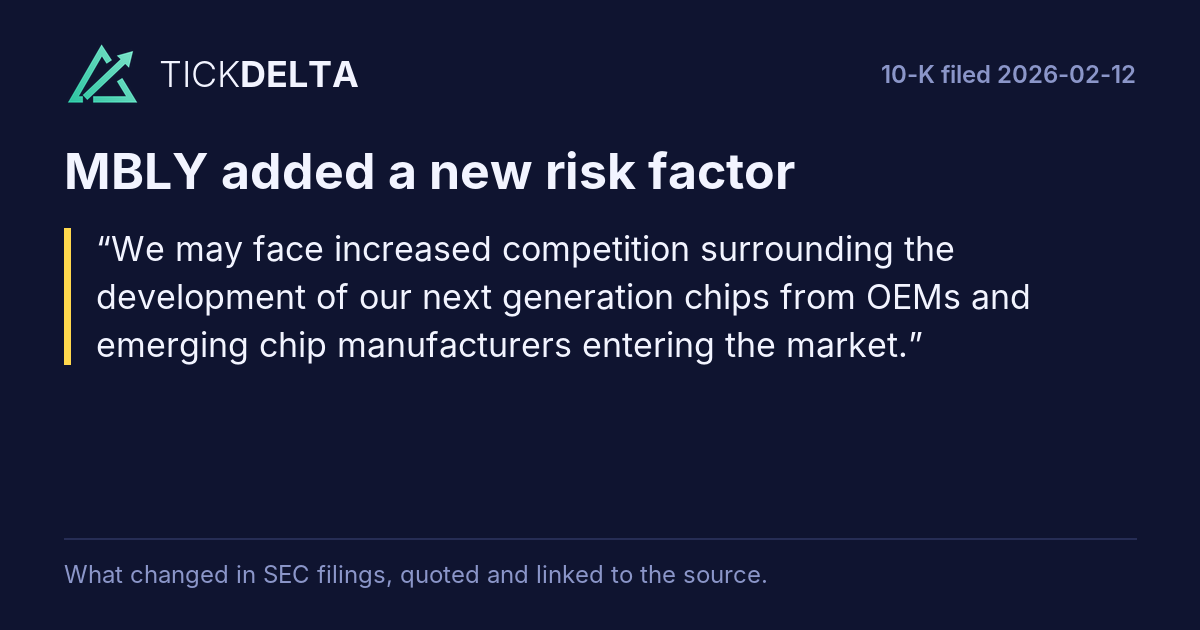
We may face increased competition surrounding the development of our next generation chips from OEMs and emerging chip manufacturers entering the market.
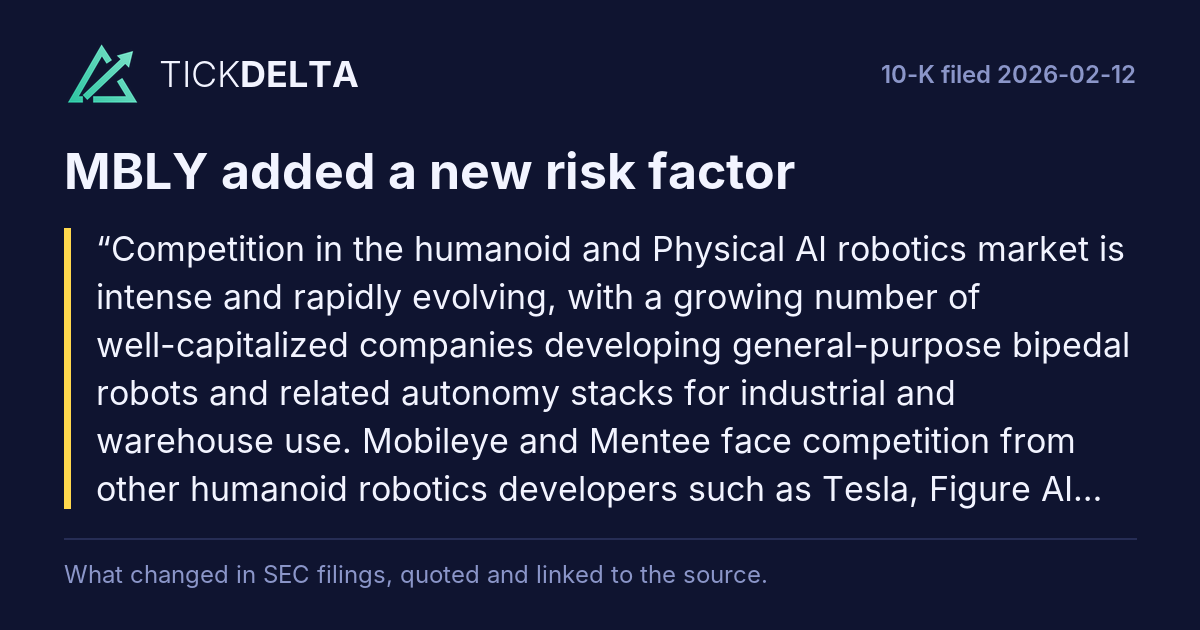
Competition in the humanoid and Physical AI robotics market is intense and rapidly evolving, with a growing number of well-capitalized companies developing general-purpose bipedal robots and related autonomy stacks for industrial and warehouse use. Mobileye and Mentee face competition from other humanoid robotics developers such as Tesla, Figure AI, Sanctuary AI, PAL Robotics, Agility Robotics and Boston Dynamics (of which HKMC holds an 80% beneficial ownership interest), as well as additional emerging players (including a number of Chinese robotics companies) seeking to commercialize similar capabilities.
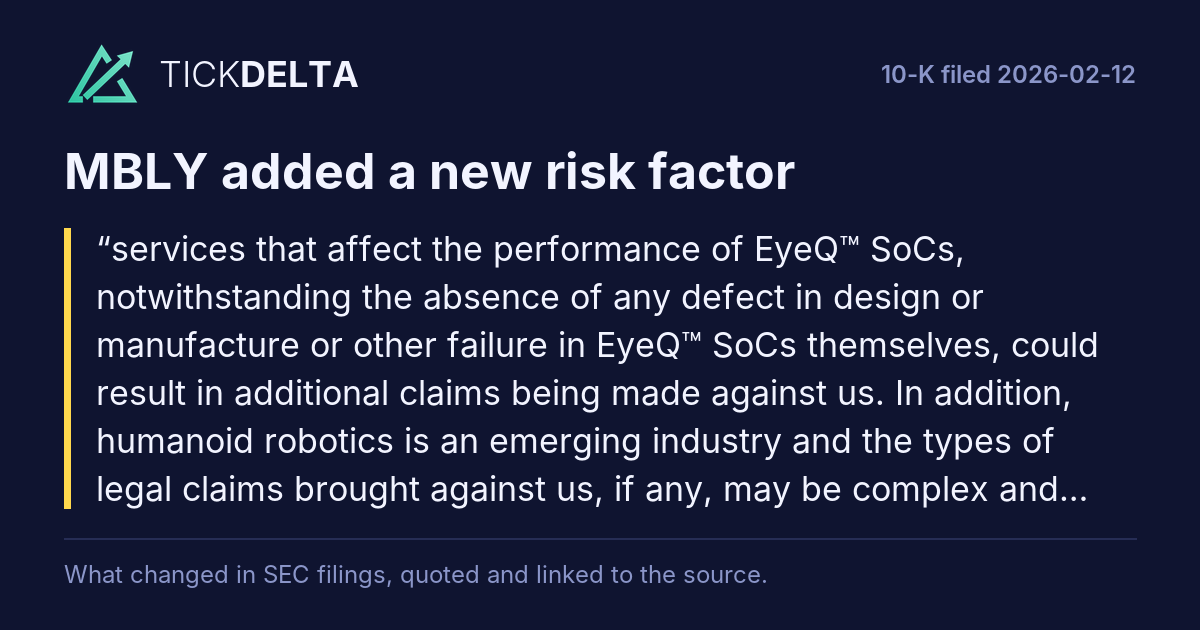
services that affect the performance of EyeQ™ SoCs, notwithstanding the absence of any defect in design or manufacture or other failure in EyeQ™ SoCs themselves, could result in additional claims being made against us.
In addition, humanoid robotics is an emerging industry and the types of legal claims brought against us, if any, may be complex and unprecedented. We may be required to incur significant costs and resources related to any litigation related to the use of humanoid robot systems as we continue the development and deployment of technologies.
Our reliance on third-party partners for robotaxi deployments exposes us to risks associated with complex and evolving commercial relationships, including disagreements regarding deployment schedules, operational responsibilities, economics, branding, data access and use, liability allocation, and the allocation of costs associated with vehicle hardware, software updates, maintenance and fleet operations. Our partners may also face their own operational, financial or strategic challenges, may decide to delay, reduce or discontinue their autonomous mobility programs, may pursue competing technologies or in-house solutions, or may exit certain markets or geographies, any of which could adversely affect demand for our technology and our ability to achieve anticipated benefits from our AMaaS and robotaxi initiatives.
Robotaxi services represent a particularly demanding application of autonomous driving technology and are subject to heightened technological, safety, regulatory and operational risks compared to driver-assistance or consumer autonomous driving applications. Autonomous vehicles intended for driverless commercial operation must function reliably across diverse and complex real-world conditions, including dense urban environments, variable weather, unpredictable behavior by other road users and rare or novel edge cases. Any real or perceived failure of vehicles incorporating our technology to operate safely could result in accidents, injuries or fatalities, increased regulatory scrutiny, litigation, reputational harm, reduced consumer acceptance and reluctance by partners or regulators to approve or expand robotaxi deployments.
In addition, the success of our robotaxi platform and future autonomous mobility products may be significantly influenced by media coverage, public commentary and public perception regarding autonomous driving technologies generally, and robotaxi services in particular. Media coverage of accidents, system failures, regulatory actions or other events involving autonomous vehicles, whether or not such events involve our technology or accurately reflect its performance, may disproportionately influence public opinion, regulatory attitudes and the willingness of consumers, fleet operators and transportation network companies and other mobility service providers to adopt or expand robotaxi services. Negative or inaccurate media coverage, heightened scrutiny by regulators or policymakers, or shifts in public sentiment regarding the safety or reliability of autonomous vehicles could adversely affect demand for our products, delay commercialization efforts and impair the long-term adoption of our autonomous mobility solutions.
Robotaxi services are also subject to evolving, fragmented and jurisdiction-specific regulatory regimes governing autonomous vehicle testing and deployment, commercial transportation services, data privacy, cybersecurity, insurance and ongoing reporting obligations. Regulatory requirements may change over time, differ materially across jurisdictions and impose conditions that limit operational flexibility, increase costs or delay or prevent large-scale deployment. There can be no assurance that the regulatory approvals required for the widespread commercialization of robotaxi services will be obtained on a timely basis, on commercially reasonable terms, or at all.
On February 3, 2026, we acquired 100% of the issued and outstanding stock of Mentee Robotics Ltd., a privately held Israeli company focused on humanoid robotics, in exchange for a purchase price consisting of cash and shares of Class A common stock. We face risks, uncertainties and potential disruptions with the integration of Mentee Robotics and its personnel, technology and operations. We may not realize the anticipated benefits of the acquisition, and our operating results and financial condition could be adversely affected. Humanoid robotics represents a nascent and rapidly evolving market characterized by significant technological complexity, long development timelines, potentially high capital requirements, uncertain customer demand, and evolving regulatory and safety frameworks. The commercialization of humanoid robotics remains subject to significant uncertainties, including regulatory approval across jurisdictions, public acceptance, safety performance, scalability and economic viability.
Show the other 4
Changes in global tariff policies, import/export controls, or related trade restrictions could increase our costs or disrupt the supply of components used in our products. Our reliance on a global semiconductor and electronics supply chain means that new or expanded tariffs, retaliatory measures, or shifts in trade policy may lead to higher procurement expenses, longer lead times, or the need to qualify alternative suppliers. These factors could adversely affect our production schedules, margins, and our customers’ demand for products incorporating our technology.
As a result of the Tax Deconsolidation, we are now solely responsible for the preparation, filing and payment of our U.S. federal and applicable state income taxes on a standalone basis. This transition may increase the complexity of our tax compliance and reporting obligations and require additional internal controls, systems, personnel and external advisory support.
resolution of issues arising from tax audits, including payment of interest and penalties;
If we determine that our goodwill has become impaired, we may incur impairment charges, which would negatively impact our operating results.
We perform an annual impairment assessment of goodwill at the reporting unit level in the fourth quarter of each year, or more frequently if indicators of potential impairment exist. The analysis may include both qualitative and quantitative factors to assess the likelihood of impairment. Indicators that are considered include industry and market considerations, overall financial performance, and other relevant events and factors affecting the reporting unit, including rising interest rates, or a significant decline in our stock price and/or market capitalization for a sustained period of time, and we consider both the income approach and the market approach to estimate a reporting unit’s fair value. Significant estimates include business projections, terminal growth rate, and discount rate based on the reporting unit’s weighted average cost of capital. The estimated fair value using a market approach is based on a number of assumptions, including current market capitalization as corroboration of fair value.
We have in the past and may in the future be required to record a significant impairment charge to earnings in our consolidated financial statements during the period in which any impairment of our goodwill is determined, due to, among other things, a decline in the market capitalization of the Company. Any such charge could have a material adverse impact on our results of operations.
Paragraphs in the 10-Q filed Oct 29, 2026 that were not in the one before
New in the latest 10-Q
22 paragraphs in the 10-Q filed Oct 29, 2026 with nothing like
them in the 10-Q filed Jul 23, 2026 (at least half the words must differ; new numbers alone do not count).
Quoted exactly, grouped by the item heading above them. This is text that changed, not a judgement of how serious it is.
Financial statements and notes
U.S. dollars in millions September 26, 2026 September 27, 2025 September 26, 2026 September 27, 2025
Read in the 10-Qopen_in_new
From time to time, in the ordinary course of business, the Company reimburses Intel for costs incurred by Intel with third-party service providers on behalf of the Company.
Read in the 10-Qopen_in_new
During the third quarter of 2026, we completed our quarterly qualitative assessment for indicators of goodwill impairment. Based on the assessment, no indicators were identified for the “Mobileye” reporting unit. For the “Other” reporting unit, we performed a quantitative goodwill impairment analysis in light of changes in business strategy and a related workforce reduction. The analysis indicated that no goodwill impairment was required. Fair value was estimated using the expected present value of future cash flows and is categorized as Level 3 within the fair value hierarchy due to the use of unobservable inputs.
Read in the 10-Qopen_in_new
At the closing, $95 million of the purchase price was deposited with an escrow agent (provided that with respect to the Mentee Founders, 50% of their pro rata portion of the escrow was deposited in the form of Class A common stock) to secure the post-closing purchase price adjustments and certain indemnification obligations of the shareholders of Mentee Robotics.
Read in the 10-Qopen_in_new
Pursuant to the Share Purchase Agreement, (i) all vested options to acquire shares of Mentee Robotics (each option, a “Mentee Option”) and 20% of unvested Mentee Options (“Accelerated Options”) were cancelled and converted into the right to receive a portion of the cash consideration based on the intrinsic value of such Mentee Options at the purchase price and (ii) all remaining unvested Mentee Options were cancelled and converted into the right to receive a number of unvested RSUs of the Company calculated based on the volume weighted average of the closing sale prices for the Company’s Class A common stock over the thirty (30) Trading Days ending immediately prior to February 3, 2026 and with a value equal to the intrinsic value of such Mentee Options at the purchase price.
Read in the 10-Qopen_in_new
Show the other 17
(1) The fair value of the Developed IP Asset was determined using the Multi-Period Excess Earnings Method and will be amortized over a useful life of 9 years. The significant assumptions used include useful economic life, estimated annual net cash flows, discount rate and applicable tax rate.
Read in the 10-Qopen_in_new
(2) The fair value of the assets and liabilities acquired is based on our preliminary valuations. Final adjustments may be made to the purchase price allocation if more information becomes available.
Read in the 10-Qopen_in_new
Comparison of the three and nine months ended September 26, 2026 and September 27, 2025
Read in the 10-Qopen_in_new
transition of our key personnel and leadership, the timing of any such transition and its anticipated effects on our business;
Read in the 10-Qopen_in_new
Other information
On October 28, 2026, Mobileye Global Inc. (the “Company”) entered into amendments to certain outstanding restricted stock unit (“RSU”) award agreements with Moran Shemesh Rojansky, Chief Financial Officer, Shai Shalev-Shwartz, Chief Technology Officer, Yaacov Ohayon, Chief Operating Officer, and Boaz Ouriel, Executive Vice President, EPG Software (collectively, the “Covered Officers”).
Read in the 10-Qopen_in_new
Under the amendments, outstanding RSUs covered by the applicable award agreements that remain unvested upon a qualifying termination of employment will become fully vested following such qualifying termination and satisfaction of the applicable release requirements, subject to the conditions described below.
Read in the 10-Qopen_in_new
Change in Control. Following the first Change in Control (as defined in the amendments) occurring after the effective date of the amendments, accelerated vesting will apply if a Covered Officer's employment is terminated by the Company or any of its subsidiaries without Cause (as defined in the amendments) or the Covered Officer resigns for Good Reason (as defined in the amendments), in either case during the period beginning three months before and ending eighteen months after such Change in Control and subject to applicable release requirements. For a qualifying termination occurring before the Change in Control, accelerated vesting is conditioned upon the Change in Control occurring and satisfaction of the applicable release requirements. In addition, if outstanding unvested RSUs would otherwise be cancelled without consideration in connection with the Change in Control, such RSUs will become fully vested immediately prior to the consummation of the Change in Control. The Change in Control protection applies only with respect to the first qualifying Change in Control following the effective date of the amendments and does not apply to subsequent transactions.
Read in the 10-Qopen_in_new
Executive Transition. The amendments also provide that, following an Executive Transition (defined as the Company's founder and Chief Executive Officer of the Company as of the date of the amendments ceasing to serve as Chief Executive Officer for any reason), outstanding unvested RSUs will become fully vested following a termination of the Covered Officer's employment by the Company or any of its subsidiaries without Cause within eighteen months following the Executive Transition and satisfaction of the applicable release requirements. An Executive Transition alone will not result in accelerated vesting. The Executive Transition provisions do not apply to the RSU award granted to Mr. Ohayon in September 2026.
Read in the 10-Qopen_in_new
Except for the acceleration applicable to RSUs that would otherwise be cancelled without consideration in connection with a Change in Control, accelerated vesting is conditioned upon the Covered Officer's execution and non-revocation of a release of claims containing restrictive covenants, confidentiality and intellectual property obligations and related provisions.
Read in the 10-Qopen_in_new
In addition, Mobileye Vision Technologies Ltd., an indirect wholly owned subsidiary of the Company, entered into non-binding letters of intent with the Covered Officers stating that, if additional equity awards are granted in the future, it will endeavor to recommend that such awards include change-in-control double-trigger vesting provisions, subject to the discretion and approval of the Compensation Committee or Board of Directors of the Company and the terms of the applicable awards.
Read in the 10-Qopen_in_new
The foregoing description does not purport to be complete and is qualified in its entirety by reference to the amendments which are filed as Exhibits 10.24, 10.25, 10.26, 10.27 and 10.28 to this Quarterly Report on Form 10‑Q and are incorporated herein by reference.
Read in the 10-Qopen_in_new
Item 6
10.24*† Amendment to Restricted Stock Unit Agreement between Mobileye Global Inc. and Moran Shemesh Rojansky, dated as of October 28, 2026.
Read in the 10-Qopen_in_new
10.25*† Amendment to Restricted Stock Unit Agreement between Mobileye Global Inc. and Shai Shalev-Shwartz, dated as of October 28, 2026.
Read in the 10-Qopen_in_new
10.26*† Amendment to Restricted Stock Unit Agreement between Mobileye Global Inc. and Boaz Ouriel, dated as of October 28, 2026.
Read in the 10-Qopen_in_new
10.27*†+ Employment Agreement between Mobileye Vision Technologies Ltd. and Yaacov Ohayon, dated as of February 12, 2017.
Read in the 10-Qopen_in_new
10.28*† Amendment to Restricted Stock Unit Agreement between Mobileye Global Inc. and Yaacov Ohayon, dated as of October 28, 2026.
Read in the 10-Qopen_in_new
+ Certain personal information has been omitted pursuant to Item 601(a)(6) of Regulation S-K.
Read in the 10-Qopen_in_new
The 10-Q's risk factors against the 10-K
Item 1A of the 10-Q filed Oct 29, 2026 against Item 1A of the 10-K filed Feb 12, 2026.
A 10-Q repeats only the risks that changed, so a 10-K paragraph that is missing from it is not counted as removed.
Added is a paragraph with nothing like it in the 10-K, Reworded a sentence that is in both with several words changed,
Quiet changes a sentence in both where one to four words changed and one is a hedge or a modal
(cut words struck through, new words highlighted).
Text on the page, not a score; each links to the filing at sec.gov.
Added10-Q Oct 29, 2026 vs 10-K Feb 12, 2026
There have been no material changes to the risk factors as disclosed in our 2025 Form 10-K. The risks described in the section entitled “Item 1A. Risk Factors” in our 2025 Form 10-K could materially and adversely affect our business, financial condition, and results of operations, and the trading price of our Class A common stock could decline. These risk factors do not identify all risks that we face. Our operations could also be affected by factors that are not presently known to us or that we currently consider to be immaterial to our operations. Due to risks and uncertainties, known and unknown, our past financial results may not be a reliable indicator of future performance and historical trends should not be used to anticipate results or trends in future periods. Refer also to the other information set forth elsewhere herein, including the sections entitled “Forward-Looking Statements”, “Management’s Discussion and Analysis of Financial Condition and Results of Operations”, and our Consolidated Condensed Financial Statements and related Notes thereto.
Read it in the 10-Q at sec.govopen_in_new
Sources
Item 1A of each 10-K and 10-Q on EDGAR, quoted exactly. Each paragraph links to the filing at sec.gov.
Also
10-K change: what was reworded or cut, section by section.
Work with it
Excel workbook · CSV. Google Sheet that stays up to date: paste =IMPORTDATA("https://tickdelta.com/company/MBLY/export.csv") into a cell.