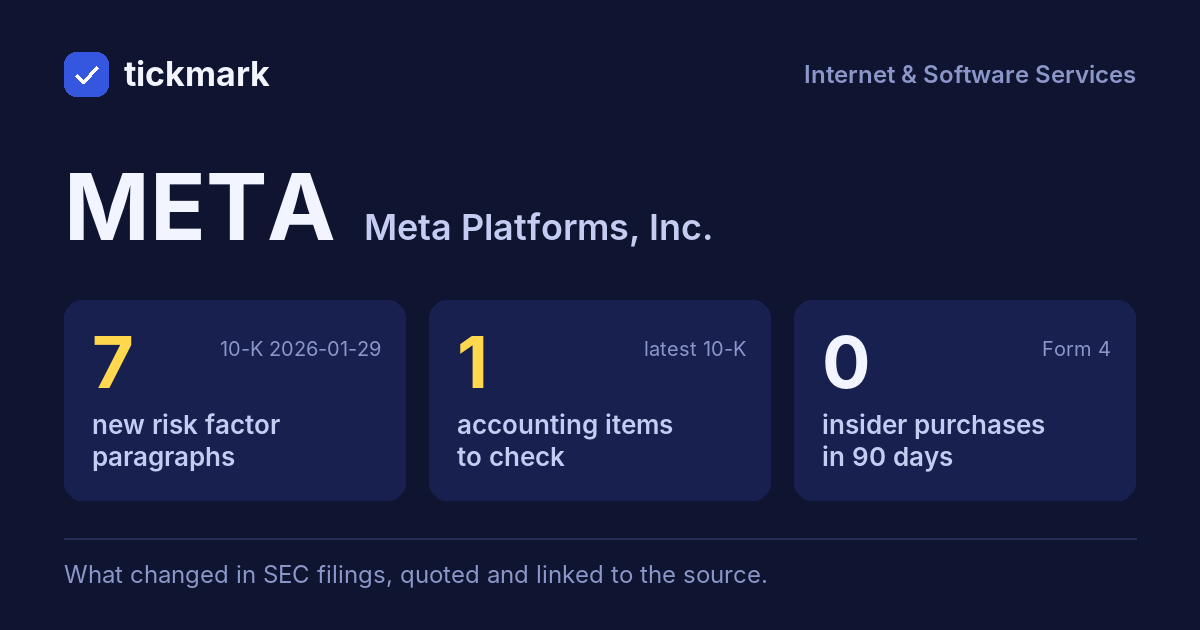
10-K 0001628280-26-003942 (2026-01-29) vs 10-K 0001326801-25-000017 (2025-01-30)
| Section | Compared text | Words now | Changed |
|---|
| Risk Factors | Item 1A | 29,355 |
11.9% |
| MD&A | Item 7 | 8,315 |
17.5% |
| Legal Proceedings | Item 3 | 6,060 |
30.2% |
| Accounting Policies | Item 8, Note 1 – Summary of Significant Accounting Policies | 5,429 |
18.5% |
The redline: what was cut and what was added
In each section, the paragraph that changed most, marked against last year's 10-K:
cut words struck through, new words highlighted and underlined.
Risk Factors 329 words changed in this paragraph; it is 31% similar to last year's version.
Our reputation and ability to attract, retain, and serve our users is dependent upon the reliable performance of our products and services and our underlying technical infrastructure. We have experienced, and may in the future experience, interruptions in the availability or performance of our products and services from time to time. Our systems may not be adequately designed or may not operate with the reliability and redundancy necessary to avoid performance delays or outages that could be harmful to our business. If our products or services are unavailable when users attempt to access them, or if they do not load as quickly as expected, users may not use our products or services as often in the future, or at all, and our ability to serve ads may be disrupted, any of which could adversely affect our business and financial performance. We have experienced such issues to varying degrees from time to time. In addition, as the amount and types of information shared on our products continue to grow and evolve, as the usage patterns of our global community continue to evolve, and as our internal operational demands continue to grow, especially with the deployment of AI technologies, we will need an increasing amount of technical infrastructure, including network capacity, computing power, and related energy requirements, to continue to satisfy our needs. Although we are making significant investments in our technical infrastructure, it is possible that we may fail to continue to effectively scale and grow our technical infrastructure to accommodate these increased demands or achieve our business objectives, which may adversely affect our user engagement and advertising revenue. In addition, our business may be subject to interruptions, delays, or failures resulting from earthquakes, adverse weather conditions, other natural disasters, power loss, terrorism, geopolitical conflict, other physical security threats, cyber-attacks, or other catastrophic events and crises. Global climate change could result in certain types of natural disasters occurring more frequently or with more intense effects. Any such events may result in users being subject to service disruptions or outages and we may not be able to recover our technical infrastructure and user data in a timely manner to restart or provide our services, which may adversely affect our financial results. We also have been, and may in the future be, subject to increased energy and/or other costs to maintain the availability or performance of our products and services in connection with any such events.
Source: Item 1A, 10-K 0001628280-26-003942 vs Item 1A, 10-K 0001326801-25-000017
Legal Proceedings 313 words changed in this paragraph; it is 68% similar to last year's version.
Beginning on March 20, 2018, multiple putative class actions were filed in state and federal courts in the United States and elsewhere against us and certain of our directors and officers alleging various causes of action in connection with our platform and user data practices as well as the misuse of certain data by a developer that shared such data with third parties in violation of our terms and policies, and seeking unspecified damages and injunctive relief. With respect to the putative class actions alleging fraud and violations of consumer protection, privacy, and other laws in connection with the same matters, several of the cases brought on behalf of consumers in the United States were consolidated in the U.S. District Court for the Northern District of California (In re Facebook, Inc., Consumer Privacy User Profile Litigation). On December 22, 2022, the parties entered into a settlement agreement to resolve the lawsuit, which provided for a payment of $725 million by us and became final on May 14, 2025. In addition, our platform and user data practices, as well as the events surrounding the misuse of certain data by a developer, became the subject of U.S. Federal Trade Commission (FTC), state attorneys general, and other government inquiries in the United States, Europe, and other jurisdictions. We entered into a settlement and modified consent order to resolve the FTC inquiry, which took effect in April 2020 and required us to pay a penalty of $5.0 billion and to significantly enhance our practices and processes for privacy compliance and oversight. The In addition, in December 2025, we entered into a settlement agreement with California to resolve its lawsuit alleging violations of consumer protection laws, which is subject to court approval. Certain other state attorneys general inquiries and litigation and certain government inquiries in other jurisdictions remain ongoing and could subject us to additional substantial fines and costs, require us to change our business practices, divert resources and the attention of management from our business, or adversely affect our business. On June 1, 2023, the court presiding over the lawsuit filed by the District of Columbia granted our motion for summary judgment, resolving the case in our favor. On June 29, 2023, the District of Columbia filed a notice of appeal. The appeal is fully briefed and will be was heard on January 30, 2025. 2025 and on July 31, 2025, the District of Columbia Court of Appeals reversed the decision on procedural grounds and remanded the matter to the lower court. Trial in the New Mexico Attorney General's case case, which has expanded to include various claims related to content moderation issues, is scheduled to begin on December 1, 2025. September 8, 2026. On July 16, 2021, a stockholder derivative action was filed in Delaware Court of Chancery against certain of our directors and officers asserting breach of fiduciary duty and related claims relating to our historical platform and user data practices, as well as our settlement with the FTC. On July 20, 2021, other stockholders filed an amended derivative complaint in a related Delaware Chancery Court action, asserting breach of fiduciary duty and related claims against certain of our current and former directors and officers in connection with our historical platform and user data practices. On November 4, 2021, the lead plaintiffs filed a second amended and consolidated complaint in the stockholder derivative action. The pending consolidated matter is In re Facebook Inc. Derivative Litigation. On January 19, 2022, we filed a motion to dismiss, which was denied in part on May 10, 2023. The insider trading claim was dismissed as to all defendants except Mark Zuckerberg, and the motion was denied as to the breach of fiduciary duty claims. Trial began on July 16, 2025. On July 17, 2025, the parties agreed to a settlement in principle to resolve all claims in the action, which is scheduled subject to begin on April 2, 2025. court approval.
Source: Item 3, 10-K 0001628280-26-003942 vs Item 3, 10-K 0001326801-25-000017
MD&A 150 words changed in this paragraph; it is 62% similar to last year's version.
Impairment testing for non-marketable equity securities investments, including equity investments without readily determinable fair values accounted for using either the measurement alternative or the equity method, is performed at each reporting date to determine whether there are triggering events for impairment. Such qualitative assessment considers factors such as, but not limited to, the investee's financial condition and business outlook; industry and sector performance; regulatory, economic or technological environment; operational and financing cash flows; and other relevant events and factors affecting the investee. When indicators of impairment exist, we estimate the fair value of our non-marketable equity securities investments using the market approach and/or the income approach and recognize impairment loss in our consolidated statements of income if the estimated fair value is less than the carrying value. In addition, for these non-marketable For equity securities, determining whether a non-marketable equity security issued by the same issuer method investments, an impairment loss is similar to the non-marketable equity security we hold may require judgment in (a) assessment of differences in rights and obligations associated with the instruments such as voting rights, distribution rights and preferences, and conversion features, and (b) adjustments to the observable price for differences such as, but not limited to, rights and obligations, control premium, liquidity, or principal or most advantageous markets. The identification of observable transactions will depend on the timely reporting of these transactions from our investee companies, which may occur in a period subsequent to recognized when the transactions take place. Therefore, our fair value adjustment for these observable transactions may occur in a period subsequent to when the transaction actually occurred. impairment is considered other-than-temporary.
Source: Item 7, 10-K 0001628280-26-003942 vs Item 7, 10-K 0001326801-25-000017
Accounting Policies 143 words changed in this paragraph; it is 43% similar to last year's version.
We hold investments in marketable debt securities, consisting of U.S. government securities, U.S. government agency securities, and investment grade corporate debt securities. We classify our Our marketable debt securities are classified as available-for-sale (AFS) investments in our marketable securities within current assets on our consolidated balance sheets because they represent investments of cash available for current operations. Our The AFS investments are carried at estimated fair value with any unrealized gains and losses, net of taxes, included in accumulated other comprehensive income (loss) in stockholders' equity. AFS debt securities with an amortized cost basis in excess of estimated fair value are assessed to determine what amount of that difference, if any, is caused by expected credit losses. Allowance for credit losses on AFS debt securities are recognized as a charge in interest and other income (expense), net on our consolidated statements of income, and any remaining unrealized losses, net of taxes, are included in accumulated other comprehensive income (loss) in stockholders' equity. We determine realized gains or losses on sale of marketable securities on a specific identification method and include such gains or losses in interest and other income (expense), net on our consolidated statements of income.
Source: Item 8, Note 1 – Summary of Significant Accounting Policies, 10-K 0001628280-26-003942 vs Item 8, Note 1 – Summary of Significant Accounting Policies, 10-K 0001326801-25-000017
Every change, by type
Sentences and paragraphs of META's Risk Factors and MD&A, 10-K 2026-01-29 against 10-K 2025-01-30.
Each links to the text at sec.gov.
Quiet changes are sentences kept from last year with one to four words changed, at least one of them a hedge, a modal or a qualifier
(may, could, will, not, significant, material…). A year or date rolling forward is not counted.
The full word list
adverse, adversely, all, although, anticipate, anticipates, any, approximately, believe, believes, can, cannot, certain, could, expect, expects, generally, however, if, intend, intends, largely, likely, many, material, materially, may, might, most, must, never, no, not, possible, primarily, probable, should, significant, significantly, some, substantial, substantially, unlikely, will, would
AddedRisk Factors
data, may adversely affect our ability to develop and use AI or subject us to legal liability. In addition, AI may not develop in accordance with our expectations, and market acceptance of features, products, or services we build is uncertain. We regularly evaluate our product roadmaps and make significant changes as our understanding of the technological challenges and market landscape of AI, as well as our product ideas and designs, continue to evolve. As a result of these or other factors, our AI strategy and investments may not be successful in the foreseeable future, or at all, which could adversely affect our business, reputation, or financial results.
Read it in 10-K 2026-01-29 at sec.gov ↗
AddedRisk Factors
Our ability to support these investments is dependent on generating sufficient profits from other areas of our business. From time to time we may also seek to raise additional capital through debt, equity, or other financing arrangements to support our business operations, strategic initiatives, or other corporate purposes. Such financings may not be available on favorable terms or at all. The incurrence of additional debt also results in increased fixed obligations and interest expense, while the issuance of additional equity securities results in dilution to our stockholders. If we are unable to obtain adequate financing when needed, our ability to finance our business operations and initiatives could be adversely affected.
Read it in 10-K 2026-01-29 at sec.gov ↗
AddedRisk Factors
Our reputation and ability to attract, retain, and serve our users is dependent upon the reliable performance of our products and services and our underlying technical infrastructure. We have experienced, and may in the future experience, interruptions in the availability or performance of our products and services from time to time. Our systems may not be adequately designed or may not operate with the reliability and redundancy necessary to avoid performance delays or outages
Read it in 10-K 2026-01-29 at sec.gov ↗
AddedRisk Factors
We have had, and may in the future have, exposure to greater than anticipated tax liabilities.
Read it in 10-K 2026-01-29 at sec.gov ↗
AddedRisk Factors
efforts will be successful. Our business and operations span numerous geographies around the world and involve thousands of employees, contractors, vendors, developers, partners, and other third parties, including AI and cloud services. At any given time, we face known and unknown cybersecurity risks and threats that are not fully mitigated, and we discover vulnerabilities in our security efforts.
Read it in 10-K 2026-01-29 at sec.gov ↗
AddedRisk Factors
Our products and internal systems rely on software and hardware, including software and hardware developed or
Read it in 10-K 2026-01-29 at sec.gov ↗
AddedRisk Factors
which could increase our exposure to intellectual property claims from competitors, non-practicing entities, and other rights holders.
Read it in 10-K 2026-01-29 at sec.gov ↗
RemovedRisk Factors
significantly from our estimates, potentially beyond our estimated error margins. As a result, it is also possible that our Family metrics may indicate changes or trends in user numbers that do not match actual changes or trends.
Read it in 10-K 2025-01-30 at sec.gov ↗
RemovedRisk Factors
no assurance that we will realize expected synergies and potential monetization opportunities for our acquisitions or a favorable return on investment for our strategic investments.
Read it in 10-K 2025-01-30 at sec.gov ↗
RemovedRisk Factors
On March 25, 2022, the European Union and United States announced that they had reached an agreement in principle on a new EU-U.S. Data Privacy Framework (EU-U.S. DPF). On October 7, 2022, President Biden signed the Executive Order on Enhancing Safeguards for United States Signals Intelligence Activities (E.O.), and on June 30, 2023, the European Union and the three additional countries making up the EEA were designated by the United States Attorney General as a “qualifying state” under Section 3(f) of the E.O. On July 10, 2023, the European Commission adopted an adequacy decision in relation to the United States. The adequacy decision concludes that the United States ensures an adequate level of protection for personal data transferred from the European Union to organizations in the United States that are included in the “Data Privacy Framework List,” maintained and made publicly available by the United States Department of Commerce pursuant to the EU-U.S. DPF. The implementation of the EU-U.S. DPF and the adequacy decision are important and welcome milestones, and we have implemented steps to comply with the above corrective orders following engagement with the IDPC. The EU-U.S. DPF replaces two prior adequacy frameworks which were invalidated by the CJEU. A further invalidation of the EU-U.S. DPF by the CJEU could create considerable uncertainty and lead to us being unable to offer a
Read it in 10-K 2025-01-30 at sec.gov ↗
RemovedRisk Factors
number of our most significant products and services, including Facebook and Instagram, in Europe, which would materially and adversely affect our business, financial condition, and results of operations.
Read it in 10-K 2025-01-30 at sec.gov ↗
RewordedRisk Factors
As we continue From time to mature, the incentives to attract, retain, and motivate employees provided by our equity awards or by future arrangements may not be as effective as in the past, and if time we issue significant equity to attract additional employees or to retain our existing employees, we would incur resulting in substantial additional share-based compensation expense and dilution to the ownership of our existing stockholders would be further diluted. stockholders.
Read it in 10-K 2026-01-29 at sec.gov ↗
RewordedRisk Factors
As we continue our company continues to mature, evolve, the incentives to attract, retain, and motivate employees provided by our equity awards or by future arrangements may not be as effective as in the past, and if we issue significant equity to attract additional employees or to retain our existing employees, we would incur substantial additional share-based compensation expense and the ownership of our existing stockholders would be further diluted. past.
Read it in 10-K 2026-01-29 at sec.gov ↗
RewordedRisk Factors
We may also be subject to increased risk as a result of the use of AI technologies in connection with such incidents and activities, or changes to our content policies and enforcement efforts which we began from time to implement in January 2025 to further free expression on our platform and mitigate over-enforcement of certain of our content policies. time.
Read it in 10-K 2026-01-29 at sec.gov ↗
RewordedRisk Factors
Other Further, we face significant competition from other companies may develop that are developing their own AI features and technologies, including competition from AI features and technologies that are may be similar or superior to our technologies or are more cost-effective to develop and deploy. deploy, or that otherwise achieve more timely or successful market acceptance.
Read it in 10-K 2026-01-29 at sec.gov ↗
RewordedRisk Factors
Any loss of access to data signals we use in our process for calculating Family metrics, whether as a result of our own product decisions, actions by third-party browser or mobile platforms, regulatory or legislative requirements, or other factors, also may impact the stability or accuracy of our reported Family metrics, as well as our ability to report these metrics at all.
Read it in 10-K 2026-01-29 at sec.gov ↗
RewordedRisk Factors
These In future periods, the tax effects of share-based compensation are dependent on our stock price, which we do not control, the CAMT system, and a decline future changes in our stock price could significantly increase our effective tax rate and adversely affect our financial results. laws.
Read it in 10-K 2026-01-29 at sec.gov ↗
RewordedRisk Factors
We also compete with companies that develop in the development and deliver application of AI, particularly with respect to the development of frontier AI models, as well as the development and delivery of consumer hardware and augmented, mixed, augmented and virtual reality products and services.
Read it in 10-K 2026-01-29 at sec.gov ↗
RewordedRisk Factors
We incur significant expenses in operating our business, and we expect our expenses to continue to increase in the future as we continue to invest in new and unproven technologies, including AI and machine learning, as we broaden our user base, as users increase the amount and types of content they consume and the data they share with us, for example with respect to video, as we develop and implement new products, as we market new and existing products and promote our brands, as we continue to expand our technical infrastructure, as we continue to invest in new and unproven technologies, including AI and machine learning, and as we continue our efforts to focus on privacy, safety, security, and content and advertising review and enforcement.
Read it in 10-K 2026-01-29 at sec.gov ↗
RewordedRisk Factors
Other A number of U.S. state privacy laws, such as the Texas Data Privacy and Security Act, the Colorado Privacy Act, and the Oregon Consumer Privacy Act, are introducing laws have introduced additional rights for users and could result in restrictions on our use of signals from third-party apps and websites through certain browser- and device-based universal opt-out mechanisms.
Read it in 10-K 2026-01-29 at sec.gov ↗
RewordedRisk Factors
Legislative proposals As a result of legislative proposals, new laws, and evolving interpretation of existing laws in Europe, Asia-Pacific, Latin America, and other jurisdictions may also jurisdictions, we are also, and expect to continue to be, subject us to new requirements relating to allegedly fraudulent or illegal activities by third parties on our platform, which could continue to cause us to incur significant compliance costs or make changes to our products or business practices, and could subject us to additional fines and penalties or liability for losses to users or other third parties in such transactions.
Read it in 10-K 2026-01-29 at sec.gov ↗
RewordedRisk Factors
We As a result of these or other factors, our Reality Labs strategy and investments may not be successful in our Reality Labs strategy and investments, the foreseeable future, or at all, which could adversely affect our business, reputation, or financial results.
Read it in 10-K 2026-01-29 at sec.gov ↗
RewordedRisk Factors
The tax laws applicable to our business, including the laws of the United States and other jurisdictions, are subject to interpretation and certain jurisdictions are aggressively interpreting their laws in new ways in an effort to raise additional tax revenue from companies such as Meta. interpretation.
Read it in 10-K 2026-01-29 at sec.gov ↗
Quiet changesRisk Factors
Any of the foregoing delays or disruptions, including actions by governments or geopolitical events such as international conflicts, could result in tariffs, sanctions, export or import controls, and other measures that restrict international trade, could reduce or eliminate the ability of our suppliers, manufacturers, or other third-party providers to continue their operations to manufacture, or limit or eliminate our ability to purchase, key components of our technical infrastructure.
Read it in 10-K 2026-01-29 at sec.gov ↗
Quiet changesRisk Factors
For example, several jurisdictions have proposed or enacted taxes applicable to certain digital services, which include business activities on digital advertising and online marketplaces, and which apply to our business.
Read it in 10-K 2026-01-29 at sec.gov ↗
Quiet changesRisk Factors
In periods in which our stock price varies from the grant price of the share-based compensation vesting in that period, we will recognize excess tax benefits or shortfalls that will may impact our effective tax rate.
Read it in 10-K 2026-01-29 at sec.gov ↗
Quiet changesRisk Factors
The Certain state attorneys general inquiries and litigation, and certain government inquiries in other jurisdictions remain ongoing.
Read it in 10-K 2026-01-29 at sec.gov ↗
Quiet changesRisk Factors
Although we have developed systems and processes that are designed to protect our data and user data, to reduce the risk of data loss or misuse, to disable undesirable accounts and activities on our platform, and to reduce the risk of or detect security breaches, such measures will not provide absolute security, and we cannot assure you that we will be able to react in a timely manner to any cyber-attacks or other security incidents, or that our remediation efforts will be successful.
Read it in 10-K 2026-01-29 at sec.gov ↗
Quiet changesRisk Factors
We have experienced unfavorable outcomes in such disputes and litigation in the past, and our business, financial condition, and results of operations could be materially and adversely affected as a result of an unfavorable resolution of the disputes and litigation referred to above.
Read it in 10-K 2026-01-29 at sec.gov ↗
AddedMD&A
•Effective tax rate was 30% for the year ended December 31, 2025. This includes the effects of the implementation of the One Big Beautiful Bill Act during the third quarter of 2025. Absent the valuation allowance charge as of the enactment date, our 2025 effective tax rate would have decreased by 17 percentage points to 13%.
Read it in 10-K 2026-01-29 at sec.gov ↗
AddedMD&A
As a result of certain U.S. income tax provisions of the One Big Beautiful Bill Act enacted in July 2025, we expect to incur Corporate Alternative Minimum Tax (CAMT) beginning in 2025. In assessing the realizability of our deferred tax assets and determining the need for a valuation allowance, our accounting policy incorporates the expected impact of future years' CAMT.
Read it in 10-K 2026-01-29 at sec.gov ↗
AddedMD&A
On July 4, 2025, the One Big Beautiful Bill Act (OBBBA) was enacted, introducing several significant U.S. income tax provisions that reduced our U.S. federal cash tax payments for the remainder of 2025 and future years. The provisions include the immediate expensing of domestic research and development costs and certain capital expenditures beginning in 2025, as well as an enhanced deduction for foreign-derived intangible income effective in 2026. The benefits from these provisions are limited by the 15% Corporate Alternative Minimum Tax (CAMT). As a result, we recorded a $15.93 billion charge in the third quarter of 2025, of which $14.03 billion was a valuation allowance against our U.S. federal deferred tax assets as of the enactment date of OBBBA, and the remaining was mostly related to the reduction of the benefit of the foreign-derived intangible income deduction. In determining the valuation allowance, our accounting policy incorporates the expected impact of future years’ CAMT in assessing the realizability of our deferred tax assets.
Read it in 10-K 2026-01-29 at sec.gov ↗
AddedMD&A
Absent any changes to our tax landscape, we expect our effective tax rate for the full year 2026 to be in the range of 13-16%.
Read it in 10-K 2026-01-29 at sec.gov ↗
AddedMD&A
Our operating and finance leases include data centers, offices, and certain network infrastructure. In addition to lease liabilities included in our consolidated balance sheets, we have leases that have not yet commenced, with total lease obligations of approximately $103.77 billion, mostly for data centers, colocations, and network infrastructure, as of December 31, 2025. These operating and finance leases will commence between 2026 and 2030 with lease terms of greater than one year to 30 years.
Read it in 10-K 2026-01-29 at sec.gov ↗
AddedMD&A
We also have $131.05 billion of contractual commitments as of December 31, 2025, mostly related to third-party cloud capacity arrangements and our continued investments in servers and network infrastructure, data centers, and consumer hardware products in Reality Labs with $30.63 billion due in 2026.
Read it in 10-K 2026-01-29 at sec.gov ↗
AddedMD&A
The timing and actual number of shares repurchased under the repurchase program depend on a variety of factors, including price, general business and market conditions, and other investment opportunities. Shares may be repurchased through open market purchases or privately negotiated transactions, including through the use of trading plans intended to qualify under Rule 10b5-1 under the Securities Exchange Act of 1934, as amended. Our share repurchase program may be suspended, delayed, discontinued, or accelerated at any time.
Read it in 10-K 2026-01-29 at sec.gov ↗
RemovedMD&A
The valuation and impairment assessment of certain assets, including recoverability, requires significant judgment and assumptions such as estimation of future cash flows, discount rates, market data of comparable assets and companies, holding period and residual value of asset groups, among others.
Read it in 10-K 2025-01-30 at sec.gov ↗
RemovedMD&A
Impairment testing for long-lived-assets, including property and equipment and operating lease right-of-use assets, occurs whenever events or circumstances indicate that the carrying amount of such assets may not be recoverable compared to the future undiscounted cash flows the assets are expected to generate from the use and eventual disposition. The impairment test is performed at the asset group level for which identifiable cash flows are largely independent of the cash flows of other assets and liabilities. When the test results indicate that the carrying amount of long-lived assets is not recoverable, the carrying amount of such assets is reduced to fair value.
Read it in 10-K 2025-01-30 at sec.gov ↗
RemovedMD&A
Our effective tax rate in 2024 decreased compared to 2023, primarily due to excess tax benefits recognized from share-based compensation and an increase in research tax credits.
Read it in 10-K 2025-01-30 at sec.gov ↗
RemovedMD&A
The accounting for share-based compensation may increase or decrease our effective tax rate based upon the difference between our share-based compensation expense and the deductions taken on our tax return, which depend upon the stock price at the time of employee award vesting. If our stock price remains constant to the January 24, 2025 price, and absent any changes to our tax landscape, we expect our effective tax rate for the full year 2025 to be in the range of 12-15%. This includes the effects of the mandatory capitalization and amortization of research and development expenses incurred in 2024, as required by the 2017 Tax Cuts and Jobs Act (Tax Act). The mandatory capitalization requirement increased our 2024 cash tax liabilities materially but also decreased our effective tax rate due to increasing the foreign-derived intangible income deduction. If the mandatory capitalization is deferred, our effective tax rate in 2025 could be higher when compared to current law and our cash tax liabilities could be lower.
Read it in 10-K 2025-01-30 at sec.gov ↗
RemovedMD&A
Our operating lease obligations mostly include data centers, offices and colocations. Our finance lease obligations include certain network infrastructure. Our facilities consolidation restructuring efforts did not materially change our operating lease obligations. Our contractual commitments are primarily related to our investments in servers and network infrastructure, and content costs from content providers whom we license video and music to increase engagement on the platform.
Read it in 10-K 2025-01-30 at sec.gov ↗
RewordedMD&A
Our effective tax rate in the future will depend upon the proportion between the following items and income before provision for income taxes: the effects of changes in tax law, changes in valuation allowance due to the effects of CAMT, U.S. tax benefits from foreign-derived intangible income, tax effects from share-based compensation, research tax credit, tax effects from capital losses not expected to be utilized, settlement of tax contingency items, and tax effects of changes in our business, and the effects of changes in tax law. business.
Read it in 10-K 2026-01-29 at sec.gov ↗
RewordedMD&A
These increases were partially offset by $39.23 $72.22 billion of capital expenditures, including which includes purchases of property and equipment and principal payments on finance leases, our leases; $31.57 billion of capital returns of $35.20 billion for repurchases of our Class A common stock and payments of dividends and dividend equivalents, and $13.77 equivalents; $18.40 billion of taxes paid related to net share settlement of employee restricted stock unit (RSU) awards. awards; and $18.33 billion of purchases of non-marketable equity investments.
Read it in 10-K 2026-01-29 at sec.gov ↗
RewordedMD&A
Cash used in financing activities during 2024 2025 mostly consisted of $30.13 $26.25 billion for repurchases of our Class A common stock, $5.07 billion of payments of dividends and dividend equivalents, and $13.77 $18.40 billion of taxes paid related to net share settlement of RSUs, and $5.32 billion of payments of dividends and dividend equivalents, partially offset by $10.43 $29.91 billion of net proceeds from the issuance of additional the Notes in August 2024. November 2025.
Read it in 10-K 2026-01-29 at sec.gov ↗
RewordedMD&A
For example, in response to regulatory developments in Europe, we announced our plans to change the legal basis for behavioral advertising on Facebook and Instagram in the European Union, European Economic Area, and Switzerland from "legitimate interests" to "consent," and began offering users in the region a "subscription for no ads" alternative.
Read it in 10-K 2026-01-29 at sec.gov ↗
RewordedMD&A
While we saw improvement in business and macroeconomic conditions in recent periods, continued We are currently subject to increased business, macroeconomic, and geopolitical uncertainty remains, uncertainty, including as a result of volatility around international trade, which could impact our financial results in future periods.
Read it in 10-K 2026-01-29 at sec.gov ↗
RewordedMD&A
The increase was primarily mainly due to higher operational expenses related to our data centers and technical infrastructure, mostly from higher which included decreases in the depreciation expense. growth rate due to an extension in the useful lives of servers and network assets, effective January 1, 2025.
Read it in 10-K 2026-01-29 at sec.gov ↗
RewordedMD&A
The increase in costs and expenses was mainly primarily due to increases in operational expenses related to our data centers and technical infrastructure, mostly from higher depreciation expense and employee compensation, partially offset by lower restructuring infrastructure costs, costs associated with partner arrangements, and legal-related costs.
Read it in 10-K 2026-01-29 at sec.gov ↗
RewordedMD&A
Our provision for income taxes in 2024 decreased $27 million 2025 increased $17.17 billion or 207% compared to 2023, 2024, primarily due to a decrease an increase in the effective tax rate, offset by an increase in income before provision for income taxes. rate.
Read it in 10-K 2026-01-29 at sec.gov ↗
RewordedMD&A
See Note 8 5 — Non-Marketable Equity Investments, Note 7 — Leases, Note 10 — Long-term Debt, Note 12 11 — Commitments and Contingencies, Note 13 12 — Stockholders' Equity, and Note 15 14 — Income Taxes in the notes to the consolidated financial statements included in Part II, Item 8, and "Legal Proceedings" contained in Part I, Item 3 of this Annual Report on Form 10-K for additional information regarding leases, debt, contractual commitments and contingencies, capital return program, and taxes, respectively. information.
Read it in 10-K 2026-01-29 at sec.gov ↗
RewordedMD&A
The higher employee compensation was mainly primarily from a 13% an 8% growth in employee headcount from 2023 2024 to 2024 2025 in engineering and other technical functions supporting our continued investment and an increase in our family of products and Reality Labs. share-based compensation expense.
Read it in 10-K 2026-01-29 at sec.gov ↗
RewordedMD&A
We currently anticipate that our available funds and cash flow from operations and financing activities will be sufficient to meet our operational cash needs and fund our cash commitments for investing and financing activities, including investments in infrastructure and AI initiatives, share repurchases and dividend payments for at least as well as any return of capital to stockholders over the next 12 months and thereafter for the foreseeable future.
Read it in 10-K 2026-01-29 at sec.gov ↗
RewordedMD&A
Cost of revenue 18 18 19 22 Research and development 29 27 29 30 Marketing and sales 6 7 9 13 General and administrative 6 6 8 10 Total costs and expenses 59 58 65 75 Income from operations 41 42 35 25 Interest and other income (expense), income, net 1 1 — 1 Income before provision for income taxes 43 43 35 25 Provision for income taxes 13 5 6 5 Net income 30% 38% 29% 20%
Read it in 10-K 2026-01-29 at sec.gov ↗