tickdelta
Sign in

Tickdelta is free for now. Sign up and get Pro free

← Screener

METAMeta Platforms

Communication · Internet & Software Services · Nasdaq

Our mission is to build the future of human connection and the technology that makes it possible. 10-K, Item 1

Employees
78,865
Headquarters
Menlo Park, CA
CEO
Mark Zuckerberg
Next results
around Jan 27, 2027
Compare with peers → Embed

When the SEC's staff reviews a filing, it writes to the company with numbered questions, and the company answers each one in a letter. SEC publishes the exchange once the review is over, at least 20 business days later. Below: what the staff asked META, and the company's answer to each question, quoted from the letters. A question is not an accusation; most reviews end with the company adding detail to its next filing.

Form 10-Q

2022-11-21 to 2023-06-28 · 2 questions · 1 letter from the SEC, 1 from the company
Review closed 2023-06-28
RevenueSegmentsResults discussion (MD&A)
Executive Overview of Third Quarter Results · Developments in Advertising, page 33
SEC asked (1)
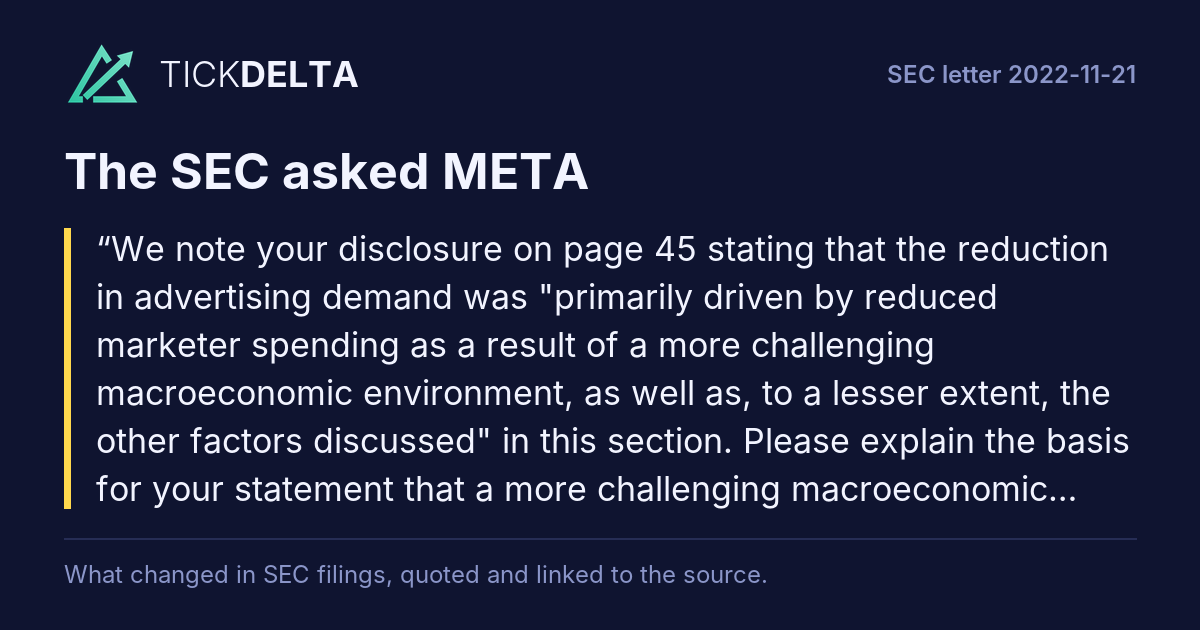
We note your disclosure on page 45 stating that the reduction in advertising demand was "primarily driven by reduced marketer spending as a result of a more challenging macroeconomic environment, as well as, to a lesser extent, the other factors discussed" in this section.
Rest of the question

Please explain the basis for your statement that a more challenging macroeconomic environment is the primary driving factor behind reduced demand for your advertising services. Disclose the basis for your belief that the other factors have had a lesser impact and explain why, if true, you cannot assess their impact on your ad revenue. Please ensure that responsive disclosure appears where relevant throughout your filing. Additionally, identify the steps you are taking to replace lost advertising revenue. In this regard, we note that in your earnings call for the third quarter of 2022, your management discussed an AI discovery engine that is powering Reels and integration with messaging, as well as click-to-messaging ads.

META answered
The Company assesses which factors have impacted advertising demand in any given period through a variety of means, including interactions with advertisers, surveys or other internal data, and external resources with market insights for the advertising industry and macroeconomic developments more generally. The Company’s belief that the reduction in demand for its advertising services was primarily driven by reduced marketer spending as a result of a more challenging macroeconomic environment during the quarter ended September 30, 2022 was based on both internal and external data.
Rest of the answer

In particular, the Company periodically surveys its sales employees supporting a representative sample of advertisers in order to understand the reasons for the respective advertisers’ spending trends with the Company. The surveys ask the Company’s sales employees to identify specific factors impacting spend in the relevant period, including those relating to the Company’s platform as well as macroeconomic, industry, and advertiser-specific conditions. These observations help inform the Company’s estimates of the magnitude of the impact of specific trends on its advertising revenue. In the third quarter of 2022, such results showed that macroeconomic trends were the most significant inhibitors of advertiser spend in the period, followed by platform-specific factors such as ad performance, including as a result of targeting and measurement challenges. More specifically with respect to macroeconomic trends, the Company believes that as macroeconomic pressures reduce the likelihood of consumer purchases of discretionary goods and services, advertisers are more likely to reduce their spending as they anticipate a lower return on investment. The Company also believes that marketers have reduced spend as a result of pressures on their advertising budgets by factors such as inflation, rising interest rates, and related market uncertainty.

This view was supported by the internal survey results, as well as various external resources, such as publicly available economic data, consumer sentiment indexes, and stock market performance, and the Company’s historical experience during prior periods of macroeconomic pressure and market uncertainty. However, as noted in the Company’s previous response, although the Company attempts to estimate the general magnitude of the impact of these trends on its advertising revenue through these means, the Company does not have full visibility into the factors driving individual advertiser decisions across its advertiser base, so its estimates are necessarily imprecise.

The Company respectfully advises the Staff that in its future filings in the section titled “Item 7. Management’s Discussion and Analysis of Financial

Condition and Results of Operations,” it will provide additional disclosure regarding its assessments of the trends driving advertising revenue results. The Company proposes the following disclosure in the Company’s Annual Report on Form 10-K for the year ended December

31, 2022 under “Item 7. Management’s Discussion and Analysis of Financial Condition and Results of Operations,” updated as applicable for the full-year reporting period and any changes since the date of this letter:

* * *

Although we regularly evaluate a variety of sources to understand trends in our advertising revenue, including those discussed in the section entitled

“—Executive Overview of Third Quarter Results,” we do not have perfect visibility into the factors driving advertiser spending decisions and our assessments involve complex judgments about what is driving advertising decisions across a large and diversified advertiser base across the globe. Trends impacting advertising spend are also dynamic and interrelated. As a result, it is difficult to identify with precision which advertiser spending decisions are attributable to which trends, and we are unable to quantify the exact impact that each trend had on the Company’s advertising revenue during the period.

December 21, 2022 2

With respect to the Company’s efforts to replace lost advertising revenue, the Company proposes the following additional disclosure in the Company’s

Annual Report on Form 10-K for the year ended December 31, 2022 under “Item 7. Management’s Discussion and Analysis of Financial

Condition and Results of Operations” (with underlined text marking new text and stricken text marking deleted text), updated as applicable for any changes since the date of this letter:

Developments in Advertising

[…]

To mitigate these developments, we are working to evolve our advertising systems to improve the performance of our ad products. We are developing privacy enhancing technologies to deliver relevant ads and measurement capabilities while reducing the amount of personal information we process, including by relying more on anonymized or aggregated third-party data. In addition, we are developing tools that enable marketers to share their data into our systems, as well as ad products that generate more valuable signals within our apps. More broadly, we also continue to innovate our advertising tools to help marketers prepare campaigns and connect with consumers, including developing growing formats such as Reels ads and our business messaging ad products. Across all of these efforts, we are making significant investments in artificial intelligence and machine learning to improve our delivery, targeting, and measurement capabilities. We are also engaging with others across our industry to explore the possibility of new open standards for the private and secure processing of data for advertising purposes. We expect that some of these efforts will be long-term initiatives, and that the regulatory and platform developments described above will continue to adversely impact our advertising revenue for the foreseeable future.

Other

Business and Macroeconomic Conditions

Other global and regional business, macroeconomic, and geopolitical conditions also have had, and we believe will continue to have, an impact on our user growth and engagement and advertising revenue. In particular, we believe advertising budgets have been pressured by factors such as inflation, rising interest rates, and related market uncertainty, which has led to reduced marketer spending. In addition, competitive products and services have reduced some users' engagement with our products and services. In response to competitive pressures, we have introduced new features such as Reels which and are investing in our artificial intelligence-powered discovery engine to recommend relevant unconnected content across our products. While Reels is growing in usage, it is not currently monetized at the same rate as our feed or Stories products. We also have seen fluctuations and declines in the size of our active user base in one or more markets from time to time. For example, in connection with the war in Ukraine, access to Facebook and Instagram was restricted in Russia and the services were then prohibited by the Russian government, which adversely affected user growth and engagement in the third quarter of 2022. These trends adversely affected advertising revenue in the third quarter of 2022, and we expect will continue to affect our advertising revenue in the foreseeable future.

To the extent these efforts are relevant in future periods, the Company intends to include similar disclosure in such reports.

Read in the reply ↗
In its next report

First report after the company's reply of 2022-12-21: 10-K filed 2023-02-02 ↗, against the 10-K filed 2022-02-03 ↗.

Tickdelta does not hold the text of both reports, so they are not compared here.
Investment Philosophy, page 34
SEC asked (2)
Please quantify how your investments in your Reality Labs segment are allocated between long-term technological developments aimed at developing the "metaverse," such as neural interfaces, and short-term projects developing specific products for sale and platforms, such as Meta Quest and Horizon Worlds.
META answered
advises the Staff that the Company will revise the disclosure set forth in its response to comment 1 in the Staff’s letter dated

September 29, 2022 as follows (with underlined text marking new text) and will include this disclosure, updated as applicable for any changes since the date of this letter, in the Company’s Annual Report on Form 10-K for the year ended December 31, 2022 under “Item

1.
Rest of the answer

Business.”

Reality

Labs Products

Many of our metaverse investments are directed toward long-term, cutting edge research and development for products that are not on the market today and may only be fully realized in the next decade. This includes exploring new technologies such as neural interfaces using electromyography, which lets people control their devices using neural signals, as well as innovations in artificial intelligence and hardware to help build next-generation interfaces. In the near term, we are continuing to develop early metaverse experiences through Reality Labs' augmented and virtual reality products that help people feel connected, anytime, anywhere. Our current product offerings include Meta Quest virtual reality devices, as well as software and content available through the Meta Quest Store, which let people defy distance and enable a range of social experiences, including gaming, fitness, entertainment, and more. For example, we have launched Horizon Worlds, a social platform where people can interact with friends, meet new people, play games, and attend virtual events, and Horizon Workrooms, a virtual reality space for teams to connect and collaborate at work. Our hardware products also include Meta Portal video calling devices and augmented reality experiences like Ray-Ban Stories smart glasses, which let people stay more present through hands-free interaction. In general, while all of these investments are part of our long-term initiative to help build the metaverse, our virtual reality and social platform efforts also include notable shorter-term projects developing specific products and services to go to market. The substantial majority of our augmented reality efforts are directed toward longer-term research and development projects. For example, in 2023, we expect to spend approximately [●]% of our Reality Labs operating expenses on our augmented reality initiatives, approximately [●]% on our virtual reality initiatives, and approximately [●]% on social platforms and other initiatives. We apply significant judgment in estimating this expense breakdown as there are certain shared costs across product lines, and our expectations are subject to change, including as the metaverse ecosystem and our business strategies evolve.

December 21, 2022 4

In connection with its response to the Staff’s comments, the Company acknowledges that the Company and its management are responsible for the accuracy and adequacy of its disclosures, notwithstanding any review, comments, action or absence of action by the Staff.

Read in the reply ↗
In its next report

First report after the company's reply of 2022-12-21: 10-K filed 2023-02-02 ↗, against the 10-K filed 2022-02-03 ↗.

Tickdelta does not hold the text of both reports, so they are not compared here.

Also in this review: request for more time, 2022-11-23, closing letter, 2023-06-28
Form 10-K for the Fiscal Year Ended December 31, 2021

2022-09-29 to 2022-10-26 · 2 questions · 1 letter from the SEC, 1 from the company
No closing letter
Results discussion (MD&A)SegmentsRevenue
After reviewing your response to these comments, we may have additional comments. Business, page 7
SEC asked (1)
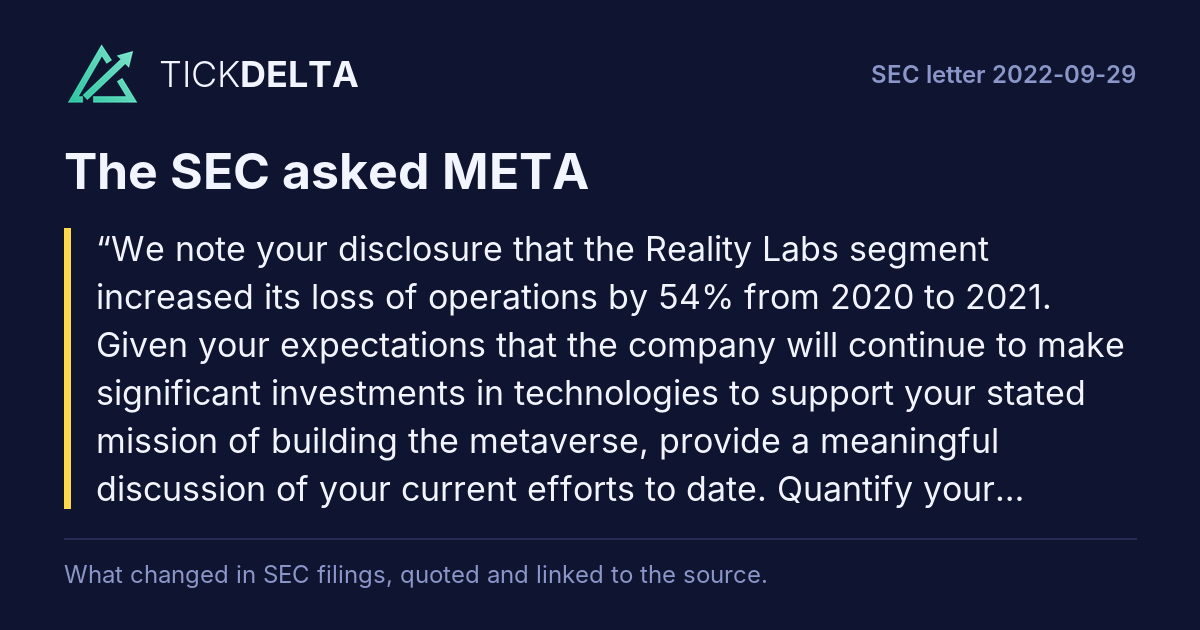
We note your disclosure that the Reality Labs segment increased its loss of operations by 54% from 2020 to 2021. Given your expectations that the company will continue to make significant investments in technologies to support your stated mission of building the metaverse, provide a meaningful discussion of your current efforts to date.
Rest of the question

Quantify your investments in these technologies, discuss your plans for monetization, and provide an anticipated timeline for development.

META answered
The Company respectfully advises the Staff that it intends to include disclosure substantially in the form set forth in this Response #1 in the Company’s

Annual Report on Form 10-K for the year ended December 31, 2022 under “Item 1. Business—Overview”, updated as applicable for any changes since the date of this letter:

Ms. Lauren Pierce,

Staff Attorney

Mr. Joshua Shainess,

Division of Corporation

Finance

U.S. Securities and

Exchange Commission

* * *

Overview

Our mission is to give people the power to build community and bring the world closer together.
Rest of the answer

All of our products, including our apps, share the vision of helping to bring the metaverse to life.

We build technology that helps people connect, find communities, and grow businesses. Our useful and engaging products enable people to connect and share with friends and family through mobile devices, personal computers, virtual reality headsets, wearables, and in-home devices.

We also help people discover and learn about what is going on in the world around them, enable people to share their opinions, ideas, photos and videos, and other activities with audiences ranging from their closest family members and friends to the public at large, and stay connected everywhere by accessing our products. Meta is moving beyond 2D screens toward immersive experiences like augmented and virtual reality to help build the metaverse, which we believe is the next evolution in social technology. Our vision for the metaverse does not center on any single product, but rather an entire ecosystem of experiences, devices, and new technologies. While we are in the very early stages of its development, we believe the metaverse will become the next computing platform and the future of social interaction.

report financial results for two segments: Family of Apps (FoA) and Reality Labs (RL). Currently, we generate substantially all of our revenue from selling advertising placements on our family of apps to marketers, which is reflected in FoA. Ads on our platforms enable marketers to reach people based on a variety of factors including age, gender, location, interests, and behaviors. Marketers purchase ads that can appear in multiple places including on Facebook, Instagram, Messenger, and third-party applications and websites. RL reflects our efforts to develop the metaverse and generates revenue from sales of consumer hardware products, software and content.

invest in our business based on our company priorities, and the majority of our investments are directed toward developing our family of apps. In 2022, [__]% of our total costs and expenses were recognized in FoA and [__]% were recognized in RL. Our FoA investments were

$[__] billion in 2022 and include expenses relating to headcount, data centers and technical infrastructure as part of our efforts to develop our apps and our advertising services. We are also making significant investments in our metaverse efforts, including developing virtual and augmented reality devices, software for social platforms, neural interfaces, and other foundational technologies for the metaverse. Our total

RL investments were $[__] billion in 2022 and include expenses relating to headcount and technology development across these efforts.

As these are fundamentally new technologies that we expect will evolve as the metaverse ecosystem develops, many products for the metaverse may only be fully realized in the next decade. Although it is inherently difficult to predict when and how the metaverse ecosystem will develop, we expect our RL segment to continue to operate at a loss for the foreseeable future, and our ability to support our metaverse efforts is dependent on generating sufficient profits from other areas of our business. We expect this will be a complex, evolving, and long-term initiative. We are investing now because we believe this is the next chapter of the internet and will unlock monetization opportunities for businesses, developers, and creators, including around advertising, hardware, and digital goods.

Family of Apps Products

• Facebook. Facebook helps give people the power to build community and bring the world closer together. It's a place for people to share life's moments and discuss what's happening, nurture and build relationships, discover and connect to interests, and create economic opportunity. They can do this through

News Feed, Stories, Groups, Watch, Marketplace, Reels, Dating, and more.

October 26, 2022 2

• Instagram. Instagram brings people closer to the people and things they love. Instagram Feed, Stories, Reels, Video,

Live, Shops, and messaging are places where people and creators can express themselves and push culture forward through photos, video, and private messaging, and connect with and shop from their favorite businesses.

• Messenger. Messenger is a simple yet powerful messaging application for people to connect with friends, family, groups, and businesses across platforms and devices through chat, audio and video calls, and Rooms.

• WhatsApp. WhatsApp is a simple, reliable, and secure messaging application that is used by people and businesses around the world to communicate and transact in a private way.

Reality Labs Products

Many of our metaverse investments are directed toward long-term, cutting edge research and development for products that are not on the market today and may only be fully realized in the next decade. This includes exploring new technologies such as neural interfaces using electromyography, which lets people control their devices using neural signals, as well as innovations in artificial intelligence and hardware to help build next-generation interfaces. In the near term, we are continuing to develop early metaverse experiences through Reality Labs' augmented and virtual reality products that help people feel connected, anytime, anywhere. Our current product offerings include Meta Quest virtual reality devices, as well as software and content available through the Meta Quest Store, which let people defy distance and enable a range of social experiences, including gaming, fitness, entertainment, and more. For example, we have launched Horizon Worlds, a social platform where people can interact with friends, meet new people, play games, and attend virtual events, and Horizon Workrooms, a virtual reality space for teams to connect and collaborate at work. Our hardware products also include Meta Portal video calling devices and augmented reality experiences like Ray-Ban

Stories smart glasses, which let people stay more present through hands-free interaction.

Read in the reply ↗
In its next report

First report after the company's reply of 2022-10-26: 10-Q filed 2022-10-27 ↗, against the 10-Q filed 2022-07-28 ↗.

Tickdelta does not hold the text of both reports, so they are not compared here.

Management's Discussion and Analysis of Financial Condition and Results of Operations · Family of Apps metrics, page 32
SEC asked (2)
We note your disclosure and belief that the reduction in advertising demand in the second quarter was driven by reduced marketer spending as a result of a more challenging macroeconomic environment and as a result of limitations on your ad targeting and measurement tools.
Rest of the question

You also disclose that other factors relating to the COVID-19 pandemic and competitive products and services have impacted your advertising revenue. Please provide a more robust discussion of the current and anticipated limitations on your ability to deliver and measure targeted advertisements to users. Describe your efforts to counteract these limitations. In this regard, please also expand your discussion of the methodological changes regarding the number and structure of ads you show and of your evolving ads business, as referenced on page 40. To the extent possible, quantify the impact each of the trends has had, or is expected to have, on your advertising revenue. We remind you that the company and its management are responsible for the accuracy and adequacy of their disclosures, notwithstanding any review, comments, action or absence of action by the staff.

META answered
The Company respectfully advises the Staff that it has added disclosure substantially in the form set forth in this Response #2 to the Company’s Quarterly Report on Form 10-Q for the three months ended September 30, 2022 under “Item 2. Management’s Discussion and Analysis of Financial Condition and Results of Operations”:

Executive Overview of Third Quarter Results mission is to give people the power to build community and bring the world closer together. All of our products, including our apps, share the vision of helping to bring the metaverse to life.
Rest of the answer

In the third quarter of 2022, we continued to focus on our main revenue growth priorities:

(i) helping marketers use our products to connect with consumers and (ii) making our ads more relevant and effective. We also continued to invest in both our family of apps and our metaverse efforts based on our company priorities.

financial results and key community metrics for the third quarter of 2022 are set forth below. Our total revenue for the third quarter of 2022 was $27.71 billion, a decrease of 4% compared to the third quarter of 2021, primarily due to a $1.79 billion negative impact from the appreciation of the U.S. dollar relative to other foreign currencies. Revenue on a constant currency basis was $29.50 billion for the third quarter of 2022, an increase of 2% compared to the third quarter of 2021. We continued to experience a reduction in advertising demand during the third quarter of 2022, which we believe was primarily driven by reduced marketer spending as a result of a more challenging macroeconomic environment. In addition, because the targeting and measurement challenges associated with iOS changes had already begun in the third quarter of 2021, the impact of these challenges on the year-over-year change in revenue in the third quarter of 2022 was less significant compared to the prior period.

October 26, 2022 4

Consolidated and Segment Results report our financial results for our two reportable segments: Family of Apps (FoA) and Reality Labs (RL). FoA includes Facebook, Instagram,

Messenger, WhatsApp, and other services. RL includes our augmented and virtual reality related consumer hardware, software, and content.

For comparative purposes, amounts in the prior periods have been recast:

Family of Apps

Reality

Labs

Total

Three

Months Ended September 30,

% change

2022

2021

(in millions, except percentages)

Revenue

$ 27,429

$ 28,452

(4)%

$ 285

$ 558

(49)%

$ 27,714

$ 29,010

Costs and expenses

$ 18,093

$ 15,398

18%

$ 3,957

$ 3,189

24%

$ 22,050

$ 18,587

19%

Income (loss) from operations

$ 9,336

$ 13,054

(28)%

$ (3,672)

$ (2,631)

(40)%

$ 5,664

$ 10,423

(46)%

Operating margin

34 %

46 %

(1,288) %

(472) %

20 %

36 %

• Net income was $4.40 billion, with diluted earnings per share of $1.64 for the three months ended

September 30, 2022.

• Capital expenditures, including principal payments on finance leases, were $9.52 billion for the three months ended September 30, 2022.

• Effective tax rate was 21% for the three months ended September 30, 2022.

• Cash, cash equivalents, and marketable securities were $41.78 billion as of September 30, 2022.

• Long-term debt was $9.92 billion as of September 30, 2022.

• Headcount was 87,314 as of September 30, 2022, an increase of 28% year-over-year.

Family of Apps Metrics

• Family daily active people (DAP) was 2.93 billion on average for September 2022, an increase of 4% year-over-year.

• Family monthly active people (MAP) was 3.71 billion as of September 30, 2022, an increase of

4% year-over-year.

• Facebook daily active users (DAUs) were 1.98 billion on average for September 2022, an increase of

3% year-over-year.

• Facebook monthly active users (MAUs) were 2.96 billion as of September 30, 2022, an increase of 2% year-over-year.

• Ad impressions delivered across our Family of Apps in the third quarter of 2022 increased by 17% year-over-year, and the average price per ad in the third quarter of 2022 decreased by 18% year-over-year.

October 26, 2022 5

Developments in Advertising

Substantially all of our revenue is currently generated from advertising on Facebook and Instagram. We rely on targeting and measurement tools that incorporate data signals from user activity on websites and services that we do not control in order to deliver relevant and effective ads to our users. Our advertising revenue has been, and we expect will continue to be, adversely affected by reduced marketer spending as a result of limitations on our ad targeting and measurement tools arising from changes to the regulatory environment and third-party mobile operating systems and browsers.

In particular, legislative and regulatory developments such as the General Data Protection Regulation, ePrivacy Directive, and California Consumer Privacy Act have impacted our ability to use data signals in our ad products, and we expect these and other developments such as the Digital Markets Act will have further impact in the future. As a result, we have implemented, and we will continue to implement, changes to our products and user data practices, which reduce our ability to effectively target and measure ads. In addition, mobile operating system and browser providers, such as Apple and Google, have implemented product changes and/or announced future plans to limit the ability of websites and application developers to collect and use these signals to target and measure advertising. For example, in 2021, Apple made certain changes to its products and data use policies in connection with changes to its iOS operating system that reduce our and other iOS developers' ability to target and measure advertising, which has negatively impacted, and we expect will continue to negatively impact, the size of the budgets marketers are willing to commit to us and other advertising platforms.

To mitigate these developments, we are working to evolve our advertising systems to improve the performance of our ad products. We are developing privacy enhancing technologies to deliver relevant ads and measurement capabilities while reducing the amount of personal information we process, including by relying more on anonymized or aggregated third-party data. In addition, we are developing tools that enable marketers to share their data into our systems, as well as ad products that generate more valuable signals within our apps. Across all of these efforts, we are making significant investments in artificial intelligence and machine learning to improve our delivery, targeting, and measurement capabilities. We are also engaging with others across our industry to explore the possibility of new open standards for the private and secure processing of data for advertising purposes. We expect that some of these efforts will be long-term initiatives, and that the regulatory and platform developments described above will continue to adversely impact our advertising revenue for the foreseeable future.

Other Business and Macroeconomic Conditions

Other global and regional business, macroeconomic, and geopolitical conditions also have had, and we believe will continue to have, an impact on our user growth and engagement and advertising revenue. In particular, we believe advertising budgets have been pressured by factors such as inflation, rising interest rates, and related market uncertainty, which has led to reduced marketer spending. In addition, competitive products and services have reduced some users' engagement with our products and services. In response to competitive pressures, we have introduced new features such as Reels, which is growing in usage but is not currently monetized at the same rate as our feed or Stories products. We also have seen fluctuations and declines in the size of our active user base in one or more markets from time to time. For example, in connection with the war in Ukraine, access to Facebook and Instagram was restricted in Russia and the services were then prohibited by the Russian government, which adversely affected user growth and engagement in the third quarter of 2022. These trends adversely affected advertising revenue in the third quarter of 2022, and we expect will continue to affect our advertising revenue in the foreseeable future.

October 26, 2022 6

The COVID-19 pandemic has also impacted our business and results of operations, with a varied impact on user growth and engagement, as well as the demand for and pricing of our ads from period to period. While we experienced a reduction in advertising demand and a related decline in pricing during the onset of the pandemic, we believe the pandemic subsequently contributed to an acceleration in the growth of online commerce, and we experienced increasing demand for advertising as a result of this trend. More recently, we believe this growth has declined, and we saw continued softening of advertising demand in the third quarter of 2022 as many activities that shifted online during COVID-19 related lockdowns continued in person. We may experience reduced advertising demand and related declines in pricing in future periods to the extent this trend continues, which could adversely affect our advertising revenue. The impact of the pandemic on the demand for and pricing of our advertising services, as well as on our overall results of operations, remains uncertain for the foreseeable future.

Investment Philosophy

In the third quarter of 2022, we continued to invest based on the following company priorities: (i) continue making progress on the major social issues facing the internet and our company, including privacy, safety, and security; (ii) build new experiences that meaningfully improve people's lives today and set the stage for even bigger improvements in the future; (iii) keep building our business by supporting the millions of businesses that rely on our services to grow and create jobs; and (iv) communicate more transparently about what we're doing and the role our services play in the world.

We anticipate that investments in our servers, data center capacity, network infrastructure, and headcount will continue to drive expense growth in 2022, which will adversely affect our operating margin and profitability. The majority of our investments are directed toward developing our family of apps. In the nine months ended September 30, 2022, 82% of our total costs and expenses were recognized in FoA and 18% were recognized in RL. Our FoA investments include expenses relating to headcount, data centers and technical infrastructure as part of our efforts to develop our apps and our advertising services. We are also making significant investments in our metaverse efforts, including developing virtual and augmented reality devices, software for social platforms, neural interfaces, and other foundational technologies for the metaverse.

Our RL investments include expenses relating to headcount and technology development across these efforts. Many of our RL investments are directed toward long-term, cutting-edge research and development for products for the metaverse that are not on the market today and may only be fully realized in the next decade. Although it is inherently difficult to predict when and how the metaverse ecosystem will develop, we expect our RL segment to continue to operate at a loss for the foreseeable future, and our ability to support our metaverse efforts is dependent on generating sufficient profits from other areas of our business. We expect this will be a complex, evolving, and long-term initiative. We are investing now because we believe this is the next chapter of the internet and will unlock monetization opportunities

[…]

October 26, 2022 7

Components of Results of Operations

Family of Apps (FoA)

Advertising.

We generate substantially all of our revenue from advertising. Our advertising revenue is generated by displaying ad products on Facebook,

Instagram, Messenger, and third-party affiliated websites or mobile applications. Marketers pay for ad products either directly or through their relationships with advertising agencies or resellers, based on the number of impressions delivered or the number of actions, such as clicks, taken by users.

We recognize revenue from the display of impression-based ads in the contracted period in which the impressions are delivered. Impressions are considered delivered when an ad is displayed to a user. We recognize revenue from the delivery of action-based ads in the period in which a user takes the action the marketer contracted for. The number of ads we show is subject to methodological changes as we continue to evolve our ads business and the structure of our ads products. In particular, the number of ads we show may vary by product (for example, our video and Reels products are not currently monetized at the same rate as our feed or Stories products), and from time to time we increase or decrease the number or frequency of ads we show as part of our product and monetization strategies. We calculate price per ad as total advertising revenue divided by the number of ads delivered, representing the effective price paid per impression by a marketer regardless of their desired objective such as impression or action. For advertising revenue arrangements where we are not the principal, we recognize revenue on a net basis.

With respect to the Staff’s request to quantify the impact that each of the trends discussed above has had on the Company’s advertising revenue, the Company respectfully submits that such quantification is not feasible in a manner that would be accurate and meaningful to investors. Although the Company attempts to estimate the general magnitude of the impact of each of these trends and understand which trends have had a greater or smaller impact relative to other trends, there is significant judgment involved in estimating what impact is attributable to each trend. Such calculations involve complex judgments about what is driving advertising decisions across a large and diversified advertiser base across the globe. The Company endeavors to understand the impact of these trends through a variety of avenues, including its own interactions with advertisers, survey or other internal data, and external resources with market insights for the advertising industry and macroeconomic developments more generally. However, the Company does not have full visibility into the factors driving individual advertiser decisions across its advertiser base, so its estimates are necessarily imprecise. The trends impacting advertising spend are also dynamic and interrelated. For example, it is difficult to identify with precision which advertiser spending decisions are attributable to the COVID-19 pandemic directly versus other macroeconomic conditions or developments, or to limitations on the Company’s ad targeting and measurement capabilities versus the availability of competitive products and services, or to other developments affecting particular regions, industries, or individual advertisers. In fact, any particular advertiser’s spending decisions can be influenced by a combination of these and/or other reasons. Factors and events affecting these trends can also change significantly from quarter to quarter. As such, although the Company endeavors to describe the general estimated magnitude of the impact of these trends in its disclosures, the Company does not believe that attempting to disclose precise numbers would be accurate.

October 26, 2022 8

In connection with its response to the Staff’s comments, the Company acknowledges that the Company and its management are responsible for the accuracy and adequacy of its disclosures, notwithstanding any review, comments, action or absence of action by the Staff.

Read in the reply ↗
In its next report

First report after the company's reply of 2022-10-26: 10-Q filed 2022-10-27 ↗, against the 10-Q filed 2022-07-28 ↗.

Tickdelta does not hold the text of both reports, so they are not compared here.

Also in this review: request for more time, 2022-10-04

Form 10-K

2021-09-21 to 2022-01-27 · 13 questions · 2 letters from the SEC, 2 from the company
Review closed 2022-01-27
ClimateResults discussion (MD&A)Risk factorsLegal and contingencies
After reviewing your response to these comments, we may have additional comments. General
SEC asked (1)
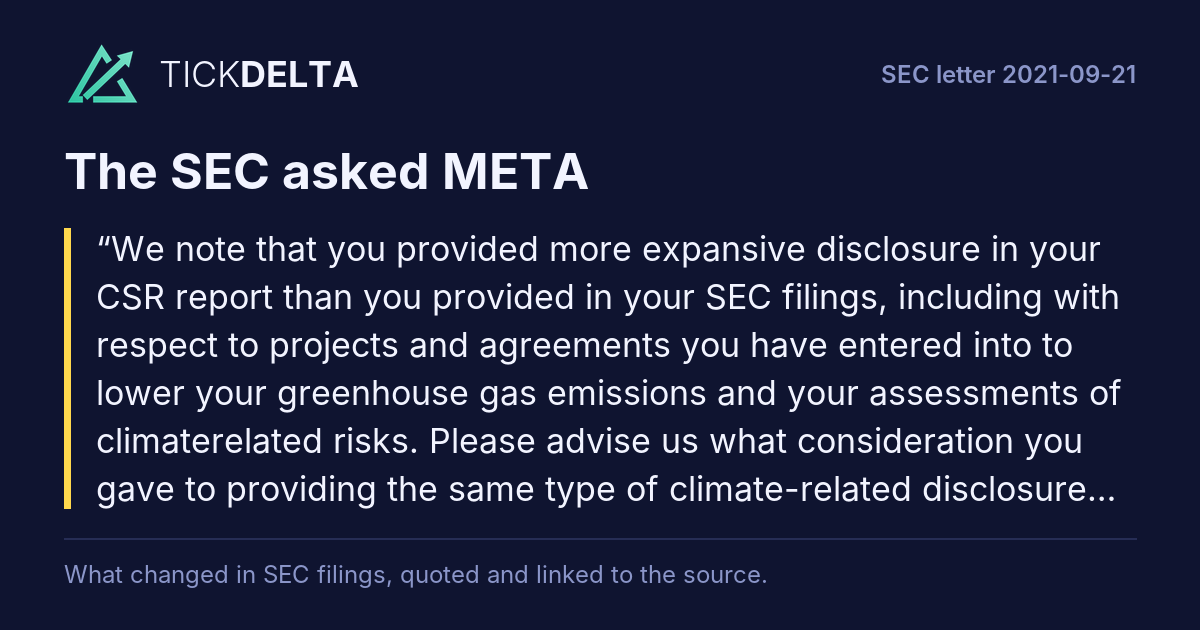
We note that you provided more expansive disclosure in your CSR report than you provided in your SEC filings, including with respect to projects and agreements you have entered into to lower your greenhouse gas emissions and your assessments of climaterelated risks.
Rest of the question

Please advise us what consideration you gave to providing the same type of climate-related disclosure in your SEC filings as you provided in your CSR report. Business, page 7

META answered
The Company respectfully advises the Staff that it prepares its disclosures in accordance with applicable disclosure requirements under U.S. securities laws and regulations (“Applicable

Disclosure Requirements”), including with respect to materiality, within the context of the Company’s business, operating results and financial condition, such that the Form 10-K includes the required information that is material to an understanding of the

Company’s business and is otherwise responsive to the disclosures required by Form 10-K.

The Company is committed to fighting climate change and
Rest of the answer

understands that climate-related disclosures are of interest to a broad range of stakeholders, including its user community, employees, suppliers, the communities in which it operates and many of its shareholders. Consistent with this belief, the Company provides transparency to external stakeholders by voluntarily reporting on climate-related activities in an annual sustainability report, including its greenhouse gas emissions and initiatives to reduce it, efforts to mitigate potentially negative environmental impacts, and other disclosures on its sustainability website at http://www.sustainability.fb.com. However, information that is of interest to a broad range of the Company’s stakeholders is distinguishable from information that is material as defined under Basic Inc. V. Levinson, 485 U.S. 224 (1988) or otherwise required to be disclosed in its SEC filings under U.S. securities laws and regulations, including the Form 10-K.

The Company is in the business of building products that enable people to connect and share with friends and family through mobile devices, personal computers, virtual reality headsets, and in-home devices. The Company generates substantially all of its revenue from selling advertisements, which are displayed on the Company’s online products – Facebook, Instagram and Messenger – as well as third-party applications and websites. As the Company is primarily in the business of providing online products and selling advertisements, its material properties are its headquarters, its offices and its data centers, as disclosed under Part I, Item 2. Properties of the Form 10-K. The Company does not own or operate manufacturing plants, factories or other industrial sites. As such, while the Company is committed to reducing its climate footprint and fighting climate change, it believes the impact of climate change is not material to its business under the Applicable Disclosure Requirements.

The Company therefore respectfully submits that there are no material pending or existing climate-related matters that it reasonably believes were required under the Applicable Disclosure

Requirements to be further described in the Form 10-K. With respect to future filings, the Company will continue to monitor and evaluate whether inclusion of any specific material pending or existing climate-related matters may be warranted in response to the Applicable

Disclosure Requirements.

Read in the reply ↗
In its next report

First report after the company's reply of 2021-11-04: 10-K filed 2022-02-03 ↗, against the 10-K filed 2021-01-28 ↗.

Tickdelta does not hold the text of both reports, so they are not compared here.

After reviewing your response to these comments, we may have additional comments. General
SEC asked (2)
There have been significant developments in federal and state legislation and regulation and international accords regarding climate change. We note that you have not discussed the impact of pending or existing climate change-related legislation, regulations, and international accords in your SEC filings.
Rest of the question

Please revise your disclosure to identify material existing climate change-related legislation, regulations, and international accords and any material effect on your business, financial condition, and results of operations. Risk Factors, page 12

META answered
The Company respectfully advises the

Staff that while there have been developments in federal and state legislation and regulation and international accords regarding climate change (“Climate Change Regulation”), it has not identified any such developments impacting its business, financial condition, and results of operations that would be considered material and necessitate disclosure in its Form 10-K under Applicable Disclosure Requirements.

November 4, 2021 2

With respect to future filings, the

Company expects to continue to assess climate-related risks, including policy, regulatory,
Rest of the answer

and legal risks in the geographies in which it operates and it will continue to evaluate whether any significant developments in Climate Change Regulation may necessitate a disclosure in its filings with the SEC.

Read in the reply ↗
In its next report

First report after the company's reply of 2021-11-04: 10-K filed 2022-02-03 ↗, against the 10-K filed 2021-01-28 ↗.

Tickdelta does not hold the text of both reports, so they are not compared here.

After reviewing your response to these comments, we may have additional comments. General
SEC asked (3)
Disclose the material effects of transition risks related to climate change that may affect your business, financial condition, and results of operations, such as policy and regulatory changes that could impose operational and compliance burdens, market trends that may alter business opportunities, credit risks, or technological changes.
META answered
Staff that it regularly conducts assessments of climate-related risks and opportunities to increase its understanding of future climate-related transitional risks that may affect the Company’s business. It also provides information on climate-related risks in its annual sustainability report available at http://www.sustainability.fb.com in an effort to provide transparency to external stakeholders on climate-related activities as discussed in response to the Staff’s comment number 1.
Rest of the answer

However, through a range of risk assessments, and in light of the Company’s business, the Company does not believe there are any material risks that would be required to be disclosed under the Applicable Disclosure Requirements at this time.

Read in the reply ↗
In its next report

First report after the company's reply of 2021-11-04: 10-K filed 2022-02-03 ↗, against the 10-K filed 2021-01-28 ↗.

Tickdelta does not hold the text of both reports, so they are not compared here.

After reviewing your response to these comments, we may have additional comments. General
SEC asked (4)
Disclose any material litigation risks related to climate change and the potential impact to the company.
META answered
Staff that it regularly monitors its legal exposures and it has not identified any material litigation risks related to climate change that would be required to be disclosed under the Applicable Disclosure Requirements. Read in the reply ↗
In its next report

First report after the company's reply of 2021-11-04: 10-K filed 2022-02-03 ↗, against the 10-K filed 2021-01-28 ↗.

Tickdelta does not hold the text of both reports, so they are not compared here.

Management's Discussion and Analysis of Financial Condition and Results of Operations, page
SEC asked (5)
To the extent material, discuss the indirect consequences of climate-related regulation or business trends, such as the following: • decreased demand for goods or services that produce significant greenhouse gas emissions or are related to carbon-based energy sources, including energy use at your offices and data centers, and emissions relating to your server hardware and consumer products; • increased demand for
Rest of the question

goods or services that result in lower emissions than competing products; • increased competition to develop innovative new products or services that result in lower emissions; and • any anticipated reputational risks resulting from operations, products or services that produce material greenhouse gas emissions.

META answered
Staff that it has not identified any material indirect consequences of climate-related regulation or business trends that would be required to be disclosed under the Applicable Disclosure Requirements. Read in the reply ↗
In its next report

First report after the company's reply of 2021-11-04: 10-K filed 2022-02-03 ↗, against the 10-K filed 2021-01-28 ↗.

Tickdelta does not hold the text of both reports, so they are not compared here.

Management's Discussion and Analysis of Financial Condition and Results of Operations, page
SEC asked (6)
You disclose that your business may be subject to interruptions, delays, or failures resulting from earthquakes, adverse weather conditions, or other natural disasters. If material, discuss the significant physical effects of climate change on your operations and results.
Rest of the question

This disclosure may include the following: • severity of weather as a result of climate change, such as floods, hurricanes, sea levels, extreme fires, and water availability and quality; • quantification of material weather-related damages to your property or operations; • potential for indirect weather-related impacts that have affected or may affect your major customers or suppliers; and • any weather-related impacts on the cost or availability of insurance.

META answered
Staff that it regularly assesses its physical climate-related risks. Under the Applicable Disclosure Requirements, it has not experienced any material physical effects of climate change, including as related to the above listed events, on its operations and results that would be required to be disclosed under the Applicable Disclosure Requirements. Read in the reply ↗
In its next report

First report after the company's reply of 2021-11-04: 10-K filed 2022-02-03 ↗, against the 10-K filed 2021-01-28 ↗.

Tickdelta does not hold the text of both reports, so they are not compared here.

Management's Discussion and Analysis of Financial Condition and Results of Operations, page
SEC asked (7)
Quantify any material increased compliance costs related to climate change. We remind you that the company and its management are responsible for the accuracy and adequacy of their disclosures, notwithstanding any review, comments, action or absence of action by the staff.
META answered
Staff that it has not experienced any material increased compliance costs related to climate change required to be disclosed under the

Applicable Disclosure Requirements.

* * *

November 4, 2021 4

In connection with its response to the Staff’s comments, the Company acknowledges that the Company and its management are responsible for the accuracy and adequacy of its disclosures, notwithstanding any review, comments, action or absence of action by the Staff. Read in the reply ↗
In its next report

First report after the company's reply of 2021-11-04: 10-K filed 2022-02-03 ↗, against the 10-K filed 2021-01-28 ↗.

Tickdelta does not hold the text of both reports, so they are not compared here.

Business, page 7
SEC asked (1)
Your response to prior comment 2 references developments in federal and state legislation and regulation and international accords regarding climate change. Please explain in greater detail which regulatory developments you considered and how you determined whether these developments are reasonably likely to have a material effect on you.
Rest of the question

Also, tell us how you considered providing disclosure regarding the difficulties involved in assessing the timing and effect of pending climate-related laws or regulations. Risk Factors, page 12

META answered
As noted in the Prior Response Letter, the Company prepares its disclosure in accordance with applicable disclosure requirements under U.S. securities laws and regulations, including with respect to materiality, within the context of the Company’s business, operating results and financial condition. In determining the materiality of information to be included in its disclosure, the Company refers to the standard of materiality set forth in Basic Inc. V. Levinson, 485 U.S.
Rest of the answer

224 (1988).

In connection with the preparation of the Company’s annual reports on Form 10-K and quarterly reports on Form 10-Q, the Company engages in a number of processes to surface potentially material developments, events, trends and risks for consideration for disclosure, including the following processes, among others:

· review of the Company’s prior disclosures, including its business, legal and regulatory, and risk factor disclosures, by members of the Company’s legal, regulatory, compliance, infrastructure, Reality Labs, communications, finance and tax teams (the “Meta

Teams”) to propose potential new disclosures for consideration to reflect developments in the quarter;

· meetings of members of the Meta Teams among each other and with key business leaders throughout the Company to discuss potentially material developments, events, trends and risks and their potential impact on the Company’s business;

· review of the Company’s prior and proposed new disclosures by the Company’s Disclosure Committee, which includes the Company’s chief financial officer, chief accounting officer, chief legal officer, and other members of the Company’s senior leadership, as well as review of the legal and regulatory and risk factor disclosures by the chief legal officer and each deputy general counsel reporting to the chief legal officer; and

· meetings of the Disclosure Committee to review the Company’s prior and proposed new disclosures and discuss any changes that may be appropriate as a result of potentially material events, trends and risks identified.

In addition, the Company establishes a scoping threshold

(the “Scoping Threshold”), which is a percentage of income before provision for income taxes that the Company uses, along with qualitative factors, to assess transactions, account balances, information about product groups and areas of the business to be disclosed in the financial statements. The Company also uses the Scoping Threshold as a guidepost, along with qualitative factors, for considering potentially material developments, events, trends and risks for consideration for disclosure outside the financial statements. For the

2020 Form 10-K, the Scoping Threshold was approximately 2% of income before provision for income taxes for the year ended December 31,

2020.

As part of this process, a variety of federal, state and international legislative and regulatory developments and their potential effects on the Company’s business, operating results and financial condition are broadly considered. The Company considers these developments in light of the Scoping Threshold as well as qualitative factors. With respect to pending legislation or regulation, the Company evaluates both the likelihood and potential timing of enactment, as well as whether the pending legislation or regulation is reasonably likely to have a material effect on the Company if enacted.

Members of the Meta Teams include attorneys and other Company personnel working on matters across the following areas: regulatory, policy, infrastructure (including data centers), sustainability, environmental, health and safety, supply chain, and tax. Members of the Meta Teams either directly monitor, or oversee or interact with other teams at the Company that monitor, relevant legislative and regulatory developments relating to climate change. Such developments include existing regulations

December 29, 2021 2 such as the European Union Emissions Trading System, as well as legislative and regulatory proposals or initiatives relating to emissions reporting, renewable energy, and carbon pricing. In addition, as part of the Company’s commitment to fighting climate change, it voluntarily seeks to minimize its energy, emissions and water impact, and works with regulators in connection with these voluntary efforts. For example, the Company is a large corporate buyer of renewable energy and regularly works with its energy suppliers in the United States to create special service contracts and green tariffs to meet its renewable energy goals, which involves interactions with state utility regulators and consideration of state and local renewable energy regulations.

As noted in the Prior Response Letter, the Company expects to continue to assess climate-related risks, including policy, regulatory, and legal risks in the geographies in which it operates as part of its disclosure process and it will continue to evaluate whether any significant legislative or regulatory developments with respect to climate change may necessitate a disclosure in its filings with the Commission.

In connection with preparing the 2020 Form 10-K, no legislative or regulatory developments relating to climate change were identified as being reasonably expected to have a material effect on the Company’s business, operating results or financial condition.

Read in the reply ↗
Business, page 7
SEC asked (2)
Your response to prior comment 3 references your analysis of climate-related transitional risks, but appears to be conclusory without providing adequate detail. Please describe the relevant transition risks you analyzed and explain how you assessed the materiality of these risks.
META answered
The Company’s sustainability team periodically runs analyses of transition risks1 related to climate change and shares the results of such analysis with relevant teams at the Company, including members of the Meta Teams that participate in the disclosure process described in response to comment 1. The transition risks reviewed in the Company’s most recent analysis included (i) reputational risks, such as the stigmatization of the information technology sector due to the emissions impacts of running global cloud infrastructure; and (ii) potential future regulations regarding climate change,
Rest of the answer

including any developments that may lead to increased emissions pricing and result in higher electricity costs. The Company assesses the materiality of these risks in light of the Scoping Threshold as well as qualitative factors.

In connection with preparing the 2020 Form 10-K, no such risks were identified as being reasonably expected to have a material effect on the Company’s business, operating results or financial condition. In particular, the Company believes that its sustainability efforts, including its achievement of net zero emissions from its global operations as of December 31, 2020, help mitigate the reputational risk relating to the stigmatization of the information technology sector. With respect to potential new regulations relating to climate change, as discussed in response to comment 1, the Company did not identify any legislative or regulatory developments as being reasonably expected to have a material

1 The Company has interpreted “transition risks” to mean risks associated with global efforts to transition to a zero carbon future.

December 29, 2021 3 effect on the Company’s business, operating results or financial condition in connection with preparing the 2020 Form 10-K, although the Company continues to monitor and assess climate-related risks.

Read in the reply ↗
Business, page 7
SEC asked (3)
Your response to prior comment 4 states that you regularly monitor your legal exposures and that you have not identified any material litigation risks related to climate change. Please tell us about the litigation risks related to climate change that were included in your most recent assessment and explain how you evaluated the materiality of these risks.
META answered
As part of the disclosure process described in response to comment 1, the Company’s corporate legal team meets quarterly with members of the Company’s litigation, regulatory and finance teams to receive updates on pending litigation and regulatory matters, including potential exposures relating to such matters.
Rest of the answer

In addition, members of several Meta Teams review the Company’s risk factor disclosures to surface potentially material risks for consideration, including the litigation, regulatory and infrastructure teams, as described in response to comment 1.

In particular, the Company assesses the materiality of pending litigation and regulatory matters by reference to the Scoping Threshold, the accounting standards applicable to loss contingencies under

ASC Topic 450, as well as qualitative factors. In connection with preparing the 2020 Form 10-K, the Company did not identify any pending litigation or regulatory matters related to climate change as part of the process described above, and the Company did not identify any litigation risk related to climate change that would reasonably be expected to have a material effect on the Company’s business, operating results or financial condition.

Read in the reply ↗
Management's Discussion and Analysis of Financial Condition and Results of Operations, page
SEC asked (4)
Your response to prior comment 5 states that you have not experienced material indirect consequences of climate-related regulation or business trends. It appears that your response is conclusory in nature and does not adequately address the individual items in our prior comment. Please describe the indirect consequences you considered in your analysis and explain how you concluded they were not material.
META answered
comment 1, the Company assesses business trends driving the Company’s operating results, including the potential indirect consequences of regulations broadly. The Company refers to the Scoping Threshold as well as qualitative factors and holds several live meetings of members of the legal and finance teams to discuss observed trends and surface potentially material trends for consideration for disclosure.

As noted in the Prior Response Letter, the Company generates substantially all of its revenue from selling advertisements, with only a small portion of revenue (approximately 2% for the
Rest of the answer

year ended

December 31, 2020) generated by sales of consumer hardware products. As a result, although the Company considers trends relating to all parts of its business, the primary trends and factors that have historically driven results have been those affecting advertising demand during the applicable reporting period, such as consumer trends, macroeconomic conditions and competition. As discussed in more

December 29, 2021 4 detail in response to comment 5, the Company has a large and diversified advertiser base, both by size and geography, and trends and factors affecting advertising demand vary widely by region and customer. Similarly, the Company has a large and diversified global user base, and the trends and factors affecting user engagement with the Company’s online products as well as purchases of its consumer hardware products also vary widely by region. In connection with preparing the 2020 Form 10-K, the Company did not identify any potentially material indirect consequences of climate change or business trends relating to climate change that affected demand or competition for the Company’s products as a result of energy usage or emissions. In addition, the Company did not identify any potentially material reputational or brand risks as a result of climate change, as noted in response to comment 2.

Read in the reply ↗
In its next report

First report after the company's reply of 2021-12-29: 10-K filed 2022-02-03 ↗, against the 10-K filed 2021-01-28 ↗.

Tickdelta does not hold the text of both reports, so they are not compared here.

Management's Discussion and Analysis of Financial Condition and Results of Operations, page
SEC asked (5)
Your response to prior comment 6 states that you have not experienced material physical effects of climate change. Please tell us about the physical effects of climate change you have experienced, such as effect on the severity of weather, and how you assessed the materiality of such effects.
Rest of the question

As requested in our prior comment, quantify weather-related damages to your property or operations, discuss how weather-related impacts have affected or may affect your customers or suppliers and discuss any weather-related impacts on the cost or availability of insurance.

META answered
As noted in response to comment 4, the Company generates substantially all of its revenue from selling advertisements, which are displayed on the Company’s online products – Facebook,

Instagram and Messenger – as well as third-party applications and websites. Its material properties are its headquarters, its offices and its data centers, as disclosed under Part I, Item 2.
Rest of the answer

Properties of the 2020 Form 10-K.

comment 1, the Company assesses whether any events, including any adverse weather conditions, had a material effect on the Company, including as a result of any damage to the Company’s properties or operations. In particular, the Company’s finance team runs a financial statement line item fluctuation analysis each quarter to identify events, including weather events, that had a significant impact on financial results in the relevant reporting period. Members of the legal and finance teams then hold a meeting (the “Significant Events Meeting”) to review the results. For purposes of this review, the finance team reviews transactions or events where the aggregate, cumulative impact is or exceeds $100 million, which is approximately 0.3% of income before provision for income taxes for the year ended December 31, 2020.

In that meeting, they assess whether any identified events had a material effect on the Company’s business, operating results or financial condition and whether to otherwise make any updates to the Company’s disclosures.

We would note that as part of this review in the first quarter of 2021, the Company’s finance team identified that the polar vortex wave impacting the United States in February 2021 caused the

Company to incur increased energy costs of approximately just over 1% of the Company’s net income for the quarter. Although the impact of the polar vortex was therefore not material to the Company, the Company determined that it would be prudent to update its risk factors relating to adverse weather events in the Form 10-Q filed for the first quarter of 2021 to disclose that it had been, and may in the future be, subject to increased energy or other costs to maintain the availability or performance of its products in connection with adverse weather events. In connection with preparing the 2020 Form 10-K, however, the Company did not identify any potentially material weather-related impacts on its business or any weather-related events that caused potentially material damages to its properties or operations.

December 29, 2021 5

With respect to the Company’s customers and suppliers, as noted above, the Company generates substantially all of its revenue from selling advertisements, which are displayed on the Company’s online products – Facebook, Instagram and Messenger – as well as third-party applications and websites. The Company has a large and diversified base of advertisers in many countries around the world. As disclosed in the 2020 Form 10-K, no customer represented

10% or more of the Company’s revenue in 2020 and the Company generated revenue from advertisers located throughout the world, with approximately 45% generated in the United States and Canada, 24% generated in Europe, 23% generated in Asia-Pacific and 8% generated in the rest of the world. The Company believes that its diversified customer base, both by size and geography, helps mitigate the risk that any adverse weather event affecting any particular customer or any particular region where it has customers would have a material effect on the Company as a whole, and in preparing the 2020 Form 10-K, the Company did not identify weather-related impacts to its customers that had a potentially material effect on the Company’s business, operating results or financial condition. Weather-related impacts that have affected the Company’s suppliers include events such as the polar vortex in the United States in February 2021 that led to disruption in the business of the Company’s energy suppliers and increased energy costs for the Company as described above. However, in preparing the 2020 Form 10-K, the Company did not identify weather-related impacts to its suppliers that had a potentially material effect on the Company’s business, operating results or financial condition.

With respect to the cost or availability of insurance, the

Company reviews events that had a significant impact on costs, including insurance costs, during the Significant Events Meeting. Members of the Company’s treasury team, which handles its insurance policies, participate in the Significant Events Meeting and in the disclosure process more generally. No potentially material increases in the cost or availability of insurance as a result of climate change were identified during the Significant Events Meeting or otherwise in connection with the preparation of the 2020 Form 10-K.

Read in the reply ↗
In its next report

First report after the company's reply of 2021-12-29: 10-K filed 2022-02-03 ↗, against the 10-K filed 2021-01-28 ↗.

Tickdelta does not hold the text of both reports, so they are not compared here.

Management's Discussion and Analysis of Financial Condition and Results of Operations, page
SEC asked (6)
Your response to prior comment 7 states that you have not experienced any material increased compliance costs related to climate change. Please tell us about the compliance costs you have incurred and explain how you analyzed the materiality of these costs. Please contact Anna Abramson, Staff Attorney, at (202) 551-4969 or Mitchell Austin, Staff Attorney, at (202) 551-3574 with any questions.
META answered
The Company generally records compliance costs2 for its business in cost of revenue, general and administrative expenses and research and development expenses, depending on the business matter to which the compliance costs relate. As discussed in response to comment 4, each quarter, members of the legal and finance teams meet to discuss observed trends and surface potentially material trends for consideration for disclosure based on both quantitative and qualitative factors.
Rest of the answer

This review includes trends impacting individual line items in the Company’s financial statements and is designed to identify events that may have had, or may be expected to have, a material impact on the Company’s cost of revenue or expenses.

For example, the $5.0 billion payment required by the Company’s 2020 settlement and modified consent order with the Federal Trade

Commission (the “FTC”) was identified and discussed in the 2020 Form 10-K, including in Management’s Discussion and

Analysis of Financial Conditions and Results of Operations under general and administrative expenses. In addition, the

2 The Company has interpreted “compliance costs” in this comment (and the Staff’s prior comment 7) to mean the necessary costs incurred to comply with laws and regulations applicable to the Company. For completeness in its responses to the Staff, the Company has also considered necessary costs incurred to comply with regulatory orders, such as the Company’s 2020 settlement with the Federal Trade Commission, as described below.

December 29, 2021 6

Company included risk factors in the 2020 Form 10-K discussing the impact of, and investments associated with, its ongoing privacy compliance and oversight efforts, including compliance with the FTC consent order and other regulatory and legislative privacy requirements. With respect to compliance costs relating to climate change, the Company did not identify any such potentially material increased costs in connection with preparing the 2020 Form 10-K.

* * *

In connection with its response to the Staff’s comments, the Company acknowledges that the Company and its management are responsible for the accuracy and adequacy of its disclosures, notwithstanding any review, comments, action or absence of action by the Staff.

Read in the reply ↗
In its next report

First report after the company's reply of 2021-12-29: 10-K filed 2022-02-03 ↗, against the 10-K filed 2021-01-28 ↗.

Tickdelta does not hold the text of both reports, so they are not compared here.

Also in this review: request for more time, 2021-09-28, request for more time, 2021-11-22, closing letter, 2022-01-27

2 other letters: notices that a filing will not be reviewed, requests to declare a registration effective, and the like

From the SEC's correspondence on EDGAR: staff letters (form UPLOAD) and company letters (form CORRESP), 16 letters filed since 2021-09-21. Questions and answers are matched by their numbers; topics come from words in each question. The reports are compared word for word (same form, before the first SEC letter against the first report after the company's reply). No AI.

Work on META in a spreadsheet: Excel workbook (a sheet per section, ten years by column, charts, links to the filings) · CSV. For a Google Sheet that stays up to date, paste =IMPORTDATA("https://tickdelta.com/company/META/export.csv") into a cell.