Form 10-K
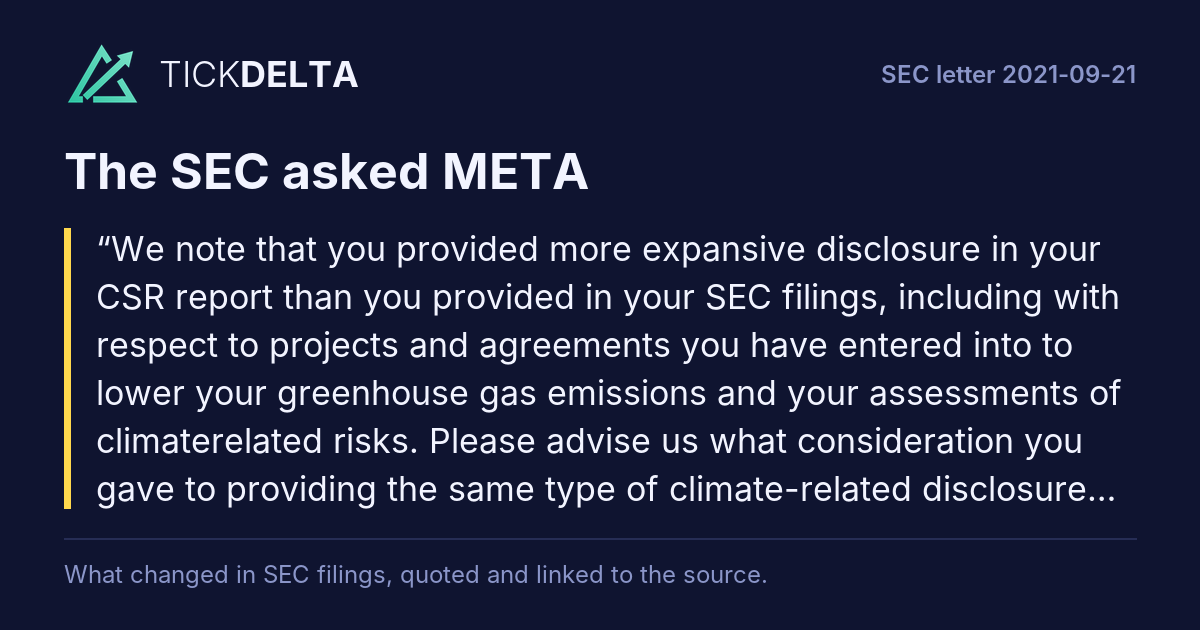
We note that you provided more expansive disclosure in your CSR report than you provided in your SEC filings, including with respect to projects and agreements you have entered into to lower your greenhouse gas emissions and your assessments of climaterelated risks.Rest of the question
Please advise us what consideration you gave to providing the same type of climate-related disclosure in your SEC filings as you provided in your CSR report. Business, page 7
The Company respectfully advises the Staff that it prepares its disclosures in accordance with applicable disclosure requirements under U.S. securities laws and regulations (“Applicable
Disclosure Requirements”), including with respect to materiality, within the context of the Company’s business, operating results and financial condition, such that the Form 10-K includes the required information that is material to an understanding of the
Company’s business and is otherwise responsive to the disclosures required by Form 10-K.
The Company is committed to fighting climate change andRead in the reply ↗Rest of the answer
understands that climate-related disclosures are of interest to a broad range of stakeholders, including its user community, employees, suppliers, the communities in which it operates and many of its shareholders. Consistent with this belief, the Company provides transparency to external stakeholders by voluntarily reporting on climate-related activities in an annual sustainability report, including its greenhouse gas emissions and initiatives to reduce it, efforts to mitigate potentially negative environmental impacts, and other disclosures on its sustainability website at http://www.sustainability.fb.com. However, information that is of interest to a broad range of the Company’s stakeholders is distinguishable from information that is material as defined under Basic Inc. V. Levinson, 485 U.S. 224 (1988) or otherwise required to be disclosed in its SEC filings under U.S. securities laws and regulations, including the Form 10-K.
The Company is in the business of building products that enable people to connect and share with friends and family through mobile devices, personal computers, virtual reality headsets, and in-home devices. The Company generates substantially all of its revenue from selling advertisements, which are displayed on the Company’s online products – Facebook, Instagram and Messenger – as well as third-party applications and websites. As the Company is primarily in the business of providing online products and selling advertisements, its material properties are its headquarters, its offices and its data centers, as disclosed under Part I, Item 2. Properties of the Form 10-K. The Company does not own or operate manufacturing plants, factories or other industrial sites. As such, while the Company is committed to reducing its climate footprint and fighting climate change, it believes the impact of climate change is not material to its business under the Applicable Disclosure Requirements.
The Company therefore respectfully submits that there are no material pending or existing climate-related matters that it reasonably believes were required under the Applicable Disclosure
Requirements to be further described in the Form 10-K. With respect to future filings, the Company will continue to monitor and evaluate whether inclusion of any specific material pending or existing climate-related matters may be warranted in response to the Applicable
Disclosure Requirements.
First report after the company's reply of 2021-11-04: 10-K filed 2022-02-03 ↗, against the 10-K filed 2021-01-28 ↗.
Tickdelta does not hold the text of both reports, so they are not compared here.
There have been significant developments in federal and state legislation and regulation and international accords regarding climate change. We note that you have not discussed the impact of pending or existing climate change-related legislation, regulations, and international accords in your SEC filings.Rest of the question
Please revise your disclosure to identify material existing climate change-related legislation, regulations, and international accords and any material effect on your business, financial condition, and results of operations. Risk Factors, page 12
The Company respectfully advises the
Staff that while there have been developments in federal and state legislation and regulation and international accords regarding climate change (“Climate Change Regulation”), it has not identified any such developments impacting its business, financial condition, and results of operations that would be considered material and necessitate disclosure in its Form 10-K under Applicable Disclosure Requirements.
November 4, 2021 2
With respect to future filings, the
Company expects to continue to assess climate-related risks, including policy, regulatory,Read in the reply ↗Rest of the answer
and legal risks in the geographies in which it operates and it will continue to evaluate whether any significant developments in Climate Change Regulation may necessitate a disclosure in its filings with the SEC.
First report after the company's reply of 2021-11-04: 10-K filed 2022-02-03 ↗, against the 10-K filed 2021-01-28 ↗.
Tickdelta does not hold the text of both reports, so they are not compared here.
Disclose the material effects of transition risks related to climate change that may affect your business, financial condition, and results of operations, such as policy and regulatory changes that could impose operational and compliance burdens, market trends that may alter business opportunities, credit risks, or technological changes.
Staff that it regularly conducts assessments of climate-related risks and opportunities to increase its understanding of future climate-related transitional risks that may affect the Company’s business. It also provides information on climate-related risks in its annual sustainability report available at http://www.sustainability.fb.com in an effort to provide transparency to external stakeholders on climate-related activities as discussed in response to the Staff’s comment number 1.Read in the reply ↗Rest of the answer
However, through a range of risk assessments, and in light of the Company’s business, the Company does not believe there are any material risks that would be required to be disclosed under the Applicable Disclosure Requirements at this time.
First report after the company's reply of 2021-11-04: 10-K filed 2022-02-03 ↗, against the 10-K filed 2021-01-28 ↗.
Tickdelta does not hold the text of both reports, so they are not compared here.
Disclose any material litigation risks related to climate change and the potential impact to the company.
Staff that it regularly monitors its legal exposures and it has not identified any material litigation risks related to climate change that would be required to be disclosed under the Applicable Disclosure Requirements. Read in the reply ↗
First report after the company's reply of 2021-11-04: 10-K filed 2022-02-03 ↗, against the 10-K filed 2021-01-28 ↗.
Tickdelta does not hold the text of both reports, so they are not compared here.
To the extent material, discuss the indirect consequences of climate-related regulation or business trends, such as the following: • decreased demand for goods or services that produce significant greenhouse gas emissions or are related to carbon-based energy sources, including energy use at your offices and data centers, and emissions relating to your server hardware and consumer products; • increased demand forRest of the question
goods or services that result in lower emissions than competing products; • increased competition to develop innovative new products or services that result in lower emissions; and • any anticipated reputational risks resulting from operations, products or services that produce material greenhouse gas emissions.
Staff that it has not identified any material indirect consequences of climate-related regulation or business trends that would be required to be disclosed under the Applicable Disclosure Requirements. Read in the reply ↗
First report after the company's reply of 2021-11-04: 10-K filed 2022-02-03 ↗, against the 10-K filed 2021-01-28 ↗.
Tickdelta does not hold the text of both reports, so they are not compared here.
You disclose that your business may be subject to interruptions, delays, or failures resulting from earthquakes, adverse weather conditions, or other natural disasters. If material, discuss the significant physical effects of climate change on your operations and results.Rest of the question
This disclosure may include the following: • severity of weather as a result of climate change, such as floods, hurricanes, sea levels, extreme fires, and water availability and quality; • quantification of material weather-related damages to your property or operations; • potential for indirect weather-related impacts that have affected or may affect your major customers or suppliers; and • any weather-related impacts on the cost or availability of insurance.
Staff that it regularly assesses its physical climate-related risks. Under the Applicable Disclosure Requirements, it has not experienced any material physical effects of climate change, including as related to the above listed events, on its operations and results that would be required to be disclosed under the Applicable Disclosure Requirements. Read in the reply ↗
First report after the company's reply of 2021-11-04: 10-K filed 2022-02-03 ↗, against the 10-K filed 2021-01-28 ↗.
Tickdelta does not hold the text of both reports, so they are not compared here.
Quantify any material increased compliance costs related to climate change. We remind you that the company and its management are responsible for the accuracy and adequacy of their disclosures, notwithstanding any review, comments, action or absence of action by the staff.
Staff that it has not experienced any material increased compliance costs related to climate change required to be disclosed under the
Applicable Disclosure Requirements.
* * *
November 4, 2021 4
In connection with its response to the Staff’s comments, the Company acknowledges that the Company and its management are responsible for the accuracy and adequacy of its disclosures, notwithstanding any review, comments, action or absence of action by the Staff. Read in the reply ↗
First report after the company's reply of 2021-11-04: 10-K filed 2022-02-03 ↗, against the 10-K filed 2021-01-28 ↗.
Tickdelta does not hold the text of both reports, so they are not compared here.
Your response to prior comment 2 references developments in federal and state legislation and regulation and international accords regarding climate change. Please explain in greater detail which regulatory developments you considered and how you determined whether these developments are reasonably likely to have a material effect on you.Rest of the question
Also, tell us how you considered providing disclosure regarding the difficulties involved in assessing the timing and effect of pending climate-related laws or regulations. Risk Factors, page 12
As noted in the Prior Response Letter, the Company prepares its disclosure in accordance with applicable disclosure requirements under U.S. securities laws and regulations, including with respect to materiality, within the context of the Company’s business, operating results and financial condition. In determining the materiality of information to be included in its disclosure, the Company refers to the standard of materiality set forth in Basic Inc. V. Levinson, 485 U.S.Read in the reply ↗Rest of the answer
224 (1988).
In connection with the preparation of the Company’s annual reports on Form 10-K and quarterly reports on Form 10-Q, the Company engages in a number of processes to surface potentially material developments, events, trends and risks for consideration for disclosure, including the following processes, among others:
· review of the Company’s prior disclosures, including its business, legal and regulatory, and risk factor disclosures, by members of the Company’s legal, regulatory, compliance, infrastructure, Reality Labs, communications, finance and tax teams (the “Meta
Teams”) to propose potential new disclosures for consideration to reflect developments in the quarter;
· meetings of members of the Meta Teams among each other and with key business leaders throughout the Company to discuss potentially material developments, events, trends and risks and their potential impact on the Company’s business;
· review of the Company’s prior and proposed new disclosures by the Company’s Disclosure Committee, which includes the Company’s chief financial officer, chief accounting officer, chief legal officer, and other members of the Company’s senior leadership, as well as review of the legal and regulatory and risk factor disclosures by the chief legal officer and each deputy general counsel reporting to the chief legal officer; and
· meetings of the Disclosure Committee to review the Company’s prior and proposed new disclosures and discuss any changes that may be appropriate as a result of potentially material events, trends and risks identified.
In addition, the Company establishes a scoping threshold
(the “Scoping Threshold”), which is a percentage of income before provision for income taxes that the Company uses, along with qualitative factors, to assess transactions, account balances, information about product groups and areas of the business to be disclosed in the financial statements. The Company also uses the Scoping Threshold as a guidepost, along with qualitative factors, for considering potentially material developments, events, trends and risks for consideration for disclosure outside the financial statements. For the
2020 Form 10-K, the Scoping Threshold was approximately 2% of income before provision for income taxes for the year ended December 31,
2020.
As part of this process, a variety of federal, state and international legislative and regulatory developments and their potential effects on the Company’s business, operating results and financial condition are broadly considered. The Company considers these developments in light of the Scoping Threshold as well as qualitative factors. With respect to pending legislation or regulation, the Company evaluates both the likelihood and potential timing of enactment, as well as whether the pending legislation or regulation is reasonably likely to have a material effect on the Company if enacted.
Members of the Meta Teams include attorneys and other Company personnel working on matters across the following areas: regulatory, policy, infrastructure (including data centers), sustainability, environmental, health and safety, supply chain, and tax. Members of the Meta Teams either directly monitor, or oversee or interact with other teams at the Company that monitor, relevant legislative and regulatory developments relating to climate change. Such developments include existing regulations
December 29, 2021 2 such as the European Union Emissions Trading System, as well as legislative and regulatory proposals or initiatives relating to emissions reporting, renewable energy, and carbon pricing. In addition, as part of the Company’s commitment to fighting climate change, it voluntarily seeks to minimize its energy, emissions and water impact, and works with regulators in connection with these voluntary efforts. For example, the Company is a large corporate buyer of renewable energy and regularly works with its energy suppliers in the United States to create special service contracts and green tariffs to meet its renewable energy goals, which involves interactions with state utility regulators and consideration of state and local renewable energy regulations.
As noted in the Prior Response Letter, the Company expects to continue to assess climate-related risks, including policy, regulatory, and legal risks in the geographies in which it operates as part of its disclosure process and it will continue to evaluate whether any significant legislative or regulatory developments with respect to climate change may necessitate a disclosure in its filings with the Commission.
In connection with preparing the 2020 Form 10-K, no legislative or regulatory developments relating to climate change were identified as being reasonably expected to have a material effect on the Company’s business, operating results or financial condition.
Your response to prior comment 3 references your analysis of climate-related transitional risks, but appears to be conclusory without providing adequate detail. Please describe the relevant transition risks you analyzed and explain how you assessed the materiality of these risks.
The Company’s sustainability team periodically runs analyses of transition risks1 related to climate change and shares the results of such analysis with relevant teams at the Company, including members of the Meta Teams that participate in the disclosure process described in response to comment 1. The transition risks reviewed in the Company’s most recent analysis included (i) reputational risks, such as the stigmatization of the information technology sector due to the emissions impacts of running global cloud infrastructure; and (ii) potential future regulations regarding climate change,Read in the reply ↗Rest of the answer
including any developments that may lead to increased emissions pricing and result in higher electricity costs. The Company assesses the materiality of these risks in light of the Scoping Threshold as well as qualitative factors.
In connection with preparing the 2020 Form 10-K, no such risks were identified as being reasonably expected to have a material effect on the Company’s business, operating results or financial condition. In particular, the Company believes that its sustainability efforts, including its achievement of net zero emissions from its global operations as of December 31, 2020, help mitigate the reputational risk relating to the stigmatization of the information technology sector. With respect to potential new regulations relating to climate change, as discussed in response to comment 1, the Company did not identify any legislative or regulatory developments as being reasonably expected to have a material
1 The Company has interpreted “transition risks” to mean risks associated with global efforts to transition to a zero carbon future.
December 29, 2021 3 effect on the Company’s business, operating results or financial condition in connection with preparing the 2020 Form 10-K, although the Company continues to monitor and assess climate-related risks.
Your response to prior comment 4 states that you regularly monitor your legal exposures and that you have not identified any material litigation risks related to climate change. Please tell us about the litigation risks related to climate change that were included in your most recent assessment and explain how you evaluated the materiality of these risks.
As part of the disclosure process described in response to comment 1, the Company’s corporate legal team meets quarterly with members of the Company’s litigation, regulatory and finance teams to receive updates on pending litigation and regulatory matters, including potential exposures relating to such matters.Read in the reply ↗Rest of the answer
In addition, members of several Meta Teams review the Company’s risk factor disclosures to surface potentially material risks for consideration, including the litigation, regulatory and infrastructure teams, as described in response to comment 1.
In particular, the Company assesses the materiality of pending litigation and regulatory matters by reference to the Scoping Threshold, the accounting standards applicable to loss contingencies under
ASC Topic 450, as well as qualitative factors. In connection with preparing the 2020 Form 10-K, the Company did not identify any pending litigation or regulatory matters related to climate change as part of the process described above, and the Company did not identify any litigation risk related to climate change that would reasonably be expected to have a material effect on the Company’s business, operating results or financial condition.
Your response to prior comment 5 states that you have not experienced material indirect consequences of climate-related regulation or business trends. It appears that your response is conclusory in nature and does not adequately address the individual items in our prior comment. Please describe the indirect consequences you considered in your analysis and explain how you concluded they were not material.
comment 1, the Company assesses business trends driving the Company’s operating results, including the potential indirect consequences of regulations broadly. The Company refers to the Scoping Threshold as well as qualitative factors and holds several live meetings of members of the legal and finance teams to discuss observed trends and surface potentially material trends for consideration for disclosure.
As noted in the Prior Response Letter, the Company generates substantially all of its revenue from selling advertisements, with only a small portion of revenue (approximately 2% for theRead in the reply ↗Rest of the answer
year ended
December 31, 2020) generated by sales of consumer hardware products. As a result, although the Company considers trends relating to all parts of its business, the primary trends and factors that have historically driven results have been those affecting advertising demand during the applicable reporting period, such as consumer trends, macroeconomic conditions and competition. As discussed in more
December 29, 2021 4 detail in response to comment 5, the Company has a large and diversified advertiser base, both by size and geography, and trends and factors affecting advertising demand vary widely by region and customer. Similarly, the Company has a large and diversified global user base, and the trends and factors affecting user engagement with the Company’s online products as well as purchases of its consumer hardware products also vary widely by region. In connection with preparing the 2020 Form 10-K, the Company did not identify any potentially material indirect consequences of climate change or business trends relating to climate change that affected demand or competition for the Company’s products as a result of energy usage or emissions. In addition, the Company did not identify any potentially material reputational or brand risks as a result of climate change, as noted in response to comment 2.
First report after the company's reply of 2021-12-29: 10-K filed 2022-02-03 ↗, against the 10-K filed 2021-01-28 ↗.
Tickdelta does not hold the text of both reports, so they are not compared here.
Your response to prior comment 6 states that you have not experienced material physical effects of climate change. Please tell us about the physical effects of climate change you have experienced, such as effect on the severity of weather, and how you assessed the materiality of such effects.Rest of the question
As requested in our prior comment, quantify weather-related damages to your property or operations, discuss how weather-related impacts have affected or may affect your customers or suppliers and discuss any weather-related impacts on the cost or availability of insurance.
As noted in response to comment 4, the Company generates substantially all of its revenue from selling advertisements, which are displayed on the Company’s online products – Facebook,
Instagram and Messenger – as well as third-party applications and websites. Its material properties are its headquarters, its offices and its data centers, as disclosed under Part I, Item 2.Read in the reply ↗Rest of the answer
Properties of the 2020 Form 10-K.
comment 1, the Company assesses whether any events, including any adverse weather conditions, had a material effect on the Company, including as a result of any damage to the Company’s properties or operations. In particular, the Company’s finance team runs a financial statement line item fluctuation analysis each quarter to identify events, including weather events, that had a significant impact on financial results in the relevant reporting period. Members of the legal and finance teams then hold a meeting (the “Significant Events Meeting”) to review the results. For purposes of this review, the finance team reviews transactions or events where the aggregate, cumulative impact is or exceeds $100 million, which is approximately 0.3% of income before provision for income taxes for the year ended December 31, 2020.
In that meeting, they assess whether any identified events had a material effect on the Company’s business, operating results or financial condition and whether to otherwise make any updates to the Company’s disclosures.
We would note that as part of this review in the first quarter of 2021, the Company’s finance team identified that the polar vortex wave impacting the United States in February 2021 caused the
Company to incur increased energy costs of approximately just over 1% of the Company’s net income for the quarter. Although the impact of the polar vortex was therefore not material to the Company, the Company determined that it would be prudent to update its risk factors relating to adverse weather events in the Form 10-Q filed for the first quarter of 2021 to disclose that it had been, and may in the future be, subject to increased energy or other costs to maintain the availability or performance of its products in connection with adverse weather events. In connection with preparing the 2020 Form 10-K, however, the Company did not identify any potentially material weather-related impacts on its business or any weather-related events that caused potentially material damages to its properties or operations.
December 29, 2021 5
With respect to the Company’s customers and suppliers, as noted above, the Company generates substantially all of its revenue from selling advertisements, which are displayed on the Company’s online products – Facebook, Instagram and Messenger – as well as third-party applications and websites. The Company has a large and diversified base of advertisers in many countries around the world. As disclosed in the 2020 Form 10-K, no customer represented
10% or more of the Company’s revenue in 2020 and the Company generated revenue from advertisers located throughout the world, with approximately 45% generated in the United States and Canada, 24% generated in Europe, 23% generated in Asia-Pacific and 8% generated in the rest of the world. The Company believes that its diversified customer base, both by size and geography, helps mitigate the risk that any adverse weather event affecting any particular customer or any particular region where it has customers would have a material effect on the Company as a whole, and in preparing the 2020 Form 10-K, the Company did not identify weather-related impacts to its customers that had a potentially material effect on the Company’s business, operating results or financial condition. Weather-related impacts that have affected the Company’s suppliers include events such as the polar vortex in the United States in February 2021 that led to disruption in the business of the Company’s energy suppliers and increased energy costs for the Company as described above. However, in preparing the 2020 Form 10-K, the Company did not identify weather-related impacts to its suppliers that had a potentially material effect on the Company’s business, operating results or financial condition.
With respect to the cost or availability of insurance, the
Company reviews events that had a significant impact on costs, including insurance costs, during the Significant Events Meeting. Members of the Company’s treasury team, which handles its insurance policies, participate in the Significant Events Meeting and in the disclosure process more generally. No potentially material increases in the cost or availability of insurance as a result of climate change were identified during the Significant Events Meeting or otherwise in connection with the preparation of the 2020 Form 10-K.
First report after the company's reply of 2021-12-29: 10-K filed 2022-02-03 ↗, against the 10-K filed 2021-01-28 ↗.
Tickdelta does not hold the text of both reports, so they are not compared here.
Your response to prior comment 7 states that you have not experienced any material increased compliance costs related to climate change. Please tell us about the compliance costs you have incurred and explain how you analyzed the materiality of these costs. Please contact Anna Abramson, Staff Attorney, at (202) 551-4969 or Mitchell Austin, Staff Attorney, at (202) 551-3574 with any questions.
The Company generally records compliance costs2 for its business in cost of revenue, general and administrative expenses and research and development expenses, depending on the business matter to which the compliance costs relate. As discussed in response to comment 4, each quarter, members of the legal and finance teams meet to discuss observed trends and surface potentially material trends for consideration for disclosure based on both quantitative and qualitative factors.Read in the reply ↗Rest of the answer
This review includes trends impacting individual line items in the Company’s financial statements and is designed to identify events that may have had, or may be expected to have, a material impact on the Company’s cost of revenue or expenses.
For example, the $5.0 billion payment required by the Company’s 2020 settlement and modified consent order with the Federal Trade
Commission (the “FTC”) was identified and discussed in the 2020 Form 10-K, including in Management’s Discussion and
Analysis of Financial Conditions and Results of Operations under general and administrative expenses. In addition, the
2 The Company has interpreted “compliance costs” in this comment (and the Staff’s prior comment 7) to mean the necessary costs incurred to comply with laws and regulations applicable to the Company. For completeness in its responses to the Staff, the Company has also considered necessary costs incurred to comply with regulatory orders, such as the Company’s 2020 settlement with the Federal Trade Commission, as described below.
December 29, 2021 6
Company included risk factors in the 2020 Form 10-K discussing the impact of, and investments associated with, its ongoing privacy compliance and oversight efforts, including compliance with the FTC consent order and other regulatory and legislative privacy requirements. With respect to compliance costs relating to climate change, the Company did not identify any such potentially material increased costs in connection with preparing the 2020 Form 10-K.
* * *
In connection with its response to the Staff’s comments, the Company acknowledges that the Company and its management are responsible for the accuracy and adequacy of its disclosures, notwithstanding any review, comments, action or absence of action by the Staff.
First report after the company's reply of 2021-12-29: 10-K filed 2022-02-03 ↗, against the 10-K filed 2021-01-28 ↗.
Tickdelta does not hold the text of both reports, so they are not compared here.
Also in this review: request for more time, 2021-09-28, request for more time, 2021-11-22, closing letter, 2022-01-27