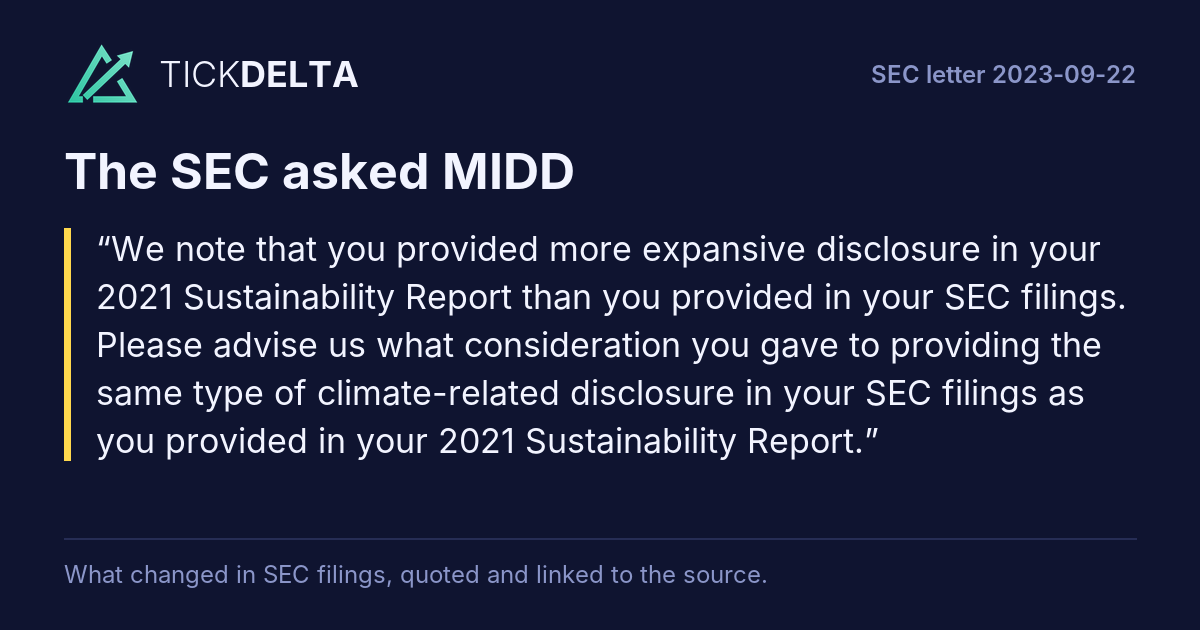
As noted in our 2021 Sustainability Report, product innovation is central to our value proposition to our customers and to our
Production, and Industry Innovation and Infrastructure. As
, the Company has established itself as a leader in all three business segments in which we operate by acquiring leading brands and through the introduction of innovative products.
Rest of the answer
However, the Company has not identified any material indirect consequences of climate-related regulation or business trends.
The following is a discussion of why we have not identified any business trends from factors such as:
carbon-based energy sources
• increased demand for goods that result in lower emissions than competing products
During the periods covered by the Form 10-K, the Company did not experience and we did not expect to experience any material change in the demand for our products based on any increase or decrease in demand for our products and services due to their carbon intensity or other climate-related impacts.
The Company regularly evaluates consumer insights, including those relating to sustainability, through participation in industry organizations, securing access to industry research tools, leveraging information gained via our strong customer relationships and analyzing current and historical sales trends. For example, we did not identify a material shift in our product mix or demand for such product mix, such as a shift away from gas and towards electric equipment. For decades, we have developed and promoted energy star products within our diverse portfolio, and we expect additional future opportunities to develop and sell sustainable products. Additionally, industry and customer insights revealed that our customers’ purchasing decisions are driven by various legal and regulatory requirements and customer-specific operational factors such as safety, price/cost, efficiency, ease of use, flexibility and sustainability. We believe our diverse customer base continues to make purchasing decisions by considering sustainability as one of many factors in making purchasing decisions. Given this, we have not experienced a material impact on the demand for our products due to climate-related changes in consumer preferences or regulation, nor a material impact on our liquidity, capital resources or results of operations.
The Company acknowledges that climate-related changes in consumer preferences more broadly may include decreased demand for goods that produce significant greenhouse gas emissions or are related to carbon-based energy sources and increased demand for goods that result in lower emissions, which may lead to increased competition to develop innovative new products that result in lower emissions. We believe that the sustainability aspect of our development, production and distribution of commercial foodservice equipment, food processing equipment and residential kitchen equipment is an important and growing area of focus for our customers and end users, and that action on climate change is an area of focus for our industry.
• increased competition to develop innovative new products that result in lower emissions
As we disclosed in “Item 1A. Risk Factors” (the “risk factors”) of the Form 10-K, within the risk factor titled “The company faces intense competition in the commercial foodservice, food processing, and residential kitchen equipment industries and failure to successfully compete could impact the company’s results of operations and cash flows”, the Company competes based on a variety of factors, including product features and design, brand recognition, reliability, durability, technology, energy efficiency, breadth of product offerings, price, customer relationships, delivery lead-times, serviceability and aftersale service. The Company is not aware of, nor have we experienced, any material increased competition to develop new products that result in lower emissions to address climate change. There continues to be strong competition in all of the markets and geographies we serve and the competition we have typically encountered has not materially changed, nor do we expect it to materially change, as new products are developed or modified to result in lower emissions. Given these competition factors, research and development (“R&D”) is critical to the success of the Company and within each of the highly competitive and fragmented industries in which we operate, driving our annual average R&D spend of approximately 1.5% of Net Sales. Our R&D and product development efforts have and continue to include a focus on delivering products that are designed to reduce energy consumption and that are environmentally safe. Our spend trends and a historical focus on R&D have remained consistent and, in these areas, we concluded that further disclosures on such trends within the MD&A in our Form 10-K was not warranted.
As it relates to the emissions created by the manufacturing of our products, that has not been, nor do we expect it to be, a critical or material consideration by our customers in choosing to purchase and using our products, as there are many other important factors customers evaluate when purchasing equipment for commercial, residential and food processing applications, as noted herein and in our risk factors referenced above. At the same time, the Company continues to aim to reduce the environmental footprint of our products by striving to limit emissions and waste in the manufacturing process.
We have also considered the following factor, as to whether there has been:
• increased demand for generation and transmission of energy from alternative energy sources
As noted in our 2021 Sustainability Report, the Company sources over 17% of our purchased electricity from renewable energy. The Company expects to continue investing in innovative processes, materials and technologies to reduce negative environmental impacts within our sustainability strategy. For the periods covered by our Form 10-K, our operations and related costs did not reflect material changes that resulted in increased demand for generation and transmission of energy from alternative energy sources.
Lastly, we have considered the following factor, as to whether
operations or products that produce material greenhouse gas emissions
Our 2021 Sustainability Report addresses our climate related metrics and strategic direction related to energy, greenhouse gas emissions, waste and water, which we noted will continue to be reported in future reports. We recognize that our brand image and reputation could be harmed if we were perceived to not be progressing on our sustainability strategy. Our Form 10-K addresses the significance of this potential reputational risk within the business competition discussion and within our risk factors, including, “The company faces intense competition in the commercial foodservice, food processing, and residential kitchen equipment industries and failure to successfully compete could impact the company’s results of operations and cash flows.” This and our other risk factors included in our Form 10-K discuss the potential impact of increased competition to evolve with changes in technology and industry standards, development of products and technologies that adhere to certification and regulatory approval schedules, exposure to potential liabilities under environmental laws, and other legal compliance risks, such as potential climate change legislation, regulation and international accord. As noted in the Form 10-K, these risks could result in a material adverse effect on the Company’s reputation, demand for its products, financial condition and results of operations.
The Company will continue to monitor the material indirect consequences of climate-related regulation or business trends, including strategic opportunities, and if they are considered reasonably likely to have a material effect on our business, financial condition, liquidity or results of operations, we will disclose such consequences in future SEC filings as appropriate.