Form 10-K for the Fiscal Year Ended December 31, 2013
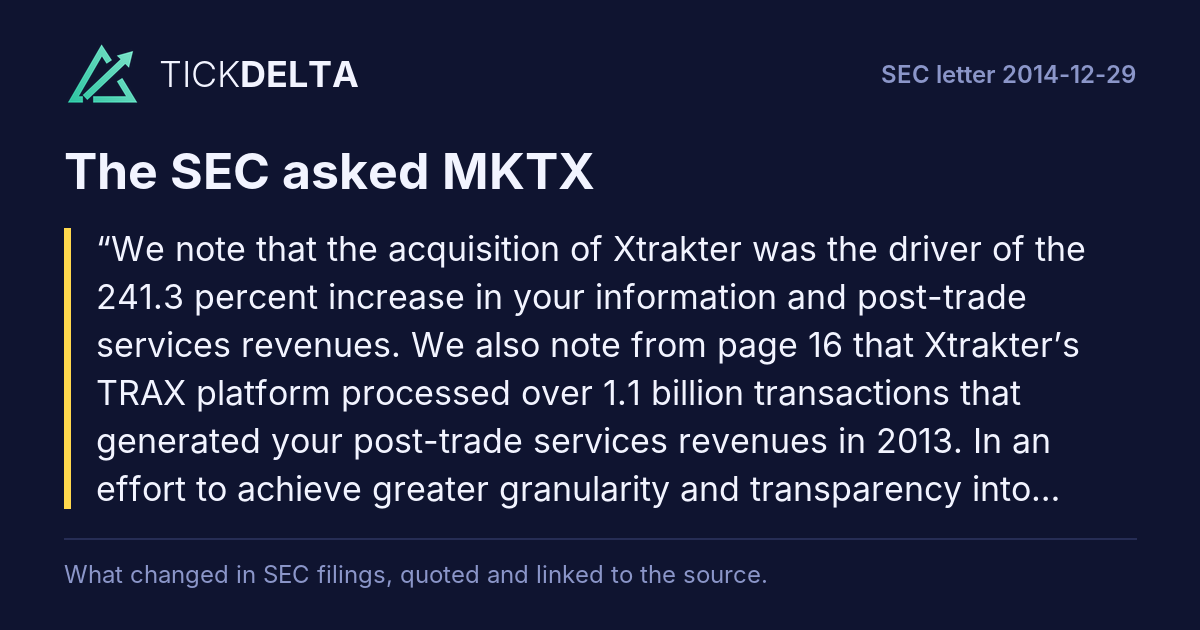
We note that the acquisition of Xtrakter was the driver of the 241.3 percent increase in your information and post-trade services revenues. We also note from page 16 that Xtrakter’s TRAX platform processed over 1.1 billion transactions that generated your post-trade services revenues in 2013.Rest of the question
In an effort to achieve greater granularity and transparency into these revenues, please revise your future filings to quantify the volume of transactions and average fee rate that are driving the changes in your information and post-trade services revenue.
Boston | Chicago | Hong Kong | London | Los Angeles | New Orleans | New York | Newark | Paris | São Paulo | Washington, DCRead in the reply
Page
We acknowledge the Staff’s comment and in future filings the Company will quantify the number of regulatory transaction reporting and trade matching transactions processed. Post-trade services revenue represents less than half of the total information and post-trade service revenue line item and is approximately 5% of the
Company’s total consolidated total revenues.Rest of the answer
Due to the relative size of this product line and the fact that the average fee rate per reported trade is small (approximately $0.01 per trade) and relatively stable, we believe that disclosure of the number of transactions processed is sufficient for a reader to achieve an understanding of any variation in related revenues.
First report after the company's reply of Jan 13, 2015: 10-K filed Feb 25, 2015 ↗, against the 10-K filed Feb 24, 2014 ↗.
Tickdelta does not hold the text of both reports, so they are not compared here.
In addition to our comment above, please explain to us supplementally how your posttrade service fees are determined, and how transaction volume impacts post-trade services revenue. For example, explain how fees are structured with your clients (i.e. subscribers) and the impact that changes in volume have on this source of revenue.
Post-trade services are comprised of (i) transaction reporting services and (ii) trade matching services. The transaction reporting services are provided for both equity and fixed income instruments and involve the compilation and subsequent reporting of required data fields for each transaction to the relevant European regulator. The trade matching service allows subscribers to match and affirm key terms of a trade following execution to assist the settlement process.Read in the reply
Transaction fees are charged to clients on a monthly basis using sliding scale or tiered fee plans.Rest of the answer
The fee plans and rates charged per transaction vary depending on the type of instrument being processed and the service rendered. Given the variable nature of the fee plans, post-trade services revenue is highly correlated with the number of transactions processed. For example, post-trade services revenue decreased by 10% in the three months ended September 30, 2014 and increased by 27% for the nine months ended September 30,
2014, compared to the prior year periods. For the three and nine month periods ended September 30, 2014, the number of transactions processed declined 8% and increased by 28%, respectively. A similar relationship would be shown between post-trade services revenues and the number transactions for other recent periods.
First report after the company's reply of Jan 13, 2015: 10-K filed Feb 25, 2015 ↗, against the 10-K filed Feb 24, 2014 ↗.
Tickdelta does not hold the text of both reports, so they are not compared here.
We note that you acquired Xtrakter in February 2013 which is based in the U.K. and provides services in Europe. We also note from your third quarter 2014 earnings call that your trading volumes from European clients increased 59% during the third quarter (in comparison to the previous year). Explain to us why you believe that financial information by geographic region would not be meaningful to your investors.Rest of the question
In addition, please revise your future filings to present information about geographic areas; refer to ASC 280-10-50-38 and 50-41.
We acknowledge the Staff comments and in future filings the Company will present revenue and long-lived asset information by geographic area to the extent required by ASC 280-10-50-38 and 50-41.Read in the reply
Historically, the Company’s international operations have not been material. For example, for the year ended December 31, 2012, non-U.S. revenues represented approximately 7% of total consolidated revenues and, as of December 31, 2012, non-U.S. long-lived assets represented approximately 1% of total consolidated long-lived assets.Rest of the answer
We acknowledge that the acquisition of
Xtrakter Limited (“Xtrakter”) in February 2013 increased our presence in the United Kingdom. For the year ended December 31, 2013, non-U.S. revenues represented approximately 13% of total consolidated revenues and, as of
December 31, 2013, non-U.S. long-lived assets represented approximately 25% of total consolidated long-lived assets. We believe that the disclosure regarding the acquisition of Xtrakter in both the footnotes to the financial statements and
Management’s Discussion and Analysis of Financial Condition and Results of Operations was sufficient to allow a reader to understand the size and relative impact of the Xtratker business on our overall business.
In addition, we operate a single trading platform that has a common technology backbone across each geographic region. We offer a highly integrated suite of products and services throughout the interrelated array of financial markets in which we compete (see “Segment Results” on page 24 of the Form 10-Q). Furthermore, a significant number of our non-U.S. institutional investor clients and broker dealer participants are part of large global financial institutions that maintain their principal relationship with us in the U.S. Moreover, we typically do not charge commissions to the institutional investor client side of the trade. Consequently, while volumes from U.S. high grade bond trades (our largest product) initiated by clients in the U.K. may increase in any period, there would not be any increase in revenues recorded in the U.K. unless the broker-dealer client on the other side of the trade was also located in the U.K. In the case of many of our product areas, including U.S. high grade bonds, most of our broker-dealer clients are located in the U.S. Clients may trade most products available on our platform (whether a U.S. or European bond issuance) regardless of the country in which they are located. Accordingly, the trading volumes for a particular geographic region are not necessarily correlated to revenues for that geographic region.
Last, in most countries other than the United States and United Kingdom, we do not have a physical presence or in-country infrastructure. Our business is not capital intensive from an equipment or physical plant perspective and we do not believe that investors view long-lived assets, or the geographic area thereof, as a meaningful metric for understanding our business.
For these reasons, notwithstanding that we will revise future filings to present the required information about geographic areas, we believe that additional disclosure of financial information by geographic regions is not meaningful in understanding our business.
First report after the company's reply of Jan 13, 2015: 10-K filed Feb 25, 2015 ↗, against the 10-K filed Feb 24, 2014 ↗.
Tickdelta does not hold the text of both reports, so they are not compared here.
Also in this review: closing letter, 2015-01-21