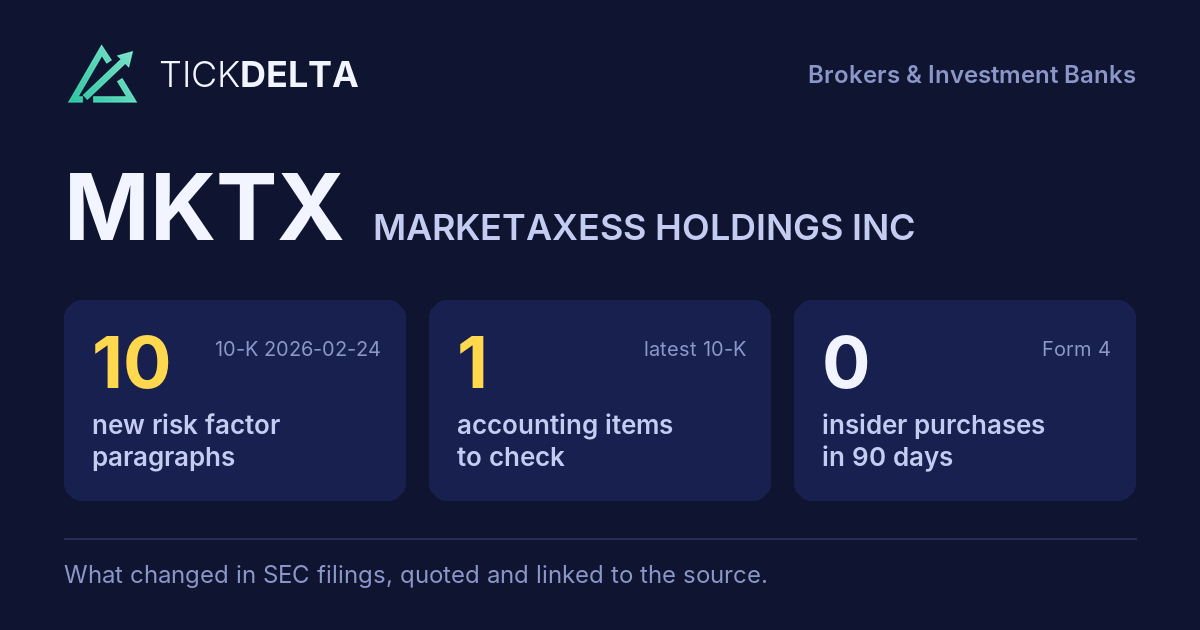
Screener / SEC EDGAR /CIK 0001278021 /10-K filed Feb 24, 2026, compared with Feb 24, 2025 /Numbers from the XBRL of the 10-Ks
Nasdaq Financials · Brokers & Investment Banks

Marketaxess Holdings Inc MKTX

Compare with peers Embed
SEC comment letters, last 20 years

3 reviews of MKTX's filings by SEC staff

UPLOAD and CORRESP
Reviews 3 latest letter Dec 29, 2014
Questions asked 10 each answered in the company's own letter
No closing letter 0 reviews without a letter saying the staff completed it

When the SEC's staff reviews a filing, it writes to the company with numbered questions, and the company answers each one in a letter. SEC publishes the exchange once the review is over, at least 20 business days later. A question is not an accusation; most reviews end with the company adding detail to its next filing.

How the reviews went

Every review on EDGAR, from the first staff letter to the letter that closes it

  1. 1. Staff letters 3 UPLOAD
  2. 2. Questions in them 10 numbered comments
  3. 3. Company replies 3 CORRESP
  4. 4. Reviews closed 3 of 3 closing letter

Half the closed reviews took 23 days or less from the first letter to the closing letter.

Form 10-K for the Fiscal Year Ended December 31, 2013

2014-12-29 to 2015-01-21 · 3 questions · 1 letter from the SEC, 1 from the company
Review closed 2015-01-21
RevenueResults discussion (MD&A)AcquisitionsSegments
Management’s Discussion and Analysis of Financial Condition and Results of Operations, page · Information and Post-Trade Services, page 53
SEC asked (1)
We note that the acquisition of Xtrakter was the driver of the 241.3 percent increase in your information and post-trade services revenues. We also note from page 16 that Xtrakter’s TRAX platform processed over 1.1 billion transactions that generated your post-trade services revenues in 2013.
Rest of the question

In an effort to achieve greater granularity and transparency into these revenues, please revise your future filings to quantify the volume of transactions and average fee rate that are driving the changes in your information and post-trade services revenue.

MKTX answered
Boston | Chicago | Hong Kong | London | Los Angeles | New Orleans | New York | Newark | Paris | São Paulo | Washington, DC

Page

We acknowledge the Staff’s comment and in future filings the Company will quantify the number of regulatory transaction reporting and trade matching transactions processed. Post-trade services revenue represents less than half of the total information and post-trade service revenue line item and is approximately 5% of the

Company’s total consolidated total revenues.
Rest of the answer

Due to the relative size of this product line and the fact that the average fee rate per reported trade is small (approximately $0.01 per trade) and relatively stable, we believe that disclosure of the number of transactions processed is sufficient for a reader to achieve an understanding of any variation in related revenues.

Read in the reply
In its next report

First report after the company's reply of Jan 13, 2015: 10-K filed Feb 25, 2015 ↗, against the 10-K filed Feb 24, 2014 ↗.

Tickdelta does not hold the text of both reports, so they are not compared here.
Management’s Discussion and Analysis of Financial Condition and Results of Operations, page · Information and Post-Trade Services, page 53
SEC asked (2)
In addition to our comment above, please explain to us supplementally how your posttrade service fees are determined, and how transaction volume impacts post-trade services revenue. For example, explain how fees are structured with your clients (i.e. subscribers) and the impact that changes in volume have on this source of revenue.
MKTX answered
Post-trade services are comprised of (i) transaction reporting services and (ii) trade matching services. The transaction reporting services are provided for both equity and fixed income instruments and involve the compilation and subsequent reporting of required data fields for each transaction to the relevant European regulator. The trade matching service allows subscribers to match and affirm key terms of a trade following execution to assist the settlement process.

Transaction fees are charged to clients on a monthly basis using sliding scale or tiered fee plans.
Rest of the answer

The fee plans and rates charged per transaction vary depending on the type of instrument being processed and the service rendered. Given the variable nature of the fee plans, post-trade services revenue is highly correlated with the number of transactions processed. For example, post-trade services revenue decreased by 10% in the three months ended September 30, 2014 and increased by 27% for the nine months ended September 30,

2014, compared to the prior year periods. For the three and nine month periods ended September 30, 2014, the number of transactions processed declined 8% and increased by 28%, respectively. A similar relationship would be shown between post-trade services revenues and the number transactions for other recent periods.

Read in the reply
In its next report

First report after the company's reply of Jan 13, 2015: 10-K filed Feb 25, 2015 ↗, against the 10-K filed Feb 24, 2014 ↗.

Tickdelta does not hold the text of both reports, so they are not compared here.

Segment Results, page 24
SEC asked (3)
We note that you acquired Xtrakter in February 2013 which is based in the U.K. and provides services in Europe. We also note from your third quarter 2014 earnings call that your trading volumes from European clients increased 59% during the third quarter (in comparison to the previous year). Explain to us why you believe that financial information by geographic region would not be meaningful to your investors.
Rest of the question

In addition, please revise your future filings to present information about geographic areas; refer to ASC 280-10-50-38 and 50-41.

MKTX answered
We acknowledge the Staff comments and in future filings the Company will present revenue and long-lived asset information by geographic area to the extent required by ASC 280-10-50-38 and 50-41.

Historically, the Company’s international operations have not been material. For example, for the year ended December 31, 2012, non-U.S. revenues represented approximately 7% of total consolidated revenues and, as of December 31, 2012, non-U.S. long-lived assets represented approximately 1% of total consolidated long-lived assets.
Rest of the answer

We acknowledge that the acquisition of

Xtrakter Limited (“Xtrakter”) in February 2013 increased our presence in the United Kingdom. For the year ended December 31, 2013, non-U.S. revenues represented approximately 13% of total consolidated revenues and, as of

December 31, 2013, non-U.S. long-lived assets represented approximately 25% of total consolidated long-lived assets. We believe that the disclosure regarding the acquisition of Xtrakter in both the footnotes to the financial statements and

Management’s Discussion and Analysis of Financial Condition and Results of Operations was sufficient to allow a reader to understand the size and relative impact of the Xtratker business on our overall business.

In addition, we operate a single trading platform that has a common technology backbone across each geographic region. We offer a highly integrated suite of products and services throughout the interrelated array of financial markets in which we compete (see “Segment Results” on page 24 of the Form 10-Q). Furthermore, a significant number of our non-U.S. institutional investor clients and broker dealer participants are part of large global financial institutions that maintain their principal relationship with us in the U.S. Moreover, we typically do not charge commissions to the institutional investor client side of the trade. Consequently, while volumes from U.S. high grade bond trades (our largest product) initiated by clients in the U.K. may increase in any period, there would not be any increase in revenues recorded in the U.K. unless the broker-dealer client on the other side of the trade was also located in the U.K. In the case of many of our product areas, including U.S. high grade bonds, most of our broker-dealer clients are located in the U.S. Clients may trade most products available on our platform (whether a U.S. or European bond issuance) regardless of the country in which they are located. Accordingly, the trading volumes for a particular geographic region are not necessarily correlated to revenues for that geographic region.

Last, in most countries other than the United States and United Kingdom, we do not have a physical presence or in-country infrastructure. Our business is not capital intensive from an equipment or physical plant perspective and we do not believe that investors view long-lived assets, or the geographic area thereof, as a meaningful metric for understanding our business.

For these reasons, notwithstanding that we will revise future filings to present the required information about geographic areas, we believe that additional disclosure of financial information by geographic regions is not meaningful in understanding our business.

Read in the reply
In its next report

First report after the company's reply of Jan 13, 2015: 10-K filed Feb 25, 2015 ↗, against the 10-K filed Feb 24, 2014 ↗.

Tickdelta does not hold the text of both reports, so they are not compared here.

Also in this review: closing letter, 2015-01-21
Form 10-K for the Fiscal Year Ended December 31, 2012

2013-09-30 to 2013-10-22 · 4 questions · 1 letter from the SEC, 1 from the company
Review closed 2013-10-22
RevenueCritical estimatesResults discussion (MD&A)
Critical Accounting Estimates, page 48 · Revenue Recognition, page 49
SEC asked (1)
We note that commission revenue, which represents approximately 88% of total revenue for the period ending December 31, 2012, is generally calculated as a percentage of the notional dollar volume of bonds traded on the platform based upon transaction fee plans, which include a distribution and variable fee plan.
Rest of the question

Please tell us, and address the following in your future filings:  Explain the type of transactions and/or products that generate either a monthly distribution fee plan versus a variable fee plan;  Disclose the amount of commission revenues that are received from clients that are institutional investors; and  Discuss whether a broker dealer client can switch between a distribution fee plan and a variable fee plan and the related impact that it could have on revenues.

MKTX answered
The Company provides a description of the commission fee plans on page 47 of the Form 10-K, including those products that contain a monthly distribution fee (namely U.S. high-grade bonds and European credit). Please note that the commissions charged to broker-dealer clients under plans that contain a monthly distribution fee are a combination of the monthly distribution fee and variable transaction fees.

The Company does not invoice or receive commission revenue from institutional investor clients. Commissions are billed to broker-dealer clients on a monthly basis.
Rest of the answer

In certain situations, the Company executes trades between and among institutional investor and broker-dealer clients on a riskless principal basis by serving as counterparty to both the buyer and the seller. In these situations, the Company earns a commission through the difference in price between the two riskless principal trades. In 2012, the dollar amount of commission earned from the difference in price between two riskless principal trades involving institutional investor clients on both sides was immaterial.

Broker-dealer clients typically execute multi-year contracts

(ordinarily two years) that are subject to annual renewals. In the case of U.S. high grade bonds and European credit, the Company has two principal fee plans: one plan that incorporates a monthly distribution fee and a variable transaction fee and a second plan that does not contain monthly distribution fees and instead incorporates a per transaction execution fee in addition to the variable transaction fee. At renewal, broker-dealer clients normally have the ability to switch between plans.

Depending on changes in the volume of trading activity from a particular broker-dealer, a movement between fee plans could have a positive or negative impact on commission revenues, which would not be material.

Read in the reply
In its next report

First report after the company's reply of Oct 11, 2013: 10-Q filed Oct 25, 2013 ↗, against the 10-Q filed Jul 26, 2013 ↗.

Tickdelta does not hold the text of both reports, so they are not compared here.

Critical Accounting Estimates, page 48 · Revenue Recognition, page 49
SEC asked (2)
Furthermore, we note that commission revenues also consist of commission earned on trades that you execute between and among institutional investor and broker-dealer clients by serving as counterparty to both the buyer and the seller. In future filings please quantify the amount of revenue earned from these transactions to the extent such revenue is material.
MKTX answered
We acknowledge the Staff comments and in future filings the Company will quantify the amount of revenue earned from trades executed between and among institutional investor and broker-dealer clients when the Company serves as counterparty to both the buyer and the seller, if material.
Read in the reply
In its next report

First report after the company's reply of Oct 11, 2013: 10-Q filed Oct 25, 2013 ↗, against the 10-Q filed Jul 26, 2013 ↗.

Tickdelta does not hold the text of both reports, so they are not compared here.

Significant Accounting Policies, page 73 · Software Development Costs, page 74
SEC asked (3)
We note that you capitalize payroll related costs and third party consulting costs incurred during the preliminary software project stage. Please tell us how this accounting policy complies with the guidance in ASC 340-40-25-1 as it requires that internal and external costs incurred during the preliminary project stage shall be expensed as they are incurred.
MKTX answered
As stated in the first sentence of the Significant Accounting Policies, Software Development Costs on page 74 of the Form 10-K, “The

Company capitalizes certain costs associated with the development of internal use software at the point at which the conceptual formulation, design and testing of possible software project alternatives have been completed.” The Company follows this statement in practice and believes that this accounting policy complies with the relevant guidance.
Rest of the answer

Upon reflection, the second sentence in the subject policy, which reads “The Company capitalizes employee compensation and related benefits and third party consulting costs incurred during the preliminary software project stage,” may be ambiguous and potentially misinterpreted. In future filings, the Company will delete the second sentence and clarify the language in the first sentence to read as follows: “The Company capitalizes certain costs associated with the development of internal use software, including among other items, employee compensation and related benefits and third party consulting costs, at the point at which the conceptual formulation, design and testing of possible software project alternatives have been completed.”

Read in the reply
In its next report

First report after the company's reply of Oct 11, 2013: 10-Q filed Oct 25, 2013 ↗, against the 10-Q filed Jul 26, 2013 ↗.

Tickdelta does not hold the text of both reports, so they are not compared here.

Item 1. Financial Statements, page 3 · Consolidated Statements of Comprehensive Income, page 5
SEC asked (4)
Please tell us how you complied with the guidance in ASC 220-10-45-14 through 45-17 regarding how reclassifications out of other comprehensive income are presented in your financial statements. Please advise and revise your future filings as necessary.
Rest of the question

In responding to our comments, please provide a written statement from the company acknowledging that:  the company is responsible for the adequacy and accuracy of the disclosure in the filing;  staff comments or changes to disclosure in response to staff comments do not foreclose the Commission from taking any action with respect to the filing; and  the company may not assert staff comments as a defense in any proceeding initiated by the Commission or any person under the federal securities laws of the United States.

MKTX answered
During the three and six months ended June 30, 2013, the Company realized a gain on the sale of certain securities-available-for-sale which was deemed to be immaterial to the consolidated financial statements. The realized gain constituted a reclassification out of other comprehensive income. In future filings, reclassifications out of other comprehensive income will be separately identified in the Consolidated Statements of Comprehensive Income, even if deemed to be immaterial.
Read in the reply
In its next report

First report after the company's reply of Oct 11, 2013: 10-Q filed Oct 25, 2013 ↗, against the 10-Q filed Jul 26, 2013 ↗.

Tickdelta does not hold the text of both reports, so they are not compared here.

Also in this review: closing letter, 2013-10-22

Form 10-K

2012-07-23 to 2012-08-20 · 3 questions · 1 letter from the SEC, 1 from the company
Review closed 2012-08-20
RevenueRisk factors
Risk Factors, page 25 · We are exposed to risks resulting from non-counterparties to certain transactions…, page 27
SEC asked (1)
You state that you act as an intermediary between and among institutional investors and broker-dealer clients on a “riskless principal basis,” yet you state that you are exposed to credit risk in your role as trading counterparty to your clients executing bond trades on your platform.
Rest of the question

Please explain the apparent inconsistency and explain why you believe it is appropriate to state that you act on a “riskless principal basis.” We could lose significant sources of revenue if we lose any of our significant institutional investor clients. page 28

MKTX answered
Raton | Boston | Chicago | Hong Kong | London | Los Angeles | New Orleans | New York | Newark | Paris | São Paulo | Washington, DC

U.S. Securities and Exchange

Commission

The use of the term “riskless principal basis” in the risk factor is consistent with the commonly accepted usage of “riskless principal” in the financial industry including, for example, as defined by FINRA and published in the NASD Notice to Members 99-65 – August 1999.

The Company executes certain bond transactions between and among institutional investor and broker-dealer clients by serving as counterparty to both the
Rest of the answer

buyer and the seller in matching back-to-back trades. The trades are executed on a “riskless principal basis” because the Company only executes a client’s order to buy (sell) a bond if the Company simultaneously executes another client’s order to sell (buy) the same bond on its platform, as principal, in order to satisfy the initial client’s order. The Company acts as riskless principal solely for the purpose of maintaining the anonymity of the counterparties to these trades. The Company does not trade as principal for its own account, nor does it warehouse or otherwise hold any of the bonds traded on its platform for the purpose of providing liquidity to its clients or otherwise facilitating trading activity.

However, as explained in the risk factor, the Company is exposed to the risk that one of the parties to a trade defaults on its obligation prior to settlement. In the event of such a default, the Company would be obligated to buy or sell the bond in the open market in order to fulfill the counterparty’s order. So, while the

Company acts as an intermediary for certain trades on a “riskless principal basis,” it still faces the risk that a party to the transaction may not perform its obligation.

We could lose significant sources of revenue if we lose any of our significant institutional investor clients. page 28

Read in the reply
In its next report

First report after the company's reply of Aug 1, 2012: 10-Q filed Nov 2, 2012 ↗, against the 10-Q filed Apr 26, 2012 ↗.

Tickdelta does not hold the text of both reports, so they are not compared here.

Risk Factors, page 25 · We are exposed to risks resulting from non-counterparties to certain transactions…, page 27
SEC asked (2)
If the investor client referenced in the discussion accounted for 10% or more of your consolidated revenues, then please identify the customer in the risk factor discussion.
MKTX answered
The revenues derived from trading activity on the Company’s platform primarily consist of commissions and monthly distribution fees that are billed to, and payable by, its broker-dealer clients. Institutional investor clients are not directly charged any commissions by the Company for executing trades on the platform.
Rest of the answer

An institutional investor client is only charged a user fee to access the platform and fees for data services, which user and data services fees are eligible to be partially or entirely rebated based on the volume of bonds traded on the platform by such institutional investor client. For these reasons, no institutional investor client directly accounted for more than 10% of the consolidated revenues of the Company in any period covered by the Form 10-K.

In addition, although one institutional investor client typically accounts for more than 10% of the Company’s quarterly and annual trading volume, neither such client nor any other customer generated, directly or indirectly, 10% or more of the Company’s consolidated revenues in any period covered by the Form 10-K or in the first six months of 2012. On a quarterly and annual basis, the Company determines whether any customer accounts for 10% or more of consolidated revenues. To the extent required by applicable rules and regulations, the Company will disclose the identity of any such client in future filings under the Exchange Act.

Read in the reply
In its next report

First report after the company's reply of Aug 1, 2012: 10-Q filed Nov 2, 2012 ↗, against the 10-Q filed Apr 26, 2012 ↗.

Tickdelta does not hold the text of both reports, so they are not compared here.

Operations, page 46 · Regulatory Environment, page 47
SEC asked (3)
Please provide the percentage of your clients and of the transactions made on your electronic trading platform that involve bank-affiliated companies that will be subject to the Volcker Rule.
MKTX answered
While the Company is unable to accurately determine precisely which of its broker-dealer clients are affiliated with a bank or bank holding company, the Company believes that approximately half of its broker-dealer market-maker clients, representing approximately 89% and 86% of the trading volume on its platform during 2011 and the first six months of 2012, respectively, was generated by clients that it believes will be subject to the Volcker Rule.
Read in the reply
In its next report

First report after the company's reply of Aug 1, 2012: 10-Q filed Nov 2, 2012 ↗, against the 10-Q filed Apr 26, 2012 ↗.

Tickdelta does not hold the text of both reports, so they are not compared here.

Also in this review: closing letter, 2012-08-20

From the SEC's correspondence on EDGAR: staff letters (form UPLOAD) and company letters (form CORRESP), 9 letters filed since 2012-07-23. Questions and answers are matched by their numbers; topics come from words in each question. The reports are compared word for word (same form, before the first SEC letter against the first report after the company's reply). No AI.

Sources

The SEC's correspondence on EDGAR: staff letters (form UPLOAD) and company letters (form CORRESP), matched question by question. No AI.

Also

Filings: the letters in the filing list.

Work with it

Excel workbook · CSV. Google Sheet that stays up to date: paste =IMPORTDATA("https://tickdelta.com/company/MKTX/export.csv") into a cell.

Next in Owners and insiders:Insider trades
Esc

Type a ticker such as AAPL, a name, an investor such as Buffett, or a topic such as tariffs. ↑ ↓ to move, Enter to open.