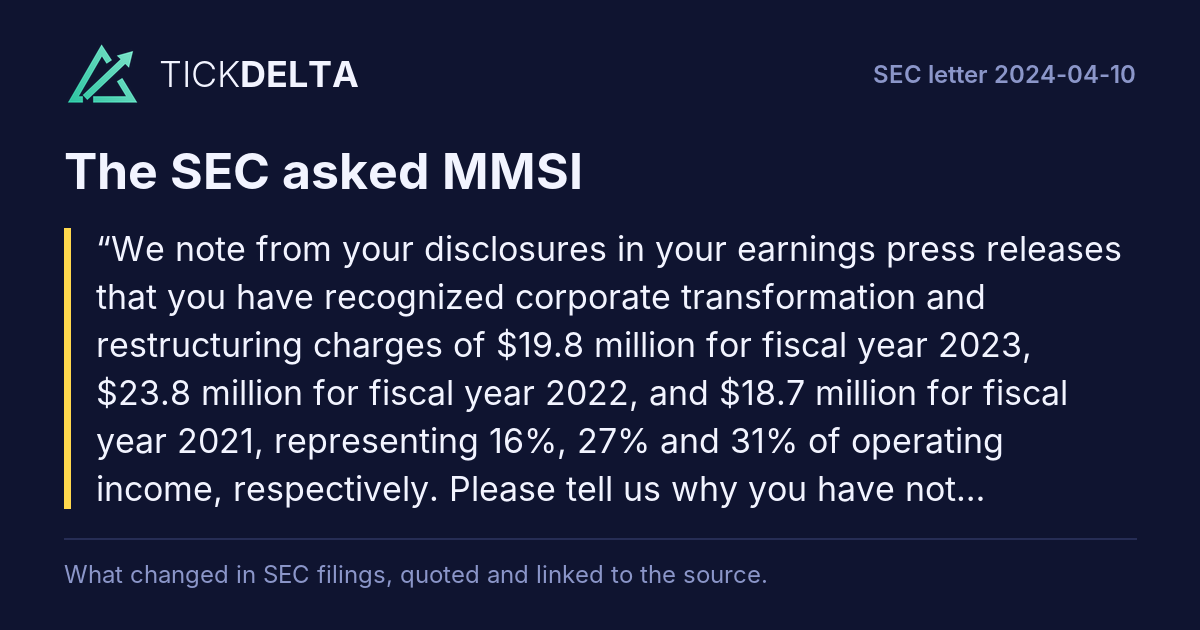
We respectfully acknowledge the Staff’s comment. For ease of the Staff’s review, we have included the following table to summarize the costs associated with our transformation and restructuring charges (in thousands):
Rest of the answer
transformation
In our Current Report on Form 8-K filed on November 10, 2020, the Company introduced a corporate transformation initiative known as “Foundations for Growth,” with multi-year financial targets for growth and improved profitability for the three-year period ended December 31, 2023. The plan to attain these targets focused on objectives including global operations and functional and commercial optimization. The primary activities associated with this transformation program were launched to drive value creation inclusive of optimizing certain commercial processes such as product life cycle management and pricing optimization, strengthening and enhancing the operating model and organizational structure, enhancing global manufacturing and supply chain processes through network consolidation and other manufacturing initiatives. As these corporate transformation initiatives are not part of the Company’s core competencies, the Company partnered with third-party consultants to develop and execute these initiatives. These transformation costs represent third-party consulting costs associated with the discrete, strategic and operational objectives under our three-year Foundations for Growth Program. We believe these costs do not meet the definition of restructuring costs as defined under ASC 420, Exit or Disposal Obligations. Rather we believe these corporate transformation costs are representative of business process reengineering activities addressed under ASC 720-45, Other Expenses – Business and Technology Reengineering.
Corporate transformation costs represent 9.9%, 19.0%, and 29.6% of operating income for the years ended December 31, 2023, 2022, 2021 respectively. Although the Foundations for Growth program has concluded, if future investments in business transformation projects are undertaken, we will include a more robust disclosure of the initiatives in our Form 10-K under Item 7 – Management’s Discussion and Analysis of Financial Condition and Results of Operations and Notes to the Consolidated Financial Statements. Please refer below for our proposed clarifying disclosure in the Notes to the consolidated financial statements for these transformation costs.
Restructuring
Asset write-downs: In connection with the Company’s initiatives discussed above, transformation and restructuring charges included the write-off of certain long-lived assets as a result of our decision to no longer distribute or market certain product lines; such charges were accounted for under ASC 360, Property, Plant and Equipment. Additionally, to the extent we wrote off inventories associated with the exit of specific product lines, such charges were recorded within cost of sales and accounted for under ASC 330, Inventory. We believe these charges do not meet the definition of restructuring activities in ASC 420, Exit or Disposal Cost Obligations, as the programs to which these costs relate did not materially change the scope of the business undertaken by the Company or the manner in which the Company’s business is conducted. Asset write downs represent 3.9%, 0%, and 0% of operating income for the years ended December 31, 2023, 2022, 2021 respectively.
Employee termination benefits: For the years ended December 31, 2023, 2022 and 2021, we incurred certain employee termination benefits for employees effected by certain site consolidation and production line optimization transfers related to the Company’s transformation initiatives described above. Expenses and liabilities associated with these restructuring activities were recorded in accordance with ASC 420-10-50-1; however, as the total expense and/or the accruals outstanding at the end of any given period were not significant to our consolidated financial statements we did not incorporate the full disclosures required under this guidance. Employee termination benefits represent 2.2%, 8.2%, and 1.0% of operating income for the years ended December 31, 2023, 2022, 2021 respectively.
Proposed Disclosures
In our consideration of the disclosure of an accounting policy in accordance with ASC 235, Notes to the Financial Statements, as well as the disclosure requirements of ASC 360-10-50 and ASC 420-10-50-1, we concluded that the asset write-downs and employee termination benefits, reflected in the tables above, were not material to the financial statements taken as a whole and thus no specific accounting policy or financial statement disclosure for these amounts was provided in our 2023 Form 10-K
We believe the asset write-downs and employee termination benefit charges referenced in the proceeding paragraphs are not material to the periods presented in the consolidated financial statements included in our 2023 Form 10-K; however, we acknowledge that similar charges may be material in the future. We therefore advise the Staff that in future filings, we will disclose our accounting policy for recognizing asset write-downs and employee termination benefits with transformation and restructuring activities and any disclosures required by ASC 360-10-50-1-3 and ASC 420-10-50-1. In our next filing, we will include the underlined edits to our existing Long-Lived Asset policy and add the Restructuring policy as noted below.
Long-Lived Assets. We periodically review the carrying amount of our long-lived assets, including property and equipment, intangible assets, and right-of-use operating lease assets, for impairment. An asset is considered impaired when undiscounted estimated future cash flows are less than the carrying amount of the asset based on the criteria for accounting for the impairment or disposal of long-lived assets under ASC 360, Property, Plant and Equipment. In the event the carrying amount of such asset is not considered recoverable, the asset is adjusted to its fair value. Fair value is generally determined based on discounted future cash flow. The Company recorded write downs of property and equipment in each of the years ended December 31, 2023, 2022 and 2021.
Restructuring. Restructuring charges consist primarily of termination benefits for employees effected by certain site consolidation and production line optimization transfers related to the company’s transformation initiatives. We account for involuntary employee termination benefits that represent a one-time benefit in accordance with ASC 420, Exit or Disposal Cost Obligations. Severance costs accounted for under ASC 420 are recognized when management with the proper level of authority commits to a restructuring plan and communicates these actions to employees and other applicable criteria. We record such costs into expense over the employee’s future service period, if any. Other exit costs are accounted for under ASC 420 and are either deferred or expensed as incurred based on the nature of the expense. We recorded restructuring charges of $2.7 million, $7.2 million and $0.6 million for the years ended December 31, 2023, 2022 and 2021, respectively. These expenses are reflected within selling, general and administrative expenses within our consolidated statements of income. The restructuring reserve balance as of December 31, 2023 and 2022 was $4.1 million and $4.6 million, respectively.
In addition to these restructuring costs, the Company incurs other costs, primarily consulting fees, related to its transformation initiatives which are recorded in selling, general and administrative expenses in the Consolidated Statements of Income. These costs were $12.3 million, $16.6 million, and $18.1 million for the years ended December 31, 2023, 2022, and 2021 respectively.