Form 10-K for the Year Ended December 31, 2021
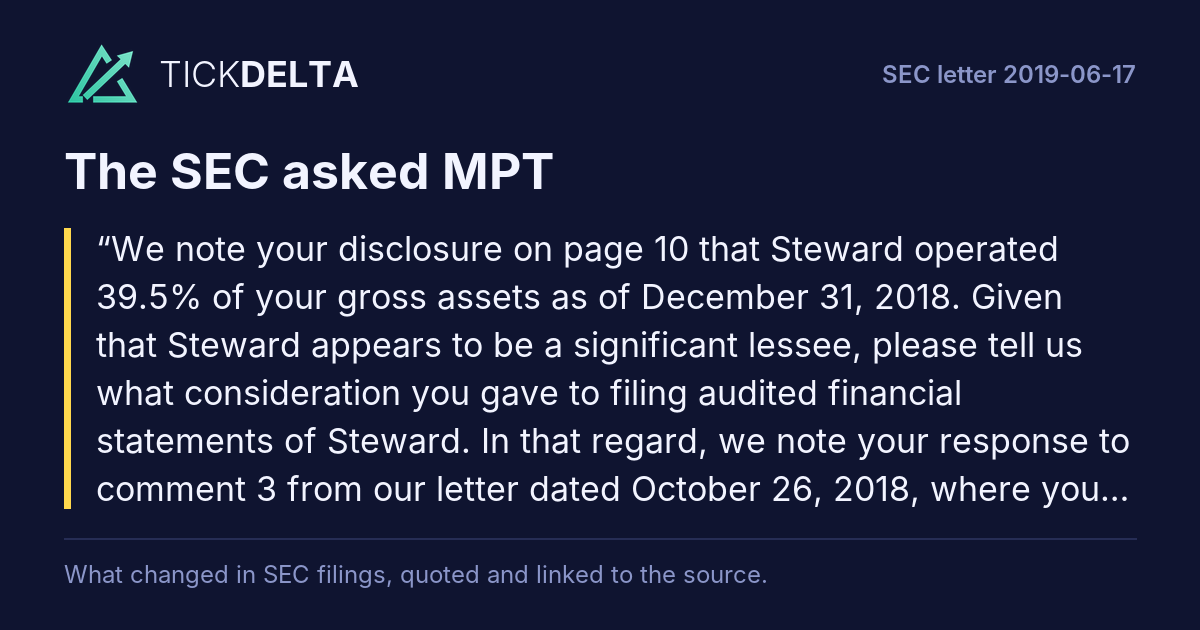
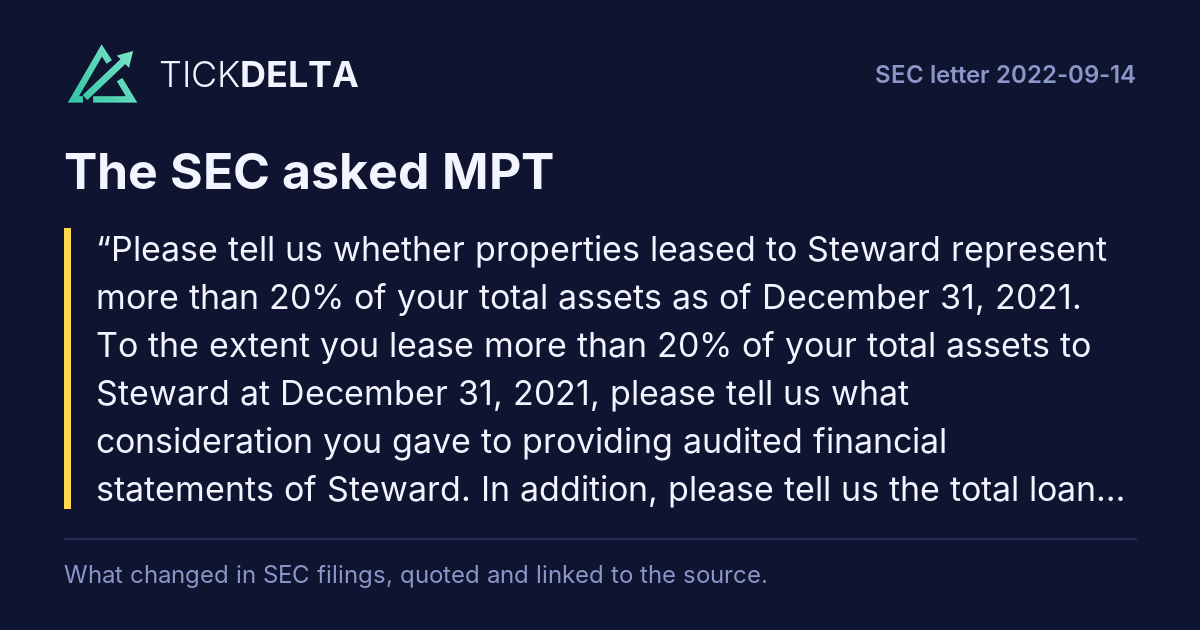
Please tell us whether properties leased to Steward represent more than 20% of your total assets as of December 31, 2021. To the extent you lease more than 20% of your total assets to Steward at December 31, 2021, please tell us what consideration you gave to providing audited financial statements of Steward. In addition, please tell us the total loan amount to Steward that was outstanding as of December 31, 2021.
As of December 31, 2021, properties leased to Steward represented 22.4% of our total assets – but only 17.8% exclusive of assets under binding agreement to sell and presented as held for sale as of such date. As discussed in Note 3 to Item 8 of the 2021 10-K, we entered into a definitive agreement on August 28, 2021, to sell a 50% interest in a portfolio of eight Massachusetts-based general acute care hospitals leased to Steward (the “MacquarieRead in the reply
Transaction”). The transaction was completed in Q1 2022.Rest of the answer
Accordingly, we did not provide audited financial statements of Steward as part of our 2021 10-K, because it was probable that the concentration of assets leased to Steward would be below 20% after the completion of the Macquarie Transaction. In making this determination, we were informed by previous oral guidance received from the Staff to the effect that spikes in tenant concentration occurring as of a fiscal year-end are not dispositive for purposes of Section 2340 of the Staff’s Financial Reporting Manual if the registrant believes in good faith that such >20% concentration is short-term. We note further, as helpful, that the Macquarie Transaction was, in fact, completed on March 14, 2022, which was prior to March 31, 2022, the reporting due date of such investee’s financial statements under Regulation S- X 3-09.
As of December 31, 2021, loans provided to affiliates of Steward totaled approximately $404 million, which represented approximately 2.0% of total assets.
First report after the company's reply of Sep 28, 2022: 10-Q filed Nov 9, 2022 ↗, against the 10-Q filed Aug 9, 2022 ↗.
Tickdelta does not hold the text of both reports, so they are not compared here.
We note your table on page 12 and your note (1) to the table. Please address the following: • Please tell us if you have made adjustments to individual line items within this table that are not also reflected within the adjustments to the total on page 49.Rest of the question
To the extent you have made such adjustments, please tell us and revise your filing to provide more quantitative and qualitative information about any such adjustments. • Please tell us if you have adjusted the amounts for Steward and HCA for a transaction that was pending as of the date of the filing. To the extent you have made such adjustments, please tell us how you determined it was appropriate to reflect this pending transaction within your table.
All adjustments from total assets to total pro forma gross assets used in preparing the 2021 columns of the table on page 12 of our 2021 10-K are reflected in the reconciliation on page 49 of our 2021 10-K.Read in the reply
As noted in footnote (1) to the table on page 12, total gross assets information in the table for 2021 is shown pro forma for the committed transactions disclosed in Note 8 to Item 8 of our 2021 10-K.Rest of the answer
This included our binding definitive agreement, as disclosed in Note 8, to lease five Utah hospitals to HCA following its purchase of the operations of these facilities from Steward, subject only to regulatory approvals. The adjustment for this transaction at December 31, 2021 is consistent with our treatment of similar transactions, including the Macquarie
Transaction in 2021 and committed transactions in previous years. We included this adjustment because we believe the total pro forma gross asset concentration metric provides a more current view of our portfolio and allows for a better understanding of our concentration levels as our commitments close. This presentation is also consistent with how our management team reviews our portfolio, including concentration metrics, and what is used in making resource allocation decisions.
Item 7. Management’s Discussion and Analysis of Financial Condition and Results of Operations Critical Accounting Policies Credit Losses, page
First report after the company's reply of Sep 28, 2022: 10-Q filed Nov 9, 2022 ↗, against the 10-Q filed Aug 9, 2022 ↗.
Tickdelta does not hold the text of both reports, so they are not compared here.
We note your disclosure related to Halsen Healthcare on page 79. In light of their bankruptcy filing, please tell us what consideration you gave to disclosing the balances of any receivables from Halsen Healthcare that were outstanding at December 31, 2021.
We disclose in Note 3 to Item 8 of our 2021 10-K that our total investment in Halsen Healthcare is less than 0.5% of our total assets as of December 31, 2021. In addition to including this total investment percentage, we disclose our $40 million real estate investment in Halsen Healthcare in this same Note 3.Read in the replyRest of the answer
Although we do not explicitly disclose the amount of any outstanding receivables (which were approximately $55 million gross and approximately $12 million, net of reserves, at December 31, 2021), we believe the general disclosure of our total investment percentage and our specific disclosure of our total real estate investment in Halsen Healthcare gives investors the necessary information to be able to reasonably determine the remaining balance of any outstanding receivables. We do not believe the inclusion of the specific balances of any outstanding receivables from Halsen Healthcare would provide any meaningful additional disclosure to investors.
First report after the company's reply of Sep 28, 2022: 10-Q filed Nov 9, 2022 ↗, against the 10-Q filed Aug 9, 2022 ↗.
Tickdelta does not hold the text of both reports, so they are not compared here.
We note your non-GAAP measure titled total pro forma gross assets. Please address the • We note your use of the phrase "pro forma" in the title. Please tell us how you considered the possibility of this measure being confused with pro forma information prepared in accordance with Article 11 of Regulation S-X.Rest of the question
• We note your adjustment for real estate commitments on new investments, your adjustment for cash used for funding the transactions above, and your notes (1) and (4) to the table. Please tell us and revise to provide more detail regarding these adjustments, or advise. • We note your adjustment for the incremental gross assets of your joint ventures and other and your note (3) to the table. Please tell us and revise to provide more detail about this adjustment, or advise. Your revisions should include, but not be limited to, how the amounts were derived and that the company does not control the joint venture or have legal claim to the assets of the joint venture. This comment also applies to your disclosure within your earnings releases. In closing, we remind you that the company and its management are responsible for the accuracy and adequacy of their disclosures, notwithstanding any review, comments, action or absence of action by the staff.
Please address the following:Read in the reply
We note your use of the phrase “pro forma” in the title. Please tell us how you considered the possibility of this measure being confused with pro forma information prepared in accordance with Article 11 of Regulation S-X.
We note your adjustment for real estate commitments on new investments, your adjustment for cash used for funding the transactions above, and your notes (1) and (4) to the table.Rest of the answer
Please tell us and revise to provide more detail regarding these adjustments, or advise.
We note your adjustment for the incremental gross assets of your joint ventures and other and your note
(3) to the table. Please tell us and revise to provide more detail about this adjustment, or advise. Your revisions should include, but not be limited to, how the amounts were derived and that the company does not control the joint venture or have legal claim to the assets of the joint venture.
This comment also applies to your disclosure within your earnings releases.
We respectfully acknowledge the Staff’s comment. In future filings and earnings releases, we will revise the title to remove the words “Pro Forma,” and instead use the word “Adjusted,” to avoid any confusion with pro forma information prepared in accordance with Article 11 of Regulation S-X.
We respectfully advise the Staff that the 2020 reconciling item titled “Real estate commitments on new investments” and the related note (1) is referring solely to the Priory transaction as described. However, in future filings and earning releases, we will modify our wording to read as follows:
(1)
The 2020 column solely reflects the Priory Group Transaction as described in Note 3 to Item 8 of our 2021 10-K, which was completed on January 19, 2021, and included the acquisition of 35 facilities in the United Kingdom.
The reconciling item titled “Cash used for funding the transactions above” and the related note (4) represents cash on-hand or cash generated from subsequent sales, like the Macquarie Transaction discussed in Note 3 to Item 8 of our 2021 10-K, expected to be used to fund new committed investments or to pay down debt. However, in future filings and earning releases, we will modify the reconciling item title to “Cash used” and clarify our wording of note (4) to read as follows:
(4)
Represents cash on-hand and cash received subsequent to period end for assets disposed, including the Macquarie Transaction in 2021, of which such cash proceeds were used to either fund new investments or paydown debt.
The reconciling item titled “Incremental gross assets of our joint ventures and other” and the related note (3) reflects an addition to total assets to present our share of each joint venture’s gross assets on a comparable basis as the remainder of our real estate portfolio. This presentation is also consistent with how our management team reviews our portfolio, including concentration metrics, and what is used in making resource allocation decisions. In future filings and earnings releases, we will modify note (3) to this reconciling item to reflect the following:
(3)
While we do not control any of our unconsolidated real estate joint venture arrangements and do not have direct legal claim to the underlying assets of the unconsolidated real estate joint ventures, we believe this adjustment allows investors to view certain concentration information on a basis comparable to the remainder of our real estate portfolio.
First report after the company's reply of Sep 28, 2022: 10-Q filed Nov 9, 2022 ↗, against the 10-Q filed Aug 9, 2022 ↗.
Tickdelta does not hold the text of both reports, so they are not compared here.
We note your response to comment 1 indicated that assets leased to Steward represented 17.8% of your total assets as of December 31, 2021, after exclusion of assets related to the Macquarie Transaction. Please address the following: • As part of the Macquarie Transaction, you received a 50% interest in the joint venture that now holds the eight Massachusetts-based hospitals that are leased to Steward.Rest of the question
Please clarify for us whether or not your 17.8% result includes your 50% interest in this joint venture. • To the extent that you have excluded your 50% interest in this joint venture from your significance calculation, please tell us why you feel it is appropriate to do so when analyzing the significance of the Steward concentration. • Please provide us with your significance calculation that details any adjustments made to the assets leased by Steward as of December 31, 2021. • Additionally, tell us if your joint venture partner, Macquarie Asset Management, is an affiliated entity of Medical Properties Trust, Inc. or its subsidiaries or has ties to any of your officers or board members.
17.8% concentration mentioned in our response to the previous comment letter does not include our 50% interest in the joint venture that now holds the eight Massachusetts-based hospitals leased to Steward. We excluded our 50% interest in the joint venture when analyzing significance since none of the Company nor any of its consolidated subsidiaries is the actual lessor of these facilities, the Company and its subsidiaries do not control the joint venture, and the Company and its subsidiaries do not have direct legal claim to the underlying assets of the joint venture.Read in the replyRest of the answer
We note, however, that, even if we included our 50% interest in the joint venture as part of our calculation of the concentration of assets leased to Steward as of
December 31, 2021, the result would have been 19.7% of our total assets, which is still below the 20% threshold for purpose of Section 2340 of the Staff’s Financial Reporting Manual.
Our significance calculations to derive the 17.8% and the 19.7% concentration measures, respectively, are as follows (dollars in thousands):
Numerator:
As of December 31, 2021
Net book value of assets leased to Steward
$
4,600,634
Less: Net book value of Massachusetts assets held-for-sale
(1,096,505
)
Adjusted net book value of assets leased to Steward
3,504,129
Denominator:
Medical Properties Trust, Inc. total assets
20,519,801
Less: Non-cash rent write-offs related to the disposal of the Massachusetts assets
(134,472
Plus: 50% interest in Massachusetts joint venture
375,975
Adjusted Medical Properties Trust, Inc. total assets
19,664,799
Steward concentration, excluding our 50% interest in the Massachusetts joint venture
17.8
%
3,880,104
Steward concentration, including our 50% interest in the Massachusetts joint
19.7
In regards to the last bullet of question #1, we confirm that the joint venture partner, Macquarie Asset
Management, is not an affiliated entity of the Company or its subsidiaries. In addition, there are no ties between Macquarie Asset Management and any of our officers or board members.
First report after the company's reply of Nov 2, 2022: 10-Q filed Nov 9, 2022 ↗, against the 10-Q filed Aug 9, 2022 ↗.
Tickdelta does not hold the text of both reports, so they are not compared here.
We note your response to our comment 2. Please address the following: • It appears that you have adjusted the line items for Steward and HCA within your table on page 12 for a pending transaction for amounts that are not reflected in your reconciliation on page 49; please confirm or clarify.Rest of the question
• Other than the Steward and HCA pending transaction noted above and the adjustments in the reconciliation on page 49, please clarify for us if any individual line items in your table on page 12 reflect any additional adjustments. • To the extent you have adjustments to any individual line items within the total adjusted gross assets by operator table that are not reflected in your reconciliation from total assets to total adjusted gross assets, please confirm that you will expand your disclosure in future filings to provide more quantitative and qualitative information about any such adjustments. • Please provide a more robust explanation of how you determined it was appropriate to reflect the impact from the pending transaction related to Steward and HCA within your table. Within your response, please address the length of time until you expected the transaction to close and your consideration of the regulatory approvals that were still pending.
The table on page 49 of the 2021 10-K presents a complete reconciliation of total assets to total pro forma (now “adjusted”) gross assets. Generally, a reclassification of the same amount of gross assets from one operator to another operator has no impact on total adjusted gross assets. This was the case for the pending transaction in which HCA would start leasing certain assets rather than Steward, with one exception. For this transaction between HCA and Steward, we expected that there would be a need for a non-cash rent write-off given the change in tenant.Read in the replyRest of the answer
However, this reduction in assets caused by the potential non-cash rent write-off was included in the reconciliation of total assets to total adjusted gross assets in the “Cash used for funding the transactions above” line, netted with other activity due to the amount being less than 0.3% of total adjusted gross assets. In future filings and press releases (which we started in the 2022 third quarter press release), we will modify our presentation of the reconciliation of total assets to total adjusted gross assets to provide more qualitative and quantitative information around these types of transactions in order to better show the increase to one operator and the decrease to another operator, and the causes underlying such changes. See Annex A attached to this letter for an example of how this new presentation would have looked as of December 31, 2021.
Other than the Steward and HCA pending transaction noted above and the adjustments in the reconciliation on page 49, please clarify for us if any individual line items in your table on page 12 reflect any additional adjustments.
The line items in the table on page 12 do not reflect any additional adjustments.
To the extent you have adjustments to any individual line items within the total adjusted gross assets by operator table that are not reflected in your reconciliation from total assets to total adjusted gross assets, please confirm that you will expand your disclosure in future filings to provide more quantitative and qualitative information about any such adjustments.
As noted in the response above to the first bullet under #2, we will modify our presentation of the reconciliation of total assets to total adjusted gross assets in future filings and press releases to provide more qualitative and quantitative information around these types of transactions. See Annex A attached to this letter for an example of how this new presentation would have looked as of December 31, 2021.
Please provide a more robust explanation of how you determined it was appropriate to reflect the impact from the pending transaction related to Steward and HCA within your table. Within your response, please address the length of time until you expected the transaction to close and your consideration of the regulatory approvals that were still pending.
The Company’s policy has historically been to reflect the effect of material pending transactions (acquisitions and dispositions) in our concentration metrics once the definitive agreements governing such transactions are binding. We include these types of adjustments in our presentation of concentration because we believe it provides a more current view of our portfolio and allows for a better understanding of our concentration levels as our commitments close. This type of presentation is also consistent with the reports that management reviews when making resource allocation decisions.
As an example of similar adjustments to our concentration presentation in the past, in the
Company’s Form 10-Q for the quarter ended June 30, 2017 (“Q2 2017 10-Q”), we reflected assets leased at that time to IASIS Healthcare LLC
(“IASIS”) in the Steward line of the operator concentration of total adjusted gross assets table, because we were party to a binding agreement as of May 18, 2017 that included a simultaneous merger transaction between Steward and
IASIS. These transactions closed on September 29, 2017, but we reflected the higher Steward concentration (which showed an increase from approximately 20% without the then-pending transaction to roughly 38% after this adjustment) in our concentration presentation prior to the completion of the transactions in our Q2 2017 10-Q.
When making this adjustment between operators, we did consider the contingent nature of the transaction. As noted in our note to the table on page 12 of the 2021 10-K, we referenced Note 8 of our 2021 10-K, which specifically stated that the completion of the transaction was uncertain due to the need for regulatory approval. However, we ultimately decided to include this adjustment in our concentration presentation because of our policy on adjusting for binding commitments (acquisitions and disposals), our history of closing similar transactions, and our then-current expectations that the HCA/Steward transaction would close during the first half of 2022. In future filings and earnings releases, we will continue to clearly emphasize the contingent nature of pending transactions, even if subject to binding agreements.
First report after the company's reply of Nov 2, 2022: 10-Q filed Nov 9, 2022 ↗, against the 10-Q filed Aug 9, 2022 ↗.
Tickdelta does not hold the text of both reports, so they are not compared here.
We note your response to our comment 4. Please address the following: • Please tell us and revise future filings to provide more qualitative and quantitative information related to the line item 'cash used for funding the transactions above (4)' in your table at the bottom of page 49.Rest of the question
In this regard, please quantify and describe each material component that results in the total adjustments of $1,377,299 and $587,384 for this line item. • Please further clarify for us and in future filings how the amounts for the line item 'incremental gross assets of our joint ventures and other (3)' are derived.
The reconciling item titledRead in the reply
“Cash used for funding the transactions above” and the related note (4) was intended to primarily represent cash on-hand or cash generated from subsequent sales (such as the Macquarie Transaction in
2021 discussed in Note 3 to Item 8 of our 2021 10-K) that was expected to be used to fund new committed investments or to pay down debt. In future filings and earning releases, we will provide more qualitative and quantitative information for this line item.Rest of the answer
See Annex A attached to this letter for an example of how this new presentation would have looked as of December 31, 2021.
The reconciling item titled “Incremental gross assets of our joint ventures and other” and the related note (3) reflects an addition to total assets to present our share of each unconsolidated real estate joint venture’s gross assets on a comparable basis as to the remainder of our real estate portfolio included in our consolidated financial statements. In future filings, we will provide more detail and clarity for this line item. See Annex A attached to this letter for an example of how this new presentation would have looked as of
December 31, 2021.
First report after the company's reply of Nov 2, 2022: 10-Q filed Nov 9, 2022 ↗, against the 10-Q filed Aug 9, 2022 ↗.
Tickdelta does not hold the text of both reports, so they are not compared here.
We note your response to our comment 1. Please tell us how you determined it was unnecessary to consider loans, equity method investments and equity investments in your assessment of whether or not you have a substantial asset concentration with respect to Steward. In addition, please tell us what qualitative factors you considered in your determination to not provide Steward's financial statements.
Section 2340 of the Division ofRead in the reply
Corporation Finance Financial Reporting Manual (“Properties Subject to Triple Net Lease”) addresses asset concentrations that arise when “a registrant has triple net leased one or more real estate properties to a single lessee/tenant
(including in the capacity as co-lessee or guarantor), and such properties represent a “significant” portion of the registrant’s assets”.Rest of the answer
As noted in our prior correspondence, because our assets leased to Steward (including in its capacity as a co-lessee or guarantor) did not equal or exceed 20% of our total assets as of December 31, 2021 (as adjusted for the subsequent event previously explained), we determined that we did not have a significant asset concentration with respect to Steward as of that date for purposes of the tenant financial requirements of Section 2340. We are not aware of any references to loans or equity investments in Section 2340 or elsewhere in the Financial Reporting Manual that would have led us to believe that inclusion of these items was required in making a significant concentration determination for purposes of Section 2340. This is also consistent with past discussions the Company has had with members of the Staff on this topic with respect to both Steward and other tenants.
In addition, beyond the black-letter guidelines of Section 2340, we further considered if we should voluntarily provide Steward’s audited financial statements nonetheless, given Steward’s overall concentration relative to our total assets at December 31, 2021. We determined that providing Steward’s audited financial statements was not advisable or of critical value to our investors for a number of reasons, including:
(i)
Steward is a private, non-reporting company. While our lease agreements with Steward require Steward to periodically provide us with financial information, including financial statements, we are required to keep this information strictly confidential other than to the extent (and only to the extent) required by the securities laws. Since, as above, the relevant securities law and rules of the SEC on their face do not mandate that Steward’s 2021 audited financial statements be publicly filed, we do not believe we have the right to compel Steward to permit the voluntary public filing of their highly confidential financial information. We respectfully submit that neither our business nor our investors are likely to benefit in the long run if we insist on making tenant confidential information publicly available other than as required by law or applicable rule/regulation.
(ii)
Our overall exposure to Steward is not a static number and fluctuates from period to period, in a trend we expect to continue downwards. As noted in prior correspondence with the Staff, our overall exposure to Steward was expected to decline by 5.5% of total assets prior to regulatory objection to the sale of Steward’s Utah hospital operations to
HCA. We anticipate further transactions and near-term opportunities to continue to reduce Steward’s concentration.
(iii)
We respectfully submit to the Staff that we believe the language of Section 2340 is appropriately tailored to concentrations of triple-net leased real estate assets. As compared to other forms of investment, the terms of a triple-net lease differ materially from the rights, remedies and overall benefits and burdens of the parties to mortgage loans, equity participations and other investment structures. Mortgage loan investments, for example, since they do not provide the benefits of property ownership (such as tax depreciation deductions, right to long-term appreciation, preferred position in bankruptcy) provide for events of defaults and remedies that are different to the lender (such as secured collateral and right of foreclosure) as compared to rights of the landlord under a triple-net lease. Likewise, we account for the income we receive from leases, mortgages, equity participations and other investment forms differently in our publicly disclosed financial statements and in our tax returns. We thus read Section 2340 as being appropriately limited to concentrations represented by triple-net leases of real property, as opposed to an amalgamation of an undefined variety of materially different investment structures.
(iv)
As we have previously discussed with the Staff, we believe facility concentration (i.e., concentration of an individual property to our total portfolio) is the primary concentration risk in our business, rather than that of any particular tenant/operator. This is because our business experience has demonstrated that if a tenant at one of our properties defaults, we likely will be able to readily find one or more replacement third-party operators to lease and operate the relevant facility(ies). We have demonstrated this repeatedly in the historical management of our portfolio. Accordingly, we believe that facility concentration is the primary concentration risk in our business, as opposed to operating company concentration.
(v)
For the reasons stated in (1(iv)), the Company underwrites its investments in leased assets based primarily on financial and other information that is not included in parent-level financial statements. This information includes, inter alia, historical and forecast results of facility-level operations, including local level revenues and cash flows;
operating data concerning local patient mix, specified local level reimbursement sources; local level market penetration, often on a diagnosis basis; competitive strengths and weaknesses with respect solely to the local market; and the physical condition of the real estate to be acquired. Moreover, our leases often require the lessee to be a sole purpose entity that is restricted in its ability to incur debt. None of this information is available to users of our financial statements and we believe to present only the less relevant parent-level financial statements without the benefit of the local level detailed underwriting analysis may wrongly imply that we consider the parent-level financial statements sufficient for investment decisions.
As such, we determined that voluntarily providing audited financial statements for Steward was not necessary for our investors to make an informed investment decision.
First report after the company's reply of Feb 8, 2023: 10-K filed Mar 1, 2023 ↗, against the 10-K filed Mar 1, 2022 ↗.
Tickdelta does not hold the text of both reports, so they are not compared here.
Please tell us the name of the guarantor entity or entities and the terms of any guarantees related to the master lease agreement and any loan agreements with Steward affiliates. Also, please summarize the key terms of any cross collateralization and default provisions for each of these agreements.Rest of the question
Finally, with respect to your holding of a 9.9% equity investment in Steward and your loan agreements with Steward, tell us if there are any agreements with underlying put or call provisions or other provisions that expose you to further investment in Steward or to provide further financing to Steward. To the extent such provisions exist, please provide a basic discussion of such provisions.
There are three guaranty agreements in place with regard to Steward:Read in the reply
1) Amended and Restated Guaranty (Master Lease I), dated as of March 14,
2022. This is a broad guaranty that secures all of the respective obligations of Steward’s subsidiaries under the master leases or loan agreements with the Company, including all ancillary agreements, security documents, and other instruments entered into from time to time in connection therewith.
2) Amended and Restated Guaranty (Master Lease II), dated as of March 14, 2022.Rest of the answer
The
Company’s rights under this guaranty are limited to the respective obligations of Steward’s subsidiaries (lessees) under Master Lease II, including all other instruments entered into from time to time in connection therewith.
First report after the company's reply of Feb 8, 2023: 10-K filed Mar 1, 2023 ↗, against the 10-K filed Mar 1, 2022 ↗.
Tickdelta does not hold the text of both reports, so they are not compared here.
Please tell us if you expect to file financial statements of Steward with your Form 10- K for the year ended December 31, 2022. Please address your expected total asset concentration with Steward from all of your arrangements (i.e.Rest of the question
master lease, loan, equity method investment and equity investment) on a combined basis in your response and specifically tell us how you considered any guarantees and cross collateralization and default provisions addressed in response to the above comment in your analysis.
Guaranty by Lessees, dated as of May 1, 2017. This guaranty was executed by each of Steward’s subsidiaries that are parties to the master leases (the lessees) and secures only the respective obligations of Steward and its subsidiaries under the loan agreements and the various ancillary loan documents.Read in the reply
In regard to cross collateralization and default provisions, the obligations of Steward and its subsidiaries under the loan agreements are secured by the Guaranty agreements noted above and other various security documents.Rest of the answer
None of the related security agreements secure any obligations under the master leases. Only monetary defaults under the loan agreements result in defaults under the master leases.
There are no agreements with underlying put or call provisions or similar provisions that might require us to make any further investment in Steward or to provide further financing to Steward.
3. Please tell us if you expect to file financial statements of Steward with your Form 10-K for the year ended December 31, 2022. Please address your expected total asset concentration with Steward from all of your arrangements (i.e. master lease, loan, equity method investment and equity investment) on a combined basis in your response and specifically tell us how you considered any guarantees and cross collateralization and default provisions addressed in response to the above comment in your analysis.
As of December 31, 2022, we expect that our assets leased to Steward will have equaled 20.3% of our total assets. We expect that our assets represented by loan and equity investments in Steward will have equaled 3.6% of our total assets as of that date. Pursuant to the guidance set forth in Section 2340 of the Division of Corporation Finance Financial Reporting Manual, since our assets leased to Steward as of December 31, 2022 exceeded 20% of our total assets as of that date, we affirm our intention to file the audited financial statements of Steward for the year ended December 31, 2022 via Form 10-K/A, subject to completion of the concentration calculation from our 2022 financial statements and consideration of any relevant subsequent events. We anticipate filing such Steward financial statements promptly upon their becoming available to us from Steward and upon receiving consent from its independent auditors.
First report after the company's reply of Feb 8, 2023: 10-K filed Mar 1, 2023 ↗, against the 10-K filed Mar 1, 2022 ↗.
Tickdelta does not hold the text of both reports, so they are not compared here.
We note your response to our comment 2 and your proposed revisions to your filing. In light of the adjustments to the individual operator line items, please tell us how you determined it was not necessary to also present a separate table for Gross Assets by Operator on an actual basis.
As noted in our prior correspondence, the Company’s disclosures and presentations with respect to total asset composition and diversity (whether by operator, geography or type) have historically reflected the effect of material pending transactions (acquisitions and dispositions) once the definitive agreements governing such transactions are binding. In the collective experience of the Company’s management team going back many decades, the overwhelming majority of transactions in our industry that have proceeded to the stage of binding definitive agreements – close as contemplated.Read in the replyRest of the answer
As noted in our prior correspondence, the adjusted presentation is also consistent with the reports that Company management reviews when making resource allocation decisions. Accordingly, we believe that a presentation that reflects the effect of pending transactions subject to binding agreements provides investors with a more accurate, current view of our portfolio and allows for a better understanding of our concentration levels. As noted previously, the commentary and footnotes to these tables, including our
“Gross Assets by Operator” table, clearly indicate the pending nature of any applicable transactions. In addition, note 8, which was referenced below the “Gross Assets by Operator” table, explicitly quantifies the impact of the expected HCA-Steward transaction – 5.5% of our total assets. Thus, the reader of our financial statements could easily quantify the Steward exposure, if the pending transaction did not close as anticipated. We respectfully submit that providing readers with a side-by-side duplicate table that excludes pending binding transactions could lead to a misrepresentation of, and confusion with respect to, the current state of our portfolio concentration levels.
We note again that the Company’s historical practice of presenting certain total asset metrics adjusted for pending binding transactions works both ways. If we are party to a binding agreement the effect of which is to increase a particular concentration metric, we will reflect (and have reflected) that higher concentration in the relevant chart or tabular disclosure as well, footnoted as appropriate to reflect the pending nature of the transaction.
We respectfully reaffirm that in future filings and earnings releases, we will continue to clearly emphasize the contingent nature of any pending transactions, even if subject to binding agreements
First report after the company's reply of Feb 8, 2023: 10-K filed Mar 1, 2023 ↗, against the 10-K filed Mar 1, 2022 ↗.
Tickdelta does not hold the text of both reports, so they are not compared here.
We note your response to our comment 2 and your proposed revisions to your filing. To the extent you have adjustments to any individual line items within the adjusted gross assets by operator table, please confirm that you will also expand your disclosure in future filings to provide more quantitative and qualitative information about any such adjustments immediately below the adjusted gross assets by operator table.
We respectfully confirm that in future filings the Company will include expanded disclosure to provide more quantitative and qualitative information about any adjustments immediately below the adjusted gross assets by operator table.Read in the reply
First report after the company's reply of Feb 8, 2023: 10-K filed Mar 1, 2023 ↗, against the 10-K filed Mar 1, 2022 ↗.
Tickdelta does not hold the text of both reports, so they are not compared here.
We note that your table presents total assets by operator on an actual basis along with corresponding percentages by operator. Immediately below this table, you present percentages for certain operators on an adjusted basis. We note that you have reconciled from total assets to total adjusted gross assets on page 52.Rest of the question
Please address the following: • Please tell us and revise your filing to clarify the nature of the assets that are associated with an operator (i.e. real estate assets, mortgage loans, investments in unconsolidated operating entities, etc.) • For the adjusted operator percentages, please tell us and revise your filing to provide additional qualitative and quantitative disclosures that provide an understanding of each of the adjustments on an operator by operator basis. • For each adjustment that relates to a transaction that had not closed by the date of the filing, please tell us your basis for presenting the percentage as if such transaction had closed.
to the Staff’s specific information requests, we respectfully advise that:Read in the reply
At December 31, 2022, total assets of our top five operators are generally comprised of real estate assets, mortgage loans, investments in unconsolidated real estate joint ventures, investments in unconsolidated operating entities, and other loans.
Our adjustments to reconcile total assets by operator (GAAP) to total adjusted gross assets
(non-GAAP) for each of our top five operators at December 31, 2022 are detailed below (in millions):
As of
December 31, 2022
Steward total assets
$
4,763
Adjustments:
Add:Rest of the answer
Accumulated depreciation and amortization
342
Add: Incremental gross assets of our Investments in Unconsolidated Real Estate Joint
Ventures
465
Reclassification between Steward and CommonSpirit as part of the Steward Transaction
(889
)
Less: Gross book value of the Steward Transaction
(481
Steward total adjusted gross assets
4,200
Circle total assets
2,062
149
Circle total adjusted gross assets
2,211
Lifepoint total assets
518
Reclassification between Springstone and Lifepoint as part of the Lifepoint Transaction
808
Lifepoint total adjusted gross assets
1,408
Swiss Medical Network total assets
749
600
Swiss Medical Network total adjusted gross assets
1,349
Priory total assets
1,290
Priory total adjusted gross assets
1,317
In light of the above, and because we have otherwise already transitioned to providing our asset concentration solely on a GAAP basis in our periodic reports, we respectfully submit to the Staff that an amended 2022 10-K filing with adjustments by operator would be unnecessary at this point and could lead to investor and analyst confusion. As noted above, our operator concentration percentages do not vary greatly between total assets (GAAP) and total adjusted gross assets (non-GAAP).
For each adjustment that relates to a transaction that had not closed by the date of the filing, please tell us your basis for presenting the percentage as if such transaction had closed.
The Company’s policy has historically been to reflect the effect of material pending transactions (acquisitions and dispositions) in our concentration metrics once the definitive agreements governing such transactions became binding, subject to only ordinary course closing conditions. We note that in our long experience as a public company and active investor in healthcare real estate, the overwhelming majority of transactions that have proceeded to binding agreements have closed substantially as contemplated. We have historically included these types of adjustments in our presentation of concentration because those often large commitments could have a measurable impact on our concentration metrics, particularly in those years when we had a smaller asset base. In addition, we believed adjusting for those commitments provided a more current view of our portfolio and allowed for a better understanding of our concentration levels as our commitments closed. This type of presentation was also consistent with the reports that management reviewed when making resource allocation decisions.
Accordingly, as noted in the description of total adjusted gross assets on page 52 of our 2022 10-K, the calculation assumes material committed transactions as of the balance sheet date are completed, including such transactions’ effect on cash on hand.
Specifically, we note that the acquisition of the majority interest in Springstone by Lifepoint (“Lifepoint Transaction”) had already occurred as of the filing date of our 2022 10-K, the sale of
Steward’s Utah operations to CommonSpirit Health (“Steward Transaction”) occurred shortly thereafter in May 2023 (from which we expect to receive $150 million to pay down outstanding loans, $100 million of which we have already received), and the sale of the three Connecticut hospitals (“Prospect Transaction”) continues to be on track per its binding commitment and is scheduled to close later in 2023.
We respectfully submit that the adjustment for these transactions at December 31, 2022 is consistent with our treatment of similar transactions, including the Macquarie Transaction in 2021 and other committed transactions, in previous years’ filings.
However, as noted previously, we have transitioned away from non-GAAP concentration disclosures in our periodic reports since the operator concentration percentages do not vary greatly between total assets and total adjusted gross assets and providing both seems duplicative and could be confusing to the readers of our financial statements.
First report after the company's reply of Jul 18, 2023: 10-Q filed Aug 9, 2023 ↗, against the 10-Q filed Aug 9, 2022 ↗.
Tickdelta does not hold the text of both reports, so they are not compared here.
We note that the reconciliation for Total Adjusted Gross Assets is quite complex. Please address the following: • Footnote (3) appears to combine elements of the committed transactions but that these elements do not appear to be clearly quantified within referenced Notes 8 and 13 to the financial statements.Rest of the question
Please enhance your disclosure by breaking out the captions "Gross book value of assets in transactions as described in Notes 8 and 13" into multiple captions (i.e. one for each transaction). • Footnote (4) appears to combine multiple transactions. Please enhance your disclosure by breaking out the caption "Expected cash proceeds generated by the transactions as described in Notes 3, 8 and 13" into multiple captions (i.e. one for each transaction). filing, please tell us your basis for presenting gross assets as if such transaction had • This comment also applies to your presentation of total adjusted gross assets in your earnings release included in your Form 8-K.
We respectfully acknowledge the Staff’s comment. WhileRead in the reply
Footnote (3) on page 52 of the 2022 10-K combines the impact of multiple transactions, we believe the information contained in Notes 8 and 13 identifies and describes the appropriate transactions and provides a material quantification of the amount in Footnote (3).Rest of the answer
We have provided below the information you requested (in millions):
Gross book value of assets in transactions as described in Notes 8 and 13:
Lifepoint Transaction (Note 13)
(205
Prospect Connecticut sale (Note 8) (1)
(457
Portion of Prospect Connecticut sale proceeds to be converted into equity of Prospect’s managed care business
157
Expected loan principal repayment with Steward’s sale of Utah operations to CommonSpirit
Health (Note 13)
(150
Total
(655
(1)
Represents sale proceeds as disclosed in Note 8. Of this, $300 million is expected to be received in cash, while the remaining $157 million is to be received in the form of equity in Prospect’s managed care business.
Given our proactive transition to reporting operator concentration solely on a GAAP basis in our periodic reports, we respectfully submit that a formal amendment of our 2022 10-K to reflect the above should not be required at this point.
Footnote (4) appears to combine multiple transactions. Please enhance your disclosure by breaking out the caption “Expected cash proceeds generated by the transactions as described in Notes 3, 8 and 13” into multiple captions (i.e. one for each transaction).
We respectfully acknowledge the Staff’s comment. However, as noted above, we believe the information in Notes 8 and 13 of our 2022 10-K identifies and describes the appropriate transactions and quantifies a significant portion of the expected proceeds. The requested information is detailed below for your review (in millions):
Expected cash proceeds generated by the transactions as described in
Notes 3, 8 and 13:
Proceeds from the Lifepoint Transaction
205
Proceeds from the Prospect Transaction
300
Proceeds from Steward as a result of the Steward Transaction
150
Other proceeds
Total expected cash proceeds generated by the transactions
659
Given our proactive transition to reporting operator concentration solely on a GAAP basis in our periodic reports, we respectfully submit that a formal amendment of our 2022 Form 10-K to reflect the above should not be required at this point.
us your basis for presenting gross assets as if such transaction had closed.
As these transactions are the same as those detailed in our response to Comment 1 above, please refer to our response to the third bullet of that comment.
This comment also applies to your presentation of total adjusted gross assets in your earnings release included in your Form 8-K.
We respectfully acknowledge the Staff’s comment and believe our previous responses in regards to the 2022 10-K apply here as well.
First report after the company's reply of Jul 18, 2023: 10-Q filed Aug 9, 2023 ↗, against the 10-Q filed Aug 9, 2022 ↗.
Tickdelta does not hold the text of both reports, so they are not compared here.
Real Estate and Other Activities Investment in Unconsolidated Operating Entities, page 84 3. We note per the table on page 84 that Steward loan investments are $362.8 million and $360.2 million as of December 31, 2022 and 2021, respectively. We also note that you disclosed on page 85 that during the second quarter of 2022 you loaned $150 million to Steward pursuant to a 5-year secured loan.Rest of the question
Further, within your disclosure regarding Steward on page 14, you disclose that you hold a promissory note totaling approximately $220 million and you made a $335 million loan to affiliates of Steward in 2021. Please • Please help us understand the reason that the Steward loan investments only increased by approximately $3 million as of December 31, 2022 versus the comparable year in light of the $150 million funding in 2022. • In your response, help us to understand what is in the loan investment balance of $362.8 million on page 84. • Please clarify for us where you reflect the $220 million promissory note, the $150 million amount lent during 2022, and the $335 million loan to affiliates of Steward made in 2021 on your balance sheet. • Please clarify if any loans to Steward or their affiliates are mortgage loans. To the extent such loans are mortgage loans, please clarify where this information is presented in your schedule IV.
, help us to understand what is in the loan investment balance of $362.8 million on pageRead in the reply
84. Please clarify for us where you reflect the $220 million promissory note, the $150 million amount lent during 2022, and the $335 million loan to affiliates of Steward made in 2021 on your balance sheet.
The $362.8 million and $360.2 million loan balances as of December 31, 2022 and December 31, 2021, respectively, consist of our $335 million loan to affiliates of Steward made in 2021, plus paid-in-kind interest accrued on the loan.Rest of the answer
This loan, which provides us opportunities for participation in the value of Steward’s growth, is presented in the “Investments in unconsolidated operating entities” line on our consolidated balance sheets.
The $220 million promissory note referenced on page 14 of our 2022 10-K is inclusive of the
$150 million lent during 2022. The promissory note balance, which is expected to be shorter-term in nature and more of a traditional working capital-type loan, is included in “Other loans” on our consolidated balance sheets.
Please clarify if any loans to Steward or their affiliates are mortgage loans. To the extent such loans are mortgage loans, please clarify where this information is presented in your schedule IV.
We did not hold any mortgage loans (or other loans not described above) with Steward or their affiliates at December 31, 2022.
We note your presentation of adjusted funds from operations ("AFFO") in your exhibit 99.1. We note that your reconcilation to arrive at AFFO includes the adjustment caption "straight-line rent revenue and other" which totals $297.6 million and $297.1 million for the years ended December 31, 2022 and 2021, respectively.Rest of the question
It appears that this caption may have significant balances derived from items other than straight-line rent revenue, as the straight-line rent revenue amounts from your income statements were $204.2 million and $241.4 million, respectively, for those same periods. Please tell us the nature of any large adjustments within this line item that are derived from items other than straight-line rent revenue. Further, please confirm that you will provide a separate line caption(s) to breakout such large items in future presentations of AFFO.
The AFFO adjustment captionedRead in the reply
“straight-line rent revenue and other” is intended to include all straight-line rent from operating leases (including such revenue recorded from our joint ventures accounted for under the equity method) along with comparable amounts for our financing leases that have minimum annual rent escalation provisions.Rest of the answer
To make this adjustment fully complete, we also include any write-offs of straight-line rent receivables that reduce the straight-line rent revenue line item of our consolidated income statement but were added back as part of the “Write-off of unbilled rent and other” line when calculating Normalized funds from operations, as we start with this measure in computing Adjusted funds from operations. See table below that quantifies each element of this line item:
For the years ended,
December 31, 2021
Straight-line rent revenue and other:
(In millions)
Straight-line rent from operating leases (reflected in “Straight-line rent” line item of our consolidated income statement)
204
241
Comparable straight-line rent from financing leases (reflected in “Income from financing leases” line item of our consolidated income statement)
Comparable straight-line rent in joint ventures accounted for under the equity method (reflected in “Earnings from equity interests” line item of our consolidated income statement)
Write-offs of straight-line rent receivables (included as a reduction in the “Straight-line rent” line item of our consolidated income statement)
Total straight-line rent revenue and other
298
297
As each adjustment above is conceptually of the same nature, we respectfully submit that each is appropriately combined in the same AFFO adjustment line item; however, after considering your comment and to enhance and clarify our disclosure, we will modify our labeling of this line item in future filings to be “Straight-line rent revenue from operating and financing leases”.
We note your presentation of adjusted net debt in your exhibit 99.2. Please address the following: • Footnote (B) appears to combine multiple transactions. Please enhance your disclosure by breaking out the caption "Adjustments after December 31, 2022" into multiple captions (i.e. one for each transaction).
We respectfully acknowledge the Staff’s comment. In future earnings releases (which we improved in the 2023 first quarter), we will enhance our disclosure by breaking out the caption identifying adjustments after period end into multiple captions (i.e., one for each transaction). The enhanced disclosure would have been as follows as of December 31, 2022 (in millions):Read in the reply
Total debt at December 31, 2022
10,269
Less: Cash at December 31, 2022
(236
Less: Cash funded for building improvements in progress and construction in progress at
December 31, 2022 (1)
(359
Adjusted NetRest of the answer
Debt
9,674
Adjustments for investment activity (2)
(659
Transaction Adjusted Net Debt
9,015
Excluded development and capital improvement projects that are in process and not yet generating a cash return but will generate a return once completed.
(2)
Reflects expected cash proceeds from the Lifepoint Transaction of approximately $205 million, the
Prospect Transaction of approximately $300 million, and Steward Transaction of approximately $150 million.
us your basis for presenting net debt as if such transaction had closed.
As these transactions are the same as those detailed in our response to Comment 1 above, please refer to our response to the third bullet of that comment.
We note your response to our prior comment 1 wherein you stated that at December 31, 2022, total assets of your top five operators are generally comprised of real estate assets, mortgage loans, investments in unconsolidated real estate joint ventures, investments in unconsolidated operating entities, and other loans.Rest of the question
We note your inclusion of a table labeled total assets by operator on page 21 of your Form 10-Q for the quarterly period ended June 30, 2023. However, we are unable to locate disclosure clarifying the nature of the assets that are associated with an operator (i.e. real estate assets, mortgage loans, investments in unconsolidated real estate joint ventures, investments in unconsolidated operating entities, and other loans). Please confirm that in future periodic filings you will include the previously requested disclosure clarifying the nature of the assets associated with an operator, or tell us why you believe such clarifying disclosure is not necessary.
We respectfully acknowledge the Staff’s comment. Beginning with the Company’s Form 10-Q for the Quarter Ended September 30, 2023 (the “Q3 2023 10-Q”), we disclosed the nature of the assets that are associated with our operators. This disclosure is included on page 24 of our Q3 2023Read in the reply
10-Q as Footnote (1) under the total assets by operator table in Note 3 and reads as follows: “Total assets by operator are generally comprised of real estate assets, mortgage loans, investments in unconsolidated real estate joint ventures, investments in unconsolidated operating entities, and other loans.” WeRest of the answer
will continue to include this disclosure in our future periodic filings.
First report after the company's reply of Nov 21, 2023: 10-K filed Feb 29, 2024 ↗, against the 10-K filed Mar 1, 2022 ↗.
Tickdelta does not hold the text of both reports, so they are not compared here.
Please tell us when you expect to amend your Form 10-K for the fiscal year ended December 31, 2022 to include audited financial statements of Steward Health Care System LLC as of and for the year ended December 31, 2022.
We will file the audited financial statements of Steward Health Care System LLC (“Steward”) as of and for the year endedRead in the reply
December 31, 2022 via Form 10-K/A promptly upon receipt of such audited financial statements and respective auditor consents. Based on recent discussions with Steward, we expect to receive the audited financial statements and auditor consents prior to December 31, 2023.
First report after the company's reply of Nov 21, 2023: 10-K filed Feb 29, 2024 ↗, against the 10-K filed Mar 1, 2022 ↗.
Tickdelta does not hold the text of both reports, so they are not compared here.
We note your response to our comment 2. We reissue the comment. Please tell us when you expect to amend your Form 10-K for the fiscal year ended December 31, 2022 to include audited financial statements of Steward Health Care System LLC as of and for the year ended December 31, 2022.
As noted in our letter to the Staff dated November 21, 2023 and phone call with the Staff on January 5,Read in the reply
2024, the Company respectfully reaffirms its intention to file the audited financial statements of Steward Health Care System LLC (“Steward”) for the year ended December 31, 2022 via Form 10-K/A promptly upon our receipt of the same from Steward, which Steward has most recently advised us is expected prior to February 28, 2024.
First report after the company's reply of Jan 24, 2024: 10-K filed Feb 29, 2024 ↗, against the 10-K filed Mar 1, 2022 ↗.
Tickdelta does not hold the text of both reports, so they are not compared here.
Also in this review: company letter, Mar 24, 2023, company letter, Feb 8, 2024