Screener / SEC EDGAR /CIK 0001287865 /10-K filed Feb 26, 2026, compared with Mar 3, 2025 /Numbers from the XBRL of the 10-Ks
NYSE Real estate · REIT

Medical Properties Trust Inc MPT

Compare with peers Embed
SEC comment letters, last 20 years

10 reviews of MPT's filings by SEC staff

UPLOAD and CORRESP
Reviews 10 latest letter Sep 14, 2022
Questions asked 67 each answered in the company's own letter
No closing letter 2 reviews without a letter saying the staff completed it

When the SEC's staff reviews a filing, it writes to the company with numbered questions, and the company answers each one in a letter. SEC publishes the exchange once the review is over, at least 20 business days later. A question is not an accusation; most reviews end with the company adding detail to its next filing.

How the reviews went

Every review on EDGAR, from the first staff letter to the letter that closes it

  1. 1. Staff letters 18 UPLOAD
  2. 2. Questions in them 67 numbered comments
  3. 3. Company replies 21 CORRESP
  4. 4. Reviews closed 8 of 10 closing letter

Half the closed reviews took 27 days or less from the first letter to the closing letter.

Form 10-K for the Year Ended December 31, 2021

2022-09-14 to 2024-02-08 · 20 questions · 6 letters from the SEC, 8 from the company
No closing letter
LeasesNon-GAAP measuresCritical estimatesResults discussion (MD&A)RevenueDebt
Form 10-K for the Year Ended December 31, 2021 filed March 1, 2022 · Significant Tenants, page 12
SEC asked (1)
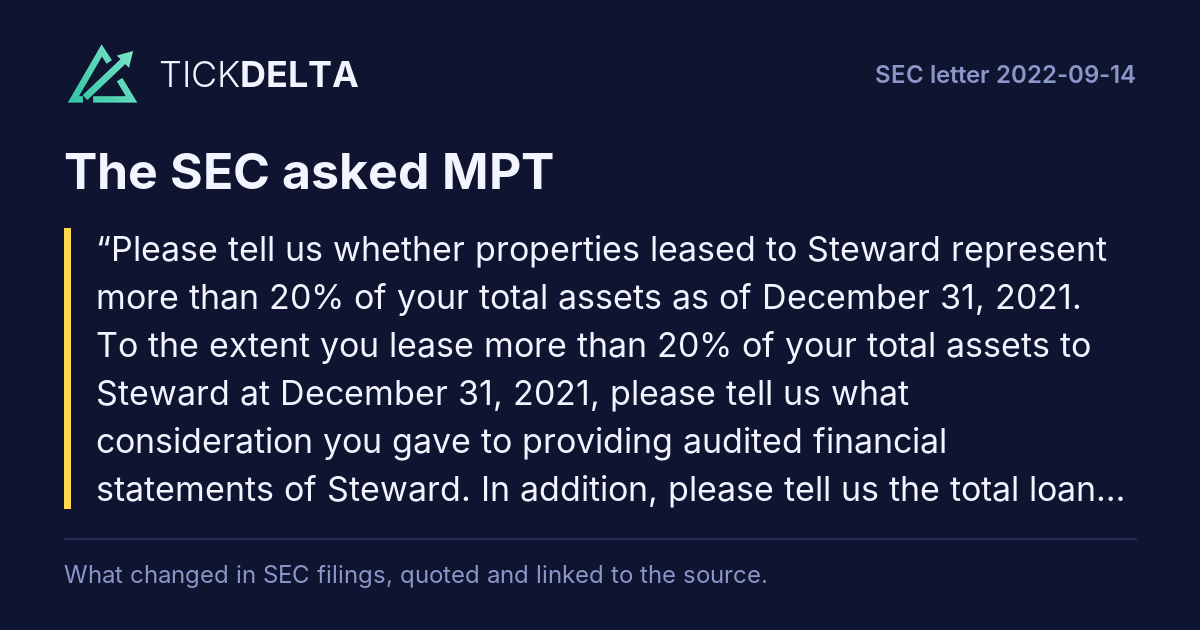
Please tell us whether properties leased to Steward represent more than 20% of your total assets as of December 31, 2021. To the extent you lease more than 20% of your total assets to Steward at December 31, 2021, please tell us what consideration you gave to providing audited financial statements of Steward. In addition, please tell us the total loan amount to Steward that was outstanding as of December 31, 2021.
MPT answered
As of December 31, 2021, properties leased to Steward represented 22.4% of our total assets – but only 17.8% exclusive of assets under binding agreement to sell and presented as held for sale as of such date. As discussed in Note 3 to Item 8 of the 2021 10-K, we entered into a definitive agreement on August 28, 2021, to sell a 50% interest in a portfolio of eight Massachusetts-based general acute care hospitals leased to Steward (the “Macquarie

Transaction”). The transaction was completed in Q1 2022.
Rest of the answer

Accordingly, we did not provide audited financial statements of Steward as part of our 2021 10-K, because it was probable that the concentration of assets leased to Steward would be below 20% after the completion of the Macquarie Transaction. In making this determination, we were informed by previous oral guidance received from the Staff to the effect that spikes in tenant concentration occurring as of a fiscal year-end are not dispositive for purposes of Section 2340 of the Staff’s Financial Reporting Manual if the registrant believes in good faith that such >20% concentration is short-term. We note further, as helpful, that the Macquarie Transaction was, in fact, completed on March 14, 2022, which was prior to March 31, 2022, the reporting due date of such investee’s financial statements under Regulation S- X 3-09.

As of December 31, 2021, loans provided to affiliates of Steward totaled approximately $404 million, which represented approximately 2.0% of total assets.

Read in the reply
In its next report

First report after the company's reply of Sep 28, 2022: 10-Q filed Nov 9, 2022 ↗, against the 10-Q filed Aug 9, 2022 ↗.

Tickdelta does not hold the text of both reports, so they are not compared here.

Form 10-K for the Year Ended December 31, 2021 filed March 1, 2022 · Significant Tenants, page 12
SEC asked (2)
We note your table on page 12 and your note (1) to the table. Please address the following: • Please tell us if you have made adjustments to individual line items within this table that are not also reflected within the adjustments to the total on page 49.
Rest of the question

To the extent you have made such adjustments, please tell us and revise your filing to provide more quantitative and qualitative information about any such adjustments. • Please tell us if you have adjusted the amounts for Steward and HCA for a transaction that was pending as of the date of the filing. To the extent you have made such adjustments, please tell us how you determined it was appropriate to reflect this pending transaction within your table.

MPT answered
All adjustments from total assets to total pro forma gross assets used in preparing the 2021 columns of the table on page 12 of our 2021 10-K are reflected in the reconciliation on page 49 of our 2021 10-K.

As noted in footnote (1) to the table on page 12, total gross assets information in the table for 2021 is shown pro forma for the committed transactions disclosed in Note 8 to Item 8 of our 2021 10-K.
Rest of the answer

This included our binding definitive agreement, as disclosed in Note 8, to lease five Utah hospitals to HCA following its purchase of the operations of these facilities from Steward, subject only to regulatory approvals. The adjustment for this transaction at December 31, 2021 is consistent with our treatment of similar transactions, including the Macquarie

Transaction in 2021 and committed transactions in previous years. We included this adjustment because we believe the total pro forma gross asset concentration metric provides a more current view of our portfolio and allows for a better understanding of our concentration levels as our commitments close. This presentation is also consistent with how our management team reviews our portfolio, including concentration metrics, and what is used in making resource allocation decisions.

Item 7. Management’s Discussion and Analysis of Financial Condition and Results of Operations Critical Accounting Policies Credit Losses, page

Read in the reply
In its next report

First report after the company's reply of Sep 28, 2022: 10-Q filed Nov 9, 2022 ↗, against the 10-Q filed Aug 9, 2022 ↗.

Tickdelta does not hold the text of both reports, so they are not compared here.

Critical Accounting Policies · Credit Losses , page 41
SEC asked (3)
We note your disclosure related to Halsen Healthcare on page 79. In light of their bankruptcy filing, please tell us what consideration you gave to disclosing the balances of any receivables from Halsen Healthcare that were outstanding at December 31, 2021.
MPT answered
We disclose in Note 3 to Item 8 of our 2021 10-K that our total investment in Halsen Healthcare is less than 0.5% of our total assets as of December 31, 2021. In addition to including this total investment percentage, we disclose our $40 million real estate investment in Halsen Healthcare in this same Note 3.
Rest of the answer

Although we do not explicitly disclose the amount of any outstanding receivables (which were approximately $55 million gross and approximately $12 million, net of reserves, at December 31, 2021), we believe the general disclosure of our total investment percentage and our specific disclosure of our total real estate investment in Halsen Healthcare gives investors the necessary information to be able to reasonably determine the remaining balance of any outstanding receivables. We do not believe the inclusion of the specific balances of any outstanding receivables from Halsen Healthcare would provide any meaningful additional disclosure to investors.

Read in the reply
In its next report

First report after the company's reply of Sep 28, 2022: 10-Q filed Nov 9, 2022 ↗, against the 10-Q filed Aug 9, 2022 ↗.

Tickdelta does not hold the text of both reports, so they are not compared here.

Non-GAAP Financial Measures · Pro Forma Gross Assets, page 49
SEC asked (4)
We note your non-GAAP measure titled total pro forma gross assets. Please address the • We note your use of the phrase "pro forma" in the title. Please tell us how you considered the possibility of this measure being confused with pro forma information prepared in accordance with Article 11 of Regulation S-X.
Rest of the question

• We note your adjustment for real estate commitments on new investments, your adjustment for cash used for funding the transactions above, and your notes (1) and (4) to the table. Please tell us and revise to provide more detail regarding these adjustments, or advise. • We note your adjustment for the incremental gross assets of your joint ventures and other and your note (3) to the table. Please tell us and revise to provide more detail about this adjustment, or advise. Your revisions should include, but not be limited to, how the amounts were derived and that the company does not control the joint venture or have legal claim to the assets of the joint venture. This comment also applies to your disclosure within your earnings releases. In closing, we remind you that the company and its management are responsible for the accuracy and adequacy of their disclosures, notwithstanding any review, comments, action or absence of action by the staff.

MPT answered
Please address the following:

We note your use of the phrase “pro forma” in the title. Please tell us how you considered the possibility of this measure being confused with pro forma information prepared in accordance with Article 11 of Regulation S-X.

We note your adjustment for real estate commitments on new investments, your adjustment for cash used for funding the transactions above, and your notes (1) and (4) to the table.
Rest of the answer

Please tell us and revise to provide more detail regarding these adjustments, or advise.

We note your adjustment for the incremental gross assets of your joint ventures and other and your note

(3) to the table. Please tell us and revise to provide more detail about this adjustment, or advise. Your revisions should include, but not be limited to, how the amounts were derived and that the company does not control the joint venture or have legal claim to the assets of the joint venture.

This comment also applies to your disclosure within your earnings releases.

We respectfully acknowledge the Staff’s comment. In future filings and earnings releases, we will revise the title to remove the words “Pro Forma,” and instead use the word “Adjusted,” to avoid any confusion with pro forma information prepared in accordance with Article 11 of Regulation S-X.

We respectfully advise the Staff that the 2020 reconciling item titled “Real estate commitments on new investments” and the related note (1) is referring solely to the Priory transaction as described. However, in future filings and earning releases, we will modify our wording to read as follows:

(1)

The 2020 column solely reflects the Priory Group Transaction as described in Note 3 to Item 8 of our 2021 10-K, which was completed on January 19, 2021, and included the acquisition of 35 facilities in the United Kingdom.

The reconciling item titled “Cash used for funding the transactions above” and the related note (4) represents cash on-hand or cash generated from subsequent sales, like the Macquarie Transaction discussed in Note 3 to Item 8 of our 2021 10-K, expected to be used to fund new committed investments or to pay down debt. However, in future filings and earning releases, we will modify the reconciling item title to “Cash used” and clarify our wording of note (4) to read as follows:

(4)

Represents cash on-hand and cash received subsequent to period end for assets disposed, including the Macquarie Transaction in 2021, of which such cash proceeds were used to either fund new investments or paydown debt.

The reconciling item titled “Incremental gross assets of our joint ventures and other” and the related note (3) reflects an addition to total assets to present our share of each joint venture’s gross assets on a comparable basis as the remainder of our real estate portfolio. This presentation is also consistent with how our management team reviews our portfolio, including concentration metrics, and what is used in making resource allocation decisions. In future filings and earnings releases, we will modify note (3) to this reconciling item to reflect the following:

(3)

While we do not control any of our unconsolidated real estate joint venture arrangements and do not have direct legal claim to the underlying assets of the unconsolidated real estate joint ventures, we believe this adjustment allows investors to view certain concentration information on a basis comparable to the remainder of our real estate portfolio.

Read in the reply
In its next report

First report after the company's reply of Sep 28, 2022: 10-Q filed Nov 9, 2022 ↗, against the 10-Q filed Aug 9, 2022 ↗.

Tickdelta does not hold the text of both reports, so they are not compared here.

Significant Tenants, page 12
SEC asked (1)
We note your response to comment 1 indicated that assets leased to Steward represented 17.8% of your total assets as of December 31, 2021, after exclusion of assets related to the Macquarie Transaction. Please address the following: • As part of the Macquarie Transaction, you received a 50% interest in the joint venture that now holds the eight Massachusetts-based hospitals that are leased to Steward.
Rest of the question

Please clarify for us whether or not your 17.8% result includes your 50% interest in this joint venture. • To the extent that you have excluded your 50% interest in this joint venture from your significance calculation, please tell us why you feel it is appropriate to do so when analyzing the significance of the Steward concentration. • Please provide us with your significance calculation that details any adjustments made to the assets leased by Steward as of December 31, 2021. • Additionally, tell us if your joint venture partner, Macquarie Asset Management, is an affiliated entity of Medical Properties Trust, Inc. or its subsidiaries or has ties to any of your officers or board members.

MPT answered
17.8% concentration mentioned in our response to the previous comment letter does not include our 50% interest in the joint venture that now holds the eight Massachusetts-based hospitals leased to Steward. We excluded our 50% interest in the joint venture when analyzing significance since none of the Company nor any of its consolidated subsidiaries is the actual lessor of these facilities, the Company and its subsidiaries do not control the joint venture, and the Company and its subsidiaries do not have direct legal claim to the underlying assets of the joint venture.
Rest of the answer

We note, however, that, even if we included our 50% interest in the joint venture as part of our calculation of the concentration of assets leased to Steward as of

December 31, 2021, the result would have been 19.7% of our total assets, which is still below the 20% threshold for purpose of Section 2340 of the Staff’s Financial Reporting Manual.

Our significance calculations to derive the 17.8% and the 19.7% concentration measures, respectively, are as follows (dollars in thousands):

Numerator:

As of December 31, 2021

Net book value of assets leased to Steward

$

4,600,634

Less: Net book value of Massachusetts assets held-for-sale

(1,096,505

)

Adjusted net book value of assets leased to Steward

3,504,129

Denominator:

Medical Properties Trust, Inc. total assets

20,519,801

Less: Non-cash rent write-offs related to the disposal of the Massachusetts assets

(134,472

Plus: 50% interest in Massachusetts joint venture

375,975

Adjusted Medical Properties Trust, Inc. total assets

19,664,799

Steward concentration, excluding our 50% interest in the Massachusetts joint venture

17.8

%

3,880,104

Steward concentration, including our 50% interest in the Massachusetts joint

19.7

In regards to the last bullet of question #1, we confirm that the joint venture partner, Macquarie Asset

Management, is not an affiliated entity of the Company or its subsidiaries. In addition, there are no ties between Macquarie Asset Management and any of our officers or board members.

Read in the reply
In its next report

First report after the company's reply of Nov 2, 2022: 10-Q filed Nov 9, 2022 ↗, against the 10-Q filed Aug 9, 2022 ↗.

Tickdelta does not hold the text of both reports, so they are not compared here.

Significant Tenants, page 12
SEC asked (2)
We note your response to our comment 2. Please address the following: • It appears that you have adjusted the line items for Steward and HCA within your table on page 12 for a pending transaction for amounts that are not reflected in your reconciliation on page 49; please confirm or clarify.
Rest of the question

• Other than the Steward and HCA pending transaction noted above and the adjustments in the reconciliation on page 49, please clarify for us if any individual line items in your table on page 12 reflect any additional adjustments. • To the extent you have adjustments to any individual line items within the total adjusted gross assets by operator table that are not reflected in your reconciliation from total assets to total adjusted gross assets, please confirm that you will expand your disclosure in future filings to provide more quantitative and qualitative information about any such adjustments. • Please provide a more robust explanation of how you determined it was appropriate to reflect the impact from the pending transaction related to Steward and HCA within your table. Within your response, please address the length of time until you expected the transaction to close and your consideration of the regulatory approvals that were still pending.

MPT answered
The table on page 49 of the 2021 10-K presents a complete reconciliation of total assets to total pro forma (now “adjusted”) gross assets. Generally, a reclassification of the same amount of gross assets from one operator to another operator has no impact on total adjusted gross assets. This was the case for the pending transaction in which HCA would start leasing certain assets rather than Steward, with one exception. For this transaction between HCA and Steward, we expected that there would be a need for a non-cash rent write-off given the change in tenant.
Rest of the answer

However, this reduction in assets caused by the potential non-cash rent write-off was included in the reconciliation of total assets to total adjusted gross assets in the “Cash used for funding the transactions above” line, netted with other activity due to the amount being less than 0.3% of total adjusted gross assets. In future filings and press releases (which we started in the 2022 third quarter press release), we will modify our presentation of the reconciliation of total assets to total adjusted gross assets to provide more qualitative and quantitative information around these types of transactions in order to better show the increase to one operator and the decrease to another operator, and the causes underlying such changes. See Annex A attached to this letter for an example of how this new presentation would have looked as of December 31, 2021.

Other than the Steward and HCA pending transaction noted above and the adjustments in the reconciliation on page 49, please clarify for us if any individual line items in your table on page 12 reflect any additional adjustments.

The line items in the table on page 12 do not reflect any additional adjustments.

To the extent you have adjustments to any individual line items within the total adjusted gross assets by operator table that are not reflected in your reconciliation from total assets to total adjusted gross assets, please confirm that you will expand your disclosure in future filings to provide more quantitative and qualitative information about any such adjustments.

As noted in the response above to the first bullet under #2, we will modify our presentation of the reconciliation of total assets to total adjusted gross assets in future filings and press releases to provide more qualitative and quantitative information around these types of transactions. See Annex A attached to this letter for an example of how this new presentation would have looked as of December 31, 2021.

Please provide a more robust explanation of how you determined it was appropriate to reflect the impact from the pending transaction related to Steward and HCA within your table. Within your response, please address the length of time until you expected the transaction to close and your consideration of the regulatory approvals that were still pending.

The Company’s policy has historically been to reflect the effect of material pending transactions (acquisitions and dispositions) in our concentration metrics once the definitive agreements governing such transactions are binding. We include these types of adjustments in our presentation of concentration because we believe it provides a more current view of our portfolio and allows for a better understanding of our concentration levels as our commitments close. This type of presentation is also consistent with the reports that management reviews when making resource allocation decisions.

As an example of similar adjustments to our concentration presentation in the past, in the

Company’s Form 10-Q for the quarter ended June 30, 2017 (“Q2 2017 10-Q”), we reflected assets leased at that time to IASIS Healthcare LLC

(“IASIS”) in the Steward line of the operator concentration of total adjusted gross assets table, because we were party to a binding agreement as of May 18, 2017 that included a simultaneous merger transaction between Steward and

IASIS. These transactions closed on September 29, 2017, but we reflected the higher Steward concentration (which showed an increase from approximately 20% without the then-pending transaction to roughly 38% after this adjustment) in our concentration presentation prior to the completion of the transactions in our Q2 2017 10-Q.

When making this adjustment between operators, we did consider the contingent nature of the transaction. As noted in our note to the table on page 12 of the 2021 10-K, we referenced Note 8 of our 2021 10-K, which specifically stated that the completion of the transaction was uncertain due to the need for regulatory approval. However, we ultimately decided to include this adjustment in our concentration presentation because of our policy on adjusting for binding commitments (acquisitions and disposals), our history of closing similar transactions, and our then-current expectations that the HCA/Steward transaction would close during the first half of 2022. In future filings and earnings releases, we will continue to clearly emphasize the contingent nature of pending transactions, even if subject to binding agreements.

Read in the reply
In its next report

First report after the company's reply of Nov 2, 2022: 10-Q filed Nov 9, 2022 ↗, against the 10-Q filed Aug 9, 2022 ↗.

Tickdelta does not hold the text of both reports, so they are not compared here.

Non-GAAP Financial Measures · Pro Forma Gross Assets, page 49
SEC asked (3)
We note your response to our comment 4. Please address the following: • Please tell us and revise future filings to provide more qualitative and quantitative information related to the line item 'cash used for funding the transactions above (4)' in your table at the bottom of page 49.
Rest of the question

In this regard, please quantify and describe each material component that results in the total adjustments of $1,377,299 and $587,384 for this line item. • Please further clarify for us and in future filings how the amounts for the line item 'incremental gross assets of our joint ventures and other (3)' are derived.

MPT answered
The reconciling item titled

“Cash used for funding the transactions above” and the related note (4) was intended to primarily represent cash on-hand or cash generated from subsequent sales (such as the Macquarie Transaction in

2021 discussed in Note 3 to Item 8 of our 2021 10-K) that was expected to be used to fund new committed investments or to pay down debt. In future filings and earning releases, we will provide more qualitative and quantitative information for this line item.
Rest of the answer

See Annex A attached to this letter for an example of how this new presentation would have looked as of December 31, 2021.

The reconciling item titled “Incremental gross assets of our joint ventures and other” and the related note (3) reflects an addition to total assets to present our share of each unconsolidated real estate joint venture’s gross assets on a comparable basis as to the remainder of our real estate portfolio included in our consolidated financial statements. In future filings, we will provide more detail and clarity for this line item. See Annex A attached to this letter for an example of how this new presentation would have looked as of

December 31, 2021.

Read in the reply
In its next report

First report after the company's reply of Nov 2, 2022: 10-Q filed Nov 9, 2022 ↗, against the 10-Q filed Aug 9, 2022 ↗.

Tickdelta does not hold the text of both reports, so they are not compared here.

Form 10-K for the year ended December 31, 2021 · Significant Tenants, page 12
SEC asked (1)
We note your response to our comment 1. Please tell us how you determined it was unnecessary to consider loans, equity method investments and equity investments in your assessment of whether or not you have a substantial asset concentration with respect to Steward. In addition, please tell us what qualitative factors you considered in your determination to not provide Steward's financial statements.
MPT answered
Section 2340 of the Division of

Corporation Finance Financial Reporting Manual (“Properties Subject to Triple Net Lease”) addresses asset concentrations that arise when “a registrant has triple net leased one or more real estate properties to a single lessee/tenant

(including in the capacity as co-lessee or guarantor), and such properties represent a “significant” portion of the registrant’s assets”.
Rest of the answer

As noted in our prior correspondence, because our assets leased to Steward (including in its capacity as a co-lessee or guarantor) did not equal or exceed 20% of our total assets as of December 31, 2021 (as adjusted for the subsequent event previously explained), we determined that we did not have a significant asset concentration with respect to Steward as of that date for purposes of the tenant financial requirements of Section 2340. We are not aware of any references to loans or equity investments in Section 2340 or elsewhere in the Financial Reporting Manual that would have led us to believe that inclusion of these items was required in making a significant concentration determination for purposes of Section 2340. This is also consistent with past discussions the Company has had with members of the Staff on this topic with respect to both Steward and other tenants.

In addition, beyond the black-letter guidelines of Section 2340, we further considered if we should voluntarily provide Steward’s audited financial statements nonetheless, given Steward’s overall concentration relative to our total assets at December 31, 2021. We determined that providing Steward’s audited financial statements was not advisable or of critical value to our investors for a number of reasons, including:

(i)

Steward is a private, non-reporting company. While our lease agreements with Steward require Steward to periodically provide us with financial information, including financial statements, we are required to keep this information strictly confidential other than to the extent (and only to the extent) required by the securities laws. Since, as above, the relevant securities law and rules of the SEC on their face do not mandate that Steward’s 2021 audited financial statements be publicly filed, we do not believe we have the right to compel Steward to permit the voluntary public filing of their highly confidential financial information. We respectfully submit that neither our business nor our investors are likely to benefit in the long run if we insist on making tenant confidential information publicly available other than as required by law or applicable rule/regulation.

(ii)

Our overall exposure to Steward is not a static number and fluctuates from period to period, in a trend we expect to continue downwards. As noted in prior correspondence with the Staff, our overall exposure to Steward was expected to decline by 5.5% of total assets prior to regulatory objection to the sale of Steward’s Utah hospital operations to

HCA. We anticipate further transactions and near-term opportunities to continue to reduce Steward’s concentration.

(iii)

We respectfully submit to the Staff that we believe the language of Section 2340 is appropriately tailored to concentrations of triple-net leased real estate assets. As compared to other forms of investment, the terms of a triple-net lease differ materially from the rights, remedies and overall benefits and burdens of the parties to mortgage loans, equity participations and other investment structures. Mortgage loan investments, for example, since they do not provide the benefits of property ownership (such as tax depreciation deductions, right to long-term appreciation, preferred position in bankruptcy) provide for events of defaults and remedies that are different to the lender (such as secured collateral and right of foreclosure) as compared to rights of the landlord under a triple-net lease. Likewise, we account for the income we receive from leases, mortgages, equity participations and other investment forms differently in our publicly disclosed financial statements and in our tax returns. We thus read Section 2340 as being appropriately limited to concentrations represented by triple-net leases of real property, as opposed to an amalgamation of an undefined variety of materially different investment structures.

(iv)

As we have previously discussed with the Staff, we believe facility concentration (i.e., concentration of an individual property to our total portfolio) is the primary concentration risk in our business, rather than that of any particular tenant/operator. This is because our business experience has demonstrated that if a tenant at one of our properties defaults, we likely will be able to readily find one or more replacement third-party operators to lease and operate the relevant facility(ies). We have demonstrated this repeatedly in the historical management of our portfolio. Accordingly, we believe that facility concentration is the primary concentration risk in our business, as opposed to operating company concentration.

(v)

For the reasons stated in (1(iv)), the Company underwrites its investments in leased assets based primarily on financial and other information that is not included in parent-level financial statements. This information includes, inter alia, historical and forecast results of facility-level operations, including local level revenues and cash flows;

operating data concerning local patient mix, specified local level reimbursement sources; local level market penetration, often on a diagnosis basis; competitive strengths and weaknesses with respect solely to the local market; and the physical condition of the real estate to be acquired. Moreover, our leases often require the lessee to be a sole purpose entity that is restricted in its ability to incur debt. None of this information is available to users of our financial statements and we believe to present only the less relevant parent-level financial statements without the benefit of the local level detailed underwriting analysis may wrongly imply that we consider the parent-level financial statements sufficient for investment decisions.

As such, we determined that voluntarily providing audited financial statements for Steward was not necessary for our investors to make an informed investment decision.

Read in the reply
In its next report

First report after the company's reply of Feb 8, 2023: 10-K filed Mar 1, 2023 ↗, against the 10-K filed Mar 1, 2022 ↗.

Tickdelta does not hold the text of both reports, so they are not compared here.
Form 10-K for the year ended December 31, 2021 · Significant Tenants, page 12
SEC asked (2)
Please tell us the name of the guarantor entity or entities and the terms of any guarantees related to the master lease agreement and any loan agreements with Steward affiliates. Also, please summarize the key terms of any cross collateralization and default provisions for each of these agreements.
Rest of the question

Finally, with respect to your holding of a 9.9% equity investment in Steward and your loan agreements with Steward, tell us if there are any agreements with underlying put or call provisions or other provisions that expose you to further investment in Steward or to provide further financing to Steward. To the extent such provisions exist, please provide a basic discussion of such provisions.

MPT answered
There are three guaranty agreements in place with regard to Steward:

1) Amended and Restated Guaranty (Master Lease I), dated as of March 14,

2022. This is a broad guaranty that secures all of the respective obligations of Steward’s subsidiaries under the master leases or loan agreements with the Company, including all ancillary agreements, security documents, and other instruments entered into from time to time in connection therewith.

2) Amended and Restated Guaranty (Master Lease II), dated as of March 14, 2022.
Rest of the answer

The

Company’s rights under this guaranty are limited to the respective obligations of Steward’s subsidiaries (lessees) under Master Lease II, including all other instruments entered into from time to time in connection therewith.

Read in the reply
In its next report

First report after the company's reply of Feb 8, 2023: 10-K filed Mar 1, 2023 ↗, against the 10-K filed Mar 1, 2022 ↗.

Tickdelta does not hold the text of both reports, so they are not compared here.

Form 10-K for the year ended December 31, 2021 · Significant Tenants, page 12
SEC asked (3)
Please tell us if you expect to file financial statements of Steward with your Form 10- K for the year ended December 31, 2022. Please address your expected total asset concentration with Steward from all of your arrangements (i.e.
Rest of the question

master lease, loan, equity method investment and equity investment) on a combined basis in your response and specifically tell us how you considered any guarantees and cross collateralization and default provisions addressed in response to the above comment in your analysis.

MPT answered
Guaranty by Lessees, dated as of May 1, 2017. This guaranty was executed by each of Steward’s subsidiaries that are parties to the master leases (the lessees) and secures only the respective obligations of Steward and its subsidiaries under the loan agreements and the various ancillary loan documents.

In regard to cross collateralization and default provisions, the obligations of Steward and its subsidiaries under the loan agreements are secured by the Guaranty agreements noted above and other various security documents.
Rest of the answer

None of the related security agreements secure any obligations under the master leases. Only monetary defaults under the loan agreements result in defaults under the master leases.

There are no agreements with underlying put or call provisions or similar provisions that might require us to make any further investment in Steward or to provide further financing to Steward.

3. Please tell us if you expect to file financial statements of Steward with your Form 10-K for the year ended December 31, 2022. Please address your expected total asset concentration with Steward from all of your arrangements (i.e. master lease, loan, equity method investment and equity investment) on a combined basis in your response and specifically tell us how you considered any guarantees and cross collateralization and default provisions addressed in response to the above comment in your analysis.

As of December 31, 2022, we expect that our assets leased to Steward will have equaled 20.3% of our total assets. We expect that our assets represented by loan and equity investments in Steward will have equaled 3.6% of our total assets as of that date. Pursuant to the guidance set forth in Section 2340 of the Division of Corporation Finance Financial Reporting Manual, since our assets leased to Steward as of December 31, 2022 exceeded 20% of our total assets as of that date, we affirm our intention to file the audited financial statements of Steward for the year ended December 31, 2022 via Form 10-K/A, subject to completion of the concentration calculation from our 2022 financial statements and consideration of any relevant subsequent events. We anticipate filing such Steward financial statements promptly upon their becoming available to us from Steward and upon receiving consent from its independent auditors.

Read in the reply
In its next report

First report after the company's reply of Feb 8, 2023: 10-K filed Mar 1, 2023 ↗, against the 10-K filed Mar 1, 2022 ↗.

Tickdelta does not hold the text of both reports, so they are not compared here.

Form 10-K for the year ended December 31, 2021 · Significant Tenants, page 12
SEC asked (4)
We note your response to our comment 2 and your proposed revisions to your filing. In light of the adjustments to the individual operator line items, please tell us how you determined it was not necessary to also present a separate table for Gross Assets by Operator on an actual basis.
MPT answered
As noted in our prior correspondence, the Company’s disclosures and presentations with respect to total asset composition and diversity (whether by operator, geography or type) have historically reflected the effect of material pending transactions (acquisitions and dispositions) once the definitive agreements governing such transactions are binding. In the collective experience of the Company’s management team going back many decades, the overwhelming majority of transactions in our industry that have proceeded to the stage of binding definitive agreements – close as contemplated.
Rest of the answer

As noted in our prior correspondence, the adjusted presentation is also consistent with the reports that Company management reviews when making resource allocation decisions. Accordingly, we believe that a presentation that reflects the effect of pending transactions subject to binding agreements provides investors with a more accurate, current view of our portfolio and allows for a better understanding of our concentration levels. As noted previously, the commentary and footnotes to these tables, including our

“Gross Assets by Operator” table, clearly indicate the pending nature of any applicable transactions. In addition, note 8, which was referenced below the “Gross Assets by Operator” table, explicitly quantifies the impact of the expected HCA-Steward transaction – 5.5% of our total assets. Thus, the reader of our financial statements could easily quantify the Steward exposure, if the pending transaction did not close as anticipated. We respectfully submit that providing readers with a side-by-side duplicate table that excludes pending binding transactions could lead to a misrepresentation of, and confusion with respect to, the current state of our portfolio concentration levels.

We note again that the Company’s historical practice of presenting certain total asset metrics adjusted for pending binding transactions works both ways. If we are party to a binding agreement the effect of which is to increase a particular concentration metric, we will reflect (and have reflected) that higher concentration in the relevant chart or tabular disclosure as well, footnoted as appropriate to reflect the pending nature of the transaction.

We respectfully reaffirm that in future filings and earnings releases, we will continue to clearly emphasize the contingent nature of any pending transactions, even if subject to binding agreements

Read in the reply
In its next report

First report after the company's reply of Feb 8, 2023: 10-K filed Mar 1, 2023 ↗, against the 10-K filed Mar 1, 2022 ↗.

Tickdelta does not hold the text of both reports, so they are not compared here.

Form 10-K for the year ended December 31, 2021 · Significant Tenants, page 12
SEC asked (5)
We note your response to our comment 2 and your proposed revisions to your filing. To the extent you have adjustments to any individual line items within the adjusted gross assets by operator table, please confirm that you will also expand your disclosure in future filings to provide more quantitative and qualitative information about any such adjustments immediately below the adjusted gross assets by operator table.
MPT answered
We respectfully confirm that in future filings the Company will include expanded disclosure to provide more quantitative and qualitative information about any adjustments immediately below the adjusted gross assets by operator table.
Read in the reply
In its next report

First report after the company's reply of Feb 8, 2023: 10-K filed Mar 1, 2023 ↗, against the 10-K filed Mar 1, 2022 ↗.

Tickdelta does not hold the text of both reports, so they are not compared here.

Significant Tenants · Total Assets by Operator, page 13
SEC asked (1)
We note that your table presents total assets by operator on an actual basis along with corresponding percentages by operator. Immediately below this table, you present percentages for certain operators on an adjusted basis. We note that you have reconciled from total assets to total adjusted gross assets on page 52.
Rest of the question

Please address the following: • Please tell us and revise your filing to clarify the nature of the assets that are associated with an operator (i.e. real estate assets, mortgage loans, investments in unconsolidated operating entities, etc.) • For the adjusted operator percentages, please tell us and revise your filing to provide additional qualitative and quantitative disclosures that provide an understanding of each of the adjustments on an operator by operator basis. • For each adjustment that relates to a transaction that had not closed by the date of the filing, please tell us your basis for presenting the percentage as if such transaction had closed.

MPT answered
to the Staff’s specific information requests, we respectfully advise that:

At December 31, 2022, total assets of our top five operators are generally comprised of real estate assets, mortgage loans, investments in unconsolidated real estate joint ventures, investments in unconsolidated operating entities, and other loans.

Our adjustments to reconcile total assets by operator (GAAP) to total adjusted gross assets

(non-GAAP) for each of our top five operators at December 31, 2022 are detailed below (in millions):

As of

December 31, 2022

Steward total assets

$

4,763

Adjustments:

Add:
Rest of the answer

Accumulated depreciation and amortization

342

Add: Incremental gross assets of our Investments in Unconsolidated Real Estate Joint

Ventures

465

Reclassification between Steward and CommonSpirit as part of the Steward Transaction

(889

)

Less: Gross book value of the Steward Transaction

(481

Steward total adjusted gross assets

4,200

Circle total assets

2,062

149

Circle total adjusted gross assets

2,211

Lifepoint total assets

518

Reclassification between Springstone and Lifepoint as part of the Lifepoint Transaction

808

Lifepoint total adjusted gross assets

1,408

Swiss Medical Network total assets

749

600

Swiss Medical Network total adjusted gross assets

1,349

Priory total assets

1,290

Priory total adjusted gross assets

1,317

In light of the above, and because we have otherwise already transitioned to providing our asset concentration solely on a GAAP basis in our periodic reports, we respectfully submit to the Staff that an amended 2022 10-K filing with adjustments by operator would be unnecessary at this point and could lead to investor and analyst confusion. As noted above, our operator concentration percentages do not vary greatly between total assets (GAAP) and total adjusted gross assets (non-GAAP).

For each adjustment that relates to a transaction that had not closed by the date of the filing, please tell us your basis for presenting the percentage as if such transaction had closed.

The Company’s policy has historically been to reflect the effect of material pending transactions (acquisitions and dispositions) in our concentration metrics once the definitive agreements governing such transactions became binding, subject to only ordinary course closing conditions. We note that in our long experience as a public company and active investor in healthcare real estate, the overwhelming majority of transactions that have proceeded to binding agreements have closed substantially as contemplated. We have historically included these types of adjustments in our presentation of concentration because those often large commitments could have a measurable impact on our concentration metrics, particularly in those years when we had a smaller asset base. In addition, we believed adjusting for those commitments provided a more current view of our portfolio and allowed for a better understanding of our concentration levels as our commitments closed. This type of presentation was also consistent with the reports that management reviewed when making resource allocation decisions.

Accordingly, as noted in the description of total adjusted gross assets on page 52 of our 2022 10-K, the calculation assumes material committed transactions as of the balance sheet date are completed, including such transactions’ effect on cash on hand.

Specifically, we note that the acquisition of the majority interest in Springstone by Lifepoint (“Lifepoint Transaction”) had already occurred as of the filing date of our 2022 10-K, the sale of

Steward’s Utah operations to CommonSpirit Health (“Steward Transaction”) occurred shortly thereafter in May 2023 (from which we expect to receive $150 million to pay down outstanding loans, $100 million of which we have already received), and the sale of the three Connecticut hospitals (“Prospect Transaction”) continues to be on track per its binding commitment and is scheduled to close later in 2023.

We respectfully submit that the adjustment for these transactions at December 31, 2022 is consistent with our treatment of similar transactions, including the Macquarie Transaction in 2021 and other committed transactions, in previous years’ filings.

However, as noted previously, we have transitioned away from non-GAAP concentration disclosures in our periodic reports since the operator concentration percentages do not vary greatly between total assets and total adjusted gross assets and providing both seems duplicative and could be confusing to the readers of our financial statements.

Read in the reply
In its next report

First report after the company's reply of Jul 18, 2023: 10-Q filed Aug 9, 2023 ↗, against the 10-Q filed Aug 9, 2022 ↗.

Tickdelta does not hold the text of both reports, so they are not compared here.

Non-GAAP measures · Total Adjusted Gross Assets, page 52
SEC asked (2)
We note that the reconciliation for Total Adjusted Gross Assets is quite complex. Please address the following: • Footnote (3) appears to combine elements of the committed transactions but that these elements do not appear to be clearly quantified within referenced Notes 8 and 13 to the financial statements.
Rest of the question

Please enhance your disclosure by breaking out the captions "Gross book value of assets in transactions as described in Notes 8 and 13" into multiple captions (i.e. one for each transaction). • Footnote (4) appears to combine multiple transactions. Please enhance your disclosure by breaking out the caption "Expected cash proceeds generated by the transactions as described in Notes 3, 8 and 13" into multiple captions (i.e. one for each transaction). filing, please tell us your basis for presenting gross assets as if such transaction had • This comment also applies to your presentation of total adjusted gross assets in your earnings release included in your Form 8-K.

MPT answered
We respectfully acknowledge the Staff’s comment. While

Footnote (3) on page 52 of the 2022 10-K combines the impact of multiple transactions, we believe the information contained in Notes 8 and 13 identifies and describes the appropriate transactions and provides a material quantification of the amount in Footnote (3).
Rest of the answer

We have provided below the information you requested (in millions):

Gross book value of assets in transactions as described in Notes 8 and 13:

Lifepoint Transaction (Note 13)

(205

Prospect Connecticut sale (Note 8) (1)

(457

Portion of Prospect Connecticut sale proceeds to be converted into equity of Prospect’s managed care business

157

Expected loan principal repayment with Steward’s sale of Utah operations to CommonSpirit

Health (Note 13)

(150

Total

(655

(1)

Represents sale proceeds as disclosed in Note 8. Of this, $300 million is expected to be received in cash, while the remaining $157 million is to be received in the form of equity in Prospect’s managed care business.

Given our proactive transition to reporting operator concentration solely on a GAAP basis in our periodic reports, we respectfully submit that a formal amendment of our 2022 10-K to reflect the above should not be required at this point.

Footnote (4) appears to combine multiple transactions. Please enhance your disclosure by breaking out the caption “Expected cash proceeds generated by the transactions as described in Notes 3, 8 and 13” into multiple captions (i.e. one for each transaction).

We respectfully acknowledge the Staff’s comment. However, as noted above, we believe the information in Notes 8 and 13 of our 2022 10-K identifies and describes the appropriate transactions and quantifies a significant portion of the expected proceeds. The requested information is detailed below for your review (in millions):

Expected cash proceeds generated by the transactions as described in

Notes 3, 8 and 13:

Proceeds from the Lifepoint Transaction

205

Proceeds from the Prospect Transaction

300

Proceeds from Steward as a result of the Steward Transaction

150

Other proceeds

Total expected cash proceeds generated by the transactions

659

Given our proactive transition to reporting operator concentration solely on a GAAP basis in our periodic reports, we respectfully submit that a formal amendment of our 2022 Form 10-K to reflect the above should not be required at this point.

us your basis for presenting gross assets as if such transaction had closed.

As these transactions are the same as those detailed in our response to Comment 1 above, please refer to our response to the third bullet of that comment.

This comment also applies to your presentation of total adjusted gross assets in your earnings release included in your Form 8-K.

We respectfully acknowledge the Staff’s comment and believe our previous responses in regards to the 2022 10-K apply here as well.

Read in the reply
In its next report

First report after the company's reply of Jul 18, 2023: 10-Q filed Aug 9, 2023 ↗, against the 10-Q filed Aug 9, 2022 ↗.

Tickdelta does not hold the text of both reports, so they are not compared here.

Notes To Consolidated Financial Statements
SEC asked (3)
Real Estate and Other Activities Investment in Unconsolidated Operating Entities, page 84 3. We note per the table on page 84 that Steward loan investments are $362.8 million and $360.2 million as of December 31, 2022 and 2021, respectively. We also note that you disclosed on page 85 that during the second quarter of 2022 you loaned $150 million to Steward pursuant to a 5-year secured loan.
Rest of the question

Further, within your disclosure regarding Steward on page 14, you disclose that you hold a promissory note totaling approximately $220 million and you made a $335 million loan to affiliates of Steward in 2021. Please • Please help us understand the reason that the Steward loan investments only increased by approximately $3 million as of December 31, 2022 versus the comparable year in light of the $150 million funding in 2022. • In your response, help us to understand what is in the loan investment balance of $362.8 million on page 84. • Please clarify for us where you reflect the $220 million promissory note, the $150 million amount lent during 2022, and the $335 million loan to affiliates of Steward made in 2021 on your balance sheet. • Please clarify if any loans to Steward or their affiliates are mortgage loans. To the extent such loans are mortgage loans, please clarify where this information is presented in your schedule IV.

MPT answered
, help us to understand what is in the loan investment balance of $362.8 million on page

84. Please clarify for us where you reflect the $220 million promissory note, the $150 million amount lent during 2022, and the $335 million loan to affiliates of Steward made in 2021 on your balance sheet.

The $362.8 million and $360.2 million loan balances as of December 31, 2022 and December 31, 2021, respectively, consist of our $335 million loan to affiliates of Steward made in 2021, plus paid-in-kind interest accrued on the loan.
Rest of the answer

This loan, which provides us opportunities for participation in the value of Steward’s growth, is presented in the “Investments in unconsolidated operating entities” line on our consolidated balance sheets.

The $220 million promissory note referenced on page 14 of our 2022 10-K is inclusive of the

$150 million lent during 2022. The promissory note balance, which is expected to be shorter-term in nature and more of a traditional working capital-type loan, is included in “Other loans” on our consolidated balance sheets.

Please clarify if any loans to Steward or their affiliates are mortgage loans. To the extent such loans are mortgage loans, please clarify where this information is presented in your schedule IV.

We did not hold any mortgage loans (or other loans not described above) with Steward or their affiliates at December 31, 2022.

Read in the reply
Form 8-K filed February 23, 2023 · Exhibits
SEC asked (4)
We note your presentation of adjusted funds from operations ("AFFO") in your exhibit 99.1. We note that your reconcilation to arrive at AFFO includes the adjustment caption "straight-line rent revenue and other" which totals $297.6 million and $297.1 million for the years ended December 31, 2022 and 2021, respectively.
Rest of the question

It appears that this caption may have significant balances derived from items other than straight-line rent revenue, as the straight-line rent revenue amounts from your income statements were $204.2 million and $241.4 million, respectively, for those same periods. Please tell us the nature of any large adjustments within this line item that are derived from items other than straight-line rent revenue. Further, please confirm that you will provide a separate line caption(s) to breakout such large items in future presentations of AFFO.

MPT answered
The AFFO adjustment captioned

“straight-line rent revenue and other” is intended to include all straight-line rent from operating leases (including such revenue recorded from our joint ventures accounted for under the equity method) along with comparable amounts for our financing leases that have minimum annual rent escalation provisions.
Rest of the answer

To make this adjustment fully complete, we also include any write-offs of straight-line rent receivables that reduce the straight-line rent revenue line item of our consolidated income statement but were added back as part of the “Write-off of unbilled rent and other” line when calculating Normalized funds from operations, as we start with this measure in computing Adjusted funds from operations. See table below that quantifies each element of this line item:

For the years ended,

December 31, 2021

Straight-line rent revenue and other:

(In millions)

Straight-line rent from operating leases (reflected in “Straight-line rent” line item of our consolidated income statement)

204

241

Comparable straight-line rent from financing leases (reflected in “Income from financing leases” line item of our consolidated income statement)

Comparable straight-line rent in joint ventures accounted for under the equity method (reflected in “Earnings from equity interests” line item of our consolidated income statement)

Write-offs of straight-line rent receivables (included as a reduction in the “Straight-line rent” line item of our consolidated income statement)

Total straight-line rent revenue and other

298

297

As each adjustment above is conceptually of the same nature, we respectfully submit that each is appropriately combined in the same AFFO adjustment line item; however, after considering your comment and to enhance and clarify our disclosure, we will modify our labeling of this line item in future filings to be “Straight-line rent revenue from operating and financing leases”.

Read in the reply
Form 8-K filed February 23, 2023 · Exhibits
SEC asked (5)
We note your presentation of adjusted net debt in your exhibit 99.2. Please address the following: • Footnote (B) appears to combine multiple transactions. Please enhance your disclosure by breaking out the caption "Adjustments after December 31, 2022" into multiple captions (i.e. one for each transaction).
MPT answered
We respectfully acknowledge the Staff’s comment. In future earnings releases (which we improved in the 2023 first quarter), we will enhance our disclosure by breaking out the caption identifying adjustments after period end into multiple captions (i.e., one for each transaction). The enhanced disclosure would have been as follows as of December 31, 2022 (in millions):

Total debt at December 31, 2022

10,269

Less: Cash at December 31, 2022

(236

Less: Cash funded for building improvements in progress and construction in progress at

December 31, 2022 (1)

(359

Adjusted Net
Rest of the answer

Debt

9,674

Adjustments for investment activity (2)

(659

Transaction Adjusted Net Debt

9,015

Excluded development and capital improvement projects that are in process and not yet generating a cash return but will generate a return once completed.

(2)

Reflects expected cash proceeds from the Lifepoint Transaction of approximately $205 million, the

Prospect Transaction of approximately $300 million, and Steward Transaction of approximately $150 million.

us your basis for presenting net debt as if such transaction had closed.

As these transactions are the same as those detailed in our response to Comment 1 above, please refer to our response to the third bullet of that comment.

Read in the reply
Significant Tenants · Total Assets by Operator, page 13
SEC asked (1)
We note your response to our prior comment 1 wherein you stated that at December 31, 2022, total assets of your top five operators are generally comprised of real estate assets, mortgage loans, investments in unconsolidated real estate joint ventures, investments in unconsolidated operating entities, and other loans.
Rest of the question

We note your inclusion of a table labeled total assets by operator on page 21 of your Form 10-Q for the quarterly period ended June 30, 2023. However, we are unable to locate disclosure clarifying the nature of the assets that are associated with an operator (i.e. real estate assets, mortgage loans, investments in unconsolidated real estate joint ventures, investments in unconsolidated operating entities, and other loans). Please confirm that in future periodic filings you will include the previously requested disclosure clarifying the nature of the assets associated with an operator, or tell us why you believe such clarifying disclosure is not necessary.

MPT answered
We respectfully acknowledge the Staff’s comment. Beginning with the Company’s Form 10-Q for the Quarter Ended September 30, 2023 (the “Q3 2023 10-Q”), we disclosed the nature of the assets that are associated with our operators. This disclosure is included on page 24 of our Q3 2023

10-Q as Footnote (1) under the total assets by operator table in Note 3 and reads as follows: “Total assets by operator are generally comprised of real estate assets, mortgage loans, investments in unconsolidated real estate joint ventures, investments in unconsolidated operating entities, and other loans.” We
Rest of the answer

will continue to include this disclosure in our future periodic filings.

Read in the reply
In its next report

First report after the company's reply of Nov 21, 2023: 10-K filed Feb 29, 2024 ↗, against the 10-K filed Mar 1, 2022 ↗.

Tickdelta does not hold the text of both reports, so they are not compared here.

Significant Tenants · Total Assets by Operator, page 13
SEC asked (2)
Please tell us when you expect to amend your Form 10-K for the fiscal year ended December 31, 2022 to include audited financial statements of Steward Health Care System LLC as of and for the year ended December 31, 2022.
MPT answered
We will file the audited financial statements of Steward Health Care System LLC (“Steward”) as of and for the year ended

December 31, 2022 via Form 10-K/A promptly upon receipt of such audited financial statements and respective auditor consents. Based on recent discussions with Steward, we expect to receive the audited financial statements and auditor consents prior to December 31, 2023.
Read in the reply
In its next report

First report after the company's reply of Nov 21, 2023: 10-K filed Feb 29, 2024 ↗, against the 10-K filed Mar 1, 2022 ↗.

Tickdelta does not hold the text of both reports, so they are not compared here.

Significant Tenants · Total Assets by Operator, page 13
SEC asked
We note your response to our comment 2. We reissue the comment. Please tell us when you expect to amend your Form 10-K for the fiscal year ended December 31, 2022 to include audited financial statements of Steward Health Care System LLC as of and for the year ended December 31, 2022.
MPT answered
As noted in our letter to the Staff dated November 21, 2023 and phone call with the Staff on January 5,

2024, the Company respectfully reaffirms its intention to file the audited financial statements of Steward Health Care System LLC (“Steward”) for the year ended December 31, 2022 via Form 10-K/A promptly upon our receipt of the same from Steward, which Steward has most recently advised us is expected prior to February 28, 2024.
Read in the reply
In its next report

First report after the company's reply of Jan 24, 2024: 10-K filed Feb 29, 2024 ↗, against the 10-K filed Mar 1, 2022 ↗.

Tickdelta does not hold the text of both reports, so they are not compared here.

Also in this review: company letter, Mar 24, 2023, company letter, Feb 8, 2024
Form 10-K for the Fiscal Year Ended December 31, 2018

2019-06-17 to 2019-08-08 · 1 question · 1 letter from the SEC, 2 from the company
Review closed 2019-08-08
Significant Tenants, page 10
SEC asked
We note your disclosure on page 10 that Steward operated 39.5% of your gross assets as of December 31, 2018. Given that Steward appears to be a significant lessee, please tell us what consideration you gave to filing audited financial statements of Steward.
Rest of the question

In that regard, we note your response to comment 3 from our letter dated October 26, 2018, where you stated that you expected to file the financial statements of Steward with your Form 10-K or Form 10-K/A for the year ended December 31, 2018.

MPT answered

No numbered answer found in the reply. Read the reply ↗

In its next report

First report after the company's reply of Jul 1, 2019: 10-Q filed Aug 9, 2019 ↗, against the 10-Q filed May 10, 2019 ↗.

Tickdelta does not hold the text of both reports, so they are not compared here.

Also in this review: company letter, Jul 23, 2019, closing letter, 2019-08-08

Form 10-K for the Fiscal Year Ended December 31, 2017

2018-07-03 to 2019-02-25 · 9 questions · 4 letters from the SEC, 4 from the company
Review closed 2019-02-25
LeasesNon-GAAP measuresCritical estimatesAcquisitionsDebt
Item 1 Business · Significant Tenants, page 11
SEC asked (1)
We note your disclosure in footnote (1) to the table that Steward operates $1.86 billion of triple net leased gross assets. Please tell us whether properties leased to Steward represent more than 20% of your total assets as of December 31, 2017. To the extent you lease more than 20% of your total assets to Steward, please tell us what consideration you gave to providing audited financial statements of Steward.
MPT answered
Securities and Exchange Commission

As of December 31, 2017, properties leased to Steward represented 21.2% of our total assets. We did not provide audited financial statements of Steward as part of our 2017 Form 10-K because we knew that this spike (above 20%) in lease concentration as of December 31, 2017 was short-term.
Rest of the answer

In making the determination on whether to provide audited financial statements of Steward, we were assisted by oral guidance from the Staff to the effect that spikes in tenant concentration occurring as of a fiscal year-end may be looked past for purposes of Section 2340 of the Staff’s Financial Reporting Manual if the registrant believes in good faith that such spike in concentration is short-term. As discussed in Note 13 to Item 8 of our Annual Report on Form 10-K, one of our properties leased to Steward, St. Joseph Medical Center in Houston, Texas, was designated as held for sale as of December 31, 2017. As further noted in such Note 13, this property was in fact sold on March 1, 2018. Pro forma for the impact of this subsequent event transaction, properties leased to Steward would have represented 19.5% of our total assets. As we have discussed previously on our earnings calls, we believe this lease concentration will continue to decrease based on our intent to sell certain additional Steward properties, including by way of a potential joint venture transaction.

Read in the reply
In its next report

First report after the company's reply of Jul 18, 2018: 10-Q filed Aug 9, 2018 ↗, against the 10-Q filed May 10, 2018 ↗.

Tickdelta does not hold the text of both reports, so they are not compared here.

Item 1 Business · Significant Tenants, page 11
SEC asked (2)
Notwithstanding the above comment and in light of your total asset concentration in Steward (i.e. leased assets, mortgage loans and equity investment), please tell us what consideration you gave to providing audited financial statements of Steward. In your response, please tell us how you determined such information is not necessary for your investors to make an investment decision.
MPT answered
Pursuant to section 2340 of the SEC Financial Reporting Manual, audited financial statements of tenants are not needed if triple-net leased properties to a single tenant are below 20% of our total assets. This is addressed above in our response to comment #1. In addition, beyond these guidelines, we further considered if we should voluntarily include Steward’s audited financial statements in our annual filing in any event, given Steward’s overall concentration relative to our total assets at December 31, 2017.
Rest of the answer

Although this overall concentration is higher than what we prefer for an extended period, and we expect to reduce this concentration (as discussed previously on our earnings calls), we believe facility concentration (i.e. concentration of an individual property to our total portfolio) is the primary concentration risk in our business, rather than that of any particular tenant/operator. The reason for this is that if a tenant defaults under one of our leases or related investments, we believe we will be able to readily find one or more third-party operators to lease and operate the relevant facility(ies) (and we have demonstrated this repeatedly in the historical management of our portfolio, most recently with our Adeptus assets). Given we believe facility concentration is the primary concentration risk in our business, we determined that voluntarily providing audited financial statements of Steward was not necessary for our investors to make an investment decision.

Item 7A.

Read in the reply
In its next report

First report after the company's reply of Jul 18, 2018: 10-Q filed Aug 9, 2018 ↗, against the 10-Q filed May 10, 2018 ↗.

Tickdelta does not hold the text of both reports, so they are not compared here.

Item 7A. Quantitative and Qualitative Disclosures about Market Risk · Foreign Currency Sensitivity, page 70
SEC asked (3)
With respect to your foreign currency exchange rate risk, please tell us how you determined it is appropriate to present a sensitivity analysis that expresses the potential change to your FFO, which is a non-GAAP measure. Please refer to Item 305 of Regulation S-K.
MPT answered
Based on questions and discussions with investors and analysts, we believe providing the sensitivity of foreign currency exchange rate changes to our FFO is important. However, we realize that we should not provide undue prominence to non-GAAP measures. Thus, in future filings (starting with our second quarter Form 10-Q), we will present our sensitivity analysis on foreign currency exchange rate risk based on net income first and then to FFO.
Rest of the answer

Such presentation will be similar to the following:

With our investments in Germany, the United Kingdom, Spain, and Italy, we are subject to fluctuations in the euro and

British pound to U.S. dollar currency exchange rates. Increases or decreases in the value of the euro to U.S. dollar and the British pound to U.S. dollar exchange rates may impact our financial condition and/or our results of operations. Based solely on operating results for 2017, if the euro exchange rate were to change by 5%, our net income and FFO would change by approximately $1.5 million and $4.1 million, respectively. Based solely on operating results for 2017, if the

British pound exchange rate were to change by 5%, our net income and FFO would change by approximately $0.1 million and $0.2 million, respectively.

Read in the reply
In its next report

First report after the company's reply of Jul 18, 2018: 10-Q filed Aug 9, 2018 ↗, against the 10-Q filed May 10, 2018 ↗.

Tickdelta does not hold the text of both reports, so they are not compared here.

Item 1 Business · Significant Tenants, page 11
SEC asked (1)
We note your responses to comments 1 and 2. We refer you to your disclosure on the bottom of page 11 of your Form 10-K for the year ended December 31, 2017. Specifically, we note you disclose that the properties leased to Steward are subject to a master lease agreement.
Rest of the question

Additionally, you disclose that the terms and provisions of your mortgage loan on six facilities are substantially similar to the master lease agreement. Further, we refer you to the Master Lease Agreement and the Real Estate Loan Agreement filed as Exhibits 10.33 and 10.34 to your Form 10-K for the year ended December 31, 2016. Based on these agreements, it appears that Steward Health guarantees the master lease and the loan. In making your determination that it is unnecessary to provide audited financial statements of Steward, please tell us how you considered the master lease agreement, the loan agreement with attributes similar to the master lease agreement, and that Steward Health appears to provide guarantees for both agreements.

MPT answered
In making our determination whether to provide audited financial statements of

Steward, we analyzed our concentration under SEC Financial Reporting Manual Sections 2340 – Properties Subject to Triple Net Lease, 2345 – Properties Securing Loans, Which in Economic Substance Represent an Investment in Real Estate, and

2350 – Properties Securing Loans that Represent an Asset Concentration.
Rest of the answer

For purposes of Section 2340, our concentration of assets triple net leased to Steward and its affiliates as of December 31, 2017 was 19.5% (after taking into account the subsequent event transaction as described in our previous comment letter response). For purposes of Section 2350, our concentration of assets secured by mortgage loans to Steward and its affiliates was 16.2%. As discussed below in our response to the Staff’s Comment #2, we had no assets to consider under Section 2345. We considered each of these sections separately, and not in the aggregate, in accordance with the SEC Reporting Manual, and our analysis of each section separately resulted in our determination that providing audited financial statements of Steward was not required.

Ms. Jennifer Monick

Securities and Exchange Commission

As addressed in our previous comment letter response, we then considered if we should voluntarily include Steward’s audited financial statements in our annual filing, and we ultimately determined that access to the audited financial statements of Steward would not be material to our investors in making investment decisions, because we believe facility concentration is the primary concentration risk of our business rather than that of any particular tenant/operator.

Read in the reply
In its next report

First report after the company's reply of Sep 11, 2018: 10-Q filed Nov 9, 2018 ↗, against the 10-Q filed May 10, 2018 ↗.

Tickdelta does not hold the text of both reports, so they are not compared here.

Item 8. Financial Statements and Supplementary Data, page 71
SEC asked (2)
Please tell us how you considered if the loan agreement with Steward is a loan, an investment in real estate, or a joint venture. We refer you to the Real Estate Loan Agreement filed as Exhibit 10.34 to your Form 10-K for the year ended December 31, 2016 and the Joinder and Amendment to Real Estate Loan Agreement filed as Exhibit 10.2 to your Form 10-Q for the quarterly period ended September 30, 2017.
Rest of the question

Based on these agreements, it appears that you have the option to purchase the properties at 110% of fair market value, which is defined as specific dollar amounts in the agreement and equals the amount lent to Steward. Your response should address how you considered the terms of the loan, including, but not limited to, the purchase option. In your response, please refer to the guidance in ASC 310-10 for Acquisition, Development, and Construction Arrangements and SAB 1I.

MPT answered
When structuring transactions, our goal is to achieve the best outcome for our shareholders, including the investment decisions we make regarding structuring a deal as either a lease or a mortgage loan. In regards to Steward specifically, we decided to structure two of our transactions with them with a combination of both leases and mortgage loans.
Rest of the answer

One of the main reasons for agreeing to originate mortgage loans was to prevent Steward from having to pay significant capital gains taxes upon transfer of the real estate, which benefited Steward, but also our shareholders, by allowing Steward to maintain more free cash on-hand to meet its obligations as they come due.

While the Master Lease Agreement and Real Estate Loan Agreement of Steward are designed to, as much as possible, produce similar economic results in terms of day-to-day cash flows (which is what we meant in our disclosure on the bottom of page 11 of our Form

10-K in regards to our leases and mortgage loans being substantially similar and we will clarify accordingly in future filings), the rights and remedies, the collateral security, and the overall benefits and burdens of the parties differ materially as between the two forms of investment. Such differences include, but are not limited to the following:

•

Mortgaged properties do not provide us with the benefits of ownership, such as tax depreciation deductions on owned properties, protection in a tenant bankruptcy scenario, automatic control of the real property following a termination, and 100% economic benefit of the long-term appreciation of an owned property;

A leased property does not have the same collateral as a mortgaged property;

Under a mortgage loan, title of the real estate is held by Steward;

Given the difference in ownership, the events of default and resulting remedies in the Master Lease Agreement can be less onerous as those set forth in the Real Estate Loan Agreement, where additional protections are necessary;

While the Master Lease Agreement and the Real Estate Loan Agreement may have parallel initial and renewal terms, those terms are not linked in any way between the agreements. For instance, the Master Lease Agreement may be renewed and extended, even though the Real Estate Loan Agreement is not (and vice versa);

In the Master Lease Agreement, each renewal term requires a fair market value rent adjustment reset.

Conversely, the Real Estate Loan Agreement maturity date may be extended and renewed, but only upon the same terms and conditions set forth in the promissory note and Real Estate Loan Agreement. No fair market value adjustment exists under the loan;

and

We account for the rental income and interest income differently in our publicly disclosed financial statements and in our tax returns.

Based on the above paragraph, we believe the Steward mortgage loans are loans versus investments in real estate from a legal perspective. We also believe the same is true from an accounting perspective under ASC 310-10 and SAB 1I. In regards to the purchase option referenced in the Staff’s comment and as reflected in our Steward Real Estate Loan Agreement, we have the option to acquire the underlying real estate of the mortgage loan either after a major default (which we do not expect to occur) or after the initial 15-year term at 110% of the fair value at the date the mortgage loan was originated. The purpose of the clause was to give us structuring flexibility in the future, yet provide Steward with the upside appreciation in the property that they requested. There was no intent here for the expected residual profit to transfer away from Steward (as owner) to us (as lender). In fact, given the expected depreciation of the properties over the 15-year term, we do not expect there to be any significant residual profit above the 10% premium we would have to pay to exercise such purchase option.

However, even if one could argue that we are entitled to expected residual profit per the purchase option, we believe we meet the other characteristics as noted in ASC 310-10 and SAB1I (and as stated below) of a loan versus an investment in real estate:

a)

Although our mortgage loans represent a substantial portion of the underlying real estate’s fair value at origination, Steward (the borrower) has title to such real estate. In addition, Steward has equity in other assets of the underlying property that are critical to their business, including licenses (CMS Medicare and Medicaid provider numbers, state hospital licenses, The Joint Commission accreditation, pharmacy licenses, etc.), workforce, supply inventory, furniture and fixtures, equipment, and lease contracts with independent third parties to occupy parts of the facilities in return for rent, etc.

b)

Pursuant to the loan agreement, the borrower is to make interest payments to us monthly. No such interest is being added to the loan balance. This requirement to make monthly interest payments is also in place as additional loan advances are made to fund ongoing capital improvement projects.

c)

As lender, we have security rights in assets other than the underlying real estate including licenses, personal property, certain equipment, etc. If Steward defaulted under a mortgage loan, we (as lender) could foreclose on the underlying real estate but also take ownership of these other assets (particularly licenses) that are crucial for Steward to be able to operate their business. Thus, we believe Steward (as borrower) has a substantial amount of risk related to these mortgage loans. In addition, the parent of the borrower does provide a guarantee for the replacement of the mortgage loans.

As previously noted, our risks and rewards in the mortgage loans to Steward differ materially from the owned properties that we lease to Steward, and we do not believe we participate in any expected residual profit, as defined in ASC 310-10. Furthermore, the borrower has title to the underlying real estate and also significant equity investment in operations of the mortgaged facilities. Based on our overall analysis, we believe the mortgage loans are most appropriately characterized as loans and accounted for in accordance with loan accounting.

Read in the reply
In its next report

First report after the company's reply of Sep 11, 2018: 10-Q filed Nov 9, 2018 ↗, against the 10-Q filed May 10, 2018 ↗.

Tickdelta does not hold the text of both reports, so they are not compared here.

Item 1 Business · Significant Tenants, page 11
SEC asked (1)
Please clarify for us the guarantor entity and terms of the guarantee for both the master lease agreement and loan agreement with Steward. Also, explain to us the cross collateralization and default provisions between the two agreements.
MPT answered
There are two guaranty agreements in place with regard to Steward:

1)

Guaranty by Steward Health Care System LLC (“Steward”) This guaranty, dated as of

October 3, 2016, was executed by Steward Health Care System LLC in favor of all of the subsidiaries of the Company that are parties to either the Master Lease Agreement or the Real Estate Loan Agreement.
Rest of the answer

This is a broad guaranty that secures all of the respective obligations of Steward’s subsidiaries (lessees and borrowers) under the Master Lease Agreement, the Real Estate Loan Agreement, and the various ancillary mortgages, promissory notes, security documents, and other instruments entered into from time to time in connection therewith.

Ms. Jennifer Monick

Securities and Exchange Commission

2)

Guaranty by Lessees This guaranty, dated as of May 1, 2017, was executed by each of

Steward’s subsidiaries that are parties to the Master Lease Agreement (the lessees) in favor of each of the subsidiaries of the Company that are parties to the Real Estate Loan Agreement (the mortgage lenders). This Guaranty is more limited, and only secures the respective obligations of the mortgage borrowers under the Real Estate Loan Agreement and the various ancillary loan documents.

Please note that there is no similar guaranty by the mortgage-borrowers of the lessees’ obligations under the Master

Lease Agreement.

In regards to cross collateralization and default provisions, we note the following:

Real Estate Loan Agreement The Real Estate Loan Agreement is not cross-defaulted to the Master Lease Agreement, meaning that defaults under the Master Lease Agreement do not cause defaults under the Real Estate Loan Agreement. The obligations under the Real Estate Loan Agreement are secured by the Security Agreement, Pledge Agreements, the aforementioned

Guaranty Agreements, the applicable mortgages, and other various security documents.

Master Lease Agreement

The Master Lease Agreement states that only “Major Events of Default” under the Real Estate Loan Agreement will trigger a default under the Master Lease Agreement.

A “Major Event of Default” under the Real Estate Loan Agreement means any payment default or financial covenant default by any Steward-borrower, or any insolvency, bankruptcy, liquidation or dissolution default by the Steward, as guarantor. No other ordinary Events of Default under the Real Estate Loan Agreement would result in any default under the Master

Lease Agreement. The occurrence of a “Major Event of Default” by either individual borrower under the Real Estate Loan Agreement would trip a default under the Master Lease Agreement with respect to all lessees.

The aforementioned Guaranty by Steward secures obligations under the Master Lease Agreement. However, none of the Security

Agreement, Pledge Agreements, or mortgages secure any obligations under the Master Lease Agreement, nor is there a cross-guaranty by the mortgage-borrowers of any of the lessees’ obligations under the Master Lease Agreement.

Read in the reply
In its next report

First report after the company's reply of Nov 30, 2018: 10-K filed Mar 1, 2019 ↗, against the 10-K filed Mar 1, 2018 ↗.

Tickdelta does not hold the text of both reports, so they are not compared here.

Item 1 Business · Significant Tenants, page 11
SEC asked (2)
You state that you believe that facility concentration is the primary concentration risk of your business rather than that of any particular tenant/operator. Please further tell us how you analyze concentration risk at each of the following levels: facility, tenant/operator by geographic market, overall tenant/operator, and guarantor.
MPT answered
As noted in our quarterly and annual filings, we analyze concentration risk at the following four levels: facility, tenant/operator, geographic market, and facility type. As noted previously, we believe our primary concentration risk in our business is facility concentration. We analyze facility concentration by taking the gross asset value of an individual property as a percentage of our total gross assets.
Rest of the answer

At September 30, 2018, our largest individual facility (leased or loaned) represented approximately 4% of our total gross assets, which we believe reflects a low concentration risk.

With respect to our tenant/operator concentration, we analyze our total arrangement with each of our tenant/operators to our total gross assets and total revenues. In regards to the guarantors of our real estate investments, we view each tenant/operator and related guarantor as one in the same from a concentration risk perspective.

As for geographic concentration, we analyze our investments at a state level, domestically, and at a country level, internationally, both on a total gross asset and total revenue basis.

From a facility type perspective, we analyze information based our three main types of hospitals (acute care, inpatient rehabilitation, and long-term acute care) on both a total gross asset and total revenue basis.

Read in the reply
In its next report

First report after the company's reply of Nov 30, 2018: 10-K filed Mar 1, 2019 ↗, against the 10-K filed Mar 1, 2018 ↗.

Tickdelta does not hold the text of both reports, so they are not compared here.

Item 1 Business · Significant Tenants, page 11
SEC asked (3)
Please tell us your expectations for filing financial statements of Steward with your Form 10-K for the year ended December 31, 2018 in order to achieve a presentation that will be adequate for investors regarding the financial condition of your company.
Rest of the question

Please address your expected total concentration with Steward from all of your arrangements (i.e., master lease, loan, and equity investment) on a combined basis in your response and specifically tell us how you considered the guarantees and cross collateralization and default provisions addressed in response to comment 1 above in your analysis.

MPT answered
We currently expect our concentration of properties leased to Steward to exceed 20% of our total assets as of December 31, 2018. When considering all of the Company’s arrangements (i.e., leases, loans, and equity investment) with Steward, as of December 31,

2018, we expect our concentration to range between 35% and 40% of our total assets.
Rest of the answer

With our concentration of leases with Steward projected to be greater than 20% of our total assets at December 31, 2018, we expect to file the financial statements of Steward either together with our Form 10-K for the year ended December 31, 2018, or by Form 10-K/A based on the due dates for financial statements of a significant equity method investee under Regulation S-X Rule 3-09 (per the guidance set forth in Section 2340 of the Staff’s Financial Reporting Manual).

Read in the reply
In its next report

First report after the company's reply of Nov 30, 2018: 10-K filed Mar 1, 2019 ↗, against the 10-K filed Mar 1, 2018 ↗.

Tickdelta does not hold the text of both reports, so they are not compared here.

SEC asked
Real Estate and Lending Activities Joint Venture Transactions, page 13 1. Please clarify for us the nature of the €290 million shareholder loan and tell us how you are accounting for the shareholder loan in connection with the Primotop joint venture transaction. Please reference the authoritative accounting literature management relied upon. 2.
Rest of the question

Your disclosure states that your 50% equity investment in the Primotop joint venture transaction is valued at approximately €211 million. In light of your determination that the fair value of the contributed properties is €1.635 billion and the gross proceeds of recently issued related debt was €655 million, please clarify for us how you determined that your 50% equity interest is valued at €211 million. Please reference the authoritative accounting literature management relied upon.

MPT answered
On August 31, 2018, we contributed the real estate of 71 post-acute hospitals by way of a joint venture arrangement in exchange for a 50% equity investment in the joint venture. Separate from our real estate contribution, we and the other joint venture partner each issued a €290 million shareholder loan in exchange for cash to the joint venture. The shareholder loan requires quarterly interest payments at a fixed rate of 5.15%, has a fixed term of 15 years, and requires the loan principal to be repaid at maturity, which is five years prior to the expiration of the joint venture.
Rest of the answer

We recorded the loan investment at cost in accordance with “Financial Accounting Standards Board (“FASB”) Accounting Standards Codification (“ASC”) Topic 310, Receivables.” According to “FASB ASC paragraph 310-10-30, Initial Measurement”, “when a note is received solely for cash and no other right or privilege is exchanged, it is presumed to have a present value at issuance measured by the cash proceeds exchanged.”

Ms. Jennifer Monick

Securities and Exchange Commission

2. Your disclosure states that your 50% equity investment in the Primotop joint venture transaction is valued at approximately €211 million. In light of your determination that the fair value of the contributed properties is €1.635 billion and the gross proceeds of recently issued related debt was €655 million, please clarify for us how you determined that your 50% equity interest is valued at €211 million. Please reference the authoritative accounting literature management relied upon.

Our 50% equity investment in the Primotop joint venture was recorded in accordance with “FASB ASC Topic 323,

Investments – Equity Method and Joint Ventures (paragraph 323-10-30-2)” and consistent with “FASB ASC paragraph 610-20, Clarifying the Scope of Asset Derecognition Guidance.” Accordingly, as stated in “FASB ASC paragraph 323-10-30-2”, “an investor shall initially measure, at fair value, an investment in the common stock of an investee (including a joint venture) recognized upon the derecognition of a distinct nonfinancial asset or distinct in substance nonfinancial asset in accordance with Subtopic 610-20.” As per the guidance, our €211 million equity investment represented the fair value of our share of the net asset value of the newly created joint venture. The net asset value of the joint venture was derived by taking the fair value of contributed real estate assets of €1.635 billion, plus working capital of approximately

€10 million, less the fair value of third party debt of €655 million, less the fair value of total shareholder loans in the amount of €580 million, for a net asset value of €410 million. Our 50% share of the joint venture’s net asset value equates to €205 million. The remaining €6 million represents capitalized transaction costs specifically attributable to the equity investment in accordance with FASB ASC Topic 323.

Read in the reply

Also in this review: closing letter, 2019-02-25

Form 10-K

2017-05-24 to 2017-06-14 · 6 questions · 1 letter from the SEC, 1 from the company
Review closed 2017-06-14
Non-GAAP measuresRevenueDebt
Form 10-K for fiscal year ended December 31, 2016 · General
SEC asked (1)
We note you have an equity interest in Ernest. Please clarify for us if you determined that Ernest is a related party and tell us how you made that determination. To the extent you determined that Ernest is a related party, please tell us how you have complied with the financial statement presentation requirements of Item 4-08(k) of Regulation S-X and the disclosure requirements of ASC 850-10-50.
MPT answered
We have determined that Ernest is a related party based on the scope the definition of related parties in ASC 850-10-20, which includes “entities for which investments in their equity securities would be required, absent the election of the fair value option method, to be

Ms. Jennifer Monick

Securities and Exchange Commission accounted for by the equity method”.
Rest of the answer

As previously disclosed, on February 29, 2012, we made loans to and acquired assets from Ernest in a transaction that included an equity contribution of $3.3 million, which we account for under the fair value option method but absent this election would be required to apply the equity method of accounting.

We acknowledge the Staff’s comment, as well as the requirements of Rule 4-08(k) of Regulation S-X, and respectfully submit that our comprehensive footnote disclosures are sufficiently informative and comply with the spirit of such reporting requirements. For instance, from a balance sheet perspective, we disclose our equity investment and mortgage and other loans due from Ernest in Note 10 (page 116) of our consolidated financial statements included in our Form 10-K. There are no other material receivables due from or payables due to Ernest. From an income statement perspective, we disclose our revenue from Ernest as part of our Concentration of Credit Risks disclosure in Note 3 (page 100) of our consolidated financial statements in our

Form 10-K. There are no other material income statement components related to Ernest. From a cash flow perspective, we provide all material investing activities related to Ernest in Note 3 (beginning on page

90) of our consolidated financials in our Form 10-K. Furthermore, we provide the total amount of revenue (from lease and loans) we earned from entities in which we have an equity interest (regardless of whether we account for them under the equity method, cost method, etc.) in the Related Party Transactions disclosure in Note 3 (page 101) of our consolidated financial statements in our Form 10-K.

We believe that presenting separate captions for related party transactions on each of the rent billed, straight-line rent, income from direct financing leases, and interest and fee income line items on the consolidated statements of income would not materially enhance our existing disclosure as total revenue from Ernest for the year ended December 31, 2016, was less than 13% of our total revenue for the same period. We also believe the same is true for our balance sheet, as the balance sheet components related to Ernest represent less than 4% of our total assets at December 31, 2016. After giving consideration to the magnitude and nature of the Ernest transactions relative to the Company as a whole, we respectfully submit separate identification of individual transactions on the face of the financial statements may in fact obscure the disclosure with excess detail that is not material to an investor’s understanding of our financial statements. We note a similar diversity in practice with respect to the application of the requirements of Rule

4-08(k) of Regulation S-X as they relate to the statements of income among many companies in our peer group, as well as other companies in our industry.

Read in the reply
In its next report

First report after the company's reply of Jun 7, 2017: 10-Q filed Aug 9, 2017 ↗, against the 10-Q filed May 10, 2017 ↗.

Tickdelta does not hold the text of both reports, so they are not compared here.

Note 2. Summary of Significant Accounting Policies · Investments in Unconsolidated Entities, page 82
SEC asked (2)
We note your $50 million investment in Steward during 2016 and we note your 5.1% investment in MEDIAN in 2014. We further note that you record your investments in Steward and MEDIAN using the cost method. Please tell us how you determined you do not have significant influence over Steward and MEDIAN. Please refer to ASC 323-970-25-6, ASC 323-30-S99-1, and ASC 323- 30-35-3.
MPT answered
Our equity investments in each of Steward and MEDIAN represent 4.9% and

5.1%, respectively, of the total outstanding equity interests in these companies. Both entities are limited liability companies that act as corporations, not partnerships, for federal tax purposes. Specific ownership accounts for each investor in these entities are not maintained.
Rest of the answer

Thus, we do not believe ASC 970-323-25-6, 323-30-S99-1 nor 323-30-35-3 are applicable.

However, we did review ASC 323 from the perspective of a corporation along with ASC 325 in determining whether our investment in these entities should be accounted for under the equity method or cost method. Based on such guidance, we believe the cost method is appropriate because 1) our equity investments do not provide us control over the investees, 2) our equity investments do not provide us with the ability to exercise significant influence over the investees, and 3) the investees do not have readily determinable fair values.

With regards to how we determined that our equity investment does not provide us the ability to exercise significant influence over either Steward or MEDIAN, we looked to the guidance in ASC

323-10-15-6 and 8. Pursuant to ASC 323-10-15-8, an investment of less than 20% in the voting stock of an investee leads to a presumption that the investor does not have the ability to exercise significant influence unless such ability can be demonstrated. Our investments of approximately 5% are obviously much lower than this 20% level. In addition, we reviewed the factors set forth in ASC 323-10-15-6 and concluded that none of them apply in a manner that would amount to demonstrating that we exert “significant influence” over either Steward or MEDIAN. For example, we do not have any representation on the boards of these entities, nor do we participate, or have the right to participate, in any policy-making processes. Likewise, there is no interchange of managerial personnel or technological dependency. While we have

“intra-entity transactions” with each of Steward and MEDIAN, such transactions are governed by fixed, long-term leases and/or mortgage loan agreements that are similar in nature to those that we transact with companies in which we do not have an equity stake. In addition, these long-term agreements are not subject to change. Thus, we cannot use these agreements to exert “significant influence” over either Steward or MEDIAN.

Our lack of significant influence over either Steward or MEDIAN is highlighted by the fact that each of these entities is controlled by a third-party majority owner in which we do not have any investment and over which we do not have any influence or control.

Read in the reply
In its next report

First report after the company's reply of Jun 7, 2017: 10-Q filed Aug 9, 2017 ↗, against the 10-Q filed May 10, 2017 ↗.

Tickdelta does not hold the text of both reports, so they are not compared here.

Schedule III, page 134
SEC asked (3)
We note your 2016 reconciliation of real estate assets. Please clarify for us the nature of the $173 million other changes in your reconciliation.
MPT answered
The $173 million of other changes in our 2016 reconciliation of real estate assets primarily represents a lease classification change in four facilities acquired in 2015 for approximately $225 million and leased to RCCH Healthcare Partners, partially offset by an approximately $52 million impact from foreign currency fluctuations and purchase price allocation adjustments. As described on page 96 of our Form 10-K, these four facilities were originally classified as direct financing leases in 2015 but were reclassified to operating leases in 2016 when the related master lease was amended.
Rest of the answer

We specifically exclude facilities classified as direct financing leases in Schedule III but include facilities classified as operating leases. Although these were new assets for

Schedule III in 2016, we reported them on the “Other” line item of the 2016 reconciliation since there were no cash expenditures related to these transactions in 2016.

Read in the reply
In its next report

First report after the company's reply of Jun 7, 2017: 10-Q filed Aug 9, 2017 ↗, against the 10-Q filed May 10, 2017 ↗.

Tickdelta does not hold the text of both reports, so they are not compared here.

Form 8-K filed February 9, 2017 · Exhibit 99.1
SEC asked (4)
Please revise future press releases to ensure that you do not provide undo prominence to non-GAAP measures. For instance, we note that you discuss Normalized FFO per diluted share and Normalized FFO on pages 1 and 2. However, there is no discussion of actual GAAP revenues or earnings until page 3. You may refer to Question 102.10 of the updated Compliance and Disclosure Interpretations issued on May 17, 2016.
MPT answered
We respectfully acknowledge the Staff’s comment. In future press releases, we will present the most directly comparable GAAP measure with equal or greater prominence than any presented non-GAAP measure as discussed in Question 102.10 of the updated Compliance and Disclosure Interpretations issued on

May 17, 2016.
Read in the reply
In its next report

First report after the company's reply of Jun 7, 2017: 10-Q filed Aug 9, 2017 ↗, against the 10-Q filed May 10, 2017 ↗.

Tickdelta does not hold the text of both reports, so they are not compared here.

Form 8-K filed February 9, 2017 · Exhibit 99.1
SEC asked (5)
Please revise future press releases to describe the nature of “pro forma total gross assets” and the amounts used to derive this financial measure.
MPT answered
We respectfully acknowledge the Staff’s comment. In future press releases, we will describe the nature of “pro forma total gross assets” and the amounts used to derive the financial measure.
Read in the reply
In its next report

First report after the company's reply of Jun 7, 2017: 10-Q filed Aug 9, 2017 ↗, against the 10-Q filed May 10, 2017 ↗.

Tickdelta does not hold the text of both reports, so they are not compared here.

Exhibit 99.2
SEC asked (6)
Please revise to properly label pro forma net debt / annualized EBITDA as pro forma net debt / annualized adjusted EBITDA in both this exhibit and in exhibit 99.1. In addition, please revise to include disclosure to clarify that your adjusted EBITDA measure is a non-GAAP measure and to include a statement disclosing why this measure provides useful information to investors.
Rest of the question

Please refer to Item 10(e) of Regulation S-K.

MPT answered
We respectfully acknowledge the Staff’s comment. In future press releases and presentations, we will label the aforementioned schedule in exhibits 99.1 and 99.2 as pro forma net debt / annualized adjusted EBITDA and include a disclosure to clarify that our adjusted EBITDA measure is a non-GAAP measure. We will also include a statement disclosing why this measure provides useful information to investors.
Rest of the answer

Such disclosure will be similar to the following:

Investors and analysts following the real estate industry utilize net debt (debt less cash) to EBITDA (net income before interest expense, income taxes, depreciation and amortization) as a measurement of leverage that shows how many years it would take for us to pay back our debt, assuming net debt and EBITDA are held constant. The table above considers the pro forma effects on net debt and EBITDA from investments and capital transactions that were either completed during the period or disclosed as firm commitments, assuming such transactions were consummated/fully funded as of the beginning of the period. In addition, we show EBITDA adjusted to exclude stock compensation expense, gains or losses on real estate and other dispositions, debt refinancing charges, impairment charges, and acquisition expenses to derive Pro forma Annualized Adjusted EBITDA, which is a non-GAAP measure. We believe Pro forma Net Debt and Pro forma Annualized Adjusted EBITDA are useful to investors and analysts as they allow for a more current view of our credit quality and allow for the comparison of our credit strength between periods and to other real estate companies without the effect of items that by their nature are not comparable from period to period.

Read in the reply
In its next report

First report after the company's reply of Jun 7, 2017: 10-Q filed Aug 9, 2017 ↗, against the 10-Q filed May 10, 2017 ↗.

Tickdelta does not hold the text of both reports, so they are not compared here.

Also in this review: closing letter, 2017-06-14

Form 10-K for the fiscal year ended December 31, 2014

2015-04-09 to 2015-05-06 · 1 question · 1 letter from the SEC, 1 from the company
Review closed 2015-05-06
AcquisitionsLeases
Financial Statements
SEC asked
Real Estate and Loans Receivable Meridian Transaction, page 82 1. It appears that you expect the second step of the Meridian Transaction to close in early 2015 and that this transaction is a sale/leaseback transaction where you will be acquiring the property subject to the transaction and then leasing it back to the seller.
Rest of the question

Please clarify whether you plan to account for the Meridian Transaction as a business combination or asset purchase. Your response should address the basis for your conclusion and cite the relevant facts, circumstances, and accounting literature relied upon. In addition, your response should outline all assets acquired and explain whether your acquisition will include any assets in addition to real estate property such as medical records, medical equipment, licenses, intangibles, and other components of the healthcare operations. Concentration of Credit Risks, page 90 2. You have disclosed that Prime represented or exceeded 20% of your total assets as of December 31, 2014 and 2013. These assets are leased to Prime under master lease agreements on a long-term, triple net-lease basis. As a result, it appears that financial information related to Prime would be relevant to investors given Prime’s concentration to your business. It appears such information was provided in previous years. Please clarify your basis for no longer providing such information and/or amend your 10-K to include such financial information.

MPT answered
Median Transaction, page 82

1. It appears that you expect the second step of the Median Transaction to close in early 2015 and that this transaction is a sale/leaseback transaction where you will be acquiring the property subject to the transaction and then leasing it back to the seller. Please clarify whether you plan to account for the Median Transaction as a business combination or asset purchase. Your response should address the basis for your conclusion and cite the relevant facts, circumstances, and accounting literature relied upon.
Rest of the answer

In addition, your response should outline all assets acquired and explain whether your acquisition will include any assets in addition to real estate property such as medical records, medical equipment, licenses, intangibles, and other components of the healthcare operations.

Securities and Exchange Commission

All of the real estate assets expected to be acquired as part of Step 2 of the Median transaction will be simultaneously leased back to the seller (as required per the purchase/sale agreements) and will be accounted for as an acquisition of a business. As part of this transaction, we expect to acquire land (unless subject to ground lease), land improvements, buildings (including fixed furniture/fixtures) and related lease intangibles, if any. We will not acquire medical records, medical equipment, intangibles, or other components of the healthcare operations – those assets will stay with the operator of the properties.

In determining whether our real estate property acquisitions are acquisitions of a business or an asset purchase, we use the guidance provided in Topic 805, Business Combinations. A business is defined as “[a]n integrated set of activities and assets that is capable of being conducted and managed for the purpose of providing a return in the form of dividends, lower costs, or other economic benefits directly to investors or other owners, members, or participants.” In the case of the Median transaction, the real estate being acquired is the “Input” of the business, the lease which is effective at the acquisition date (and a requirement to close on the real estate as stated above) is the “Process”, and the rent paid to us pursuant to the lease is the

“Output”. As such, we have determined that the real estate assets to be acquired as part of the Median Transaction and leased back to the seller meet the definition of a business and will be accounted for as acquisitions of a business.

Concentration of Credit Risks, page 90

2. You have disclosed that Prime represented or exceeded 20% of your total assets as of December 31, 2014 and 2013. These assets are leased to Prime under master lease agreements on a long-term, triple net-lease basis. As a result, it appears that financial information related to Prime would be relevant to investors given Prime’s concentration to your business. It appears such information was provided in previous years. Please clarify your basis for no longer providing such information and/or amend your 10-K to include such financial information.

Our concentration disclosure about Prime on page 90 includes both our investment in properties leased backed to Prime on a triple net-lease basis and our investment in properties for which we hold a mortgage loan. In total, these investments made up 20.0% and 24.5% of our total assets at December 31, 2014 and 2013, respectively; however, our investment in properties leased to Prime on a triple net-lease basis represents, in the aggregate, significantly less than 20% of our total assets as follows:

Concentration %

Investment Type

December 31, 2014

December 31, 2013

Triple-net leases

12.6

%

15.3

Mortgage loans

7.4

9.2

Total

20.0

24.5

Pursuant to SEC Staff Training Manual, Topic II.B – Properties Subject to Net Lease, “the disclosure pertaining to a material lessee, including its audited financial statements if the investment exceeds 20% of total assets, should be provided in filings made under both the Securities Act and the Exchange Act.” Since our investments under a triple-net lease basis to Prime are below 20% of our total assets at December 31, 2014 or 2013, we do not believe Prime’s financial statements are required to be filed with our 2014 Form 10-K.

Medical Properties Trust, Inc. acknowledges that:

1)

Medical Properties Trust, Inc. is responsible for the adequacy and accuracy of the disclosure in the filing;

2)

Staff comments or changes in disclosure in response to Staff comments do not foreclose the Commission from taking any action with respect to the filing; and

3)

Medical Properties Trust, Inc. may not assert Staff comments as a defense in any proceeding initiated by the Commission or any person under the federal securities law of the United States.

Read in the reply
In its next report

First report after the company's reply of Apr 23, 2015: 10-Q filed May 11, 2015 ↗, against the 10-Q filed Nov 10, 2014 ↗.

Tickdelta does not hold the text of both reports, so they are not compared here.

Also in this review: closing letter, 2015-05-06

Form 10-K for the year ended December 31, 2013

2014-04-10 to 2014-05-06 · 4 questions · 1 letter from the SEC, 1 from the company
Review closed 2014-05-06
Results discussion (MD&A)
Item 2. Properties, page 32
SEC asked (1)
In your future Exchange Act reports, please include occupancy data for your properties.
MPT answered
Our business model is to lease hospital facilities to a single tenant under long-term, triple-net leases. Only under rare circumstances would we lease the same facility to more than one tenant at the same time. This means that, unlike those REITs who lease individual spaces in a single asset to multiple tenants, unless we have a facility that is not under lease we typically have

100% occupancy. Accordingly, we do not believe that occupancy data is relevant to understanding our financial condition or operating results.
Rest of the answer

We note that at December 31, 2013, we did have one property (Twelve Oaks) that was only 55% occupied, and we noted this on page 32 in footnote (A) to the Properties table. In future filings, we will continue to note any exceptions as we did in the case of Twelve Oaks at December 31, 2013.

Read in the reply
In its next report

First report after the company's reply of Apr 24, 2014: 10-Q filed May 12, 2014 ↗, against the 10-Q filed Nov 8, 2013 ↗.

Tickdelta does not hold the text of both reports, so they are not compared here.

Item 7. Management’s Discussion and Analysis…, page 40
SEC asked (2)
In your future Exchange Act reports, please include a discussion of same property performance comparing the last two fiscal years. Please clearly disclose any properties that you have backed out of such disclosure and the reasons for not including properties in the same property comparison subset.
MPT answered
Our revenue is generally earned from the leasing of healthcare facilities to single tenants under long-term, triple-net leases or from mortgage loans structured similar to our triple-net lease agreements. Accordingly, we do not experience variability in revenues from each facility as one might from multi-tenant assets such as office or medical office buildings. Management thus does not consider same property performance to be a key performance indicator when evaluating the performance of our portfolio.
Rest of the answer

The only variability in our revenues is generally from contractual based annual escalations of rent and interest unless additional investments are made or such leases or loans are terminated. In the Results of Operation section of Management’s Discussion and Analysis of Financial Condition and Results of Operation starting on page 51 of our 2013 Form 10-K, we have disclosed the impact of such annual escalator provisions on our same property revenue, while at the same time disclosing and quantifying the impact of acquisitions or other transactions on our revenues period over period. In future filings, we will continue to provide similar disclosures.

Read in the reply
In its next report

First report after the company's reply of Apr 24, 2014: 10-Q filed May 12, 2014 ↗, against the 10-Q filed Nov 8, 2013 ↗.

Tickdelta does not hold the text of both reports, so they are not compared here.

Item 7. Management’s Discussion and Analysis…, page 40
SEC asked (3)
Please discuss in future Exchange Act reports how you monitor the credit quality of your tenants. Item 8. Financial Statements and Supplementary Data Notes to Consolidated Financial Statements 3. Real Estate and Loans Receivable
MPT answered
In the Notes to the Consolidated Financial Statements starting on page 73 of our 2013 Form 10-K and under the subheading of Losses from Rent

Receivables, we disclose our process for monitoring the credit quality of our tenants. Such monitoring procedures are the same for our loan investments, which we explain under the subheading Loans.
Rest of the answer

In future filings, we will add similar disclosure to the Management’s Discussion and Analysis of Financial Condition and Results of Operation section of our Form 10-K.

Item 8.

Financial Statements and Supplementary Data

Notes to Consolidated Financial Statements

3. Real Estate and Loans Receivable

Loans,

Read in the reply
In its next report

First report after the company's reply of Apr 24, 2014: 10-Q filed May 12, 2014 ↗, against the 10-Q filed Nov 8, 2013 ↗.

Tickdelta does not hold the text of both reports, so they are not compared here.

Loans, page 85
SEC asked (4)
Explain to us how you have met all of the disclosure requirements of ASC Topic 310-10-50 related to your financing receivables. Specifically, explain to us how you have met the disclosure requirements related to non-accrual or past due loans and impaired loans, and disclosures related to the allowance for credit losses.
Rest of the question

Additionally, explain to us how you have met the requirements to disclose certain credit quality information or explain to us why these disclosures are not applicable.

MPT answered
To assist in responding to the Staff’s comment, we have separated our explanation and response into three categories: 1) accounting policies, 2) presentation and 3) nonaccrual, past due and impaired loans.

Accounting Policies

In Note 2 to the Notes to the Consolidated Financial Statements under the subheading of Loans (starting on page 73), we disclose the general make-up of our loans and the basis for accounting for our loans including how we evaluate collectability of both interest and principal, how we consider a loan to be impaired, how we calculate the impairment amount, when we place
Rest of the answer

a loan on non-accrual status, and how we recognize interest income on an impaired loan. In the same Note 2 under the subheading Revenue Recognition (starting on page 70), we disclose our method for recognizing interest income on non-impaired loans including how we recognize any commitment or origination fee income associated with our loans. Finally, in the same Note 2 under the subheading Deferred Costs (page 75), we disclose the accounting for any costs we incur associated with the origination of any loans.

Presentation

In Note 3 to the Notes to the Consolidated Financial Statements under the subheading of Loans (starting on page 85), we show a table of loans at the balance sheet date and prior year along with an explanation of the significant changes from period to period and the general make-up of these loans. Any unearned income or deferred fees related to our loans are immaterial for disclosure.

Nonaccrual or Past Due and Impaired Loans

As background, please note that our mortgage loans are structured similar to our triple net leases. In addition, we only make acquisition, working capital and other loans to tenants of our facilities. Because of this, we underwrite and monitor the credit worthiness of borrowers under our loans the same way we do for tenants under our leases.

As discussed above, we disclose, in Note 2 of our Notes to Consolidated Financial Statements under the subheading of Losses from Rent Receivables (starting on page 73), how we monitor the creditworthiness of our tenants/borrowers and reference such discussion in the subheading of Loans on page 73. As disclosed, we monitor various aspects of our borrowers including, but not limited to: admission levels and surgery/procedure volumes by type; current operating margins; ratio of the borrower’s operating margins both to facility rent and to facility rent plus other fixed costs; trends in revenue and patient mix; the effect of evolving healthcare regulations; the borrower’s payment and default history; the prospects for support from any financially responsible guarantor; and if appropriate the realizable value of any collateral. On a loan-by-loan basis, we use each of the measures above in determining the overall credit quality of the borrower and in determining if the loan is impaired.

At December 31, 2013 and 2012, we only had one loan in our loan portfolio that was deemed to be impaired with related interest receivables that were past due – our Monroe working capital loan. All other loans and related interest receivables were current (i.e. none greater than 90 days past due). Disclosure surrounding the Monroe impaired loan is discussed in Note 3 under the subheading Monroe facility and encompasses our net investment in and exposure to Monroe. In this disclosure, we separately disclose the amount of the loan at December 31, 2013 and any advances made on the loan in

2013. We also note the amount of interest combined with rent and other charges that are past due along with a specific disclosure of the amount of interest receivables (i.e. $6 million at December 31, 2013) that is past due greater than 90 days. In regards to interest income, we note in this same disclosure that no interest income has been recognized since 2010. Finally, we describe the reasons for deeming this loan impaired, the amount of the impairment charge taken (i.e. $12 million in 2010), and why we believe the remaining net loan balance is deemed to be collectable.

We believe the combination of the disclosures above meet the requirements of ASC Topic 310-10-50.

Medical Properties Trust, Inc. acknowledges that:

1)

Medical Properties Trust, Inc. is responsible for the adequacy and accuracy of the disclosure in the filing;

2)

Staff comments or changes in disclosure in response to Staff comments do not foreclose the Commission from taking any action with respect to the filing; and

3)

Medical Properties Trust, Inc. may not assert Staff comments as a defense in any proceeding initiated by the Commission or any person under the federal securities law of the United States.

Read in the reply

Also in this review: closing letter, 2014-05-06

Form 10-K for the year ended December 31, 2012

2013-04-11 to 2013-04-29 · 6 questions · 1 letter from the SEC, 1 from the company
Review closed 2013-04-29
RevenueAcquisitionsResults discussion (MD&A)LeasesLiquidity and cashCritical estimates
FORM 10-K FOR THE YEAR ENDED DECEMBER 31, 2012 · Results Of Operations, pages 46 – 48
SEC asked (1)
We note that fluctuations within your results of operations were impacted by multiple factors. For example, base rent was impacted by annual escalation provisions and properties acquired or completed. In future periodic filings please provide a more robust discussion of your results of operations including the quantification of individual drivers behind the significant changes in individual income and expense line
Rest of the question

items. For instance in the example above, we would expect you to discuss further the annual escalation provisions by providing a comparison of the new and old average rent rate and the properties acquired or completed by quantifying the number of properties acquired or completed and the amount of incremental revenue increase related to each.

MPT answered
Securities and Exchange Commission

As requested, we agree to expand our disclosures of material impacts to our results of operations and primary underlying causes in our future periodic filings starting with our first quarter Form 10-Q to be filed on or around May 10, 2013.

With respect to the base rent example provided above, we respectfully submit to the Staff that showing incremental revenue from acquisitions on a property by property basis would allow others to calculate our pricing on each deal.
Rest of the answer

We consider such pricing information to be proprietary and would prefer not to disclose it publicly, as it would provide a significant advantage to our competitors similar to a manufacturer publishing its confidential pricing structure to its competitors. In our future filings, we will denote the properties making up such total revenue impact so that the users of our financials know how many properties are included.

In regards to the impact on our base rent from rent escalations, we will specifically quantify the dollar impact in future filings

(which may be more relevant for our company than a comparison of average rental rates).

Read in the reply
In its next report

First report after the company's reply of Apr 25, 2013: 10-Q filed May 10, 2013 ↗, against the 10-Q filed Nov 9, 2012 ↗.

Tickdelta does not hold the text of both reports, so they are not compared here.

Note 3 – Real Estate and Loans Receivable, pages 72 – 79
SEC asked (2)
We note you acquired several properties and simultaneously leased them back to the seller in a sale/leaseback transaction, and these acquisitions appear to be accounted for as an asset purchase. Please tell us how you evaluated each purchase transaction to determine whether the acquired assets meet the definition of a business or are an asset purchase.
Rest of the question

Please tell us the basis for your conclusion and cite the relevant accounting literature relied upon. Also, please tell us the amount of transaction costs that were incurred and capitalized.

MPT answered
All of the acquired properties that were simultaneously leased back to the seller were accounted for as an acquisition of a business.

In determining whether our real estate property acquisitions are acquisitions of a business or an asset purchase, we use the guidance provided in Topic 805, Business Combinations.
Rest of the answer

A business is defined as “[a]n integrated set of activities and assets that is capable of being conducted and managed for the purpose of providing a return in the form of dividends, lower costs, or other economic benefits directly to investors or other owners, members, or participants.” As such, we have determined that our acquired real estate assets, as noted on pages 72-79 of our 2012 Form 10-K, meet the definition of a business and are accounted for as acquisitions of a business. In the purchase of real estate property that meets the definition of a business, our purchase prices were allocated to the assets acquired and liabilities assumed (if applicable) based on their fair values, including applicable intangible assets. All of the acquisition-related costs were expensed and appeared as a single line item on our income statement.

However, for our development projects, we treat the related purchase of land as an asset acquisition, and any costs incurred to acquire such land are capitalized.

Read in the reply
In its next report

First report after the company's reply of Apr 25, 2013: 10-Q filed May 10, 2013 ↗, against the 10-Q filed Nov 9, 2012 ↗.

Tickdelta does not hold the text of both reports, so they are not compared here.

Note 3 – Real Estate and Loans Receivable, pages 72 – 79
SEC asked (3)
As part of the transaction with Ernest, we note you provided a $93.2 million acquisition loan which also provided you a preferential return of 15% of the loan amount and approximately 79% of the remaining earnings of Ernest. As a result, it appears you participate in the expected residual profit of Ernest.
Rest of the question

Please clarify how you have considered the guidance outlined in paragraphs 310-10-25-14 to 30 of the Financial Accounting Standards Codification in determining that your acquisition loan should be accounted for as a loan versus investment in real estate.

MPT answered
The Ernest transaction included four primary components including:

1)

$200 million acquisition and leaseback of 12 real estate properties;

2)

$100 million in mortgage loans related to four properties;

3)

$93.2 million unsecured acquisition loan; and

4)

$3.3 million minority equity investment.

In regards to the $93.2 million acquisition loan, it is an unsecured loan that bears interest at a rate of 15.0%, with a 6% coupon payable in cash in the first year, a 7% coupon payable in cash in the second year and a 10% coupon payable in cash thereafter.
Rest of the answer

The remaining 9% in year one; 8% in year two and 5% thereafter will be accrued and paid upon the occurrence of any capital or liquidity events of Ernest and will be payable in all events at maturity. We are not entitled to any residual profit via this acquisition loan; instead we are just entitled to interest per the stated interest rate described above. Based on these terms, we believe we have properly accounted for this as a loan in accordance with paragraphs 310-10-25-14 to 30 of the Financial Accounting Standards Codification.

Separate from the acquisition loan, we made a $3.3 million equity contribution to Ernest, representing a 49% aggregate initial equity interest. Pursuant to the operating agreement, we share profits and distributions from Ernest according to a distribution waterfall, if certain benchmarks are met, such that after taking into account interest paid on the $93.2 million acquisition loan, we will share in cash generated by Ernest in a ratio of 21% to the management company of Ernest (unrelated to us) and 79% to us.

We have no management authority or control except for certain rights consistent with a passive ownership interest, such as a limited right to approve annual budget components and the right to approve extraordinary transactions, and except in the case of certain extraordinary events, which events include any defaults under the master sublease agreement or the acquisition loan, in which case we are given special member rights including, without limitation, the right to terminate the management agreement, hire new management, or market the company for sale. As such, we account for this $3.3 million investment under the equity method of accounting in accordance with Topic 323, Investments – Equity Method and Joint Ventures

We will clarify the distinction between these two instruments in our future periodic filings starting with our first quarter Form 10-Q to be filed on or around May 10, 2013.

Read in the reply
In its next report

First report after the company's reply of Apr 25, 2013: 10-Q filed May 10, 2013 ↗, against the 10-Q filed Nov 9, 2012 ↗.

Tickdelta does not hold the text of both reports, so they are not compared here.

Note 3 – Real Estate and Loans Receivable, pages 72 – 79
SEC asked (4)
We note you have provided disclosures related to your direct financing leases on page 77. Please clarify how your disclosures fully comply with the requirements outlined in paragraph 840-30-50-4 of the Financial Accounting Standards Codification and/or revise future periodic filings accordingly.
MPT answered
We have re-read the disclosure requirements in 840-30-50-4 and believe the disclosures made in our 2012 Form 10-K meet such requirements. We disclose our future minimum lease payments for direct financing leases on page 77 in our 2012 Form 10-K. We do not have any executory costs or accumulated allowance for uncollectible minimum lease payments included in our minimum lease payments. Our unearned income and estimated residual values are also disclosed on page 77 in our 2012 Form 10-K.
Rest of the answer

We did not have any material initial direct costs for these direct financing leases.

In addition, we disclose our future minimum lease payments to be received with respect to direct financing leases for each of the five succeeding fiscal years as of December 31, 2012 on page 77 of our 2012 Form 10-K. We do not have any contingent rentals included in income for the year ended December 31, 2012. As such, we believe such disclosures required in paragraph 840-30-50-4 of the Financial Standards Codification is adequately provided for in Note 3 to Item 8 of our 2012 Form 10-K.

We respectfully advise the Staff that, if we record allowances on direct financing leases in future periods or if our income includes contingent rentals, we will disclose such amounts in accordance with ASC 840-30-50-4 in our future filings.

Read in the reply
In its next report

First report after the company's reply of Apr 25, 2013: 10-Q filed May 10, 2013 ↗, against the 10-Q filed Nov 9, 2012 ↗.

Tickdelta does not hold the text of both reports, so they are not compared here.

Note 10 – Fair Value of Financial Instruments, pages 90 – 91
SEC asked (5)
We note some of the significant estimates you utilize within your discounted cash flow model include projected revenue and expenses and appropriate discount rates based on the risk profile of comparable companies.
Rest of the question

Please tell us and expand disclosures in future periodic filings to discuss the underlying characteristics of the risk profile you compiled for Ernest and how you determined or obtained the projected revenue and expense figures utilized within your discounted cash flow model. As a part of your response, please also clarify any procedures you perform to validate or confirm the results of your discounted cash flow model and how often you perform these procedures.

MPT answered
After re-reading our disclosure on page 91 in regards to how we value our interest in Ernest, we believe we should clarify our wording in future filings as the discount rate used in our fair value model was based on a weighted-average cost of capital that includes market assumptions that incorporate the fair value framework, while we considered the underlying risk of Ernest’s operations as part of our overall assessment of their projected revenues and expenses.
Rest of the answer

See below for our proposed changes to this disclosure in future filings.

In regards to the projected revenues and expenses used in our fair value model, we obtain such projections from Ernest directly at least annually. We review any assumptions made for reasonableness and analyze these projections thoroughly against actuals and our expectations based on monthly financial reviews. As discussed in our accounting policy note on page 68 of our 2012

Form 10-K, we continuously monitor the performance of all of our existing tenants (including Ernest), which includes an analysis of operating statistics such as admission levels and surgery/procedure volumes by type along with financial results including current operating margins, trends in revenue and patient mix. In addition, we analyze the effect of evolving healthcare regulations on our tenant’s profitability and liquidity. As part of this review and analysis, we talk with key members of the Ernest team to understand current developments, future strategic plans, etc. Based on such thorough analysis, we believe we have a unique perspective into the reasonableness of Ernest’s projections and will make adjustments as deemed appropriate if such projections are not in line with such analysis.

In future filings starting with our 2013 first quarter Form 10-Q, we will clarify and expand our disclosures related to our fair value assessment of our interest in Ernest as follows:

Our mortgage loans with Ernest are recorded at fair value based on Level 3 inputs by discounting the estimated cash flows using the market rates which similar loans would be made to borrowers with similar credit ratings and the same remaining maturities. Our acquisition loan and equity investments in Ernest are recorded at fair value based on Level 3 inputs, by using a discounted cash flow model, which requires significant estimates of our investee such as projected revenue and expenses and appropriate consideration of the underlying risk profile of the forecast assumptions associated with the investee. We classify these loans and equity investments as Level 3, as we use certain unobservable inputs to the valuation methodology that are significant to the fair value measurement, and the valuation requires management judgment due to the absence of quoted market prices. For these cash flow models, our observable inputs include use of a capitalization rate, discount rate (which is based on a weighted-average cost of capital), and market interest rates, and our unobservable input includes an adjustment for a marketability discount on our equity investment of 40% at December 31, 2012.

In regards to the underlying projection of revenues and expenses used in the discounted cash flow model, such projections are provided by Ernest. However, we will modify such projections (including underlying assumptions used) as needed based on our review and analysis of Ernest’s historical results, meetings with key members of management, and our understanding of trends and developments within the healthcare industry.

In arriving at the discount for lack of marketability (“DLOM”), we started with a DLOM range based on the results of studies supporting valuation discounts for other transactions or structures without a public market. To select the appropriate DLOM within the range, we then considered many qualitative factors including the percent of control, the nature of the underlying investee’s business along with our rights as an investor pursuant to the operating agreement, the size of investment, expected holding period, number of shareholders, access to capital marketplace, etc.

Read in the reply
In its next report

First report after the company's reply of Apr 25, 2013: 10-Q filed May 10, 2013 ↗, against the 10-Q filed Nov 9, 2012 ↗.

Tickdelta does not hold the text of both reports, so they are not compared here.

Note 10 – Fair Value of Financial Instruments, pages 90 – 91
SEC asked (6)
Further to our above comment, we note you applied a marketability discount on your equity investment of 40% at December 31, 2012. Please clarify your basis for utilizing a 40% marketability discount and expand disclosures in future periodic filings to discuss. Your discussion should include significant factors considered in determining and supporting that a marketability discount of 40% was appropriate.
MPT answered
To determine the appropriate discount for lack of marketability (“DLOM”), we started with a

DLOM range from a quantitative standpoint and then adjusted accordingly based on several qualitative factors applicable to our interest in Ernest , including percent control, the nature of the underlying company (public vs.
Rest of the answer

private), the size of the block in question, expected holding period, the number of shareholders, access to the capital marketplace, etc.

From a quantitative perspective, we considered certain quantitative factors including examining the results of studies supporting valuation discounts. Several IPO studies since 1980 have analyzed the stock prices of companies before and after they became public, (e.g. Emory and

Willamette IPO studies). DLOMs associated with both of these studies ranged from 32.0% to 73.0%. We also looked at several restricted stock studies including Gelman, Maher, Trout, Moroney, Williamette, SEC studies, etc., which had DLOMs ranging from

13.0% to 50.0%.

From a qualitative perspective, we combined several factors including the following: Ernest is privately held and no orderly market exists for the buying and selling of privately held companies as such we believe we would likely experience a significant time delay (i.e. discount) in finding a buyer. Ernest’s business is also highly leveraged, which warrants a higher discount. In addition, Ernest is only owned by two parties, which would warrant a higher discount as well. Pursuant to the operating agreement in place, we hold a minority position in Ernest and have only protective rights with no control over the day-to-day operations of Ernest, which we believe are factors that would be considered by a willing buyer and thus lead to a higher DLOM. Finally, our equity interest is exposed to a higher risk of absorbing losses in case of dissolution than the other investor, which would lead to a higher DLOM.

Based on the quantitative and qualitative factors discussed above, we believe using 40% as the DLOM is reasonable.

We will expand our disclosures of how we derived the DLOM in our future periodic filings starting with our first quarter Form 10-Q to be filed on or around May 10, 2013. See response to question 5 for our proposed future disclosure.

Medical Properties Trust, Inc. acknowledges that:

Medical Properties Trust, Inc. is responsible for the adequacy and accuracy of the disclosure in the filing;

Staff comments or changes in disclosure in response to Staff comments do not foreclose the Commission from taking any action with respect to the filing; and

Medical Properties Trust, Inc. may not assert Staff comments as a defense in any proceeding initiated by the Commission or any person under the federal securities law of the United States.

Read in the reply
In its next report

First report after the company's reply of Apr 25, 2013: 10-Q filed May 10, 2013 ↗, against the 10-Q filed Nov 9, 2012 ↗.

Tickdelta does not hold the text of both reports, so they are not compared here.

Also in this review: closing letter, 2013-04-29

Form 10-K for the fiscal year ended December 31, 2011

2012-07-20 to 2012-08-08 · 2 questions · 1 letter from the SEC, 1 from the company
Review closed 2012-08-08
Non-GAAP measures
Operations · Reconciliation of Non-GAAP Financial Measures, pages 49 and 50
SEC asked (1)
Please tell us how you current disclosures surrounding adjusted funds from operations meet the requirements of Item 10 (E) of Regulation S-K.
MPT answered
We note the Staff’s comment and advise the Staff that the intent of our disclosure and presentation was to address the usefulness of Funds From Operations (FFO), which is the most common non-GAAP financial measure for real estate investment trusts (REITs). We also included normalized FFO as a supplement to our FFO disclosure because it allows investors and analysts to compare our operating

Securities and Exchange Commission performance to the operating performance of others and between periods on a consistent basis without having to account for differences caused by unanticipated events or
Rest of the answer

non-core activities.

In regard to the disclosure requirements of

Item 10(E) of Regulation S-K, we believe we have met the disclosure requirements in Item 10(E) of Regulation S-K with respect to FFO and normalized FFO as follows: (1) the presentation of FFO and normalized FFO have no greater prominence than the presentation of our net income attributable to common stockholders; (2) page 49 of our Form 10-K for the year ended December 31, 2011 includes an explanation disclosing the reasons why we believe FFO is an appropriate performance measure for a real estate company and provides useful information to investors regarding our results of operations (more discussion on normalized FFO below); (3) the calculations of FFO and normalized FFO do not exclude any items identified as non-recurring, infrequent, or unusual; (4) there are no non-GAAP financial measures presented on the face of the financial statements; in fact our discussion of FFO and normalized FFO is limited to Item 7 of the 2011

Form-10K; and (5) page 50 of our Form 10-K for the year ended December 31, 2011 includes a quantitative reconciliation of FFO and normalized FFO to net income attributable to common stockholders.

In order to further clarify our disclosures in future filings (particularly as it relates to our reasoning for using normalized FFO), we propose the following revision to our lead-in disclosure of non-GAAP financial measures starting with our 2012 second quarter Form 10-Q:

Investors and analysts following the real estate industry utilize funds from operations, or FFO, as a supplemental performance measure. FFO, reflecting the assumption that real estate asset values rise or fall with market conditions, principally adjusts for the effects of GAAP depreciation and amortization of real estate assets, which assumes that the value of real estate diminishes predictably over time. We compute FFO in accordance with the definition provided by the National Association of Real

Estate Investment Trusts, or NAREIT, which represents net income (loss) (computed in accordance with GAAP), excluding gains (losses) on sales of real estate and impairment charges on real estate assets, plus real estate depreciation and amortization and after adjustments for unconsolidated partnerships and joint ventures.

In addition to presenting FFO in accordance with the NAREIT definition, we also disclose normalized FFO, which adjusts FFO for items that relate to unanticipated or non-core events or activities or accounting changes that, if not noted, would make comparison to prior period results and market expectations less meaningful to investors and analysts.

We believe that the use of FFO, combined with the required GAAP presentations, improves the understanding of our operating results among investors and the use of normalized FFO makes comparisons of our operating results with prior periods and other companies more meaningful. While FFO and normalized FFO are relevant and widely used supplemental measures of operating and financial performance of REITs, they should not be viewed as a substitute measure of our operating performance since the measures do not reflect either depreciation and amortization costs or the level of capital expenditures and leasing costs necessary to maintain the operating performance of our properties, which can be significant economic costs that could materially impact our results of operations. FFO and normalized FFO should not be considered an alternative to net income (loss) (computed in accordance with GAAP) as indicators of our financial performance or to cash flow from operating activities (computed in accordance with GAAP) as an indicator of our liquidity.

Read in the reply
In its next report

First report after the company's reply of Jul 31, 2012: 10-Q filed Aug 9, 2012 ↗, against the 10-Q filed May 10, 2012 ↗.

Tickdelta does not hold the text of both reports, so they are not compared here.

Summary of Significant Accounting Policies · Real Estate and Depreciation, page 66
SEC asked (2)
Please expand your discussion of costs included with your construction in progress to include the types of indirect costs associated with construction. Please disclose the periods of capitalization including a discussion of when the capitalization period begins and ends. Reference is made to paragraphs 835-20-25-2 and 3 and 970-340-25-8 of the Financial Accounting Standards Codification.
Rest of the question

Lastly, please disclose the amount of interest and payroll expenditures capitalized for all periods presented with a narrative discussion of significant fluctuations. We urge all who are responsible for the accuracy and adequacy of the disclosure in the filing to be certain that the filing includes the information the Securities Exchange Act of 1934 and all applicable Exchange Act rules require. Since the company and its management are in possession of all facts relating to a company’s disclosure, they are responsible for the accuracy and adequacy of the disclosures they have made. In responding to our comments, please provide a written statement from the company acknowledging that: the company is responsible for the adequacy and accuracy of the disclosure in the filing; staff comments or changes to disclosure in response to staff comments do not foreclose the Commission from taking any action with respect to the filing; and the company may not assert staff comments as a defense in any proceeding initiated by the Commission or any person under the federal securities laws of the United States.

MPT answered
We commence capitalization of costs associated with a development project when the development of the future asset is probable and activities necessary to get the underlying property ready for its intended use have been initiated. We stop the capitalization of costs when the property is substantially complete and ready for its intended use.
Rest of the answer

We will add such disclosure of the capitalization period in our accounting policy note on construction in progress in future filings starting with our 2012 Form 10-K.

Typically for a development project and as noted in our accounting policy note for construction in progress on page 66 of our 2011 Form 10-K, we capitalize direct costs such as the cost of land, the cost of constructing the building, improvements and fixed equipment, costs for design and engineering, and costs incurred by independent third-party consultants who supervise/monitor the construction process. In addition, we capitalize insurance and property taxes associated with the project. We also capitalize interest based on any project specific financing, or if no specific project financing was made, it is based on our general corporate financing to the extent of our aggregate investment in the project. We disclose such capitalized interest at the bottom of our consolidated statement of cash flows - page 58 of our 2011 Form 10-K.

Although we may have such costs in the future, we have historically not incurred or capitalized any other indirect costs, such as payroll expenditures, on our development projects. If such costs are incurred in the future, we will capitalize and disclose those amounts.

Medical Properties Trust, Inc. acknowledges that:

1)

Medical Properties Trust, Inc. is responsible for the adequacy and accuracy of the disclosure in the filing;

2) staff comments or changes in disclosure in response to staff comments do not foreclose the Commission from taking any action with respect to the filing; and

3)

Medical Properties Trust, Inc. may not assert staff comments as a defense in any proceeding initiated by the Commission or any person under the federal securities law of the United States.

Read in the reply
In its next report

First report after the company's reply of Jul 31, 2012: 10-Q filed Aug 9, 2012 ↗, against the 10-Q filed May 10, 2012 ↗.

Tickdelta does not hold the text of both reports, so they are not compared here.

Also in this review: closing letter, 2012-08-08

Schedule TO-I

2011-06-23 to 2011-06-29 · 10 questions · 1 letter from the SEC, 1 from the company
No closing letter
General
SEC asked (1)
The formula you have described does not necessarily correspond with prior no-action relief or other interpretive positions that may exist with respect to an issuer’s ability to comply with Item 1004(a)(1)(ii) of Regulation M-A and Rule 14e-1(b). For example, it is not clear the extent to which the subject securities trade at prices that are directly related to the trading price of your common stock.
Rest of the question

Please advise us of the basis upon which you concluded that this offer complies with Rule 13e-4(f)(1)(ii) and Rule 14e-1(b). In addition, please confirm, if true, that you would not consider adjusting the pricing formula or minimum or maximum price points after the purchase price is fixed.

MPT answered
When the tender offer (the “Tender Offer”) for the Operating Partnership’s

9.25% Exchangeable Senior Notes due 2013 (the “Notes”) was structured, Medical Properties Trust carefully reviewed the facts and the structure described in a no-action letter issued by the Staff of the Commission to TXU Corporation (September 13, 2004) (the “TXU Letter”) and concluded that the facts and structure described in the Offer to Purchase conform fully with that letter.
Rest of the answer

As a result, and as explained below, Medical Properties Trust believes the Tender Offer is consistent with the Staff’s prior no-action positions and therefore complies with Rules 13e-4(1)(ii) and Rule

14e-1(b).

Factual Background. Holdings’ common stock (the “Common Stock”) is listed on the New York

Stock Exchange. The Notes are exchangeable for cash up to their principal amount and for shares of the Common Stock for the remainder of the exchange value in excess of the principal amount, with the amount of consideration deliverable on exchange determined by the trading price of the Common

Stock. Medical Properties Trust believes the Notes trade at prices that are related to the trading prices of the Common Stock due to the exchangeability of the Notes and the resulting relationship between the value of the Notes and the trading price of the Common Stock. Medical Properties Trust has observed this relationship over time and has confirmed its existence with the dealer manager.

These facts are all consistent with the facts described in the TXU Letter.

Structural Background. The Tender Offer is structured consistently with the TXU Letter except in two respects in which the Tender Offer provides investors additional protection (use of a longer averaging period and provision of a website), as described below. Significant structural commonalities between the Tender Offer and the tender offer described in the TXU Letter include the following:

a) the Notes trade at prices which are related to the trading prices of the Common Stock;

b) the formula for fixing the purchase price has been disclosed in the Offer to Purchase and such formula will remain fixed throughout the duration of the Tender Offer;

c) the mechanism for fixing the purchase price is based on the volume weighted average trading prices of the Common Stock, multiplied by a fixed factor, plus a fixed dollar amount per Note;

d) an averaging period of 15 trading days (longer than the 10 day minimum described in the

TXU Letter);

e) the purchase price is subject to a specified fixed minimum and fixed maximum;

f) holders may obtain information on the daily volume weighted prices and closing prices with respect to the Common Stock throughout the Tender Offer via a specified toll-free number; in addition, an indicative purchase price is available throughout the offer period via a specified toll-free number (and, though not present in the TXU Letter, in the Tender

Offer this indicative purchase price will also be available via a specified website);

g) the averaging period ends two business days prior to the expiration of the offer period;

h) the purchase price will be fixed promptly after the close of trading two business days prior to the expiration of the offer period, and such purchase price will be announced by press release no later than 9 a.m. on the following business day (and, though not present in the TXU Letter, in the Tender Offer this information will be available via a specified website by the same deadline); and i)

Medical Properties Trust will file an amendment to the Schedule TO on the same date as the press release setting forth the final purchase price.

Discussion. In light of the exchangeability of the Notes and the resulting relationship between the value of the Notes and the trading price of the Common Stock, Medical Properties Trust and its advisors expect there to be a material relationship between the prices at which holders of

Notes will be willing to tender their Notes and the market price, at the time of tender, of the

Common Stock. Hypothetically, if Medical Properties Trust were to launch a tender offer at a fixed price and there were increases in the market price of the Common Stock during the Tender Offer period, Medical Properties Trust would expect holders to demand an increased purchase price in order to be willing to tender their Notes. Such an increase in purchase price would cause Medical

Properties Trust to have to extend such a hypothetical offer to comply with Rule 13e-4(f)(1)(ii).

During that extension period subsequent changes in the market price of the Common Stock could occur, necessitating further amendments and extensions. The prospect of multiple rounds of extensions and repricings, especially in light of current market volatility, creates uncertainty for holders and Medical Properties Trust. The proposed pricing formula significantly reduces that uncertainty and therefore benefits Medical Properties Trust and the holders of Notes.

As was stated in the incoming inquiry that forms part of the TXU Letter, Rule 13e-4(d)(1) requires the offer document to specify the consideration offered. Rule 13e-4(f)(1)(ii) and Rule

14e-1(b) provide that a tender offer must remain open for at least ten business days from the date that notice of any increase or decrease in the consideration offered is first published or sent to or given to the security holders. We believe the pricing mechanism described in the Tender Offer is consistent with the Staff’s requirements for formula pricing as set forth in the

TXU Letter and other no-action letters granted by the Staff, including Lazard (August 11,

1995), Epicor Software Corporation (May 13, 2004) and AB Volvo (May 16, 1997). We further believe the Staff’s implicit conclusion in granting the TXU Letter is that formula pricing, when structured as described therein, satisfies the investor protection goals that each of the above rules is meant to accomplish.

Consequently, we believe the formula pricing structure of the Tender Offer is consistent with policy objectives of the above-mentioned rules.

In addition and as noted above, Medical Properties Trust has taken additional steps not required by the TXU Letter to convey pricing information to investors. Whereas the TXU Letter required the company to make certain market information available via toll-free numbers and press releases, Medical Properties Trust has supplemented its compliance with those requirements with a website on which it is posting daily, with respect to the period prior to the beginning of the averaging period (or the period prior to June 20, 2011), indicative volume weighted average prices and the resulting indicative purchase prices with respect to the Common Stock calculated as though each day were the pricing date, and, with respect to the averaging period (or the series of 15 trading days beginning on June 20, 2011), indicative volume weighted average prices and the resulting indicative purchase prices that reflect the average of the daily volume weighted average prices for each day and the preceding trading days of the averaging period. In addition, the TXU

Letter required the company to make indicative offer pricing available via a toll-free number and make the final offer price available via press release, which would be filed in an amended Schedule

TO. Medical Properties Trust will meet all of these requirements, and in addition will provide the same information via a specified website. We believe these additional steps provide investors with ready access to information that will keep them up-to-date and able to make an informed decision to tender or refrain from tendering their Notes.

Read in the reply
General
SEC asked (2)
Please clarify throughout the document that the VWAP is of your common stock.
MPT answered
Medical Properties Trust has revised its disclosure in the Amended Offer to

Purchase to clarify that the Average VWAP is of Holdings’ Common Stock.
Read in the reply
General
SEC asked (3)
Please add the operating partnership as an offeror, or advise why you believe that this is not appropriate. Refer to General Instruction K(1) of Schedule TO.
MPT answered
Medical Properties Trust has revised the Schedule TO in Amendment No. 1, the

Amended Offer to Purchase and the Amended Letter of Transmittal to include the Operating

Partnership as an offeror. As of March 31, 2011, Holdings had a 99.9% equity ownership interest in the Operating Partnership. Furthermore, Medical Properties Trust, LLC, a

Delaware limited liability company, is the Operating Partnership’s sole general partner, and

Holdings is the sole equity owner of Medical Properties Trust, LLC.
Read in the reply
Conditions to the Tender Offer, page 12
SEC asked (4)
All offer conditions, except those related to the receipt of government regulatory approvals necessary to consummate the offer, must be satisfied or waived at or before the expiration of the offer, not merely before acceptance of the notes for exchange. Please revise the language accordingly.
MPT answered
Medical Properties Trust has revised the language in the Amended Offer to

Purchase accordingly.
Read in the reply
Conditions to the Tender Offer, page 12
SEC asked (5)
We refer to the disclosure in the next to last paragraph of this section regarding your failure to assert conditions. Please note that if a condition is triggered and you determine to proceed with the offer anyway, we believe that this amounts to a waiver of the triggered condition.
Rest of the question

Depending on the materiality of the waived condition and the number of days remaining in the offer, you may be required to extend the offer and circulate new disclosure. In addition, when a condition is triggered by events that occur prior to expiration, you should promptly inform holders of how you intend to proceed, rather than wait until expiration, unless satisfaction of the particular condition may be determined only upon expiration. Please confirm your understanding of these points.

MPT answered
Medical Properties Trust confirms its understanding that if a condition to the Tender Offer is “triggered” and Medical Properties Trust proceeds with the Tender Offer anyway, this may amount to a waiver of the condition. Medical Properties Trust further understands that depending on the materiality of the waived condition and the number of days remaining in the Tender

Offer, Medical Properties Trust may be required to extend the Tender Offer and circulate new disclosure to Holders.
Rest of the answer

Medical Properties Trust understands that it should promptly inform Holders of how it intends to proceed in the event a condition to the Tender Offer is triggered by events that occur prior to the expiration of the Tender Offer.

Read in the reply
Conditions to the Tender Offer, page 12
SEC asked (6)
We note your statement, here and elsewhere in your offering documents, that you may terminate the offer for any reason in your sole discretion. If the offer may be terminated for any reason, the Commission believes that the offer would be illusory. See SEC Release No. 34-43069 (July 24, 2000). Please revise, here and elsewhere in your offering documents.
MPT answered
Medical Properties Trust has clarified the meaning of the disclosure on page

12 by revising the subject language as follows: “Subject to applicable law and notwithstanding any other term of the Tender Offer, and in addition to (and not in limitation of) our right to extend or amend the Tender Offer at any time, in our sole discretion, we will not be required to accept for payment or, subject to any applicable rules and regulations of the SEC, including Rules 13e-4 and 14e-l under the Exchange Act, pay for, and may delay the acceptance for payment of or, subject to the restriction referred to
Rest of the answer

above, the payment for, any tendered

Notes, and may terminate the Tender Offer, if, before the expiration of the Tender Offer, any of the following events or conditions exist or shall occur and remain in effect or shall be determined by us in our reasonable judgment to exist or have occurred:”. Medical Properties Trust has made conforming changes elsewhere.

Read in the reply
Compliance with “Short Tendering” Rule, page 17
SEC asked (7)
Please advise why you have included this section.
MPT answered
As Medical Properties Trust will not be engaging in a partial tender offer,

Medical Properties Trust has deleted the disclosure on page 17 of the Offer to Purchase entitled

“Compliance With “Short Tendering” Rule” in the Amended Offer to Purchase.
Read in the reply
Other Matters, page 18
SEC asked (8)
You state that holders will be deemed to have released you, the operating partnership and your respective affiliates from any and all claims that holders may have arising out of or relating to the notes validly tendered and not withdrawn and accepted for purchase by you. Please revise this statement in light of Section 29(a) of the Exchange Act. Similar language appears in your letter of transmittal.
MPT answered
Medical Properties Trust has revised the disclosure in the Amended Offer to

Purchase and the Amended Letter of Transmittal to state that, by tendering the notes, holders are not waiving any rights they may have under the federal securities laws.
Read in the reply
Acceptance of Notes for Purchase; Payment for Notes, page 19
SEC asked (9)
You state that you will accept tenders of notes only in principal amounts equal to $1,000 or integral multiples thereof. Please advise how you determined that it was appropriate to exclude holders of notes in principal amounts less than $1,000, or confirm that there cannot be any such holders. See Rule 13e-4(f)(8)(i) and (ii).
MPT answered
Medical Properties Trust determined that it was appropriate to accept tenders of Notes only in principal amounts equal to $1,000 or integral multiples thereof because the Notes were initially issued in minimum denominations of $1,000 principal amount and integral multiples thereof and the indenture governing the Notes provides that the Notes must be held or exchanged in $1,000 principal amount or integral multiples of $1,000 in excess thereof. Therefore, there cannot be any Holders who hold Notes in denominations that are not an integral multiple of

$1,000 principal amount.
Read in the reply
Miscellaneous, page 31
SEC asked (10)
You state that the offer is not being made to, nor will tenders be accepted from, holders residing in certain jurisdictions. Please provide your analysis as to how limiting participation in this manner is consistent with Rule 14d-10(a)(1). If you are attempting to rely on Rule 14d-10(b)(2), we note that Rule 14d-10(b)(2) is restricted to state law. Refer to Section II.G.1 of SEC Release No. 34 58597 for guidance.
MPT answered
Medical Properties Trust has amended the disclosure in the Amended Offer to

Purchase to reflect that Medical Properties Trust intended to limit its offer solely in reliance on

Rule 14d-10(b)(2). We confirm that all holders, including holders located outside of the United

States, are permitted to participate in the Offer subject only to the limited exception provided by

Rule 14d-10(b)(2).

* * * * *

As requested in your letter, Medical Properties Trust has acknowledged to us, and granted us the authority to represent to the Commission on its behalf, that:

•

Medical Properties Trust is
Rest of the answer

responsible for the adequacy and accuracy of the disclosure in the filing;

Staff comments or changes to disclosure in response to staff comments do not foreclose the Commission from taking any action with respect to the filing; and

Medical Properties Trust may not assert Staff comments as a defense in any proceeding initiated by the Commission or any person under the federal securities laws of the United States.

Read in the reply

Form 10-K

2011-05-20 to 2011-07-08 · 8 questions · 1 letter from the SEC, 1 from the company
Review closed 2011-07-08
Results discussion (MD&A)Liquidity and cashDebtRevenueAcquisitionsLeasesSegments
Form 10-K for the fiscal year ended December 31, 2010 · Item 2. Properties, page 23
SEC asked (1)
In future Exchange Act periodic reports, please provide the average effective annual rental per square foot or bed, based on your property type, for the current and preceding reporting periods. If you elect to provide only the base rentals per square foot or bed, please quantify and discuss the impact of tenant concessions, abatements, and allowances on the net rents you would be able to collect.
MPT answered
Rent per square foot or per bed is not a relevant measure in our business. In almost all cases, our real estate is 100% leased to single operators on a long-term basis at rental amounts that are not determined based on per unit measures. Instead, the more important criterion for setting rental rates is our total cost and our long-term requirements. We do not use per square foot or per bed measures as part of our internal decision making processes or in earnings releases and other communications with the investment community.
Rest of the answer

Please note that we include revenue by property type in Item 1 of the Form 10-K along with square footage and number of beds, where applicable, per property type in

Securities and Exchange Commission

Item 2 of the Form 10-K. Therefore, should a reader believe such metrics are relevant, all pertinent information necessary to calculate rent per bed or square foot is included in the Form

10-K.

Read in the reply
In its next report

First report after the company's reply of Jun 6, 2011: 10-Q filed Aug 9, 2011 ↗, against the 10-Q filed May 10, 2011 ↗.

Tickdelta does not hold the text of both reports, so they are not compared here.

Form 10-K for the fiscal year ended December 31, 2010 · Item 2. Properties, page 23
SEC asked (2)
To the extent your aggregate acquisitions for the reporting period are material, please disclose, in future Exchange Act periodic reports, the weighted average capitalization rate for such acquisitions and explain how the rate was calculated.
MPT answered
We have not recently disclosed the “capitalization rates” of our acquisitions for two primary reasons:

1)

We consider such information to be proprietary, the disclosure of which would provide a significant advantage to our competitors similar to a manufacturer publishing its confidential pricing structure to its competitors.
Rest of the answer

Because a single hospital facility may be of itself a material acquisition, disclosure of a weighted average rate in a period with only one acquisition may result in disclosure of our pricing.

2)

Our peers may not calculate capitalization rates in the same way that we do and, as a result, comparison of any capitalization rates that we disclose with those of our competitors would not be meaningful to investors.

In our periodic filings, we have regularly provided detailed information to investors regarding our material acquisitions and dispositions, including descriptions of the actual transactions, purchase price or sale price information and information regarding the impact of the acquisition or disposition on our operating results. Readers of our financial statements are also able to calculate our weighted average periodic return on our acquisition costs by reference to information readily apparent in our GAAP-basis financial statements.

Read in the reply
In its next report

First report after the company's reply of Jun 6, 2011: 10-Q filed Aug 9, 2011 ↗, against the 10-Q filed May 10, 2011 ↗.

Tickdelta does not hold the text of both reports, so they are not compared here.

Form 10-K for the fiscal year ended December 31, 2010 · Item 2. Properties, page 23
SEC asked (3)
In future Exchange Act periodic reports, please expand your disclosure of your leasing activities for the most recent quarter, including a discussion of the volume of new or renewed leases, average rents or yields, as applicable, a discussion of the percentage of leases with rent escalators and a representative range of escalation, and, where applicable, average tenant improvement costs, leasing commissions and
Rest of the question

tenant concessions. To the extent you have material lease expirations in the next year, please include disclosure regarding the relationship of rents on expiring leases to market rents.

MPT answered
In future periodic filings, we will expand our disclosure relating to the percentage of leases/loans with escalators and a representative range of escalation for our overall portfolio.

Please note that we have historically been providing such disclosure for our two largest tenants in

Item 1 of our previous Form 10-K filings.

In reference to your comment requesting expanded disclosure of our leasing and lending activities for the most recent quarter, including a discussion of the volume of new or renewed leases/loans, we believe such disclosure is adequately provided for in Note 3 to Item 8
Rest of the answer

of our Form 10-K or in

Note 3 to Item 1 of our Form 10-Q. In this note, we disclose all significant additions, disposals or other changes to our leasing and loan portfolio including any lease/loan terminations or renewals.

In regards to your comment requesting disclosure of average tenant improvement costs, leasing commissions and tenant concessions, we will include such additional disclosure in future filings if deemed material. However, please note that we typically do not provide for significant tenant concessions or incur significant leasing commissions. We do fund tenant improvements from time to time but typically only to the extent that we receive an immediate return on such improvements in the form of a higher rental income stream from the tenant.

To the extent we have material lease expirations in the next year, we will include, in future filings, disclosure discussing the relationship of rents on expiring leases to market rents.

Read in the reply
In its next report

First report after the company's reply of Jun 6, 2011: 10-Q filed Aug 9, 2011 ↗, against the 10-Q filed May 10, 2011 ↗.

Tickdelta does not hold the text of both reports, so they are not compared here.

Operations · Overview, page 27
SEC asked (4)
Please tell us whether funds from operations is viewed as a key performance measure. If so, please include such performance measure in future Exchange Act periodic reports, as applicable, with the appropriate reconciliation to net income.
MPT answered
We will include such performance measures in future filings along with the appropriate reconciliation to net income.
Read in the reply
Liquidity and Capital Resources, page 33
SEC asked (5)
On page 34, you discuss your short term and long term liquidity requirements, including your upcoming principal payments. In future Exchange Act periodic reports, please expand your disclosure in this section to discuss your anticipated cash uses for the next fiscal year to include interest payments, dividend payments and capital expenditures, in addition to anticipated debt maturities.
MPT answered
We respectfully draw the Staff’s attention to our disclosure of short-term and long-term liquidity requirements as noted on page 34, which specifically includes a qualitative discussion about our cash uses, including interest obligations, dividend payments (referred to as “distributions in compliance with REIT requirements” in our Form 10-K) and capital expenditures (referred to as “firm commitments” in our Form 10-K).
Rest of the answer

However, in future filings, we will reassess our disclosure to make sure it is clear that our cash uses include interest payments, dividend payments and capital expenditures (if any).

Read in the reply
In its next report

First report after the company's reply of Jun 6, 2011: 10-Q filed Aug 9, 2011 ↗, against the 10-Q filed May 10, 2011 ↗.

Tickdelta does not hold the text of both reports, so they are not compared here.

Results of Operations, page 35
SEC asked (6)
We note that you consider your lending business to be an important element of your overall business strategy and also note that interest from loans exceeded 20% of revenues for each of the past three fiscal years. Please tell us why you believe it is appropriate to aggregate your leasing and lending businesses into one reportable segment.
Rest of the question

As part of your response, please explain in detail how your chief operating decision maker reviews your financial results for purposes of making decisions about allocating resources and for purposes of assessing performance. Also, if you believe it is appropriate to aggregate these businesses, please explain in detail how they meet the criteria required for aggregation outlined in ASC 280-10-50-11 and why you believe the aggregated operations have similar economic characteristics.

MPT answered
We are in the business of financing hospital real estate primarily through leasing transactions and manage our business accordingly. However, there are times that we finance hospital real estate via mortgage loans when a leasing transaction would have an adverse impact to our tenant/borrower (such as in the form of higher taxes from gain on sale of property).
Rest of the answer

In these limited circumstances (we had only two mortgage loans receivable at December 31, 2010), we structure the mortgage loan agreements to provide us the same level and character of risks and returns as our sale/lease-back transactions do.

We do not manage our leasing activities separately from our loan activities. In addition, we do not allocate resources separately between these activities. We have not structured our organization between leasing and lending activities, which means the same acquisition, underwriting, asset management and legal personnel work on both lease and loan transactions, and in fact, may not be aware of the financial structure (lease or loan) until well into the acquisition process. The chief operating decision maker is our President and Chief Executive Officer, who reviews monthly financial results (balance sheet, income statement and related analyses) on a consolidated basis along with certain revenue information broken down by property, state and operator.

Our loan portfolio consists of mortgage loans, working capital and other loans. Mortgage loans represent approximately 75% of our total loan portfolio. As noted, our mortgage loans are intentionally structured similarly to our leases from an economic return, term, and security perspective as our management team looks at them the same way as a lease. The only real difference is that we do not own the real estate. At December 31, 2010, our mortgage loans were on two properties with one borrower. This same borrower also leases eleven of our other properties.

Our working capital and other loans are made only to tenants of our leased properties. We do not make working capital or other loans to parties unrelated to our leased real estate.

With how we are structured, how we manage our business and how we view our business from a financial perspective, we believe we have one reporting segment.

Read in the reply
In its next report

First report after the company's reply of Jun 6, 2011: 10-Q filed Aug 9, 2011 ↗, against the 10-Q filed May 10, 2011 ↗.

Tickdelta does not hold the text of both reports, so they are not compared here.

Results of Operations, page 35
SEC asked (7)
We note that you have included interest income from your lending activities within revenues. Please clarify the source of funds used to finance your lending activities. To the extent the mortgage, working capital and other loans were made using proceeds from your debt, tell us why the related interest expense has been included below operating income. Item 8.
Rest of the question

Financial Statements and Supplementary Data, page 40 Notes to Consolidated Financial Statements 4. Debt, page 55

MPT answered
As noted in our response to Comment 6 above, we are primarily in the business of leasing healthcare real estate but from time to time we do make mortgage loans based on the reasons cited above.

However, our mortgage loans are structured similar to our leases and our other loans are only made to tenants of our leased properties. Thus, we look at loans and leases similarly.
Rest of the answer

We fund our purchases of real estate for leasing and investments in loans along with other cash flow needs, including dividend payments, from cash flows from operations, equity raises and issuances of debt.

We do not specifically issue debt to fund lending activities. We believe interest expense is properly shown below operating income in accordance with Regulation S-X as it is a direct result of the financing of our overall business and not a core part of our business.

Item 8. Financial Statements and Supplementary Data, page 40

Notes to the Consolidated Financial Statements

4. Debt, page 55

Read in the reply
In its next report

First report after the company's reply of Jun 6, 2011: 10-Q filed Aug 9, 2011 ↗, against the 10-Q filed May 10, 2011 ↗.

Tickdelta does not hold the text of both reports, so they are not compared here.

Exchangeable Senior Notes, page 56
SEC asked (8)
We note the exchangeable senior notes issued by your operating partnership are exchangeable for cash up to the principal amounts and cash or common shares for the remainder of the exchange value in excess of the principal amount. Clarify if the election to issue cash or shares is at your option.
Rest of the question

In addition, please disclose in future filings the accounting treatment for these notes and the accounting literature relied upon. Provide us with your proposed disclosure.

MPT answered
to the Staff’s comment, please be advised that the reference in our disclosure on page

57 to a cash settlement option for the remainder of any exchange value in excess of the principal amount appears to be in error. The terms of the notes provide that any such excess value may be exchanged for common shares only. We will correct this in future filings.

We account for our exchangeable senior notes in accordance with ASC 470-20 (formerly known as FSP

No. APB 14-1).
Rest of the answer

In future filings, we will provide the following additional disclosure in our significant accounting policy section:

Exchangeable Senior Notes:

The initial proceeds from the issuance of the exchangeable senior notes are required to be allocated between a liability component and an equity component such that the interest expense on the exchangeable senior notes is not recorded at the stated rate of interest but rather at an effective rate that reflects our borrowing rate on conventional debt at the date of issuance. We calculate the liability component of the exchangeable senior notes based on the present value of the contractual cash flows discounted at a comparable market rate for conventional debt at the date of issuance. The difference between the principal amount and the fair value of the liability component is reported as a discount on the exchangeable senior notes that is accreted as additional interest expense from the issuance date through the contractual maturity date using the effective interest method. The liability component of the exchangeable senior notes is reported net of discounts on our consolidated balance sheets. We calculate the equity component of the exchangeable senior notes based on the difference between the initial proceeds received from the issuance of the exchangeable senior notes and the fair value of the liability component at the issuance date. The equity component is included in additional paid-in-capital, net of issuance costs, on our consolidated balance sheets.

We allocate issuance costs for exchangeable senior notes between the liability and the equity components based on their relative values.

In responding to your comments, please be advised that Medical Properties Trust, Inc. acknowledges that:

Medical Properties Trust, Inc. is responsible for the adequacy and accuracy of the disclosure in the filing;

Staff comments or changes in disclosure in response to staff comments do not foreclose the Commission from taking any action with respect to the filing; and

3)

Medical Properties Trust, Inc. may not assert staff comments as a defense in any proceeding initiated by the Commission or any person under the federal securities law of the United States.

To the extent applicable, we will modify our disclosures in our Form 10-K for the year ended

December 31, 2011 to incorporate our responses in this letter.

Read in the reply
In its next report

First report after the company's reply of Jun 6, 2011: 10-Q filed Aug 9, 2011 ↗, against the 10-Q filed May 10, 2011 ↗.

Tickdelta does not hold the text of both reports, so they are not compared here.

Also in this review: closing letter, 2011-07-08

Letters without questions

Other letters

UPLOAD and CORRESP
3 other letters: notices that a filing will not be reviewed, requests to declare a registration effective, and the like
  • Feb 29, 2024 · SEC: letter · Medical Properties Trust, Inc. · Form 10-K for the Year Ended December 31, 2021 · Form...
  • Jul 3, 2023 · SEC: letter · Medical Properties Trust, Inc. · Form 10-K for the Year Ended December 31, 2022 ·...
  • Jan 25, 2024 · SEC: letter · Medical Properties Trust, Inc. · Form 10-K for the Year Ended December 31, 2021 · Form...

From the SEC's correspondence on EDGAR: staff letters (form UPLOAD) and company letters (form CORRESP), 50 letters filed since 2011-05-20. Questions and answers are matched by their numbers; topics come from words in each question. The reports are compared word for word (same form, before the first SEC letter against the first report after the company's reply). No AI.

Sources

The SEC's correspondence on EDGAR: staff letters (form UPLOAD) and company letters (form CORRESP), matched question by question. No AI.

Also

Filings: the letters in the filing list.

Work with it

Excel workbook · CSV. Google Sheet that stays up to date: paste =IMPORTDATA("https://tickdelta.com/company/MPT/export.csv") into a cell.

Next in Owners and insiders:Insider trades
Esc

Type a ticker such as AAPL, a name, an investor such as Buffett, or a topic such as tariffs. ↑ ↓ to move, Enter to open.