Screener / SEC EDGAR /CIK 0001104657 /Numbers from the XBRL of the 10-Ks
NYSE Industrials · Metal Forgings & Stampings

MATERION Corp MTRN

Compare with peers Embed
SEC comment letters, last 20 years

2 reviews of MTRN's filings by SEC staff

UPLOAD and CORRESP
Reviews 2 latest letter Dec 2, 2024
Questions asked 13 each answered in the company's own letter
No closing letter 0 reviews without a letter saying the staff completed it

When the SEC's staff reviews a filing, it writes to the company with numbered questions, and the company answers each one in a letter. SEC publishes the exchange once the review is over, at least 20 business days later. A question is not an accusation; most reviews end with the company adding detail to its next filing.

How the reviews went

Every review on EDGAR, from the first staff letter to the letter that closes it

  1. 1. Staff letters 3 UPLOAD
  2. 2. Questions in them 13 numbered comments
  3. 3. Company replies 4 CORRESP
  4. 4. Reviews closed 2 of 2 closing letter

Half the closed reviews took 60 days or less from the first letter to the closing letter.

Form 10-K for the Fiscal Year Ended December 31, 2023

2024-12-02 to 2025-01-24 · 4 questions · 1 letter from the SEC, 1 from the company
Review closed 2025-01-24
SegmentsNon-GAAP measuresResults discussion (MD&A)Liquidity and cashRevenueInventory
Management's Discussion and Analysis of Financial Condition and Results of Operations · Results of Operations, page 21
SEC asked (1)
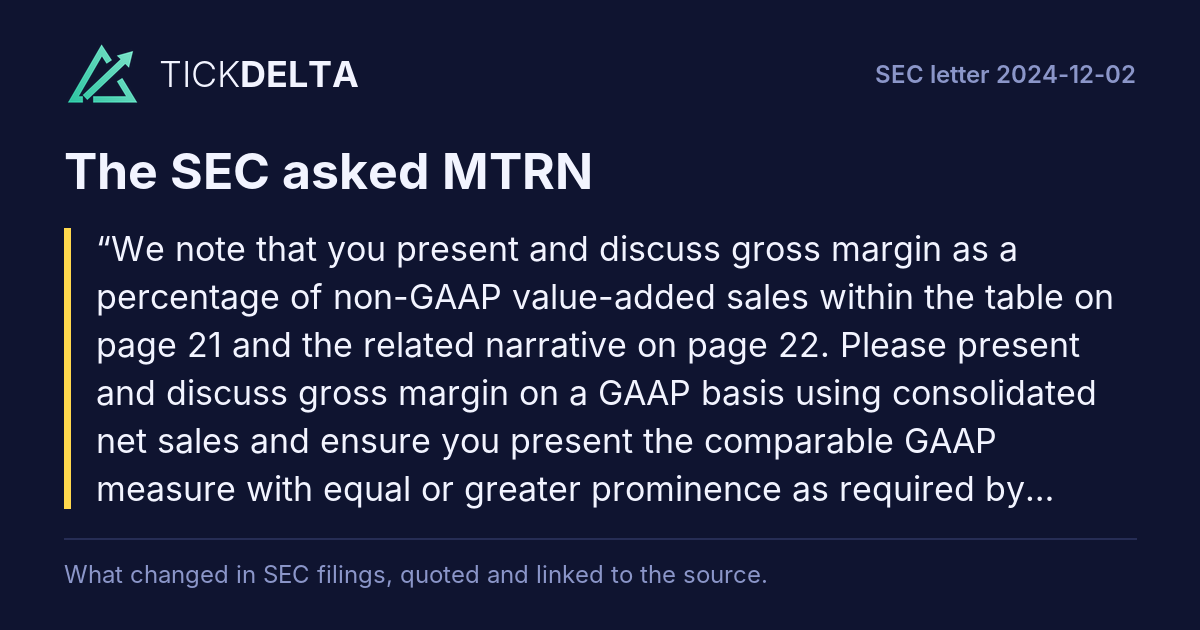
We note that you present and discuss gross margin as a percentage of non-GAAP value-added sales within the table on page 21 and the related narrative on page 22. Please present and discuss gross margin on a GAAP basis using consolidated net sales and ensure you present the comparable GAAP measure with equal or greater prominence as required by Item 10(e)(1)(i)(A) of Regulation S-K and Question 102.10(a) of the
Rest of the question

Non-GAAP Financial Measures Compliance and Disclosure Interpretations ("Non-GAAP C&DIs"). Please also apply the nature of this comment to your press releases furnished under Item 2.02 of Form 8-K, such as for the consolidated and segment measures presented within Attachments 5 and 7 of the Form 8-K furnished October 30, 2024.

MTRN answered
The Company uses the value-added sales, a Non-GAAP financial measure that removes the impact of pass-through metal costs and allows for analysis without the distortion of the movement or volatility in precious metal market prices and changes in mix due to customer-supplied material. Internally, we manage our business on this basis, and we provide a reconciliation of net sales, the most directly comparable GAAP financial measure, to value-added sales when we disclose value-added sales.
Rest of the answer

Gross margin as a percentage of net sales could vary significantly from period to period due to volatility in the precious metal markets, even though there would be little to no impact on the overall profitability of the business as our pricing policy is to directly pass the costs of the metals on to the customer in order to mitigate the impact of metal price volatility on our results of operations.

Although we believe gross margin as a percent of value-added sales is more reflective of our current period performance, the Company acknowledges the Staff’s comment and going forward, in future period reports filed with the Commission and future earnings releases furnished to the Commission, we will present and discuss gross margin as a percent of net sales prior to providing gross margin as a percentage of value added sales, similar to the following examples from the 10-K and press release, presented for illustrative purposes:

RESULTS OF OPERATIONS

(Thousands except per share data)

2022

2021

Net sales

$

1,665,187

1,757,109

1,510,644

Value-added sales

1,127,071

1,114,411

829,572

Gross margin

349,042

343,880

283,762

Gross margin as a % of Net sales

21 %

20 %

19 %

Gross margin as a % of Value-added sales

31 %

34 %

Attachment 5

Materion Corporation and Subsidiaries

Reconciliation of Net Sales to Value-added Sales, Net Income to EBITDA and Adjusted EBITDA

(Unaudited)

Third Quarter Ended

Nine Months Ended

(Millions)

Sep 27,

2024

% of

Net

Sales

VA

Sep 29,

Read in the reply
In its next report

First report after the company's reply of Dec 23, 2024: 10-K filed Feb 19, 2025 ↗, against the 10-K filed Feb 15, 2024 ↗.

Tickdelta does not hold the text of both reports, so they are not compared here.
Financial Position, page 26
SEC asked (2)
Please provide a more informative discussion and analysis of cash flows from operating activities, including changes in working capital components, for the periods presented. In doing so, explain the underlying reasons and implications of material changes between periods to provide investors with an understanding of trends and variability in cash flows.
Rest of the question

Also ensure that your disclosures are not merely a recitation of changes evident from the financial statements. Refer to Item 303(a) of Regulation S-K and SEC Release No. 33-8350.

MTRN answered
In future periodic reports, we will provide a more informative discussion and analysis of cash flows from operating activities, including changes in working capital components, for the periods presented, explaining the underlying reasons and implications of material changes between periods. By way of example, included below is the revised wording for the period ended December 31, 2023.

Net cash provided by operations increased by $28.5 million from 2022 to 2023.
Rest of the answer

In addition to the

$16.7 million increase in operating income, the increase in cash provided by operating activities was favorably impacted by the Company’s working capital initiatives implemented through 2023. Specifically, the Company continued to focus on streamlining customer payment terms, resulting in a $28 million favorable impact to operating cash flow when compared to the prior year. Although inventory increased during 2023 to support organic growth initiatives, the increase in inventory was less than the increase experienced in 2022, favorably impacting operating cash flow by approximately $45 million. These items were offset by lower unearned income for customer prepayments related to the agreements with a customer as discussed in Note K. The net activity of the prepayments and servicing the agreements by providing product and therefore reducing the unearned revenue was a net outflow of $0.1 million in 2023 compared to a net cash inflow of $17.8 million in 2022. Additionally, there was a $19 million increase in unbilled receivables in 2023 due to an increase in projects in the fourth quarter of 2023, which qualified for over time revenue recognition based on the contract terms. Lastly, the

Company paid $9.4 million more in interest expense in 2023 when compared to 2022.

Read in the reply
In its next report

First report after the company's reply of Dec 23, 2024: 10-K filed Feb 19, 2025 ↗, against the 10-K filed Feb 15, 2024 ↗.

Tickdelta does not hold the text of both reports, so they are not compared here.

Note B - Segment Reporting and Geographic Information, page 50
SEC asked (3)
Please address the following comments related to your segment disclosures: • As required by ASC 280-10-50-20, provide segment disclosures for each period for which an income statement is presented, unless explicitly exempted.
Rest of the question

• Pursuant to ASC 280-10-50-22 and 280-10-50-30(c), present total assets for each reportable segment and a reconciliation of such totals to consolidated assets or explain to us why the requirement is not applicable.

MTRN answered
The Company acknowledges the

Staff’s comment. In future periodic reports, the Company will provide the segment disclosures for each period in which a consolidated statement of income is included as required by ASC 280-10-50-20.

Pursuant to ASC 280-10-50-22 and 280-10-50-30(c), present total assets for each reportable segment and a reconciliation of such totals to consolidated assets or explain to us why the requirement is not applicable.

Response:

Segment assets are not regularly reviewed by the Company’s chief operating decision maker to make decisions regarding the allocation of
Rest of the answer

resources to our reportable segments and assess their performance. Accordingly, the Company did not disclose total assets by reportable segment in the

Form 10-K. The Company plans to include this reasoning as to our exclusion of reportable segment asset information in the Annual Report on Form 10-K for the year ending

December 31, 2024 in accordance with ASC 280-10-50-26.

Read in the reply
In its next report

First report after the company's reply of Dec 23, 2024: 10-K filed Feb 19, 2025 ↗, against the 10-K filed Feb 15, 2024 ↗.

Tickdelta does not hold the text of both reports, so they are not compared here.

Note B - Segment Reporting and Geographic Information, page 50
SEC asked (4)
We note your disclosure that one customer accounted for approximately 10% of your net sales for fiscal year 2023. Please revise future filings to disclose the identity of the segment(s) reporting the revenues from such customer pursuant to ASC 280-10-5042.
Rest of the question

Exhibit 99.1, page 9 We note that your non-GAAP measures include adjustments for "restructuring and cost reduction," "Electronic Materials inventory adjustment," "business transformation costs," and "additional start up resources and scrap." Please explain to us in sufficient detail the nature of all items included in each adjustment. Explain how you concluded each cost is not a normal, recurring, cash operating expense of your business and why 5. eliminating it within your non-GAAP financial measures is meaningful and appropriate. Refer to Question 100.01 of the Non-GAAP C&DIs. 6. We note you present and discuss adjusted EBITDA margin in a "Business Highlights" bullet before you present and discuss the most directly comparable GAAP measure. Please ensure you present the most directly comparable GAAP measure with equal or greater prominence as required by Item 10(e)(1)(i)(A) of Regulation S-K and Question 102.10 of the Non-GAAP C&DI's.

MTRN answered
In future periodic reports, when disclosing that one customer accounted for 10% or more of our net sales, we will disclose the identity of the segment reporting the revenue from such customer (the customer is in the Performance Materials segment).
Read in the reply
In its next report

First report after the company's reply of Dec 23, 2024: 10-K filed Feb 19, 2025 ↗, against the 10-K filed Feb 15, 2024 ↗.

Tickdelta does not hold the text of both reports, so they are not compared here.

Also in this review: closing letter, 2025-01-24
Form 10-K for the Year Ended December 31, 2021

2022-03-21 to 2022-05-20 · 9 questions · 2 letters from the SEC, 3 from the company
Review closed 2022-05-20
RevenueInventoryResults discussion (MD&A)Income taxesDerivatives and hedgingSegmentsPensionsAcquisitionsReserves and insuranceNon-GAAP measures
Results of Operations · Segment Disclosures, page 23
SEC asked (1)
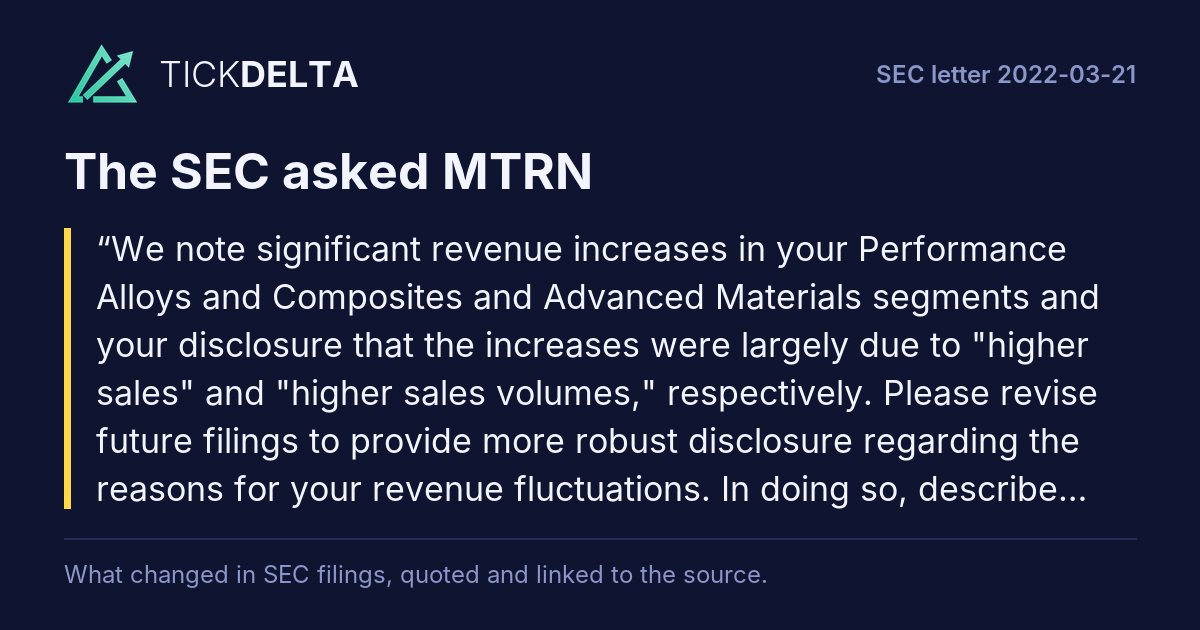
We note significant revenue increases in your Performance Alloys and Composites and Advanced Materials segments and your disclosure that the increases were largely due to "higher sales" and "higher sales volumes," respectively. Please revise future filings to provide more robust disclosure regarding the reasons for your revenue fluctuations.
Rest of the question

In doing so, describe and consider quantifying the extent to which such changes are attributable to changes in prices or to changes in the volume or amount of goods or services being sold or to the introduction of new products or services. In addition, describe and consider quantifying any other significant components of revenues that would be material to an understanding of your results of operations, such as revenues attributable to significant new customers. See Item 303(b)(2) of Regulation S-K and SEC Release No. 33-8350.

MTRN answered
In future filings, we will provide more robust disclosure regarding the reasons for our revenue fluctuations, including describing and, to the extent possible, quantifying the material reasons for such fluctuations, including the extent to which such fluctuations are attributable to changes in prices, changes in the volume or amount of identified goods being sold or to the introduction of new products.
Rest of the answer

Additionally, in future filings, we will describe and, to the extent possible, quantify any other significant components of revenues that would be material to an understanding of our results of operations, such as revenue attributable to significant new customers.

Read in the reply
In its next report

First report after the company's reply of Apr 7, 2022: 10-Q filed Apr 28, 2022 ↗, against the 10-Q filed Nov 2, 2021 ↗.

Tickdelta does not hold the text of both reports, so they are not compared here.

Note H - Income Taxes, page 56
SEC asked (2)
We note that you present two deferred tax asset balances totaling approximately $19 million related to "Revenue recognition" and "Interest expense carryforward" that are new for fiscal 2021. Please tell us what these line items represent and why the deferred tax assets were not applicable for the prior year.
MTRN answered
As of December 31, 2021, the Company recorded a deferred tax asset related to Revenue recognition and Interest expense carryforward of $5.027 million and $14.163 million, respectively.

The Company recorded a deferred tax asset of $5.027 million as of December 31, 2021 related to revenue recognition. As stated in Note L –

Customer Prepayments – of the Company’s consolidated financial statements in the Form 10-K, the Company entered into an investment agreement (the “Investment Agreement”) and a master supply agreement (the “Supply Agreement”) with a customer that has provided prepayments to
Rest of the answer

the Company. The deferred tax asset for revenue recognition reflects the fact that a portion of the customer prepayments were required to be recognized as income for tax purposes pursuant to Internal Revenue Code (“IRC”) Section 451(c) before such amounts could be recognized as income for financial statement purposes as of December 31, 2021, creating a deductible temporary difference. The Company did not have a deferred tax asset related to revenue recognition as of December 31, 2020.

The Company recorded a deferred tax asset of $14.163 million as of December 31, 2021 related to interest expense carryforward attributes. The Company completed the acquisition of HCS-Electronic Materials on November 1, 2021.

Please refer to Note B of the Company’s consolidated financial statements in the Form 10-K. The transaction was structured as an acquisition of 100% of the stock of the

HCS-Electronic Materials domestic entity and as a result, the Company received carryover tax basis in the assets of HCS-Electronic Materials. The deferred tax asset recorded for interest expense carryforward represents the total IRC Section 163(j) interest expense carryforward that the Company acquired as part of the HCS-Electronic Materials acquisition, less the portion utilized by the Company in 2021 subsequent to the acquisition. The Company, prior to the acquisition of HCS-Electronic Materials, did not have any IRC Section 163(j) interest carryforward attributes.

Read in the reply
In its next report

First report after the company's reply of Apr 7, 2022: 10-Q filed Apr 28, 2022 ↗, against the 10-Q filed Nov 2, 2021 ↗.

Tickdelta does not hold the text of both reports, so they are not compared here.

Notes to Consolidated Financial Statements · Note L - Customer Prepayments, page 60
SEC asked (3)
We note that you entered into an investment and master supply agreement with a customer that has provided prepayments to you to procure equipment and manufacture product for the customer. You further disclose that you have recorded the prepayments as unearned income, which "will be applied when the product is sold and delivered to the customer." Please tell us in sufficient detail how you account for these
Rest of the question

transactions, including the accounting literature you relied upon that supports the basis for your conclusions, such as ASC 606, ASC 340-40, ASC 360 and/or ASC 730. In doing so, tell us if and how you determined the pre-production activities represented a promised good or service or fulfillment activities and clarify the nature of items capitalized on your balance sheet and the nature of any items expensed as incurred. Quantify for us the impact of this arrangement on your historical financial statements, such as the amounts of property, plant, and equipment and capitalized contract costs recorded on your balance sheet and the related revenues recognized.

MTRN answered
In accordance with the Investment Agreement with the customer, Materion has received $72.6 million from the customer as a prepayment to fund the necessary infrastructure and procure the equipment necessary to supply the customer with desired product. The Investment Agreement also stipulates that any equipment procured with these funds are owned (legal title retained) by Materion and the equipment will remain with Materion after the expiry of the Investment Agreement.

The Supply Agreement relates to the commercial supply of product

Materion manufactures utilizing these assets.
Rest of the answer

No transactions had been recorded under the Supply Agreement as no commercial products utilizing these assets had been ordered or produced as of December 31, 2021.

Materion considered guidance within ASC 606 to evaluate if the preproduction activities represent a promised good or service and constitute a separate performance obligation. We also considered ASC 340-40 and ASC 360 as they relate to recording the value of the equipment and the cash payments received prior to production of the products.

The Investment Agreement and the Supply Agreement require Materion to both install equipment to establish the necessary infrastructure and to ship commercial product to authorized buyers. The establishment of the infrastructure and procurement of the equipment is concluded to be a preproduction activity that is not a promised good or service to the customer but is considered a fulfillment activity because control of the facility and equipment does not transfer to the customer (ASC 606-10-25-17, TRG 46 Paragraph 8 & 9 at the meeting on November 9, 2015). For costs incurred in fulfilling a contract with a customer that are within the scope of another Topic, an entity shall account for those costs in accordance with those other Topics (340-40-25-6). We considered such guidance and concluded the costs for infrastructure and equipment fall within the scope of ASC 360,

PPE and relate to the direct future benefit of the equipment’s production capabilities. As of December 31, 2021, the value of the assets procured are recorded within the Property, Plant and Equipment, net within the balance sheet line items. The assets were not in service as of December 31, 2021 and as such, the Company has not recorded depreciation expense for the related assets.

Revenue will be recognized when the Company receives and fulfills purchase orders, including shipment of the commercial product to the customer as the product delivery is considered the fulfillment of the performance obligation. There have been no purchase orders received from the customer for the commercial product out of these assets as of

December 31, 2021. Therefore, the Company has not recognized any revenue on the $72.6 million prepayment as of December 31, 2021.

Materion accounts for the customer prepayment as unearned income and these assets were not placed in service or used in production as of December 31, 2021. The prepayment will remain in long term unearned income until the assets are placed into service and purchase orders are received. Once the assets are placed in service and purchase orders are received, the value of orders received will be re-classified as short-term unearned revenue on the balance sheet until the performance obligation is satisfied upon shipment, at which time revenue will be recognized on a per unit basis over the life of the Supply Agreement.

Below is how both the prepayments and capital purchases have been presented on our financial statements since the inception of the project:

Historic Financial Statements

(in Thousands)

DR/(CR)

2019

2020

2021

PP&E*

$ 2,604

$ 39,744

$ 90,786

Unearned Income^

(4,733)

(58,836)

(72,588)

Revenue

$ -

*

PP&E represents the aggregate cost of assets purchased as part of pre-production activities

^

Unearned Income represents the aggregate value of customer prepayments received as no revenue had been recorded as of December 31, 2021

Pre-production activities have also included costs that would not be capitalized as PP&E under ASC 360. These activities are primarily start-up actions for assets that are for commercial production scale and not related to (1) pilot plants and/or (2) facilities or equipment whose sole use is for a particular research and development project and therefore are not considered research and development expense under ASC 730. These costs have been expensed to the income statement in the period in which incurred.

Read in the reply
In its next report

First report after the company's reply of Apr 7, 2022: 10-Q filed Apr 28, 2022 ↗, against the 10-Q filed Nov 2, 2021 ↗.

Tickdelta does not hold the text of both reports, so they are not compared here.

Note P - Pensions and Other Post-Employment Benefits, page 65
SEC asked (4)
We note that the weighted-average discount rate used to determine the pension benefit obligation at fiscal year-end is significantly different from the discount rate used to determine net pension cost for the subsequent fiscal year. For example, the 2.14% discount rate used at fiscal year-end 2020 is significantly less than the 4.69% discount rate used to determine net pension cost for fiscal 2021.
Rest of the question

Please tell us how your accounting treatment complies with ASC 715-30-35-68.

MTRN answered
The Company’s accounting treatment complies with ASC

715-30-35-68 by applying the fiscal year end discount rate for the pension benefit obligation to the following year’s net pension (benefit) cost determination, measuring net pension (benefit) costs on the assumptions used for the previous year-end measurement. For example, the December 31, 2020 pension benefit obligation discount rate for the plans is used to calculate the 2021 net pension (benefit) cost.
Rest of the answer

As the Company maintains several pension plans, the discount rates have been disclosed on a weighted average basis for both the benefit obligation and the net pension (benefit) cost. The weighted average calculation of the net pension (benefit) cost discount rate is impacted by the domestic plan benefit while the other plans incurred net pension costs.

In order to more clearly demonstrate that the Company is utilizing the prior year discount rates for net pension (benefit) costs in future filings, the

Company will disclose a range of the discount rates utilized across the different plans for both the pension benefit obligation and the net pension (benefit) cost for the fiscal year, instead of a weighted average. For example, the proposed disclosure based on the December 31, 2021 and 2020 information would be as follows:

Read in the reply
In its next report

First report after the company's reply of Apr 7, 2022: 10-Q filed Apr 28, 2022 ↗, against the 10-Q filed Nov 2, 2021 ↗.

Tickdelta does not hold the text of both reports, so they are not compared here.

Note S - Fair Value Information and Derivative Financial Instruments, page 73
SEC asked (5)
We note your disclosure on page 75 that you maintain the majority of your precious metal production requirements on consignment until the product is fabricated and ready for shipment to the customer. Please tell us in sufficient detail how you determined that the consigned precious metal should not be recognized as inventory on your balance sheet.
Rest of the question

In doing so, describe to us the key terms of the agreements and how the consigned precious metals are managed, including whether they must be segregated or can be commingled with your owned inventory and whether the related financial institutions may terminate the arrangements and demand the physical return of the consigned precious metals. If terms of the arrangements vary based on the state of the consigned precious metals within the production process, such as within work in progress or finished goods, please advise.

MTRN answered
The Company is party to various consignment agreements with precious metals consignors (each, a “PM Consignor”) that allow the Company and certain of its subsidiaries to obtain precious metals on a consignment basis to be used in the production of products for our customers. Pursuant to each consignment agreement, title to the consigned precious metal remains with the PM Consignor unless and until it is purchased, and includes the following provision (subject only to minor variations among the consignment agreements to reflect the usage of defined terms, etc.)

“Title to Consigned Metal shall
Rest of the answer

remain in the [PM Consignor] until such Consigned Metal is purchased and withdrawn from consignment by [the Company or one of its subsidiaries], and Consigned Metal shall for the purposes of this Agreement be deemed to be outstanding on Consignment until paid for in full, whereupon title to such purchased Consigned Metal shall pass to [the Company or the subsidiary] to whom such Consigned Metal was consigned.”

See, e.g., Exhibit 10.1 to the

Company’s Current Report on Form 8-K filed on August 29, 2019.

The PM Consignors maintain control over our storage and use of the consigned precious metal throughout the entire consignment process. Under the consignment agreements, we are required to keep the consigned precious metal only at locations that have been approved by the PM Consignors.

While at those locations, we are required to hold or use the consigned precious metal only in a secure storage facility, in our work-in-process, or for related refining and fabricating. Terms of our consignment arrangements do not vary based on the state of the metal in the production process.

While we are permitted to commingle consigned precious metal to accommodate our ordinary production processes, we are required to furnish the PM Consignors with regular reports regarding the amounts, types and locations of consigned precious metal. The Company maintains a separate ledger within our ERP system that allows us to track all consigned precious metal in our system to generate these reports. We also conduct our own physical inventories of consigned precious metal on a quarterly basis and reconcile any discrepancies between our physical counts and our reported amounts with the PM Consignors. In addition, each PM Consignor is entitled to audit our books and records with respect to the amount, type and location of consigned precious metal, and to perform physical inspections of each location where consigned precious metal is stored or used.

In accordance with the terms of the applicable consignment agreement, the Company is deemed to have purchased consigned precious metal at the same time we sell and deliver a product containing that metal to one of our customers. The Company then pays the PM Consignor for the purchased precious metal in accordance with the payment terms of the applicable consignment agreement.

Most of our consignment agreements have definitive maturity dates.

Upon any expiration of a consignment agreement, we are required to purchase all of the precious metal then on consignment under the facility or return that precious metal (or precious metal of the same type and fineness) to the PM Consignor, or any combination thereof. It is our practice, however, to extend each consignment agreement prior to its maturity date. If any consigned precious metal is in our production process when the corresponding consignment agreement expires (and was not extended), we would still be required to purchase it directly from the PM Consignor, return that precious metal (or precious metal of the same type and fineness), or refine/re-melt the work-in-process to extract and return the consigned precious metal.

Based on the forgoing, the Company does not recognize the consigned precious metal as inventory on its balance sheet.

Read in the reply
In its next report

First report after the company's reply of Apr 7, 2022: 10-Q filed Apr 28, 2022 ↗, against the 10-Q filed Nov 2, 2021 ↗.

Tickdelta does not hold the text of both reports, so they are not compared here.

Schedule II - Valuation and Qualifying Accounts, page 88
SEC asked (6)
Please address the following comments related to your schedule of valuation and qualifying accounts: • In footnote 6 of the table, you disclose allowance additions due to "acquired reserves." Please tell us how these allowance adjustments comply with ASC 805-2030-4. • Confirm whether or not the activity in your inventory reserve is presented on a gross basis.
Rest of the question

If not, present the activity on a gross basis in future filings. If already on a gross basis, clarify why the activity in the account is significantly less than the beginning balance. For example, explain why the beginning balance has not largely been cycled out via inventory sales and write-offs.

MTRN answered
The Schedule II addition for the

“acquired reserve” deferred tax valuation allowance is specific to a valuation allowance acquired in the recent 2021 HCS-Electronic Materials acquisition related to an acquired capital loss carryforward, which complies with the ASC 805 rules regarding acquired valuation allowances.

The Company notes that acquired Accounts Receivables and

Inventory are recorded at fair value on the consolidated balance sheet in accordance with ASC 805.
Rest of the answer

For our internal records, the Company records acquired Accounts Receivable and Inventory balances on a gross basis within our ledgers so the Company has knowledge of the historical records to track the gross inventory balance to maintain existence controls and to locate for potential future usage, which can be years in the future. Schedule II reflects these reserves on a gross basis based on the Company’s tracking of inventory for internal purposes. In future filings, the Company will not include the information relating to the acquired reserves in its Schedule II – Valuation and Qualifying accounts.

Confirm whether or not the activity in your inventory reserve is presented on a gross basis. If not, present the activity on a gross basis in future filings. If already on a gross basis, clarify why the activity in the account is significantly less than the beginning balance. For example, explain why the beginning balance has not largely been cycled out via inventory sales and write-offs.

Response:

The Company confirms that the activity in our inventory reserve is presented on a gross basis. The activity in the inventory reserve account is less than the beginning balance due the nature of the Company’s inventory. A portion of the Company’s inventory is comprised of specifically designed applications and products which are not perishable nor obsolete technologies, but there is no current demand. The value of these slow-moving inventory items are reserved. To serve our customers who sometimes have demand years in the future for these items, the Company does not dispose of or write-off the balances on these types of inventory items so the assets can be maintained and tracked, which results in a higher beginning reserve balance when compared to the activity. As a result, the annual activity in the reserve account is typically less than the reserve balance in any given period.

In connection with researching and investigating the

Staff’s comment, we reviewed Rule 12-09 of Regulation S-X, SAB Topic 5.BB, and ASC 330-10-35-14 and noted that the amounts recorded in separate accounts for the acquired reserves (comment 6, first bullet point) and recognition of slow-moving inventory are not considered reserves for the purpose of this schedule because those amounts in substance represent normal adjustments / impairment of inventory rather than true “reserves”. In future filings, the Company will not include the information relating to the acquired reserves and reserve for slow-moving information in its Schedule II – Valuation and Qualifying accounts.

Read in the reply
In its next report

First report after the company's reply of Apr 7, 2022: 10-Q filed Apr 28, 2022 ↗, against the 10-Q filed Nov 2, 2021 ↗.

Tickdelta does not hold the text of both reports, so they are not compared here.

Exhibit 99.1, page 8
SEC asked (7)
We note that you present several non-GAAP measures in your earnings release, such as non-GAAP operating profit, net income, diluted EPS, and EBIT. Please address the following comments related to your non-GAAP disclosures: • For each each non-GAAP measure presented, ensure that you provide a separate GAAP reconciliation that begins with the GAAP measure and ends with the non- GAAP measure.
Rest of the question

Ensure you reconcile EBIT and adjusted operating profit to net income. Refer to Question 103.02 of the SEC Staff’s Compliance and Disclosure Interpretations on Non-GAAP Financial Measures. • Although you present net income under the heading "Non-GAAP Measures - Adjusted Profitability," there is no reconciliation of a non-GAAP net income measure. Accordingly, revise future filings to include a reconciliation of adjusted net income to net income in accordance with Item 10(e)(1)(i)(B) of Regulation S-K and Item 100(a)(2) of Regulation G. If applicable, clearly disclose the nature of the items included in the "non-operating (income) expense" adjustment. • Ensure that you clearly identify and appropriately title each non-GAAP measure. As an example, to the extent you include a "Non GAAP Measures - Adjusted Profitability" section in future filings, ensure that you clearly label the "EPS - Diluted" line item as "Adjusted diluted EPS" or a similar title.

MTRN answered
In future disclosures, for each non-GAAP measure that we present, we will provide a separate GAAP reconciliation that begins with the GAAP measure and ends with the non- GAAP measure, and will ensure that we reconcile EBIT and adjusted operating profit to net income.

In future disclosures, as noted above, we will provide a separate GAAP reconciliation of non-GAAP net income that begins with GAAP net income and ends with non-GAAP net income.
Rest of the answer

While Attachment 5 in the Form 8-K provided GAAP net income and special items, net of tax and tax special items to calculate non-GAAP net income, going forward, we will clearly show the reconciliation from GAAP net income to non-GAAP net income.

In future disclosures, we will clearly identify and appropriately title each non-GAAP measure. For example, to the extent we include a “Non GAAP Measures—Adjusted Profitability” section in future disclosures, we will clearly label the “EPS - Diluted” line item as “Adjusted diluted EPS” or a similar title.

Read in the reply
In its next report

First report after the company's reply of Apr 7, 2022: 10-Q filed Apr 28, 2022 ↗, against the 10-Q filed Nov 2, 2021 ↗.

Tickdelta does not hold the text of both reports, so they are not compared here.

Notes to Consolidated Financial Statements · Note H - Incomes Taxes, page 56
SEC asked (1)
We note your response to comment 2. Since your investment and master supply agreements appeared to exist in fiscal 2020 and it appears the customer provided prepayments in fiscal 2020, please clarify for us why there was not an associated deferred tax asset related to these agreements in the prior year.
MTRN answered
The Company historically has followed a tax method that allows for the deferral of income recognition under Section 451(c) of the Internal Revenue Code for a period of one year after cash receipts. In 2021, as part of the return-to-provision analysis completed prior to filing the Company’s tax return for 2020, the

Company determined that a deferred tax asset of approximately $1.1 million should have been recognized as of December 31, 2020 in the consolidated balance sheet related to prepayments received as of December 31, 2019.
Rest of the answer

An offsetting adjustment to increase current taxes payable within the balance sheet was also identified as part of this analysis. There was no impact on the Company’s consolidated income statement, income tax provision/expense, or consolidated statement of cash flows for 2020. When the $1.1 million deferred tax asset was identified in 2021, the Company evaluated the impact of the uncorrected adjustment and determined that the effect of the adjustment on the balance sheet was immaterial on both a quantitative and qualitative basis to the 2020 financial statements and the footnotes thereto. As a result, the Company did not record a correcting entry to the 2020 financial statements.

The Company’s current taxes payable and deferred tax asset balances in the December 31, 2021 balance sheet properly reflect all prepayments received as of December 31, 2020.

Read in the reply
In its next report

First report after the company's reply of May 10, 2022: 10-Q filed Aug 3, 2022 ↗, against the 10-Q filed Nov 2, 2021 ↗.

Tickdelta does not hold the text of both reports, so they are not compared here.

Note S - Fair Value Information and Derivative Financial Instruments, page 73
SEC asked (2)
We note your response to comment 5. Please tell us whether the precious metal consignors have the ability to unilaterally demand return of consigned inventory or terminate the consignment arrangements. In doing so, tell us the historical frequency of such returns and terminations and summarize the related contractual terms.
Rest of the question

For example, explain if you have the option to either return the precious metals or deliver cash and, if so, specify how cash payments are derived. Also explain if you have the practical ability to return the consigned precious metals, particularly those that would need to be extracted from work-in-process or finished goods inventory. A summary of your manufacturing and product sale life cycle for consigned inventory would be helpful for our understanding of these arrangements. For example, tell us the standard timeframe necessary to convert consigned raw materials into work-in-process and finished goods and the percentage range of consigned inventory held as raw material versus work-in-process and finished goods during the historical periods presented.

MTRN answered
As noted in our response to comment 5 of the

Comment Letter, we have consignment agreements with multiple precious metal consignors (each, a “PM Consignor”). Those agreements can be separated into the three different categories described below. For all three categories, the PM

Consignors maintain control over our storage and use of the consigned precious metal throughout the entire consignment process. Under the consignment agreements, we are required to keep the consigned precious metal only at locations that have been approved by the PM Consignors.
Rest of the answer

While at those locations, we are required to hold or use the consigned precious metal only in a secure storage facility, in our work-in-process (“WIP”), or for related refining and fabricating. The three categories of consignment agreements are as follows and each category covers approximately one third of the consigned precious metal in our possession at any point in time:

•

Uncommitted – These agreements can be unilaterally terminated by the PM Consignor with the right to demand the return of all consigned precious metal with 30 days’ notice. Although these facilities are in place, consignment fees must be negotiated each time we take possession of consigned precious metal.

Partially Committed –These agreements have definitive maturity dates; however, the agreements do not have definitive consignment fees and, consequently, the applicable PM Consignor can unilaterally prevent additional consignments through pricing increases. In that event, it may not be feasible for us to obtain additional consigned precious metals and we may also choose to return consigned precious metals. The PM Consignors do not, however, have the contractual right to unilaterally demand the return of their consigned precious metal or terminate the agreement.

Committed – This agreement is in place until a defined termination date. Consignment fees are agreed to as part of the negotiation process and carry throughout the life of the contract. Upon maturity, however, the Company is required to return or purchase any precious metal then on consignment. The PM Consignor does not have the contractual right to unilaterally demand the return of the consigned precious metal or terminate the agreement. The specific contract language can be referenced in our Current Report on Form 8-K filed on August 29, 2019

(Exhibit 10.1).

Regardless of how we categorize our consignment agreements, each consignment agreement expressly confirms the intent of the parties to “create a true consignment from the [PM Consignor] to the [Company and its subsidiaries] and for title to remain with the [PM Consignor].” Further, the provisions of the consignment agreements – retention of title, storage and use restrictions, physical tracking and reporting, audit and inspection rights and events of default, among others – reflect the PM Consignors’ continued control over the consigned precious metal even while it is in our possession. Under the consignment agreements, we are required to keep the consigned precious metal only at locations that have been approved by the PM Consignors. While at those locations, we are required to hold or use the consigned precious metal only in a secure storage facility, in our WIP, or for related refining and fabricating. Terms of our consignment arrangements do not vary based on the state of the precious metal in the production process.

Our outstanding consignment balance changes daily as we (a) return precious metal not required for production and (b) purchase precious metal that has been incorporated into products we have manufactured and delivered to our customers. We manage consignment precious metal closely, keeping only what is needed and returning excess precious metal to the PM Consignor on a regular basis, often occurring multiple times a month.

Because we have our own precious metal refinery, we are able to convert precious metal in any state of the manufacturing process (including WIP and finished goods) into an acceptable precious metal purity that the PM Consignors will accept if return is required. Additionally, we have refining partners who will refine precious metal in any state of the manufacturing process (including WIP and finished goods) for us and those same partners will transfer the precious metal back to the applicable PM Consignor upon the completion of the refining process, effectively returning consigned precious metal to the PM Consignor and reducing our outstanding precious metal consignment balance.

While the refining process is part of our normal course of operations, the duration and cost of the refining process can vary depending on the purity of the precious metal and whether we can easily refine it in our own refinery, or it is more efficient and cost effective to refine at a third-party refiner.

In general, the cost of refining is immaterial compared to the value of the consigned precious metal. Once the precious metal is refined, we determine whether we need to keep the precious metal to satisfy internal demand or we can return it to the

PM Consignor. The amount of returned precious metal from our internal and external refinery practices varies depending on demand, but at a minimum we are returning some refined precious metal to a PM Consignor at least monthly.

Each consignment agreement entitles the PM Consignor to demand the immediate purchase or return of precious metal during an event of default. Events of default are not limited to payment defaults, and include failures with respect to our storage and use of consigned precious metals, failures to properly secure consigned precious metals, loss or theft of consigned precious metals, inaccuracies in our consigned precious metal reports, and discrepancies in our physical precious metal counts, as well as other customary events such as breaches of representations and warranties, insolvency events, adverse judgements and cross-defaults with other material agreements. The PM Consignors periodically perform onsite audits and inspections to ensure that we are adhering to the terms of our agreements. We have never had a PM consignor terminate an agreement due to default; however, we return precious metal to the PM Consignor(s) frequently in the normal course of business based on operational needs, availability limits or due to not extending the maturity of the agreement(s).

In connection with an event of default or if one of our committed or partially committed consignment facilities matures (without extension) or one of our uncommitted facilities is terminated, we are required to (a) return the precious metal then on consignment or (b) purchase that precious metal. In either case, the return or payment is typically due within two business days. If we choose to purchase the precious metal, the purchase price is equal to (i) the value of the precious metal at that time by reference to the spot price on the relevant metal exchange (e.g., London Bullion Market Association or London Metal Exchange) or as quoted by the relevant PM Consignor, plus (ii) any applicable premium based on the purity of the precious metal. If we choose to return the precious metal, we can return the actual precious metal we have on hand or deliver to the PM

Consignor a quantity of the same type and purity of precious metal then on consignment.

Precious metal obtained from the PM Consignors is stored in secure locations within our facilities until it is issued into production. Once the precious metal is issued into production it generally moves completely through the manufacturing process within one week (on average). We maintain approximately half of our consigned precious metal in a raw material form and half in WIP and finished goods. Finished goods containing consigned precious metal are sent to a customer typically within one day of finalizing the product. Once we complete production and deliver a product to our customer, we purchase from the PM Consignor, any consigned precious metal that has been incorporated into that product. Under each of the consignment agreements, title to the consigned precious metal transfers from the PM

Consignor to our customer concurrently with our payment to the PM Consignor.

Read in the reply
In its next report

First report after the company's reply of May 10, 2022: 10-Q filed Aug 3, 2022 ↗, against the 10-Q filed Nov 2, 2021 ↗.

Tickdelta does not hold the text of both reports, so they are not compared here.

Also in this review: company letter, Mar 30, 2022, closing letter, 2022-05-20

From the SEC's correspondence on EDGAR: staff letters (form UPLOAD) and company letters (form CORRESP), 9 letters filed since 2022-03-21. Questions and answers are matched by their numbers; topics come from words in each question. The reports are compared word for word (same form, before the first SEC letter against the first report after the company's reply). No AI.

Sources

The SEC's correspondence on EDGAR: staff letters (form UPLOAD) and company letters (form CORRESP), matched question by question. No AI.

Also

Filings: the letters in the filing list.

Work with it

Excel workbook · CSV. Google Sheet that stays up to date: paste =IMPORTDATA("https://tickdelta.com/company/MTRN/export.csv") into a cell.

Next in Owners and insiders:Insider trades
Esc

Type a ticker such as AAPL, a name, an investor such as Buffett, or a topic such as tariffs. ↑ ↓ to move, Enter to open.