MATERION Corp MTRN
Paragraphs with nothing like them in last year's 10-K
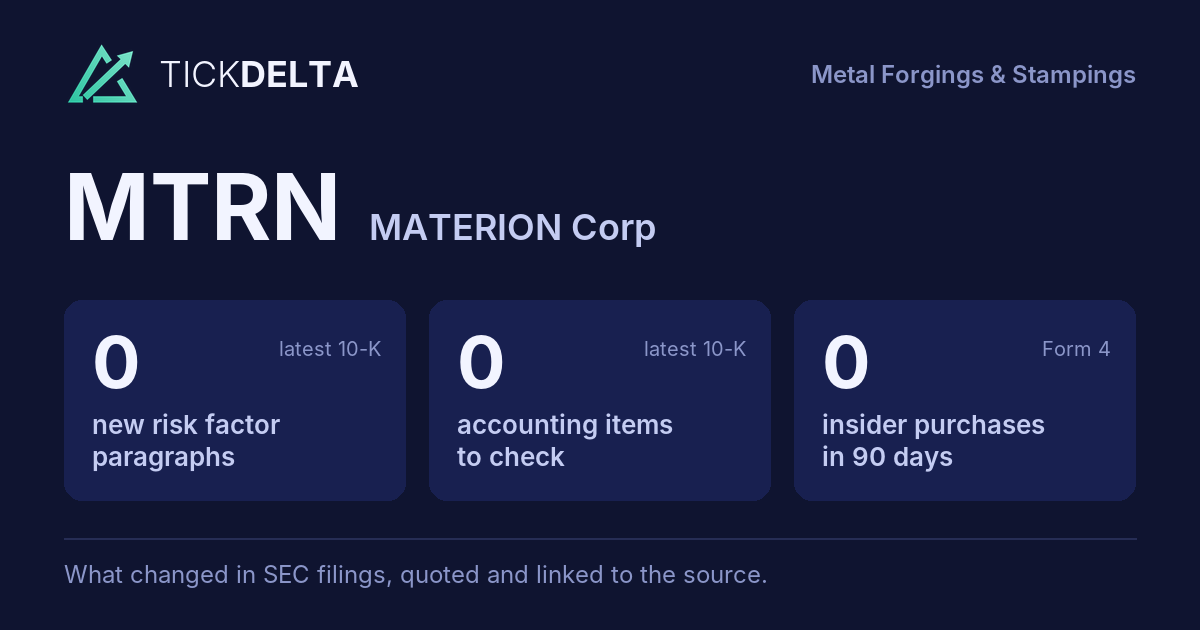
No new paragraphs in Risk Factors.
Paragraphs in the 10-Q filed Nov 4, 2026 that were not in the one before
New in the latest 10-Q
3 paragraphs in the 10-Q filed Nov 4, 2026 with nothing like them in the 10-Q filed Aug 5, 2026 (at least half the words must differ; new numbers alone do not count). Quoted exactly, grouped by the item heading above them. This is text that changed, not a judgement of how serious it is.
Financial statements and notes
Proceeds from (repayments of) borrowings under credit facilities, net (57,429) 30,574
Read in the 10-Q
The primary measures used by management to allocate resources and measure the financial performance of each segment are earnings before interest and taxes (EBIT) and earnings before interest, taxes, depreciation and amortization (EBITDA). Segment EBIT is the measure of segment profit or loss that is most consistent with the measurement principles used in measuring the corresponding amounts in the Company's consolidated financial statements. The CODM evaluates segment EBIT in assessing the profitability and operating performance of each reportable segment and uses segment EBITDA to evaluate operating performance excluding the effects of depreciation and amortization and to compare performance among periods. The Company believes the use of EBITDA assists in understanding the ongoing operating performance by presenting comparable financial results between periods and believes that by removing the impact of depreciation and amortization and amounts spent on interest and taxes that may vary from year to year, EBITDA provides a performance measure that reflects the impact to operations from trends in changes in net sales, gross margin and operating expenses,
Read in the 10-Q
providing a perspective not immediately apparent from net income (loss) and operating income (loss). The adjustments the Company makes to derive the financial measure of EBITDA excludes items which may cause short-term fluctuations in net income (loss) and operating income (loss) and which the Company does not consider to be the fundamental attributes or primary drivers of its business. EBITDA provides disclosure on the same basis as that used by the CODM to evaluate financial performance on a reportable segment basis.
Read in the 10-Q
The 10-Q's risk factors against the 10-K
Item 1A of the 10-Q filed Nov 4, 2026 against Item 1A of the 10-K filed Feb 12, 2026.
A 10-Q repeats only the risks that changed, so a 10-K paragraph that is missing from it is not counted as removed.
Added is a paragraph with nothing like it in the 10-K, Reworded a sentence that is in both with several words changed,
Quiet changes a sentence in both where one to four words changed and one is a hedge or a modal
(cut words struck through, new words highlighted).
Text on the page, not a score; each links to the filing at sec.gov.
This 10-Q has no Item 1A (Risk Factors) text of its own, so there is nothing to compare. Many companies leave it out when their risks have not changed.
Phrases used for the first time
Two-word phrases in Risk Factors of the 10-K filed Feb 12, 2026 that are in none of the 1 earlier 10-Ks stored, back to Feb 19, 2025
Where each one is used
- government shutdowns: A substantial number of our customers are in the semiconductor, industrial, aerospace and defense, automotive, energy, consumer electronics, and life sciences end markets. Each of these end markets is cyclical in nature, influenced by a combination of factors which could have a negative impact on our business,...
Used at least twice, small words left out. Counted, not picked: a phrase can be new because the company renamed something.
Sources
Item 1A of each 10-K and 10-Q on EDGAR, quoted exactly. Each paragraph links to the filing at sec.gov.
Also
10-K change: what was reworded or cut, section by section.
Work with it
Excel workbook · CSV. Google Sheet that stays up to date: paste =IMPORTDATA("https://tickdelta.com/company/MTRN/export.csv") into a cell.