Screener / SEC EDGAR /CIK 0000015615 /10-K filed Feb 26, 2026, compared with Feb 28, 2025 /Numbers from the XBRL of the 10-Ks
NYSE Industrials · Water, Sewer, Pipeline, Comm & Power Line Construction

Mastec Inc MTZ

Compare with peers Embed
SEC comment letters, last 20 years

2 reviews of MTZ's filings by SEC staff

UPLOAD and CORRESP
Reviews 2 latest letter Apr 28, 2017
Questions asked 20 each answered in the company's own letter
No closing letter 0 reviews without a letter saying the staff completed it

When the SEC's staff reviews a filing, it writes to the company with numbered questions, and the company answers each one in a letter. SEC publishes the exchange once the review is over, at least 20 business days later. A question is not an accusation; most reviews end with the company adding detail to its next filing.

How the reviews went

Every review on EDGAR, from the first staff letter to the letter that closes it

  1. 1. Staff letters 3 UPLOAD
  2. 2. Questions in them 20 numbered comments
  3. 3. Company replies 4 CORRESP
  4. 4. Reviews closed 2 of 2 closing letter

Half the closed reviews took 98 days or less from the first letter to the closing letter.

Form 10-K for the Year Ended December 31, 2016

2017-04-28 to 2017-05-31 · 4 questions · 1 letter from the SEC, 1 from the company
Review closed 2017-05-31
Non-GAAP measuresResults discussion (MD&A)AcquisitionsLiquidity and cashDebtRevenue
Form 10-K for the Fiscal Year Ended December 31, 2016 · Management’s Discussion and Analysis of Financial Condition and Results of Operations
SEC asked (1)
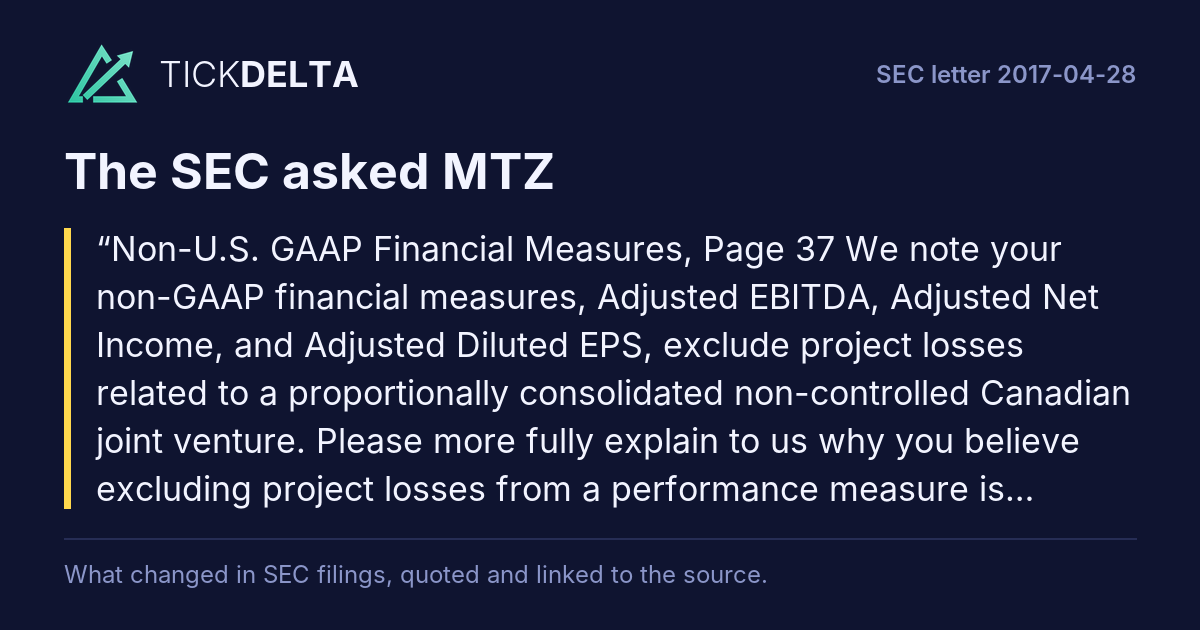
Non-U.S. GAAP Financial Measures, Page 37 We note your non-GAAP financial measures, Adjusted EBITDA, Adjusted Net Income, and Adjusted Diluted EPS, exclude project losses related to a proportionally consolidated non-controlled Canadian joint venture.
Rest of the question

Please more fully explain to us why you believe excluding project losses from a performance measure is useful to investors, including how it complies with Item 10(e) of Regulation S-K and Question 100.01 of the updated Non-GAAP Financial Measures Compliance and Disclosure Interpretations issued on May 17, 2016. We note your disclosure that you have “minimal direct construction involvement” related to this joint venture; however, we note this joint venture appears to be in a similar line of business and we assume it may have other projects for which you are not making any adjustment. Please be advised this comment is also applicable to your presentation of these non-GAAP financial measures in earnings releases filed under Form 8-K.

MTZ answered
MasTec has not excluded any project results, whether income or losses, from its non-GAAP financial measures as they represent ordinary course activity. Due to the factors detailed below, in the case of the “proportionally consolidated non-controlled Canadian joint venture,” we believe that results for this specific project are appropriately excluded from our non-GAAP financial measures and are in compliance with Item 10(e) of Regulation S-K and Question 100.01 of the updated Non-GAAP Financial Measures Compliance and Disclosure Interpretations issued on May 17, 2016.

The proportionately
Rest of the answer

consolidated non-controlled Canadian joint venture referred to in the non-GAAP Financial Measures discussion on page 37 of the 10-K is the Acciona-Pacer Joint Venture (“APJV”). APJV is a contractual joint venture that was entered into by Pacer Construction Holdings Corporation (“Pacer”) prior to Pacer’s 2014 acquisition by MasTec. Pacer owns a minority interest of 35% of APJV and APJV automatically terminates upon the completion and settlement of the project. APJV’s sole activity is execution of a single project, as general contractor, consisting of the erection of a bridge in Alberta,

Canada. APJV executes no other projects. APJV is managed by the 65% partner and neither Pacer nor any other MasTec entity has performed any significant construction work since MasTec acquired its indirect minority interest via the Pacer acquisition.

None of MasTec’s operations have previously engaged, or currently engage in, construction activity of the type undertaken by APJV, and MasTec has no current plans to engage in this type of construction activity in the future. Relative to

Pacer’s pre-acquisition principal activities, which focused on the Canadian oil sands industry, APJV was idiosyncratic. Accordingly, APJV is not representative of our active construction service offerings or performance capabilities, and as a result, has been included in the “Other” segment since 2014.

Various information about APJV is disclosed throughout the 10-K;

however, to better explain our rationale for excluding the APJV results from our non-GAAP financial measures, we have modified the Non-U.S. GAAP Financial Measures discussion in our Form 10-Q for the Quarterly Period Ended March 31, 2017, filed on May 4, 2017 (the “2017 10-Q”), as follows:

“The “adjusted” non-U.S. GAAP measures exclude, as applicable to the particular periods…project results, which for the periods presented, were losses, from a proportionately consolidated non-controlled Canadian joint venture that was underway when we acquired Pacer in 2014, and whose sole activity involves the construction of a bridge, a business in which we do not otherwise engage, is managed by a third party, and for which we have minimal direct construction involvement and automatically terminates upon completion of the project…”

Please note that APJV results on its single project have been losses since the 2014 acquisition of Pacer.

Accordingly, all non-GAAP adjustments related to this project through the filing date of our 10-K have been referred to as “project losses.” APJV is, however, actively pursuing several potential recovery options and the project may have income in the future if any of these recovery options prove to be successful. If project income were to materialize on future APJV activity, they will also be portrayed as exclusions from our non-GAAP financial measures at that time, fully consistent with the treatment to date of the APJV losses. We believe we clarified this point by referring to “project results” instead of “project losses” in the 2017 10-Q. While we do not believe that APJV is indicative of our operating activities, we also note that we have not characterized the losses as unusual, infrequent or non-recurring. Moreover, the APJV adjustment is conspicuously reconciled as a separate line item in our non-GAAP financial measures.

Accordingly, in light of the foregoing, we believe that this adjustment is not misleading, provides a meaningful comparison of our core operating results, and that the exclusion of the results of APJV from our non-GAAP financial measures complies with the provisions of Item 10(e) of Regulation S-K and Question 100.01 of the updated Non-GAAP Financial Measures Compliance and

Disclosure Interpretations issued on May 17, 2016.

Read in the reply
In its next report

First report after the company's reply of May 25, 2017: 10-Q filed Aug 3, 2017 ↗, against the 10-Q filed Nov 3, 2016 ↗.

Tickdelta does not hold the text of both reports, so they are not compared here.
Form 10-K for the Fiscal Year Ended December 31, 2016 · Management’s Discussion and Analysis of Financial Condition and Results of Operations
SEC asked (2)
We note your non-GAAP financial measures, Adjusted EBITDA, Adjusted Net Income, and Adjusted Diluted EPS, appear to only exclude charges. Please more fully explain to us how you believe your measures comply with Question 100.03 of the updated Non- GAAP Financial Measures Compliance and Disclosure Interpretations issued on May 17, 2016.
Rest of the question

In this regard, we note your non-GAAP financial measures exclude a court mandated settlement and acquisition integration costs but do not exclude income related to a settlement, the reduction of an earn-out liability for an acquired business, and gains on sales of equipment. Please be advised this comment is also applicable to your presentation of these non-GAAP financial measures in earnings releases filed under Form 8-K.

MTZ answered
We consider both charges and income for exclusion from our non-GAAP financial measures and believe that the exclusions from MasTec’s non-GAAP financial measures have been carefully considered and are in compliance with Question 100.03 of the Updated Non-GAAP Financial Measures Compliance and Disclosure Interpretations issued on May 17, 2016.

Court Mandated Mediation Settlement

We typically settle many legal matters and project disputes in the ordinary course of MasTec’s operations, with no exclusion from our non-GAAP financial measures.
Rest of the answer

In the case of the “court mandated settlement” referred to in your comment, we determined that exclusion from our non-GAAP financial measures was appropriate due to various factors specific to this settlement.

This court mandated mediation settlement was related to a customer decision to terminate MasTec for “convenience” in the midst of a large transmission project. Termination of a large “in process” project in this manner is uncommon and gave rise to a disagreement regarding the customer’s contractual responsibilities under the termination for convenience provision that requires reimbursement for both pre-termination and post-termination costs incurred under the project. Ordinary course negotiations to resolve the matter were unsuccessful and led to formal legal proceedings, initiated by MasTec, to seek collection of amounts due MasTec. These proceedings, which related to amounts due under this contract’s termination for convenience provision, ultimately resulted in a court mandated mediation settlement. The combination of the above factors led us to determine that this settlement was of a nature that was not typical of our ordinary course customer dispute resolution process. Accordingly, we believe that it was appropriate to exclude this item from our non-GAAP financial measures so that our investors would have a clearer comparison of our results to other periods. We also note that this litigation and its outcome were disclosed in our annual and quarterly reports, and the court mandated mediation settlement was conspicuously reconciled as a separate line item in our non-GAAP financial measures.

Income Related to a Settlement, Earnout Liability Adjustments

MasTec is an acquisitive company, having made over 25 acquisitions since 2007, and typically utilizes some form of “earnout” contingent consideration as part of the acquisition consideration. As is common for an acquisitive company, MasTec has settled many acquisition purchase price matters, including opening balance sheet matters, contingency settlements, and earnout consideration matters, and historically all of these matters have been reflected as ordinary course activities, with no exclusion from our non-GAAP financial measures.

The “income related to a settlement,” which is referred to in your comment, related to a complex acquisition purchase price matter pertaining to the working capital of an acquired company that required post-acquisition assessment and determination as to the status of several thousand small projects as of the 2014 acquisition date. In order to reach the settlement in 2016,

MasTec incurred significant expenses in 2015, with no exclusion from our non-GAAP financial measures. The settlement was not estimable and the agreement did not occur until after the one year measurement period of the acquisition, thus, in accordance with GAAP, this settlement amount was properly recorded as other income during the first quarter of 2016.

With regard to your comment on “reduction of earnout liability for an acquired business,” please note that we do not exclude adjustments to earnout liabilities, whether gains or losses, when presenting our non-GAAP financial measures. Earnout liability adjustments, both increases and decreases, are disclosed, as appropriate, in the applicable reporting periods.

As an acquisitive company, we consider the acquisition related adjustments discussed above, including acquisition purchase price matters and adjustments to earnout liabilities, as ordinary course activities. Therefore, we do not exclude these items, whether gains or losses, when presenting our non-GAAP financial measures. Moreover, the effects of the above mentioned items are disclosed in our annual and quarterly reports in either the notes to our financial statements and/or within management’s discussion and analysis of financial condition and results of operations, as appropriate.

Acquisition Integration Costs

MasTec’s acquisition strategy has not traditionally resulted in significant post-acquisition integration activities because acquired businesses typically expand our service offerings, customer base and/or geographic territory. Thus, our acquisitions have, almost without exception, operated with similar post-acquisition operating structures relative to personnel, systems and locations. In 2014, however, we acquired a business within an existing service offering, partially within existing geographic territories, and we determined that this acquired business would be integrated within our existing operations. Accordingly, contrary to our historical acquisition activity, this required significant post-acquisition integration costs, such as elimination of redundant personnel and locations, as well as the migration of operations to MasTec’s existing systems and processes. As a result, the costs of these post-acquisition integration activities were excluded from our non-GAAP financial measures. Acquisition integration costs are distinct from transaction-related or acquisition purchase price matters, which relate to accounting for the business combination itself as of the closing date. Given that we have not incurred significant post-acquisition integration costs in connection with our numerous other acquisitions, we determined that investors would have a better perspective of our core operating results by excluding these costs from our non-GAAP financial measures. Moreover, these acquisition integration costs were conspicuously reconciled as a separate line item in our non-GAAP financial measures.

Gains on Sales of Equipment

In reference to your comment on “gains on sales of equipment,” please note that both gains and losses on sales of equipment are typically considered an ordinary course activity for MasTec, with no exclusion from our non-GAAP financial measures. We also note that “gains on sales of equipment,” as disclosed on page 34 of the 10-K, are net of any related losses. This net presentation is more clearly described within our consolidated statement of cash flows in the 10-K, in which gains and losses on sales of assets are presented as “Losses (gains), net, on asset sales, including fixed assets held-for-sale and discontinued operations.” We will clarify this presentation in future filings where the results of asset sales are described. We also note that the only gains or losses on sales of equipment that are considered for exclusion from our non-GAAP financial measures are disposals of equipment directly resulting from reorganizational activities that are not representative of MasTec’s underlying operating performance. If any future recoveries or gains subsequently occur relating to equipment identified as held-for-sale under these reorganizational activities, they would be treated on a consistent basis as exclusions from our non-GAAP financial measures.

Read in the reply
In its next report

First report after the company's reply of May 25, 2017: 10-Q filed Aug 3, 2017 ↗, against the 10-Q filed Nov 3, 2016 ↗.

Tickdelta does not hold the text of both reports, so they are not compared here.

Form 10-K for the Fiscal Year Ended December 31, 2016 · Management’s Discussion and Analysis of Financial Condition and Results of Operations
SEC asked (3)
We note your disclosure that you consider EBITDA and Adjusted EBITDA to be indicators of your ability to generate cash to service debt, fund capital expenditures and expand your business and you reconcile these measures to net income and cash provided by operating activities.
Rest of the question

We also note your disclosure that you do not consider these non- GAAP financial measures to be measures of your liquidity and they do not comply with the provisions of Item 10(e)(1)(ii)(A) of Regulation S-K. Please clarify or revise these inconsistencies.

MTZ answered
In light of this comment, in our 2017 10-Q, we eliminated the disclosure that indicates that we consider Adjusted EBITDA to be an indicator of our ability to generate cash to service debt, fund capital expenditures and expand our business and also struck the reference to the fact that we do not consider EBITDA to be a measure of liquidity. We did, however, continue to highlight the limitations on EBITDA as a liquidity measure because it excludes certain cash impacts on assets and liabilities.
Rest of the answer

We understand Item 10(e)(1)(ii)(A) of Regulation S-K to permit the use of EBIT and EBITDA as a measure of liquidity despite the fact that such measures exclude cash settled charges. Consistent with the foregoing, our 2017 10-Q included a reconciliation of EBITDA, but not Adjusted EBITDA, to net cash provided by operating activities. Upon further consideration, however, we expect in future filings to eliminate the language regarding the use of EBITDA as an indicator of MasTec’s ability to generate cash. Consistent with that change, we would also eliminate the reconciliation of EBITDA to net cash from operating activities.

Read in the reply
In its next report

First report after the company's reply of May 25, 2017: 10-Q filed Aug 3, 2017 ↗, against the 10-Q filed Nov 3, 2016 ↗.

Tickdelta does not hold the text of both reports, so they are not compared here.

Note 1 – Business, Basis of Presentation and Significant Accounting Policies, Page 53 · New Accounting Pronouncements, Page 60
SEC asked (4)
You state that you are in the process of evaluating the impact that the amended revenue recognition guidance in Topic 606 will have on your consolidated financial statements. Please revise to provide qualitative financial statement disclosures of the potential impact that this standard will have on your financial statements when adopted.
Rest of the question

In this regard, include a description of the effects of the accounting policies that you expect to apply, if determined, and a comparison to your current revenue recognition policies. Describe the status of your process to implement the new standard and the significant implementation matters yet to be addressed. In addition, to the extent that you determine the quantitative impact that adoption of Topic 606 is expected to have on your financial statements, please also disclose such amounts. Please refer to ASC 250-10-S99-6 and SAB Topic 11.M.

MTZ answered
The disclosures in our 10-K pertaining to the status of our evaluation process for the amended revenue recognition guidance in Topic

606 reflected the status of our evaluation process and assessment at that time. Our progress subsequent to the filing of our 10-K was included within the updated disclosures in Footnote 1, Recently Issued Accounting Pronouncements, Accounting

Pronouncements Not Yet Adopted, paragraphs 2, 3, and 4 in our Condensed Consolidated Financial Statements in our 2017 10-Q, in accordance with ASC 250-10-S99-6 and SAB Topic 11.M.
Rest of the answer

Presented below is the language included in our 2017 10-Q, based on the status of our evaluation process at that time, with the primary updates to the disclosures in our 10-K highlighted in bold italics:

“In May 2014, the FASB issued ASU 2014-09, Revenue from Contracts with Customers (Topic 606)(“ASU

2014-09”). The core principle of this ASU is that a company will recognize revenue when it transfers goods or services to customers in an amount that reflects the consideration to which it expects to be entitled in exchange for those goods or services. In doing so, companies will need to use judgment and make estimates when evaluating contract terms and other relevant facts and circumstances. Additionally, ASU 2014-09 requires enhanced disclosures about the nature, amount, timing and uncertainty of revenue and cash flows arising from customer contracts. In August 2015, the FASB issued ASU 2015-14, Revenue from Contracts with Customers (Topic 606): Deferral of the Effective Date, which delayed the effective date of ASU

2014-09 by one year. ASU 2014-09, as amended, is effective using either the full retrospective or modified retrospective transition approach for fiscal years, and for interim periods within those years, beginning after December 15, 2017. In

2016, the FASB issued several accounting standards updates to clarify certain topics within ASU 2014-09. The Company will adopt ASU 2014-09, and its related clarifying ASUs, as of January 1, 2018.

The Company is continuing to assess the potential effects of these ASUs on its consolidated financial statements, business processes, systems and controls. The Company’s assessment includes a detailed review of representative contracts at each of the Company’s business units and a comparison of its historical accounting policies and practices to the new standard. Based on the Company’s progress in reviewing various types of revenue arrangements, the Company expects to recognize revenue and earnings over time utilizing the cost-to-cost measure of progress for its fixed price contracts and certain master service and other service agreements, consistent with current practice. For these contracts, the cost-to-cost measure of progress best depicts the transfer of control of goods or services to the customer under the new standard. The

Company is continuing to assess the potential effect of accounting for uninstalled materials. Under the Company’s current practice, the cost of uninstalled materials is excluded from the measure of progress, unless specifically produced or fabricated for a project, and the Company is evaluating whether its current practice is consistent with the new standard.

The Company anticipates adopting the standard using the modified retrospective transition approach. Under this approach, the new standard would apply to all new contracts initiated on or after January 1, 2018. For existing contracts that have remaining obligations as of January 1, 2018, any difference between the recognition criteria in these ASUs and the

Company’s current revenue recognition practices would be recognized using a cumulative effect adjustment to the opening balance of retained earnings. Any potential effect of adoption of these ASUs has not yet been quantified, however, based on the review of contracts across all of the Company’s business units to date, the adoption of these ASUs is not expected to have a material effect on the timing or amount of revenue recognized as compared to current practices. The

Company’s expectations may change as its assessment progresses, which is expected to be substantially completed in the second quarter of 2017.”

As noted in the above excerpt, we expect to substantially complete our evaluation process in the second quarter of 2017 and will continue to add details to our footnote and other disclosures, as necessary, as further determinations or decisions are made, including with respect to the anticipated effects of the expanded disclosure requirements under Topic 606, as well as the systems capabilities required to capture this information.

* * *

If you or any other member of the Staff should have any further comments or questions regarding this response, please do not hesitate to contact the undersigned at 305.406.1811.

Read in the reply
In its next report

First report after the company's reply of May 25, 2017: 10-Q filed Aug 3, 2017 ↗, against the 10-Q filed Nov 3, 2016 ↗.

Tickdelta does not hold the text of both reports, so they are not compared here.

Also in this review: closing letter, 2017-05-31

Form 10-K for the Year ended December 31, 2011

2012-10-05 to 2013-01-11 · 16 questions · 2 letters from the SEC, 3 from the company
Review closed 2013-01-11
SegmentsResults discussion (MD&A)RevenueNon-GAAP measuresDebtAcquisitionsGoodwill and impairmentLiquidity and cash
Form 10-K for Year Ended December 31, 2011 · Note 15 - Operations by Geographic Areas and Segments, page 93
SEC asked (1)
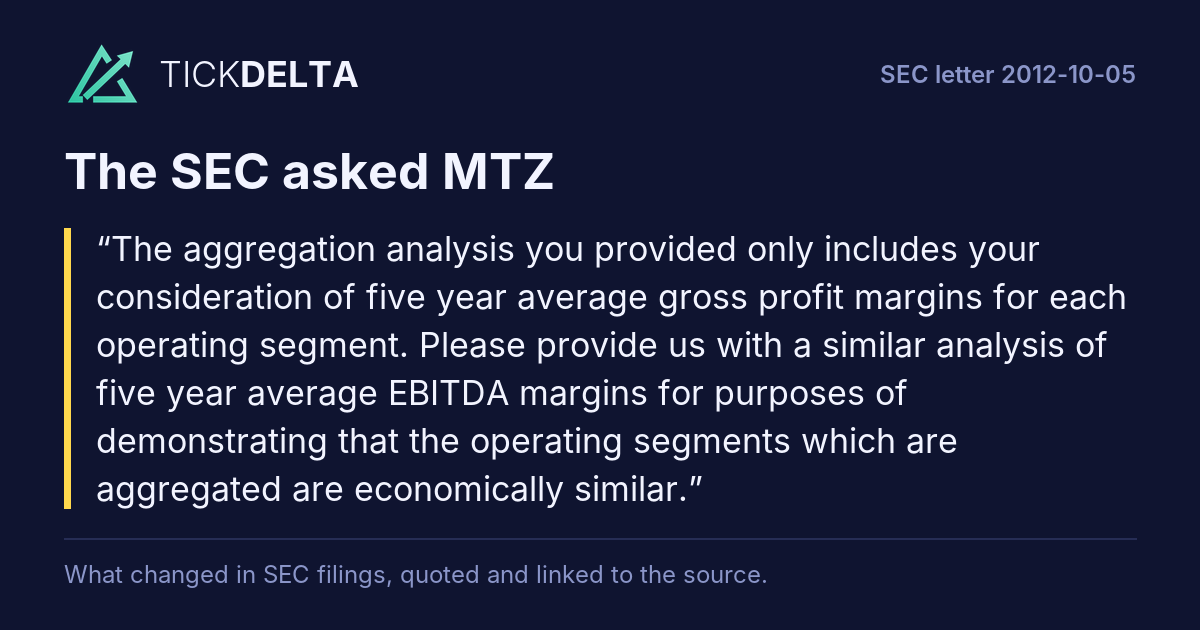
The aggregation analysis you provided only includes your consideration of five year average gross profit margins for each operating segment. Please provide us with a similar analysis of five year average EBITDA margins for purposes of demonstrating that the operating segments which are aggregated are economically similar.
MTZ answered

No numbered answer found in the reply. Read the reply ↗

In its next report

First report after the company's reply of Nov 19, 2012: 10-K filed Feb 28, 2013 ↗.

No earlier 10-K before the SEC's letter is in Tickdelta, so there is nothing to compare with.

Form 10-K for Year Ended December 31, 2011 · Note 15 - Operations by Geographic Areas and Segments, page 93
SEC asked (2)
The aggregation analysis provided does not address what consideration was given to financial trends in revenues, gross profit, EBITDA, gross profit margins, and EBITDA margins in determining that the operating segments are economically similar.
Rest of the question

In this regard, please provide us with a revised analysis which shows each of these financial measures for each of the five years ended December 31, 2011 as well as the budgeted amounts for 2012. Your analysis should also include the actual amounts for the nine months ended September 30, 2012 (or six months ended June 30, 2012 if the nine months information is unavailable). Please ensure that you show the amount of the actual change and percentage change in each line item from period to period in your analyses and provide explanations for any apparent differences in trends for a given operating segment when compared to another operating segment within the same reportable segment.

MTZ answered
To facilitate the Staff’s review, we are responding to

Comments 1 and 2 together.

Our analysis of five year average EBITDA margins requested by comment 1 is included in Attachment

1 which displays EBITDA margin percentages for each operating segment (as presented in our September 28, 2012 comment response letter) for the five years ending in December 31, 2011, the nine months ended September 30, 2012, the 2012 updated forecast and five year average amounts.

The analysis of financial trends in revenues, gross profit, EBITDA, gross profit margin percentage, and EBITDA margin percentages
Rest of the answer

requested by the Staff in comment 2 is included in Attachment 2. We have included the actual amounts for the nine months ended September 30, 2012 and the updated forecast amounts for the year 2012, as well as the amounts of changes and percentage changes period to period.

Attachments 3 and 4 set forth the summary of the five year track record, the 2012 forecast and nine months ended September 30, 2012 for the reportable segments, as revised to reflect the reorganization of operating segments described above.

Communications Segment

This reportable segment includes Advanced Technologies, the newly reorganized Nsoro described above, and the Utilities Services Group

(USG).

We reviewed the trends in revenues, gross margin and EBITDA and found them to be similar in each operating segment except for a decline in USG from 2008 through 2010. Nsoro, which was acquired in 2008, ramped up through 2010, leveled off in 2011, and continued its growth in 2012. The decline in USG and MasTec Network Services in 2008 through 2010 coupled with the large increases in the Nsoro and Advanced Technologies businesses are purely indicative of business trends occurring during that period within the overall communications industry. Due to declines in customer counts for wireline telephone (caused by the recession and declines in new housing construction), [***] and other large telephone companies decreased capital spending on maintenance of the wireline network in favor of wireless and a large marketing push toward the bundling of cable, telephone and internet all on the same infrastructure (such as AT&T’s U-verse or Verizon’s FiOS bundles). DirecTV also showed significant growth during the period, first teaming with AT&T, then working on its own. The trends experienced across this reportable segment reflect the trends in the communications industry generally. The five year average gross margins of

Advanced Technologies, Nsoro and Utilities Services Group ([***], [***] and [***], respectively) demonstrate economic similarity.

The Advanced Technologies, Nsoro and Utilities Services Group operating segments provide installation and maintenance services predominantly related to large, communications networks. Additionally, all operate under master service agreements with their customers, manage a significant number of subcontractors and receive a very high annual volume of transactions and work orders. The master service agreements were initially won by competitive bid but can be renewed through direct renegotiation. As discussed further in the response to comment 3, segment customers are large, industry leading public companies, some of which have subsidiaries or divisions that provide communications or utilities services to their end customers and may also contract with MasTec to construct the infrastructure needed to provide these types of services. This segment differs from our other segments in maintaining a significant system of permanent warehouses and yards and material inventory which is distributed to employees and subcontractors for installation on the jobsite.

Power Infrastructure

Segment

This reportable segment includes the Electrical Transmission Group and the Oil & Gas Group.

Power Infrastructure segment contracts relate to large, fixed price or cost plus installation projects with individualized contract terms that are tailored to each particular project and its risks. This reportable segment is the only one that routinely performs projects with a duration of over one year and primarily uses percentage-of-completion accounting. Segment projects are all competitively bid and represent capital expenditures for our customers. As these contracts often include engineering, procurement and construction services, the segment is required to manage the full range of installation services. The managers of this segment lead both the business development and project execution aspects of the business.

The trends in revenues, gross margin and EBITDA were similar from 2008 forward, except in 2010. In November 2009, the Oil & Gas Group acquired Precision Pipeline and immediately after the acquisition completed one large, cost-plus contract and signed a second large, cost-plus contract. Together, these two contracts significantly and positively affected revenues, gross margin, and EBITDA for 2009 and 2010. Electrical transmission in 2009 and 2010 had a flat period caused by lower performing projects and related management issues. The segment turned those around with additional attention to management and the acquisition of EC Source, with its experienced management team, significantly restored the gross margin percentage and EBITDA margin percentage, after which the percentages converged. The five year average gross margins for the Oil & Gas Group and the Electrical Transmission Group were [***] and [***], respectively. The five year average EBITDA margin percentage for the Oil & Gas

Group was [***] and for the Electrical Transmission Group was [***]. Although these five year average margins varied, the turnaround and EC Source acquisition drove the EBITDA margin percentages to converge in 2011 and 2012. The Company believes the

EBITDA margin and gross margin trends will continue to converge in the future.

Power Generation Segment

This reportable segment includes Wanzek.

The Power Generation segment primarily serves the energy and utility end markets and other end markets through the installation and construction of power plants, wind farms, solar farms, electrical transmission infrastructure, ethanol facilities and various types of industrial infrastructure.

Other Segment

This reportable segment includes Mexico and International.

The Other segment consists of less than 0.5% of the Company revenues from 2007 to date and includes operating segments that are not at this time economically similar to the other reportable segments.

Read in the reply
In its next report

First report after the company's reply of Nov 19, 2012: 10-K filed Feb 28, 2013 ↗.

No earlier 10-K before the SEC's letter is in Tickdelta, so there is nothing to compare with.

Form 10-K for Year Ended December 31, 2011 · Note 15 - Operations by Geographic Areas and Segments, page 93
SEC asked (3)
Customers of the Utility Services group include leading communications companies and utilities and governments which provide communications and utility services. For each of the five years ended December 31, 2011 and the nine months ended September 30, 2012, please tell us the revenue amounts and percentages of this operating segment which are related to each of the following groups of customers: communications,
Rest of the question

utilities and other.

MTZ answered
The predominant amount of

USG’s revenues in all years reviewed (ranging from 55% to 69%) are derived, as noted in the table below, from wireline and wireless communications construction services. Internally, management views and manages this business as part of our communications businesses, largely due to the predominance of communications customers (currently and historically1) and the structure of the revenue stream.
Rest of the answer

The revenue stream for USG, and our other operating segments in our Communications reportable segment, is primarily from the performance of short duration projects that are generated by work-orders which are often under master services agreements. Additionally, the skill sets and equipment USG uses to perform work for its communications and utility customers are the same. Thus, each USG crew can perform services for both communications and utilities customers.

The following table is a summary of our analysis of the end-markets of the customers generating revenue for the

Utilities Services Group for the last five years (2007-2011) and the year-to-date period ended September 30, 2012 (revenue amounts in millions).

[***]

In order to clarify the nature of the Communications reportable segment, please note that the revenues earned are predominantly related to the construction and maintenance of communications networks. We noted in prior correspondence with the Staff that Communications segment customers include utility customers. However, we did not make clear that those contracts represent a small portion (10.2%) of the revenues during the period from 2010 through 2012.

Note that the USG historically was known as the “Communications Group”. The name changed when Energy Core was merged into this operating segment in January 2010.

The following table is a summary of the overlap of end-market customers for the

Communications reportable segment for the last five years (2007-2011) and the year-to-date period ended September 30, 2012 (revenue amounts in millions):

As noted above, Communications segment revenues related to utility contracts is approximately 8%, 9% and 12% for the years ended 2010, 2011 and 2012 to date, respectively, an average of 10%. The percentage of utilities related revenue in the Communications segment has declined over the years due, in part, to the growth of Nsoro, after its 2008 acquisition. Of the 6.4% of Communications segment revenue earned from customers that procure both communications and utilities services, 67% (2007-2012) represents communications work on wireline or wireless networks or “install to the home” construction supporting wireline telephone or cable networks. The remaining utilities work is primarily electrical distribution work, which is the business of Energy Core, now an integrated part of USG.

In order to understand why the Communications segment includes utility customers, it is important to understand the reason why USG and

Energy Core were combined. The integration of USG and Energy Core was appropriate because the companies are virtually identical in every way. Each of them installs and maintains telephone cables (copper or fiber) and electrical cables, plus related facilities necessary to distribute phone signals or electricity. Cables are installed on telephone poles or underground in both instances. They use the same equipment and employees who require the same skills sets. In fact, now that they’re integrated, the work force can perform for each type of customer and operate out of the same yards, or local offices.

The technology being deployed is closely related. The telephone networks and electric networks were originally designed over a century ago and have undergone significant change since then. The elements of these networks are constantly being upgraded including, on the electrical side, the cables themselves, the switches, the transformers and all elements of the substations. In telephony, most of the circuit-switched telephone networks are digital, other than the “last mile” which terminates at each home or office. All equipment is being upgraded on a regular basis, including cables (copper and fiber) which is bundled into trunk lines which tie into switches, or switching centers, and into multiplexers. The medium of transferring the signal, which includes telephone lines, fiber optic cables, microwave transmission links, cellular networks, communications satellites, and undersea telephone cables, is undergoing constant technological change. The best known telephone system upgrade is Long Term Evolution (LTE), which is the new standard for high speed cellular networks. These upgrades primarily provide improved reliability, the key to effective and efficient phone or electric networks particularly in cases where networks have aged and may not have been properly maintained or upgraded. This is what USG does. Because the largest part of USG’s revenue has been and continues to be related to telephone networks, our CODM views USG as a communications company.

In addition to USG’s customers, including both communications and utility industries, a small portion of revenues is generated from communications work performed for government customers.

On a consolidated basis, we also have certain customers generating revenue in more than one reportable segment. In these instances, the contracting party within that consolidated end customer, whether it is a large utility or communications customer, often is a different legal entity or division of that end customer and the services provided to the components of that customer can differ. For example, [***]:

In addition, as disclosed in Note 15 to the financial statements in the Quarterly Report on Form 10-Q for the quarter ended September 30, 2012, revenues from the Company’s top ten customers were 66% of total revenues for the nine month period. With such a high customer concentration, we respectfully submit that there is an increased likelihood that various divisions of the same large end customer will contract with more than one MasTec operating segment for various projects.

As a result of the analyses described herein, which demonstrate that the preponderance of operating segment revenues in the reportable segment result from communications services, we have made the following changes from our September 28 submission:

We changed the name of this segment to “Communications” from “Communications and Utility Infrastructure”.

We revised our footnote to further clarify the customers and work performed by each of our reportable segments.

Additionally, we will include supplemental disclosure quantifying the portion of utilities revenues included within the Communications segment revenues.

Read in the reply
In its next report

First report after the company's reply of Nov 19, 2012: 10-K filed Feb 28, 2013 ↗.

No earlier 10-K before the SEC's letter is in Tickdelta, so there is nothing to compare with.

Form 10-K for Year Ended December 31, 2011 · Note 15 - Operations by Geographic Areas and Segments, page 93
SEC asked (4)
You intend to use EBITDA as the measure of profitability to be reported in your segment footnote and related disclosures. Given that it does not appear the board reports previously provided to us as well as all of the operating segment reports provided to the CODM included EBITDA, please tell us how you determined that this is the appropriate measure to report.
Rest of the question

Please also tell us whether you will continue to present net profit before tax in your board and CODM reports. Please address what consideration was given to reporting net profit before tax as your measure of profitability in your segment footnote. Refer to ASC 280-10-50-27 and 28 as well as ASC 280-10-55-9 and 10.

MTZ answered
Although the reports to the Board of Directors do not specifically identify the key measure of segment profitability as EBITDA, the results of segment operations reported are essentially the same as what would have been reported as EBITDA. Interest expense at the operating segment level includes only interest on capital leases and certain equipment financing and is not significant. Total consolidated interest expense for the Company tends to be less than 1.5% of revenues. Depreciation and amortization are not significant at 2.5% of revenues on a consolidated basis.
Rest of the answer

As a result, the reports to the CODM reflect an amount substantially equivalent to EBITDA. We believe that the reporting is consistent with ACS 280-10-50-27 and -28 as well as ASC 280-10-55-9 and -10. Further, we believe that EBITDA will be useful to the readers of our financial statements because we typically use EBITDA in our public communications regarding performance of our various businesses and end-markets.

The Company undertakes that reporting to the CODM and the Board of Directors will include EBITDA under the reorganization and new reportable segment structure.

Read in the reply
In its next report

First report after the company's reply of Nov 19, 2012: 10-K filed Feb 28, 2013 ↗.

No earlier 10-K before the SEC's letter is in Tickdelta, so there is nothing to compare with.

Form 10-K for Year Ended December 31, 2011 · Note 15 - Operations by Geographic Areas and Segments, page 93
SEC asked (5)
The executive level organizational chart dated September 2012 includes an entity described as Energy. Please help us understand why this entity is not included in your listing of operating segments. Please also tell us what operations are included in this entity. It appears that the manager of this entity is the same as the manager of the utility services operating segment.
MTZ answered
Since January 1, 2010, Energy Core (or Energy) has been part of the USG operating segment and is managed by that operating segment manager. Its inclusion as “Energy” in the organization chart provided previously to the Staff was an oversight. We have provided a corrected executive level organizational chart as

Attachment 6.
Read in the reply
In its next report

First report after the company's reply of Nov 19, 2012: 10-K filed Feb 28, 2013 ↗.

No earlier 10-K before the SEC's letter is in Tickdelta, so there is nothing to compare with.

Form 10-K for Year Ended December 31, 2011 · Note 15 - Operations by Geographic Areas and Segments, page 93
SEC asked (6)
In regards to your proposed segment disclosures, please address the following:  Please separately present amounts related to eliminations or reversal of transactions between reportable segments from corporate amounts. Refer to ASC 280-10-50-31.
Rest of the question

Please also ensure that you discuss the business reasons for fluctuations in these corporate amounts in MD&A subsequent to your discussion of results of operations by segment; and  In your description of each reportable segment pursuant to ASC 280-10-50-21, please better distinguish the differences between each reportable segment.

MTZ answered
Please see Attachment 5 for our revised proposed segment disclosures including separate disclosure of eliminations and corporate amounts and revised descriptions of each reportable segment. We will include a discussion of the business reasons for significant fluctuations in corporate amounts in the MD&A section of our future filings.
Read in the reply
In its next report

First report after the company's reply of Nov 19, 2012: 10-K filed Feb 28, 2013 ↗.

No earlier 10-K before the SEC's letter is in Tickdelta, so there is nothing to compare with.

Form 10-K for Year Ended December 31, 2011 · Note 15 - Operations by Geographic Areas and Segments, page 93
SEC asked (7)
Please separately present revenues from external customers and intersegment revenues for each reportable segment. Please also disclose the amount of each segment’s EBITDA which is derived from intersegment revenues. Refer to ASC 280-10-50-22(a) and (b). Please provide us with the reconciliations that you intend to provide pursuant to ASC 280-10-50- 30. Refer to the examples provided in ASC 280-10-55-48 and 55-49.
MTZ answered
Please see Attachment 5 for our revised proposed segment disclosures. We have disclosed that intersegment revenue and costs are de minimus (approximately 1% of revenue). Intersegment EBITDA is also de minimus. We have also included additional reconciliations as required by ASC 280-10-50-30.

Form S-3 Filed April 5, 2012.
Read in the reply
In its next report

First report after the company's reply of Nov 19, 2012: 10-K filed Feb 28, 2013 ↗.

No earlier 10-K before the SEC's letter is in Tickdelta, so there is nothing to compare with.

Form S-3 Filed April 5, 2012
SEC asked (8)
You filed a shelf registration statement related to the public offer and sale of common stock, preferred stock, depositary shares, debt securities, guarantees, warrants, stock purchase contracts and stock purchase units that you and subsidiary guarantors may offer from time to time in one or more series.
Rest of the question

Please tell us whether you have offered securities under this shelf registration statement and/or have plans to do so in the six months.

MTZ answered
We confirm that we have made no offers or sales of securities under the above described registration statement since it became effective nor do we have any current plans to effect any such offering prior to such time as we have filed the restated financial statements referred to below in response to Comment 9 and provided segment information in accordance with ASC 280.
Read in the reply
In its next report

First report after the company's reply of Nov 19, 2012: 10-K filed Feb 28, 2013 ↗.

No earlier 10-K before the SEC's letter is in Tickdelta, so there is nothing to compare with.

Form S-3 Filed April 5, 2012
SEC asked (9)
You filed a Form S-3 on April 5, 2012. You sold DirectStar TV, LLC and its subsidiaries in June 2012. You filed a Form 8-K on June 18, 2012 which included pro forma financial information for the year ended December 31, 2011 and the three months ended March 31, 2012.
Rest of the question

Please tell us what consideration you gave to filing a Form 8-K giving retrospective effect to this component in discontinued operations in your historical financial statements for each period presented in accordance with ASC 205-20.

MTZ answered
We have considered the requirement to give retrospective effect to the discontinued operations treatment of DirectStar TV, LLC and its subsidiaries (“DirectStar”), as well as with respect to the projects and net assets of our wholly owned subsidiary, Globetec Construction LLC and its subsidiaries (“Globetec”), described in our Quarterly Report on Form 10-Q for the quarter ended September 30, 2012. We have also considered the guidance set forth in Topics 13100 and 13200 of the Division of Corporation Finance Financial Reporting Manual regarding discontinued operations.
Rest of the answer

We currently contemplate that we will file our historical financial statements (along with the related Management’s Discussion of Financial Condition and Results of Operations), as applicable, giving retrospective effect to the discontinued operations treatment of DirectStar and Globetec prior to conducting any offering of securities pursuant to the above referenced registration statement. We would expect to accomplish such filing through a Current Report on

Form 8-K or the filing of our Form 10-K for the year ended December 31, 2012, depending on the timing of any such offering (which timing would also take into account the considerations referred to in response to Comment 8 above). We note that our Quarterly Report on Form 10-Q for the quarter ended June 30, 2012 gave retrospective effect to the discontinued operations treatment of DirectStar for the three and six month periods ended June 30, 2011, and our Quarterly Report on

Form 10-Q for the quarter ended September 30, 2012 gave retrospective effect to the discontinued operations treatment of both DirectStar and Globetec for the three and nine month periods ended September 30, 2011. As a result, we do not anticipate filing restated financial statements for quarterly periods earlier than those reflected in the June 2012 and September 2012 Forms 10-Q. Notwithstanding the foregoing, our intention to file the financial statements described above should not be taken to mean that we have determined that the completed disposition of DirectStar or the planned disposition of Globetec (or both) constitutes a fundamental change.

As requested, we acknowledge that:

the Company is responsible for the adequacy and accuracy of the disclosure in the filing;

Staff comments or changes to disclosure in response to Staff comments do not foreclose the Commission from taking any action with respect to the filing; and the Company may not assert Staff comments as a defense in any proceeding initiated by the Commission or any person under the federal securities laws of the United States.

If you or any other member of the Staff should have any further comments or questions regarding this response, please do not hesitate to contact the undersigned at 305.406.1811.

Read in the reply
In its next report

First report after the company's reply of Nov 19, 2012: 10-K filed Feb 28, 2013 ↗.

No earlier 10-K before the SEC's letter is in Tickdelta, so there is nothing to compare with.

Form 10-K for Year Ended December 31, 2011 · General
SEC asked (1)
Where a comment below requests additional disclosures or other revisions to be made, please show us in your supplemental response what the revisions will look like. These revisions should be included in your future filings, including your interim filings, if applicable.
MTZ answered
We confirm that we have included proposed additional disclosures and revisions in this letter, as requested, and that the additional disclosures and revisions will be included in our future filings, including interim filings, if applicable. In order to provide the appropriate context to our proposed disclosures, we have provided in Attachment A a draft of the relevant sections of our MD&A including the sections we have entitled Business Overview, Overview of Financial Results, Comparison of Fiscal Year Results of Operations and Non US GAAP Financial Measures that will be included in our 2012
Rest of the answer

Form 10-K. Please note that in such draft MD&A, we have recast 2011 and prior year data to conform to the discontinued operations treatment resulting from the disposition of DirectStar in 2012 and the held for sale treatment of GlobeTec, all as previously reported in our 2012 interim reports. Additionally, upon further review, we have changed the name of our “Power Generation” reportable segment to the “Power Generation and Industrial” reportable segment as we believe this title provides a better description of the underlying business. No change has been made to the composition of the segment.

Read in the reply
Management’s Discussion and Analysis, page 30
SEC asked (2)
Your proposed disclosures include the presentation of consolidated EBITDA and EBITDA margin. Please provide the disclosures required by Item 10(e) of Regulation S-K. Refer to Compliance and Disclosures Interpretation 104.04 which is available on our website at http://www.sec.gov/divisions/corpfin/guidance/nongaapinterp.htm.
MTZ answered
The MD&A provided in our Form 10-K for the year ended December 31, 2011, included on pages 43 and 44 the non-GAAP reconciliations for EBITDA and Adjusted EBITDA. These were omitted from the draft portion of the MD&A submitted with our December 13, 2012 response given its focus on the segment comparisons that were requested during our various conference calls with the Staff. To clarify, we will include non-GAAP reconciliations for EBITDA and Adjusted EBITDA, on a consolidated basis. The draft portion of the MD&A has been modified accordingly. See Attachment A.
Read in the reply
In its next report

First report after the company's reply of Jan 9, 2013: 10-K filed Feb 28, 2013 ↗.

No earlier 10-K before the SEC's letter is in Tickdelta, so there is nothing to compare with.

Management’s Discussion and Analysis, page 30
SEC asked (3)
Please quantify the impact of each factor when multiple factors contribute to material changes in a line item. For example, in your results of operations proposed discussion for the Electrical Transmission segment for the year ended December 31, 2011 compared to the year ended December 31, 2010, EBITDA increased by $32.4 million due to multiple factors including the addition of several large transmission projects in
Rest of the question

connection with the EC Source acquisition with higher than historical-average project margins. Please separately quantify the impact of each of these factors. Refer to Items 303(a)(3)(i) and (iii) of Regulation S-K as well as Financial Reporting Codification 501.04.

MTZ answered
Where multiple factors contribute to material changes in a line item, the explanation will include a quantification of each material factor as required by Items 303(a)(3)(i) and (iii) of Regulation S-K to the extent practicable. Please see Attachment A for the revised explanations. Paragraphs including expanded wording have been underlined for your convenience.
Read in the reply
In its next report

First report after the company's reply of Jan 9, 2013: 10-K filed Feb 28, 2013 ↗.

No earlier 10-K before the SEC's letter is in Tickdelta, so there is nothing to compare with.

Notes to the Financial Statements · Note 15 - Operations by Geographic Areas and Segments, page 93
SEC asked (4)
Please provide the entity-wide disclosures required by ASC 280-10-50-41 and 50-42 for significant customers as well as geographical information regarding revenues and long-lived assets.
MTZ answered
Please note that the disclosure of our significant customers will be included in

Note 15 to the financial statements. Disclosures regarding our foreign operations will be included in the Segment note to the financial statements and discussed in MD&A. Please see our proposed disclosure in Attachments A and B.
Read in the reply
In its next report

First report after the company's reply of Jan 9, 2013: 10-K filed Feb 28, 2013 ↗.

No earlier 10-K before the SEC's letter is in Tickdelta, so there is nothing to compare with.

Notes to the Financial Statements · Note 15 - Operations by Geographic Areas and Segments, page 93
SEC asked (5)
In a similar manner to your proposed disclosures to be included in MD&A, please discuss the reorganization and change in reportable segments.
MTZ answered
See Attachment B, an update of the draft Segment footnote, which has been modified to reflect a discussion of the reorganization and change in reportable segments which conforms to the draft MD&A discussion provided in our December 13 response.

In addition, as a courtesy we want to mention that in late December 2012, we completed separate acquisitions of three small infrastructure construction businesses for a total consideration of $[***] million plus contingent consideration.
Rest of the answer

We do not consider these transactions, individually or in the aggregate, material, nor are they significant; accordingly, no additional disclosures are required under Rule 3-05 or Article 11 of Regulation S-X.

One of these businesses provides communications tower construction services related to the wireless industry similar to our Optima business. It will be included in our Communications segment and will be managed by that segment’s manager The other two acquired businesses provide pipeline and facility construction services in the Oil and Gas industry and are substantially similar to our Pumpco and Fabcor businesses. These two companies will be included in our Oil and Gas segment and will be managed by that segment’s manager. Our footnote describing these acquisitions in our 2012 Form 10-K will disclose the reportable segment in which these acquired companies will be included.

Read in the reply
In its next report

First report after the company's reply of Jan 9, 2013: 10-K filed Feb 28, 2013 ↗.

No earlier 10-K before the SEC's letter is in Tickdelta, so there is nothing to compare with.

Notes to the Financial Statements · Note 15 - Operations by Geographic Areas and Segments, page 93
SEC asked (6)
Please help us better understand how you determined that your four operating segments also represent your reporting units pursuant to ASC 350-20-35-33 through 35-37. We remind you that a reporting unit for purposes of testing goodwill for impairment is an operating segment or one level below. Please clarify if you are aggregating two or more components of an operating segment to arrive at your reporting units.
Rest of the question

If so, please provide us with a comprehensive explanation as to how you determined this was appropriate pursuant to ASC 350-20-35-5. Your explanation should also address ASC 350-20-55-7, which states that all of the factors in ASC 280-10-50-11 should be considered in determining whether the components of an operating segment have similar economic characteristics.

MTZ answered

No numbered answer found in the reply. Read the reply ↗

In its next report

First report after the company's reply of Jan 9, 2013: 10-K filed Feb 28, 2013 ↗.

No earlier 10-K before the SEC's letter is in Tickdelta, so there is nothing to compare with.

Management’s Discussion and Analysis · EBITDA and Adjusted EBITDA, page 38
SEC asked (7)
You consider EBITDA and Adjusted EBITDA as indicators of your ability to generate cash. Your disclosures indicate that you view these to also be liquidity measures. In this regard, please also provide a reconciliation from cash flows from operations to EBITDA and Adjusted EBITDA pursuant to Item 10(e)(1)(i)(b) of Regulation S-K.
Rest of the question

Please discuss any limitations related to the use of these measures as liquidity measures. You currently only reconcile income from continuing operations to Adjusted EBITDA. Please also provide a reconciliation from income from continuing operations to EBITDA. Please similarly revise your Form 10-K, as applicable.

MTZ answered

No numbered answer found in the reply. Read the reply ↗

In its next report

First report after the company's reply of Jan 9, 2013: 10-K filed Feb 28, 2013 ↗.

No earlier 10-K before the SEC's letter is in Tickdelta, so there is nothing to compare with.

Also in this review: request for more time, Oct 15, 2012, request for more time, Oct 31, 2012, company letter, Dec 13, 2012, closing letter, 2013-01-11

Letters without questions

Other letters

UPLOAD and CORRESP
4 other letters: notices that a filing will not be reviewed, requests to declare a registration effective, and the like

From the SEC's correspondence on EDGAR: staff letters (form UPLOAD) and company letters (form CORRESP), 15 letters filed since 2012-09-24. Questions and answers are matched by their numbers; topics come from words in each question. The reports are compared word for word (same form, before the first SEC letter against the first report after the company's reply). No AI.

Sources

The SEC's correspondence on EDGAR: staff letters (form UPLOAD) and company letters (form CORRESP), matched question by question. No AI.

Also

Filings: the letters in the filing list.

Work with it

Excel workbook · CSV. Google Sheet that stays up to date: paste =IMPORTDATA("https://tickdelta.com/company/MTZ/export.csv") into a cell.

Next in Owners and insiders:Insider trades
Esc

Type a ticker such as AAPL, a name, an investor such as Buffett, or a topic such as tariffs. ↑ ↓ to move, Enter to open.