Cloudflare, Inc. NET
New risk paragraphs, branching off last year
Each branch is a paragraph in Risk Factors with nothing like it in the 10-K filed Feb 20, 2025. A box jumps to the paragraph as filed, below.
Paragraphs with nothing like them in last year's 10-K
20 paragraphs in Risk Factors of the 10-K filed Feb 26, 2026 with nothing like them in the 10-K filed Feb 20, 2025. Quoted exactly. Paragraphs that were only edited are under 10-K change.
The United States government has implemented, or threatened to implement, tariffs on some or all of the goods imported into the United States from a number of other countries around the world. In response, many of the countries subject to these tariffs have themselves implemented or threatened to implement tariffs, taxes, or other retaliatory measures on U.S. goods or services or U.S. companies, or have restricted or threatened to restrict the operations of certain U.S. companies in those countries. The implementation, or threatened implementation, of tariffs, taxes, and other restrictions on goods, services, or businesses by the United States and other countries and the resulting additional costs and uncertainties may cause the costs of our products to increase. Additionally, future tariffs could cause the costs of the equipment we use to operate our global network to increase, corporate spending to become delayed or curtailed, increase rates of inflation, reduce economic growth rates, create an economic downturn or recession, or result in other similar or unexpected adverse effects on our business, financial condition, or results of operations.
duration of conflicts and geopolitical tension around the world, and any economic downturns and the actions taken by governmental authorities and other third parties in response.
•the potential implementation of tariffs or retaliatory measures due to tariffs on the sales of our products in countries where our potential paying customers are located;
In addition, our sales efforts typically involve educating our prospective large customers about the uses, benefits, and value proposition of our network and products. Our sales force develops relationships directly with our customers and our channel partners through account penetration, account coordination, sales, and overall market development. Potential large customers often view the subscription to our products, including any expansion of those subscriptions, as a significant strategic decision and, as a result, in some cases require considerable time to
In addition, we must comply with laws and regulations relating to the formation, administration, and performance of contracts with the public sector, including U.S. federal, state, and local governmental organizations, as well as
Show the other 12
Any cybersecurity insurance that we carry may be insufficient to cover all liabilities incurred by us in connection with any privacy or cybersecurity incidents or may not cover the kinds of incidents for which we submit claims. For
customers, result in gaps or loss in customer analytics or functionality with respect to some of our products, impact our ability to bill our customers, result in the loss of customers or reduction in their purchases from us due to dissatisfaction with the reliability of our products and network, and otherwise materially and adversely impact our business, reputation, and results of operations.
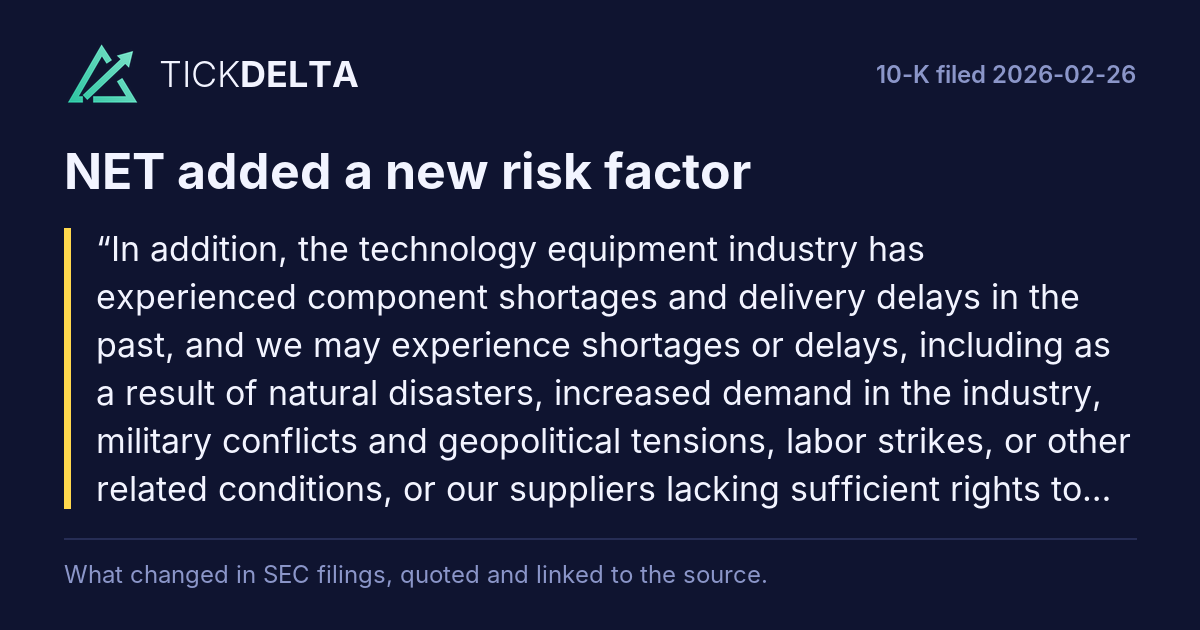
In addition, the technology equipment industry has experienced component shortages and delivery delays in the past, and we may experience shortages or delays, including as a result of natural disasters, increased demand in the industry, military conflicts and geopolitical tensions, labor strikes, or other related conditions, or our suppliers lacking sufficient rights to supply the components in all jurisdictions in which we have co-location facilities that support our global network. For example, we expect significant component shortages that may impact our server supply chain during the current year, particularly in memory products such as Dual In-line Memory Modules (DIMMs), as well as enterprise Solid State Drives (SSDs), Central Processing Units (CPUs), and high-capacity Hard Disk Drives (HDDs). These anticipated shortages, driven by factors such as the reallocation of manufacturing capacity to support artificial intelligence infrastructure and increased demand from hyperscale data center
operators, and other shortages or similar supply constraints in the future may disrupt and increase the cost of our expected purchases of network equipment and servers.
If our supply of certain components is disrupted or delayed or becomes more expensive, there can be no assurance that additional supplies or components can serve as adequate replacements or that supplies will be available on terms that are favorable to us, if at all. Any disruption or delay or additional costs in the supply of our hardware components may delay the opening of new co-location facilities, limit capacity expansion or replacement of defective or obsolete equipment, cause other constraints on our operations that could damage our customer relationships, or otherwise adversely impact our business, financial condition, or results of operations.
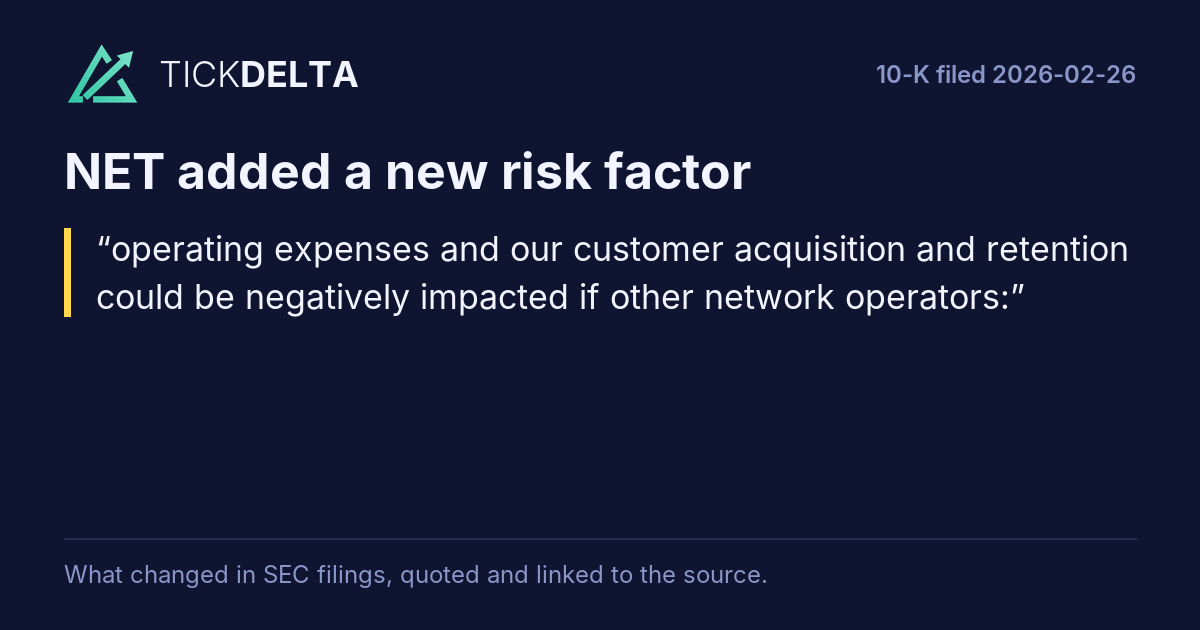
operating expenses and our customer acquisition and retention could be negatively impacted if other network operators:
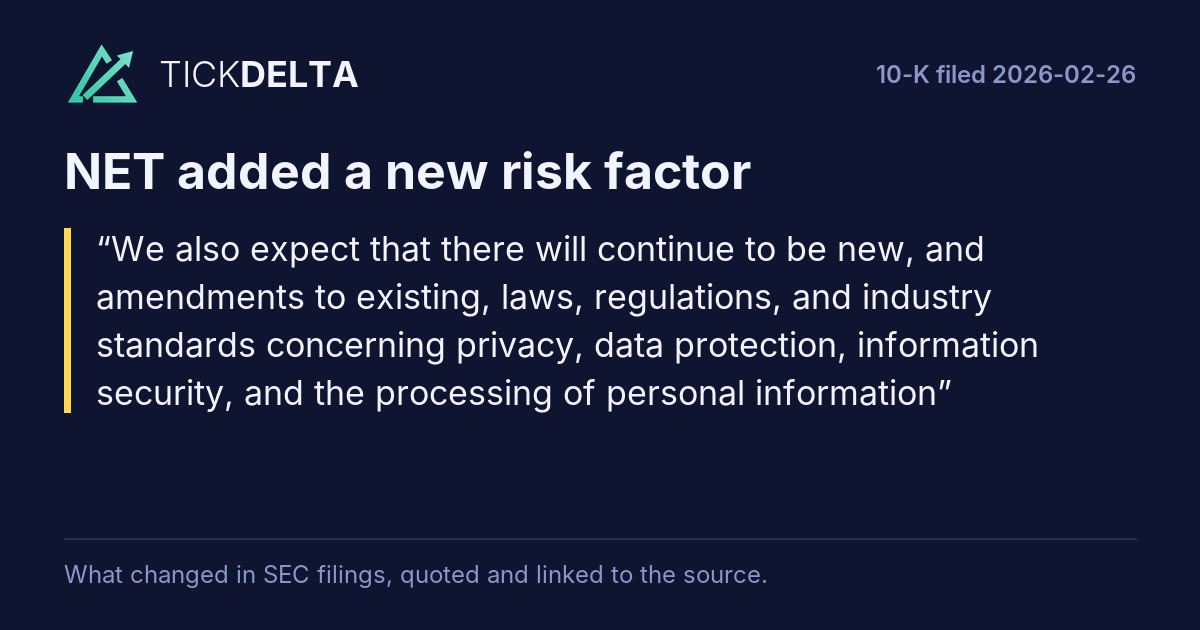
We also expect that there will continue to be new, and amendments to existing, laws, regulations, and industry standards concerning privacy, data protection, information security, and the processing of personal information
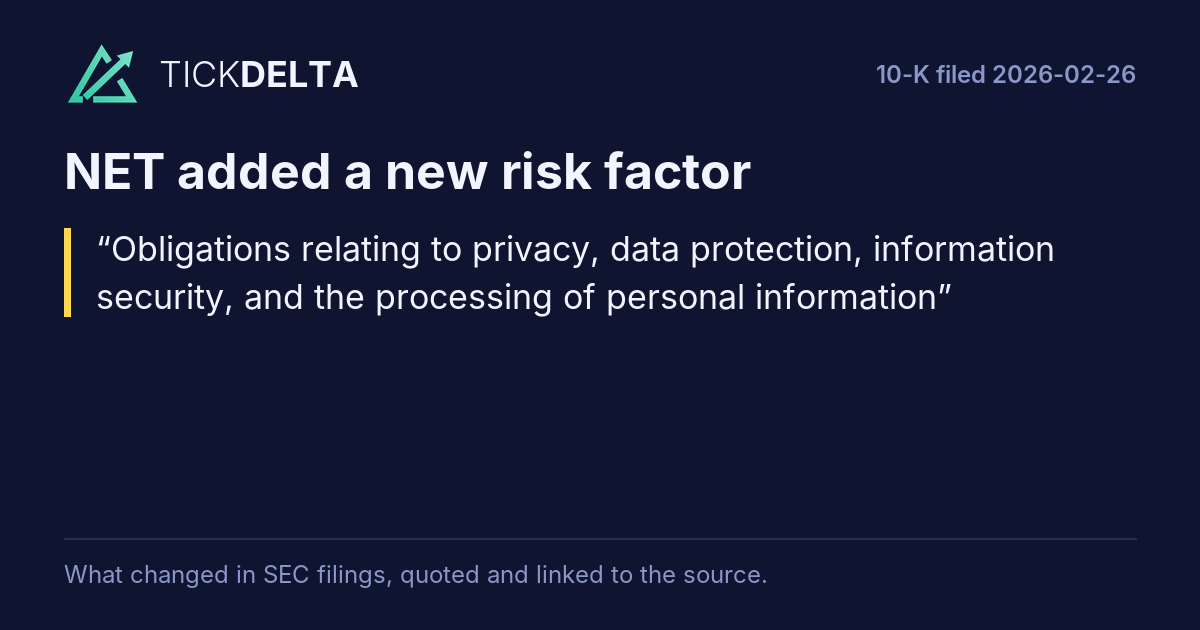
Obligations relating to privacy, data protection, information security, and the processing of personal information
Laws and regulations regarding the development, use, and deployment of AI technologies in the EU, U.S., and elsewhere are increasing in complexity. For example, the EU AI Act has compliance deadlines throughout 2025 and into 2026, and a number of U.S. states have enacted AI governance and safety frameworks. Numerous jurisdictions have proposed legislation to regulate the development, use, and deployment of AI, in whole or in part. As we continue to see efforts to regulate this new technology, we have incurred and will continue to incur costs to address the impact, if any, of these laws and regulations regulating AI on our products and practices.
More generally, as obligations regarding privacy, AI, data protection, information security, and the processing of personal information and other content increase in complexity, we may be required to incur substantial costs to
We are subject to indirect taxes, such as payroll, sales, use, value-added, goods and services, property, and digital services taxes, in both the United States and various foreign jurisdictions. Sales and use, value-added, goods and
On September 29, 2025, the U.S. Department of Commerce’s Bureau of Industry and Security (BIS) released an interim final rule that expanded export control restrictions and licensing requirements under the EAR Entity List and Military End-User List to foreign entities that are 50% or more owned by one or more parties on those lists, which BIS has labeled the “Affiliates rule.” Although the Affiliates rule was suspended for a period of one year on November 10, 2025, the Affiliates rule, if implemented, would significantly raise the bar for compliance with EAR by imposing an affirmative responsibility to know the ownership of the foreign companies that are parties to any transactions. Even though we take precautions and have implemented policies and practices to assist in compliance, there is a risk that we may not be in full compliance with these laws.
rights claim, we may have to seek a license to continue practices found to be in violation of third-party rights, which may not be available on reasonable terms and may significantly increase our operating expenses. A license to continue such practices may not be available to us at all, and we may be required to develop alternative non-infringing technology or practices or discontinue the practices. The development of alternative, non-infringing technology or practices could require significant effort and expense. Our business, results of operations, and financial condition could be materially and adversely affected as a result.
In order to protect our proprietary technologies and processes, we rely in part on trade secret laws and confidentiality agreements with our employees, contractors, consultants, and third parties. These agreements may not effectively prevent disclosure of confidential information and may not provide an adequate remedy in the event
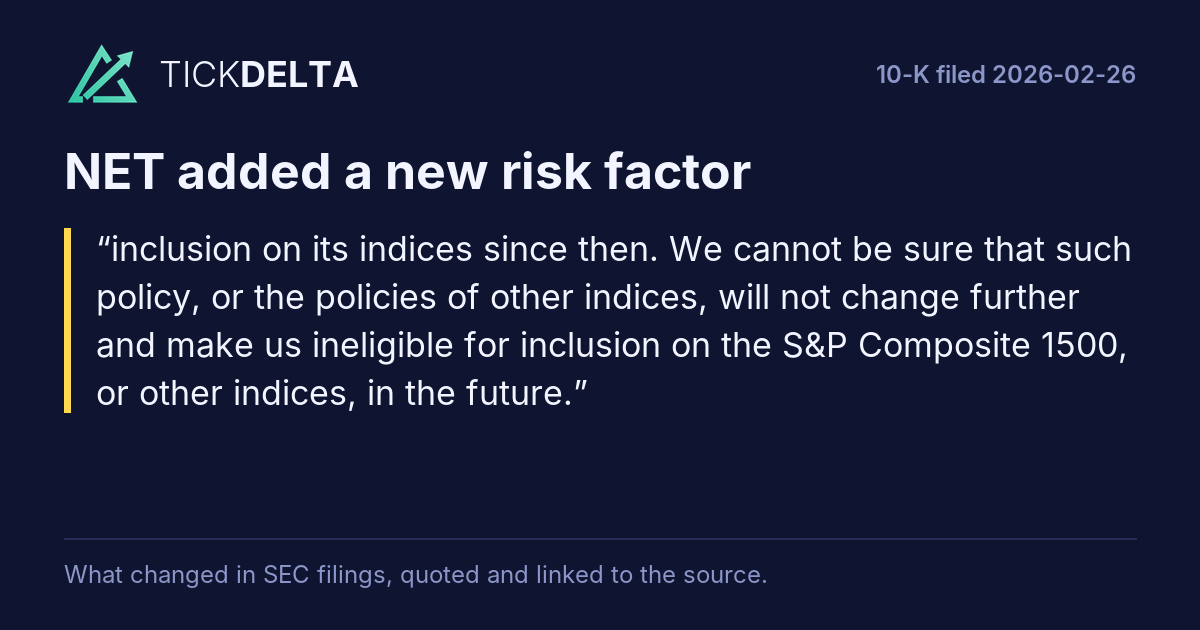
inclusion on its indices since then. We cannot be sure that such policy, or the policies of other indices, will not change further and make us ineligible for inclusion on the S&P Composite 1500, or other indices, in the future.
Paragraphs in the 10-Q filed Nov 5, 2026 that were not in the one before
New in the latest 10-Q
24 paragraphs in the 10-Q filed Nov 5, 2026 with nothing like them in the 10-Q filed Aug 6, 2026 (at least half the words must differ; new numbers alone do not count). Quoted exactly, grouped by the item heading above them. This is text that changed, not a judgement of how serious it is.
Financial statements and notes
In addition, if the 2031 Notes are converted prior to the maturity date following certain specified corporate events or because the Company issues a notice of redemption, the Company will increase the conversion rate for such 2031 Notes converted in connection with such a corporate event or during the related redemption period, as the case may be, in certain circumstances set forth in the 2031 Indenture.
Read in the 10-Q
Upon conversion, the Company will pay or deliver, as the case may be, cash, shares of the Company's Class A common stock, or a combination of cash and shares of the Company's Class A common stock, at the Company's election. It is the Company’s current intent to settle the principal amount of 2031 Notes in cash.
Read in the 10-Q
Except in the case of a cleanup redemption (as defined below), the Company may redeem for cash all or any portion of the 2031 Notes (subject to the partial redemption limitation (as defined below)), at its option, on or after August 20, 2029, if the last reported sale price of the Company’s Class A common stock has been at least 130 % of the conversion price then in effect for at least 20 trading days (whether or not consecutive) during any 30 consecutive trading day period (including the last trading day of such period) ending on, and including, the trading day preceding the date on which the Company provides notice of redemption. In addition, subject to certain conditions, the Company may redeem for cash all, but not less than all, of the 2031 Notes at any time if the aggregate principal amount of the 2031 Notes that remains outstanding at such time is less than $ 200.0 million (a "cleanup redemption"). The redemption price for any optional redemption or cleanup redemption will be equal to 100 % of the principal amount of the 2031 Notes to be redeemed, plus any accrued and unpaid special interest to, but excluding, the redemption date. If the Company elects to redeem fewer than all of the outstanding 2031 Notes, at least $ 100.0 million aggregate principal amount of 2031 Notes must be outstanding and not subject to redemption as of the relevant redemption date. No sinking fund is provided for the 2031 Notes.
Read in the 10-Q
If the Company undergoes a fundamental change (as defined in the 2031 Indenture), holders of the 2031 Notes may require the Company to repurchase for cash all or any portion of their notes at a repurchase price equal to 100 % of the principal amount of the 2031 Notes to be repurchased, plus accrued and unpaid special interest to, but excluding, the fundamental change repurchase date.
Read in the 10-Q
connection with the settlements and recognized a gain of $ 1.3 million in other income (expense), net on the Company's condensed consolidated statement of operations.
Read in the 10-Q
Show the other 19
The Revolving Credit Facility commitments terminate, and all outstanding loans are due and payable on May 17, 2029.
Read in the 10-Q
On October 8, 2026, the Company acquired Deno Land Inc. which has developed an open-source JavaScript and TypeScript runtime and related developer infrastructure, for approximately $ 26.5 million in cash. The purchase accounting for this acquisition is in progress.
Read in the 10-Q
Since our inception, we have financed our operations primarily through net proceeds from the sale of our equity and debt securities, as well as cash flow from our operating activities, and we expect to continue to finance our operations using the same sources for the foreseeable future.
Read in the 10-Q
As of September 30, 2026, we had $2,500.0 million aggregate principal amount of the 2031 Notes and $2,000.0 million aggregate principal amount of the 2030 Notes outstanding. The 2031 Notes and 2030 Notes mature on August 15, 2031 and June 15, 2030, respectively. In connection with the offering of the Notes, we entered into the 2031 Capped Calls and 2030 Capped Calls. The 2031 Capped Calls and 2030 Capped Calls expire in incremental components on each trading date between July 17, 2031 and August 13, 2031, and between May 16, 2030 and June 13, 2030, respectively.
Read in the 10-Q
During the three months ended September 30, 2026, we settled conversions and repaid approximately $1,293.8 million aggregate principal amount of the 2026 Notes. We paid in cash equal to the principal amount of the 2026 Notes and issued approximately 2.2 million shares of our Class A common stock for the remainder of the conversion value in excess of the aggregate principal amount converted. For excess conversion value that otherwise would have resulted in the issuance of fractional shares, we paid cash in lieu of such fractional shares. We also settled the 2026 Capped Calls associated with the 2026 Notes and received 1.4 million shares of our Class A common stock and an immaterial amount of cash in lieu of fractional shares.
Read in the 10-Q
and other current liabilities, a $9.3 million increase in accrued compensation, and a $4.4 million decrease in other noncurrent assets related to operating activities.
Read in the 10-Q
Risk Factors
controls, content delivery networks, domain name systems, email security vendors, advanced threat prevention, wide area network (WAN) technology, developer platforms, and AI inference.
Read in the 10-Q
• appropriately documenting and testing our ERP and other IT systems and business processes.
Read in the 10-Q
these risks and challenges could reduce the commercial benefit to us or otherwise preclude us from selling our products to government organizations.
Read in the 10-Q
Any cybersecurity insurance that we carry may be insufficient to cover all liabilities incurred by us in connection with any privacy or cybersecurity incidents or may not cover the kinds of incidents for which we submit claims. For
Read in the 10-Q
customers, result in gaps or loss in customer analytics or functionality with respect to some of our products, impact our ability to bill our customers, result in the loss of customers or reduction in their purchases from us due to dissatisfaction with the reliability of our products and network, and otherwise materially and adversely impact our business, reputation, and results of operations.
Read in the 10-Q
reputation, distraction to our senior management team, potential investigations and fines, and loss of customers, or result in other liabilities or adverse consequences on our business.
Read in the 10-Q
More generally, as obligations regarding privacy, AI, data protection, information security, and the processing of personal information and other content increase in complexity, we may be required to incur substantial costs to
Read in the 10-Q
agreement. The risk of such an early termination event may have increased during the current environment of economic trade negotiations and tensions between the Chinese and U.S. governments.
Read in the 10-Q
sanctions. On April 9, 2026, we received a No Action Letter from OFAC, stating that OFAC was closing its review without penalties or further action.
Read in the 10-Q
In addition, our products, including AI Gateway, allow our customers to proxy, route, and interact with third-party generative AI models and AI search providers. The legal and regulatory landscape surrounding the use of copyrighted material, proprietary data, and trademarked content by third-party AI models (including for training and generating outputs) remains highly unsettled. As we integrate these third-party models and AI search capabilities into our products, we may be increasingly exposed to allegations of secondary copyright infringement.
Read in the 10-Q
certain of our vendors and partners, including JD Cloud with respect to the facilities included within China. We must protect this proprietary information in order to realize commercial benefit from our investment.
Read in the 10-Q
On October 16, 2026, in the Consolidated Action, the Court of Chancery (the Court) preliminarily enjoined implementation of the Capitalization Changes, holding that the plaintiffs had shown a reasonable probability of success that the Capitalization Changes are not subject to the safe harbor protections in Section 144 of the Delaware General Corporation Law. The defendants in the Consolidated Action have sought an interlocutory appeal of that decision. The defendants are waiting for a decision from the Delaware Supreme Court about whether it will accept the interlocutory appeal.
Read in the 10-Q
registered public accounting firm, we could be subject to investigations or sanctions by regulatory authorities, and we could incur substantial expenses.
Read in the 10-Q
The 10-Q's risk factors against the 10-K
Item 1A of the 10-Q filed Nov 5, 2026 against Item 1A of the 10-K filed Feb 26, 2026.
A 10-Q repeats only the risks that changed, so a 10-K paragraph that is missing from it is not counted as removed.
Added is a paragraph with nothing like it in the 10-K, Reworded a sentence that is in both with several words changed,
Quiet changes a sentence in both where one to four words changed and one is a hedge or a modal
(cut words struck through, new words highlighted).
Text on the page, not a score; each links to the filing at sec.gov.
Show the other 19
The first 24 of 96 are shown (at most 12 of each type).
Phrases used for the first time
Two-word phrases in Risk Factors of the 10-K filed Feb 26, 2026 that are in none of the 1 earlier 10-Ks stored, back to Feb 20, 2025
Where each one is used
- applicable indenture: Holders of the Notes have the right to require us to repurchase their Notes upon the occurrence of a fundamental change (which is defined in the applicable indenture governing the applicable series of Notes) at a repurchase price equal to 100% of the principal amount of such Notes to be repurchased, plus accrued...
- applicable series: Holders of the Notes have the right to require us to repurchase their Notes upon the occurrence of a fundamental change (which is defined in the applicable indenture governing the applicable series of Notes) at a repurchase price equal to 100% of the principal amount of such Notes to be repurchased, plus accrued...
- retaliatory measures: The United States government has implemented, or threatened to implement, tariffs on some or all of the goods imported into the United States from a number of other countries around the world. In response, many of the countries subject to these tariffs have themselves implemented or threatened to implement tariffs,...
- software updates: Additionally, even in the absence of malicious actions, our network and products may experience errors, failures, vulnerabilities, or bugs that cause our products not to perform as intended and the likelihood of these problems may increase as we continue to expand the number and complexity of our products and...
- widespread service: Additionally, even in the absence of malicious actions, our network and products may experience errors, failures, vulnerabilities, or bugs that cause our products not to perform as intended and the likelihood of these problems may increase as we continue to expand the number and complexity of our products and...
- service unavailability: Additionally, even in the absence of malicious actions, our network and products may experience errors, failures, vulnerabilities, or bugs that cause our products not to perform as intended and the likelihood of these problems may increase as we continue to expand the number and complexity of our products and...
- affiliates rule: On September 29, 2025, the U.S. Department of Commerce’s Bureau of Industry and Security (BIS) released an interim final rule that expanded export control restrictions and licensing requirements under the EAR Entity List and Military End-User List to foreign entities that are 50% or more owned by one or more...
- either series: Holders of the Notes have the right to require us to repurchase their Notes upon the occurrence of a fundamental change (which is defined in the applicable indenture governing the applicable series of Notes) at a repurchase price equal to 100% of the principal amount of such Notes to be repurchased, plus accrued...
Used at least twice, small words left out. Counted, not picked: a phrase can be new because the company renamed something.
What was taken out
13 paragraphs of last year's Risk Factors with nothing like them now. The longest are quoted.
Sources
Item 1A of each 10-K and 10-Q on EDGAR, quoted exactly. Each paragraph links to the filing at sec.gov.
Also
10-K change: what was reworded or cut, section by section.
Work with it
Excel workbook · CSV. Google Sheet that stays up to date: paste =IMPORTDATA("https://tickdelta.com/company/NET/export.csv") into a cell.