
tickdelta
Sign in

Tickdelta is free for now. Sign up and get Pro free

← Screener

NOWServiceNow

Technology · Software · NYSE

ServiceNow delivers solutions that help public and private organizations govern, secure and manage artificial intelligence and digitalize and streamline workflows to drive collaboration, productivity and better experiences across the enterprise. 10-K, Item 1

Headquarters
Santa Clara, CA
CEO
William R. McDermott
Next results
around Jan 27, 2027
Compare with peers → Embed

When the SEC's staff reviews a filing, it writes to the company with numbered questions, and the company answers each one in a letter. SEC publishes the exchange once the review is over, at least 20 business days later. Below: what the staff asked NOW, and the company's answer to each question, quoted from the letters. A question is not an accusation; most reviews end with the company adding detail to its next filing.

Form S-4

2025-05-01 to 2025-05-13 · 2 questions · 1 letter from the SEC, 1 from the company
No closing letter
Risk factorsIncome taxes
Risk Factors · If the Mergers, taken together, do not qualify as a "reorganization"..., page 18
SEC asked (1)
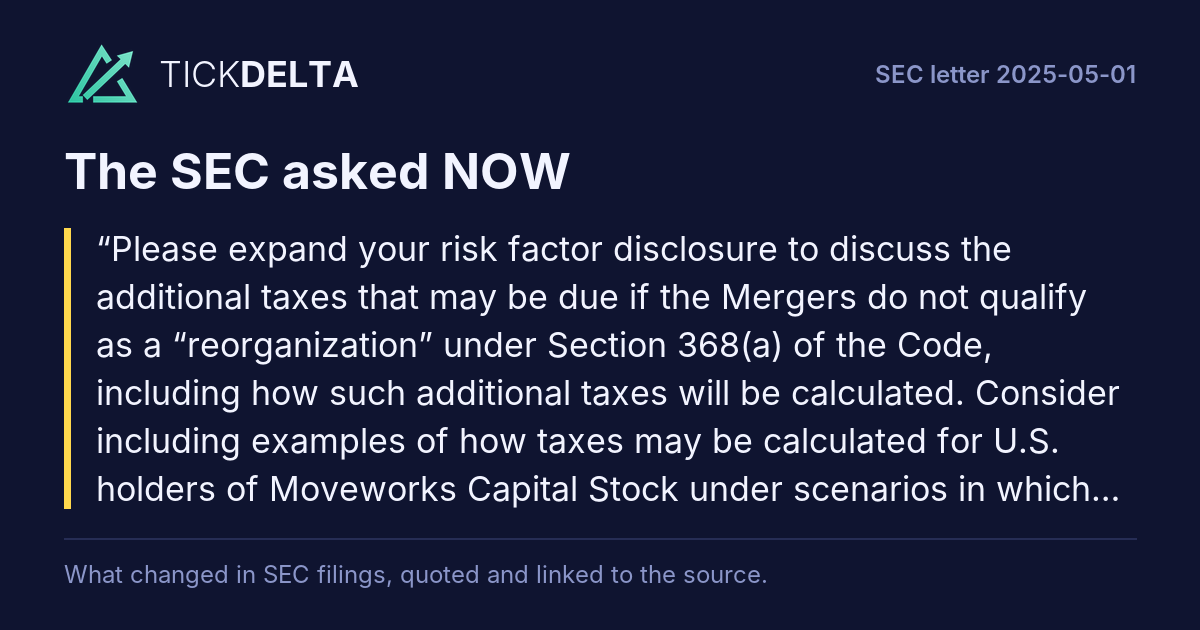
Please expand your risk factor disclosure to discuss the additional taxes that may be due if the Mergers do not qualify as a “reorganization” under Section 368(a) of the Code, including how such additional taxes will be calculated. Consider including examples of how taxes may be calculated for U.S.
Rest of the question

holders of Moveworks Capital Stock under scenarios in which the Mergers qualify and do not qualify as a "reorganization" under Section 368(a) of the Code.

NOW answered
The Company respectfully acknowledges the Staff’s comment and has revised the disclosure on page 18 of Amendment

No. 1 accordingly. Read in the reply ↗
U.S. Federal Income Tax Consequences of the Mergers · Tax Consequences of the Mergers, page 74
SEC asked (2)
We note your disclosure that the Mergers “are intended to qualify as a 'reorganization' within the meaning of Section 368(a) of the Code." We also note that two tax opinions were obtained and included as exhibits. Please revise your disclosure here and elsewhere to identify both tax counsels and summarize tax counsels' opinions regarding the tax consequences of the transaction.
Rest of the question

Also please ensure that the filed tax opinions are both signed and dated.

NOW answered
The Company acknowledges the Staff’s comment and has revised the referenced disclosure on page 74 of

Amendment No. 1, the prospectus cover page and the disclosures on pages 10, 12, 18, 47 and 69 of Amendment No. 1 to identify both tax counsels. The Company respectfully submits that the disclosure under the section entitled “U.S.

Federal Income Tax Consequences of the Mergers” on page 74 of Amendment No.
Rest of the answer

1 currently summarizes the substance of the opinions (i.e., the Mergers will qualify as a “reorganization” within the meaning of Section 368(a) of the Code), and the impact of such qualification on holders’ tax consequences is discussed in detail on pages 74, 75 and 76 of Amendment No. 1. Additionally, in response to the Staff’s comment, the Company has filed signed and dated tax opinions as Exhibit 8.1 and Exhibit 8.2 to Amendment No. 1.

We hope that the foregoing has been responsive to the Staff’s comments. If you have any questions, please contact me at (650) 470-4522 or Sonia K. Nijjar at (650) 470-4592.
Read in the reply ↗

Form 10-K for the Fiscal Year Ended December 31, 2022

2023-04-04 to 2023-09-14 · 5 questions · 1 letter from the SEC, 1 from the company
Review closed 2023-09-14
Income taxesRevenueNon-GAAP measures
SEC asked (1)
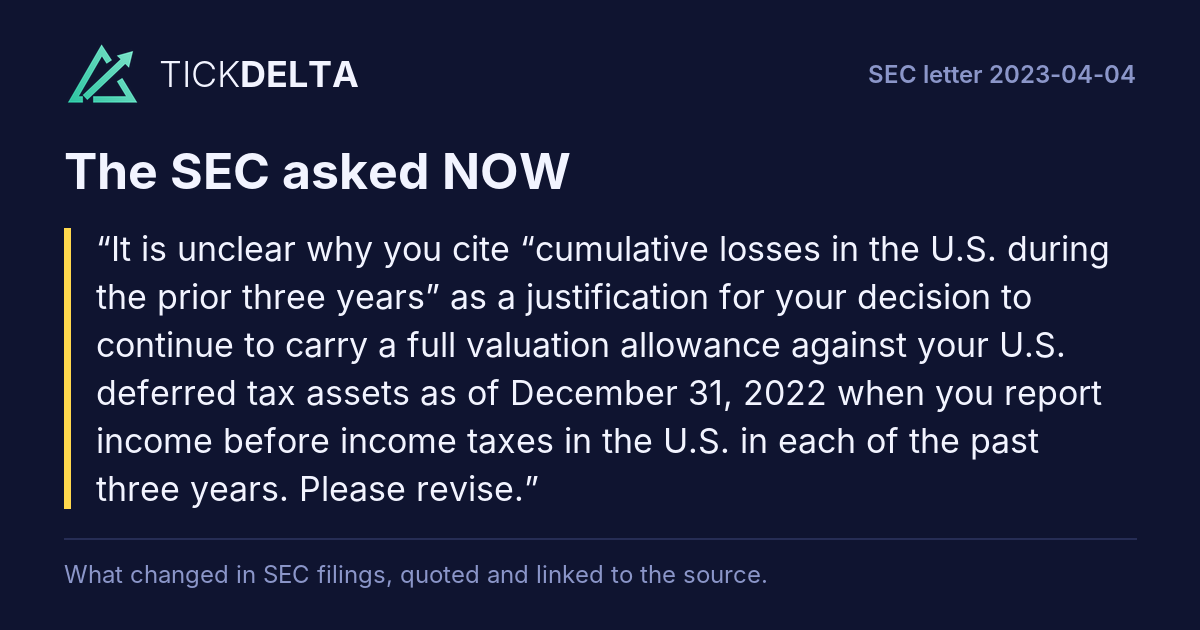
It is unclear why you cite “cumulative losses in the U.S. during the prior three years” as a justification for your decision to continue to carry a full valuation allowance against your U.S. deferred tax assets as of December 31, 2022 when you report income before income taxes in the U.S. in each of the past three years. Please revise.
NOW answered
As described in Accounting Standards Codification (“ASC”) 740-10-30-23, “a cumulative loss in recent years is a significant piece of negative evidence that is difficult to overcome.” However, ASC 740 does not define “cumulative losses in recent years.” In practice, a three-year period is a widely accepted benchmark used to analyze pretax income or loss from continuing operations, adjusted for permanent differences, discontinued operations and other comprehensive income. As noted, we reported U.S. pretax income from continued operations in each of the past three years.
Rest of the answer

However, after adjusting for permanent differences, primarily related to excess tax benefits from stock-based compensation (i.e., “windfalls”), the outcome results in a cumulative U.S. loss position in all reported periods. More specifically, as of December 31, 2022, the three-year total U.S. pre-tax income of $338 million was offset by the three-year total U.S. permanent differences and other comprehensive losses of approximately $720 million, resulting in a three-year cumulative U.S. loss of approximately $380 million.

We have enhanced our disclosure to more clearly specify the nature and amount of our cumulative loss position as of December 31, 2022. Please refer to our response to Comment 4 below, which provides the disclosure we included in our Form 10-Q for the period ended March 31, 2023.

Read in the reply ↗
SEC asked (2)
We note the disclosure on page 73. However, you do not provide clear disclosure of the objectively verifiable negative evidence that reasonably offsets the positive evidence in support of your conclusion that it is more likely than not that the entire balance of deferred tax assets will not be realized.
Rest of the question

Please identify for us all of the objectively verifiable negative evidence considered by management when determining that it is more likely than not that your U.S. deferred tax assets will not be realized as of December 31, 2022. Tell us where you disclosed this objectively verifiable negative evidence in your Form 10-K or revise as necessary.

NOW answered
Our description of Critical Accounting Policies and Significant Judgments and Estimates for income taxes, on page 34, included a description of factors considered when we determined that the U.S. valuation allowance was required. In particular, we disclosed that:

“Due to cumulative losses, including tax deductible stock compensation, and based on all available positive and negative evidence, we have determined that it is more likely than not that our U.S. deferred tax assets will not be realizable as of December 31, 2022.
Rest of the answer

Management applied significant judgment in assessing the positive and negative evidence available in the determination of the amount of deferred tax assets that were more likely than not to be realized in the future. In determining the need, or continued need, for a valuation allowance, we considered the weighting of the positive and negative evidence which includes, among other things, cumulative losses including tax deductible stock compensation expense, future growth, forecasted earnings and future taxable income…”

We also noted that:

“The exact timing and amount of the valuation allowance release are subject to change based on the level of sustained U.S. profitability that the Company is able to actually achieve, as well as the amount of tax deductible stock compensation dependent upon our publicly traded share price, foreign currency movements and macroeconomic conditions, among other factors…”

In making the valuation allowance determination, we observed that ASC 740-10-30-23 states “a cumulative loss in recent years is a significant piece of negative evidence that is difficult to overcome.” While the fiscal year ended December 31, 2022 was the first year in which the company had positive U.S. pretax income adjusted for permanent items, the Company has yet to realize a cumulative positive position. Estimates about uncertain future events, such as forecasted future taxable income, are much less objectively verifiable than historical results, such as recent cumulative losses. Accordingly, in weighing positive and negative evidence, we gave more weight to the cumulative loss in our assessment; we did not consider one year of positive results and forecasted future taxable income adjusted for permanent items to be sufficient evidence to overcome the evidentiary weight of the three-year cumulative loss.

Read in the reply ↗
SEC asked (3)
With respect to tax deductible stock compensation, we note in the rate reconciliation stock based compensation had the effect of raising the tax rate in 2022. Tell us the more likely than not effect of stock based compensation on your income taxes in 2023 and your basis for this conclusion.
NOW answered
In 2022, due to a decline in our stock price, non-deductible book stock compensation expense exceeded the excess tax benefits from tax-deductible stock compensation. This difference was included in the determination of the three-year cumulative loss which formed the basis for the more likely than not conclusion that a valuation allowance was needed.
Rest of the answer

Due to the inherent difficulty associated with forecasting our stock price, we concluded that the fair market value of the stock as of the 2022 balance sheet date was the most objectively verifiable way to forecast the stock-based compensation on our 2023 income taxes as it is the most recent information available. Accordingly, we held our stock price constant when considering the impact of future tax deductions from stock-based compensation in the U.S. Using this methodology, we expected that there would be an immaterial benefit from windfalls in 2023. However, this only takes into account awards already granted to employees as of December 31, 2022 and not future awards that were expected to be granted in 2023.

Read in the reply ↗
SEC asked (4)
With respect to positive evidence, in addition to income in the past three years, please explain how you considered management's guidance for 2023, which presumably is conservative. In this regard, we also note in the press release dated January 25, 2023 several positive statements from management such as from your Chairman and CEO, William McDermott, who said “ServiceNow continues to perform as a beyond
Rest of the question

expectations company” and “Our Q4 surge in new business shows that the secular tailwinds of digitization aren’t going anywhere." Also, your CFO, Gina Mastantuono, said “Q4 was another great quarter of execution as we exceeded our subscription revenue and profitability guidance” and “we outperformed our NNACV expectations, driven by robust net expansion and over 30% NNACV growth year-over-year from new logos. What’s more, our results were generated with a lower mix of early renewals from 2023, providing us more opportunities to drive further expansion throughout the year. With our strong results it's clear that ServiceNow remains a strategic priority, generating durable demand that is positioning us well for 2023 and beyond.”

NOW answered
Management’s estimate of future income is a factor we considered when weighing all available negative and positive evidence. Management’s forecast for 2023 earnings anticipates U.S. profitability and public statements by our CEO and CFO are aligned with this expectation. Determining the weight to give a forecast is a matter of significant judgment. In our judgment, the objectively verifiable evidence of the three-year cumulative U.S. loss through December 31, 2022 outweighed management’s positive guidance for 2023.
Rest of the answer

In our judgment, the strength of our forecasted profitability, when coupled with a cumulative twelve-quarter income position, would provide sufficient evidence of sustained profitability to support the release of the valuation allowance.

We included the following enhanced disclosure in our Form 10-Q for the quarter ended March 31, 2023:

“We maintain a full valuation allowance against our U.S. federal and state deferred tax assets. We regularly assess the need for a valuation allowance against our deferred tax assets. In making that assessment, we consider both positive and negative evidence related to the likelihood of realization of the deferred tax assets to determine, based on the weight of available evidence, whether it is more likely than not that some or all of the deferred tax assets will not be realized. As of December 31, 2022, the three-year cumulative U.S. pre-tax income of $338 million was offset by the three-year total U.S. permanent differences and other comprehensive losses of approximately $720 million, resulting in a three-year cumulative U.S. loss of approximately $380 million. Due to the cumulative U.S. losses during the prior twelve quarters, including permanent differences and other comprehensive losses, and based on all available positive and negative evidence, as of March 31, 2023 and December 31, 2022, we have determined that it is more likely than not that our U.S. deferred tax assets will not be realized. However, given our current U.S. earnings and anticipated future earnings, we believe there is a reasonable possibility that prior to the fourth quarter of 2023 sufficient positive evidence of sustained U.S. profitability may become available to allow us to reach a conclusion that the U.S. valuation allowance will no longer be needed. Release of the valuation allowance would result in the recognition of material U.S. federal and state deferred tax assets and a corresponding decrease to income tax expense estimated to be $1.0 billion to $1.2 billion in the fiscal year the release is recorded. The exact timing and amount of the valuation allowance release are subject to change based on the level of sustained U.S. profitability the Company is able to actually achieve.”

Read in the reply ↗
Form 8-K filed on January 25, 2023 · Exhibit 99.1, page 10
SEC asked (5)
Your GAAP to Non-GAAP reconciliation on pages 10-12 appears to include most of the major captions of the consolidated statements of operations, which gives undue prominence to your Non-GAAP financial measures. Please revise your presentation to comply with Question 102.10(c) of the Compliance and Disclosure Interpretations on Non-GAAP Financial Measures.
NOW answered
To better align with the guidance in Question 102.10(c) of the Compliance and Disclosure Interpretations on Non-GAAP Financial Measures (“CDIs”), we revised our earnings release disclosures to:

•remove the quantitative reconciliations for financial measures adjusted only for foreign currency rate fluctuations, in accordance with CDIs Question 104.06, and discontinue presenting reconciliations of cost of revenues and operating expense line items to the extent those items are not otherwise presented as non-GAAP financial measures.

•discontinue presenting reconciliations of cost of revenues
Rest of the answer

and operating expense line items to the extent those items are not otherwise presented as non-GAAP financial measures.

*****

Should the Staff have additional questions or comments regarding the foregoing, please do not hesitate to contact me at kevin.mcbride@servicenow.com.

Read in the reply ↗
In its next report

First report after the company's reply of 2023-05-02: 10-Q filed 2023-07-27 ↗.

No earlier 10-Q before the SEC's letter is in Tickdelta, so there is nothing to compare with.

Also in this review: closing letter, 2023-09-14

1 other letter: notices that a filing will not be reviewed, requests to declare a registration effective, and the like

From the SEC's correspondence on EDGAR: staff letters (form UPLOAD) and company letters (form CORRESP), 6 letters filed since 2023-04-04. Questions and answers are matched by their numbers; topics come from words in each question. The reports are compared word for word (same form, before the first SEC letter against the first report after the company's reply). No AI.

Work on NOW in a spreadsheet: Excel workbook (a sheet per section, ten years by column, charts, links to the filings) · CSV. For a Google Sheet that stays up to date, paste =IMPORTDATA("https://tickdelta.com/company/NOW/export.csv") into a cell.