Form 10-K
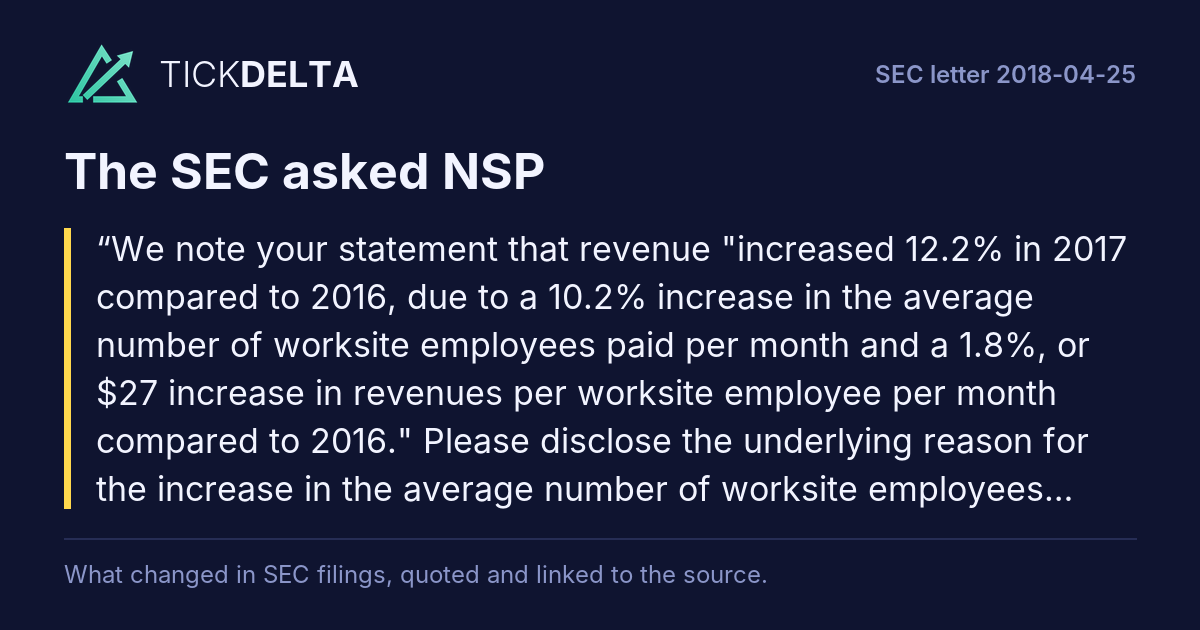
Please disclose, present and discuss the GAAP measure that is most comparable to adjusted EBITDA per WSEE per month with equal or greater prominence. Refer to Item 10(e)(1)(i)(A) of Regulation S-K and Question 102.10(a) of our Non-GAAP Financial Measures Compliance and Disclosure Interpretations.
In response to the Staff’s comment, when applicable, Insperity intends to incorporate such comparable GAAP disclosures with equal or greater prominence within its Executive Summary and Highlights discussion in its 2024 Annual Report on Form 10-K anticipated to be filed in February of 2025.Read in the reply
While Insperity proposes to modify its disclosures in future filings, an example of the proposed modification to the Executive Summary, 2023 Highlights, of the 2023 Form 10-K is provided in attachment #1 to this letter for reference with changes redlined.
First report after the company's reply of Nov 19, 2024: 10-K filed Feb 11, 2025 ↗, against the 10-K filed Feb 9, 2024 ↗.
Tickdelta does not hold the text of both reports, so they are not compared here.
Adjusted EBITDA and adjusted EPS and their growth percentages are non-GAAP measures. Please disclose their most comparable GAAP measures and growth percentages with equal or greater prominence. Refer to Item 10(e)(1)(i)(A) of Regulation S-K and Question 102.10(a) of our Non-GAAP Financial Measures Compliance and Disclosure Interpretations.Rest of the question
This comment also applies to your Forms 10-Q and the headline earnings section of your August 1, 2024 earnings release.
In response to the Staff’s comment, we have added the comparable GAAP measures and their growth percentages in equal or greater prominence in our Key Operating Metrics discussion of MD&A in our third quarter 2024 Form 10-Q filed on October 31, 2024.Read in the reply
We have included an example of this modification to our 2023 Form 10-K in attachment #1 to this letter for reference with changes redlined. In addition, we have included the change we made with our Form 10-Q filed on October 31, 2024 in attachment #2.
First report after the company's reply of Nov 19, 2024: 10-K filed Feb 11, 2025 ↗, against the 10-K filed Feb 9, 2024 ↗.
Tickdelta does not hold the text of both reports, so they are not compared here.
We note that you present “% change year over year” for the non-GAAP measures you reconcile here. Please disclose their most comparable GAAP measures with equal or greater prominence. Refer to Item 10(e)(1)(i)(A) of Regulation S-K and Question 102.10(a) of our Non-GAAP Financial Measures Compliance and Disclosure Interpretations. This comment also applies to your Forms 10-Q and earnings releases.
In response to the Staff’s comment, to the extent applicable, we have added in the comparable GAAP year over year percentage changes with equal or greater prominence in our third quarter 2024 Form 10-Q and our third quarter earnings release included in Item 2.02 of our Form 8-K, both of which were filed on October 31, 2024.Read in the reply
We have included an example of this modification to our 2023 Form 10-K in attachment #1 and to our fourth quarter 2023 earnings release included in Item 2.02 of our Form 8-K in attachment #4 for reference with changes redlined.Rest of the answer
In addition, we have included the change we made with our third quarter 2024 Form 10-Q in attachment #2 and our earnings release included in Item 2.02 of our Form 8-K in attachment #3, both of which were filed on October 31, 2024.
First report after the company's reply of Nov 19, 2024: 10-K filed Feb 11, 2025 ↗, against the 10-K filed Feb 9, 2024 ↗.
Tickdelta does not hold the text of both reports, so they are not compared here.
Please provide us the analysis you performed in concluding payroll tax revenues and expenses can be presented on a gross basis under ASC 606, despite your revenues being presented net for the directly-related payroll costs. Also, provide us the analysis you performed in determining that the payroll taxes can be separated from the directly-related payroll costs for ASC 606 accounting purposes.
The Company’s most comprehensive HR services offerings are provided through its Workforce Optimization® and Workforce SynchronizationTM solutions (together, the “PEO HR Outsourcing Solutions”) by its PEO subsidiary, Insperity PEO Services, L.P. The PEO HR Outsourcing Solutions encompass a broad range of HR functions, including, among others, employer payroll tax services (“Tax Services”) and other payroll services (“Payroll Services”).Read in the replyRest of the answer
These services are separately identified under the terms of the client service agreements (“CSA”) entered into by the Company with its customers.
Under the terms of the CSAs, the Company becomes a co-employer of its customer’s existing workforce (the worksite employees or “WSEEs”). As discussed further below, as a co-employer of the WSEEs, the Company is the statutory employer with primary responsibility for the Tax Services. The Company’s customers, however, maintain the obligation of, and have liability for, all worksite related activities and the provision of business services by WSEEs to their end consumers, including determining wages, making day-to-day assignments, supervision and training, and hiring of WSEEs.
In accordance with ASC 606-10-25-19 through 25-21, we determined that Tax Services and Payroll Services are separate, distinct performance obligations, as the customer can benefit from each of these services on its own. The terms of the CSA separately identify each of the services to be provided to the customer, and each of these services could be purchased separately by our customers either from us or from other third-party providers in the industry which only provide payroll tax services or payroll services. Accordingly, each service is capable of being distinct in accordance with ASC 606-10-25-19(a) and ASC 606-10-25-20.
As previously mentioned, the Company’s Tax Services may be performed for a customer even if the Company does not provide Payroll Services for that customer. Relevant examples that the Company considered in its ASC 606 analysis with respect to evaluating the distinct nature of its Tax Services and Payroll Services include:
•The Company provides Tax Services for non-cash payroll items such as equity compensation or deferred compensation, the amounts of which are determined by the customer and provided by the customer to the WSEEs.
•The Company also provides Tax Services associated with a customer’s direct payments to WSEEs such as a cash bonus or fringe benefit programs that are processed by the customer outside of the Company’s payroll system.
•The Company provides Payroll Services for teachers, ministers or self-employed owners but does not provide Tax Services.
As such, depending on each customer’s needs, the Company is able to provide one or both of the Tax Services and Payroll Services to a customer, indicating that the Tax Services and Payroll Services are not highly interdependent or interrelated. As a result, Tax Services and Payroll Services are distinct within the context of the contract in accordance with ASC 606-10-25-19(b) and ASC 606-10-25-21. Therefore, the Company determined that its Tax Services and its Payroll Services are separate, distinct performance obligations to its customers.
As it relates to the Payroll Services performance obligation, although the Company is the co-employer, the Company does not obtain control of the WSEEs business services before they are transferred to the customer. The customer makes hiring and firing decisions, determines the amount and frequency of wages and hours worked, and is responsible for the supervision and management of the WSEEs. The Company establishes and charges a contractually set service fee for the Payroll Services. Thus, the Company determined it is an agent in accordance with ASC 606-10-55-36 through 55-40, as amounts directly related to Payroll Services are “pass through” items for the Company based on the terms of its CSAs. Accordingly, revenues earned from Payroll Services and the corresponding costs of such revenues are presented on a net basis within the Company’s statement of income.
Conversely, with respect to its Tax Services, the Company is providing a service directly to its customer as the co-employer of the WSEE. That is, there is not another party involved in providing Tax Services to the customer. The Company therefore determined the transaction price using the guidance in ASC 606-10-32-2. Under this guidance, the transaction price is the amount of consideration to which an entity expects to be entitled to in exchange for transferring promised goods or services to a customer, excluding amounts collected on behalf of third parties. The Company considered whether the employer payroll taxes remitted to the relevant taxing authorities should be included within the transaction price on a gross basis or excluded from the transaction price as amounts collected on behalf of third parties. In making this determination, the Company considered the terms of its CSA and its customary business practices. The Company has discretion in establishing the rates that it charges its customers for providing the Tax Services. The amounts due and paid by the Company to the applicable taxing authorities for employer payroll taxes, however, are based on the applicable statutory rates established by the various government agencies. Under the CSA, the Company’s rights to change the service fees it charges its customers is limited; therefore, the Company bears the risk if a statutory rate change occurs.
In performing our analysis under ASC 606 regarding whether the Company is collecting amounts from the customer on behalf of a third party, the Company also considered the Small Business Efficiency Act (“SBEA”), which created a federal regulatory framework for the payment of wages to WSEEs and the reporting and remittance of federal payroll taxes on those wages paid by PEOs certified under the Internal Revenue Code as meeting certain requirements (“CPEOs”). The SBEA clarified that a CPEO (such as Insperity PEO Services, L.P), rather than the customer, is treated as the employer for purposes of reporting and remitting payroll taxes.
Under 26 CFR Section 301.7705-1(b)(3)(ii), CPEOs “[a]ssume responsibility for reporting, withholding, and paying any applicable federal employment taxes with respect to the individual’s wages, without regard to the receipt or adequacy of payment from the customer for the services.”
CPEO regulations issued by the Internal Revenue Service regarding CPEOs specify that the CPEO is solely liable for the reporting and payment of payroll taxes that are filed under the CPEO’s FEIN. See IRS website: https://www.irs.gov/tax-professionals/cpeo-customers-what-you-need-to-know.
Thus, as previously mentioned, the Company has sole liability with respect to, and is the statutory employer in terms of managing, reporting and remitting employer payroll taxes under the terms of its CSAs and relevant CPEO regulations, regardless of whether or not it receives payment from its customers for the Tax Services. That is, based on the terms of its CSAs and application of the relevant regulatory framework, the amounts are not “pass through” items for the Company. Though the SBEA framework above is specific to federal payroll taxes, the Company’s ASC 606 analysis also contemplated similar state-level payroll tax regulations. The Company has discretion in establishing rates charged for the Tax Services, which affects the pricing or mark-up for each customer with which it executes a CSA and which contributes, in part, to the Company’s profitability. Accordingly, the taxes paid on wages are not collected from the customer on behalf of a third party and the Company is solely responsible to the taxing authorities for the employer payroll taxes. The Company therefore includes the full amount of the consideration it expects to be entitled to in exchange for providing Tax Services to the customer within the transaction price and the revenues earned from Tax Services and the corresponding costs of such revenues are presented on a gross basis within the Company’s statement of income.
First report after the company's reply of Nov 19, 2024: 10-K filed Feb 11, 2025 ↗, against the 10-K filed Feb 9, 2024 ↗.
Tickdelta does not hold the text of both reports, so they are not compared here.
Also in this review: request for more time, Nov 5, 2024, closing letter, 2025-01-30