Netscout Systems Inc NTCT
New risk paragraphs, branching off last year
Each branch is a paragraph in Risk Factors with nothing like it in the 10-K filed May 15, 2025. A box jumps to the paragraph as filed, below.
Paragraphs with nothing like them in last year's 10-K
35 paragraphs in Risk Factors of the 10-K filed May 14, 2026 with nothing like them in the 10-K filed May 15, 2025. Quoted exactly. Paragraphs that were only edited are under 10-K change.
•If we are unable to effectively use or integrate AI, or if our use of AI exposes us to significant risks, we may not achieve intended benefits and our results of operations could be adversely affected.
•Disruptions in our global supply chain and our reliance on sole or limited source suppliers could adversely impact our business.
•A portion of our revenue is generated by sales to government entities, which are subject to a number of challenges and risks.
•Our success depends on our ability to protect our intellectual property rights.
•Our business is subject to laws, regulations and expectations relating to sustainability, human capital, governance and other corporate responsibility matters, which could increase costs and expose us to additional risks.
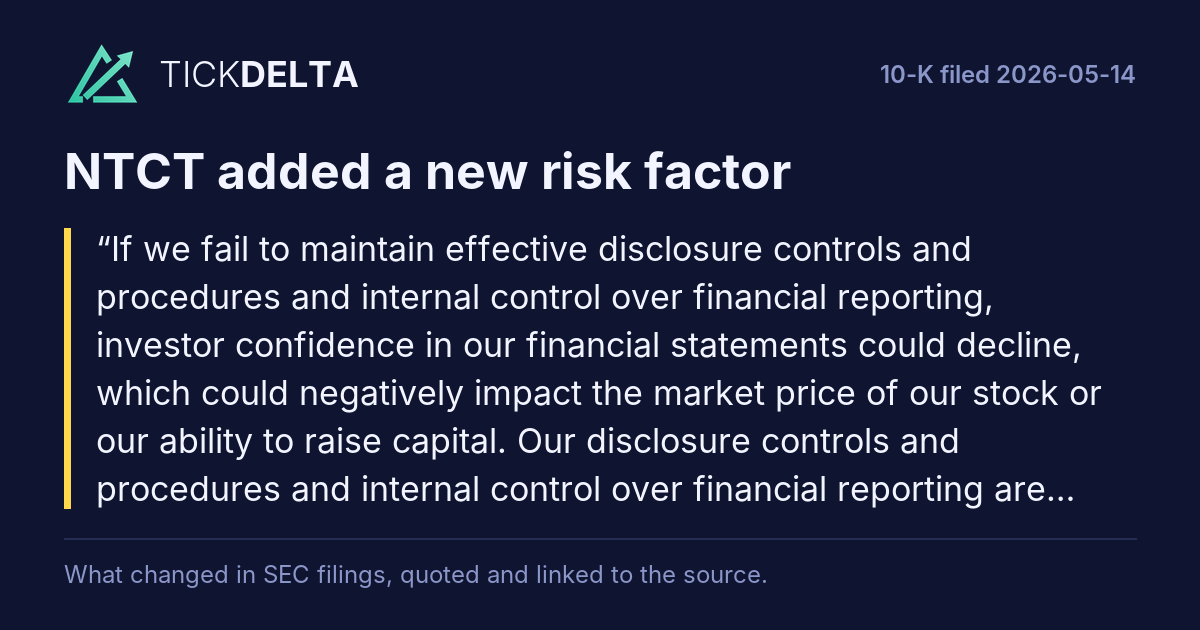
•If we fail to maintain effective disclosure controls and procedures and internal control over financial reporting, investor confidence in our financial statements could decline, which could negatively impact the market price of our stock or our ability to raise capital.
In addition, advances in tools and automation, including artificial intelligence (“AI”), may both increase the speed and sophistication with which vulnerabilities are identified or exploited and influence how vulnerabilities are detected, prioritized, and remediated.
Show the other 12
If we are unable to effectively use or integrate AI, or if our use of AI exposes us to significant risks, we may not achieve intended benefits and our results of operations could be adversely affected.
We have integrated, and plan to further integrate, AI technologies developed by third parties and open-source communities into our products, services, and internal operations. These AI-related initiatives, whether successful or not, could require us to incur substantial costs and could result in delays in developing, enhancing, or releasing products and services.
In addition, AI algorithms and models may be flawed, and the datasets underlying them may be insufficient, outdated, or contain biased or otherwise problematic information. If AI tools that we develop, integrate, or use, including AI systems that operate with varying levels of autonomy and may interact with other systems or tools, generate outputs, analyses, or recommendations that are or are alleged to be deficient, inaccurate, or biased, our reputation, business, financial condition, and results of operations may be adversely affected.
AI technologies, including those integrated into our products, services or operations or used by our workforce or vendors, are subject to evolving laws and regulations and increased scrutiny, including with respect to data privacy, cybersecurity and intellectual property.
The use of AI by third parties or us may increase the risk of cybersecurity incidents or unauthorized access and could expose sensitive, confidential, proprietary, or personal data. In addition, while we have policies, protocols, and procedures in place, our use of AI may increase the risk of claims that our use of data, training materials, or outputs violates contractual, legal, or ethical standards, including with respect to intellectual property. Any legislation or regulatory requirements concerning AI adopted domestically or globally may require us to expend significant resources to comply, lead to regulatory investigations, fines, or penalties, require changes to our products, services, or business practices, or prevent or limit our use of AI. In addition, our use of third-party AI services may subject us to risks related to service availability, performance, and cost volatility.
In addition, if we are unable to effectively integrate AI into our products and services, or if our competitors adopt AI more rapidly or successfully, our competitive position may be adversely affected.
Disruptions in our global supply chain and our reliance on sole or limited source suppliers could adversely impact our business.
We rely on a global supply chain for the production of components for our products. Disruptions to the global supply chain generally and hardware shortages caused by the rapid build out of AI data centers have led to and could in the future continue to lead to delays, shortages, longer than normal lead times, unfavorable contractual terms relating to pricing and refundability and cancellation, discontinued components, and increased costs, which could negatively impact our revenue and our results of operations. Continued price increases across our supply chain may adversely affect our gross margins.
In response, we may take steps to mitigate supply-chain issues, including entering into additional or long‑term purchase commitments with suppliers or maintaining higher inventory levels. However, these actions could negatively impact our cash flow and financial results if we do not accurately forecast customer demand or if customers change their purchasing patterns in response to evolving supply‑chain conditions. We continue to monitor supply‑chain categories and key suppliers to manage these risks.
A portion of our revenue is generated by sales to government entities, which are subject to a number of challenges and risks.
Our public sector sales are conducted primarily through third‑party distribution and other intermediary arrangements or channel partners, which may limit our control over certain aspects of the sales process and increase our reliance on a limited number of such distributors or channel partners.
Selling to government entities can be highly competitive, expensive, and time-consuming, and often requires significant upfront time and expense without any assurance that we will win a sale. In addition, certain government customers require our products and service offerings to obtain and maintain specific certifications, authorizations, or accreditations, before they may be deployed. The process of obtaining and maintaining such certifications, authorizations, or accreditations can be costly, time-consuming and subject to evolving standards and ongoing compliance requirements, and there can be no assurance that we will obtain, maintain or timely renew any required certifications, authorizations, or accreditations. If we fail to do so, or if applicable requirements change, we may be unable to sell to certain government customers or may incur additional costs, which could adversely affect our public sector revenue.
Government demand and payment for our products and service offerings may also be impacted by public sector budgetary cycles and funding authorizations, with funding reductions or delays adversely affecting public sector demand for our offerings. Actual or threatened government shutdowns, continuing resolution, sequestration and other fiscal or budgetary disruptions may delay procurements, contract awards, renewals and payments, reduce spending on cybersecurity initiatives and otherwise adversely affect our public sector revenue and cash flows. Government entities may also have statutory, contractual or other legal rights to terminate contracts with us for convenience or due to a default, and any such termination may adversely affect our future operating results.
In the United States, federal government agencies may promulgate regulations, and the President may issue executive orders, requiring federal contractors to adhere to different or additional requirements after a contract is signed. Government contract laws and regulations affect how we do business with our customers and, in some instances, impose added costs on our business, including the establishment of compliance procedures and obtaining and maintaining required security clearances. If we do not meet applicable requirements of law or contract, we could be subject to fines and penalties, contract termination, suspension or debarment from government contracting, or other adverse consequences, which could materially and adversely affect our business, results of operations and financial condition.
We derive nearly all our revenue from the sale of products and services that are designed to protect our customers from cyberattacks and performance and availability disruptions. We have expanded our operations in the past through acquisitions and
material and adverse impact on our business, operating results and financial condition. Sales to customers outside the United States accounted for 45%, 43%, and 36% of our total revenue for the fiscal years ended March 31, 2026, 2025 and 2024, respectively.
We rely on third-party suppliers, manufacturers and service providers globally, and these parties may be impacted by such events, including through facility closures, workforce disruptions, transportation constraints, border closures, or restrictions on the export, import, or shipment of products. These disruptions may result in the delays or interruptions in product availability, increased costs, or reduced demand of our products and services, which could adversely affect our revenues and operating results.
In addition, our operations depend on the effective functioning of our technology infrastructure and systems, many of which are operated or hosted by third parties. The business continuity and disaster recovery programs we maintain may not anticipate or effectively address every risk scenario, and they may not always be fully or even partially successful or effective in preventing or mitigating third-party risks, which are out of our control, that could have a material impact on our business, operations and financial condition. A significant disruption could result in the loss of data, delays in completing sales or providing products and services, challenges in producing accurate and timely financial statements, or difficulties in meeting our disclosure obligations, which could adversely affect our reputation and the trading price of our common stock.
We are party to a Third Amended and Restated Credit Agreement, which provides for a five-year $600 million senior secured revolving credit facility, including a letter of credit sub-facility of up to $75 million. We may elect to use the credit facility for working capital or for other capital allocation purposes. The commitments under the Third Amended and Restated Credit Agreement
will expire on October 4, 2029, and any outstanding loans will be due on that date. As of the date of this report, we did not have any amounts outstanding under the Third Amended and Restated Credit Agreement.
Moreover, our debt level can have negative consequences, including exposing us to future interest rate risk. We may incur additional debt in the future, and there can be no assurance that our cost of funding will not substantially increase at that time.
•the potential loss of key employees, customers, distributors, or suppliers; and
We could be materially adversely affected by increased regulation of the Internet in any country where we operate, as well as access to or commerce conducted on the Internet. Governments may change or increase regulations or impose restrictions on sales, licensing, distribution, and the exporting or importing of certain technologies to or from certain countries.
Failure to comply with applicable laws and regulations governing Internet access could subject us to investigations, sanctions, enforcement actions, lost profits, fines, damages, civil and criminal penalties, injunctions or other consequences, and could materially
adversely affect our business, reputation, results of operations and financial condition. In addition, responding to any action will likely result in a significant diversion of management’s attention and resources.
Our business is subject to laws, regulations and expectations relating to sustainability, human capital, governance and other corporate responsibility matters, which could increase costs and expose us to additional risks.
If we fail to maintain effective disclosure controls and procedures and internal control over financial reporting, investor confidence in our financial statements could decline, which could negatively impact the market price of our stock or our ability to raise capital.
Our disclosure controls and procedures and internal control over financial reporting are designed to provide reasonable assurance regarding the reliability of our financial reporting and the preparation of financial statements in accordance with applicable accounting standards. Like all control systems, they are subject to inherent limitations and may not prevent or detect all errors, misstatements or intentional misconduct. These limitations may arise from, among other things, management judgments, human errors, misinterpretation of information or circumvention of controls.
Paragraphs in the 10-Q filed Nov 5, 2026 that were not in the one before
New in the latest 10-Q
12 paragraphs in the 10-Q filed Nov 5, 2026 with nothing like them in the 10-Q filed Aug 6, 2026 (at least half the words must differ; new numbers alone do not count). Quoted exactly, grouped by the item heading above them. This is text that changed, not a judgement of how serious it is.
Financial statements and notes
(a) Notional amounts represent the gross contract/notional amount of the derivatives outstanding.
Read in the 10-Q
September 30, 2026 September 30, 2025 Location September 30, 2026 September 30, 2025
Read in the 10-Q
NOTE 17 - SEGMENT AND GEOGRAPHIC INFORMATION The Company's operating segments are determined based on the units that constitute a business for which discrete financial information is available and for which operating results are regularly reviewed by the chief operating decision-maker (CODM). The Company's President and CEO is the CODM. Operating results are reviewed by the CODM at the consolidated entity level for the purpose of making resource allocation decisions and for evaluating financial performance, primarily by monitoring actual results
Read in the 10-Q
from operations to adjusted EBITDA. Investors are encouraged to review the related GAAP financial measures and the reconciliation of these non-GAAP financial measures to their most directly comparable GAAP financial measures included in the attached tables within this Quarterly Report.
Read in the 10-Q
Beginning with the three months ended September 30, 2026, we revised our definitions of non-GAAP gross profit, non-GAAP income from operations, non-GAAP net income, and adjusted EBITDA to no longer adjust for acquisition-related depreciation expense, as such amounts are not currently material. We may adjust for acquisition-related depreciation expense in future periods if such amounts become material. The change does not impact our financial position, cash flows, or GAAP consolidated results of operations. Prior-period non-GAAP financial measures presented have been recast to conform to the current presentation.
Read in the 10-Q
Show the other 7
gross profit percentage was consistent at 73% during the six months ended September 30, 2026 as compared with the six months ended September 30, 2025.
Read in the 10-Q
Revenue Revenue Interest and other income (expense), net $ 7,564 2% $2,632 1% $ 4,932 187%
Read in the 10-Q
Six Months Ended September 30, (in thousands) 2026 2025 ───────────────────────────────────────────────────────────────────────────────────────────────────────────────────────── Cash used in investing activities included the following: Purchase of marketable securities and investments $ (60,310) $ (50,589) Proceeds from sales and maturity of marketable securities 46,250 30,362 Purchase of fixed assets (4,133) (4,111) Proceeds from sale of equity investment — 11,772 Acquisition of business (55,000) — Capitalized software development costs (4,964) — $ (78,157) $ (12,566)
Read in the 10-Q
Other information
Sanjay Munshi, Former Chief Operating Officer August 20, 2026 Rule 10b5-1 Trading Arrangement Up to 7,863 shares to be sold September 15, 2027 N/A
Read in the 10-Q
John Downing, Executive Vice President, Worldwide Sales Operations September 10, 2026(3) Rule 10b5-1 Trading Arrangement Up to 40,000 shares to be sold February 25, 2028 N/A
Read in the 10-Q
Represents the expiration date of the Rule 10b5-1 Trading Arrangement. Pursuant to the terms of the Rule 10b5-1 Trading Arrangement, the Rule 10b5-1 Trading Arrangement may terminate earlier upon the occurrence of certain events.
Read in the 10-Q
There are no overlapping transactions between Mr. Downing’s 10b5-1 trading arrangement adopted on September 10, 2026 and his arrangement adopted on November 11, 2025.
Read in the 10-Q
The 10-Q's risk factors against the 10-K
Item 1A of the 10-Q filed Nov 5, 2026 against Item 1A of the 10-K filed May 14, 2026.
A 10-Q repeats only the risks that changed, so a 10-K paragraph that is missing from it is not counted as removed.
Added is a paragraph with nothing like it in the 10-K, Reworded a sentence that is in both with several words changed,
Quiet changes a sentence in both where one to four words changed and one is a hedge or a modal
(cut words struck through, new words highlighted).
Text on the page, not a score; each links to the filing at sec.gov.
1 paragraph in the 10-Q's Item 1A, and none of them adds, rewords or quietly edits a paragraph of the 10-K's.
Phrases used for the first time
Two-word phrases in Risk Factors of the 10-K filed May 14, 2026 that are in none of the 1 earlier 10-Ks stored, back to May 15, 2025
Where each one is used
- enterprise network: •The success of our business depends, in part, on the continued growth in the market for and the continued commercial demand for enterprise network observability, carrier service assurance, cybersecurity, and DDoS protection solutions.
- network observability: •The success of our business depends, in part, on the continued growth in the market for and the continued commercial demand for enterprise network observability, carrier service assurance, cybersecurity, and DDoS protection solutions.
- observability carrier: •The success of our business depends, in part, on the continued growth in the market for and the continued commercial demand for enterprise network observability, carrier service assurance, cybersecurity, and DDoS protection solutions.
- carrier service: •The success of our business depends, in part, on the continued growth in the market for and the continued commercial demand for enterprise network observability, carrier service assurance, cybersecurity, and DDoS protection solutions.
- ddos protection: •The success of our business depends, in part, on the continued growth in the market for and the continued commercial demand for enterprise network observability, carrier service assurance, cybersecurity, and DDoS protection solutions.
- protection solutions: •The success of our business depends, in part, on the continued growth in the market for and the continued commercial demand for enterprise network observability, carrier service assurance, cybersecurity, and DDoS protection solutions.
- corporate responsibility: •Our business is subject to laws, regulations and expectations relating to sustainability, human capital, governance and other corporate responsibility matters, which could increase costs and expose us to additional risks.
- global supply: •Disruptions in our global supply chain and our reliance on sole or limited source suppliers could adversely impact our business.
Used at least twice, small words left out. Counted, not picked: a phrase can be new because the company renamed something.
What was taken out
9 paragraphs of last year's Risk Factors with nothing like them now. The longest are quoted.
Sources
Item 1A of each 10-K and 10-Q on EDGAR, quoted exactly. Each paragraph links to the filing at sec.gov.
Also
10-K change: what was reworded or cut, section by section.
Work with it
Excel workbook · CSV. Google Sheet that stays up to date: paste =IMPORTDATA("https://tickdelta.com/company/NTCT/export.csv") into a cell.