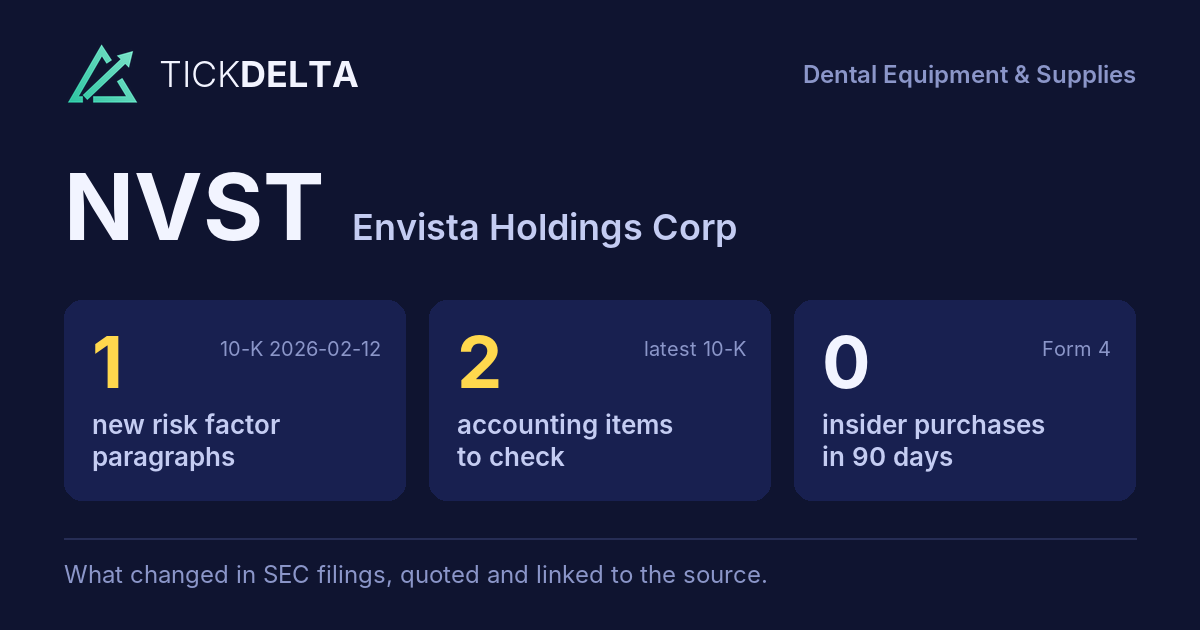
Screener / SEC EDGAR /CIK 0001757073 /10-K filed Feb 12, 2026, compared with Feb 13, 2025 /Numbers from the XBRL of the 10-Ks
NYSE Health care · Dental Equipment & Supplies

Envista Holdings Corp NVST

Compare with peers Embed
The 10-K against last year's

129 changes: 9 added, 33 removed, 84 reworded, 3 quiet changes

10-K Feb 12, 2026 vs Feb 13, 2025

10-K 0001757073-26-000011 (Feb 12, 2026) vs 10-K 0001757073-25-000007 (Feb 13, 2025)

Every paragraph, and how much of it changed

One bar per paragraph, in the order of the 10-K. Height and colour show the share of its words not in the closest paragraph a year earlier; the tallest bars are new paragraphs.

Risk Factors

235 paragraphs · 1 new · 43 reworded · 19 gone · 10-K Feb 12, 2026 against Feb 13, 2025
New paragraph Reworded (5% of its words or more) Same or nearly
Paragraph 69 · 50% changed Every version of it
In particular, trade tensions between the U.S. and China have led to increased tariffs and trade restrictions. In addition, The U.S. has significantly increased tariffs on products imported from China into the U.S. has recently and implemented new tariffs on China and proposed to significantly increase tariffs on foreign imports into the U.S. from other countries, particularly from Canada Canada, Mexico, and Mexico. It is difficult the EU. In response to predict what further trade-related actions governments may take, these tariffs, some foreign countries, including China, have instituted retaliatory tariffs, which may include trade restrictions and additional or increased impact our products, while other countries have threatened retaliatory tariffs and export controls imposed on short notice, and we may be unable to quickly and effectively react to or mitigate such actions. certain U.S. products.
Paragraph 70 · 49% changed Every version of it
As of the date of this Annual Report on Form 10-K, discussions remain ongoing in respect of such trade restrictions and tariffs as well as retaliatory tariffs enacted in response to such actions. In particular, light of these events, there continues to exist significant uncertainty about the future trade tensions relationships between the U.S. and China have led other countries with respect to increased such trade policies, treaties, and tariffs and trade restrictions. In addition, the U.S. has recently implemented new tariffs on China and proposed to significantly increase tariffs on foreign imports into the U.S. from other countries, particularly from Canada and Mexico. It it is difficult to predict what further trade-related actions governments may take, which may include trade restrictions and additional or increased tariffs and export controls imposed on short notice, and we may be unable to quickly and effectively react to or mitigate such actions. We have already experienced an increase in costs attributable to higher tariffs. To the extent that we are unable to offset the tariffs or if the tariffs or our countermeasures negatively impact demand, our business, profitability, financial condition, results of operations or cash flows will continue to be adversely affected. Any future tariffs and trade restrictions may also adversely affect our business, financial condition, results of operations or cash flows.
Paragraph 100 · 49% changed Every version of it
As a global healthcare organization, we are subject to relatively stringent data privacy and security laws, regulations, and customer-imposed controls in numerous jurisdictions as a result of having access to and processing confidential, personal and/or sensitive data in the course of our business. Our subcontractors and vendor vendors to whom we outsource our information technology systems are also subject to the requirements of data privacy and security laws, regulations, and controls. For example, in the U.S., the Health Insurance Portability and Accountability Act a discussion of 1996 (“HIPAA”) privacy, security, and breach notification rules require certain of our operations to maintain controls to protect the confidentiality, availability, and integrity of patient health information. In addition, individual states regulate these data breach notification requirements as well as more general privacy and security requirements. Entities within the U.S. that are found laws and regulations, please refer to be in violation of HIPAA, for example as the result of a breach of unsecured protected health information, a complaint about privacy practices, or an audit by HHS, may be subject to significant civil, criminal “Item 1. Business—Regulatory Matters—Data Privacy and administrative fines and penalties and/or additional reporting and oversight obligations if required to enter into a resolution agreement and corrective action plan with HHS to settle allegations of HIPAA non-compliance. Security Laws.”
Paragraph 116 · 45% changed Every version of it
•Our Our success depends on our ability to manage executive leadership transitions and to attract, develop and retain our key personnel is critical to our success. personnel.
Paragraph 215 · 43% changed Every version of it
In addition, because we have not chosen to be exempt from Section 203 of the Delaware General Corporation Law (the “DGCL”), this provision could also delay or prevent a change of control that you may favor. Section 203 provides that, subject to limited exceptions, persons that acquire, or are affiliated with a person that acquires, more than 15% of the outstanding voting stock of a Delaware corporation (an “interested stockholder”) shall not engage in any business combination with that corporation, including by merger, consolidation or acquisitions of additional shares, for a three-year period following the date on which the person became an interested stockholder, unless (i) prior to such time, the board of directors of such corporation approved either the business combination or the transaction that resulted in the stockholder becoming an interested stockholder; (ii) upon consummation of the transaction that resulted in the stockholder becoming an interested stockholder, the interested stockholder owned at least 85% of the voting stock of such corporation at the time the transaction commenced (excluding for purposes of determining the voting stock outstanding (but not the outstanding voting stock owned by the interested stockholder) the voting stock owned by directors who are also officers or held in employee benefit plans in which the employees do not have a confidential right to tender or vote stock held by the plan); or (iii) on or subsequent to such time the business combination is approved by the board of directors of such corporation and authorized at a meeting of stockholders by the affirmative vote of at least two-thirds of the outstanding voting stock of such corporation not owned by the interested stockholder. We believe these provisions will protect our stockholders from coercive or otherwise unfair takeover tactics by requiring potential acquirers to negotiate with our board Board of directors Directors and by providing our board Board of directors Directors with more time to assess any acquisition proposal. These provisions are not intended to make us immune from takeovers. However, these provisions will apply even if the offer may be considered beneficial by some stockholders and could delay or prevent an acquisition that our board Board of directors Directors determines is in the best interests of us and our stockholders. These provisions may also prevent or discourage attempts to remove and replace incumbent directors.
Paragraph 16 · 40% changed Every version of it
•Our success depends on our ability to manage executive leadership transitions and to attract, develop and retain our key personnel is critical to our success. personnel.
Paragraph 231 · 36% changed Every version of it
The U.S. Congress, government agencies in non-U.S. jurisdictions where we and our affiliates do business, business and the Organisation for Economic Co-operation and Development (“OECD”) Development, have recently focused continued to focus on issues related to the taxation of multinational corporations. One example is in the area of “base erosion and profit shifting,” where profits are claimed to be earned for tax purposes in low-tax jurisdictions, or payments are made between affiliates from a jurisdiction with high tax rates to a jurisdiction with lower tax rates. The OECD has released several components of its comprehensive plan to create an agreed set of international rules for addressing base erosion and profit shifting. As a result, the tax laws in the U.S. and other countries in which we do business could change on a prospective or retroactive basis, and any such changes could adversely affect our business business, financial condition, and financial statements. results of operations.
Paragraph 154 · 31% changed Every version of it
In addition, the increasing concern over climate change has resulted and may continue to result in more regional, federal, and/or global legal and regulatory requirements relating to climate change, including regulating The regulations surrounding greenhouse gas emissions, alternative energy policies emissions disclosures and sustainability initiatives, such as the State of California’s new climate change disclosure rules. Changes in environmental laws and regulations, in particular relating reporting have also continued to climate change and greenhouse gas emissions, could require us, or our contract manufacturers or suppliers, to install additional equipment, or alter operations to incorporate new technologies or processes, which may result in additional expenses and adversely affect our operating results. In addition, regulators, customers, investors, employees evolve, with compliance requirements varying by jurisdiction. Governments, regulatory bodies and other stakeholders are focusing more on vary in their support of or opposition to sustainability and environmental matters in different jurisdictions in which we operate, which can lead to rapid shifts in reporting obligations and related disclosures. differing obligations across these jurisdictions. Both the standard setting and regulatory landscapes are also extremely complex and present significant compliance and communication challenges in light of these uncertain and varied approaches to greenhouse gas emissions disclosures and sustainability reporting. These changing rules, regulations and stakeholder expectations have resulted in, and are likely to continue to result in, increased general and administrative expenses and increased management time and attention spent meeting such regulations and expectations and complying with disclosure requirements. If legislation or regulations are enacted or promulgated in the U.S. or in any other jurisdictions in which we do business that impose more stringent restrictions and requirements than our current legal or regulatory obligations, we may experience disruptions in, or increases in the costs associated with, sourcing, manufacturing and distributing our products, which may adversely affect our business, results of operations and financial condition. Any such regulatory changes could have a significant effect on our operating and financial decisions, including those involving capital expenditures to reduce emissions and comply with other regulatory requirements.

MD&A

108 paragraphs · 8 new · 56 reworded · 14 gone · 10-K Feb 12, 2026 against Feb 13, 2025
New paragraph Reworded (5% of its words or more) Same or nearly
Paragraph 42 · 44% changed
The increase in cost of sales and decrease in gross profit margin during the year ended December 31, 2024, 2025, as compared to the comparable period in 2023, 2024, was driven primarily driven by higher sales volume, higher costs due to the unfavorable product mix, impact of foreign currency exchange rates, and increased tariffs, partially offset by the absence of impairment of related to certain long-lived assets and lower period-over-period savings associated with productivity improvements. The decrease in gross profit margin percentage was further impacted by lower volume driven by channel inventory realignment, and changes to revenue deferral related to our clear aligner treatment plans, partially offset by a 0.7% increase in sales price. from the comparable prior period.
Paragraph 43 · 42% changed
The increase in cost of sales and decrease in gross Gross profit margin during the year ended December 31, 2024, percentage was flat as compared to the comparable period in 2023, was 2024 driven primarily driven by unfavorable product mix, positive factors such as higher sales volume including the impairment impact from the timing of certain long-lived assets and lower period-over-period savings associated with productivity improvements. The decrease in gross profit margin percentage was further impacted by lower volume driven by channel inventory realignment, and changes to deferred revenue deferral recognition related to our clear aligner treatment plans, partially offset by a 0.7% an increase in sales price. price, manufacturing productivity, and the absence of impairment related to certain long-lived assets from the comparable prior period, offset by unfavorable product mix and higher costs due to the unfavorable impact of foreign currency exchange rates and tariffs.
Paragraph 54 · 42% changed
Geographically, sales for the year ended December 31, 2024 decreased primarily due to lower demand in 2025 were positively impacted by higher sales from North America and Europe, partially offset by Russia. Europe.
Paragraph 50 · 40% changed
Our effective tax rate for the year ended December 31, 2024 2025 was (3.1)% 73.5% compared to (82.5)% (3.1)% in 2023. 2024. The change in the effective rate was primarily due to larger the impact of nondeductible impairment charges for goodwill and intangible assets in 2024 and a change in the current year compared indefinite reinvestment assertion related to the prior year. restructuring of a foreign subsidiary with certain intercompany loans in 2025. We anticipate the restructuring will have a beneficial tax impact going forward.
Paragraph 103 · 35% changed
As part of our second quarter assessment, we also reviewed our For indefinite-lived intangible assets for impairment and test, we used the relief from royalty method to estimate the fair value of such assets. value. Our significant assumptions vary amongst, and are specific to, each underlying indefinite-lived intangible asset which includes, but is not limited to, discount rates, revenue growth rates assumptions (including perpetual growth rates) and royalty rates. As a result of our indefinite-lived intangible asset impairment test at June 28, 2024, we recorded an impairment charge of $101.1 million related to certain indefinite-lived trade names within the Specialty Products & Technologies segment. The reduction in value is primarily due to a reduction in projected cash flows as discussed above.
Paragraph 64 · 32% changed
Net cash provided by operating activities was $336.5 $275.7 million during the year ended December 31, 2024, 2025, as compared to net cash provided by operating activities of $275.7 $336.5 million in 2023. 2024. The increase decrease is primarily due to better overall working capital management lower prior year incentive compensation payments, combined with the timing of cash collections, inventory payments, vendor payments and tax payments. payments, partially offset by higher net income.
Paragraph 8 · 32% changed
Increasing protectionism and economic nationalism may lead to further changes in trade policies and regulations, domestic sourcing initiatives, or other formal and informal measures that could make it more difficult to sell our products in, or restrict our access to, some to certain markets. In particular, For example, trade tensions between the U.S. and China have led to increased tariffs and trade restrictions. In addition, The U.S. has significantly increased tariffs on products imported from China into the U.S. has recently and implemented new tariffs on China and proposed to significantly increase tariffs on foreign imports into the U.S. from other countries, particularly from Canada Canada, Mexico, and Mexico. the EU. In response to these tariffs, some foreign countries, including China, have instituted retaliatory tariffs, which impact our products, while other countries have threatened retaliatory tariffs on certain U.S. products. It is difficult to predict what further trade-related actions governments may take, which may include trade restrictions and additional or increased tariffs and export controls imposed on short notice. Existing While we expect to largely offset the impact of the existing tariffs with mitigating actions including supply chain adjustments, pricing strategies, and cost management, we have already experienced an increase in cost due to higher tariffs. To the extent that we are unable to offset the tariffs or if the tariffs or our countermeasures negatively impact demand, our business, financial condition, results of operations or cash flows will continue to be adversely affected. Any future tariffs and trade restrictions may have a material adverse effect on also adversely affect our business and business, financial condition, results of operations. operations or cash flows.
Paragraph 46 · 32% changed
The increase in R&D expenses as a percentage of sales for the year ended December 31, 2024, was consistent with 2025, as compared to the comparable period of 2024, was driven by increased investment in 2023. existing R&D projects and new product development initiatives.

A paragraph is matched with the one last year that shares the most of its words; under half in common makes it new. The paragraphs shown are the 8 reworded the most in each section.

The paragraph that changed most in each section

The redline

Marked against last year's 10-K: cut words struck through, new words highlighted.

MD&A205 words changed in this paragraph; it is 47% similar to last year's version.
During the second fourth quarter ended June 28, 2024 and prior to of 2025, we performed our annual goodwill and indefinite-lived intangible asset impairment test. For our goodwill test, we identified indicators used a combination of a "more likely than not" impairment related to various reporting units within our Specialty Products & Technologies and Equipment & Consumables segments. As part of our second quarter evaluation, we used the valuation techniques, including an income approach in performing our goodwill impairment test in order and a market-based approach to determine whether it is more likely than not that the fair value of a reporting unit is less than its carrying value amount. The income approach uses a discounted cash flow model with inputs developed using both internal Our reporting units are the financial components of operating segments which constitute businesses for which discrete financial information is available and market-based data. regularly reviewed by segment management. Our significant assumptions in the discounted cash flow models vary amongst, and are specific to, each reporting unit which include, but are not limited to, discount rates, revenue growth rates, and operating margin assumptions. The discounted cash flow model requires judgments and assumptions about projected sales growth, future operating margins, discount rates and terminal values. In evaluating the estimates derived by the market-based approach, management makes judgments about the relevance and reliability of the multiples by considering factors unique to our reporting units, including operating results, business plans, economic projections, anticipated future cash flows, business trends and our market capitalization. There are inherent uncertainties related to these assumptions and our judgment in applying them to the analysis of goodwill impairment. Our reporting units are the financial components of operating segments which constitute businesses for which discrete financial information is available and regularly reviewed by segment management.

Source: Item 7, 10-K 0001757073-26-000011 vs Item 7, 10-K 0001757073-25-000007

Accounting Policies192 words changed in this paragraph; it is 34% similar to last year's version.
In November December 2023, the Financial Accounting Standards Board (“FASB”) issued Accounting Standards Update (“ASU”) 2023-07, “Segment Reporting - Improving Reportable Segment Disclosures” ASU 2023-09, Income Taxes (Topic 280). 740): “Improvements to Income Tax Disclosures." The update is intended requires a public business entity to improve reportable segment disclosure requirements, primarily through enhanced disclosures about significant expenses. The ASU requires disclosures to include significant segment expenses that are regularly provided disclose, on an annual basis, a tabular rate reconciliation using both percentages and currency amounts, broken out into specified categories with certain reconciling items further broken out by nature and jurisdiction to the chief operating decision maker (“CODM”), extent those items exceed a description specified threshold. In addition, all entities are required to disclose income taxes paid, net of other segment items refunds received disaggregated by reportable segment, federal, state/local, and any additional measures foreign and by jurisdiction if the amount is at least 5% of a segment's profit total income tax payments, net of refunds received. Adoption of the ASU allows for either the prospective or loss used by retrospective application of the CODM when deciding how to allocate resources. ASU 2023-07 amendment and is effective for annual reporting periods beginning after December 15, 2023 and interim reporting periods after December 15, 2024. The Company prospectively adopted this guidance on December 31, 2024 2025 and updated its disclosures to conform to this new segment income tax disclosure requirement.

Source: Item 8, Note 2 – SUMMARY OF SIGNIFICANT ACCOUNTING POLICIES, 10-K 0001757073-26-000011 vs Item 8, Note 2 – SUMMARY OF SIGNIFICANT ACCOUNTING POLICIES, 10-K 0001757073-25-000007

Risk Factors190 words changed in this paragraph; it is 61% similar to last year's version.
In addition, the increasing concern over climate change has resulted and may continue to result in more regional, federal, and/or global legal and regulatory requirements relating to climate change, including regulating The regulations surrounding greenhouse gas emissions, alternative energy policies emissions disclosures and sustainability initiatives, such as the State of California’s new climate change disclosure rules. Changes in environmental laws and regulations, in particular relating reporting have also continued to climate change and greenhouse gas emissions, could require us, or our contract manufacturers or suppliers, to install additional equipment, or alter operations to incorporate new technologies or processes, which may result in additional expenses and adversely affect our operating results. In addition, regulators, customers, investors, employees evolve, with compliance requirements varying by jurisdiction. Governments, regulatory bodies and other stakeholders are focusing more on vary in their support of or opposition to sustainability and environmental matters in different jurisdictions in which we operate, which can lead to rapid shifts in reporting obligations and related disclosures. differing obligations across these jurisdictions. Both the standard setting and regulatory landscapes are also extremely complex and present significant compliance and communication challenges in light of these uncertain and varied approaches to greenhouse gas emissions disclosures and sustainability reporting. These changing rules, regulations and stakeholder expectations have resulted in, and are likely to continue to result in, increased general and administrative expenses and increased management time and attention spent meeting such regulations and expectations and complying with disclosure requirements. If legislation or regulations are enacted or promulgated in the U.S. or in any other jurisdictions in which we do business that impose more stringent restrictions and requirements than our current legal or regulatory obligations, we may experience disruptions in, or increases in the costs associated with, sourcing, manufacturing and distributing our products, which may adversely affect our business, results of operations and financial condition. Any such regulatory changes could have a significant effect on our operating and financial decisions, including those involving capital expenditures to reduce emissions and comply with other regulatory requirements.

Source: Item 1A, 10-K 0001757073-26-000011 vs Item 1A, 10-K 0001757073-25-000007

Sentences and paragraphs added, removed or reworded

Every change, by type

Sentences and paragraphs of NVST's Risk Factors and MD&A, 10-K Feb 12, 2026 against 10-K Feb 13, 2025. Each links to the text at sec.gov.

Quiet changes are sentences kept from last year with one to four words changed, at least one of them a hedge, a modal or a qualifier (may, could, will, not, significant, material…). A year or date rolling forward is not counted.

The full word list

adverse, adversely, all, although, anticipate, anticipates, any, approximately, believe, believes, can, cannot, certain, could, expect, expects, generally, however, if, intend, intends, largely, likely, many, material, materially, may, might, most, must, never, no, not, possible, primarily, probable, should, significant, significantly, some, substantial, substantially, unlikely, will, would

AddedRisk Factors
We are also subject to various laws regulating fraud and abuse, pricing and sales and marketing practices in the health care industry and the privacy and security of health information as well as manufacturing and quality standards, including the federal regulations described in “Item 1. Business —Regulatory Matters.” Ensuring that our internal operations and business arrangements with third parties comply with applicable healthcare laws and regulations involves substantial costs. It is possible that government authorities will conclude that our business practices do not comply with current or future statutes, regulations, agency guidance or case law involving applicable fraud and abuse or other healthcare laws and regulations.
Read it in 10-K Feb 12, 2026 at sec.gov
RemovedRisk Factors
Based on the annual revisions for 2024, penalties for HIPAA violations can range from $141 to $2.134 million dollars per violation, with a maximum fine of $2.134 million for identical violations during a calendar year. In 2018, a nation-wide health benefit company paid $16 million to HHS following a data breach. Prior to this record payment, the largest HIPAA fine was $5.55 million. Under the law, state attorneys general have authority to bring civil enforcement actions under HIPAA, and attorneys general are actively engaged in enforcement. In addition, any penalties assessed under HIPAA could be in addition to other penalties assessed by a state for a data breach in violation of state laws.
Read it in 10-K Feb 13, 2025 at sec.gov
RemovedRisk Factors
The Health Information Technology for Economic and Clinical Health (“HITECH”) Act was enacted as an update to HIPAA and makes business associates of covered entities directly liable for compliance with certain HIPAA requirements, strengthens the limitations on the use and disclosure of protected health information without individual authorizations, and contemplates enforcement of noncompliance with HIPAA due to willful neglect. These changes have stimulated increased enforcement activity and enhanced the potential that health care providers will be subject to financial penalties for violations of HIPAA. In addition, the Secretary of HHS is required to perform periodic audits to ensure covered entities (and their business associates, as that term is defined under HIPAA) comply with the applicable HIPAA requirements, increasing the likelihood that a HIPAA violation will result in an enforcement action.
Read it in 10-K Feb 13, 2025 at sec.gov
RemovedRisk Factors
In addition to the federal HIPAA regulations, most states also have laws that protect the confidentiality of health information and other personal information, and these laws may be broader in scope with respect to protected health information and other personal information than HIPAA. Certain of these laws grant individuals various rights with respect to personal information, and we may be required to expend significant resources to comply with these laws. Further, all 50 states and the District of Columbia have adopted data breach notification laws that impose, in varying degrees, an obligation to notify affected persons and/or state regulators in the event of a data breach or compromise, including when their personal information has or may have been accessed by an unauthorized person.
Read it in 10-K Feb 13, 2025 at sec.gov
RemovedRisk Factors
Some state laws may also impose physical and electronic security requirements regarding the safeguarding of personal information, such as social security numbers and bank and credit card account numbers. Finally, several states have adopted comprehensive privacy laws, such as the California Consumer Privacy Act, as amended by the California Privacy Rights Act (“CPRA”) (collectively, the “CCPA”). Such laws grant consumers various rights over how their personal information is collected, use, and shared, as well as the ability to access their information, request that their information be deleted, corrected, to opt out of certain processing, to port their information to other third parties, and other rights.
Read it in 10-K Feb 13, 2025 at sec.gov
RemovedRisk Factors
Violation of state privacy, security, and breach notification laws can trigger significant monetary penalties. Certain of the states’ privacy, security, and data breach laws, including, for example, the CCPA, include private rights of action that may expose us to private litigation regarding our privacy and security practices and significant damages awards or settlements in civil litigation. The CPRA, which went into effect on January 1, 2023, significantly amended the CCPA and imposed additional data protection obligations on covered businesses, including additional consumer rights processes, limitations on data uses, new audit requirements for higher risk processing, and opt outs for certain uses of sensitive data. It also created a new California Privacy Protection Agency (“CPPA”) authorized to issue substantive regulations and enforce the CCPA, which could result in increased privacy and information security enforcement. The CPPA continues to engage in additional rulemaking addressing various proposed requirements around privacy, security, automated decision-making technology, data brokers, and other related issues.
Read it in 10-K Feb 13, 2025 at sec.gov
Show the other 52
RemovedRisk Factors
In addition, as federal, state and local governments consider adopting new privacy and security legislation, our operations may be subject to different standards in different geographical regions. This may require significantly more resources for compliance and increase the risk of regulatory enforcement and private litigation with respect to our privacy and security practices.
Read it in 10-K Feb 13, 2025 at sec.gov
RemovedRisk Factors
We are also subject to the General Data Protection Regulation (“GDPR”), the primary data protection law in the European Economic Area, including the European Union (collectively, the “EU”), as well as associated EU member state data protection laws and the UK GDPR in the United Kingdom. These laws impose significant requirements for covered businesses (controllers and processors) of personal data, including, for example, standards for obtaining consent from individuals to process their personal data, disclosures to individuals, an individual data rights regime, specified timelines for data breach notifications, limitations on retention and secondary uses of information, requirements pertaining to health data and pseudonymised (i.e., deidentified) data, restrictions on data transfers outside of the EU, and obligations when we contract third-party processors in connection with the processing of personal data. The GDPR allows EU member states certain flexibility to make additional laws and regulations concerning the same issues, including, for example, further limiting the processing of genetic, biometric or health data. Failure to comply with the requirements of the GDPR may result in fines of up to €20,000,000 or up to 4% of the total worldwide annual turnover of the preceding financial year, whichever is higher. Other administrative penalties may be imposed under the applicable national data protection laws of the EU member states.
Read it in 10-K Feb 13, 2025 at sec.gov
RemovedRisk Factors
We also have to comply with a number of data privacy laws that apply to cross border data transfers including those in the EU, Switzerland, UK, Brazil and China. These may result in increased compliance costs and complexity when transferring data internationally.
Read it in 10-K Feb 13, 2025 at sec.gov
RemovedRisk Factors
Data residency and localization laws have also been passed or are under consideration in several countries (such as China and Russia), which require personal information relating to their citizens to be maintained on local servers and impose additional data transfer restrictions.
Read it in 10-K Feb 13, 2025 at sec.gov
RemovedRisk Factors
Finally, the last few years have seen a number of U.S. federal and state regulatory efforts around the use of artificial intelligence. Like privacy and security, this is a quickly evolving patchwork of guidance, rules, and regulation from a number of legislative bodies, agencies, and other authorities. In the European Union, even more comprehensive and prescriptive requirements over artificial intelligence have been enacted in the form of the EU AI Act, which went into effect on August 1, 2024 with varying implementation deadlines. To the extent our efforts in research and innovation entail or embed the use of artificial intelligence into our products and services, or to the extent we leverage artificial intelligence in our internal operations (either directly or through third-party vendors), such legal and regulatory changes could ultimately apply to and thus impact our company’s practices.
Read it in 10-K Feb 13, 2025 at sec.gov
RewordedRisk Factors
This indebtedness could adversely affect our businesses and our ability to meet our obligations.As of February 7, 2025, 6, 2026, we had outstanding indebtedness of approximately $1.4 $1.5 billion, including approximately $793.6 $960.6 million under our Second second amended credit agreement (the “Second Amended Credit Agreement, $489.9 Agreement”), $492.7 million under our 2028 Convertible Notes, $116.1 million under our 2025 Convertible Notes (together (the “Notes”), with the 2028 Convertible Notes, the “Notes”), and had an additional $750.0 million of aggregate available borrowing capacity up to $750.0 million, with a maximum alternative currency sublimit of $675.0 million, under the revolving credit facility (the “Revolving Credit Facility”) pursuant to the Second Amended Credit Agreement, with the ability to request further increases to the revolving credit facility up to the greater of consolidated EBITDA or $525.0 million.
Read it in 10-K Feb 12, 2026 at sec.gov
RewordedRisk Factors
It In light of these events, there continues to exist significant uncertainty about the future trade relationships between the U.S. and other countries with respect to such trade policies, treaties, and tariffs and it is difficult to predict what further trade-related actions governments may take, which may include trade restrictions and additional or increased tariffs and export controls imposed on short notice, and we may be unable to quickly and effectively react to or mitigate such actions.
Read it in 10-K Feb 12, 2026 at sec.gov
RewordedRisk Factors
Food Failure to comply with those regulations could adversely affect our reputation, ability to do business and Drug Administration (the “FDA”), financial statements.Most of our products are medical devices subject to regulation by the FDA, by other federal and state governmental agencies, by comparable agencies of other countries and regions, by certain accrediting bodies and by regulations governing hazardous materials (or the manufacture and sale of products containing any such materials).
Read it in 10-K Feb 12, 2026 at sec.gov
RewordedRisk Factors
As Following the recording of December 31, 2024, $1.1 billion and $0.3 million in goodwill and indefinite-lived intangible assets impairment charges in 2024 and 2023, respectively, the net carrying value of our goodwill and other intangible assets totaled approximately $2.9 billion. $3.0 billion as of December 31, 2025.
Read it in 10-K Feb 12, 2026 at sec.gov
RewordedRisk Factors
In addition, The U.S. has significantly increased tariffs on products imported from China into the U.S. has recently and implemented new tariffs on China and proposed to significantly increase tariffs on foreign imports into the U.S. from other countries, particularly from Canada Canada, Mexico, and Mexico. the EU.
Read it in 10-K Feb 12, 2026 at sec.gov
RewordedRisk Factors
Furthermore, the deployment of AI artificial intelligence systems could expose us to increased cybersecurity threats, such as data breaches and unauthorized access access, including risks from employees using unauthorized artificial intelligence systems in violation of our artificial intelligence governance policy, leading to financial losses, legal liabilities, and reputational damage.
Read it in 10-K Feb 12, 2026 at sec.gov
RewordedRisk Factors
Our failure to repurchase the Notes or to pay the cash amounts due upon conversion when required will constitute a default under the indentures indenture governing the 2028 Convertible Notes and the 2025 Convertible Notes between us and Wilmington Trust, National Association, as trustee, dated as of August 10, 2023 and May 21, 2020, respectively. 2023.
Read it in 10-K Feb 12, 2026 at sec.gov
RewordedRisk Factors
We cannot predict whether additional U.S. and foreign customs quotas, duties (including antidumping or countervailing duties), tariffs, taxes or other charges or restrictions, requirements as to where raw materials must be purchased or other restrictions on our imports will be imposed in the future or adversely modified, whether retaliatory tariffs and trade measures will be imposed by other counties on U.S. exports, or what effect such actions would have on our costs of operations.
Read it in 10-K Feb 12, 2026 at sec.gov
RewordedRisk Factors
The supply chains for our businesses have also been impacted by global conflicts, including the COVID-19 related lockdowns in China Russia-Ukraine war and the Russia-Ukraine conflict. Israel-Hamas war.
Read it in 10-K Feb 12, 2026 at sec.gov
RewordedRisk Factors
When growth in the global economy or in any of the markets we serve slows for a significant period, there is significant deterioration in the global economy or such markets or when improvements in the global economy do not benefit the markets we serve, we may be unable to execute on our growth strategy and our business and financial statements could be adversely affected.
Read it in 10-K Feb 12, 2026 at sec.gov
RewordedRisk Factors
Historically, a substantial portion of our sales had come from a limited number of distributors, particularly Henry Schein, which accounted for approximately 12% of our sales in 2025 and 10% of our sales in 2024 and 2023. 2024.
Read it in 10-K Feb 12, 2026 at sec.gov
RewordedRisk Factors
From our IPO through February 7, 2025, 6, 2026, the sales price of our common stock as reported by the NYSE New York Stock Exchange or NYSE, has ranged from a low sales price of $10.08 on March 19, 2020 to a high sales price of $52.03 on March 29, 2022.
Read it in 10-K Feb 12, 2026 at sec.gov
Quiet changesRisk Factors
Trade policies and disputes at times may result in increased tariffs, trade barriers, and other protectionist measures, which can increase our manufacturing costs, make our products less competitive, reduce demand for our products, limit our ability to sell to certain customers, limit our ability to procure components or raw materials, or impede or slow the movement of our goods across borders.
Read it in 10-K Feb 12, 2026 at sec.gov
Quiet changesRisk Factors
Increasing protectionism and economic nationalism may lead to further changes in trade policies and regulations, domestic sourcing initiatives, or other formal and informal measures that could make it more difficult to sell our products in, or restrict our access to, some certain markets.
Read it in 10-K Feb 12, 2026 at sec.gov
AddedMD&A
We also hold certain receivables and payables denominated in a currency other than the U.S. dollar. Movement in the related foreign currency rates in relation to the U.S. dollar may also impact our results of operations.
Read it in 10-K Feb 12, 2026 at sec.gov
AddedMD&A
For the Years Ended December 31, ($ in millions) 2025 2024 2023 Selling, general and administrative expenses $ 1,156.6 $1,158.0 $1,056.9 Research and development expenses $ 114.0 $99.1 $93.8 Goodwill and intangible asset impairment $ — $1,153.8 $258.3 SG&A as a % of sales 42.5 % 46.1% 41.2% R&D as a % of sales 4.2 % 3.9% 3.7%
Read it in 10-K Feb 12, 2026 at sec.gov
AddedMD&A
During the second quarter of 2025, we borrowed from our Revolving Credit Facility to pay in full the $116.3 million in principal amount outstanding on our 2025 Convertible Notes which matured on June 1, 2025.
Read it in 10-K Feb 12, 2026 at sec.gov
AddedMD&A
In early 2025, we transferred approximately $320 million of international cash to the U.S. Although local laws may restrict the repatriation of certain cash held outside the U.S., most of our foreign cash is available for repatriation. Under current U.S. tax law, cash may generally be repatriated to the U.S. without additional U.S. tax; however, such repatriation may be subject to non-U.S. withholding or other taxes on distributions. Cash held by our non-U.S. subsidiaries that is designated for indefinite reinvestment is primarily used to finance foreign operations and investments, including acquisitions. The income tax effects, if any, applicable to such earnings, including basis differences in our foreign subsidiaries, are not readily determinable or are impracticable to estimate.
Read it in 10-K Feb 12, 2026 at sec.gov
AddedMD&A
On February 5, 2025, our Board of Directors authorized a stock repurchase program, allowing us to purchase up to $250 million of our outstanding common stock through December 31, 2026. Stock repurchases made in connection with this program totaled approximately $165.9 million, or 9.2 million shares during the year ended December 31, 2025. Refer to Part II, Item 5 “Market for Registrant’s Common Equity, Related Stockholder Matters and Issuer Purchases of Equity Securities” in this Annual Report on Form 10-K for more details. The cash outflows associated with the Company’s stock repurchases are classified in financing activities in the accompanying Consolidated Statements of Cash Flows.
Read it in 10-K Feb 12, 2026 at sec.gov
AddedMD&A
Additionally, we use foreign currency forward and call option contracts to hedge our foreign currency risk associated with certain foreign denominated balance sheet transactions. These foreign currency forward and call option contracts are not designated as a hedge for accounting purposes and therefore the changes in the fair value of these instruments are recognized immediately in earnings. On December 31, 2025, we entered into various foreign currency forward contracts with an aggregate notional amount of $162.7 million, which had a fair value of zero at December 31, 2025, and matured in January 2026. The realized and unrealized gains (losses) related to forward contracts or call options partially offset the corresponding gains (losses) related to the underlying foreign denominated balance sheet transactions.
Read it in 10-K Feb 12, 2026 at sec.gov
AddedMD&A
For goodwill and indefinite-lived intangible assets we performed our 2025 annual test of impairment on the first day of the fourth quarter. Based on this assessment, our analysis indicated that the fair value of our reporting units and the fair value of our indefinite-lived intangible assets exceeded their carrying values and consequently did not result in an impairment charge for the year ended December 31, 2025. However, any deviation in future actual financial results compared to the forecasted financial results or valuation assumptions used in the impairment tests, a decline in equity valuations, increases in interest rates, or changes in the use of intangible assets, among other factors, could have a material adverse effect on the fair value of either the reporting units or indefinite-lived intangible assets and could result in future impairment charges. There can be no assurance that our future asset impairment testing will not result in a material charge to earnings.
Read it in 10-K Feb 12, 2026 at sec.gov
RemovedMD&A
Other (expense) income, net for the year ended December 31, 2024 consists primarily of net losses on investments, offset by net periodic benefit costs. Other expenses, net for the year ended December 31, 2023 consists primarily of $29.0 million of inducement and other expenses associated with the Notes Exchanges, offset by a $3.6 million net gain on investments.
Read it in 10-K Feb 13, 2025 at sec.gov
RemovedMD&A
While repatriation of some cash held outside the United States may be restricted by local laws, most of our foreign cash could be repatriated to the United States. In early 2025, we transferred approximately $320 million in international cash to the United States.
Read it in 10-K Feb 13, 2025 at sec.gov
RemovedMD&A
Following enactment of the Tax Cut and Jobs Act of 2017 (“TCJA”) and the associated transition tax, in general, repatriation of cash to the United States can be completed with no incremental U.S. tax; however, repatriation of cash could subject us to non-U.S. jurisdictional taxes on distributions. Additionally, we have determined that unremitted foreign earnings are not considered indefinitely reinvested to the extent foreign earnings can be distributed without a significant tax cost. As such, we have recorded foreign withholding tax liabilities related to the future repatriation of such earnings. We continue to indefinitely reinvest all other outside basis differences to the extent reversal would incur a significant tax liability.
Read it in 10-K Feb 13, 2025 at sec.gov
RemovedMD&A
On August 31, 2023, we entered into the Second Amended Credit Agreement, whereby we entered into the senior term loan facility due 2028 for $530.0 million and the senior euro term loan facility due 2028 for €350.0 million (collectively the “2028 Term Loans”). The Second Amended Credit Agreement also includes a revolving credit facility with an aggregate available borrowing capacity of $750.0 million. The Senior Credit Facilities mature on August 31, 2028, and are subject to an earlier maturity date of 91 days prior to the maturity date of the 2028 Convertible Notes, if more than $250.0 million of such notes are outstanding at that time.
Read it in 10-K Feb 13, 2025 at sec.gov
RemovedMD&A
The proceeds from the Second Amended Credit Agreement were used to repay outstanding indebtedness for the senior term loan facility due 2024 (the “2024 Term Loan”) and the senior euro term loan facility due 2024 (the “2024 Euro Term Loan”). Additionally, we paid fees aggregating approximately $5.2 million in connection with the Second Amended Credit Agreement.
Read it in 10-K Feb 13, 2025 at sec.gov
RemovedMD&A
On August 10, 2023, we issued the 2028 Convertible Notes due on August 15, 2028, unless earlier repurchased, redeemed or converted. The aggregate principal amount, which includes the initial purchasers’ exercise in full of their option to purchase an additional $65.2 million principal amount of the 2028 Convertible Notes, was $500.2 million. The net proceeds from the issuance, after deducting purchasers’ discounts and estimated offering expenses, were $485.9 million. We used a portion of the net proceeds to partially exchange the 2025 Convertible Notes. The 2028 Convertible Notes will accrue interest at a rate of 1.75% per annum, payable semi-annually in arrears on February 15 and August 15 of each year, beginning on February 15, 2024. The 2028 Convertible Notes have an initial conversion rate of 21.5942 shares of our common stock per $1,000 principal amount, which is equivalent to an initial conversion price of approximately $46.31 per share of our common stock and is subject to adjustment upon the occurrence of specified events. The 2028 Convertible Notes have customary provisions relating to the occurrence of “Events of Default” (as defined in the Indenture governing the 2028 Convertible Notes).
Read it in 10-K Feb 13, 2025 at sec.gov
RemovedMD&A
Concurrently with the offering of the 2028 Convertible Notes, in separate, privately negotiated transactions, we entered into exchange agreements with a limited number of holders of the 2025 Convertible Notes to exchange $401.2 million principal amount of the 2025 Convertible Notes for aggregate consideration of approximately $403.0 million in cash, including accrued interest, and approximately 8.4 million shares of our common stock. We may engage in additional exchanges, or we may repurchase or induce conversions, of the remaining 2025 Convertible Notes.
Read it in 10-K Feb 13, 2025 at sec.gov
RemovedMD&A
In connection with the offering of the 2025 Convertible Notes, we entered into the Capped Calls with certain counterparties. The Capped Calls have an initial strike price of approximately $21.01 per share, subject to certain adjustments, which corresponds to the initial conversion price of the 2025 Convertible Notes. The Capped Calls have initial cap prices of $23.79 per share, subject to certain adjustments. The Capped Calls are generally intended to reduce or offset the potential dilution from shares of common stock issued upon any conversion with such reduction or offset, as the case may be, subject to a cap based on the cap price. The cost of $20.7 million incurred in connection with the Capped Calls was recorded as a reduction to additional paid-in capital.
Read it in 10-K Feb 13, 2025 at sec.gov
RemovedMD&A
Simultaneously with the Notes Exchanges, we also completed a partial unwind of the Capped Calls resulting in a repurchase of 1.0 million shares of our common stock. The Capped Calls will mitigate dilution for the conversion of the remaining 2025 Convertible Notes up to our common stock price of $23.79. If the remaining 2025 Convertible Notes are converted at a price higher than $23.79 per share, the Capped Calls will no longer mitigate dilution from the conversion of the 2025 Convertible Notes.
Read it in 10-K Feb 13, 2025 at sec.gov
RemovedMD&A
Our growth strategy contemplates future acquisitions that either strategically fit with our existing portfolio or expand our portfolio. As a result, accounting for such business combinations requires the allocation of purchase price to the various assets and liabilities of the acquired business at their respective fair values. We use all available information to make these fair value determinations. Determining the fair value of assets acquired requires judgement and assumptions regarding future projection of sales and operating margin, including discount rates.
Read it in 10-K Feb 13, 2025 at sec.gov
RemovedMD&A
Our goodwill impairment analysis at June 28, 2024 indicated that the fair value of five of our eight reporting units did not exceed their carrying values and consequently resulted in a $960.5 million impairment charge. The excess of the estimated fair value over carrying value (expressed as a percentage of carrying value for the respective reporting unit) for the three reporting units not impaired, ranged from approximately 38% to approximately 88%, and zero for the five reporting units with impairments. In order to evaluate the sensitivity of the fair value calculations used in the goodwill impairment test, we applied a hypothetical 10% decrease to the fair values of each reporting unit and compared those hypothetical values to the reporting unit carrying values. Based on this hypothetical 10% decrease, the excess of the estimated fair value over carrying value (expressed as a percentage of carrying value for the respective reporting unit) for the three reporting units not impaired, ranged from approximately 24% to approximately 69%. For the five impaired reporting units, the application of a hypothetical 10% decrease in fair value would result in an additional impairment of approximately $289 million.
Read it in 10-K Feb 13, 2025 at sec.gov
RewordedMD&A
Year Ended December 31, ($ in millions) 2025 2024 2023 2022 Net cash provided by operating activities $ 275.7 $ 336.5 $ 275.7 $ 182.7 Payments for additions to property, plant and equipment $ (45.3) $ (33.8) $ (58.2) $ (75.7) Purchases of investments held in rabbi trust (9.9) (32.8) — — Proceeds from sale of investments held in rabbi trust 10.4 9.3 — — Proceeds from sales of property, plant and equipment 0.5 0.1 6.1 3.3 Proceeds from sale of equity investment — 0.4 10.7 — Acquisitions, net of cash acquired — — (696.2) Proceeds from sale of KaVo Treatment Unit and Instrument Business — — 73.9 Proceeds from the settlement of derivative financial instruments 2.5 1.6 56.0 All other investing activities (0.3) (22.6) (18.6) (6.8) 2.2 (21.0) Net cash used in investing activities $ (51.1) $ (54.6) $ (62.4) $ (657.3) Proceeds from stock option exercises $ 2.8 $ 2.4 $ 11.3 $ 21.8 Cash paid for treasury stock (166.6) — — Tax withholding payment related to net settlement of equity awards (6.2) (5.3) (7.9) (9.1) Proceeds from issuance of convertible notes due 2028 — — 500.2 — Debt issuance costs related to issuance of convertible notes due 2028 — — (13.8) — Principal paid related to exchange of convertible notes due 2025 (116.3) — (401.2) — Proceeds from borrowing — — 323.5 0.3 Repayments of borrowing — (100.0) (288.8) (0.5) Proceeds from revolving line of credit 115.4 — — Debt issuance costs related to other borrowings — — (4.5) — Proceeds from revolving line of credit — — 124.0 Repayment of revolving line of credit — — (124.0) All other financing activities — (0.8) 0.1 — Net cash (used in) provided by financing activities $ (170.9) $ (103.7) $ 118.9 $ 12.5
Read it in 10-K Feb 12, 2026 at sec.gov
RewordedMD&A
The decrease increase in operating profit margin was primarily due to lower sales, higher sales volume, including the impact from changes to the timing of deferred revenue deferral recognition related to our clear aligner treatment plans, higher sales price, lower bad debt expense, manufacturing productivity, and the absence of impairment of certain long-lived assets, assets from the comparable prior period, partially offset by increased tariffs, higher costs due to the impact of unfavorable product mix, lower period-over-period savings associated with productivity improvements, higher bad debt costs, foreign exchange rates and our continuing investment in our long-term growth initiatives.
Read it in 10-K Feb 12, 2026 at sec.gov
RewordedMD&A
Net cash used in financing activities was $103.7 $170.9 million during the year ended December 31, 2024, 2025, compared to net cash provided by used in financing activities of $118.9 $103.7 million for the comparable period of 2023 2024 and was primarily due to a driven by stock repurchases and the repayment of the 2025 Convertible Notes which matured on June 1, 2025, partially offset by the borrowings under the Revolving Credit Facility and the repayment of $100.0 million of the 2028 Term Loan during 2024 compared to net borrowings during 2023. 2024.
Read it in 10-K Feb 12, 2026 at sec.gov
RewordedMD&A
The increase in cost of sales and decrease in gross profit margin during the year ended December 31, 2024, 2025, as compared to the comparable period in 2023, 2024, was driven primarily driven by higher sales volume, higher costs due to the unfavorable product mix, impact of foreign currency exchange rates, and increased tariffs, partially offset by the absence of impairment of related to certain long-lived assets and lower period-over-period savings associated with productivity improvements. from the comparable prior period.
Read it in 10-K Feb 12, 2026 at sec.gov
RewordedMD&A
The increase decrease in SG&A expenses as a percentage of sales for the year ended December 31, 2024, 2025, as compared to the comparable period of 2023, 2024, was driven primarily due to by higher sales and marketing investments, increased compensation, increased sales, along with lower bad debt, higher restructuring amortization of intangible assets, legal settlement costs, and higher legal settlement general and administrative costs, partially offset by a decrease our continuing investment in amortization of intangible assets. our long-term growth initiatives.
Read it in 10-K Feb 12, 2026 at sec.gov
RewordedMD&A
Operating profit margin was 17.0% 16.3% for the year ended December 31, 2024, 2025, as compared to an operating profit margin of 16.9% 17.0% for the comparable period of 2023. 2024, primarily due to the impact of unfavorable foreign exchange rates, unfavorable product mix, increased tariffs, partially offset by higher sales volume and sales price and a decrease in amortization of intangibles.
Read it in 10-K Feb 12, 2026 at sec.gov
RewordedMD&A
Any future weakening of the U.S. dollar against major currencies would positively impact our sales and results of operations and any strengthening of the U.S. dollar against major currencies would adversely impact our sales and results of operations and any weakening of the U.S. dollar against major currencies would positively impact our sales and results of operations.
Read it in 10-K Feb 12, 2026 at sec.gov
RewordedMD&A
The decrease in sales and core sales increase was primarily due to changes to an increase in sales volume coupled with the timing of deferred revenue deferral recognition related to our clear aligner treatment plans plans, which positively impacted sales by 4.5% on a period-over-period basis. basis, while sales price increased by 2.0%.
Read it in 10-K Feb 12, 2026 at sec.gov
RewordedMD&A
We also For the year ended December 31, 2024, we recorded goodwill impairment charges as a result of our annual goodwill impairment test during the year ended 2023, analysis at June 28, 2024, whereby we recorded a pre-tax goodwill impairment charge of $212.3 $960.5 million, with $134.5 $707.8 million related to our Specialty Products & Technologies segment and $77.8 $252.7 million related to our Equipment & Consumables segment, and a $46.0 $101.1 million indefinite-lived intangible asset impairment related to certain indefinite-lived trade names within our the Specialty Products & Technologies segment.
Read it in 10-K Feb 12, 2026 at sec.gov
RewordedMD&A
Sales and core sales growth for the year ended December 31, 2024 decreased 1.6% 2025 increased 8.1% and 0.9%, 6.9%, respectively, compared to the comparable period in 2023. 2024, driven primarily by an increase in sales price of 3.8%, coupled with an increase in sales volume of 3.1% on a period-over-period basis.
Read it in 10-K Feb 12, 2026 at sec.gov
RewordedMD&A
In addition, The U.S. has significantly increased tariffs on products imported from China into the U.S. has recently and implemented new tariffs on China and proposed to significantly increase tariffs on foreign imports into the U.S. from other countries, particularly from Canada Canada, Mexico, and Mexico. the EU.
Read it in 10-K Feb 12, 2026 at sec.gov
RewordedMD&A
The change in the effective rate was primarily due to larger the impact of nondeductible impairment charges for goodwill and intangible assets in 2024 and a change in the current year compared indefinite reinvestment assertion related to the prior year. restructuring of a foreign subsidiary with certain intercompany loans in 2025.
Read it in 10-K Feb 12, 2026 at sec.gov
Quiet changesMD&A
Increasing protectionism and economic nationalism may lead to further changes in trade policies and regulations, domestic sourcing initiatives, or other formal and informal measures that could make it more difficult to sell our products in, or restrict our access to, some to certain markets.
Read it in 10-K Feb 12, 2026 at sec.gov

Sources

The two latest 10-Ks on EDGAR, section by section. Each change links to the text at sec.gov.

Also

New risk factors: paragraphs with nothing like them last year, quoted in full.

Work with it

Excel workbook · CSV. Google Sheet that stays up to date: paste =IMPORTDATA("https://tickdelta.com/company/NVST/export.csv") into a cell.

Next:Related parties
Esc

Type a ticker such as AAPL, a name, an investor such as Buffett, or a topic such as tariffs. ↑ ↓ to move, Enter to open.