Marked against last year's 10-K:
cut words struck through, new words highlighted and underlined.
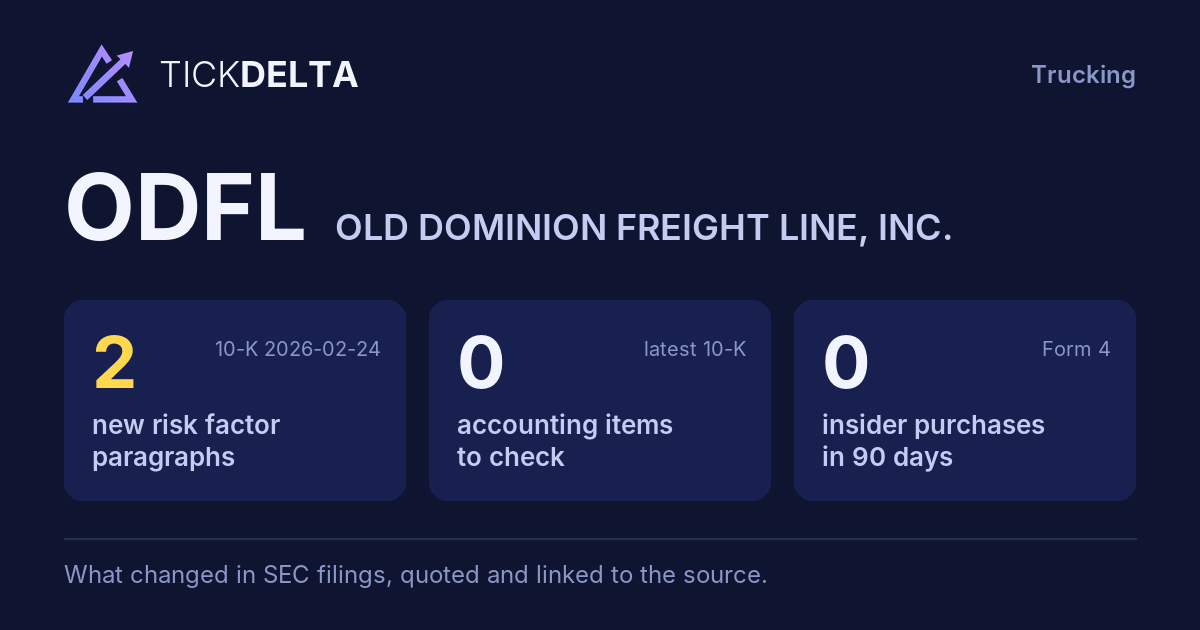
Risk Factors 237 words changed in this paragraph; it is 46% similar to last year's version.
In December 2022, the U.S. Environmental Protection Agency (“EPA”) finalized new stringent emission standards to reduce nitrogen oxides and establish new standards for greenhouse gas emissions from heavy-duty engines under the Clean Trucks Plan. In December 2021, the California Air Resources Board (“CARB”) adopted more stringent standards to reduce nitrogen oxide emissions from heavy-duty trucks. Although CARB recently withdrew its request for a waiver trucks and authorization from approved the EPA for its Advanced Clean Fleets rule, a proposal that would have required trucking companies to gradually add zero emission vehicles (“ZEVs”) to their fleets, CARB may seek to enforce certain portions of the rule or curtail emissions through other programs. Furthermore, CARB’s Advanced Clean Trucks rule, a proposal that (“ACT”) regulation, which would require manufacturers to only sell ZEVs zero-emission vehicles (“ZEVs”) as an increasing percentage of annual truck sales in California beginning and other adopting states. Uncertainty regarding the ACT and other emissions standards due to regulatory developments and related litigation, however, has resulted in varied application across jurisdictions, including delayed enforcement, executive orders pausing implementation, and legislative efforts to modify or repeal the 2036 model year, is still requirements. In addition, there are also virtually no ZEVs widely available that are suitable replacements for current technology used in effect. our LTL operations. If ZEV requirements are ultimately enforced and vehicles are not commercially available or viable for our LTL business, we may be required to modify or curtail our operations in California and other adopting states. The potential transition to utilizing ZEVs, combined with the current regulatory uncertainty affecting long-term fleet planning and investment decisions, could have a material adverse effect on our financial condition, results of operations, and cash flows, or may require us to incur significant additional costs for vehicles, electric vehicle charging infrastructure, or other operational modifications. Future strengthening of EPA, CARB CARB, or other federal or state regulatory requirements regarding fuel-efficiency or engine emissions of tractors could also result in increases in the cost of capital equipment and maintenance.
Source: Item 1A, 10-K 0001193125-26-067161 vs Item 1A, 10-K 0000950170-25-026661
Accounting Policies 130 words changed in this paragraph; it is 65% similar to last year's version.
We On May 28, 2024, we entered into an accelerated share repurchase agreements agreement (the “ASR Agreement”) with a third-party financial institution on each of August 26, 2021, February 24, 2022 and May 28, 2024. institution. The Company’s accelerated share repurchase agreements were each ASR Agreement was accounted for as a settled treasury stock purchase and a forward stock purchase contract. The par value of the initial shares received was recorded as a reduction to common stock, with the excess purchase price recorded as a reduction to retained earnings. The forward stock purchase contract was accounted for as a contract indexed to our own stock and was is classified within capital in excess of par value on our Balance Sheets. The Company's accelerated share repurchase agreements were each ASR Agreement was settled with the final number of shares received based on the daily volume-weighted average share price of our common stock over the term of the agreement, less a negotiated discount. The table below summarizes Under the ASR Agreement, we paid the third-party financial institution $200.0 million and received an initial delivery of 923,201 shares of our accelerated share repurchase activity common stock for $160.0 million, representing approximately 80% of the total value of shares to be received by us under the ASR Agreement, and the remaining balance of $40.0 million was settled in 2024 and 2022. November 2024. We did not enter into any accelerated share repurchase agreements during 2023. repurchased a total of 1,056,213 shares for $200.0 million under the ASR Agreement.
Source: Item 8, Note 1 – Significant Accounting Policies, 10-K 0001193125-26-067161 vs Item 8, Note 1 – Significant Accounting Policies, 10-K 0000950170-25-026661
MD&A 125 words changed in this paragraph; it is 51% similar to last year's version.
The decrease in salaries and wages in 2025 as compared to 2024 was primarily due to the 5.4% decrease in our average number of active full-time employees, as we balanced our workforce with current shipping trends, and a decrease in performance-based bonus compensation. These changes were partially offset by the annual wage increase provided to our employees at the beginning of both September 2025 and 2024. Our productive labor costs, which include wages for drivers, platform employees, and fleet technicians, increased as a percent of revenue to 24.4% in 2025 as compared to 24.1% in 2024 from 23.6% as a result of the decrease in 2023. We continued to operate efficiently in 2024, despite the network density. Despite this decrease in network density that generally results from the decline in volumes. Our P&D shipments and stops per hour both improved in 2024 as compared volumes, our team continued to 2023, which helped offset the reduction in deliver superior service to our linehaul laden load factor. customers while also focusing on operating efficiencies. Our other salaries and wages as a percent of revenue also increased to 9.8% in 2025 as compared to 9.5% in 2024 as compared to 9.0% in 2023. 2024.
Source: Item 7, 10-K 0001193125-26-067161 vs Item 7, 10-K 0000950170-25-026661