Form 10-K for the Fiscal Year Ended December 31, 2020
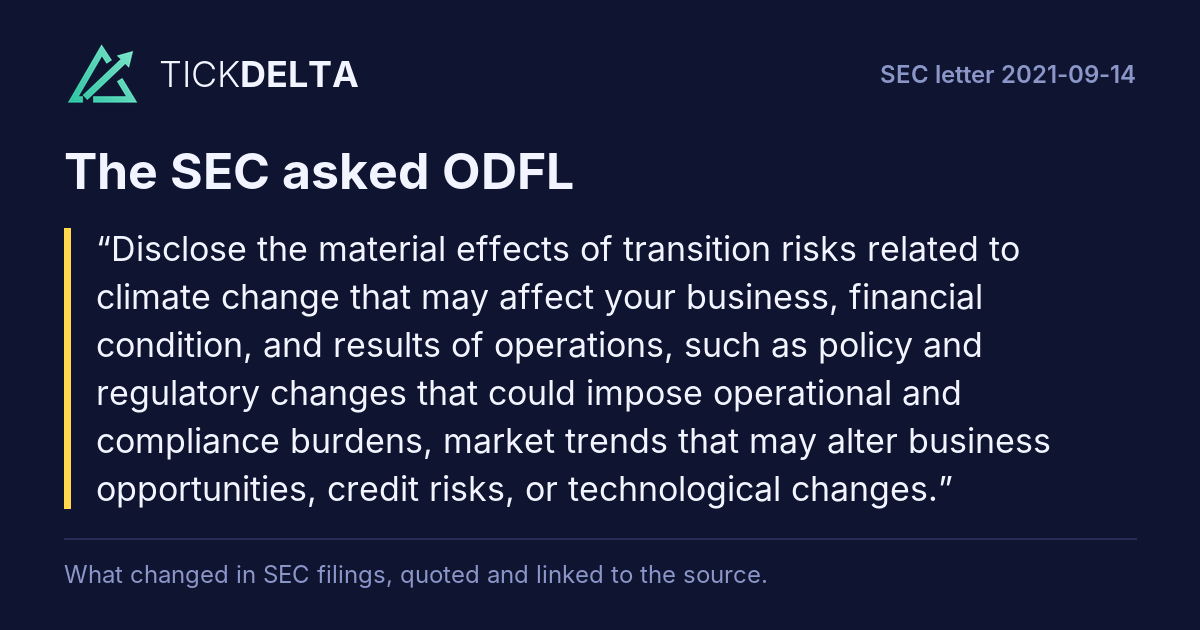
Disclose the material effects of transition risks related to climate change that may affect your business, financial condition, and results of operations, such as policy and regulatory changes that could impose operational and compliance burdens, market trends that may alter business opportunities, credit risks, or technological changes.
The Company respectfully advises the Staff that it has disclosed the material effects of transition risks related to climate change that may affect its business, financial condition and results of operations. This disclosure is integrated throughout the “Risk Factors” section of the Form 10-K. In particular, the Company refers the Staff to:
•
“Risk Factors—Risks Related to our Business and Operations—Limited supply and increased costs of new equipment may adversely affect our earnings and cash flow” on pages 7-8 for a discussion of material risks related to regulatory changes, includingRead in the reply ↗Rest of the answer
changes in regulations related to exhaust emissions from diesel engines, on the price of our equipment;
“Risk Factors—Risks Related to our Business and Operations—We may be adversely impacted by fluctuations in the availability and price of diesel fuel” and “—Our results of operations may be affected by seasonal factors, harsh weather conditions and disasters” on page 8 for a discussion of material risks related to weather conditions and disasters;
“Risk Factors—Risks Related to Legal and Regulatory Matters—We are subject to various governmental laws and regulations, and costs of compliance with, liabilities under, or violations of, existing or future governmental laws or regulations could adversely affect our business” on page 13 for a discussion of material risks related to changes to environmental laws and regulations that could impose operational and compliance burdens on the Company; and
“Risk Factors—Risks Related to Legal and Regulatory Matters—We may be adversely affected by legal, regulatory, or market responses to climate change concerns” on page 14 for a discussion of material risks related to climate change.
The Company will continue to evaluate the transition risks related to climate change that may affect its business, financial condition and results of operations and disclose the material risks related thereto, updated as appropriate, in its future filings.
First report after the company's reply of 2021-09-22: 10-Q filed 2021-11-03 ↗, against the 10-Q filed 2021-08-05 ↗.
Tickdelta does not hold the text of both reports, so they are not compared here.
If material, discuss the significant physical effects of climate change on your operations and results. This disclosure may include the following: • quantification of material weather-related damages to your property or operations; and • any weather-related impacts on the cost or availability of insurance.
The Company respectfully advises the Staff that the physical effects of climate change have not had a material effect on the Company’s business, financial condition and results of operations. Read in the reply ↗
First report after the company's reply of 2021-09-22: 10-Q filed 2021-11-03 ↗, against the 10-Q filed 2021-08-05 ↗.
Tickdelta does not hold the text of both reports, so they are not compared here.
If material, please quantify past capital expenditures for climate-related projects.
The Company respectfully advises the Staff that past capital expenditures for climate-related projects have not had a material effect on the Company’s business, financial condition and results of operations. Read in the reply ↗
First report after the company's reply of 2021-09-22: 10-Q filed 2021-11-03 ↗, against the 10-Q filed 2021-08-05 ↗.
Tickdelta does not hold the text of both reports, so they are not compared here.
Quantify any material increased compliance costs related to climate change.
The Company respectfully advises the Staff that any changes in compliance costs related to climate change have not had a material effect on the Company’s business, financial condition and results of operations. Read in the reply ↗
First report after the company's reply of 2021-09-22: 10-Q filed 2021-11-03 ↗, against the 10-Q filed 2021-08-05 ↗.
Tickdelta does not hold the text of both reports, so they are not compared here.
If applicable and material, provide disclosure about any purchase or sale of carbon credits or offsets and any material effects on your business, financial condition, and results of operations.
The Company respectfully advises the Staff that the Company has not purchased or sold any carbon credits or offsets.
* * * * *
We hope that our response appropriately addresses your comments. Please contact me at 336.822.5519 if you require any additional information or have any questions regarding our response. Read in the reply ↗
First report after the company's reply of 2021-09-22: 10-Q filed 2021-11-03 ↗, against the 10-Q filed 2021-08-05 ↗.
Tickdelta does not hold the text of both reports, so they are not compared here.
We note your response to prior comment 1 identifies several transition risks disclosed in your Form 10-K. Tell us how you considered disclosing other transition risks related to climate change such as changes in customer behavior, advances in technology, and market trends specific to the trucking industry.
The Company respectfully advises the Staff that it comprehensively monitors the risks faced by its business and regularly evaluates its risk factor disclosure to ensure that it reflects the material factors that may affect the Company’s business, financial condition and results of operations. The “Risk Factors” section of the Form 10-K addresses risks related to changes in customer behavior, advances in technology and market trends specific to the trucking industry in the following risk factors, among others:
•
“Risk Factors—Risks Related to our Business and Operations—Changes in ourRead in the reply ↗Rest of the answer
relationships with significant customers, including the loss or reduction in business from one or more of them, could have an adverse impact on our business.”
“Risk Factors—Risks Related to our Industry—We operate in a rapidly evolving and highly competitive industry, and our business will suffer if we are unable to adequately address potential downward pricing pressures and other factors that may adversely affect our operations and profitability.”
“Risk Factors—Risks Related to Owning our Common Stock—The market value of our common stock has been and may in the future be volatile, and could be substantially affected by various factors.”
These areas are each affected by a multitude of factors. Many of these individual factors are not material but collectively form the overall relevant risk. In the Company’s experience, decision-making in these areas is complex, with many factors together contributing to an overall result as opposed to decisions being materially affected by transition risks related solely to climate change. While the Company is monitoring transition risks related to climate change as they relate to customer behavior, advances in technology and market trends specific to the trucking industry as part of its comprehensive monitoring of risks, the Company has not determined such risks to be individually material or materially different than the overall risks related to such topics for which disclosure has been made in the Form 10-K.
First report after the company's reply of 2021-11-05: 10-K filed 2022-02-23 ↗, against the 10-K filed 2021-02-24 ↗.
Tickdelta does not hold the text of both reports, so they are not compared here.
Your response to prior comment 2 states that the physical effects of climate change have not had a material effect on your business, financial condition and results of operations. Provide us with an analysis supporting this statement.
The Company respectfully advises the Staff that it has not experienced material weather-related damages to its property or operations occurring outside of the ordinary course of business during the periods presented in the Form 10-K. For the various weather events impacting any of the Company’s facilities during these periods, the Company responded by leveraging its extensive geographic footprint to direct freight to nearby Company facilities that were not impacted by the weather events.Read in the reply ↗Rest of the answer
The Company also maintains insurance on significant facilities to help mitigate the impact of any losses due to physical damage caused by weather events. However, the Company notes that it has not incurred losses which, in the aggregate or individually, were material to the Company’s financial condition during the periods presented in the Form 10-K.
While climate change may contribute to weather events that the Company experiences in the normal course of its operations, the Company has not identified changes in the impact of weather-related events on its business or financial condition and results of operations that the Company is able to determine as resulting from the physical effects of climate change. In any event, the Company has concluded that the physical effects of weather-related events in general, whether climate change-related or not, have not had a material effect on its business, financial condition and results of operations during the periods presented.
First report after the company's reply of 2021-11-05: 10-K filed 2022-02-23 ↗, against the 10-K filed 2021-02-24 ↗.
Tickdelta does not hold the text of both reports, so they are not compared here.
We note from your response to prior comment 3 that past capital expenditures for climaterelated projects have not had a material effect on your business, financial condition and results of operations. Provide us with additional detail to support this statement.
The Company respectfully advises the Staff that it has not historically undertaken large capital expenditures predominantly for climate-related reasons. Environmental sustainability considerations, including climate-related considerations, are some of the many factors the Company takes into account in its holistic approach to making capital expenditures.Read in the reply ↗Rest of the answer
The Company is focused on continual improvement in the efficiency of its operations and is proud of examples where it has completed capital projects designed to decrease operating expenses while also lessening the Company’s environmental impact. For example, in 2011, the Company installed a 1.8 megawatt, roof-mounted solar installation on its Thomasville, North Carolina warehouse. While the Company recognizes the environmental benefit of the solar installation, the project was undertaken primarily to reduce the operating cost for the facility. During the periods presented in the Form 10-K, the Company did not undertake any projects solely for climate reasons. Accordingly, the Company concluded that capital expenditures for climate-related projects have not had a material effect on its business, financial condition and results of operations.
First report after the company's reply of 2021-11-05: 10-K filed 2022-02-23 ↗, against the 10-K filed 2021-02-24 ↗.
Tickdelta does not hold the text of both reports, so they are not compared here.
Your response to prior comment 4 states that any changes in compliance costs related to climate change have not had a material effect on your business, financial condition and results of operations. Tell us about the compliance costs you have incurred and explain how you concluded the related amounts were not material.
The Company respectfully advises the Staff that it does not generally experience significant compliance costs directly related to climate change regulations in its operations. Instead, the Company may be affected by compliance costs related to climate change impacting vendors or service providers that may be required to comply with specific climate change regulations. For example, diesel tractor engine manufacturers may be required to meet more restrictive carbon emission standards when producing new engines that could impact the ultimate cost of the engines.Read in the reply ↗Rest of the answer
These costs, along with other changes to annual equipment models, are considered by the tractor manufacturers annually and could impact the ultimate sales price of vehicles we choose to purchase. As the purchaser and end-user of these tractors, the Company has little visibility as to the detailed breakdown of price increases and to what extent such increases are a result of compliance costs related to climate change compared with other factors. To the extent that the manufacturer increased prices as a result of costs to comply with specific climate change regulations, the tractor purchased may be more efficient than older tractors, helping to offset the impact of the initial increase in price paid by the Company with lower ongoing operating expenses. There have not been any increases in the price of equipment or operating expenses over the periods presented in the Form 10-K that were material to the Company’s financial statements and that were otherwise identified by the Company to be a result of compliance costs directly related to climate change regulations.
* * * * *
We hope that our response appropriately addresses your comments. Please contact me at 336.822.5519 if you require any additional information or have any questions regarding our response.
First report after the company's reply of 2021-11-05: 10-K filed 2022-02-23 ↗, against the 10-K filed 2021-02-24 ↗.
Tickdelta does not hold the text of both reports, so they are not compared here.
Your response to prior comment 1 states that you comprehensively monitor the risks faced by your business, including transition risks related to climate change. Please describe the process through which you monitor risk and explain in greater detail how you determined that transition risks related to climate change are not individually material.
The Company respectfully advises the Staff that it has a robust process through which it monitors risks faced by its business, including transition risks related to climate change. The process includes, but is not limited to, the following key elements:
•
The Company’s Board of Directors (the “Board”) and its committees are responsible for the oversight of the Company’s policies, procedures and systems in place to manage the Company’s risk exposure, including those related to environmental, social and governance (“ESG”) matters.
The Company’s Chief Executive Officer and Chief FinancialRead in the reply ↗Rest of the answer
Officer are responsible for the assessment and management of the Company’s risks and regularly report their findings to the Board directly or through their communications with its committees.
The Company’s Risk Management Department is responsible for identifying, assessing and monitoring risks inherent to the Company’s business and providing guidance to senior management and the Audit Committee of the Board (the “Audit Committee”) regarding the Company’s enterprise risk management, insurance portfolio, business continuity programs, crisis management, and governance. Through the Company’s comprehensive risk management program, an in-depth review of core risks, goal-setting, and evaluation of plans with risk owners is performed annually. The Company’s core risks are closely monitored by the respective risk owners and senior management on a regular basis.
The Company’s ESG Steering Committee, which includes leaders from operations, fleet maintenance, real estate, marketing, information technology, compliance, human resources, safety, legal, accounting and investor relations, is responsible for monitoring identified risks related to ESG matters and provides guidance to senior management and the Audit Committee.
The Company determined that transition risks related to climate change, to the extent they have not been disclosed in the Form 10-K, are not individually material because, while the Company continues to monitor such risks, including through the channels described above, no such risks have had a meaningful qualitative or quantitative impact on the Company’s financial statements for the periods presented in the Form 10-K or have otherwise become a material factor that makes an investment in the Company speculative or risky. For example, one such transition risk that the Company monitors is the potential impact of the development and deployment of electric vehicles and equipment in the transportation industry. In 2021, in an effort to further understand the potential impact, if any, that this transition may have on the Company’s future operations and financial results, the Company ordered its first electric tractor and forklift for use in its California operations. The ordering, expected testing and evaluation of the equipment represents one action that the Company has taken to address a transition risk related to climate change that has not had a material impact on the Company’s financial statements in the periods presented in the Form 10-K and may mitigate such risk from having a material impact on the Company’s financial statements in future periods. Other transition risks related to climate change that the Company monitors, but that have not had a material impact on the Company’s financial statements, include potential increased costs related to future regulatory compliance or regulations on greenhouse gas emissions. If any of these or other transition risks related to climate change have a material impact on the Company’s financial statements, or if the Company otherwise determines that any of these or other transition risks related to climate change have become material factors that make an investment in the Company speculative or risky to the extent not already disclosed, the Company will include additional, appropriate disclosure in its future filings.
First report after the company's reply of 2022-02-16: 10-K filed 2022-02-23 ↗, against the 10-K filed 2021-02-24 ↗.
Tickdelta does not hold the text of both reports, so they are not compared here.
We note your response to prior comment 2 regarding the significant physical effects of climate change on your operations and results. Consistent with comment 2 from our letter dated September 14, 2021, provide us with quantitative information supporting the statement that you have not experienced material weather-related damages to your property or operations.Rest of the question
In addition, quantify and tell us about any weather-related impacts on the cost or availability of insurance.
The Company respectfully advises the Staff that the disclosure in the Form 10-K supports the statement that the Company has not experienced material weather-related damages to its property or operations. As noted in the Company’s prior response, for the various weather events impacting any of the Company’s locations, the Company leverages its extensive geographic footprint to direct freight and equipment to nearby Company locations that were not impacted by the weather events, thereby reducing the impact to the Company’s operations.Read in the reply ↗Rest of the answer
In addition, as discussed on page 4 in the Form 10-K, the Company maintains insurance coverage for various risk exposures with third-party insurance carriers at levels that the Company believes are appropriate for the Company’s operations. The Company’s insurance includes protection for damages to its locations, whether resulting from weather-related incidents or other causes. For the three years presented in the Form 10-K, the Company’s deductible limit for property claims generally was a minimum of $10,000 (2018) or $100,000 (2019 and 2020) per occurrence, excluding earthquakes or a named storm event (in which case the deductible was a single-digit percentage of the value of the applicable affected locations). The Company’s low deductible levels, along with the expansive geographic footprint of the Company’s locations, helps minimize the potential impact to the Company’s financial statements caused by any losses from damages to the Company’s locations. This is reflected in the Company’s “Loss on disposal of property and equipment” line item disclosed in the Statements of Cash Flows on page 32 ($0.7 million in 2020; $6.1 million in 2019; and $0.5 million in 2018), which represented less than 1% of the Company’s pre-tax income in each of the three years presented. As a point of reference, the Company submitted only one building damage claim under its applicable property insurance policy during the three-year period presented in the Form 10-K, and the total loss for that claim (including the applicable deductible) was only slightly over $200,000.
The Company also maintains that it has not experienced any material weather-related impacts on the cost or availability of insurance during the periods presented in the Form 10-K. In the Company’s Statements of Operations on page 30, the “Insurance and claims” line item was $42.4 million in 2020; $52.5 million in 2019; and $44.1 million in 2018. This line item captures all of the Company’s costs for insurance coverage and claims expenses, which include cargo loss or damage, bodily injury, and property damage, whether or not attributable to weather-related incidents. The Company respectfully advises the Staff that the aggregate amount of this line item, of which the cost of our property insurance coverage is an insignificant percentage, consistently represented approximately 1% of the Company’s revenue and approximately 5-6% of the Company’s pre-tax income in each of the three years presented. Had the Company experienced weather-related impacts on the cost of its insurance coverage that were material to the financial statements, these amounts would have been significantly higher.
We hope that our response appropriately addresses your comments. Please contact me at 336.822.5519 if you require any additional information or have any questions regarding our response.
First report after the company's reply of 2022-02-16: 10-K filed 2022-02-23 ↗, against the 10-K filed 2021-02-24 ↗.
Tickdelta does not hold the text of both reports, so they are not compared here.
Also in this review: request for more time, 2021-10-21, request for more time, 2022-01-21, closing letter, 2022-02-23