Screener / SEC EDGAR /CIK 0001030469 /10-K filed Feb 25, 2026, compared with Feb 27, 2025 /Numbers from the XBRL of the 10-Ks
NYSE Financials · Banks

OFG Bancorp OFG

Compare with peers Embed
SEC comment letters, last 20 years

5 reviews of OFG's filings by SEC staff

UPLOAD and CORRESP
Reviews 5 latest letter Dec 7, 2020
Questions asked 28 each answered in the company's own letter
No closing letter 1 reviews without a letter saying the staff completed it

When the SEC's staff reviews a filing, it writes to the company with numbered questions, and the company answers each one in a letter. SEC publishes the exchange once the review is over, at least 20 business days later. A question is not an accusation; most reviews end with the company adding detail to its next filing.

How the reviews went

Every review on EDGAR, from the first staff letter to the letter that closes it

  1. 1. Staff letters 7 UPLOAD
  2. 2. Questions in them 28 numbered comments
  3. 3. Company replies 7 CORRESP
  4. 4. Reviews closed 4 of 5 closing letter

Half the closed reviews took 56 days or less from the first letter to the closing letter.

Form 10-K

2020-12-07 to 2021-01-11 · 5 questions · 1 letter from the SEC, 1 from the company
Review closed 2021-01-11
Non-GAAP measuresRisk factors
Business · Loan Underwriting, page 1
SEC asked (1)
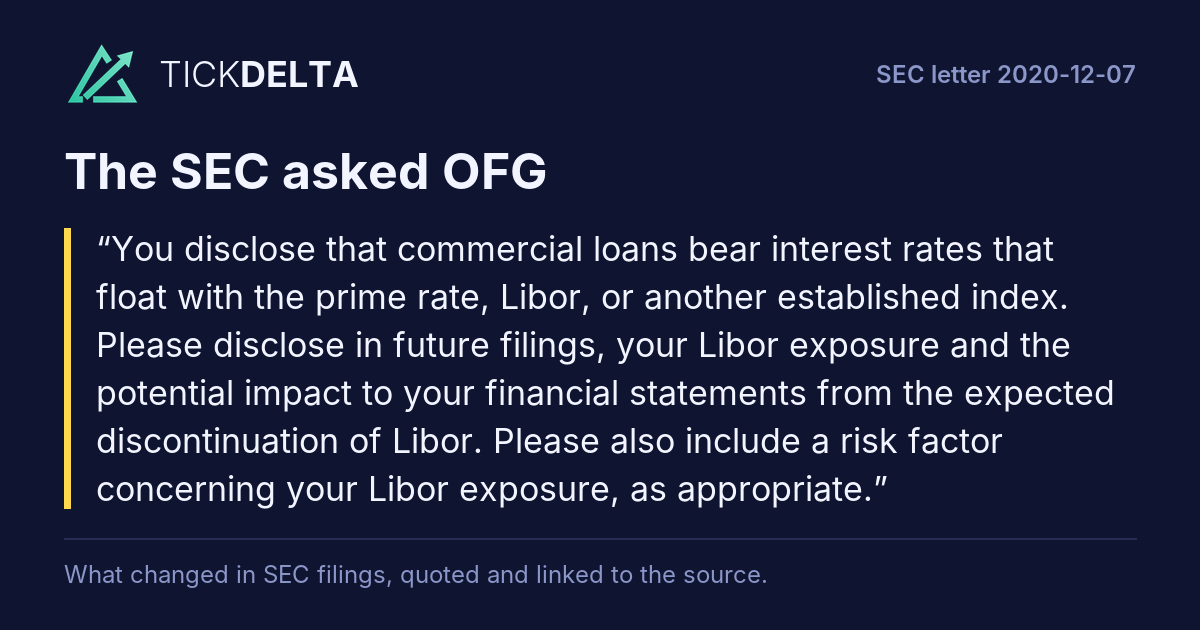
You disclose that commercial loans bear interest rates that float with the prime rate, Libor, or another established index. Please disclose in future filings, your Libor exposure and the potential impact to your financial statements from the expected discontinuation of Libor. Please also include a risk factor concerning your Libor exposure, as appropriate.
OFG answered
We refer to the comment letter, dated December 7, 2020 (the “Comment Letter”), from the staff (the “Staff”) of the Office of Finance, Division of Corporation Finance of the Securities and Exchange Commission (the “Commission”) concerning the OFG Bancorp (the “Company”) filings referenced above (the “December 31 st have set forth below the text of each of the Staff’s comments, as set forth in the Comment Letter, followed by the Company’s response. You disclose that commercial loans bear interest rates that float with the prime rate, Libor, or another established index.
Rest of the letter

Please disclose in future filings, your Libor exposure and the potential impact to your financial statements from the expected discontinuation of Libor. Please also include a risk factor concerning your Libor exposure, as appropriate. The Company will disclose in future filings our Libor exposure and potential impact in our financial statements from the expected discontinuation of Libor and a risk factor concerning our On July 27, 2017, the United Kingdom’s Financial Conduct Authority, which regulates the London Interbank Offered Rate (“LIBOR”), publicly announced that it intends to stop persuading or compelling banks to submit LIBOR rates after 2021. It is expected that a transition away from the widespread use of LIBOR to alternative rates will occur over the course of the next several years. On April 3, 2018, the Federal Reserve began publishing three new reference rates, including the Secured Overnight Financing Rate (“SOFR”). The Alternative Reference Rates Committee (ARRC) has recommended SOFR as the alternative to USD LIBOR and published fallback interest rate consultations for public comment as well as a Paced Transition Plan to SOFR use. The Financial Stability Board has taken an interest in LIBOR and possible replacement indices as a matter of risk management. The International Organization of Securities Commissions, or IOSCO, has been active in this area and is expected to call on market participants to have backup options if a reference rate, such as LIBOR, ceases publication. The International Swap Dealers Association has published guidance on interest rate benchmarks and alternatives in July and On November 30th, 2020 the Board of Governors of the Federal Reserve System, the Office of the Comptroller of the Currency, and the Federal Deposit Insurance Corporation (collectively, the agencies) issued an Interagency Statement on LIBOR Transition to encourage banks to transition away from U.S. dollar (USD) LIBOR as soon as practicable. The Statement exposes that the LIBOR transition is a significant event that banks should closely manage and further explains that new financial contracts should either utilize a reference rate other than LIBOR or have robust fallback language that includes a clearly defined alternative reference rate after LIBOR’s discontinuation. Separately, the agencies recently issued a statement that says a bank may use any reference rate for its loans that the bank determines to be appropriate for its funding model and customer needs. The key aspect of this Statement is that the administrator of LIBOR announced it will consult on its intention to cease the publication of the one week and two month USD LIBOR settings immediately following the LIBOR publication on December 31, 2021, and the remaining USD LIBOR settings immediately following the LIBOR publication on June 30, 2023. This extension allows most USD LIBOR contracts to mature before LIBOR experiences disruptions. Failure to prepare for disruptions to USD LIBOR, including operating with insufficiently robust fallback language, could undermine financial stability and banks’ safety and soundness. The statement does go on to clearly specify that it should not be read as announcing that the LIBOR benchmark has ceased, or will cease, to be provided permanently or indefinitely or that it is not, or no longer will be, representative for the purposes of language adopted by the International Swaps and Derivatives Association (ISDA). Recently, ISDA launched the IBOR Fallbacks Protocol, marking a major step in reducing the systemic impact of a key interbank offered rate becoming unavailable while market participants continue to have exposure to that rate. The supplement will amend ISDA’s standard definitions for interest rate derivatives to incorporate robust fallbacks for derivatives linked to certain IBORs, with the changes coming into effect on January 25, 2021. Oriental’s LIBOR exposure is mainly concentrated within the commercial loan portfolio. The Company has identified its LIBOR-based contracts that will be impacted by the cessation of LIBOR and is incorporating fallback language in negotiated contracts and incorporating non- LIBOR reference rate and/or fallback language in new contracts to prepare for these changes. Furthermore, management has established a LIBOR transition team to lead the Company in the execution of its project plan. The replacement of LIBOR creates operational and market risks that will become clear as replacement choices are developed. We will continue to assess all of our contracts and financial instruments that are directly or indirectly dependent on LIBOR to determine what impact the replacement of LIBOR will have on us. Uncertainty as to the nature of such potential changes or other reforms may adversely affect our financial condition and results of operations. In March 2020, the FASB issued guidance within ASU 2020-04, Reference Rate Reform (Topic 848): Facilitation of the Effects of Reference Rate Reform on Financial Reporting, in response to the scheduled discontinuation of LIBOR on December 31, 2021. The amendments in this Update provide optional guidance designed to provide relief from the accounting analysis and impacts that may otherwise be required for modifications to agreements (e.g., loans, debt securities, derivatives, borrowings) necessitated by reference rate reform. As of December 31, 2020, we have not yet elected any optional expedients related to contract modifications or hedging relationships as outlined in this ASU. However, we will continue to evaluate if we will elect these optional expedients in the future. We note that you disclose non-GAAP adjusted net income excluding the impact of "qualitative factors adjustment" as a result of sustained favorable macroeconomic conditions in Puerto Rico. It appears that this adjustment represents a tailored accounting principal prohibited by Rule 100(b) of Regulation G, as discussed in Question 100.04 of the Non-GAAP Financial Measures Compliance and Disclosures Interpretations (CD&Is). Please remove this adjustment from future filings. Alternatively, tell us how you comply with the guidance. The Company respectfully acknowledges the Staff’s comment and will remove the impact of "qualitative factors adjustment" from the non-GAAP adjusted net income in future filings. We note that you classify certain loans as US Loan Program. Please clarify in future filings the basis for this classification, including customer and or loan characteristics as well as distinct credit quality features. The Company will disclose in future filings the basis for this classification, including customer and or loan characteristics as well as distinct credit quality features as follows: Oriental’s lending activities in the continental United States – referred to as the U.S. Loan Program – are conducted through Oriental International Bank and OFG USA LLC. These activities include the purchase of middle market senior secured cash flow loan participations and the purchase of participations of loans to small and medium sized businesses. 8-3: Reconciliation of GAAP to Non-GAAP with adjustments to exclude the impact of significant events, page 15 We note that you disclose non-GAAP adjusted net income including the impact of additional provision for credit losses due to Covid-19. Please tell us how you were able to differentiate between changes in expected credit losses directly related to Covid-19 and credit losses attributable to other market factors and conditions, including how this adjustment is calculated. In addition, tell us how you plan to report this adjustment going forward as the impact from macroeconomic conditions due to COVID subsides. Refer to Rule 100(b) of Regulation G, as discussed in Question 100.4 of the Non-GAAP Financial Measures Compliance and Disclosures Interpretations (CD&Is) The Company respectfully acknowledges the Staff’s comment and has determined to remove the impact of additional provision for credit losses due to Covid-19 in non-GAAP adjusted net income in future filings for reasons discussed in this paragraph. The Covid-19 pandemic was an unprecedented event. As a result, the Company changed during the first quarter of 2020 the macroeconomic scenario previously selected at implementation of the current expected credit loss (CECL) methodology at the beginning of the year to consider the worsening of the current economic environment. The Company also identified the need to make a qualitative adjustment to the loan portfolios with inherent risk in this economic environment for conditions not considered in the selected macroeconomic scenario. This adjustment was calculated through our CECL model considering the impact of these changes on our ACL reserve. As the economy evolves in subsequent quarters and we continue to make changes to our provisions we understand that continuing to include Non-GAAP adjustments for such changes may not continue to comply with Rule 100(b) of Regulation G, as discussed in Question 100.4 of the We note that you disclose non-GAAP adjusted net income including the impact of Covid- 19 expenses. Please tell us, and enhance future filings to describe the nature of these expenses and how you were able to determine they are incremental to your normal operations and nonrecurring. Refer to Rule 100(b) of Regulation G, as discussed in Question 100.1 of the Non-GAAP Financial Measures Compliance and Disclosures Covid-19 expenses mainly represented expenses incurred within our premises, as acrylic shields, face shields and masks, and cleaning and disinfecting costs, in order to control pandemic spread and keep customers and employees safe, and also included employee Covid-19 testing. These expenses are expected to be incurred while the pandemic continues. The Company will evaluate in each subsequent filing based on the facts and circumstances if they continue to be incremental and nonrecurring. The Company acknowledges that it is responsible for the accuracy and adequacy of the disclosure in the reports and other filings it makes with the Commission. are hopeful that we have adequately addressed the Staff’s comments. If you have any questions or comments regarding the foregoing, please do not hesitate to contact me at

One letter for all the questions, without numbered answers. Read the reply
In its next report

First report after the company's reply of Dec 16, 2020: 10-K filed Feb 26, 2021 ↗, against the 10-K filed Mar 3, 2020 ↗.

Tickdelta does not hold the text of both reports, so they are not compared here.
Financial Highlights · Year ended 2019, page 31
SEC asked (2)
We note that you disclose non-GAAP adjusted net income excluding the impact of "qualitative factors adjustment" as a result of sustained favorable macroeconomic conditions in Puerto Rico. It appears that this adjustment represents a tailored accounting principal prohibited by Rule 100(b) of Regulation G, as discussed in Question 100.04 of the Non-GAAP Financial Measures Compliance and Disclosures Interpretations
Rest of the question

(CD&Is). Please remove this adjustment from future filings. Alternatively, tell us how you comply with the guidance.

OFG answered

See the reply above.

In its next report

First report after the company's reply of Dec 16, 2020: 10-K filed Feb 26, 2021 ↗, against the 10-K filed Mar 3, 2020 ↗.

Tickdelta does not hold the text of both reports, so they are not compared here.

Form 10Q for the Quarterly Period Ending September 30, 2020 · Note 5 - Loans, page 27
SEC asked (3)
We note that you classify certain loans as US Loan Program. Please clarify in future filings the basis for this classification, including customer and or loan characteristics as well as distinct credit quality features. Form 8-K filed October 23, 2020 Table 8-3: Reconciliation of GAAP to Non-GAAP with adjustments to exclude the impact of significant events, page 15
OFG answered

See the reply above.

In its next report

First report after the company's reply of Dec 16, 2020: 10-K filed Feb 26, 2021 ↗, against the 10-K filed Mar 3, 2020 ↗.

Tickdelta does not hold the text of both reports, so they are not compared here.

Form 10Q for the Quarterly Period Ending September 30, 2020 · Note 5 - Loans, page 27
SEC asked (4)
We note that you disclose non-GAAP adjusted net income including the impact of additional provision for credit losses due to Covid-19. Please tell us how you were able to differentiate between changes in expected credit losses directly related to Covid-19 and credit losses attributable to other market factors and conditions, including how this adjustment is calculated.
Rest of the question

In addition, tell us how you plan to report this adjustment going forward as the impact from macroeconomic conditions due to COVID subsides. Refer to Rule 100(b) of Regulation G, as discussed in Question 100.4 of the Non-GAAP Financial Measures Compliance and Disclosures Interpretations (CD&Is).

OFG answered

See the reply above.

In its next report

First report after the company's reply of Dec 16, 2020: 10-K filed Feb 26, 2021 ↗, against the 10-K filed Mar 3, 2020 ↗.

Tickdelta does not hold the text of both reports, so they are not compared here.

Form 10Q for the Quarterly Period Ending September 30, 2020 · Note 5 - Loans, page 27
SEC asked (5)
We note that you disclose non-GAAP adjusted net income including the impact of Covid19 expenses. Please tell us, and enhance future filings to describe the nature of these expenses and how you were able to determine they are incremental to your normal operations and nonrecurring.
Rest of the question

Refer to Rule 100(b) of Regulation G, as discussed in Question 100.1 of the Non-GAAP Financial Measures Compliance and Disclosures Interpretations (CD&Is).

OFG answered

See the reply above.

In its next report

First report after the company's reply of Dec 16, 2020: 10-K filed Feb 26, 2021 ↗, against the 10-K filed Mar 3, 2020 ↗.

Tickdelta does not hold the text of both reports, so they are not compared here.

Also in this review: closing letter, 2021-01-11
Form 10-K for the Fiscal Year Ended December 31, 2016

2017-11-28 to 2017-12-12 · 1 question · 1 letter from the SEC, 1 from the company
Review closed 2017-12-12
Goodwill and impairment
10-Q For the Fiscal Period Ended September 30, 2017 · General
SEC asked
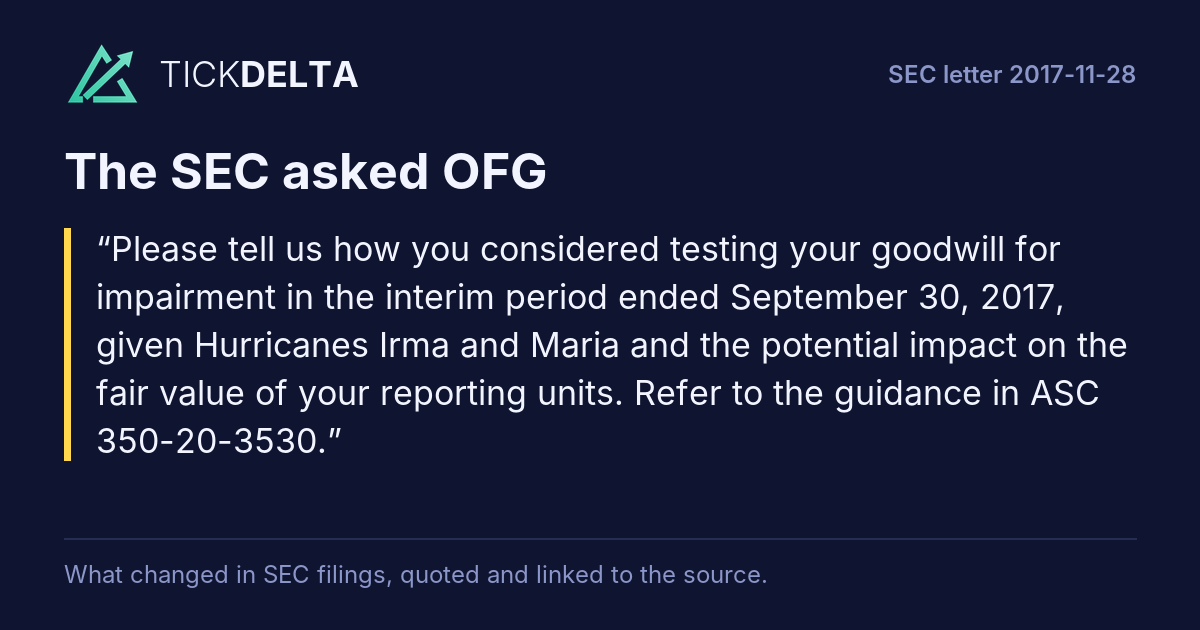
Please tell us how you considered testing your goodwill for impairment in the interim period ended September 30, 2017, given Hurricanes Irma and Maria and the potential impact on the fair value of your reporting units. Refer to the guidance in ASC 350-20-3530.
OFG answered
350-20-35-30.

As reported in our most recent Form 10Q for the third quarter ended September 30, 2017, the Company performed “an assessment of events or circumstances that could trigger reductions in the book value of the goodwill,” and “no events were identified that triggered changes in the book value of the goodwill at September 30, 2017.” This assessment evaluated in depth the effect of hurricanes Irma and Maria to the Company, and determined that the impact of the hurricanes was not likely to reduce the fair value of the Company’s goodwill below its carrying amount.

The Company performs
Rest of the answer

this quarterly assessment pursuant to its internal accounting policies and in compliance with ASC

350-20-35-30. If management determines that it is more likely than not that a change in circumstances may reduce the fair value of the goodwill below its carrying amount, the Company will perform the impairment test analysis and make adjustments, as necessary.

Examples of events or circumstances that are evaluated each quarter include:

a.

A significant adverse change in legal factors or in the business climate, b. An adverse action by a regulator, c. Unanticipated competition that could have a material impact in business projections, d. A loss of key personnel that could affect the operations, e. A more likely than not expectation that a reporting unit or a significant portion of a reporting unit will be sold or otherwise disposed of, and f. Any other change in circumstance that management believes could have a material impact in the operation of OFG.

As documented in the Company’s third quarter assessment, the Company recorded a special provision of $27 million during the third quarter related to hurricanes Irma and Maria. Management calculated such provision by evaluating the impact of the hurricanes on the repayment sources and underlying collateral of the Company’s loan portfolios. Excluding the impact of the special provision, the Company had a net income of $22.3 million for such quarter. This special provision did not significantly impact the capital of the Company or its bank subsidiary, which remained strong and significantly above regulatory requirements for well-capitalized institutions.

Therefore, the financial operations of the Company were not and are not expected to be materially affected by the hurricanes.

The quarterly assessment also took into account economic projections provided by independent recognized economists of economic losses from damages caused by the hurricanes and economic growth from the anticipated distribution of insurance proceeds and federal aid.

The Company performs its annual test of impairment to goodwill for each of its Banking and Wealth Management units on October 31 of each year. Its 2016 annual goodwill impairment test determined that the Banking unit failed step one of the two-step impairment test because its adjusted net book value exceeded its fair value, whereas the Wealth Management unit passed.

The Company then performed step two with respect to the Banking unit, which concluded that the carrying value of the goodwill allocated to the Banking unit was not impaired as of the valuation date. As of such date, the fair value of

$253.2 million significantly exceeded the carrying value of $84.1 million.

Based on the assessment and given that the estimated fair value significantly exceeded the carrying balance of goodwill of the

Banking unit, management concluded that it is not likely that the changes in circumstances related to the hurricanes impaired goodwill as of September 30,

2017.

Read in the reply

Also in this review: closing letter, 2017-12-12

Form 10-K

2015-06-10 to 2015-08-05 · 4 questions · 1 letter from the SEC, 1 from the company
Review closed 2015-08-05
Results discussion (MD&A)Executive pay
Note 5 – Loans · Nonaccrual Loans, page 138
SEC asked (1)
The total of nonperforming loans for both 2013 and 2014 in table 12 does not agree to the information provided in the tables on pages 138-139. Please tell us the reasons for the differences and revise future filings, if necessary.
OFG answered
Table 12 presents information with respect to nonperforming loans, whereas the tables on page 138-139 present information with respect to loans in non-accrual status. The variance in the total of nonperforming loans and non-accrual loans is due to the treatment of

FHA and VA insured mortgage loans. These insured mortgage loans are classified as nonperforming assets when they become 90 days or more past due, but are not placed in non-accrual until they become 18 months or more past due.

As requested, we will revise in future filings the disclosures set forth on pages 65 and 139 concerning
Rest of the answer

the accrual treatment of FHA and VA insured mortgage loans to disclose that such loans are considered nonperforming loans when they become 90 days or more past due.

Read in the reply
In its next report

First report after the company's reply of Jun 24, 2015: 10-Q filed Aug 10, 2015 ↗, against the 10-Q filed May 8, 2015 ↗.

Tickdelta does not hold the text of both reports, so they are not compared here.

Non-covered Acquired Loans Accounted for under ASC 310-30, page 141
SEC asked (2)
We note that significant changes in the types of impaired non-covered loans between the years ended December 31, 2013 and December 2014. Specifically, there were $380 million of acquired auto loans identified as being impaired at year end 2013 compared to none at year end 2014. In addition, there were significant increases in both construction and commercial impaired loan pools during 2014.
Rest of the question

Please tell us, and revise in future filings, to address the reasons for the significant increases or decreases between these periods.

OFG answered
The table set forth on page 141 only presents information with respect to non-covered loans and loan pools accounted under ASC 310-30 if there is a recorded impairment to such loans or loan pools and a specific allowance for loan losses. In other words, if an impaired loan or loan pool does not have a specific allowance, the Company’s recorded investment in, and the unpaid principal balance of, such loan or loan pool is not reflected in this table.

As of December 31, 2014, the

Company eliminated the specific allowance of $732 thousand maintained on the impaired non-covered acquired auto
Rest of the answer

loan pool accounted under ASC 310-30 because there was an increase in the net present value of cash flows expected to be collected from such pool when compared with the recorded investment. Likewise, the increase in commercial and construction loans and loan pools from December

31, 2013 to December 31, 2014 was caused by the establishment of a specific reserve with respect to 11 additional impaired commercial and construction loans and loan pools that were required based on the net present value of the cash flows expected to be collected.

As requested, we will revise future filings to clarify that the disclosure only quantifies impaired loans and loan pools that have a specific reserve and to address the reasons for the significant changes between the dates disclosed.

Read in the reply
In its next report

First report after the company's reply of Jun 24, 2015: 10-Q filed Aug 10, 2015 ↗, against the 10-Q filed May 8, 2015 ↗.

Tickdelta does not hold the text of both reports, so they are not compared here.

Note 4. Loans · Credit Quality Indicators, page 31
SEC asked (3)
We note the Company placed the $200 million participation in the fuel purchase line of credit with the Puerto Rico Electric Power Authority on nonaccrual status at March 31, 2015. You recorded a provision of $24 million due to the entity’s unwillingness to meet its contractual obligations. Please tell us how the company determined the amount of the provision recorded on this line of credit at March 31, 2015.
OFG answered
The Company performed an analysis, in close consultation with its legal advisors, of the reasonably foreseeable possible outcomes both in a base scenario, which management believed to be the probable outcome of events, and a stress scenario, which assumes that PREPA is unwilling to reach a negotiated agreement and the creditors are forced to seek legal remedies.

The base scenario evaluated the probabilities of the occurrence of the following events: (i) the acceptance by the Puerto Rico Electric Power Authority (“PREPA”) of the bondholders’ proposal; (ii) an agreement is reached by and among
Rest of the answer

PREPA and its creditors, assuming that the bondholders’ proposal is rejected; (iii) the Puerto Rico Debt

Recovery and Enforcement Act (the “Recovery Act”) is found constitutional by the United States Court of Appeals for the First Circuit, assuming an agreement is not reached and the creditors seek legal remedies, (iv) assuming the

Recovery Act is found unconstitutional, a settlement is reached by and among

PREPA and its creditors, and (v) assuming the Recovery Act is found unconstitutional and a settlement is not reached, the creditors are successful in obtaining legal remedies.

The stress scenario, on the other hand, assumes that the creditors will be forced to seek legal remedies and estimates a lower probability than the base scenario that a settlement would be reached if the Recovery Act is found unconstitutional.

For each potential result under both scenarios, the Company assigned a probability that such result would have a low, moderate or high impact on the Company’s recovery, or would not have any impact. The losses estimated in each case reflected management’s best estimate based on the net present value of cash flows from the participation. The

Company then calculated the weighted average estimated loss based on the probability assigned to the impact of each possible result under each scenario. Based on this evaluation, the Company likewise assigned a likelihood of 70% to the base scenario and 30% to the stress scenario to calculate a weighted average estimated loss of $23.678 million.

Based on this evaluation, the

Company decided to establish a $24 million specific reserve for the PREPA participation.

Read in the reply
In its next report

First report after the company's reply of Jun 24, 2015: 10-Q filed Aug 10, 2015 ↗, against the 10-Q filed May 8, 2015 ↗.

Tickdelta does not hold the text of both reports, so they are not compared here.

Compensation Discussion and Analysis · Analysis of Compensation Decisions, page 28
SEC asked (4)
We note your disclosure regarding weighting and actual percentage of target achieved for each performance measure. Please tell us and in future filings quantify the threshold, target and maximum levels for each performance measure. For guidance, please refer to Item 402(b)(2)(v) of Regulation S-K.
OFG answered
Please find below a revised table quantifying the threshold, target and maximum levels for each performance measure.

Performance

Measure

Weight

Threshold

Target

Maximum

% of Target

Earnings per Share

(Diluted)

$0.92

$1.32

1.65

113.56%

Fee Income

$60,815,471

$86,879,244

$108,599,055

89.72%

Non-Interest

Expense

$163,019,122

$232,884,459

$291,105,574

104.23%

Loan Book Balance

Plus Customer Deposits

$5,703,786,614

$8,148,266,591

$10,185,333,239

95.83%

Grow Customer

Relationship Index

1.61

2.30

2.88

88.09%

Risk Management
Rest of the answer

Scorecard

70.0

100.0

125.0

93.00%

In future filings, we will quantify the threshold, target and maximum levels for the corresponding performance measures to the extent that such disclosure does not cause the

Company competitive harm in accordance with the Staff’s Compliance and

Disclosure Interpretation Question 118.04.

*****************

As requested, we hereby acknowledge that:

·

The Company is responsible for the adequacy and accuracy of the disclosure in the filing;

Staff comments or changes to disclosure in response to staff comments do not foreclose the Commission from taking any action with respect to the filing; and

The Company may not assert staff comments as a defense in any proceeding initiated by the Commission or any person under the federal securities laws of the United States.

Read in the reply
In its next report

First report after the company's reply of Jun 24, 2015: 10-Q filed Aug 10, 2015 ↗, against the 10-Q filed May 8, 2015 ↗.

Tickdelta does not hold the text of both reports, so they are not compared here.

Also in this review: closing letter, 2015-08-05

Form 10-K

2014-09-22 to 2014-12-05 · 6 questions · 2 letters from the SEC, 2 from the company
Review closed 2014-12-05
Results discussion (MD&A)Liquidity and cashSegments
Operations · General
SEC asked (1)
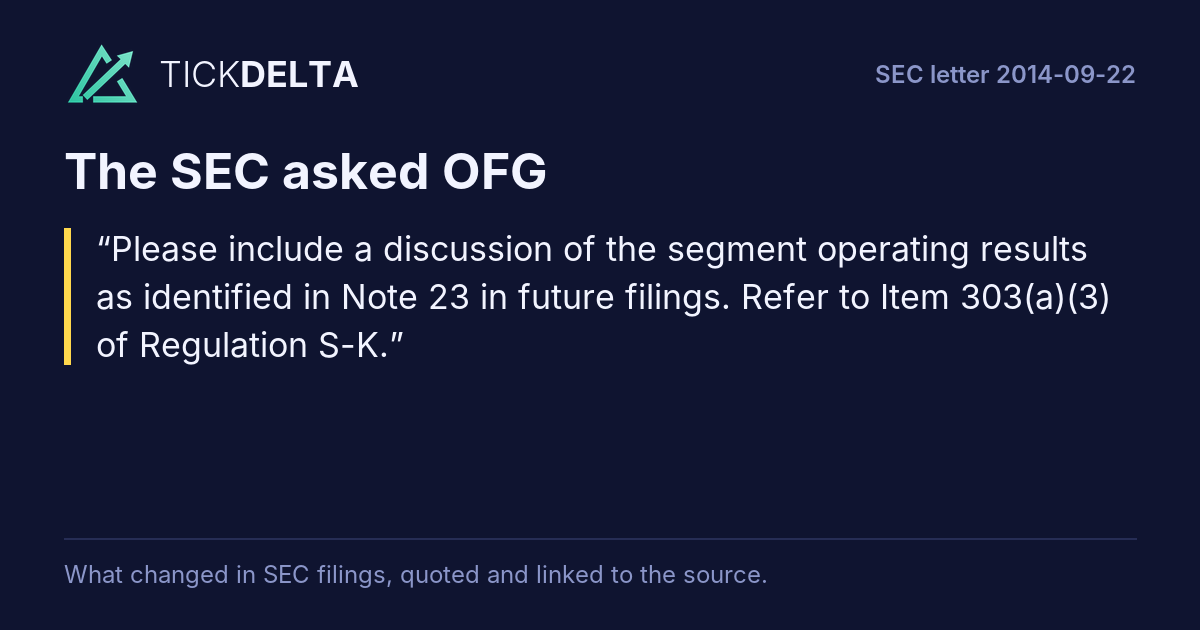
Please include a discussion of the segment operating results as identified in Note 23 in future filings. Refer to Item 303(a)(3) of Regulation S-K.
OFG answered
We note your response to comment 5 in our letter dated September 22, 2014. Cash receipts from dividends received from your wholly-owned subsidiaries are cash flows from operating activities based on ASC 230-10-45-16(b). The reference in your response to ASC 230-10-45-12(b) applies to returns on investments from other entities as opposed to your wholly-owned subsidiaries.
Rest of the answer

Please revise the dividends received from your wholly-owned subsidiaries to cash flows from operating activities in future filings.

We acknowledge the Staff’s comments and confirm that in future filings we will include dividends received from our wholly-owned subsidiaries in cash flows from operating activities.

*****************

As requested, we hereby acknowledge that:

·

The Company is responsible for the adequacy and accuracy of the disclosure in the filing;

Staff comments or changes to disclosure in response to staff comments do not foreclose the Commission from taking any action with respect to the filing; and

The Company may not assert staff comments as a defense in any proceeding initiated by the Commission or any person under the federal securities laws of the United States.

Read in the reply
In its next report

First report after the company's reply of Dec 3, 2014: 10-K filed Feb 26, 2015 ↗, against the 10-K filed Mar 3, 2014 ↗.

Tickdelta does not hold the text of both reports, so they are not compared here.

Table 2 – Non-Interest Income Summary · Comparison of the years ended December 31, 2013 and 2012, page 51
SEC asked (2)
You disclose that the higher FDIC loss sharing expense in 2013 compared to prior year periods was primarily attributable to reduced projected losses expected to be collected from the FDIC and the improved accretable yield on covered loans.
Rest of the question

Please tell us and revise future filings to disclose the underlying factors that led to your revision of the projected losses from the FDIC and the improved accretable yield on covered loans. Additionally, please more fully quantify and explain how material annual changes in individual components of FDIC loss sharing expense, net, impacted the overall annual net change in this account in future filings.

OFG answered

No numbered answer found in the reply. Read the reply ↗

In its next report

First report after the company's reply of Dec 3, 2014: 10-K filed Feb 26, 2015 ↗, against the 10-K filed Mar 3, 2014 ↗.

Tickdelta does not hold the text of both reports, so they are not compared here.

Notes to Consolidated Financial Statements · Note 10. FDIC Loss Share Asset and True-Up Payment Obligation, page 153
SEC asked (3)
Please consider presenting a roll forward of the Clawback liability in future filings for each period presented with commentary to allow an investor to understand the significant drivers of the changes, including how they are reflected in specific Consolidated Statements of Operations line items, as appropriate.
OFG answered

No numbered answer found in the reply. Read the reply ↗

In its next report

First report after the company's reply of Dec 3, 2014: 10-K filed Feb 26, 2015 ↗, against the 10-K filed Mar 3, 2014 ↗.

Tickdelta does not hold the text of both reports, so they are not compared here.

Note 22 – Fair Value of Financial Instruments, page 183
SEC asked (4)
Please revise future filings to include quantitative information for Foreclosed real estate measured at fair value on a non-recurring basis as required by ASC 820-10-50-2.bbb.
OFG answered

No numbered answer found in the reply. Read the reply ↗

In its next report

First report after the company's reply of Dec 3, 2014: 10-K filed Feb 26, 2015 ↗, against the 10-K filed Mar 3, 2014 ↗.

Tickdelta does not hold the text of both reports, so they are not compared here.

NOTE 24 – OFG Bancorp (Holding Company Only) Financial Information, page 193
SEC asked (5)
You classified dividends received from your banking and non-banking subsidiaries of $15.6 million in 2013, $385 million in 2012 and $87 million in 2011 as cash flows from investing activities. Please tell us why you classified these cash inflows to the parent company as investing cash flows as opposed to operating cash flows.
Rest of the question

Please refer to ASC230-10-4516(b) for specific guidance on how to classify dividends received on a statement of cash flows.

OFG answered

No numbered answer found in the reply. Read the reply ↗

In its next report

First report after the company's reply of Dec 3, 2014: 10-K filed Feb 26, 2015 ↗, against the 10-K filed Mar 3, 2014 ↗.

Tickdelta does not hold the text of both reports, so they are not compared here.

SEC letter of Nov 14, 2014 ↗ no reply letter on EDGAR
NOTE 24 – OFG Bancorp (Holding Company Only) Financial Information, page 193
SEC asked
We note your response to c omment 5 in our letter dated September 22, 2014 . Cash receipts from dividends received from your wholly -owned subsidiaries are cash flows from operating activities based on ASC 230 -10-45-16(b). The reference in your response to ASC 230 -1045-12(b) applies to returns on investments from other entities as opposed to your wholly - owned subsidiaries.
Rest of the question

Please revise the dividends received from your wholly -owned subsidiaries to cash flows from operating activities in future filings.

OFG answered

No reply letter found.

In its next report

First report after the SEC's letter of Nov 14, 2014: 10-K filed Feb 26, 2015 ↗, against the 10-K filed Mar 3, 2014 ↗.

Tickdelta does not hold the text of both reports, so they are not compared here.

Also in this review: company letter, Oct 2, 2014, closing letter, 2014-12-05

Form S-1

2012-10-05 to 2012-10-19 · 12 questions · 2 letters from the SEC, 2 from the company
No closing letter
AcquisitionsResults discussion (MD&A)
SEC letter of Oct 5, 2012 ↗ no reply letter on EDGAR (the company may have answered in an amended filing)
Form S-1 · Prospectus cover page
SEC asked (1)
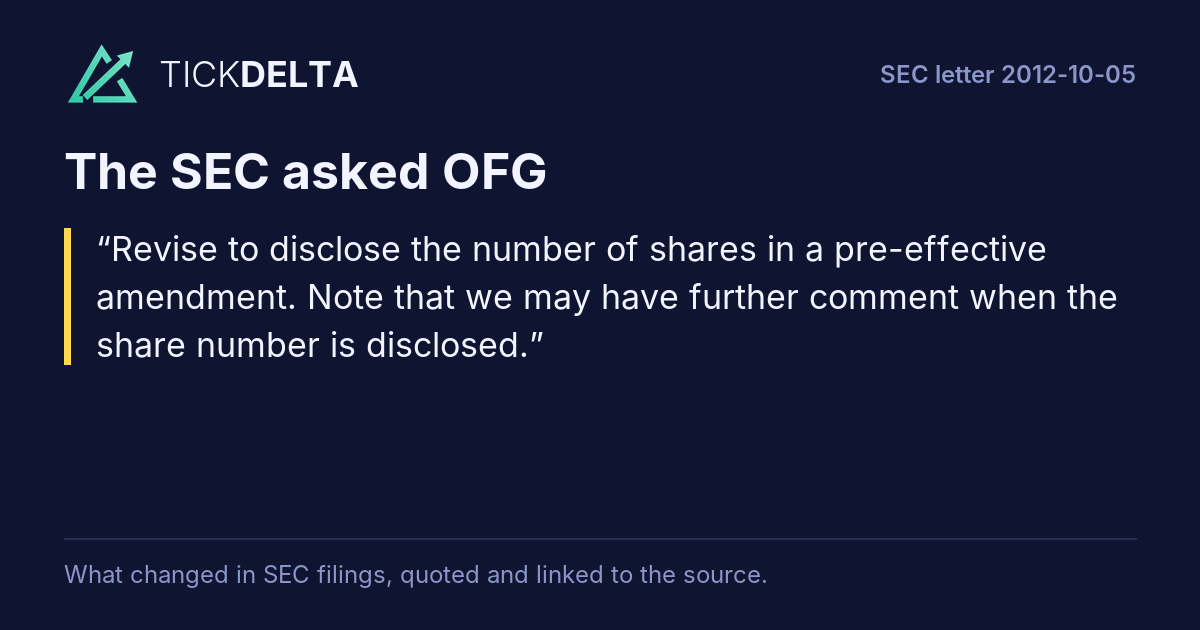
Revise to disclose the number of shares in a pre-effective amendment. Note that we may have further comment when the share number is disclosed.
OFG answered

No reply letter found.

Recent Developments · Pending Acquisition of BBVAPR, page 3
SEC asked (2)
Revise to use bullets in the third paragraph to disclose the anticipated sources of funds for the acquisition. In this regard, and in reference to the proposed offering of perpetual preferred, disclose, if known, the anticipated date of the offering and whether it is expected to be a public or private offering.
OFG answered

No reply letter found.

Recent Developments · Pending Acquisition of BBVAPR, page 3
SEC asked (3)
Disclose the extent of any material affiliation between the two companies.
OFG answered

No reply letter found.

Recent Developments · Pending Acquisition of BBVAPR, page 3
SEC asked (4)
Please disclose in the summary that BBVAPR Holding Corporation is a privately held company.
OFG answered

No reply letter found.

Recent Developments · Pending Acquisition of BBVAPR, page 3
SEC asked (5)
Discuss to what extent the board and officers of BBVAPR Holding Corporation and its subsidiary operations will be employed by the combined entity.
OFG answered

No reply letter found.

Recent Developments · Pending Acquisition of BBVAPR, page 3
SEC asked (6)
Discuss the impact of the material decrease in assets related to the $1.8 billion deleveraging transactions contemplated on the operations of the combined companies.
OFG answered

No reply letter found.

Recent Developments · Pending Acquisition of BBVAPR, page 3
SEC asked (7)
Disclose under what name the company will go forward after the acquisition.
OFG answered

No reply letter found.

Signature Page
SEC asked (8)
Please revise to identify the principal accounting officer.
OFG answered

No reply letter found.

Signature Page
SEC asked (9)
Please revise the signature page to identify the principal accounting officer. In regard to the Form 10-K, we urge all persons who are responsible for the accuracy and adequacy of the disclosure in the filing to be certain that the filing includes the information the Securities Exchange Act of 1934 and all applicable Exchange Act rules require.
Rest of the question

Since the company and its management are in possession of all facts relating to a company’s disclosure, they are responsible for the accuracy and adequacy of the disclosures they have made. In responding to our comments, please provide a written statement from the company acknowledging that:  the company is responsible for the adequacy and accuracy of the disclosure in the filing;  staff comments or changes to disclosure in response to staff comments do not foreclose the Commission from taking any action with respect to the filing; and  the company may not assert staff comments as a defense in any proceeding initiated by the Commission or any person under the federal securities laws of the United States.

OFG answered

No reply letter found.

SEC asked (1)
As previously requested in prior comment number 5, and with a view towards additional disclosure, advise the staff if there are any plans, arrangements or understandings to appoint any existing officers, directors, and/or affiliates of the “BBVAPR Companies” as members of the Board of Oriental Financial Group.
OFG answered

No numbered answer found in the reply. Read the reply ↗

Prospectus Summary · General
SEC asked (2)
Noting both company’s third quarter ended several weeks ago, revise to add a Recent Development section in the Prospectus Summary to disclose if there was any material adverse change in either company’s results of operations or financial condition.
OFG answered
In response to the Staff’s comment, the Company advises the Staff that there are no plans, arrangements or understandings to appoint any existing officers, directors, and/or affiliates of the BBVAPR Companies as members of the board of directors of Oriental Financial Group. The Company has included disclosure in the

Registration Statement that it does not expect any change to the composition of its board of directors as a result of the BBVAPR Acquisition.

Prospectus Summary

General

Noting both company’s third quarter ended several weeks ago, revise to add a Recent Development section in
Rest of the answer

the Prospectus Summary to disclose if there was any material adverse change in either company’s results of operations or financial condition.

Response

In response to the Staff’s comment, the Company advises the Staff that there has not been any material adverse change in either company’s results of operations or financial condition for the third quarter of 2012. The Company further advises the Staff that for marketing purposes the Company will include in the Recent Developments section of the Registration Statement disclosure on its preliminary third quarter financial results. The Company will supplementally provide a draft of this disclosure to the Staff.

Read in the reply
Related transactions, page 4
SEC asked (3)
Noting the significant change to the size of the company’s assets, revise to disclose if management expects the deleveraging to have any material impact, going forward, to the company’s results of operations.
OFG answered
In response to the Staff’s comment, the Company has revised the disclosure on page 4 to include the expected impact of the deleveraging to the

Company’s results of operations.

As requested, the Company acknowledges that:

n it is responsible for the adequacy and accuracy of the disclosure in the filing;

the Staff comments or changes to disclosure in response to the Staff comments do not foreclose the SEC from taking any action with respect to the filing; and it may not assert Staff comments as a defense in any proceeding initiated by the SEC or any person under the federal securities laws
Rest of the answer

of the United States.

Read in the reply

Also in this review: company letter, Oct 19, 2012

Letters without questions

Other letters

UPLOAD and CORRESP
5 other letters: notices that a filing will not be reviewed, requests to declare a registration effective, and the like

From the SEC's correspondence on EDGAR: staff letters (form UPLOAD) and company letters (form CORRESP), 23 letters filed since 2012-10-05. Questions and answers are matched by their numbers; topics come from words in each question. The reports are compared word for word (same form, before the first SEC letter against the first report after the company's reply). No AI.

Sources

The SEC's correspondence on EDGAR: staff letters (form UPLOAD) and company letters (form CORRESP), matched question by question. No AI.

Also

Filings: the letters in the filing list.

Work with it

Excel workbook · CSV. Google Sheet that stays up to date: paste =IMPORTDATA("https://tickdelta.com/company/OFG/export.csv") into a cell.

Next in Owners and insiders:Insider trades
Esc

Type a ticker such as AAPL, a name, an investor such as Buffett, or a topic such as tariffs. ↑ ↓ to move, Enter to open.