New risk paragraphs, branching off last year
Each branch is a paragraph in Risk Factors with nothing like it in the 10-K filed Feb 27, 2025. A box jumps to the paragraph as filed, below.
Paragraphs with nothing like them in last year's 10-K
7 paragraphs in Risk Factors of the 10-K filed Feb 25, 2026 with nothing like them in the 10-K filed Feb 27, 2025. Quoted exactly. Paragraphs that were only edited are under 10-K change.
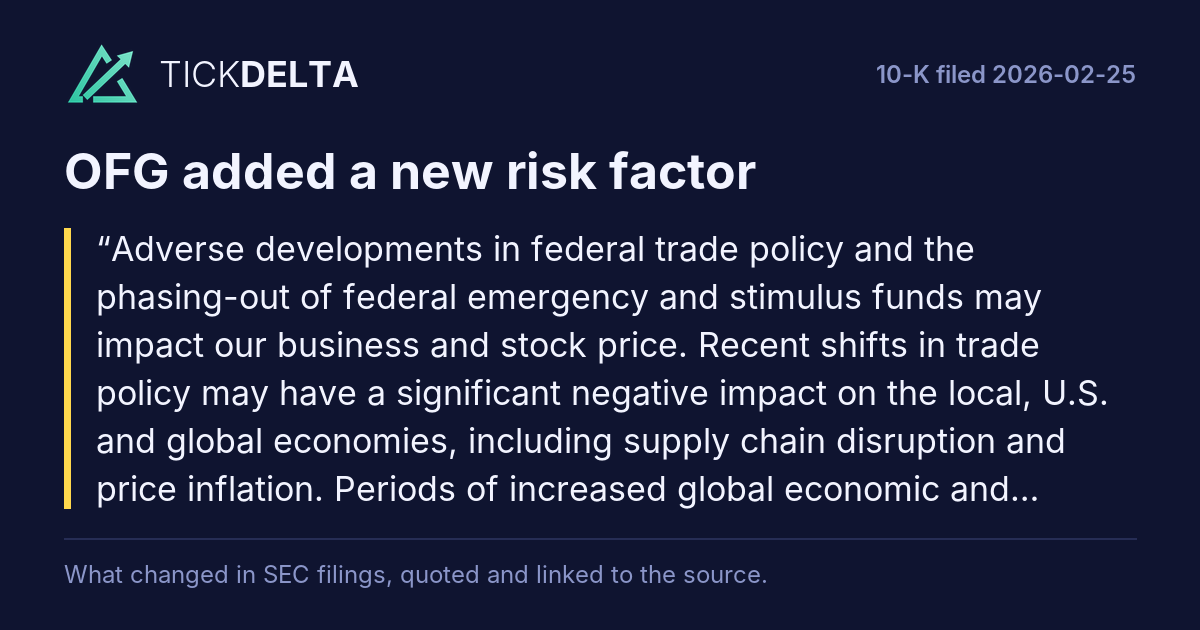
Adverse developments in federal trade policy and the phasing-out of federal emergency and stimulus funds may impact our business and stock price.
Recent shifts in trade policy may have a significant negative impact on the local, U.S. and global economies, including supply chain disruption and price inflation. Periods of increased global economic and geopolitical uncertainties caused by changes in U.S. trade policy have resulted in considerable volatility in the trading markets and may increase the risk of a recession. In addition, proposed significant reductions in federal spending, including cuts to programs and funding streams, could impact the federal emergency and stimulus funds that are vital to Puerto Rico’s economy. Many of Puerto Rico’s government programs and services are supported by these funds and their phase-out could adversely impact Puerto Rico’s economy. As a financial institution with its main operations in Puerto Rico, we are exposed to the potential negative effects of the phase-out of these federal funds and the uncertainty it creates in the local economy These uncertainties may also lead to heightened credit risks,
reduced economic activity, and limited growth opportunities, thereby potentially adversely impacting our financial performance. Furthermore, these developments have adversely impacted, and could continue to adversely impact, the market price of our common stock.
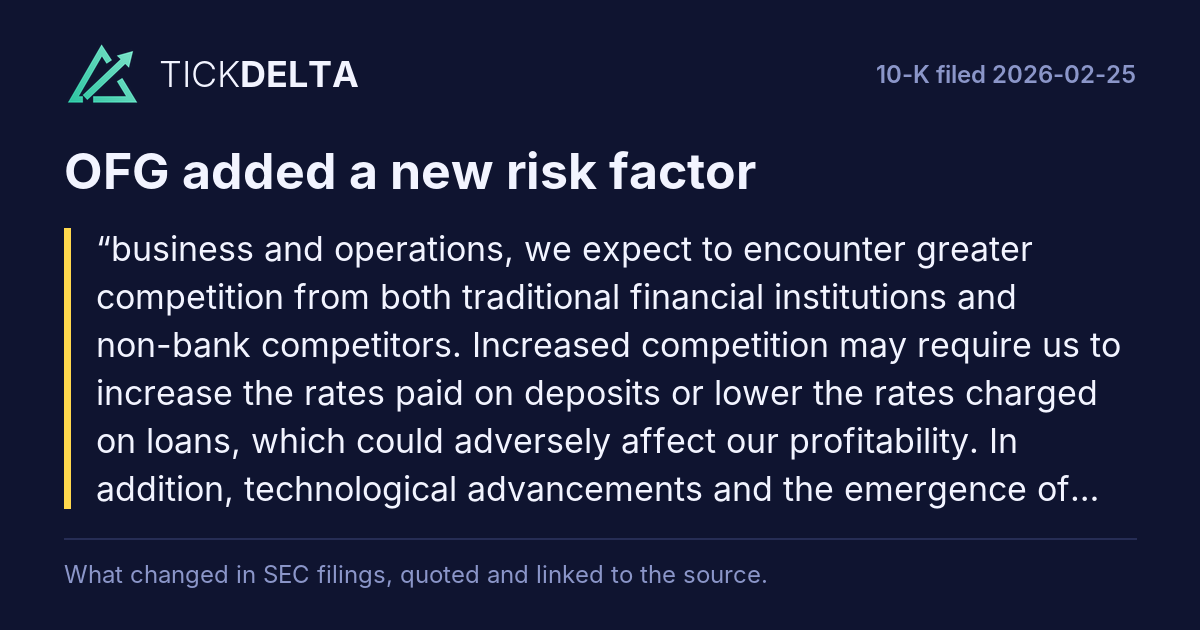
business and operations, we expect to encounter greater competition from both traditional financial institutions and non-bank competitors. Increased competition may require us to increase the rates paid on deposits or lower the rates charged on loans, which could adversely affect our profitability. In addition, technological advancements and the emergence of digital banking platforms have lowered barriers to entry, enabling new market participants to compete for our customers. Our failure to effectively compete for customers could result in a loss of market share and have a material adverse effect on our business, financial condition, or results of operations.
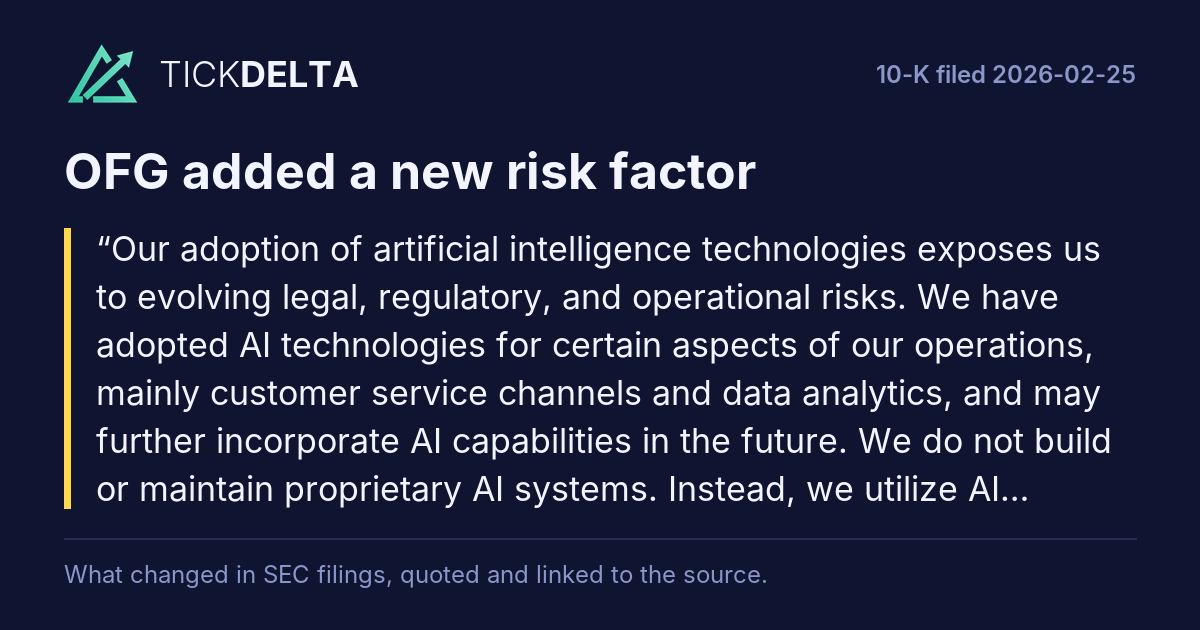
Our adoption of artificial intelligence technologies exposes us to evolving legal, regulatory, and operational risks.
We have adopted AI technologies for certain aspects of our operations, mainly customer service channels and data analytics, and may further incorporate AI capabilities in the future. We do not build or maintain proprietary AI systems. Instead, we utilize AI solutions provided by third-party technology vendors. Our reliance on these external AI platforms extends to tools that support real-time business analytics and improve operational decision-making. We also face indirect exposure to AI-related risks through vendors, business partners, and customers who may employ AI technologies in ways that affect our operations or services.
The rapidly evolving nature of AI regulation and technology creates significant uncertainty for our business. Federal and state lawmakers are actively developing new rules governing AI deployment, while existing regulatory frameworks—including consumer protection laws enforced by the CFPB, data privacy requirements under the Gramm-Leach-Bliley Act, and fair lending statutes—are being interpreted and applied to AI use cases in ways that remain unsettled. As a financial institution with more than $10 billion in assets, we face heightened regulatory scrutiny of our consumer-facing technologies, including AI applications. Our dependence on third-party AI vendors means that provider failures, service disruptions, or contract terminations could impair certain business functions with limited ability to quickly pivot to alternative solutions. Additionally, cybercriminals are increasingly using AI to conduct more sophisticated attacks against financial institutions. Failure to promptly adapt to and effectively implement security measures in response to rapidly evolving technological threats could significantly heighten our risks of data breaches, financial fraud, operational disruptions, regulatory scrutiny, reputational harm, and financial losses.
Paragraphs in the 10-Q filed Nov 5, 2026 that were not in the one before
New in the latest 10-Q
15 paragraphs in the 10-Q filed Nov 5, 2026 with nothing like them in the 10-Q filed Aug 6, 2026 (at least half the words must differ; new numbers alone do not count). Quoted exactly, grouped by the item heading above them. This is text that changed, not a judgement of how serious it is.
10-Q
OFG BANCORP UNAUDITED CONSOLIDATED STATEMENTS OF CASH FLOWS FOR THE NINE-MONTH PERIODS ENDED SEPTEMBER 30, 2026 AND 2025 (CONTINUED) Nine-Month Period Ended September 30, 2026 2025 (In thousands) ──────────────────────────────────────────────────────────────────────────────────────────────────────────────────────────────────────────────────────────────────────────────────── Cash flows from investing activities: Purchases of: Investment securities available-for-sale (267,407) (352,634) FHLB stock (14,175) (30,367) Equity securities (4,535) (3,869) Maturities and redemptions of: Investment securities available-for-sale 296,634 262,070 Investment securities held-to-maturity 16,807 16,634 FHLB stock 16,721 27,226 Proceeds from sales of: Foreclosed real estate and other repossessed assets, including write-offs 37,690 40,225 Premises and equipment 17 — Origination and purchase of loans, excluding loans held-for-sale (2,796,522) (2,546,785) Principal repayment of loans 2,393,210 2,133,731 Additions to premises and equipment (17,744) (12,485) Net cash used in investing activities $ (339,304) $ (466,254) Cash flows from financing activities: Net (decrease) increase in: Deposits (291,151) 395,492 Securities sold under agreements to repurchase 100,400 25,000 FHLB advances and other borrowings (55,006) 130,000 Exercise of stock options and restricted units lapsed, net of employee awards repurchased (2,477) (3,528) Purchase of treasury stock (58,016) (51,486) Dividends paid on common stock (42,829) (38,517) Net cash (used in) provided by financing activities $ (349,079) $ 456,961 Net change in cash and cash equivalents (473,562) 149,212 Cash and cash equivalents at beginning of period 1,040,335 591,137 Cash and cash equivalents at end of period $ 566,773 $ 740,349
Read in the 10-Q
With year-over-year increases of 14.7% in EPS, 9.2% in net income and 1.0% in core revenues, third quarter results reflected continued momentum in commercial loan growth, stable credit quality and core deposit balances, disciplined expense management, and healthy profitability. OFG also repurchased $13.5 million of common shares, reinforcing its commitment to creating long-term shareholder value.
Read in the 10-Q
During the third quarter of 2026, OFG continued advancing its digital bank with a human touch strategy. Customers are embracing OFG’s digital tools and value-added services while our Libre+, Elite, and My Biz accounts are attracting new clients and helping our bankers deepen existing relationships.
Read in the 10-Q
On a macro level, the Puerto Rico economy remains stable, supported by a healthy labor market and ongoing expansion by local and mainland businesses.
Read in the 10-Q
Credit Quality: The early and total delinquency rates of 2.65% and 3.91% both increased sequentially from the second quarter of 2026 due to seasonal trends, but declined year over year compared to third quarter of 2025. At the same time, the third quarter of 2026 net charge-offs (“NCOs”) and nonperforming loan rates of 0.70% and 0.74% both declined compared to both the second quarter of 2026 and the third quarter of 2025.
Read in the 10-Q
Show the other 10
The increase was partially offset by a $1.7 million decrease in other non-interest income reflecting $1.9 million gains recognized during the prior year quarter on investments held by OFG Ventures in fintech-focused funds.
Read in the 10-Q
The increase was partially offset by a $2.0 million decrease in other non-interest income reflecting $1.9 million gains recognized on investments held by OFG Ventures in fintech-focused funds during the prior year period.
Read in the 10-Q
• A $992 thousand decrease in professional and service fees reflecting lower compliance-related expenses; and
Read in the 10-Q
• A $982 thousand decrease in information technology expenses primarily reflecting $724 thousand in reduced data processing costs and $772 thousand in reduced IT support expenses, partially offset by a $520 thousand increase in cloud computing costs.
Read in the 10-Q
On the retail side, consumer and auto loan portfolios continued to perform well, reporting lower early delinquency and 90 days and over delinquency levels compared to December 31, 2025. The residential mortgage loan portfolio experienced lower early delinquency and a modest increase of $1.3 million or 1.9% in the 90 days and over delinquency amount, mainly as a result of a $2.2 million increase in the GNMA buy-back option program, compared to December 31, 2025.
Read in the 10-Q
Net charge-offs for consumer and auto loans improved year-over-year, and recovery performance remained strong. Collateral liquidation values in the auto loan portfolio have remained stable, resulting in consistent loss severity. Mortgage loan recoveries continued to exceed charge-offs.
Read in the 10-Q
Commercial non-performing loan rates at September 30, 2026 were 0.68 percent compared to 2.50 percent at December 31, 2025. Delinquencies and non-performing levels are down, criticized exposure has declined, and overall asset quality has improved materially.
Read in the 10-Q
OFG maintains a strong liquidity position, supported by a diversified funding base. Although a higher interest rate environment affects funding costs and elevated mortgage rates may somewhat slow securities prepayment speeds, OFG’s liquidity sources remain ample to meet its funding needs. OFG continues to actively monitor market conditions and manage its liquidity and funding to support its operations and balance sheet strategies.
Read in the 10-Q
Regulatory capital ratios are not affected by these market value adjustments as OFG has made the election not to include accumulated other comprehensive income (losses) in its regulatory capital calculations. Nevertheless, other capital ratios and measures, such as total equity to total assets, total equity to risk-weighted assets, tangible common equity to total assets, tangible common equity to tangible assets, book value per common share, and tangible book value per common share, have been affected.
Read in the 10-Q
Share sales and buybacks
The table below sets forth the information with respect to purchases of our common stock made by or on behalf of OFG during the quarter ended September 30, 2026, excluding the month of July during which no shares were repurchased as part of the repurchase programs:
Read in the 10-Q
The 10-Q's risk factors against the 10-K
Item 1A of the 10-Q filed Nov 5, 2026 against Item 1A of the 10-K filed Feb 25, 2026.
A 10-Q repeats only the risks that changed, so a 10-K paragraph that is missing from it is not counted as removed.
Added is a paragraph with nothing like it in the 10-K, Reworded a sentence that is in both with several words changed,
Quiet changes a sentence in both where one to four words changed and one is a hedge or a modal
(cut words struck through, new words highlighted).
Text on the page, not a score; each links to the filing at sec.gov.
Phrases used for the first time
Two-word phrases in Risk Factors of the 10-K filed Feb 25, 2026 that are in none of the 1 earlier 10-Ks stored, back to Feb 27, 2025
Where each one is used
- trade policy: Adverse developments in federal trade policy and the phasing-out of federal emergency and stimulus funds may impact our business and stock price.
- federal emergency: Adverse developments in federal trade policy and the phasing-out of federal emergency and stimulus funds may impact our business and stock price.
- stimulus funds: Adverse developments in federal trade policy and the phasing-out of federal emergency and stimulus funds may impact our business and stock price.
- rapidly evolving: The rapidly evolving nature of AI regulation and technology creates significant uncertainty for our business. Federal and state lawmakers are actively developing new rules governing AI deployment, while existing regulatory frameworks—including consumer protection laws enforced by the CFPB, data privacy requirements...
Used at least twice, small words left out. Counted, not picked: a phrase can be new because the company renamed something.
Sources
Item 1A of each 10-K and 10-Q on EDGAR, quoted exactly. Each paragraph links to the filing at sec.gov.
Also
10-K change: what was reworded or cut, section by section.
Work with it
Excel workbook · CSV. Google Sheet that stays up to date: paste =IMPORTDATA("https://tickdelta.com/company/OFG/export.csv") into a cell.