Screener / SEC EDGAR /CIK 0001660134 /10-K filed Mar 5, 2026, compared with Mar 5, 2025 /Numbers from the XBRL of the 10-Ks
Nasdaq Technology · Software

Okta, Inc. OKTA

Compare with peers Embed
The 10-K against last year's

142 changes: 18 added, 35 removed, 87 reworded, 2 quiet changes

10-K Mar 5, 2026 vs Mar 5, 2025

10-K 0001660134-26-000020 (Mar 5, 2026) vs 10-K 0001660134-25-000049 (Mar 5, 2025)

Every paragraph, and how much of it changed

One bar per paragraph, in the order of the 10-K. Height and colour show the share of its words not in the closest paragraph a year earlier; the tallest bars are new paragraphs.

Risk Factors

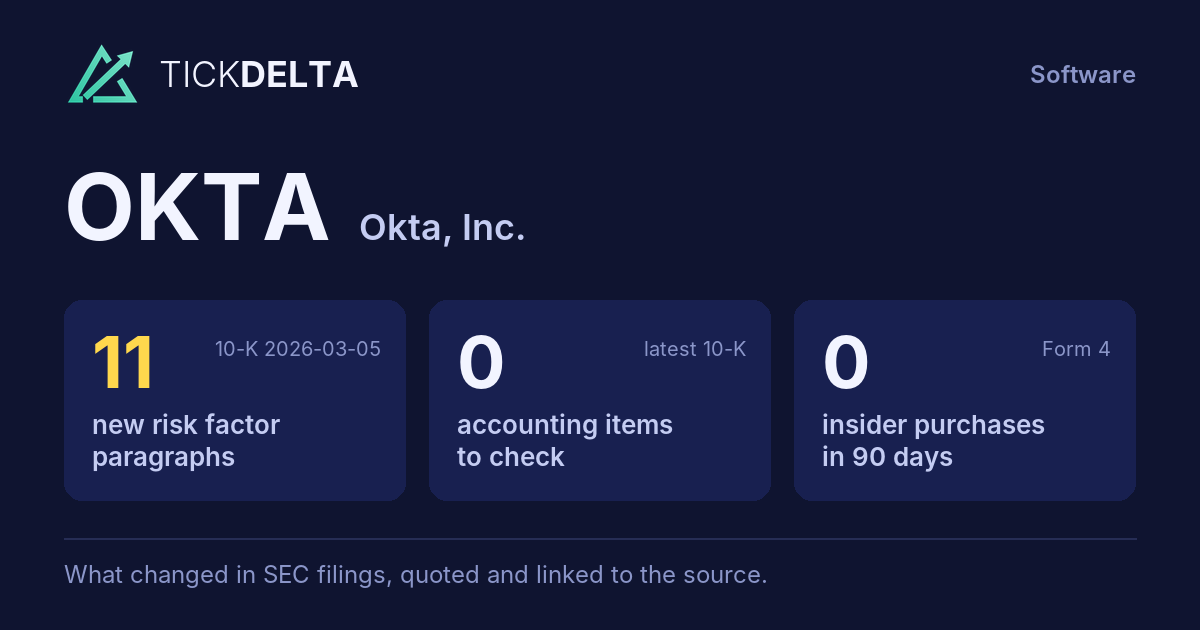
240 paragraphs · 11 new · 120 reworded · 27 gone · 10-K Mar 5, 2026 against Mar 5, 2025
New paragraph Reworded (5% of its words or more) Same or nearly
Paragraph 151 · 50% changed Every version of it
Today, a vast majority of our customer contracts are denominated in U.S. dollars. Over time, however, an increasing portion of our international customer contracts may be denominated in local currencies. In addition, the majority of our international costs are denominated in local currencies. As a result, fluctuations in the value of the U.S. dollar and foreign currencies may affect our results of operations when translated into U.S. dollars. We do not currently engage in currency hedging activities to limit the risk of exchange rate fluctuations. However, in the future, we may use derivative instruments, such as foreign currency forward and option contracts, to hedge certain exposures to fluctuations in foreign currency exchange rates. The use of such hedging activities may not offset any or more than a portion of the adverse financial effects of unfavorable movements in foreign exchange rates over the limited time the hedges are in place. Moreover, the use of hedging instruments may introduce additional risks if we are unable to structure effective hedges with such instruments.
Paragraph 73 · 50% changed Every version of it
We plan our expenses based on certain assumptions about the length and variability of our sales cycle. These assumptions are based upon historical trends for sales cycles and conversion rates associated with our existing customers. We are increasingly focused on sales to larger organizations, which often involve lengthy purchasing approval processes and less predictable sales cycles. The length of sales cycles may be further impacted by the current macroeconomic environment and by the discretionary nature of customer spending. Customers may also take prolonged evaluation periods of our platforms, or their features or functionality, and those of our competitors. As a result, it is difficult to predict exactly when, or even if, we will make a sale. If we are unable to close one or more of expected significant transactions in a particular period, or if such an expected transaction is delayed until a subsequent period, our results of operations for that period, and for any future periods in which revenue from such transaction would otherwise have been recognized, may be harmed.
Paragraph 132 · 40% changed Every version of it
We use internally developed In addition, we are working to incorporate generative AI Technologies (i.e., those that can produce and third-party developed machine learning output new content, software code, data and AI technologies in information) into our offerings and business, and we are making investments in expanding our AI capabilities in our portfolio, including ongoing deployment and improvement of existing machine learning and AI technologies, as well as developing new product features using AI technologies, including, for example, generative AI. AI technologies are complex and rapidly evolving, and we face significant competition from other companies as well as an evolving regulatory landscape. For example, in the European Union, the Artificial Intelligence Act establishes obligations on the use of AI based on the type of AI and its potential risks to society. Additionally, in the United States, federal and state legislatures and agencies are introducing legal frameworks and rules governing AI. The introduction of AI technologies into new or existing solutions may result in new or enhanced governmental or regulatory scrutiny, litigation, confidentiality or security risks, ethical concerns, or other complications that could adversely affect our business, reputation, or financial results. For example, even if permitted by our privacy policy and contractual rights, our use of data in novel AI applications may, in time, expand beyond customer expectations. The intellectual property ownership and license rights, including copyright, surrounding AI technologies has not been fully addressed by courts or national or local laws or regulations, and the use or adoption of third-party AI technologies into our solutions may result in exposure to claims of copyright infringement or other intellectual property misappropriation. internal business practices. Uncertainty around new and emerging AI technologies, Technologies, such as generative AI, AI Technologies, may require additional investment in the development and maintenance of proprietary and third-party datasets and machine learning models, development of new approaches and processes to provide attribution or remuneration to creators of training data, and development of appropriate protections and safeguards for handling the use of customer data with AI technologies, Technologies, which may be costly and could impact our expenses as we continue to expand generative AI Technologies into our product offerings. If such investments do not deliver anticipated benefits or are not otherwise successful, our business and results of operations may be harmed. Furthermore, there is a risk that generative AI technologies, including generative AI, Technologies may create content that appears correct but is factually inaccurate or flawed. misleading, or that creates other discriminatory content or unexpected results or behaviors. Our customers or others may rely on or use this flawed misleading content to their detriment, which may expose us to brand or reputational harm, competitive harm, harm and/or legal liability. The use of AI technologies Technologies presents emerging ethical and social issues, and if we enable or offer solutions that draw scrutiny or controversy due to their perceived or actual impact on customers or on society as a whole, we may experience brand or reputational harm, competitive harm, harm and/or legal liability.
Paragraph 131 · 39% changed Every version of it
We use internally developed and third-party developed machine learning and AI technologies in our offerings and business, and we are making investments in expanding our AI capabilities in our portfolio, including ongoing deployment and improvement of existing machine learning and AI technologies, as well as developing new product features using AI technologies, including, for example, generative AI. AI technologies Technologies are complex and rapidly evolving, and we face significant competition from other companies as well as an evolving regulatory landscape. For example, in the European Union, the EU Artificial Intelligence Act now establishes obligations on the use of AI based on the type of AI and its potential risks to society. Additionally, in the United States, legislation related to AI Technologies has been introduced at the federal level and is advancing at the state legislatures level. It is possible that further new laws and agencies regulations will be adopted in the United States and in other non-U.S. jurisdictions, or that existing laws and regulations, including competition and antitrust laws, may be interpreted or challenged in ways that would limit our ability to use AI Technologies for our business, or require us to change the way we use AI Technologies in a manner that negatively affects the performance of our products, services, and business. We may need to expend resources to adjust our products or services in certain jurisdictions if the laws, regulations, or decisions are introducing legal frameworks and rules governing AI. The not consistent across jurisdictions. Further, the introduction of AI technologies Technologies into new or existing solutions may result in new or enhanced governmental or regulatory scrutiny, litigation, confidentiality or security risks, ethical concerns, concerns or other complications that could adversely affect our business, reputation, reputation or financial results. For example, even if permitted by our privacy policy and contractual rights, our use of data in novel AI applications may, in time, expand beyond customer expectations. The intellectual property ownership and license rights, including copyright, surrounding AI technologies Technologies has not been fully addressed by courts or national or local laws or regulations, and the use or adoption of third-party AI technologies Technologies into our solutions may result in exposure to claims of copyright infringement or other intellectual property misappropriation. Uncertainty around new and emerging AI technologies, such as generative AI, may require additional investment in the development and maintenance of proprietary datasets and machine learning models, development of new approaches and processes to provide attribution or remuneration to creators of training data, and development of appropriate protections and safeguards for handling the use of customer data with AI technologies, which may be costly and could impact our expenses as we continue to expand generative AI into our product offerings. AI technologies, including generative AI, may create content that appears correct but is factually inaccurate or flawed. Our customers or others may rely on or use this flawed content to their detriment, which may expose us to brand or reputational harm, competitive harm, and/or legal liability. The use of AI technologies presents emerging ethical and social issues, and if we enable or offer solutions that draw scrutiny or controversy due to their perceived or actual impact on customers or on society as a whole, we may experience brand or reputational harm, competitive harm, and/or legal liability.
Paragraph 121 · 35% changed Every version of it
Our success also depends on the willingness of third-party developers and technology providers to build applications and provide integrations that are complementary to our service. Without the development of these applications and integrations, both current and potential customers may not find our service sufficiently attractive, attractive and our business, results of operations and financial condition could suffer.
Paragraph 202 · 34% changed Every version of it
The trading market for our Class A common stock will depend in part on the research and reports that securities or industry analysts publish about us or our business. If industry analysts do not publish or cease publishing research on our company, the trading price for our Class A common stock would be negatively affected. If one or more of the analysts who cover us downgrade our Class A common stock or publish inaccurate or unfavorable research about our business, our Class A common stock price would likely decline. If one or more of these analysts cease coverage of us or fail to publish reports on us on a regular basis, demand for our Class A common stock could decrease, which might cause our Class A common stock price and trading volume to decline.
Paragraph 64 · 33% changed Every version of it
•political, •general political, economic and social uncertainties, including macroeconomic and geopolitical conditions and financial market conditions;
Paragraph 88 · 33% changed Every version of it
Increased attention to environmental Investors, regulators, customers and other stakeholders, both in the United States and internationally, are increasingly attentive to, and have evolving expectations about, sustainability and social issues, as well as societal expectations regarding voluntary sustainability initiatives and disclosures, may result in increased costs (including but not limited to, increased costs related to compliance, stakeholder engagement and contracting), impact our reputation, or otherwise affect our business performance. disclosures. We have undertaken certain sustainability-related initiatives, goals and commitments, which we have communicated on our website, in our SEC filings and elsewhere. We elsewhere, and may undertake additional actions in the future. These actions, including establishing certain sustainability goals or targets, targets to improve our sustainability profile and/or respond to demand from investors, regulators, customers stakeholder demands or requirements, may result in increased costs (including, but not limited to, increased costs related to compliance, stakeholder engagement and other stakeholders, both U.S.-based and internationally. However, meeting our contractual commitments). Our ability to perform or carry out such actions may be costly or subject to numerous conditions that are outside our control, and we cannot guarantee that such any actions will have the desired effect. Our actual or perceived failure to achieve such goals or targets could negatively impact our reputation and impact our ability to compete as effectively to recruit or retain employees.

MD&A

98 paragraphs · 7 new · 52 reworded · 8 gone · 10-K Mar 5, 2026 against Mar 5, 2025
New paragraph Reworded (5% of its words or more) Same or nearly
Paragraph 66 · 45% changed
Effective the first quarter of fiscal 2025, we We satisfy employee payroll tax withholding obligations due upon the vesting of share-based compensation awards with our own funds under the "net share settlement" approach. Previously, payroll tax withholding was satisfied via the sale of shares of our common stock in the open market. The through net share settlement approach using available cash. This practice reduces our equity dilution rate by covering such withholding tax obligations from existing cash reserves and impacts future liquidity. The liquidity as our cash outflow requirements for these obligations are primarily driven by the market price of our Class A common stock at the time of vesting. In fiscal 2026 and 2025, cash paid to cover satisfy these employee tax withholding obligations is classified as a financing activity in the statement of cash flows. was $192 million and $148 million, respectively.
Paragraph 67 · 43% changed
In June 2020, September 2019, we completed our private offering of the 2026 Notes 2025 convertible senior notes (“2025 Notes”) due on June 15, 2026 September 1, 2025 and received aggregate gross proceeds of $1,150 million. The interest rate on the 2026 Notes is fixed at 0.375% per year and is payable semi-annually in arrears on June 15 and December 15 of each year, beginning on December 15, 2020. In connection with the 2026 Notes, we used a portion of the proceeds to enter into capped call transactions ("2026 (“2025 Capped Calls") Calls”) with respect to our Class A common stock. The 2025 Notes matured on September 1, 2025, and we settled in full the principal amount then outstanding of $510 million in cash and the associated then outstanding 2025 Capped Calls expired unexercised.
Paragraph 57 · 42% changed
For fiscal 2025, 2026, income tax expense resulted primarily from income in profitable foreign jurisdictions, federal jurisdictions and state taxes resulting from limitations on tax attribute utilization, and local taxes, offset by the impact favorable impacts of tax windfalls from stock-based compensation in the United States. “One Big Beautiful Bill Act” (the “Act”) enacted on July 4, 2025.
Paragraph 14 · 41% changed
Our Dollar-Based Net Retention Rate is based upon our ACV which is calculated based on the terms of that customer’s contract and represents the total contracted annual subscription amount as of that period end. We calculate our Dollar-Based Net Retention Rate as of a period end by starting with the ACV from all customers as of twelve months prior to such period end ("Prior Period ACV"). We then calculate the ACV from these same customers as of the current period end ("Current Period ACV"). Current Period ACV includes any upsells and is net of contraction or churn over the trailing twelve months but excludes ACV from new customers in the current period. We then divide the Current Period ACV by the Prior Period ACV to arrive at our Dollar-Based Net Retention Rate. Our Dollar-Based Net Retention Rate is inclusive of ACV from self-service customers.
Paragraph 77 · 36% changed
During fiscal 2025, 2026, cash used in financing activities was $359 $720 million, a decrease an increase of $524 $361 million compared to fiscal 2024. 2025. The decrease increase was primarily attributable to lower volume of an increase in payments made for upon maturity and repurchases of the Notes offset by the convertible senior notes, an increase in taxes paid related to net share settlement of equity awards, and further impacted by common stock repurchases related to the initiation of our share repurchase program in fiscal 2026. The cash outlay for common stock repurchases and taxes paid on net share settlement of equity awards during fiscal 2025. are generally predicated on the closing price of our stock on the respective transaction dates.
Paragraph 83 · 35% changed
We prepare our consolidated financial statements in accordance with accounting principles generally accepted in the United States of America. In the preparation of these consolidated financial statements, we are required to make estimates and assumptions that affect the reported amounts of assets, liabilities, revenue, costs and expenses, and related disclosures. To the extent that there are material differences between these estimates and actual results, our financial condition or results of operations would be affected. We base our estimates on past experience and other assumptions that we believe are reasonable under the circumstances, and we evaluate these estimates on an ongoing basis. We refer to accounting estimates of this type as critical accounting estimates, which we discuss below.
Paragraph 24 · 34% changed
We intend to continue to invest additional resources in our platform infrastructure, our platforms support organizations and security posture. We will continue to invest in technology innovation and we anticipate that costs qualifying for capitalization of internal-use software costs and related amortization may fluctuate over time. We expect our investment in technology to expand the capability of our platform, platforms, enabling us to improve our gross margin over time. The level and timing of investment in these areas could affect our cost of subscription revenue in the future.
Paragraph 53 · 33% changed
For fiscal 2025, restructuring Restructuring and other charges decreased primarily in fiscal 2026 due to a reduction in the absence scale of lease impairments along with a smaller overall restructuring plan implemented in fiscal 2025 initiatives compared to fiscal 2024. 2025.

A paragraph is matched with the one last year that shares the most of its words; under half in common makes it new. The paragraphs shown are the 8 reworded the most in each section.

The paragraph that changed most in each section

The redline

Marked against last year's 10-K: cut words struck through, new words highlighted.

Risk Factors365 words changed in this paragraph; it is 49% similar to last year's version.
We use internally developed and third-party developed machine learning and AI technologies in our offerings and business, and we are making investments in expanding our AI capabilities in our portfolio, including ongoing deployment and improvement of existing machine learning and AI technologies, as well as developing new product features using AI technologies, including, for example, generative AI. AI technologies Technologies are complex and rapidly evolving, and we face significant competition from other companies as well as an evolving regulatory landscape. For example, in the European Union, the EU Artificial Intelligence Act now establishes obligations on the use of AI based on the type of AI and its potential risks to society. Additionally, in the United States, legislation related to AI Technologies has been introduced at the federal level and is advancing at the state legislatures level. It is possible that further new laws and agencies regulations will be adopted in the United States and in other non-U.S. jurisdictions, or that existing laws and regulations, including competition and antitrust laws, may be interpreted or challenged in ways that would limit our ability to use AI Technologies for our business, or require us to change the way we use AI Technologies in a manner that negatively affects the performance of our products, services, and business. We may need to expend resources to adjust our products or services in certain jurisdictions if the laws, regulations, or decisions are introducing legal frameworks and rules governing AI. The not consistent across jurisdictions. Further, the introduction of AI technologies Technologies into new or existing solutions may result in new or enhanced governmental or regulatory scrutiny, litigation, confidentiality or security risks, ethical concerns, concerns or other complications that could adversely affect our business, reputation, reputation or financial results. For example, even if permitted by our privacy policy and contractual rights, our use of data in novel AI applications may, in time, expand beyond customer expectations. The intellectual property ownership and license rights, including copyright, surrounding AI technologies Technologies has not been fully addressed by courts or national or local laws or regulations, and the use or adoption of third-party AI technologies Technologies into our solutions may result in exposure to claims of copyright infringement or other intellectual property misappropriation. Uncertainty around new and emerging AI technologies, such as generative AI, may require additional investment in the development and maintenance of proprietary datasets and machine learning models, development of new approaches and processes to provide attribution or remuneration to creators of training data, and development of appropriate protections and safeguards for handling the use of customer data with AI technologies, which may be costly and could impact our expenses as we continue to expand generative AI into our product offerings. AI technologies, including generative AI, may create content that appears correct but is factually inaccurate or flawed. Our customers or others may rely on or use this flawed content to their detriment, which may expose us to brand or reputational harm, competitive harm, and/or legal liability. The use of AI technologies presents emerging ethical and social issues, and if we enable or offer solutions that draw scrutiny or controversy due to their perceived or actual impact on customers or on society as a whole, we may experience brand or reputational harm, competitive harm, and/or legal liability.

Source: Item 1A, 10-K 0001660134-26-000020 vs Item 1A, 10-K 0001660134-25-000049

Legal Proceedings189 words changed in this paragraph; it is 36% similar to last year's version.
On January 10, 2025, the Company and defendants agreed in principle to the non-monetary terms of a global resolution of the California Federal Derivative Actions, the Delaware Federal Derivative Actions, and the Delaware Chancery Actions, Actions (collectively, the “Derivative Actions”), and executed a Memorandum of Understanding in connection therewith containing the agreed-upon material, non-monetary terms of the proposed settlement. The parties in the Derivative Actions subsequently agreed that the Company would not oppose a fee award to plaintiffs’ counsel of $2.25 million, which the Company, as part of the final settlement documentation, agreed to cause its D&O insurers to pay. The parties in the Derivative Actions executed a Stipulation of Settlement on June 26, 2025, and the plaintiffs in the consolidated California Federal Derivative Actions filed a motion for preliminary approval of the proposed settlement on July 1, 2025. On August 18, 2025, the court in the consolidated California Federal Derivative Actions granted preliminary approval of the proposed settlement. On October 22, 2025, the court in the consolidated California Federal Derivative Actions granted final approval of the settlement and entered a judgment dismissing the consolidated California Federal Derivative Actions with prejudice. On November 24, 2025, the court in the Delaware Federal Derivative Actions entered orders dismissing those actions with prejudice pursuant to the terms of the settlement. On December 1, 2025, the court in the Delaware Chancery Actions entered an order dismissing that consolidated action pursuant to the terms of the settlement.

Source: Item 3, via Note 10 – Commitments and Contingencies, 10-K 0001660134-26-000020 vs Item 3, via Note 10 – Commitments and Contingencies, 10-K 0001660134-25-000049

Accounting Policies126 words changed in this paragraph; it is 53% similar to last year's version.
The fair value of each option and ESPP awards are estimated on the grant date using the Black-Scholes option pricing model which requires the use of various assumptions, including the expected term of the award, the expected volatility of the price of the underlying common stock, risk-free interest rates, and expected dividend yield of the underlying common stock. Stock-based compensation expense is recognized following the straight-line attribution method over the requisite service period for options, and over the offering period for ESPP awards. The expected term of the Company’s stock options, which were last granted to employees in fiscal 2022, was determined utilizing the simplified method due to lack of historical exercise data. The expected volatility was determined using a weighted-average of the historical volatility measures of a group of guideline companies and the Company's own historical volatility. The risk-free interest rate was based on the U.S. Treasury yield in effect at the time of grant for a period consistent with the expected term of the award. The expected dividend was assumed to be zero as the Company has never declared or paid any cash dividends and do not currently intend to declare dividends in the foreseeable future.

Source: Item 8, Note 2 – Summary of Significant Accounting Policies, 10-K 0001660134-26-000020 vs Item 8, Note 2 – Summary of Significant Accounting Policies, 10-K 0001660134-25-000049

MD&A114 words changed in this paragraph; it is 33% similar to last year's version.
Effective the first quarter of fiscal 2025, we We satisfy employee payroll tax withholding obligations due upon the vesting of share-based compensation awards with our own funds under the "net share settlement" approach. Previously, payroll tax withholding was satisfied via the sale of shares of our common stock in the open market. The through net share settlement approach using available cash. This practice reduces our equity dilution rate by covering such withholding tax obligations from existing cash reserves and impacts future liquidity. The liquidity as our cash outflow requirements for these obligations are primarily driven by the market price of our Class A common stock at the time of vesting. In fiscal 2026 and 2025, cash paid to cover satisfy these employee tax withholding obligations is classified as a financing activity in the statement of cash flows. was $192 million and $148 million, respectively.

Source: Item 7, 10-K 0001660134-26-000020 vs Item 7, 10-K 0001660134-25-000049

Sentences and paragraphs added, removed or reworded

Every change, by type

Sentences and paragraphs of OKTA's Risk Factors and MD&A, 10-K Mar 5, 2026 against 10-K Mar 5, 2025. Each links to the text at sec.gov.

Quiet changes are sentences kept from last year with one to four words changed, at least one of them a hedge, a modal or a qualifier (may, could, will, not, significant, material…). A year or date rolling forward is not counted.

The full word list

adverse, adversely, all, although, anticipate, anticipates, any, approximately, believe, believes, can, cannot, certain, could, expect, expects, generally, however, if, intend, intends, largely, likely, many, material, materially, may, might, most, must, never, no, not, possible, primarily, probable, should, significant, significantly, some, substantial, substantially, unlikely, will, would

AddedRisk Factors
•Any actual or perceived failure by us, our third-party service providers or our customers to comply with new or existing laws, regulations or other requirements relating to the privacy, security and processing of personal information could adversely affect our business, results of operations or financial condition.
Read it in 10-K Mar 5, 2026 at sec.gov
AddedRisk Factors
outcomes will have the desired effect. Our actual or perceived failure to achieve such goals or targets could negatively impact our reputation and otherwise affect our business performance.
Read it in 10-K Mar 5, 2026 at sec.gov
AddedRisk Factors
Our business relies on computer systems, hardware, software, technology infrastructure, and online sites and networks for operations that are critical to our business. Increasingly, we and other companies are subject to a wide variety of attacks on their systems and networks on an ongoing basis. In addition to threats from traditional computer “hackers,” malicious code (such as malware, viruses, worms and ransomware), employee or contractor
Read it in 10-K Mar 5, 2026 at sec.gov
AddedRisk Factors
Any actual or perceived failure by us, our third-party service providers or our customers to comply with new or existing laws, regulations or other requirements relating to the privacy, security and processing of personal information could adversely affect our business, results of operations or financial condition.
Read it in 10-K Mar 5, 2026 at sec.gov
AddedRisk Factors
We use internally developed and third-party developed machine learning and AI technologies (collectively, “AI Technologies”) in our offerings and business, and we are making investments in expanding our AI capabilities in our portfolio, including ongoing deployment and improvement of existing AI Technologies, as well as developing new product features using AI Technologies. We expect to rely on AI Technologies to help drive future growth and efficiency in our business. While our use of AI Technologies may become more important to our operations or to our future growth over time, we may not be able to realize the desired or anticipated benefits from AI in a timely or cost-effective manner.
Read it in 10-K Mar 5, 2026 at sec.gov
Show the other 56
AddedRisk Factors
•our inability to execute on our publicly announced stock repurchase program as planned, including failure to meet internal or external expectations around the timing or price of share repurchases, and any reductions or discontinuances of repurchases thereunder;
Read it in 10-K Mar 5, 2026 at sec.gov
AddedRisk Factors
We cannot guarantee that our Share Repurchase Program will be fully consummated or will enhance long-term stockholder value, and stock repurchases could increase the volatility of the trading price of our Class A common stock and diminish our cash reserves.
Read it in 10-K Mar 5, 2026 at sec.gov
AddedRisk Factors
On January 5, 2026, we announced that our board of directors (our “board”) approved a stock repurchase program with authorization to purchase up to $1 billion of our Class A common stock from time to time (the “Share Repurchase Program”). As of January 31, 2026, a total of $921 million remained available for repurchase under the Share Repurchase Program. Repurchases under the Share Repurchase Program are made in the open market, through privately negotiated transactions or other means, including pursuant to Rule 10b5-1 trading arrangements, and in compliance with applicable securities laws and other requirements. The timing, manner, price, and amount of the Share Repurchase Program is subject to the discretion of our management. The Share Repurchase Program does not obligate us to acquire a specified number of shares, and may be suspended, modified, or terminated at any time, without prior notice. We may not be able to repurchase shares at favorable prices. Further, our share repurchases could affect the trading price of our Class A common stock, increase its volatility, reduce our cash reserves, and may be suspended or terminated at any time, which may result in a lower market valuation of our Class A common stock.
Read it in 10-K Mar 5, 2026 at sec.gov
RemovedRisk Factors
•If we fail to manage our growth effectively or fail to execute our business plan, we may not be able to maintain high levels of service and customer satisfaction or adequately address competitive challenges.
Read it in 10-K Mar 5, 2025 at sec.gov
RemovedRisk Factors
•We and our third-party service providers have, in the past, failed or been perceived to have failed to fully comply with the privacy or security provisions of our privacy policy, our contracts and/or legal or regulatory requirements, which could result in proceedings, actions or penalties against us. We may experience similar incidents in the future.
Read it in 10-K Mar 5, 2025 at sec.gov
RemovedRisk Factors
If we fail to manage our growth effectively or fail to execute our business plan, we may not be able to maintain high levels of service and customer satisfaction or adequately address competitive challenges.
Read it in 10-K Mar 5, 2025 at sec.gov
RemovedRisk Factors
We have experienced rapid growth and organizational change, which has placed, and may continue to place, significant demands on our management and our operational and financial resources. In order to manage future growth and better align our organizational structure and resources with our business priorities, we may undertake restructuring plans from time to time. For example, in recent years we have announced restructuring plans intended to reduce operating expenses and improve profitability that involved reductions of our workforce. We have in the past encountered, and may in the future encounter, challenges in the execution of these restructuring efforts, such as adverse impacts on employee morale or attrition beyond the intended reductions, and these challenges could impact our ability to execute on our business initiatives, which could cause our restructuring efforts to not be as effective as anticipated and harm our financial results.
Read it in 10-K Mar 5, 2025 at sec.gov
RemovedRisk Factors
In addition, as we expand our business, it is important that we continue to maintain a high level of customer service and satisfaction. As our customer base continues to grow, we will need to expand our account management, customer service and other personnel, and our network of independent software vendors (“ISVs”), system integrators and other channel partners, to provide personalized account management and customer service. If we are not able to continue to provide high levels of customer service, our reputation, as well as our business, results of operations and financial condition, could be harmed.
Read it in 10-K Mar 5, 2025 at sec.gov
RemovedRisk Factors
While we achieved profitability in fiscal 2025, we have incurred net losses of $355 million and $815 million in fiscal 2024 and 2023, respectively. We will need to generate and sustain increased revenue levels in future periods in order to become consistently profitable, and even if we do, we may not be able to maintain or increase our level of profitability. We may incur losses in the future for a number of reasons, including the risks described in these risk factors, an increase in operating expense, and other unknown risks. Any failure by us to sustain profitability on a consistent basis could cause the value of our common stock to decline.
Read it in 10-K Mar 5, 2025 at sec.gov
RemovedRisk Factors
solutions than ours at lower prices. Any delay or failure in the introduction of new or enhanced solutions that gain market acceptance and meet customer requirements could harm our business, results of operations and financial condition.
Read it in 10-K Mar 5, 2025 at sec.gov
RewordedRisk Factors
Concerns about International and regional economic conditions, including instability or security concerns abroad, such as widespread downturns and recessions; geopolitical events; changes in trade policies, trade restrictions, economic sanctions or the threat of such actions; the instability of financial institutions; the availability and cost of credit; fluctuations in the inflation and interest rate environment, the instability of financial institutions, environment; health epidemics, the systemic impact of a widespread recession (in the United States epidemics; or internationally), energy costs, geopolitical issues, such as Russia’s invasion of Ukraine, or the availability and cost of credit costs have and could continue to lead to increased market volatility, decreased consumer confidence and diminished growth expectations in the U.S. economy and abroad, which in turn could result in reductions in spending on our platforms by our existing and prospective customers.
Read it in 10-K Mar 5, 2026 at sec.gov
RewordedRisk Factors
Our customers’ use of As our technology to access business systems platforms store, transmit and store data concerning, among others, their employees, contractors, partners and customers is essential to their use of our platforms, which stores, transmits and processes process customers’ proprietary information and users’ personal data data, they have experienced and likely will in the future experience attacks targeting such customer data.
Read it in 10-K Mar 5, 2026 at sec.gov
RewordedRisk Factors
Although we take precautions to prevent our solutions from being provided in violation of such laws, our solutions may have been in the past, these laws are subject to change and could in the future be, provided inadvertently in violation of such laws, despite the precautions we take. interpretation over time.
Read it in 10-K Mar 5, 2026 at sec.gov
RewordedRisk Factors
We expect that we may need to change our pricing in future periods and potentially in response to increased costs, including as a result of the inflation and interest rate environment and increased costs. environment, geopolitical considerations, as well as changes in trade policies, trade restrictions or the threat of such actions.
Read it in 10-K Mar 5, 2026 at sec.gov
RewordedRisk Factors
Our customers’ use of our technology to access business systems and store data concerning, among others, their employees, contractors, partners and customers is essential to their use of our platforms, which stores, transmits and processes customers’ proprietary information and users’ personal data experienced and likely will in the future experience attacks targeting such customer data. platforms.
Read it in 10-K Mar 5, 2026 at sec.gov
RewordedRisk Factors
Furthermore, there is a risk that generative AI technologies, including generative AI, Technologies may create content that appears correct but is factually inaccurate or flawed. misleading, or that creates other discriminatory content or unexpected results or behaviors.
Read it in 10-K Mar 5, 2026 at sec.gov
RewordedRisk Factors
Alternatively, if a court were to find the choice of forum provision contained in our amended and restated certificate of incorporation to be inapplicable or unenforceable in an action, we may incur additional costs associated with resolving such action in other jurisdictions, which could harm our business, results of operations and financial condition.
Read it in 10-K Mar 5, 2026 at sec.gov
RewordedRisk Factors
We may not achieve anticipated revenue growth if we are unable to hire and develop talented sales personnel or retain our existing sales personnel, or if our new sales personnel are unable to achieve desired productivity levels in a reasonable period of time or if we are unable to retain our existing sales personnel. time.
Read it in 10-K Mar 5, 2026 at sec.gov
RewordedRisk Factors
Accordingly, investors must rely on sales of their Class A common stock after price appreciation, which may never occur, as the only way to realize any future gains on their investments.
Read it in 10-K Mar 5, 2026 at sec.gov
RewordedRisk Factors
Further, as competitors introduce new solutions that compete with ours ours, or if they reduce their prices, prices or adopt preferable pricing models for evolving technologies, such as AI agents, we may be unable to attract new customers or retain existing customers based on our historical pricing.
Read it in 10-K Mar 5, 2026 at sec.gov
RewordedRisk Factors
However, Our ability to perform or carry out such actions may be costly or subject to numerous conditions that are outside our control, and we cannot guarantee that such any actions will have the desired effect. or
Read it in 10-K Mar 5, 2026 at sec.gov
RewordedRisk Factors
These laws create a patchwork of legislation and regulation that impose heightened transparency obligations about data collection, use, use and sharing practices, practices; add restrictions on the “sale” or “sharing” or transfer of personal information to third parties for purposes such as advertising or analytics, analytics; create new data privacy rights for consumers including the ability to limit the use of personal information for advertising, advertising; and carry significant enforcement penalties for non-compliance, including monetary and injunctive relief.
Read it in 10-K Mar 5, 2026 at sec.gov
Quiet changesRisk Factors
If Moreover, if our platforms are perceived to cause, or are otherwise unfavorably associated with, violations of privacy or data security requirements, it may subject us or our customers to public criticism and potential legal liability.
Read it in 10-K Mar 5, 2026 at sec.gov
Quiet changesRisk Factors
We do not have employment agreements with our executive officers or other key personnel that require them to continue to work for us for any specified period and they could terminate their employment with us at any time.
Read it in 10-K Mar 5, 2026 at sec.gov
AddedMD&A
The Act, among other provisions, maintains the U.S. federal 21% corporate tax rate, makes permanent the immediate expensing of domestic research and development expenditures, allows for 100% bonus depreciation for qualified assets, and modifies the U.S. taxation of profits derived from foreign operations. The provisions of the Act have staggered effective dates beginning in 2025 and continuing through 2027. Our provision for income taxes reported for fiscal 2026 was computed to reflect the effects of the change in the tax law. We expect the immediate expensing of domestic R&D expenditures to be the most significant impact of the Act, resulting in a reduction in federal and state cash tax payments and in our provision for income taxes for future periods.
Read it in 10-K Mar 5, 2026 at sec.gov
AddedMD&A
In addition, certain provisions of the Act, particularly those related to international taxation, are effective beginning in the fiscal period ending January 31, 2027. We are currently evaluating the impact of these provisions on our financial statements and tax positions.
Read it in 10-K Mar 5, 2026 at sec.gov
AddedMD&A
We periodically evaluate the realizability of our deferred tax assets based on all available evidence, both positive and negative. The realization of the net deferred tax assets is dependent on our ability to generate sufficient
Read it in 10-K Mar 5, 2026 at sec.gov
AddedMD&A
In January 2026, our board authorized a stock repurchase program of up to $1 billion of our outstanding shares of Class A common stock (the “Share Repurchase Program”). We have and may repurchase shares of our Class A common stock from time to time through open market purchases, in privately negotiated transactions, or by other means. Open market repurchases may be structured to occur in accordance with the requirements of Rule 10b-18. We may also, from time to time, enter into Rule 10b5-1 trading plans to facilitate repurchases of shares. The timing and the amount of stock repurchases under the Share Repurchase will be based on our evaluation of factors including business and market conditions, corporate and regulatory requirements, and other considerations. The Share Repurchase Program does not obligate us to repurchase any specific number of shares and may be modified, suspended, or terminated at any time. During the year ended January 31, 2026, we repurchased and immediately retired 875,150 shares of our Class A common stock for an aggregate amount, including commissions, of $79 million under the Share Repurchase Program. As of January 31, 2026, approximately $921 million of the originally authorized amount under the Share Repurchase Program remained available for future repurchases.
Read it in 10-K Mar 5, 2026 at sec.gov
AddedMD&A
On September 4, 2025, we acquired all of the outstanding equity of Axiom Security Ltd (“Axiom”), a privately held company specializing in privileged access management solutions. The acquisition date cash consideration was $54 million. See Note 16 to our consolidated financial statements “Business Combinations” for additional information.
Read it in 10-K Mar 5, 2026 at sec.gov
RemovedMD&A
Given the growth trends in cloud adoption and the number of applications customers use and the movement to remote and hybrid workforces, identity is becoming the most critical layer of an organization’s security. As organizations shift from network-based security models to a Zero Trust security model focusing on adaptive and context-aware controls, identity has become the most reliable way to manage user access and protect digital assets. Our approach to identity allows our customers to simplify and efficiently scale their security infrastructures across internal IT systems and external customer facing applications.
Read it in 10-K Mar 5, 2025 at sec.gov
RemovedMD&A
As of January 31, 2025, we had over 19,650 customers on our platforms. Increasing awareness of our platforms and capabilities, coupled with the mainstream adoption of cloud technology, has expanded the diversity of our customer base to include organizations of all sizes across all industries. Beginning in the first quarter of fiscal 2026, we will no longer provide the number of total customers as a business metric on which to evaluate the strength of our business.
Read it in 10-K Mar 5, 2025 at sec.gov
RemovedMD&A
The Tax Cuts and Jobs Act of 2017 requires taxpayers to capitalize and amortize research and development expenses over five years for U.S. activities and 15 years for foreign activities, per IRC Section 174, instead of deducting them in the year they were incurred. Starting in fiscal 2023, this change has increased our U.S. federal and state cash taxes. This impact is expected to continue in future years as our capitalized research and development expenses continue to increase.
Read it in 10-K Mar 5, 2025 at sec.gov
RemovedMD&A
The Organization for Economic Cooperation and Development ("OECD") and many countries have proposed to reallocate some portion of profits of large multinational companies with global revenues exceeding EUR 20 billion to markets where sales arise ("Pillar One"), as well as enacted a global minimum tax rate of at least 15% for multinationals with global revenues exceeding EUR 750 million ("Pillar Two"), with additional countries considering or intending to adopt these proposals. In December 2022, the Council of the European Union ("EU") formally adopted the EU Minimum Tax Directive, which would require member states to adopt Pillar Two into their domestic law. The directive requires the rules to initially become effective for fiscal years starting on or after December 31, 2023. Certain jurisdictions in which we operate have enacted Pillar Two legislation, with other countries considering changes to their tax laws to adopt the OECD's proposals. The enactment of Pillar Two legislation is not expected to
Read it in 10-K Mar 5, 2025 at sec.gov
RemovedMD&A
have a material adverse effect on our effective tax rate, financial position, results of operations and cash flows. We will continue to monitor and reflect the impact of such legislative changes in future financial statements as appropriate.
Read it in 10-K Mar 5, 2025 at sec.gov
RemovedMD&A
On February 1, 2024, we completed the acquisition of Spera Cybersecurity, Inc. and its subsidiary ("Spera"), an identity security platform provider. The acquisition date cash consideration was $58 million. Of this amount, $12 million was transferred to an escrow fund as partial security for any purchase price adjustments and indemnification obligations, and will be paid to the former Spera stockholders following the 18-month anniversary of the closing date (less any such adjustments or indemnification obligations). See Note 16 to our consolidated financial statements "Business Combinations" for additional information.
Read it in 10-K Mar 5, 2025 at sec.gov
RewordedMD&A
The following table sets forth our results of operations for the periods presented:Year Ended January 31, 2026 2025 2024 2023 (dollars in millions) Revenue Subscription $ 2,855 $ 2,556 $ 2,205 $ 1,794 Professional services and other 64 54 58 64 Total revenue 2,919 2,610 2,263 1,858 Cost of revenue Subscription(1) 578 549 502 464 Professional services and other(1) 83 69 79 82 Total cost of revenue 661 618 581 546 Gross profit 2,258 1,992 1,682 1,312 Operating expenses Research and development(1) 639 642 656 620 Sales and marketing(1) 1,018 965 1,036 1,066 General and administrative(1) 448 448 450 409 Restructuring and other charges 4 11 56 29 Total operating expenses 2,109 2,066 2,198 2,124 Operating loss income (loss) 149 (74) (516) (812) Interest expense (4) (5) (8) (11) Interest income and other, net 110 106 81 22 Gain on early extinguishment of debt — 19 106 — Interest and other, net 106 120 179 11 Income (loss) before provision for income taxes 255 46 (337) (801) Provision for income taxes 20 18 18 14 Net income (loss) $ 235 $ 28 $ (355) $ (815)
Read it in 10-K Mar 5, 2026 at sec.gov
RewordedMD&A
The following table sets forth our results of operations for the periods presented as a percentage of our total revenue:Year Ended January 31, 2026 2025 2024 2023 Revenue Subscription 98 % 97 98 % 97% Professional services and other 2 3 2 3 Total revenue 100 100 100 Cost of revenue Subscription 20 21 22 25 Professional services and other 3 4 3 4 Total cost of revenue 23 24 26 29 Gross profit 77 76 74 71 Operating expenses Research and development 22 25 29 33 Sales and marketing 35 37 46 58 General and administrative 15 17 20 22 Restructuring and other charges — 2 — 2 Total operating expenses 72 79 97 115 Operating loss income (loss) 5 (3) (23) (44) Interest expense — — (1) — Interest income and other, net 4 4 2 4 Gain on early extinguishment of debt — 1 4 — Interest and other, net 4 5 8 1 Income (loss) before provision for income taxes 9 2 (15) (43) Provision for income taxes 1 1 1 Net income (loss) 8 % 1 % (16) % (44)% (16)%
Read it in 10-K Mar 5, 2026 at sec.gov
RewordedMD&A
For fiscal 2025, 2026, income tax expense resulted primarily from income in profitable foreign jurisdictions, federal jurisdictions and state taxes resulting from limitations on tax attribute utilization, and local taxes, offset by the impact favorable impacts of tax windfalls from stock-based compensation in the United States. “One Big Beautiful Bill Act” (the “Act”) enacted on July 4, 2025.
Read it in 10-K Mar 5, 2026 at sec.gov
RewordedMD&A
The following table represents the Company’s our known short-term (i.e., the next twelve months) and long-term (i.e., beyond the next twelve months) obligations as of January 31, 2025:Short-term 2026:Short-term Long-term Total (dollars in millions) Convertible Senior Notes:(1) Principal payments $ 510 350 $ — $ 350 $ 860 Interest payments 2 1 3 — 1 Operating leases(2) 34 102 136 36 77 113 Purchase obligations(3) 336 210 546 306 163 469 Total contractual obligations $ 882 693 $ 663 240 $ 1,545 933
Read it in 10-K Mar 5, 2026 at sec.gov
RewordedMD&A
Subscription $ 578 $ 549 $ 502 $47 9% $29 5% Professional services and other 83 69 79 (10) (12) 14 19 Total cost of revenue $ 661 $ 618 $ 581 $37 6% $43 7% Gross profit $ 2,258 $ 1,992 $ 1,682 $310 18% $266 13% Gross margin:
Read it in 10-K Mar 5, 2026 at sec.gov
RewordedMD&A
Interest and Other, NetYear Ended January 31, 2026 2025 2024 $ Change % Change (dollars in millions) Interest expense $ (4) $ (5) $ (8) $ 3 (30)% 1 (34)% Interest income and other, net 110 106 81 25 31 4 4 Gain on early extinguishment of debt — 19 106 (87) (82) (19) (100) Interest and other, net $ 106 $ 120 $ 179 $ (59) (33)% (14) (11)%
Read it in 10-K Mar 5, 2026 at sec.gov
RewordedMD&A
In connection with September 2019, we completed our private offering of the 2026 Notes, 2025 convertible senior notes (“2025 Notes”) due on September 1, 2025 and we used a portion of the proceeds to enter into capped call transactions ("2026 (“2025 Capped Calls") Calls”) with respect to our Class A common stock.
Read it in 10-K Mar 5, 2026 at sec.gov
RewordedMD&A
Effective the first quarter of fiscal 2025, we We satisfy employee payroll tax withholding obligations due upon the vesting of share-based compensation awards with our own funds under the "net through net share settlement" approach. settlement using available cash.
Read it in 10-K Mar 5, 2026 at sec.gov
RewordedMD&A
We may in the future enter into arrangements to acquire or invest in complementary businesses, services and technologies, including intellectual property rights. rights; additionally, we have, and may in the future, repurchase shares of our Class A common stock from time to time under our Share Repurchase Program.
Read it in 10-K Mar 5, 2026 at sec.gov
RewordedMD&A
For fiscal 2025, 2026, cost of subscription revenue increased primarily due to an increase of $15 $20 million in labor costs, third-party hosting costs of $15 million, and an increase in stock-based compensation software costs of $7 million as we expanded our headcount. $9 million.
Read it in 10-K Mar 5, 2026 at sec.gov
RewordedMD&A
We review a number of operating and financial metrics, including the following key metrics, to evaluate our business, measure our performance, identify trends affecting our business, formulate business plans, and make strategic decisions.As of January 31, 2026 2025 2024 2023 (dollars in millions) Number of total customers 19,650 18,950 17,600 Customers with annual contract value ("ACV") (“ACV”) above $100,000 5,100 4,800 4,485 3,930 Dollar-based net retention rate for the trailing 12 months ended 106 % 107 % 111 % 120 % Current remaining performance obligations $ 2,513 $ 2,248 $ 1,952 $ 1,684 Remaining performance obligations $ 4,827 $ 4,215 $ 3,385 $ 3,007
Read it in 10-K Mar 5, 2026 at sec.gov
RewordedMD&A
As of January 31, 2025, 2026, the 2025 outstanding principal balance of the 2026 Notes are of $350 million is classified as a current liabilities liability due to their upcoming maturity on September 1, 2025, June 15, 2026 and we currently intend to settle the principal amount of the 2025 2026 Notes in cash.
Read it in 10-K Mar 5, 2026 at sec.gov

Sources

The two latest 10-Ks on EDGAR, section by section. Each change links to the text at sec.gov.

Also

New risk factors: paragraphs with nothing like them last year, quoted in full.

Work with it

Excel workbook · CSV. Google Sheet that stays up to date: paste =IMPORTDATA("https://tickdelta.com/company/OKTA/export.csv") into a cell.

Next:Related parties
Esc

Type a ticker such as AAPL, a name, an investor such as Buffett, or a topic such as tariffs. ↑ ↓ to move, Enter to open.