Form 10-K
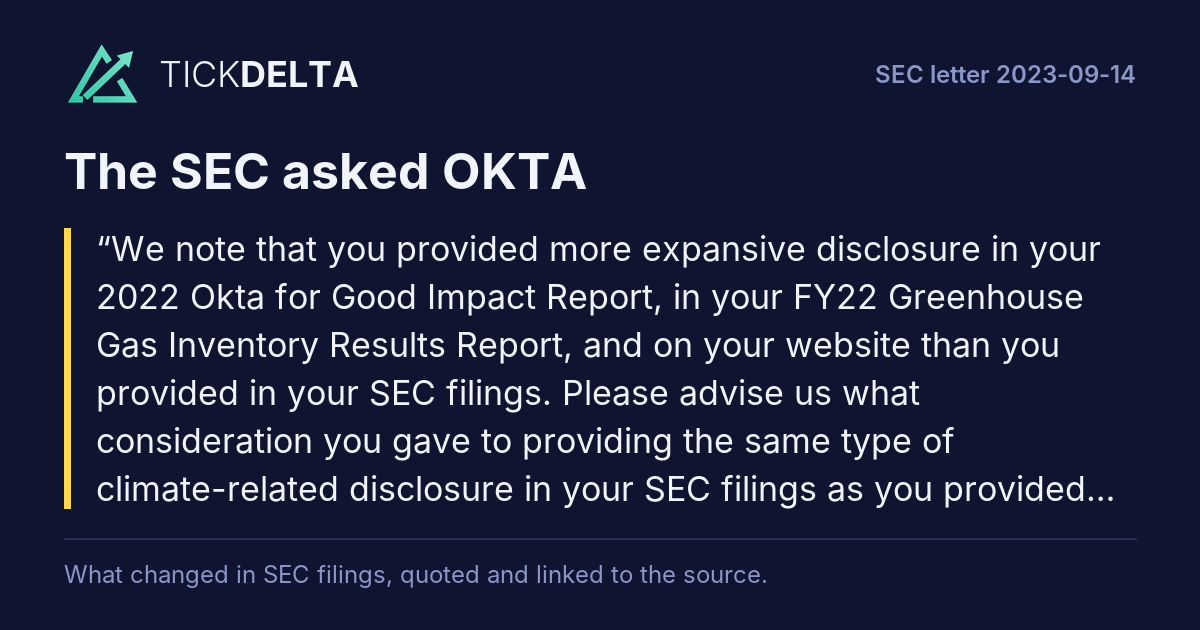
We note that you provided more expansive disclosure in your 2022 Okta for Good Impact Report, in your FY22 Greenhouse Gas Inventory Results Report, and on your website than you provided in your SEC filings. Please advise us what consideration you gave to providing the same type of climate-related disclosure in your SEC filings as you provided in these reports and on your website.
In response to the Staff’s comment, the Company respectfully provides the following supplemental information.Read in the reply
In May 2020, the Company formally launched its Environmental, Social and Governance (“ESG”) program. In connection with these efforts, the Company first published its annual social impact report in February 2021. Additionally, the Company published the 2022 Okta for Good Impact Report, as well as its Greenhouse Gas Inventory Results Report for the fiscal year ended January 31, 2022 and its ESG Fact Sheet for the fiscal year ended January 31, 2022 (collectively, the “ESG Materials”).Rest of the answer
The ESG Materials address the Company’s sustainability reporting practices and speak to a wide range of stakeholder interests. Additionally, the ESG Materials are developed in accordance with certain relevant sustainability reporting standards and frameworks: the Company’s greenhouse gas emissions inventory is developed in accordance with the frameworks established by GHG Protocol, and the Company’s climate targets are validated by the Science Based Targets initiative (SBTi).
Consistent with the various standards intended to communicate an array of ESG issues and aimed at a broad group of stakeholders interested in many varying ESG issues, the Company’s ESG Materials, which are available on the Company’s website, provide information beyond that considered material for investors in the context of disclosures required in an annual report on Form 10-K. As such, the Company’s approach to ESG issues and social impact is a process distinct from materiality assessments for purposes of the federal securities laws; instead, the issues and goals identified are those which were most important to the Company’s ESG strategy. The ESG Materials provided updates on these issues and goals as a part of a sustainability-focused assessment.
By comparison, the contents of the 2023 10-K were guided by compliance with the requirements of the SEC’s forms, rules, and interpretations applicable to the Company. In evaluating whether to include climate-related information from the ESG Materials in the 2023 10-K or other filings, the disclosure requirements of Regulation S-K (including Items 101, 103, 105 and 303) were considered, as well as whether the information constituted “material information ... as may be necessary to make the required statements, in the light of the circumstances under which they were made, not misleading” pursuant to Rule 12b-20 of the Securities Exchange Act of 1934. The Company further considered relevant Interpretive Releases, including Guidance Regarding Disclosure Related to Climate Change (Release No. 34-61469) and Guidance Regarding Management’s Discussion and Analysis of Financial Condition and Results of Operations (Release No. 34-48960).
Despite the present financial immateriality of certain of these topics, the Company recognizes the increasing interest of long-term investors in climate change and other ESG information, and the Company will continue to evaluate relevant information within its Form 10-K and other periodic report filings related to climate change risk and other relevant ESG topics in a manner consistent with applicable regulations. For example, pages 14 and 15 of the 2023 10-K Business section provide an overview of the Company’s community and social impacts and sustainability efforts, emphasizing Okta for Good and its core focus areas, the Company’s climate strategy to address emissions, its public commitments to climate targets, and its renewable energy program.
In addition, the risk factors section of the 2023 10-K on page 28 includes a standalone risk factor regarding how increased and complex scrutiny of ESG matters may require the Company to incur additional costs or otherwise adversely impact its business.
While the initiatives and goals identified in the ESG Materials were strategically important to the Company’s overall sustainability program at the time they were published, the Company did not and currently does not find that these initiatives, either individually or in the aggregate, rise to the level of materiality under the SEC’s rules, regulations and interpretive guidance noted above, either qualitatively or quantitatively. Consistent with its approach to all periodic report disclosures, the Company will continue to monitor and evaluate its climate-related disclosures, including whether additional climate-related information is appropriate as future SEC filings are prepared.
To the extent material, discuss the indirect consequences of climate-related regulation or business trends, such as the following: • decreased demand for products or services that produce significant greenhouse gas emissions or are related to carbon-based energy sources; • increased demand for products or services that result in lower emissions than competing products; • increased competition to develop innovativeRest of the question
new products that result in lower emissions; • increased demand for generation and transmission of energy from alternative energy sources; and • any anticipated reputational risks resulting from operations or products that produce material greenhouse gas emissions.
The Company respectfully acknowledges the Staff’s comment and advises the Staff that the Company has not identified any indirect consequences of climate-related regulation or business trends that have or were reasonably likely to have materially affected its business, financial condition, or results of operations. Company management reviews business activities, including a review of performance metrics to determine if a trend is material for purposes of MD&A disclosures in the Form 10-K.Read in the replyRest of the answer
Company management also reviews historical sales information as well as customer feedback, market insights and engagement surveys to determine trends that may be connected to climate-related matters. The Company considered financial, operational, and other market information known to its management and whether these trends had, or were reasonably likely to have, a material impact on its liquidity, capital resources, or results of operations. The information below is its response to each of the items specifically referenced in this comment.
1.decreased demand for products or services that produce significant greenhouse gas emissions or are related to carbon-based energy sources;
The Company has not experienced material decreased demand for products and services that are related to carbon-based energy sources. The Company believes that customer demand for its products and services is driven by a multitude of business factors, including product features, performance metrics, reliability, and cost (together, the “Primary Considerations”), and the Company has not experienced decreased demand for its products or services as a result of customers indicating that those products or services produce significant greenhouse gases or are related to carbon-based energy sources.
As one example, the Company believes that its customers who purchase its products do so primarily for reasons related to the applicability of its products to their use cases, performance, feature-set, reliability and cost of such products, and does not believe that energy consumption is a primary consideration, nor does the Company believe that overall demand for such products is driven by greenhouse gas emissions or whether such products are related to carbon-based energy sources.
2.increased demand for products or services that result in lower emissions than competing products;
As discussed above, the Company notes that there are many underlying business reasons, including the Primary Considerations, why customers may demand its products and services. The Company does not consider the greenhouse gas emissions of its operations, products and services to be one of the primary considerations a majority of its customers have for the Company's products and services given the cloud-based nature of the products and services. Thus, the Company does not believe there is a discernible trend of customers increasing (or decreasing) their demand for products that result in lower emissions than competing products based on the feedback the Company has received, to date, from its customers.
First report after the company's reply of Sep 27, 2023: 10-Q filed Dec 1, 2023 ↗, against the 10-Q filed Aug 31, 2023 ↗.
Tickdelta does not hold the text of both reports, so they are not compared here.
We note disclosure in your Form 10-K regarding the potential risks of natural disasters or other catastrophic events, including earthquakes, wildfires, and power loss, to your operations and systems, as well as to those of your third-party data centers and service providers, and to public infrastructure. Please discuss the physical effects of climate change on your operations and results.Rest of the question
This disclosure may include the following: • severity of weather, such as floods, hurricanes, sea levels, extreme fires, and water availability and quality; • quantification of weather-related damages to your property or operations; • potential for indirect weather-related impacts that have affected or may affect your major customers or suppliers; and • the extent to which extreme weather events have reduced the availability of insurance or increased the cost of insurance. Include quantitative information for each of the periods covered by your Form 10-K and explain whether increased amounts are expected in future periods.
increased competition to develop innovative new products that result in lower emissions;Read in the reply
While the Company monitors competitive product offerings, it is not aware of any material increased competition to develop new products that result in lower emissions to address climate change. Company management reviews external market trends in developing strategic plans and continues to develop and launch products to meet consumer demand.
As described above, given the cloud-based nature of the Company’s products and services, the primary considerations of the majority of the Company’s customers areRest of the answer
unrelated to the energy usage of its products and services, and, to date, the Company does not believe that there is any significant increase in competition to design products that result in lower emissions. Rather, the Company believes that the Primary Considerations of the majority of its customers are prioritized over a desire for a product with lower carbon emissions, and, consequently, the Company believes that there is not a significant increase in competition based exclusively and directly upon an effort to lower product emissions.
The Company believes there is continued and expected competition to design and provide products with particular features, reliability, and cost as Primary Considerations. The Company expects design around these factors to drive innovation and that such innovation may have the added benefit of reducing emissions.
First report after the company's reply of Sep 27, 2023: 10-Q filed Dec 1, 2023 ↗, against the 10-Q filed Aug 31, 2023 ↗.
Tickdelta does not hold the text of both reports, so they are not compared here.
Your proxy statement filed on May 11, 2023, references the purchase of renewable energy certificates ("RECs"). If material, please provide disclosure about your purchase and sale of carbon credits, carbon offsets, or RECs, and any material effects on your business, financial condition, and results of operations.Rest of the question
Provide us with quantitative information for each of the periods covered by your most recent Form 10-K and the amounts budgeted for or expected to be incurred in future periods.
increased demand for generation and transmission of energy from alternative energy sources; andRead in the reply
The Company respectfully advises the Staff that it believes the increased demand for generation and transmission of energy from alternative energy sources has no material business impacts to the Company’s operations.
As part of the Company’s ESG program, it has implemented voluntary projects, including (1) investing in energy-efficient buildings at its direct-leased offices; (2) committing to building out all new direct-leased offices to both LEED Silver and WELL Silver standards; and (3)Rest of the answer
reducing emissions due to reduced workplace square footage per employee. Additionally, in fiscal years 2023 and 2022, the Company purchased renewable energy certificates (“RECs”) to match 100% of the electricity consumed by its global offices and its employees’ estimated work from home consumption. However, the Company has not experienced an increased demand for the generation and transmission of energy from alternative energy sources that would be material under Regulation S-K.
First report after the company's reply of Sep 27, 2023: 10-Q filed Dec 1, 2023 ↗, against the 10-Q filed Aug 31, 2023 ↗.
Tickdelta does not hold the text of both reports, so they are not compared here.
Your response to prior comment 2 indicates that you have implemented voluntary projects as part of your ESG program and purchased renewable energy certificates to match 100% of electricity consumption. In light of these projects and purchases, please provide support for the conclusion that increased demand for generation and transmission of energy from alternative energy sources has no material impacts on yourRest of the question
operations or results. Include quantification of the project costs incurred during the periods covered by your Form 10-K and expected to be incurred in future periods, and tell us how you assessed materiality.
As disclosed in the 2023 10-K and noted in the First Response Letter, the Company has implemented projects as part of its Environmental, Social, and Governance (“ESG”) program and set a goal of 100% renewable electricity for the Company’s global real estate footprint on an annual basis. In order to help meet this goal, the Company purchases renewable energy certificates (“RECs”) to match the use of electricity that the Company calculated it had consumed that had been produced by non-renewable sources.Read in the replyRest of the answer
For example, in fiscal year 2023, the Company purchased RECs for 17,047 MWh, which match 100% of its estimated electricity consumption for its global offices, remote workforce, and cloud services based on information provided to the Company by third-party vendors for that period.
While the Company is proud of its engagement in ESG initiatives, it believes that the financial impact to the Company of such participation has been and remains immaterial. In fiscal years 2023, 2022, and 2021, the Company expended $0.4 million, $0.1 million, and $0.1 million, respectively, for RECs. The Company is unable to quantify the costs associated with its other voluntary ESG projects noted in its response to prior comment 2 because such costs are commingled with the Company’s office build-out costs and not separately tracked. However, the Company estimates that it spent no more than $0.5 million on its other voluntary ESG projects annually during those periods and therefore the Company believes that such costs are immaterial. By comparison, during those periods the Company’s revenue totaled $1,858 million, $1,300 million, and $835 million, and the Company’s operating expenses totaled $2,124 million, $1,672 million, and $821 million, respectively.
The Company respectfully advises the Staff that the Company carefully considers and prepares its disclosures in accordance with applicable U.S. securities laws and regulations, Commission guidance, and Commission Compliance and Disclosure Interpretations (collectively, the “Disclosure Requirements”), including with respect to materiality within the context of the Company’s business, operating results, and financial condition. In assessing the materiality of costs associated with RECs and the Company’s voluntary ESG projects, the Company took into account the standard of materiality set forth in the Disclosure Requirements and the Commission’s Guidance Regarding Disclosure Related to Climate Change (Securities Act Rel. 33-9160, Feb. 2, 2010) (the “2010 Guidance”). Based on this evaluation, the Company determined that the financial impact of its engagement with respect to RECs did not, and were not reasonably expected to, have a material effect on the Company’s operations and financial results for the periods reported in the 2023 10-K that would require disclosure under the Disclosure Requirements or the 2010 Guidance.
The Company expects future REC expenditures to be similar to those incurred in fiscal year 2023, due to its vendors’ progress in purchasing a greater percentage of their direct electricity consumption through renewable sources, thereby reducing the Company’s need to purchase RECs to match their electricity use, and as a result of the Company's strategy of reducing electricity consumption via energy efficiency improvements, both of which may be offset by its purchase of RECs to match additional electricity consumed if the Company increases its employee headcount.
As the Company engages in future purchases of RECs and continues to implement voluntary projects in connection with its ESG program, it will continue to evaluate the effects of those future purchases and implementations in SEC filings, including disclosures on the Company’s business, financial condition, or results of operations, in light of relevant rules, regulations and guidance and the applicable standard of materiality.
First report after the company's reply of Oct 24, 2023: 10-Q filed Dec 1, 2023 ↗, against the 10-Q filed Aug 31, 2023 ↗.
Tickdelta does not hold the text of both reports, so they are not compared here.
Your response to prior comment 3 indicates that you have “not experienced any material physical effects of climate change” and “did not identify any weather-related impacts on [your] business or any weather-related events that caused directly-attributable damages to [your] operations or results.” However, we note disclosure in your Form 10-K that describes events of PG&E shutting off power in order to reduce theRest of the question
risk of wildfires, which resulted in many of your employees being unable to work remotely. Please reconcile this apparent inconsistency, including by providing more information regarding the physical effects of climate change you and your suppliers have experienced during the periods covered by your Form 10-K. Provide the quantification of weather-related damages requested by our prior comment, and tell us how you assessed materiality.
The Company respectfully advises the Staff that, as noted in the First Response Letter, the Company assesses whether any events, including any adverse weather conditions, had a material effect on the Company, including as a result of any damage to the Company’s properties or operations. The Company carefully considers and prepares its disclosures in accordance with Disclosure Requirements and 2010 Guidance, including with respect to materiality within the context of the Company’s properties or operations and the operations of the Company’s customers.Read in the replyRest of the answer
The Company also maintains a global security operations center that monitors Company offices and employee locations for a variety of potential security events, including adverse weather conditions.
In preparing its 2023 10-K, the Company assessed whether any events, including the physical impacts of climate change, such as severe adverse weather conditions, impacted the Company’s operations and financial results and the operations of the Company’s customers. The Company also considered the effects of weather-related disruptions to the operations of the Company’s customers based on the Company’s ability to provide its products to the Company’s customers. As noted by the Staff, the Company disclosed in its 2023 10-K that, in the fall of 2019 and 2020, PG&E shut off power to certain cities in the San Francisco Bay Area in order to reduce the risk of wildfires and this resulted in many of the Company’s employees being unable to work remotely. These power shutoffs generally lasted no more than three days at a time, with the duration and effect varying by city. The Company’s headquarters and regional office in the San Francisco Bay Area is located in San Francisco, which was unaffected by the power outages in the fall of 2019 and 2020. In 2019, prior to the power outages, the Company launched “Dynamic Work”, a new framework for its global workforce that provided most employees with the flexibility to work remotely, while providing regional office space for its employees based on the needs of their role. As a result of the Company’s Dynamic Work framework, combined with the fact that its headquarters was unaffected by the power shutoffs, the Company’s employees in the San Francisco Bay Area had the option of working in its headquarters or in another remote location unaffected by the power shutoffs during the fall of 2019 and 2020. Additionally, the Company’s workforce is predominately comprised of exempt, salaried employees who can compensate for unproductive time during a power outage by completing work at other times without the
Company incurring any additional costs related to payment of wages. Any time when an employee was without power in their remote work location did not necessarily translate to an actual loss for the Company. As a result, the Company does not believe that it incurred any costs associated with PG&E shutting off power in order to reduce the risk of wildfires in 2019 and 2020, which was the only severe weather event experienced by the Company during the periods covered by the 2023 10-K, and the Company does not believe that these outages had a material impact on the Company’s operations and financial results. Thus, the Company determined that, despite impacting some of its employees’ ability to work remotely for a brief period of time, the events associated with such power shutoff did not create a disruption to the overall operations of the Company. The Company did, however, believe that disclosing the specific circumstances from those weather-related events would help investors understand with specificity the risks that the Company could face in the future and, thus, made the specific disclosures in the 2023 10-K.
The Company employs a software-as-a-service business model and generates revenue primarily by selling multi-year subscriptions to its cloud-based offerings. It also relies on third-party cloud service providers to run its operations and thus does not own or operate any co-location data centers. As a result, the Company does not hold inventory and does not operate warehouses or manufacturing facilities. Further supporting the conclusion above, in the last three fiscal years, the Company did not identify any property or inventory damages directly related to weather events.
After completing its review in connection with the 2023 10-K, the Company did not identify any weather-related impacts on its business or any weather-related events that caused directly-attributable damages to its operations or results. The Company will continue to monitor the physical impacts of climate change and severe weather activity on its operations and results. If, in the future, the Company experiences material physical impacts of climate change and severe weather activity on its operations or identifies any weather-related events that cause directly-attributable damages to the Company’s operations or results, the Company will include appropriate disclosures in future filings.
First report after the company's reply of Oct 24, 2023: 10-Q filed Dec 1, 2023 ↗, against the 10-Q filed Aug 31, 2023 ↗.
Tickdelta does not hold the text of both reports, so they are not compared here.
We note your response to prior comment 3 regarding insurance. Please quantify for us the cost of insurance for each of the periods covered by your Form 10-K, and clarify how the upward trend in the costs of insurance noted in your response has affected your expectations for insurance costs and availability in future periods, including as a result of weather-related impacts.
The Company respectfully advises the Staff that it has not experienced any material changes to the amount or availability of overall insurance coverage, or coverage specific to weather-related events. As provided in the table below, the overall cost of the Company’s property and casualty insurance (“P&C insurance”) has increased during the periods covered by the 2023 10-K primarily due to (i) the Company’s expansion into new locations and increased office space footprint globally; (ii) the significant increase in the Company’s employee headcount and related increase in workers’ compensationRead in the replyRest of the answer
insurance, a component of the Company’s P&C insurance; and (iii) an increase in the Company’s sales levels and related increase in general liability insurance, a component of the Company’s P&C insurance. For the periods covered by the 2023 10-K, the Company experienced an increase in P&C insurance premiums of $0.1 million from fiscal year 2021 to 2022, and $0.1 million from fiscal year 2022 to 2023.
For reference, during fiscal years 2023, 2022, and 2021, the Company had revenue of $1,858 million, $1,300 million, and $835 million, respectively, and as demonstrated in the table below the Company’s overall costs for P&C insurance represented approximately 0.02% of revenue in each of those fiscal years. In addition, for reference, during fiscal years 2023, 2022, and 2021, the Company had operating expenses of $2,124 million, $1,672 million, and $821 million, respectively, and as demonstrated in the table below the Company’s overall costs for P&C insurance represented approximately 0.02% of operating expenses in each of those fiscal years.
(in millions, except percentages) FY23 FY22 FY21
P&C Insurance Premiums $ 0.4 $ 0.3 $ 0.2
Revenue $ 1,858 $ 1,300 $ 835
Operating Expenses $ 2,124 $ 1,672 $ 821
P&C Insurance Premiums % of Revenue 0.02 % 0.02 % 0.02 %
P&C Insurance Premiums % of Operating Expenses 0.02 % 0.02 % 0.02 %
The Company believes that these P&C insurance premiums as a whole, and any associated weather impacts on such premiums, remained immaterial to warrant disclosure for any of the fiscal years covered by the 2023 10-K. The Company will continue to monitor its costs in these areas and will analyze the materiality of any premium increases to the financial performance or business operations of the Company, and, if material, the Company will include appropriate disclosures in future filings.
* * * *
We hope the foregoing answers have been responsive to your comments. Please do not hesitate to contact me by telephone at ([***]) [***]-[****] or by email at [******] with any questions or comments regarding this correspondence.
First report after the company's reply of Oct 24, 2023: 10-Q filed Dec 1, 2023 ↗, against the 10-Q filed Aug 31, 2023 ↗.
Tickdelta does not hold the text of both reports, so they are not compared here.
Also in this review: closing letter, 2023-11-08