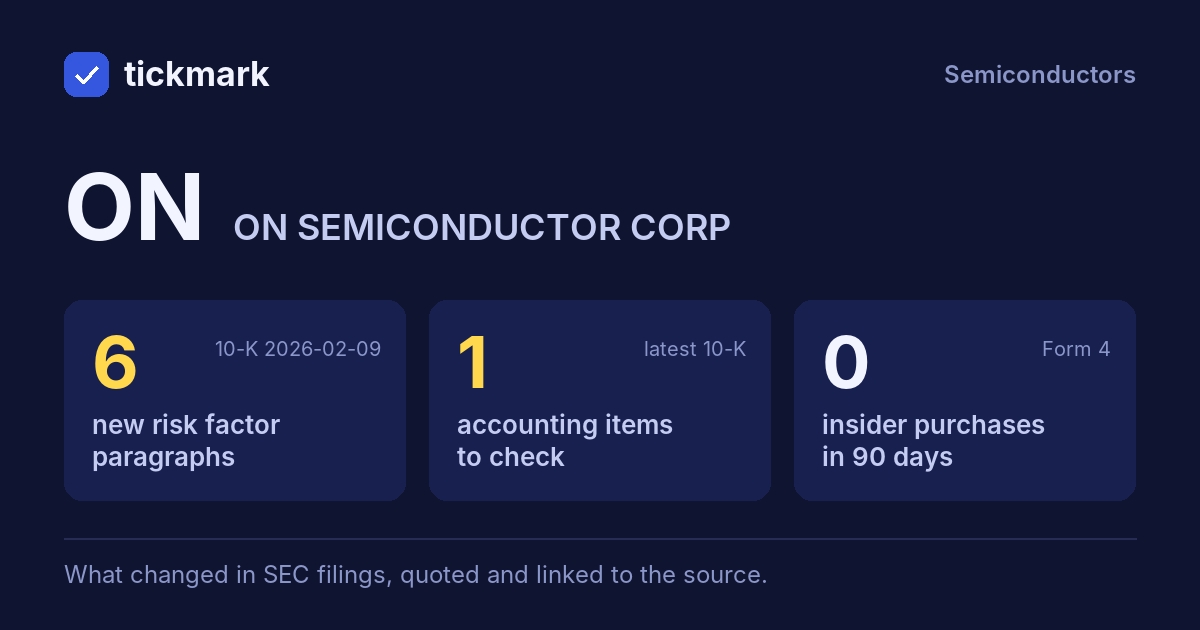
10-K 0001097864-26-000006 (2026-02-09) vs 10-K 0001628280-25-004557 (2025-02-10)
| Section | Compared text | Words now | Changed |
|---|
| Risk Factors | Item 1A | 13,006 |
15.1% |
| MD&A | Item 7 | 6,857 |
23.3% |
| Legal Proceedings | Item 3, via Note 13 – Commitments and Contingencies | 2,939 |
6.9% |
| Accounting Policies | 10-K text, Note 2 – Significant Accounting Policies | 4,243 |
14.3% |
The redline: what was cut and what was added
In each section, the paragraph that changed most, marked against last year's 10-K:
cut words struck through, new words highlighted and underlined.
MD&A 193 words changed in this paragraph; it is 50% similar to last year's version.
We evaluate the recoverability of the carrying amount of our property, plant and equipment and intangible assets, long-lived assets whenever events or changes in circumstances indicate that the carrying amount value of an asset group may not be fully recoverable. Impairment For assets to be held and used, we group a long-lived asset or assets with other assets and liabilities at the lowest level for which identifiable cash flows are largely independent of the cash flows of other assets and liabilities. Estimates of future cash flows used to test the recoverability of a long-lived asset group include only the future cash flows that are directly associated with and that are expected to arise as a direct result of the use and eventual disposition of the asset group. A potential impairment charge is first assessed evaluated when the undiscounted expected cash flows derived for from an asset group are less than its carrying amount. Impairment losses, if applicable, are measured as the amount by which the carrying value of an asset group exceeds its fair value and are recognized in operating results. We continually apply our best judgment value. Judgment is used when applying these impairment rules to determine the timing of the impairment test, the undiscounted cash flows used to assess impairments and the fair value of an impaired the asset group. The dynamic economic environment in which we operate and the resulting assumptions used to estimate future cash flows impact the outcome of our impairment tests. As we continue to implement our business strategy to rationalize products and manufacturing locations to transition to a lighter internal fabrication model, there could be divestiture transactions that result in a portion of goodwill or other assets being de-recognized and result in accounting charges.
Source: Item 7, 10-K 0001097864-26-000006 vs Item 7, 10-K 0001628280-25-004557
Risk Factors 137 words changed in this paragraph; it is 63% similar to last year's version.
In addition, implementation of a business strategy may lead to the disruption of our existing business operations. For example, in light of our goal to achieve net zero emissions by 2040, we may take actions to pursue our goal of generating net-zero emissions that may result in material expenditures that could impact our financial condition or results of operations and/or could disrupt our existing operations. Similarly, the contingent risks associated with transferring our existing operations to an acquirer, as is the case with several transition services being provided in connection with some of our prior divestitures, could materially impact our financial condition or results of operations and/or could disrupt our existing operations, especially if the acquirer is unable to meet its commitments under any transition services agreements or if the acquirer encounters financial difficulty. Furthermore, any adjustments we make to our increased investment manufacturing capacity, whether in manufacturing capacity (including increased response to customer demand or based on business strategy (such as increasing investment in capacity for SiC-based new products and technology), while concurrently technology or divesting other non-strategic operations, operations), may adversely impact our existing operations, operations or our customer relationships, require additional management time and effort to implement successfully, and and, in the case of capacity expansion, lead to higher than anticipated capital expenditures. There are inherent execution risks in expanding or right-sizing production capacity, whether at one of our own factories or at a third-party factory that we utilize, all of which could increase our costs and negatively impact our operating results.
Source: Item 1A, 10-K 0001097864-26-000006 vs Item 1A, 10-K 0001628280-25-004557
Legal Proceedings 130 words changed in this paragraph; it is 80% similar to last year's version.
On January 3, 2024, a purported stockholder derivative action captioned Silva v. El-Khoury, et al., Case No. 1:24-cv-00007 (D. Del.) ("Silva"), Del.), was filed by a purported stockholder of the Company in the U.S. District Court for the District of Delaware. On February 12, 2024, a purported stockholder derivative action captioned Smalley et al. v. El-Khoury et al. Case No. 1:24-cv-00183 (D. Del.) ("Smalley"), Del.), was filed by a purported stockholder of the Company in the U.S. District Court for the District of Delaware. Both aforementioned derivative actions, Silva and Smalley, were voluntarily dismissed without prejudice on April 15, 2024. On February 28, 2024, a purported stockholder derivative action captioned Mumme et al. v. El-Khoury et al. Case No. CV2024-003974 (D. AZ.) ("Mumme"), AZ.), was filed by a purported stockholder of the Company in the Superior Court of the State of Arizona in and for the County of Maricopa and on Maricopa. On March 15, 2024, a purported stockholder derivative action captioned Chan et al. v. Abe et al. Case No. 2:24-cv-00552 (D. AZ.) ("Chan"), AZ.), was filed by a purported stockholder of the Company in the U.S. District Court for the District of Arizona. On June 16, 2025, a purported stockholder derivative action captioned Balsam-Respler et al. v. El-Khoury et al. Case No. 2:25-cv-001672 (D. AZ.), was filed by a purported stockholder of the Company in the U.S. District Court for the District of Arizona. On September 23, 2025, the U.S. District Court for the District of Arizona consolidated the Balsam-Respler and Chan derivative complaints into a consolidated action entitled In re ON Semiconductor Corporation Stockholder Derivative Litigation, Case No. CV-24-00552 (D.AZ.). The allegations in these derivative complaints are substantially similar to the allegations in the securities class action complaint discussed above. The derivative suits purport to assert claims (1) on behalf of the Company against certain of its officers for contribution under the federal securities laws and (2) against all of the defendants for breach of fiduciary duty, aiding and abetting, unjust enrichment, abuse of control, gross mismanagement, and waste. The plaintiffs seek an award of damages, pre-judgment interest, punitive damages, attorneys’ fees, and other costs and expenses related to the litigation. The Company believes that the plaintiffs lack standing to assert claims on the Company’s behalf. These two pending derivative actions, Mumme and Chan, were stayed by court order, pending the resolution of Hubacek.
Source: Item 3, via Note 13 – Commitments and Contingencies, 10-K 0001097864-26-000006 vs Item 3, via Note 13 – Commitments and Contingencies, 10-K 0001628280-25-004557
Accounting Policies 93 words changed in this paragraph; it is 70% similar to last year's version.
The Company evaluates the recoverability of the carrying amount of its property, plant and equipment long-lived assets whenever events or changes in circumstances indicate that the carrying value of an asset group may not be fully recoverable. For assets to be held and used, the Company groups a long-lived asset or assets with other assets and liabilities at the lowest level for which identifiable cash flows are largely independent of the cash flows of other assets and liabilities. Estimates of future cash flows used to test the recoverability of a long-lived asset group include only the future cash flows that are directly associated with and that are expected to arise as a direct result of the use and eventual disposition of the asset group. A potential impairment charge is evaluated when the undiscounted expected cash flows derived from an asset group are less than its carrying amount. Impairment losses, if applicable, are measured as the amount by which the carrying value of an asset group exceeds its fair value. Judgment is used when applying these impairment rules to determine the timing of the impairment test, the undiscounted cash flows used to assess impairments and the fair value of the asset group.
Source: 10-K text, Note 2 – Significant Accounting Policies, 10-K 0001097864-26-000006 vs 10-K text, Note 2 – Significant Accounting Policies, 10-K 0001628280-25-004557
Every change, by type
Sentences and paragraphs of ON's Risk Factors and MD&A, 10-K 2026-02-09 against 10-K 2025-02-10.
Each links to the text at sec.gov.
Quiet changes are sentences kept from last year with one to four words changed, at least one of them a hedge, a modal or a qualifier
(may, could, will, not, significant, material…). A year or date rolling forward is not counted.
The full word list
adverse, adversely, all, although, anticipate, anticipates, any, approximately, believe, believes, can, cannot, certain, could, expect, expects, generally, however, if, intend, intends, largely, likely, many, material, materially, may, might, most, must, never, no, not, possible, primarily, probable, should, significant, significantly, some, substantial, substantially, unlikely, will, would
AddedRisk Factors
We had one customer, a distributor, whose revenue accounted for approximately 11% and 10% of the total revenue for the years ended 2025 and 2024, respectively, across all reportable segments. Although we are not dependent on any single customer, a significant disruption in key customer relationships could adversely affect our business. Further, we could experience fluctuations in our customer base or the mix of revenue by customer or end-market, as markets and strategies evolve.
Read it in 10-K 2026-02-09 at sec.gov ↗
AddedRisk Factors
on a timely basis or at all. Additional tariffs, export controls or other trade restrictions between the two countries could materially adversely affect our results of operations.
Read it in 10-K 2026-02-09 at sec.gov ↗
AddedRisk Factors
We are increasingly incorporating AI tools and capabilities into our business operations where we believe appropriate, which may subject us to significant competitive, legal, regulatory and other risks. There can be no assurance that our use of AI tools will enhance our business operations or result in a benefit to us. Our competitors may be more successful in their use of AI tools, including by developing superior products or improving their operations with the assistance of AI. Additionally, there could be adverse impacts from inaccurate or flawed algorithms. Our use of AI tools could also result in the loss of confidential information or intellectual property or an inability to claim or enforce intellectual property rights, as well as subject us to risks related to intellectual property infringement or misappropriation, data privacy, cybersecurity, and the unauthorized use of Company data. The jurisdictions in which we conduct business have and may adopt laws and regulations related to AI, which could cause us to incur greater compliance costs, limit our use of AI tools, or subject us to legal liabilities.
Read it in 10-K 2026-02-09 at sec.gov ↗
AddedRisk Factors
acquire non-infringing technologies; discontinue the use of certain processes; or obtain licenses, which may not be available on reasonable terms, to continue the use, development and/or sale of the allegedly infringing technologies.
Read it in 10-K 2026-02-09 at sec.gov ↗
AddedRisk Factors
craft sophisticated cybersecurity attacks. Any of the foregoing could irreparably damage our reputation and business, which could have a material adverse effect on our results of operations. We maintain cyber risk insurance, although an insufficiency or unavailability of insurance coverage could adversely affect our cash flows and overall profitability. Furthermore, our efforts to comply with evolving laws and regulations related to cybersecurity may be costly and any failure to comply could result in investigations, proceedings, investor lawsuits and reputational damage.
Read it in 10-K 2026-02-09 at sec.gov ↗
AddedRisk Factors
On July 4, 2025, the U.S. government enacted the One Big Beautiful Bill Act (the “OBBBA”). While we are subject to the Corporate Alternative Minimum Tax (“CAMT”), we currently have no CAMT liability. However, future changes in our financial results, business operations, or the interpretation and implementation of the OBBBA could result in a CAMT liability in subsequent periods.
Read it in 10-K 2026-02-09 at sec.gov ↗
RemovedRisk Factors
In relation to production of SiC-based products and manufacturing at EFK and at our facilities in Hudson, New Hampshire, the Czech Republic and South Korea, we may face challenges or risks related to: increased capital spending and long-term capital expenditure commitments, installing and qualifying new manufacturing equipment, meeting planned process yields, maintaining suitable quality control and educating or providing employees with the requisite know-how to operate the processes at our expanded manufacturing facilities. There are inherent execution risks in expanding production capacity, whether at one of our own factories or at a third party that we utilize, all of which could increase our costs and negatively impact our operating results.
Read it in 10-K 2025-02-10 at sec.gov ↗
RemovedRisk Factors
In addition, to streamline our operations and for efficiency purposes, we are pursuing a number of actions, including the outsourcing of certain internal business processes and the deployment of enhanced end-to-end digital processes (which, in some cases, include the use of AI) for certain business use cases. Such opportunities for improvement and enhanced productivity bring risks associated with managing change, transition costs, and the potential for reduced productivity or user error, in addition to those risks specific to each new process.
Read it in 10-K 2025-02-10 at sec.gov ↗
RemovedRisk Factors
The semiconductor industry requires substantial investment in research and development in order to develop and bring to
Read it in 10-K 2025-02-10 at sec.gov ↗
RemovedRisk Factors
Some of these systems are managed or provided by third-party service providers, including certain cloud platform providers. Failure by these third-party service providers to meet their contractual, regulatory and other obligations to us, or our failure to
Read it in 10-K 2025-02-10 at sec.gov ↗
RewordedRisk Factors
Furthermore, any adjustments we make to our increased investment manufacturing capacity, whether in manufacturing capacity (including increased response to customer demand or based on business strategy (such as increasing investment in capacity for SiC-based new products and technology), while concurrently technology or divesting other non-strategic operations, operations), may adversely impact our existing operations, operations or our customer relationships, require additional management time and effort to implement successfully, and and, in the case of capacity expansion, lead to higher than anticipated capital expenditures.
Read it in 10-K 2026-02-09 at sec.gov ↗
RewordedRisk Factors
In addition to general economic conditions, impacts of other macroeconomic events, such as valuation concerns related to AI technologies, continued inflation and labor market concerns, public health crises, geopolitical tensions or conflicts and risks, such as the ongoing conflict in the Middle East and military conflict between Russia and Ukraine, climate change and other severe weather and natural disasters, banking failures disasters and uncertainties in global financial markets, could materially adversely impact our operations by causing disruptions in the geographies in which we and or those of our suppliers, third party distributors and sub-contractors operate. sub-contractors.
Read it in 10-K 2026-02-09 at sec.gov ↗
RewordedRisk Factors
We have in the past and could in the future experience period-to-period fluctuations in operating results due to general industry or economic conditions; the onset of an economic recession and volatile or uncertain economic conditions can adversely impact our sales and profitability and make it difficult for us and our competitors to accurately forecast and plan our future business activities. conditions.
Read it in 10-K 2026-02-09 at sec.gov ↗
RewordedRisk Factors
In the event of an adverse outcome or pursuant to the terms of a settlement of any such litigation, we may be required to: to pay substantial damages or settlement costs; indemnify customers or distributors; cease the manufacture, use, sale or importation of infringing products; expend significant resources to develop or acquire non-infringing technologies; discontinue the use of certain processes; or obtain licenses, which may not be available on reasonable terms, to continue the use, development and/or sale of the allegedly infringing technologies.
Read it in 10-K 2026-02-09 at sec.gov ↗
RewordedRisk Factors
To the extent that we do not achieve the profitability enhancement or other anticipated benefits of our strategy or restructuring initiatives, initiatives do not enhance our profitability or yield other anticipated benefits, our results of operations may be materially adversely affected.
Read it in 10-K 2026-02-09 at sec.gov ↗
RewordedRisk Factors
The automotive industry is cyclical and the industrial sector tends to thrive during a time of economic expansion, and, as As a result, our customers in each end-market are sensitive to changes in general economic conditions, inflationary pressure, increases changes in interest rates, disruptive innovation and end-market preferences, any of which can adversely affect sales of our products and, correspondingly, our results of operations.
Read it in 10-K 2026-02-09 at sec.gov ↗
RewordedRisk Factors
Specific elements of our compensation programs may not be competitive with those of our competitors, and there can be no assurance that we will be able to retain our current personnel or recruit the key personnel we require.
Read it in 10-K 2026-02-09 at sec.gov ↗
RewordedRisk Factors
We have in the past and could in the future experience period-to-period fluctuations in operating results due to general industry or economic conditions; the The onset of an economic recession and volatile or uncertain economic conditions can adversely impact our sales and profitability and make it difficult for us and our competitors to accurately forecast and plan our future business activities.
Read it in 10-K 2026-02-09 at sec.gov ↗
RewordedRisk Factors
Our extensive reliance on, and investments in, on information technology systems, including reliance on third-party service providers, could have a materially adverse impact on our business. business, and our substantial investments in such information technology systems could result in significant potential risks and failures.
Read it in 10-K 2026-02-09 at sec.gov ↗
RewordedRisk Factors
Furthermore, in light pursuit of our goal to achieve net zero emissions by 2040, or in response to future customer or investor expectations and regulatory requirements, we may take certain actions to pursue our goal of generating net-zero emissions or to alter our processes that may result in material expenditures that could impact our financial condition or results of operations and/or disrupt our existing operations.
Read it in 10-K 2026-02-09 at sec.gov ↗
RewordedRisk Factors
These efforts efforts, including the continued transition to and implementation of the new enterprise resource planning system and related systems, could result in significant potential risks, including failure of the systems to operate as designed, unexpected impacts on related systems or processes, potential loss or corruption of data, failures in security processes and internal controls, cost overruns, implementation delays or errors, disruption of operations, and the potential inability to meet business and reporting requirements.
Read it in 10-K 2026-02-09 at sec.gov ↗
RewordedRisk Factors
If we are unable to access such funding or incentives, or if any awards or incentives we do receive are reduced, terminated or clawed back, or if our competitors receive more funding or incentives than we do, we may be at a disadvantage in developing and producing new or improved products or technologies, which could adversely affect our market share, revenue and profitability.
Read it in 10-K 2026-02-09 at sec.gov ↗
Quiet changesRisk Factors
Shortages However, shortages could occur in various essential raw materials, and if we are unable to obtain adequate supplies of raw materials in a timely manner, the costs of our raw materials increase significantly, their quality deteriorates or they give rise to compatibility or performance issues in our products, our results of operations could be materially adversely affected.
Read it in 10-K 2026-02-09 at sec.gov ↗
Quiet changesRisk Factors
We may be unable to implement certain business strategies and restructuring initiatives and any issue with the pursuit of such strategies and initiatives could materially adversely affect our business and results of operations.
Read it in 10-K 2026-02-09 at sec.gov ↗
Quiet changesRisk Factors
If we cannot advance our process technologies or improve our production efficiencies to a degree sufficient to maintain required margins, we will no longer not be able to make a profit from the sale of older products.
Read it in 10-K 2026-02-09 at sec.gov ↗
Quiet changesRisk Factors
Further, our assertion of IP rights often results in the other party seeking to assert alleged IP rights of its own against us, which may materially and adversely impact our business.
Read it in 10-K 2026-02-09 at sec.gov ↗
Quiet changesRisk Factors
Furthermore, if If our customers move manufacturing operations to the United States, our FDII deduction may be reduced.
Read it in 10-K 2026-02-09 at sec.gov ↗
Quiet changesRisk Factors
These types of initiatives and changes, if as they are adopted or enacted, may increase tax uncertainty and may adversely affect our provision for income taxes, which could have a material impact on our results of operations and financial condition.
Read it in 10-K 2026-02-09 at sec.gov ↗
Quiet changesRisk Factors
These legal and regulatory requirements, as well as some investors' heightened investor expectations, on corporate environmental and social responsibility practices and disclosure are subject to change, can be unpredictable and may be difficult and expensive for us to comply with, given the complexity of our supply chain and our significant outsourced manufacturing.
Read it in 10-K 2026-02-09 at sec.gov ↗
AddedMD&A
Net income attributable to ON Semiconductor Corporation $ 121.0 $ 1,572.8 $ (1,451.8)
Read it in 10-K 2026-02-09 at sec.gov ↗
AddedMD&A
Gross profit was $1,983.9 million and $3,216.1 million for 2025 and 2024, respectively, representing a decrease of $1,232.2 million or approximately 38.3%. We recorded excess and obsolete inventory charges of $268.2 million, of which $230.3 million related to inventory primarily considered work in progress within the ISG reportable segment, as a result of changes in business strategy due to the 2025 Manufacturing Realignment Program. See Note 7: ''Restructuring, Asset Impairments and Other, net'' for additional information. We also continued to experience a decline in sales volume across end-markets.
Read it in 10-K 2026-02-09 at sec.gov ↗
AddedMD&A
Other income, net was $22.9 million and $20.6 million in 2025 and 2024, respectively. The increase was primarily driven by slightly higher dividend income in 2025.
Read it in 10-K 2026-02-09 at sec.gov ↗
AddedMD&A
In November 2025, the Board of Directors approved a New Share Repurchase Program under which the Company may repurchase up to an aggregate of $6.0 billion of the Company's common stock (exclusive of fees, commissions and other expenses). Under the New Share Repurchase Program, which does not require the Company to purchase any minimum amount of common stock or at all, the Company may repurchase shares from January 1, 2026 through December 31, 2028.
Read it in 10-K 2026-02-09 at sec.gov ↗
AddedMD&A
We classify assets as held-for-sale in the period when all of the following conditions are met: (i) management, having the authority to approve the action, commits to a plan to sell the assets; (ii) the assets are available for immediate sale in their present condition subject only to terms that are usual and customary for sales of such assets; (iii) an active program to locate a buyer and other actions required to complete the plan to sell the assets have been initiated; (iv) the sale of the assets is probable, and transfer of the assets is expected to qualify for recognition as a completed sale within one year, except if events or circumstances beyond our control extend the period of time required to sell the assets beyond one year; (v) the assets are being actively marketed for sale at a price that is reasonable in relation to their current fair value; and (vi) actions required to complete the plan indicate that it is unlikely that significant changes to the plan will be made or that the plan will be withdrawn. The Company evaluates the probability of sale within one year, considering current market conditions for semiconductor equipment and the status of active marketing efforts. If disposal does not occur within 12 months, the Company reassesses whether delays are caused by factors outside its control.
Read it in 10-K 2026-02-09 at sec.gov ↗
AddedMD&A
The assets that are classified as held-for-sale are initially measured at the lower of their carrying value or fair value less any costs to sell. The determination of the fair value less costs to sell may require management to make judgments on significant estimates and assumptions including, but not limited to, indicative sales values, current market conditions and available data for transactions for similar assets. We may use third-party valuation specialists to assist in the determination of such estimates. Any impairment loss resulting from this measurement is recorded in Restructuring, asset impairments and other, net on the Consolidated Statements of Operations and the assets held-for-sale are recorded as a separate line within the Consolidated Balance Sheets. Gains or losses are not recognized on assets held-for-sale until the sale date, when control transfers to the counterparty.
Read it in 10-K 2026-02-09 at sec.gov ↗
RemovedMD&A
(1)During the first quarter of 2024, the Company reorganized certain reporting units and its segment reporting structure. As a result of the reorganization of divisions within PSG and AMG, the prior-period amounts have been reclassified to conform to current-period presentation.
Read it in 10-K 2025-02-10 at sec.gov ↗
RemovedMD&A
•Draw down of $500.0 million on the Revolver due 2024 and partial repayment of the outstanding balance on the Term Loan "B" Facility and corresponding write off of $7.3 million of unamortized debt discount and issuance costs.
Read it in 10-K 2025-02-10 at sec.gov ↗
RemovedMD&A
•Settlement with certain holders of the 1.625% Notes to repurchase or exchange, as applicable, $16.0 million in aggregate principal amount of the 1.625% Notes for a total consideration of $16.0 million in cash and 552,000 shares of common stock.
Read it in 10-K 2025-02-10 at sec.gov ↗
RemovedMD&A
•Entry into the Tenth Amendment to the Prior Credit Agreement to transition the interest rate base from LIBOR to Term SOFR.
Read it in 10-K 2025-02-10 at sec.gov ↗
RewordedMD&A
Amortization of acquisition-related intangible assets was $44.4 million and $52.0 million for 2025 and $51.1 million for 2024 and 2023, 2024, respectively, representing an increase a decrease of $0.9 $7.6 million, or approximately 2%, year-over-year. 15%, year-over-year due to previously acquired assets becoming fully amortized during 2025.
Read it in 10-K 2026-02-09 at sec.gov ↗
RewordedMD&A
Selling and marketing expenses were $273.5 Gross profit was $3,216.1 million and $279.1 million, or approximately 4% and 3% of revenue $3,883.5 million for 2024 and 2023, respectively, representing a decrease of $5.6 million, $667.4 million or approximately 2% year-over-year. 17.2%.
Read it in 10-K 2026-02-09 at sec.gov ↗
RewordedMD&A
The decrease of $728.1 $471.3 million for the year ended December 31, 2024 2025 compared to the year ended December 31, 2023 2024 was primarily attributable to a significant decrease in capital expenditures and payments for the acquisition of our EFK location during the year ended 2023, partially offset by expenditures, the net impact of purchases and maturities of short-term investments.
Read it in 10-K 2026-02-09 at sec.gov ↗
RewordedMD&A
PSG gross profit decreased by $437.4 $696.9 million, primarily driven by the decline in sales volume in both existing products the automotive and new products which negatively impacted gross profit by approximately $316 million and $121 million, respectively. industrial end-markets.
Read it in 10-K 2026-02-09 at sec.gov ↗
RewordedMD&A
PSG gross profit decreased by $437.4 $437.5 million, primarily driven by the decline in sales volume in both existing products the automotive and new products which negatively impacted gross profit by approximately $316 million and $121 million, respectively. industrial end-markets.
Read it in 10-K 2026-02-09 at sec.gov ↗
RewordedMD&A
PSG gross margin decreased by 5.6 16.8 percentage points to 41.3% 24.5% from 47.0%, 41.3%, primarily as a result of the decline in sales volume, underutilization of our manufacturing facilities, and the related impact of unfavorable product mix. mix, and the impact of the consumables and manufacturing supplies write-off discussed above.
Read it in 10-K 2026-02-09 at sec.gov ↗
RewordedMD&A
Research and development expenses were $612.7 $583.6 million and $577.3 $612.7 million, or approximately 10% and 9% and 7% of revenue for 2024 2025 and 2023, 2024, respectively, representing an increase a decrease of $35.4 $29.1 million, or approximately 6% 5% year-over-year.
Read it in 10-K 2026-02-09 at sec.gov ↗
RewordedMD&A
Selling General and marketing administrative expenses were $273.5 $348.9 million and $279.1 $376.3 million, or approximately 4% 6% and 3% 5% of revenue for 2024 2025 and 2023, 2024, respectively, representing a decrease of $5.6 $27.4 million, or approximately 2% 7% year-over-year.
Read it in 10-K 2026-02-09 at sec.gov ↗
RewordedMD&A
Interest expense decreased increased by $12.5 $8.6 million, or approximately 17%, 14%, to $70.9 million during 2025 compared to $62.3 million during 2024 compared to $74.8 million in 2023. 2024.
Read it in 10-K 2026-02-09 at sec.gov ↗
RewordedMD&A
We used cash to repay $375.0 million of borrowings on the Revolving Credit Facility and for share repurchases of $654.1 $1,377.6 million for the year ended December 31, 2024 2025 compared to $564.2 $654.1 million in 2023. 2024.
Read it in 10-K 2026-02-09 at sec.gov ↗
RewordedMD&A
ISG gross profit decreased by $114.9 $385.5 million, primarily driven by the decline in sales volume from existing products. $230.3 million excess and obsolete inventory charges discussed above.
Read it in 10-K 2026-02-09 at sec.gov ↗
RewordedMD&A
Our weighted average interest rate on our gross amount of long-term debt (including current maturities) was 2.1% and 1.8% and 2.3% per annum in 2024 2025 and 2023, 2024, respectively.
Read it in 10-K 2026-02-09 at sec.gov ↗
Quiet changesMD&A
The decrease from 2023 to 2024 of $1,170.7 million, or 14.2%, was attributable primarily to lower sales volumes across all segments, which are further explained below.
Read it in 10-K 2026-02-09 at sec.gov ↗
Quiet changesMD&A
However, the The New Share Repurchase Program may be modified, suspended or terminated by the Board of Directors at any time without prior notice.
Read it in 10-K 2026-02-09 at sec.gov ↗