tickdelta
Sign in

Tickdelta is free for now. Sign up and get Pro free

← Screener

ONON Semiconductor

Technology · Semiconductors · Nasdaq
Compare with peers → Embed
SEC comment letters, last 20 years

2 reviews of ON's filings by SEC staff

UPLOAD and CORRESP
ReviewsRead ↓
2
latest letter 2023-08-24
Questions asked
6
each answered in the company's own letter
No closing letter
0
reviews without a letter saying the staff completed it

When the SEC's staff reviews a filing, it writes to the company with numbered questions, and the company answers each one in a letter. SEC publishes the exchange once the review is over, at least 20 business days later. A question is not an accusation; most reviews end with the company adding detail to its next filing.

Form 10-K for the Fiscal Year Ended December 31, 2022

2023-08-24 to 2023-09-14 · 2 questions · 1 letter from the SEC, 1 from the company
Review closed 2023-09-14
SegmentsRevenueResults discussion (MD&A)
Note 3. Revenue and Segment Information, page 62
SEC asked (1)
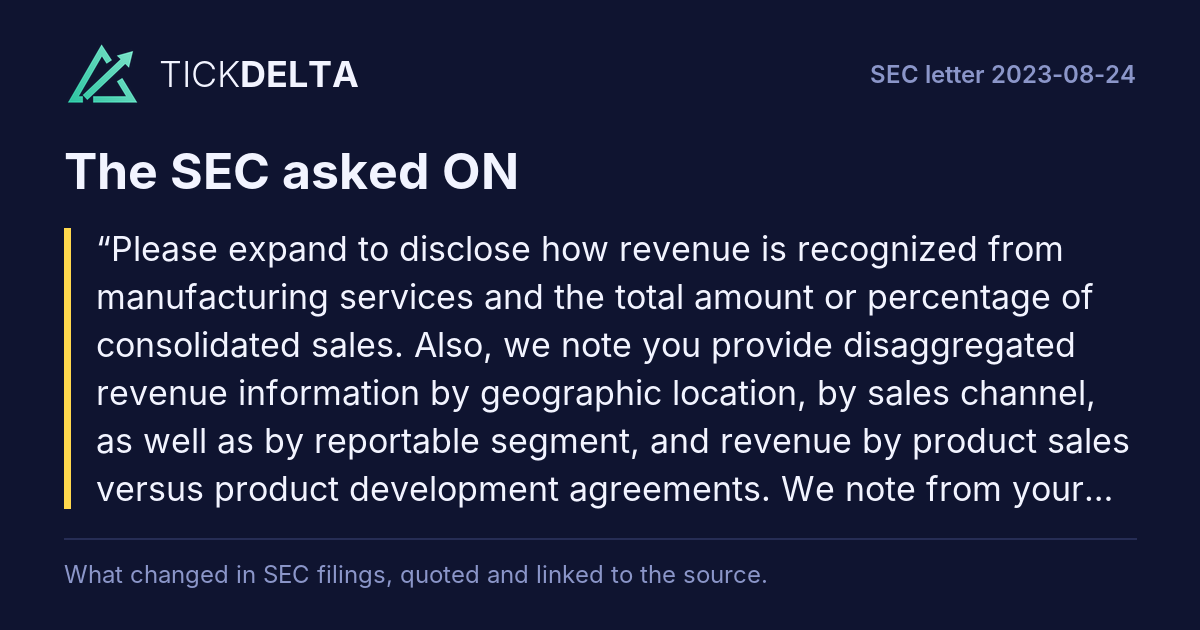
Please expand to disclose how revenue is recognized from manufacturing services and the total amount or percentage of consolidated sales. Also, we note you provide disaggregated revenue information by geographic location, by sales channel, as well as by reportable segment, and revenue by product sales versus product development agreements.
Rest of the question

We note from your recent earnings call transcripts, you discuss revenue by end market, such as automotive and industrial, along with type of revenue product sales, such as silicon carbide, intelligent power and intelligent sensing. Additionally, your earnings release furnished on Form 8-K on July 31, 2023 includes three prominent bullets at the top of the release that disclose revenue for automotive and industrial, and the change in revenue for silicon carbide. Please tell us the consideration given to further expanding your revenue disaggregation disclosures to also present revenue along the aforementioned lines. Your response should address ASC 606-10-55-89 through 55-91, as well as ASC 280-10-50-40.

ON answered
to the Staff’s comment, the Company respectfully advises the

Staff that the Company’s disaggregated revenue disclosures required under ASC 606-10-55-89 through 55-91 and ASC 280-10-50-40 are based on economic factors as noted in ASC 606-10-55-89 pertaining to the Company’s type of good or service, geographical region, or sales channel as well as the

Company’s reportable segments. More recently, the Company has focused its business strategy on the automotive and industrial end-markets.
Rest of the answer

The Company anticipates that these end-markets will continue to be a primary focus for the Company moving forward. As a result, the Company expects to continue to discuss revenue by end-markets as part of the Company’s commentary on financial performance in the Company’s earnings releases and on earnings calls. As such, going forward and including in the Company’s upcoming Quarterly Report on Form

10-Q for the quarter ending September 29, 2023, the Company will disclose disaggregated revenue for the Automotive, Industrial and Other end-markets for all periods presented in the footnotes to its financial statements.

In response to the Staff’s comment, the Company respectfully advises the Staff that the discussion of product technologies, including intelligent power and intelligent sensing, on the Company’s most recent earnings call was related to product technologies that are similar to how the Company classifies its reportable segments. The

Company’s intelligent power products generally align with the Company’s Power Solutions Group (“PSG”), the Company’s intelligent sensing products generally align with the Company’s Intelligent Sensing

Group (“ISG”) and the remaining category of other products generally align with the Company’s Advanced Solutions Group (“ASG”). However, there is some cross distribution of technologies depending on the nature of such products between each of the product categories. As such, going forward and including in the Company’s upcoming Quarterly Report on Form 10-Q for the quarter ending September 29, 2023, the

Company will disclose disaggregated revenue by Intelligent Power, Intelligent Sensing and Other product technologies for all periods presented in the footnotes to its financial statements.

In response to the Staff’s comment, the Company respectfully advises the Staff that the Company’s entire product revenue is generated by the sale of semiconductors, some of which include products with silicon carbide content. Further, silicon carbide describes the physical material content for certain of our semiconductor products, primarily within the PSG reportable segment. As such, the reference to silicon carbide is not meant to imply that there are substantially different customers, contracts, or end-use applications for these semiconductor products. In light of these facts and the disclosure considerations and objectives of ASC 606-10-55-89 through 55-91, the Company does not believe that it is necessary to provide a detailed breakdown of products containing silicon carbide in its financial statements.

Read in the reply ↗
In its next report

First report after the company's reply of 2023-09-11: 10-Q filed 2023-10-30 ↗, against the 10-Q filed 2023-07-31 ↗.

Tickdelta does not hold the text of both reports, so they are not compared here.
Management's Discussion and Analysis of Financial Condition and Results of Operations · Results of Operations, page 28
SEC asked (2)
We note from your disclosure on page 32 that gross profit decreased by $87.5 million for the six months ended June 30, 2023 compared to the six months ended July 1, 2022 and gross margin decreased by 2.5% from 49.6% for the six months ended July 1, 2022 to 47.1% for the six months ended June 30, 2023.
Rest of the question

You also disclose that the decline in both gross profit and gross margin was primarily driven by start-up and ramp-up costs at our EFK location and new products. However, we also note from the table above these disclosures that gross profit for the PSG segment and the ISG segment increased by 3% and 25% respectively, and the ASG segment gross profit decreased by 25%. Margins decreased by 1% and 8% for PSG and ASG, respectively, and increased for ISG by 3%. In this regard, your disclosure should be revised to explain and quantify the amount of related expenses of start-up and ramp-up costs attributable to increase costs at your EFK location as well as the impact from new products. Further, your disclosure should be enhanced to explain and quantify the factors responsible for the changes in gross profit for each segment. This would include the increases in gross profit, as well as the offsetting significant decrease. Please revise future filings accordingly.

ON answered
The Company acknowledges the Staff’s comment and respectfully advises the Staff that the Company will enhance the disclosures in future filings to quantify the key factors responsible for the changes in gross profit and gross margin for each segment, including the impact of any significant offsetting increases or decreases.

The following is illustrative of the additional disclosure the Company plans to incorporate into future filings. Similar disclosures will be included for the

PSG, ASG and ISG reportable segments.
Rest of the answer

These disclosures will be based on facts and circumstances applicable for the period, inclusive of considerations for costs at the Company’s EFK location and given their relative materiality to the Company or a reportable segment’s results.

The Company’s gross profit was $XX million for the period ended XX, 2023 compared to $XX million for the period ended XX, 2022. Gross profit increased/decreased by $X million, primarily due to [$X in volume changes, $X in pricing changes, or $X for other applicable circumstances]. Gross margin increased/decreased by X% to XX% for the period ended XX,

2023 from XX% for the period ended XX, 2022, primarily due to [X% in pricing changes, X% from the impact of new products, or X% for other applicable circumstances].

Read in the reply ↗
In its next report

First report after the company's reply of 2023-09-11: 10-Q filed 2023-10-30 ↗, against the 10-Q filed 2023-07-31 ↗.

Tickdelta does not hold the text of both reports, so they are not compared here.

Also in this review: closing letter, 2023-09-14
Form 10-K for the Fiscal Year Ended December 31, 2016

2017-05-03 to 2017-05-23 · 4 questions · 1 letter from the SEC, 1 from the company
Review closed 2017-05-23
ChinaRussia and UkraineRevenueIncome taxesAcquisitionsDebt
General
SEC asked (1)
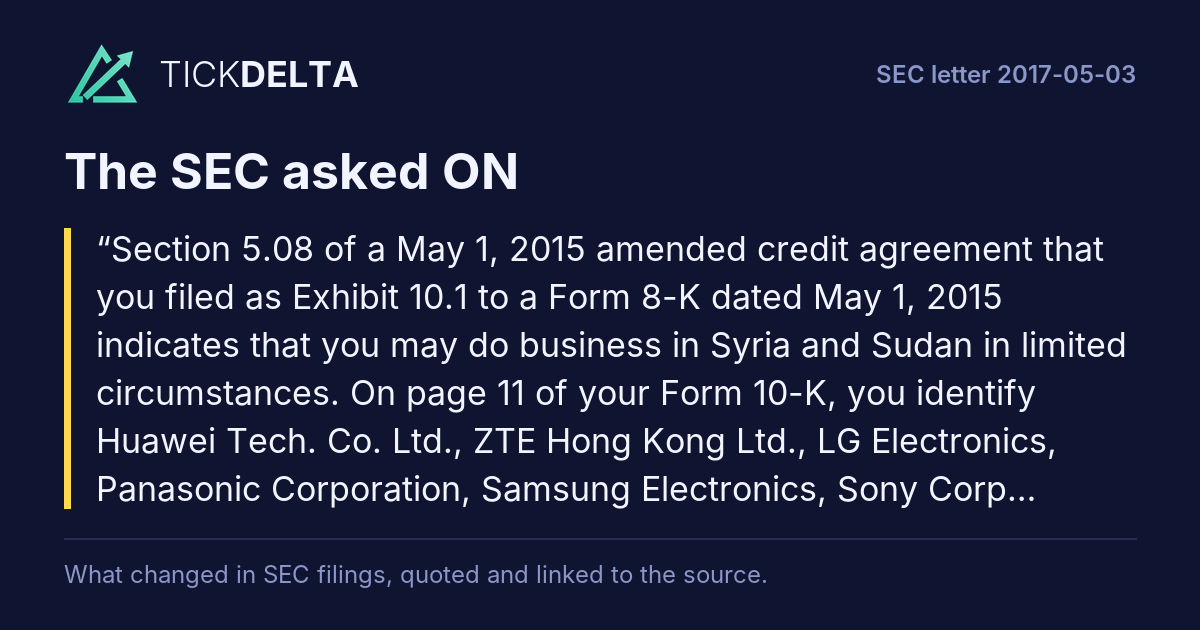
Section 5.08 of a May 1, 2015 amended credit agreement that you filed as Exhibit 10.1 to a Form 8-K dated May 1, 2015 indicates that you may do business in Syria and Sudan in limited circumstances. On page 11 of your Form 10-K, you identify Huawei Tech. Co. Ltd., ZTE Hong Kong Ltd., LG Electronics, Panasonic Corporation, Samsung Electronics, Sony Corp., Ericsson, Alcatel Lucent and Siemens Industrial as customers.
Rest of the question

Each of these companies conducts business or sells products in Syria and Sudan. Syria and Sudan are designated by the State Department as state sponsors of terrorism and are subject to U.S. economic sanctions and export controls. Please describe to us the nature and extent of any past, current, and anticipated contacts with Syria and Sudan, whether through subsidiaries, affiliates, customers, distributors, resellers, or other direct or indirect arrangements. You should describe any products, components, technology or services you have provided to Syria or Sudan, directly or indirectly, and any agreements, commercial arrangements or other contacts with the governments of those countries or entities they control.

ON answered
In response to the Staff’s comment, the Company advises the Staff that it is aware of, and takes seriously its compliance obligations with respect to applicable export control laws and regulations and employs significant resources to conduct its business in compliance with such laws and regulations. Furthermore, the Company advises the Staff that it does not currently provide, and has no future plans to provide, any services, products, information or technologies to Sudan or Syria, their governments or entities they control.
Rest of the answer

Moreover, the Company does not maintain any offices or other facilities in Sudan or Syria, has no employees in either of those countries, and has no assets or liabilities associated with activities in either of those countries.

With respect to the amended credit agreement (the “Credit Agreement”) referenced in the Staff’s comment, the Company notes that Section 5.08 of the Credit Agreement sets forth restrictions on the Company’s ability to use the proceeds of any loans under the Credit Agreement for, among other purposes,

“…funding, financing or facilitating any activities, business or transaction of or with any Sanctioned Person, or in any Sanctioned Country to the extent such activities, businesses or transactions would be prohibited by Sanctions if conducted by an entity organized in the United States or in a European Union member state, or (iii) in any manner that would result in the violation of any Sanctions applicable to any party hereto.”

For purposes of Section 5.08 of the Credit Agreement, “Sanctioned Country” is defined to mean Crimea, Cuba, Iran, North Korea,

Sudan and Syria, and “Sanctions” is defined to mean all economic or financial sanctions or trade embargoes imposed, administered or enforced from time to time by the U.S. government, including those administered by OFAC or the U.S. Department of State. (emphasis added). Rather than indicating that the Company may have been doing business in Syria or Sudan, Section 5.08 of the Credit Agreement expressly prohibited the Company from using any proceeds for the purpose of funding, financing or facilitating any activities, business or transactions with Sudan and Syria or in any manner that would result in the violation of economic or financial sanctions or trade embargoes imposed, administered or enforced by, among other governmental agencies, the U.S. Department of State. The Company advises the Staff that it complied with the restrictions set forth in Section 5.08 of the Credit Agreement while that Credit Agreement was in effect and that that Credit Agreement has been terminated.

As described in the Form 10-K, the

Company sells its semiconductor products, directly and indirectly, to original equipment manufacturers, or OEMs, who incorporate the Company’s products into a variety of end products, including networking and telecommunications equipment. The

Company sells its products to a wide range of OEMs, including the companies identified in the Staff’s letter, and the products the Company sells to its OEM customers are just one of the many components that they incorporate into their products. The companies identified in the Staff’s letter are enterprises with global operations, but the Company has no knowledge of any nexus between such customers’ use of the Company’s products in Sudan or Syria.

Read in the reply ↗
General
SEC asked (2)
Please discuss the materiality of any contacts with Syria or Sudan you describe in response to the comment above, and whether those contacts constitute a material investment risk for your security holders. You should address materiality in quantitative terms, including the approximate dollar amounts of any associated revenues, assets, and liabilities for the last three fiscal years and the subsequent interim period.
Rest of the question

Also, address materiality in terms of qualitative factors that a reasonable investor would deem important in making an investment decision, including the potential impact of corporate activities upon a company’s reputation and share value. Various state and municipal governments, universities, and other investors have proposed or adopted divestment or similar initiatives regarding investment in companies that do business with U.S.- designated state sponsors of terrorism. You should address the potential impact of the investor sentiment evidenced by such actions directed toward companies that have operations associated with Syria and Sudan.

ON answered
As noted in the Company’s response to Comment No. 1, the Company has no known past, current or anticipated contacts, direct or indirect, with Sudan or Syria or entities they control. Read in the reply ↗
General
SEC asked (3)
Please tell us whether any contacts with Syria and Sudan you describe in response to the comments above involve dual use products.
ON answered
As noted in the Company’s response to Comment No. 1, the Company has no known past, current or anticipated contacts, direct or Read in the reply ↗
Note 15: Income Taxes, page 157
SEC asked (4)
We note on page 159 that you reassessed your prior years’ indefinite reinvestment assertion due to the debt incurred to fund the Fairchild acquisition. Please explain to us in more detail your basis for releasing $267.9 million of your valuation allowance related to the change in your judgment about the realizability of your U.S. federal deferred tax assets. Refer to the guidance in ASC 740.
ON answered
The Company acknowledges the Staff’s comment and notes that the Form 10-K disclosed that the

Company had released a valuation allowance of approximately $267.9 million related to its U.S. federal deferred tax assets upon consummation of the Fairchild acquisition in September 2016. Similar disclosures were in the Company’s Form 10-Q for the quarter ended September 30, 2016.

The Company advises the Staff that the U.S.
Rest of the answer

federal deferred tax assets primarily consisted of net operating loss and credit carryforwards, the amounts of which are also disclosed in the Form 10-K, which expire in varying amounts from 2017 through 2036.

In accordance with ASC

740-10-30-5e, the Company performed an analysis of its ability to realize the benefits of our deferred tax assets, including our

U.S. federal deferred tax assets. With reference to applicable accounting literature and related guidance, the Company considered the weight of available evidence, both positive and negative, in determining the amount of valuation allowance to be recorded and/or released. The Company also referred to ASC 740-10-30-18, which describes the following sources of taxable income that must be considered when measuring the future realizability of deferred tax assets:

Future reversals of existing taxable temporary differences;

Future taxable income exclusive of reversing temporary differences;

Taxable income in prior carryback years; and

Tax planning strategies.

Prior to the consummation of the Company’s acquisition of

Fairchild, the Company had U.S. cumulative losses for the prior three years. The Company had not identified prudent and feasible tax planning strategies that could utilize its U.S. tax attributes, nor was the Company expecting significant future

U.S. taxable income. There was, therefore, sufficient negative evidence that the Company’s U.S. net deferred tax assets would not be realized and the Company had recorded a valuation allowance for its deferred tax assets. This analysis changed following the consummation of the acquisition of Fairchild on September 19, 2016, resulting in a change in judgment regarding the realizability of substantially all of the Company’s U.S. federal deferred tax assets.

Subsequent to the acquisition of Fairchild, the Company considered the following material positive and negative factors in arriving at its conclusion regarding the realizability of the related deferred tax assets:

ON Semiconductor® :: 5005 E. McDowell Road

:: Phoenix AZ 85008 :: 602-244-6600 :: fax

602-244-5544

Positive Factors

As disclosed in the Form 10-K, the consummation of the acquisition of Fairchild caused the Company to reassess its prior years’ indefinite reinvestment assertion on unremitted foreign earnings because of the U.S. debt incurred to fund the acquisition. Given the amount and terms of the Fairchild transaction debt as disclosed in Note 8: Long-Term Debt, the Company had to reassess its U.S. cash flows and the need to repatriate offshore cash to the U.S. to fully service the transaction debt. This reassessment resulted in the change of judgment regarding the Company’s prior years’ indefinite reinvestment assertion and the recording of a deferred tax liability for future U.S. taxes for the quarter ended September 30, 2016. The impact of the recording of this deferred tax liability was a $310.8 million increase to income tax expense and was disclosed in Note 15: Income Taxes (page 159).

The combined U.S. federal deferred tax liabilities after recording the $310.8 million deferred tax liability for prior years’ foreign earnings exceeded the combined U.S. federal deferred tax assets (without considering the deferred tax liabilities related to indefinite lived intangibles). In addition, the schedule of the reversal of taxable temporary differences (i.e. deferred tax liabilities relating to the repatriation to the U.S. of offshore earnings) demonstrated a utilization of the U.S. federal deferred tax assets prior to their expiration.

Negative

Factors

As of December 31, 2016, both the U.S. subsidiaries of Fairchild and the Company’s legacy U.S. operations had a history of recent cumulative losses over three years.

Limited history of generating U.S. taxable income prior to the acquisition of Fairchild.

Based on the Company’s evaluation of all material available evidence, both positive and negative, management of the Company concluded the positive evidence outweighed the negative, placing the most weight on the positive factor listed above regarding future reversals of existing taxable temporary differences, and accordingly the Company released $267.9 million of the valuation of its U.S. deferred tax assets. As disclosed, the Company continues to maintain a valuation allowance in the U.S.

on a portion of its foreign tax credit carryforwards and a full valuation allowance on the Company’s capital loss carryforwards and U.S. state deferred tax assets.

* * *

The Company respectfully believes that the information contained herein is responsive to the

Staff’s comments. If you have any questions or would like further information concerning the Company’s response to the Staff’s Comment Letter, please do not hesitate to contact me at (602)

244-3886.

Read in the reply ↗
In its next report

First report after the company's reply of 2017-05-11: 10-Q filed 2017-08-07 ↗, against the 10-Q filed 2016-11-07 ↗.

Tickdelta does not hold the text of both reports, so they are not compared here.

Also in this review: closing letter, 2017-05-23

From the SEC's correspondence on EDGAR: staff letters (form UPLOAD) and company letters (form CORRESP), 6 letters filed since 2017-05-03. Questions and answers are matched by their numbers; topics come from words in each question. The reports are compared word for word (same form, before the first SEC letter against the first report after the company's reply). No AI.

Next in Owners and insiders Insider trades →