Added10-Q Nov 5, 2026 vs 10-K Feb 26, 2026
• compliance with tax, employment, immigration and labor laws for our employees;
Each branch is a paragraph in Risk Factors with nothing like it in the 10-K filed Feb 27, 2025. A box jumps to the paragraph as filed, below.
32 paragraphs in Risk Factors of the 10-K filed Feb 26, 2026 with nothing like them in the 10-K filed Feb 27, 2025. Quoted exactly. Paragraphs that were only edited are under 10-K change.
•Restrictive covenants in our facilities agreements may limit our ability to respond to changes in market conditions or pursue business opportunities.
In April 2025, the Trump administration published Executive Order 14273 (90 Fed. Reg. 16441), “Lowering Drug Prices by Once Again Putting Americans First,” which generally directs the U.S. Department of Health and Human Services (“HHS”) to take steps to reduce drug prices. In May 2025, the administration published Executive Order 14297 (90 Fed. Reg. 20749), “Delivering Most-Favored-Nation Prescription Drug Pricing to American Patients” which generally, among other things, directs certain executive officials to “communicate most-favored-nation price targets to pharmaceutical manufacturers to bring prices for American patients in line with comparably developed nations” and facilitate direct-to-consumer and direct-to-business purchasing programs and directs the Secretary of Commerce and the U.S. Trade Representative to “take all necessary and appropriate action to ensure foreign countries are not engaged in any act, policy, or practice that may be unreasonable or discriminatory or that may impair United States national security . . . including by suppressing the price of pharmaceutical products below fair market value in foreign countries.” Subsequently, some pharmaceutical manufacturers have announced direct-to-consumer offerings with discounted prices or reached agreement with the federal government regarding prices for prescription drugs sold to U.S. patients and through Medicaid programs, and in February 2026, the Trump administration announced the launch of TrumpRx, a website operated by the federal government that is intended to redirect consumers to pharmaceutical companies’ direct-to-consumer channels. Additionally, in December 2025, the Centers for Medicare and Medicaid Services (“CMS”) proposed a rule to implement the Global Benchmark for Efficient Drug Pricing (GLOBE) Model and the Guarding U.S. Medicare Against Rising Drug Costs (GUARD) Model – both are new Medicare payment models under section 1115A of the Social Security Act. The scope, timing, and implementation details of these policies remain uncertain and may be subject to legal challenges, regulatory rulemaking, and changes in administrative priorities. If implemented, these policies could have a material impact on the pricing and reimbursement of our products in the United States, particularly those covered under Medicare Part B or Part D. Potential effects include reduced pricing flexibility, downward pressure on reimbursement rates and changes to market access dynamics and to pricing negotiations with commercial payors and international markets. Because the outcome, timing, and specifics of these policies are uncertain, we cannot predict the effect on our business, financial condition, results of operations, or prospects, but the impact could be material and adverse.
In addition, at the state level, legislatures have increasingly passed legislation and implemented regulations similar to those under consideration at the federal level, as well as laws designed to control pharmaceutical and biotherapeutic product pricing, including restrictions on pricing or reimbursement at the state government level, limitations on discounts to patients, marketing cost disclosure and transparency measures, restrictions or other limitations on patient assistance, and, in some cases, policies to encourage importation from other countries (subject to federal approval) and bulk purchasing. Certain states are also pursuing cost containment efforts through Prescription Drug Affordability Boards and similar entities.
Furthermore, on April 1, 2025, the Bureau of Industry and Security of the U.S. Department of Commerce (“BIS”) initiated an investigation into whether imports of pharmaceutical products present a risk to the national security of the U.S. This investigation could result in BIS recommending additional tariffs on imports of pharmaceutical products into the U.S. The scope or scale of any resulting tariffs as well as their secondary effects could adversely impact our business.
Clinical development is expensive and can take many years to complete, and its outcome is inherently uncertain. Failure can occur at any time during the clinical trial process, and we cannot predict with any certainty the success of any clinical trial or whether or when we might complete a given clinical trial. We may also experience delays in initiating and conducting clinical trials of our drug candidates, and we do not know whether our clinical trials will begin on time, need to be redesigned, recruit and enroll patients on time or be completed on schedule, or at all.
Federal legislative and regulatory efforts to implement reference pricing or most-favored-nation pricing models could impact our product revenues and materially harm our business.
On May 12, 2025, President Trump issued an executive order calling on pharmaceutical manufacturers to voluntarily reduce the prices of medicines in the U.S. and directing the Secretary of HHS to communicate MFN price targets to pharmaceutical manufacturers to align prices with those in comparably developed nations and, in the event significant progress towards MFN pricing is not delivered, to propose rulemaking to impose MFN pricing.
Since the May 12, 2025 order, the Trump administration has continued to exert pressure on drug manufacturers to implement MFN pricing, including by suggesting that the administration may impose significant tariffs on pharmaceuticals if such manufacturers do not reach agreements to implement MFN pricing. Further, in November 2025, the Centers for Medicare & Medicaid Services (CMS) introduced the GENEROUS (GENErating cost Reductions fOr U.S. Medicaid) Model, a voluntary Medicaid payment initiative under which participating drug manufacturers may voluntarily offer supplemental rebates to participating state Medicaid programs that are intended to provide such Medicaid programs with an MFN price for the manufacturers’ products. Additionally, in December 2025, CMS announced proposals for new mandatory demonstration payment models through two proposed rules under its Center for Medicare and Medicaid Innovation (“CMMI”) authority, the Global Benchmark for Efficient Drug Pricing (GLOBE) for Medicare Part B and Guarding U.S. Medicare Against Rising Drug Costs (GUARD) for Medicare Part D. If finalized, these models would impose additional mandatory rebates on manufacturers of certain Medicare Part B and Medicare Part D drugs, for select Medicare populations intended to represent 25% of Medicare patients, if the Medicare prices for such products exceed those paid in economically comparable countries. Both the GLOBE and GUARD models have proposed seven-year testing periods, with the GLOBE model proposed to begin on October 1, 2026 and the GUARD model proposed to begin on January 1, 2027.
If the GLOBE and GUARD models are finalized as proposed under CMMI authority, we could be required to pay additional rebates on products reimbursed by Medicare for the covered populations during the applicable model periods. In addition, if MFN pricing or similar reference pricing policies are enacted or implemented in the U.S. outside of the CMMI framework and applied more broadly, we could be required to pay rebates on products on utilization by a broader portion of U.S. patients to align with prices in certain reference countries. We currently derive the substantial portion of our revenue from U.S. sales, and any requirement to pay additional rebates in the U.S. to match international reference prices would impact our overall net revenue.
MFN pricing models in the U.S. could also affect our international pricing strategy and future decisions on reimbursement and commercialization in certain jurisdictions. If our U.S. pricing becomes tied to international reference prices, we may face decisions regarding pricing in foreign markets that could result in reduced patient access internationally, affect our relationships with foreign regulatory authorities and payers, or impact our ability to obtain or maintain reimbursement approvals in ex-U.S. markets.
These reforms remain subject to change, potential legal challenges, or expansion through additional rulemaking or sub regulatory guidance, creating uncertainty for our overall pricing strategy. It remains to be seen whether and how these drug pricing initiatives will apply to our products, how they will affect the broader pharmaceutical industry, and whether similar reform measures may be adopted in the future.
In the U.S., China, Europe and some other jurisdictions, there have been a number of legislative and regulatory changes and proposed changes regarding healthcare that could prevent or delay regulatory approval of our drug candidates, restrict or regulate post-approval activities and affect our ability to profitably sell our medicines and any drug candidates for which we obtain regulatory approval. For example, in August 2022, the Inflation Reduction Act of 2022 (the “IRA”) was signed into law. The IRA includes several provisions that may impact our business to varying degrees, including provisions that create a $2,000 out-of-pocket cap for Medicare Part D beneficiaries, impose new manufacturer financial liability on all drugs in Medicare Part D, allow the U.S. government to negotiate Medicare Part B and Part D pricing for certain high-cost drugs and biologics without generic or biosimilar competition, require companies to pay rebates to Medicare for drug prices that increase faster than inflation, and delay the rebate rule that would require pass through of pharmacy benefit manager rebates to beneficiaries. Any reduction in reimbursement from Medicare or other government programs may result in a similar reduction in payments from private payors. The implementation of cost containment measures or other healthcare reforms may prevent us from being able to generate revenue, attain profitability, or commercialize our medicines and drug candidates. For additional information, please see the section of this Annual Report titled “Part I – Item 1 – Business – Government Regulation – U.S. Regulation – Healthcare Reform.”
In addition, in July 2025, the OBBBA was signed into law. This legislation reduces funding to federal healthcare programs and imposes additional requirements to be eligible for healthcare, and, to the extent the OBBBA reduces the number of enrollees in federal healthcare programs and covered services, our business could be adversely impacted.
In addition, we evaluate our deferred income tax assets and record a valuation allowance if it is “more likely than not” that all or a portion of the deferred tax asset will not be realized. The assessment of the appropriate amount of a valuation allowance against the deferred tax assets is dependent upon several factors, including estimates of the realization of deferred income tax assets, which realization will be primarily based on future taxable income, including the reversal of existing taxable temporary differences. Given our recent history of earnings, our management believes that there is a reasonable possibility that, within the next twelve months, sufficient positive evidence may become available to allow management to reach a conclusion that a significant portion of the valuation allowance recorded against the deferred tax assets held will be reversed. We will continue to monitor the likelihood of a reversal, and the exact timing and amount of a valuation allowance release are subject to change based on the level of profitability that we actually achieve. Moreover, if actual results differ significantly from these estimates of future taxable income, we may need to maintain the valuation allowance for all or a significant portion of our deferred tax assets. Changes in the amount of any valuation allowance could materially increase or decrease our provision for income taxes in a given period.
Restrictive covenants in our facilities agreements may limit our ability to respond to changes in market conditions or pursue business opportunities.
The Facilities Agreement and our other facilities agreements contain restrictive covenants that, among other things, limit certain activities or actions, including incurring additional indebtedness or liens, dispositions of assets, making certain fundamental changes, entering into restrictive agreements, making certain investments, entering into certain joint ventures, making certain loans, advances, guarantees or acquisitions, prepaying certain indebtedness, paying dividends or making certain other distributions or redemptions/repurchases on certain equity interests, and engaging in transactions with affiliates or amending certain material documents. As a result of these covenants, we are limited in the manner in which we conduct our business and we may be unable to react to changes in market conditions, take advantage of business opportunities we believe to be desirable, obtain future financing, fund needed capital expenditures or withstand a continuing or future downturn in our business.
In addition, the Facilities Agreement and our other facilities agreements require us to maintain certain financial ratios and to make certain required payments of principal, premium, if any, and interest. If we fail to comply with these provisions or other financial and operating covenants in such agreements, we could be in default under the terms of such agreements. In the event of such default and we were unable to cure such default, the holders of such indebtedness could elect to declare all the funds borrowed thereunder to be due and payable, together with accrued and unpaid interest, and the lenders thereunder could elect to terminate their commitments thereunder, cease making further loans and institute foreclosure proceedings against our assets. If any of these events occurred, then our business, operating results and financial condition could be materially and adversely affected.
We may not be able to generate sufficient cash to service all of our indebtedness and may be forced to take other actions to satisfy our obligations under applicable debt instruments, which may not be successful.
Our ability to make scheduled payments on or to refinance our indebtedness obligations depends on our financial condition and operating performance, which are subject to financial, macroeconomic, competitive and other factors, some of which may be beyond our control. We may not be able to maintain a level of cash flows from operating activities sufficient to permit us to pay the principal, premium, if any, and interest on our indebtedness.
If our cash flows and capital resources are insufficient to fund debt service obligations, we may be forced to reduce or delay investments and R&D expenditures, sell assets, seek additional capital or restructure or refinance indebtedness. These alternative measures may not be successful and may not permit us to meet scheduled debt service obligations. Our ability to restructure or refinance indebtedness will depend on the condition of the capital markets and our financial condition at such time. Also, we may not be able to consummate dispositions at such time on terms acceptable to us or at all, and the proceeds of any such dispositions may not be adequate to meet such debt service obligations. Furthermore, any refinancing of indebtedness could be at higher interest rates and may require us to comply with more onerous covenants, which could further restrict business operations. In addition, the terms of existing or future debt instruments may restrict us from adopting some of these alternatives. For example, the Facilities Agreement may restrict our ability to dispose of assets under certain circumstances and our use of the proceeds from such disposition. Our inability to generate sufficient cash flows to satisfy our debt obligations, and resulting actions we may be forced to take or restricted from taking pursuant to our debt instruments, would have a material adverse effect on our business, results of operations, financial condition and prospects.
In January 2023, the National Development and Reform Commission (the “NDRC”) promulgated the Administrative Measures for Examination and Registration of Medium and Long-term Foreign Debts of Enterprises (the “Foreign Debts Measures”), which became effective as of February 10, 2023. According to the Foreign Debts Measures, overseas enterprises that have material business operations in Chinese mainland may be required to complete applications for registration of foreign debts with the NDRC prior to the borrowing of foreign debts with a term of over one year. If any of our debt financing is subject to the Foreign Debt Measures and we fail to successfully complete such registrations or obtain approval from the NDRC in a timely manner or at all, we may need to seek alternative, shorter-term financing, and our ability to finance strategic transactions may be limited, which could adversely affect our business.
Any future distribution of dividends will be subject to approval by shareholders at a general meeting based on a proposal by the board of directors in accordance with Swiss law. The proposal by the board of directors to shareholders to approve a declaration of a dividend will depend, among other things, upon then existing conditions, including our financial condition, results of operations, contractual and other relevant legal or regulatory restrictions, capital requirements, business prospects and other factors deemed relevant by our board of directors.
We are now a corporation (Aktiengesellschaft) organized under Swiss law. Our corporate affairs are governed by Swiss Articles, our organizational regulations (as may be amended from time to time), and the laws of Switzerland, in particular the Swiss Code of Obligations (Obligationenrecht).
Under Swiss law, shareholder rights are broader than those under Cayman Islands law previously applicable to us before the Continuation. Swiss law reserves for approval by shareholders certain corporate actions over which a board of directors would have authority in some other jurisdictions. For example, shareholder approval is required for all dividend distributions, subject to the Company having sufficient distributable reserves. The board of directors cannot unilaterally declare dividends, unlike under Hong Kong, Delaware, or Cayman Islands law, which give the board of directors discretion to directly declare dividends, providing more flexibility. Actions for which our shareholders must vote will require that we file a proxy statement with the SEC and convene a shareholders' meeting that could delay the timing to execute such actions.
Furthermore, under Swiss law, a staggered or classified board is not permitted and all directors are elected or re-elected annually, which could increase board turnover and potentially reduce continuity and stability in management. Under Hong Kong, Delaware, and Cayman Islands law, staggered boards are allowed, which may provide greater stability. These and other Swiss law requirements could limit our flexibility to swiftly implement certain initiatives or strategies that could otherwise provide meaningful benefits to our shareholders.
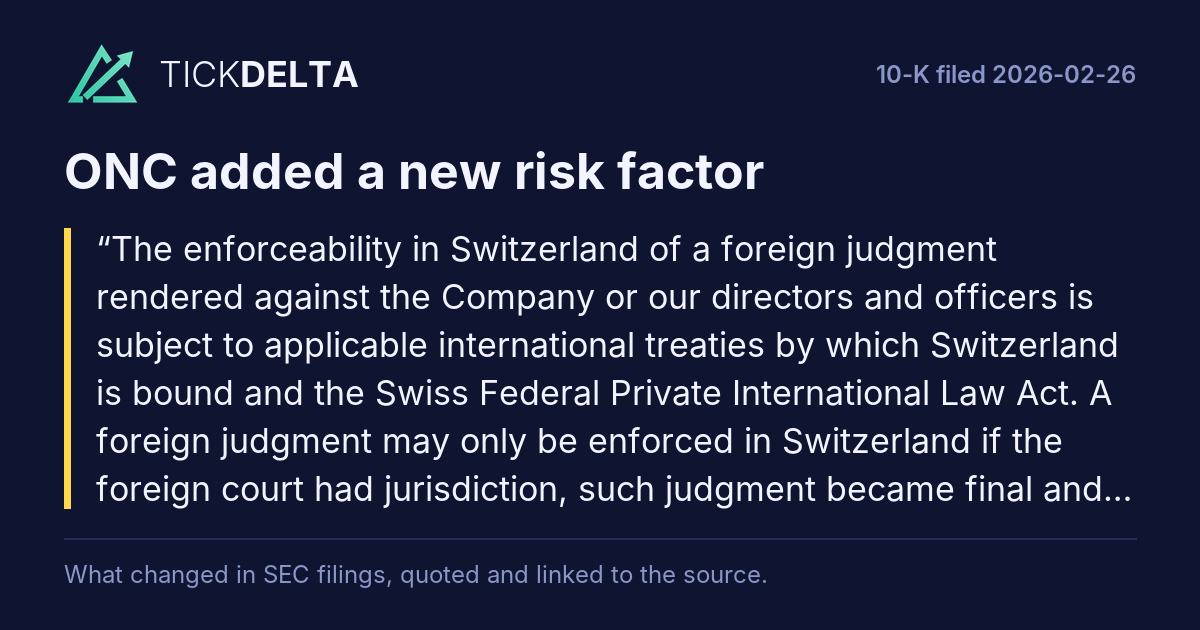
The enforceability in Switzerland of a foreign judgment rendered against the Company or our directors and officers is subject to applicable international treaties by which Switzerland is bound and the Swiss Federal Private International Law Act. A foreign judgment may only be enforced in Switzerland if the foreign court had jurisdiction, such judgment became final and non-appealable, the court procedures leading to such judgment following the due process of law (including proper service of process), and such judgment does not violate Swiss legal principles of public policy. We have been advised that the U.S. and Switzerland currently do not have a treaty providing for reciprocal recognition and enforcement of judgments in civil and commercial matters. Some remedies available under the laws of U.S. jurisdictions, including under U.S. federal securities laws, may not be recognized in Swiss courts as they are contrary to Swiss public policy.
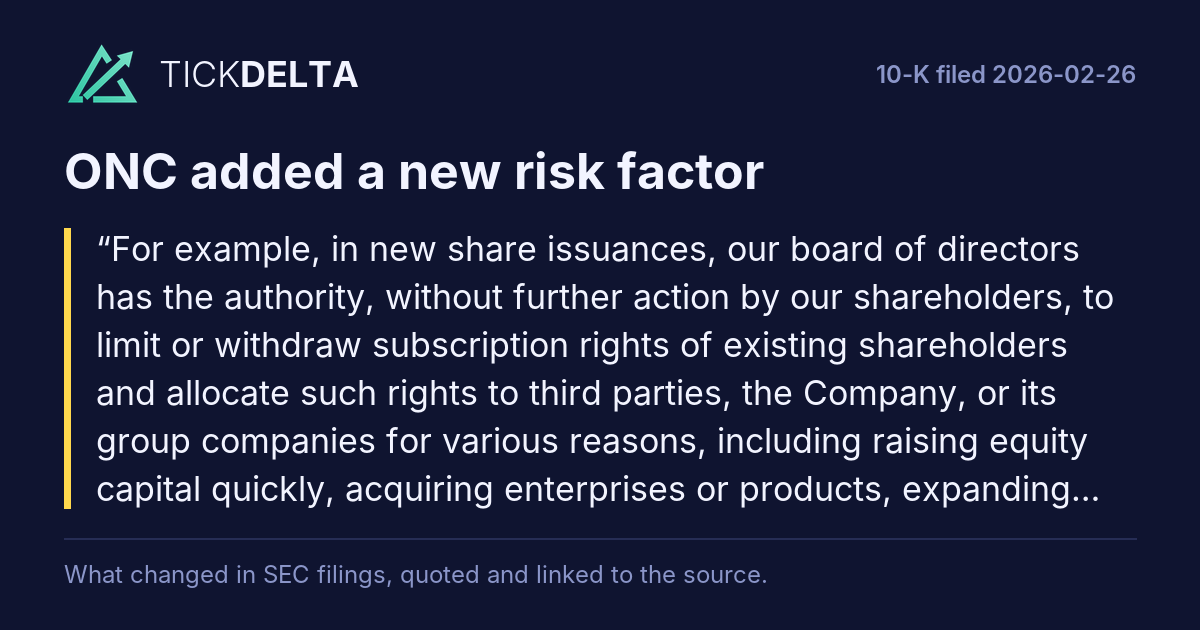
For example, in new share issuances, our board of directors has the authority, without further action by our shareholders, to limit or withdraw subscription rights of existing shareholders and allocate such rights to third parties, the Company, or its group companies for various reasons, including raising equity capital quickly, acquiring enterprises or products, expanding the shareholder base, or defending against a takeover bid.
Further, our Swiss Articles require a majority of all shares entitled to vote at the relevant general meeting of shareholders to pass resolutions on the removal of board members during their one-year term of office. This threshold makes it difficult for a potential acquirer to remove existing directors during their one-year term and replace them with their own nominees.
Swiss law regulates a corporation’s ability to hold, purchase or repurchase its own shares. We and our subsidiaries may only purchase or repurchase our own shares (the “treasury shares”) to the extent that sufficient freely available equity is available. The aggregate par value of the treasury shares may not exceed 10% of our stated share capital, unless our shareholders authorize (including through the capital band) our board of directors to purchase or repurchase our registered shares in an amount in excess of 10% and the treasury shares are dedicated for cancellation to effect a capital reduction.
Swiss law allows our shareholders to authorize the board of directors to issue shares without additional shareholder approval, but this authorization is limited to (i) 50% of our stated share capital (among other things, for the issuance of shares in connection with an acquisition or to raise new equity capital, subject to compliance with shareholders’ preemptive rights, unless withdrawn for the reasons specified in the Swiss Articles) (the “capital band”), and (ii) an additional 20% of our stated share capital for the issuance of shares in connection with convertible or similar financial instruments and our equity incentive plans (the “conditional share capital”). The authority of the board of directors to issue shares based on the capital band must be renewed by our shareholders every five years. The Swiss Articles provide for a capital band authorizing the board of directors to issue or increase the nominal value of up to 770,487,949 shares or to cancel or reduce the nominal value of up to 154,097,590 shares up until April 28, 2029. After April 28, 2029, the capital band will only be available to the board of directors for issuance or cancellation of registered shares if a renewed authorization is approved by shareholders.
Additionally, Swiss law grants existing shareholders preemptive rights to subscribe for newly issued shares and advance subscription rights to subscribe for convertible and similar financial instruments. Preemptive rights and advance subscription rights may be limited or withdrawn only for valid reasons. In connection with share issuances based on the capital band and the conditional share capital, the preemptive rights and the advance subscription rights may only be limited or withdrawn for the reasons specified in the Swiss Articles.
In comparison to Cayman Islands law, Swiss law does not provide as much flexibility in the various terms that can attach to different classes of shares. Further, Swiss law also reserves for approval by shareholders many corporate actions, including the declaration and approval of dividends under certain circumstances. While we do not believe that the differences between Cayman Islands law and Swiss law relating to our capital management will have an adverse effect on our company, Swiss law requirements may limit our flexibility to swiftly implement certain initiatives or strategies and situations may arise where greater flexibility would have provided substantial benefits to our shareholders.
New in the latest 10-Q
13 paragraphs in the 10-Q filed Nov 5, 2026 with nothing like them in the 10-Q filed Aug 5, 2026 (at least half the words must differ; new numbers alone do not count). Quoted exactly, grouped by the item heading above them. This is text that changed, not a judgement of how serious it is.
1 In the three and nine months ended September 30, 2025, the Company recognized an impairment loss of $ 15,552 within other income (expense), net, resulting from a decline in the enterprise value related to a business acquisition of one of its investees.
Read in the 10-Q
Included within the amortization expense for the three and nine months ended September 30, 2026 was a developed product intangible asset impairment charge of $ 22,027 associated with the Company’s decision to discontinue promotion of
Read in the 10-Q
As of September 30, December 31, 2026 2025 $ $ A Loan Facility 25,654 12,298 B2 Term Loan Facility 112,000 — Less: unamortized debt issuance costs (9,945) (3,235) Total short-term debt 127,709 9,063 A Loan Facility 295,019 295,152 B2 Term Loan Facility 448,000 560,000 Less: unamortized debt issuance costs (4,505) (18,783) Total long-term debt 738,514 836,369
Read in the 10-Q
On August 31, 2026, we announced our entry into a voluntary agreement with the U.S. government to expand access to innovative cancer medicines for American patients while strengthening our U.S. manufacturing footprint and further expanding the capabilities needed to deliver medicines at scale.
Read in the 10-Q
On August 31, 2026, we announced positive topline results from the second interim analysis of the Phase 3 HERIZON-GEA-01 trial evaluating ZIIHERA® (zanidatamab), in combination with chemotherapy, with and without TEVIMBRA® (tislelizumab), as first-line treatment for HER2-positive (“HER2+”) locally advanced or metastatic gastroesophageal adenocarcinoma (“GEA”).
Read in the 10-Q
On August 25, 2026, we announced that the U.S. Food and Drug Administration (“FDA”) approved the supplemental Biologics License Application (“sBLA”) for TEVIMBRA in combination with ZIIHERA and chemotherapy for the first-line treatment of adult patients with unresectable locally advanced or metastatic HER2+ gastric, gastroesophageal junction, or GEA.
Read in the 10-Q
On August 18, 2026, we announced the renewal of our partnership with the BeOne Care Foundation and The Max Foundation through 2028 to expand access to BRUKINSA® (zanubrutinib) for the treatment of chronic lymphocytic leukemia in low- and middle-income countries, with the program projected to support approximately 1,000 patients cumulatively.
Read in the 10-Q
On August 10, 2026, we announced a multi-part collaboration with Revolution Medicines, Inc., including: a clinical collaboration to evaluate drug combinations incorporating select clinical-stage oncology assets from our pipeline with any of Revolution Medicines’ four clinical RAS(ON) inhibitors; and a separate regional rights agreement granting us exclusive development and commercialization rights to these Revolution Medicines assets in select Asian markets.
Read in the 10-Q
Our employees and personnel, and third parties or vendors with whom we work, may use generative AI and other AI-enabled tools to perform their work. Employee or vendor use of unapproved or inadequately governed AI tools (including third-party tools) could create ungoverned data flows, unmonitored compliance gaps and data protection risks that are not visible until an adverse event occurs. In addition, in the ordinary course of using AI tools, users may inadvertently input or upload confidential, proprietary or other sensitive information (including trade secrets or competitively sensitive data). The providers of these artificial intelligence tools may not meet regulatory standards, including with respect to privacy and data security, and such information may be retained, processed or used in ways that are inconsistent with our policies, contractual protections, or applicable legal requirements. Further, through the use of AI-enabled tools, third parties may infer non-public information about us from public sources, data brokers or other means that reveal commercially sensitive information about our business, strategic priorities or development plans, which could be used to adversely impact our competitive positioning. Any of these effects could damage our reputation, result in the loss of valuable property and information, cause us to breach applicable laws and regulations, and adversely impact our business.
Read in the 10-Q
The GDPR in the EU and the UK, which have been incorporated into their respective laws, impose stringent requirements on the processing of personal data (especially, health and other sensitive data). These requirements encompass: (i) providing information to individuals regarding data processing activities; (ii) ensuring a legal basis or condition applies to the processing of personal data and, where applicable, obtaining consent from individuals to whom the data processing relates; (iii) responding to data subject requests; (iv) imposing requirements to notify the competent national data protection authorities and data subjects of personal data breaches; (v) implementing safeguards in connection with the security and confidentiality of the personal data; (vi) accountability requirements; and (vii) taking certain measures when engaging third-party processors.
Read in the 10-Q
Effective August 3, 2026, we issued 866,073 ordinary shares (the “New Shares”) to BG NC 2, Ltd., a company incorporated in the Cayman Islands with limited liability and our wholly owned subsidiary (“BGNC2”) for an aggregate subscription price of $86.61, representing the aggregate par value of the New Shares, pursuant to a share transfer agreement between us and BGNC2. The New Shares were issued to BGNC2 to facilitate the delivery of ordinary shares to participants under our Sixth Amended and Restated 2018 Employee Share Purchase Plan.
Read in the 10-Q
The New Shares were issued in reliance on the exemption from registration provided by Section 4(a)(2) of the Securities Act.
Read in the 10-Q
# Certain portions of the exhibit have been omitted by means of redacting a portion of the text and replacing it with “[…***…]”, because they are both (i) not material and (ii) the type of information that the Registrant treats as private or confidential.
Read in the 10-Q
Item 1A of the 10-Q filed Nov 5, 2026 against Item 1A of the 10-K filed Feb 26, 2026.
A 10-Q repeats only the risks that changed, so a 10-K paragraph that is missing from it is not counted as removed.
Added is a paragraph with nothing like it in the 10-K, Reworded a sentence that is in both with several words changed,
Quiet changes a sentence in both where one to four words changed and one is a hedge or a modal
(cut words struck through, new words highlighted).
Text on the page, not a score; each links to the filing at sec.gov.
What the 10-Q itself says about its risk factors:The risk factors denoted with a “*”, if any, are newly added or have been materially updated from our Annual Report on Form 10-K for the year ended December 31, 2025 (the “Annual Report”).
Read in the 10-Q
The first 27 of 59 are shown (at most 12 of each type).
Two-word phrases in Risk Factors of the 10-K filed Feb 26, 2026 that are in none of the 1 earlier 10-Ks stored, back to Feb 27, 2025
Used at least twice, small words left out. Counted, not picked: a phrase can be new because the company renamed something.
11 paragraphs of last year's Risk Factors with nothing like them now. The longest are quoted.
Item 1A of each 10-K and 10-Q on EDGAR, quoted exactly. Each paragraph links to the filing at sec.gov.
10-K change: what was reworded or cut, section by section.
Excel workbook · CSV. Google Sheet that stays up to date: paste =IMPORTDATA("https://tickdelta.com/company/ONC/export.csv") into a cell.